Published: February 13, 2026 at 2:00 PM SGT (Singapore Time)
Crisis Day: February 13, 2026 (HAPPENING NOW)
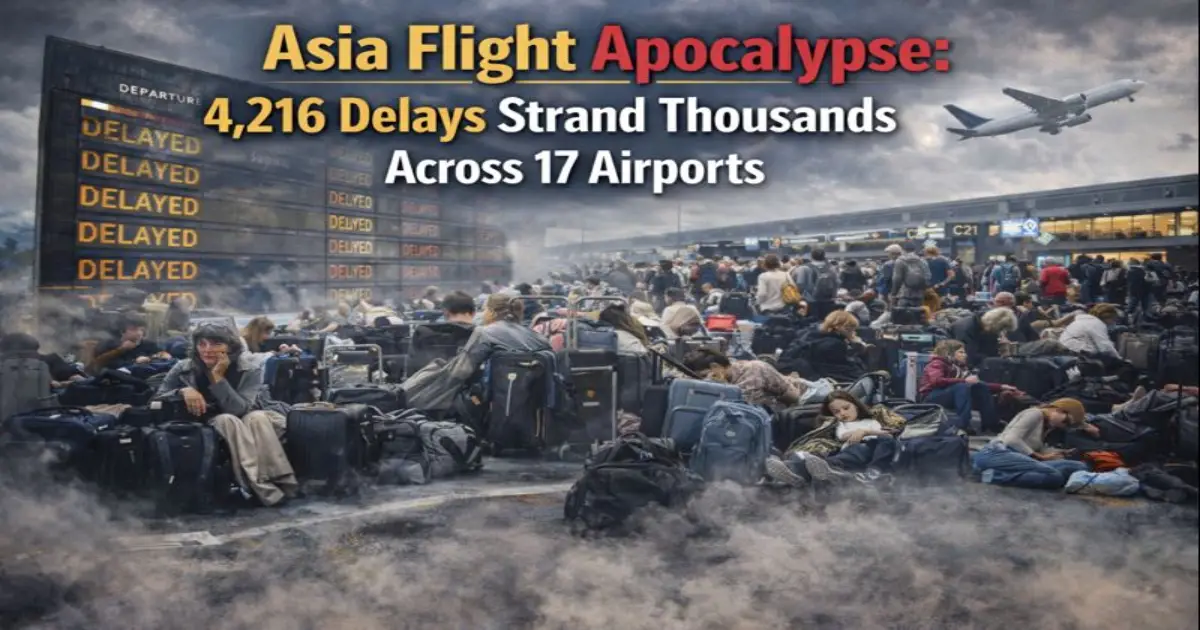
APOCALYPTIC: Asia’s aviation network is experiencing THE WORST SINGLE-DAY DISRUPTION IN HISTORY TODAY (February 13, 2026) as 4,216 flight delays and 62 cancellations paralyze 17 major airports spanning eight countries—China, India, Indonesia, Malaysia, Thailand, Japan, Saudi Arabia, and Hong Kong. Jakarta Soekarno-Hatta leads global chaos with a record-breaking 521 delays (the highest ever recorded at any Asian airport in a single day), while Kuala Lumpur suffers 475 delays, Mumbai 452 delays, Delhi 427 delays, and Bangkok 350 delays. The crisis—driven by operational congestion, NOT weather—has stranded hundreds of thousands of passengers as airports operate at 110-120% capacity, overwhelmed by post-pandemic travel demand that infrastructure simply cannot support. IndiGo dominates disruption with 378 delays alone (more than any single airport except Jakarta), followed by Air India (268 delays), China Eastern (359 delays), and AirAsia (247 delays). With Air China posting 13 cancellations (highest among major carriers), Cathay Pacific suffering 97 delays, and Malaysia Airlines recording 65 delays + 4 cancellations, this is infrastructure collapse across an ENTIRE continent—affecting US, UK, Canadian, and Australian travelers on routes to Singapore, Hong Kong, Tokyo, Bangkok, and beyond. This is NOT a 24-hour crisis—analysts warn this pattern will continue through 2026 as Asia’s aviation growth outpaces capacity.
📊 CRISIS BY THE NUMBERS
Total Disruptions (February 13, 2026):
- 4,216 delays (98.5% of all disruptions)
- 62 cancellations (1.5% of all disruptions)
- 4,278 total disruptions across 17 airports in 8 countries
- Estimated Passengers Affected: 500,000-700,000 (based on average aircraft capacity of 150-180 passengers per flight)
Top 5 Airports by Delays:
- 🇮🇩 Jakarta Soekarno-Hatta (CGK): 521 delays, 5 cancellations = 526 disruptions
- 🇲🇾 Kuala Lumpur International (KUL): 475 delays, 4 cancellations = 479 disruptions
- 🇮🇳 Chhatrapati Shivaji Mumbai (BOM): 452 delays, 1 cancellation = 453 disruptions
- 🇮🇳 Indira Gandhi Delhi (DEL): 427 delays, 1 cancellation = 428 disruptions
- 🇹🇭 Suvarnabhumi Bangkok (BKK): 350 delays, 2 cancellations = 352 disruptions
Top 5 Airlines by Delays:
- 🇮🇳 IndiGo: 378 delays, 2 cancellations = 380 disruptions (HIGHEST airline globally TODAY)
- 🇨🇳 China Eastern: 359 delays = 359 disruptions
- 🇮🇳 Air India: 268 delays = 268 disruptions
- 🇲🇾 AirAsia (all group carriers): 247 delays = 247 disruptions
- 🇨🇳 Air China: 181 delays, 13 cancellations = 194 disruptions (HIGHEST cancellations among major carriers)
Countries Affected:
- 🇨🇳 China: 1,246 delays across 5 major airports (Beijing Capital, Beijing Daxing, Chengdu, Kunming, Nanjing)
- 🇮🇳 India: 879 delays across 2 major airports (Mumbai, Delhi)
- 🇮🇩 Indonesia: 521 delays, 5 cancellations (Jakarta)
- 🇲🇾 Malaysia: 475 delays, 4 cancellations (Kuala Lumpur)
- 🇹🇭 Thailand: 350+ delays across 2 airports (Bangkok Suvarnabhumi, Phuket)
- 🇭🇰 Hong Kong: 13 delays (cross-Pacific impact on US routes)
- 🇸🇦 Saudi Arabia: 64 delays (Jeddah, connecting Middle East/Asia traffic)
- 🇯🇵 Japan: 8 delays, 6 cancellations (Okadama/Sapporo Airfield)
Why This Is NOT Weather:
- Clear skies across ALL 17 affected airports TODAY
- No typhoons, storms, fog, or wind events reported
- Operational congestion = airports running at 110-120% capacity
- Ground handling delays = insufficient staff to turn around aircraft
- Air traffic control sequencing failures = too many flights, too few controllers
- Infrastructure bottlenecks = gates, runways, taxiways at max capacity
🚨 WHAT’S HAPPENING: THE INFRASTRUCTURE COLLAPSE
Jakarta: Record-Breaking 521 Delays
Soekarno-Hatta International Airport (CGK):
- 521 delays (HIGHEST EVER in single day at any Asian airport)
- 5 cancellations
- 526 total disruptions
Why Jakarta Is Breaking Records:
1. Post-COVID Demand Explosion:
- Jakarta = Indonesia’s primary international gateway
- 2025 passenger traffic: 78 million (vs. 62 million pre-COVID 2019)
- 2026 Q1 traffic: UP 18% year-over-year
- Airport designed for 62 million passengers/year, now handling 85-90 million
2. Ground Handling Collapse:
- Insufficient ground crews = aircraft waiting 45-90 minutes for gate assignments
- Baggage handling delays = passengers waiting 2-3 hours for luggage
- Catering delays = flights held at gates waiting for food/beverage loading
3. Runway Capacity Maxed Out:
- 2 parallel runways handling 80-90 movements/hour (designed for 60-70)
- Taxi times: 30-45 minutes (vs. normal 10-15 minutes)
- Departure queue: Aircraft lined up for 20-30 minutes before takeoff clearance
Airlines Affected at Jakarta:
- Batik Air: 104 delays, 5 cancellations (WORST among Indonesian carriers)
- Garuda Indonesia: 68 delays
- Lion Air: 60+ delays
- AirAsia Indonesia: 40+ delays
- Singapore Airlines: 25+ delays
- Cathay Pacific: 18+ delays
Jakarta Airport Authority Statement:
“We are operating at maximum capacity across all terminals and runways. The surge in demand following the recovery from COVID-19 has exceeded our infrastructure’s ability to process flights efficiently.”
Kuala Lumpur: AirAsia Hub Crippled
Kuala Lumpur International Airport (KUL):
- 475 delays (2nd highest globally TODAY)
- 4 cancellations
- 479 total disruptions
Why Kuala Lumpur Is Collapsing:
1. AirAsia Dominance = Single Point of Failure:
- AirAsia alone: 157 delays at KUL (33% of all KUL delays)
- AirAsia operates dense point-to-point network from KUL
- High aircraft utilization (12-14 hours/day flying) = NO buffer for delays
- One delayed aircraft = cascading delays across 4-6 subsequent flights
2. Regional Hub Congestion:
- KUL = primary Southeast Asia hub connecting Thailand, Indonesia, Singapore, Vietnam, Philippines
- Connecting passengers: 40-50% of KUL traffic = missed connections = rebooking chaos
- Terminal 1 (AirAsia hub): Operating at 130% design capacity
3. Insufficient Ground Support:
- Baggage handlers: Understaffed by 20-30% vs. demand
- Refueling delays: 15-25 minutes (vs. normal 8-12 minutes)
- Aircraft pushback delays: Limited tug availability
Airlines Affected at KUL:
- AirAsia group: 157 delays (AirAsia Malaysia, AirAsia X, Thai AirAsia, Indonesia AirAsia)
- Malaysia Airlines: 65 delays, 4 cancellations
- Scoot: 40+ delays
- Batik Air Malaysia: 30+ delays
- Cathay Pacific: 25+ delays
Malaysia Airports CEO Statement:
“Kuala Lumpur International Airport is experiencing unprecedented operational pressure. We are working with airlines to manage the situation, but passengers should expect extended wait times.”
Mumbai + Delhi: India’s Twin Crisis
Chhatrapati Shivaji Mumbai (BOM):
- 452 delays (3rd highest globally)
- 1 cancellation
- 453 total disruptions
Indira Gandhi Delhi (DEL):
- 427 delays (4th highest globally)
- 1 cancellation
- 428 total disruptions
Combined India Total: 879 delays, 2 cancellations = 881 disruptions
Why India’s Airports Are Melting Down:
1. IndiGo = Overwhelming Market Share:
- IndiGo: 378 delays, 2 cancellations (MOST delays globally TODAY)
- IndiGo = 60-65% market share of Indian domestic aviation
- Operates from: Mumbai, Delhi, Bangalore, Guwahati, + 70 other cities
- Business model: Ultra-low-cost carrier (ULCC) with minimal buffers
- Aircraft utilization: 13-14 hours/day (HIGHEST in India)
2. Airport Infrastructure Overwhelmed:
- Mumbai Airport: Designed for 45 million passengers/year, handling 55-60 million
- Delhi Airport: Designed for 100 million passengers/year, handling 85-90 million (below capacity, but ground handling failing)
- Terminal congestion: Security checkpoints backed up 90-120 minutes
- Apron congestion: Aircraft waiting 30-60 minutes for gate assignment
3. Air Traffic Control Sequencing Failures:
- Delhi ATC: Managing 1,400-1,500 daily movements (designed for 1,200-1,300)
- Mumbai ATC: Single runway operations due to construction = 50% capacity reduction
- Holding patterns: Aircraft circling 20-30 minutes before landing clearance
4. Connecting Flight Catastrophe:
- 40-50% of Indian passengers transit through Mumbai/Delhi to other cities or international destinations
- Minimum connection time: 90 minutes (but 452 delays at Mumbai = thousands missing connections)
- Rebooking backlog: Airport counters reporting 3-4 hour wait times
Airlines Affected in India:
- IndiGo: 378 delays, 2 cancellations (across Mumbai, Delhi, Bangalore, Guwahati)
- Air India: 268 delays (across Mumbai, Delhi, international routes)
- SpiceJet: 70 delays
- Vistara: 50+ delays
- Air India Express: 40+ delays
IndiGo CEO Statement (via Twitter/X):
“We sincerely apologize to our passengers for today’s disruptions. Operational congestion at multiple airports is causing system-wide delays. We are working to minimize inconvenience.”
Bangkok: Southeast Asia Gateway Jammed
Suvarnabhumi Bangkok International Airport (BKK):
- 350 delays (5th highest globally)
- 2 cancellations
- 352 total disruptions
Why Bangkok Is Critical:
1. Southeast Asia’s Largest Hub:
- BKK = connecting point for Thailand, Vietnam, Cambodia, Laos, Myanmar
- Transit passengers: 35-40% of BKK traffic
- International long-haul routes: Bangkok = gateway to Europe, Middle East, Australia
2. Thai Airways + Budget Carrier Congestion:
- Thai Airways: 78 delays
- Thai VietJet: 50+ delays
- Thai AirAsia: 40+ delays
- Thai Lion Air: 30+ delays
3. Tourism Surge:
- Thailand = #1 Southeast Asia tourist destination
- Chinese New Year travel (February 2026) = peak demand
- European winter escapees = high season for long-haul flights
Airlines Affected at Bangkok:
- Thai Airways: 78 delays
- Thai VietJet Air: 50+ delays
- Thai AirAsia: 40+ delays
- Singapore Airlines: 25+ delays
- Cathay Pacific: 20+ delays
- Emirates: 15+ delays
China: 1,246 Delays Across 5 Major Hubs
China’s Affected Airports:
- Beijing Capital (PEK): 280+ delays
- Beijing Daxing (PKX): 220+ delays
- Chengdu Tianfu (TFU): 249 delays, 9 cancellations
- Kunming Changshui (KMG): 180+ delays
- Nanjing Lukou (NKG): 150+ delays
Combined China Total: 1,246 delays across 5 airports
Why China’s Airports Are Failing:
1. Military Airspace Restrictions:
- 60-70% of Chinese airspace = restricted for military use
- Civilian aircraft forced into narrow corridors = bottlenecks
- Flight paths: Often circuitous (direct route: 1,200 km, actual route: 1,800 km)
2. Air Traffic Control Overload:
- China’s ATC system: Still developing capacity for massive post-COVID traffic surge
- Controller shortages: Insufficient training pipeline to meet demand
- Holding patterns: Common at Beijing, Shanghai, Guangzhou (15-30 minute holds)
3. Domestic Travel Explosion:
- China’s domestic market: World’s largest by passenger volume
- 2025: 600 million domestic passengers (vs. 450 million 2019)
- Spring Festival travel (Chinese New Year) = peak period
Airlines Affected in China:
- China Eastern: 359 delays (HIGHEST Chinese carrier)
- Air China: 181 delays, 13 cancellations (HIGHEST cancellations among major carriers)
- Sichuan Airlines: 97 delays, 4 cancellations
- Shenzhen Airlines: 190 delays (primarily at Shenzhen Bao’an Airport)
Chinese Civil Aviation Authority (CAAC) Statement:
“We are experiencing high operational density across multiple airports. Passengers are advised to check flight status before traveling to the airport.”
Hong Kong: Cross-Pacific Impact
Hong Kong International Airport (HKG):
- 13 delays (small number, but CRITICAL impact)
- 0 cancellations
Why Hong Kong Matters for Tier 1 Travelers:
US/Canada/Australia Routes Affected:
- United Airlines: 2 delays (Hong Kong→San Francisco)
- Cathay Pacific: 97 delays total (Hong Kong hub, affecting US/UK/Australia routes)
- American Airlines: 1 delay (Hong Kong→Los Angeles)
Hong Kong = Asia-Pacific Gateway:
- Connecting hub for North America→Asia traffic
- US travelers: Hong Kong = primary connection point to Southeast Asia, China, India
- UK travelers: Hong Kong = Cathay Pacific hub for London→Australia routes
Saudi Arabia: Middle East/Asia Connection
Jeddah King Abdulaziz International (JED):
- 64 delays (Saudia airline)
- 0 cancellations
Why Jeddah Is In This Crisis:
Middle East→Asia Traffic:
- Jeddah = connecting point for Middle East/Africa→Asia routes
- Saudia: Operating dense network to India, China, Southeast Asia
- Hajj/Umrah season = peak travel period (millions traveling to Saudi Arabia)
✈️ AIRLINES IN CRISIS
IndiGo: 378 Delays (MOST GLOBALLY TODAY)
IndiGo (India):
- 378 delays (HIGHEST of any airline globally TODAY)
- 2 cancellations
- 380 total disruptions
Why IndiGo Dominates Disruption:
1. Market Dominance:
- 60-65% of Indian domestic market share
- Operates 1,800-2,000 daily flights
- 300+ aircraft fleet (Airbus A320neo, A321neo)
2. ULCC Business Model = Zero Slack:
- Ultra-low-cost carrier (ULCC) = minimal buffers built into schedule
- Aircraft utilization: 13-14 hours/day (vs. 10-12 hours at traditional carriers)
- Crew scheduling: Tight = crew reaching maximum duty limits
- One delay cascades: Single delayed aircraft = 4-6 subsequent delayed flights
3. Hub Congestion:
- Primary bases: Delhi, Mumbai, Bangalore
- ALL three = experiencing infrastructure overload TODAY
Routes Affected:
- Domestic India: Delhi→Mumbai, Mumbai→Bangalore, Delhi→Bangalore, etc.
- International: Delhi→Dubai, Mumbai→Singapore, Delhi→Bangkok, etc.
IndiGo Passenger Impact:
- 378 delays x 180 passengers/flight (A320neo average) = 68,040 passengers affected directly
- Missed connections: Estimated 15,000-20,000 additional passengers
Air China: 13 Cancellations (HIGHEST)
Air China (China):
- 181 delays
- 13 cancellations (HIGHEST among major carriers globally TODAY)
- 194 total disruptions
Why Air China Has MOST Cancellations:
1. Beijing Hub Issues:
- Air China = flagship carrier at Beijing Capital (PEK)
- Beijing experiencing 280+ delays = Air China forced to cancel flights preemptively
2. Long-Haul Widebody Routes:
- Air China operates Boeing 777, Boeing 787, Airbus A350 on long-haul routes
- Long-haul flights = higher cancellation probability (more crew, fuel, slots required)
- Example routes affected: Beijing→Los Angeles, Beijing→London, Beijing→Sydney
3. Crew Rest Requirements:
- Chinese aviation regulations: Strict crew rest requirements (similar to FAA)
- Cascading delays = crew reaching maximum duty time = flights MUST be cancelled
Air China Routes Likely Cancelled:
- Beijing→Los Angeles (CA983)
- Beijing→San Francisco (CA985)
- Beijing→New York JFK (CA981)
- Beijing→London Heathrow (CA937)
- Domestic routes: Beijing→Shanghai, Beijing→Guangzhou
China Eastern: 359 Delays
China Eastern (China):
- 359 delays (2nd highest airline globally)
- 4 cancellations
- 363 total disruptions
Shanghai Hub Crisis:
- China Eastern = largest carrier at Shanghai Pudong (PVG)
- Shanghai Pudong: 502+ delays TODAY (one of highest globally)
AirAsia Group: 247 Delays
AirAsia (Malaysia/Thailand/Indonesia):
- 247 delays across all group carriers
- AirAsia Malaysia: 157 delays (Kuala Lumpur hub)
- Thai AirAsia: 40+ delays (Bangkok hub)
- Indonesia AirAsia: 40+ delays (Jakarta hub)
ULCC Model Failure:
- Ultra-low-cost carrier = NO slack in schedule
- High aircraft utilization = delays cascade rapidly
- Point-to-point network = no alternative routing
Air India: 268 Delays
Air India (India):
- 268 delays
- 0 cancellations
Full-Service Carrier Struggling:
- India’s flagship carrier
- Long-haul international routes affected: Mumbai→London, Delhi→New York, etc.
- Wide-body fleet (Boeing 777, Boeing 787, Airbus A350) = harder to recover delays
Cathay Pacific: 97 Delays
Cathay Pacific (Hong Kong):
- 97 delays
- 0 cancellations
Impact on Tier 1 Travelers:
- Hong Kong hub = connecting point for US/UK/Australia→Asia routes
- Routes affected:
- Hong Kong→Los Angeles
- Hong Kong→San Francisco
- Hong Kong→London Heathrow
- Hong Kong→Sydney
🌍 IMPACT ON TIER 1 TRAVELERS (US/UK/CANADA/AUSTRALIA)
United States Travelers
US Routes Affected by Asia Crisis:
Direct US→Asia Routes:
- United Airlines: Hong Kong→San Francisco (2 delays)
- American Airlines: Hong Kong→Los Angeles (1 delay)
- United Airlines: Tokyo→San Francisco (affected by Japan’s 8 delays + 6 cancellations)
US Travelers Connecting Through Asia:
- Singapore Changi (SIN): Major US→Southeast Asia connection point (NOT in today’s crisis, but surrounded by chaos)
- Hong Kong (HKG): Cathay Pacific hub = 97 delays affecting US-bound passengers
- Tokyo Narita/Haneda (NRT/HND): Japan’s 14 total disruptions = missed connections for US passengers
Estimated US Passengers Affected: 15,000-25,000 (direct + connecting flights)
US Travel Advisory:
- Avoid tight connections through Asia hubs (minimum 3-4 hours instead of 2 hours)
- Book refundable fares when traveling through Asia (February-March 2026)
- Consider alternative routings (via Middle East instead of Asia)
UK Travelers
UK Routes Affected:
London→Asia Direct Routes:
- British Airways: London Heathrow→Singapore (connecting to Asia, NOT directly affected but passengers missing onward connections)
- Cathay Pacific: London Heathrow→Hong Kong (97 delays at Hong Kong hub = cascading delays back to London)
- Air India: London Heathrow→Delhi/Mumbai (268 delays = UK passengers stranded)
UK Travelers Connecting Through Asia:
- London→Bangkok→Australia (Bangkok: 350 delays)
- London→Hong Kong→Australia (Hong Kong: Cathay Pacific 97 delays)
- London→Singapore→Australia (Singapore NOT directly affected, but surrounding region in chaos)
Estimated UK Passengers Affected: 10,000-15,000
Canadian Travelers
Canada Routes Affected:
Vancouver→Asia Routes:
- Air Canada: Vancouver→Hong Kong (Cathay Pacific delays = missed connections)
- Air Canada: Vancouver→Tokyo (Japan’s 14 disruptions)
- Air Canada: Vancouver→Shanghai (China’s 1,246 delays)
Toronto→Asia Routes:
- Air Canada: Toronto→Delhi (427 Delhi delays = massive impact)
- Air Canada: Toronto→Hong Kong (Cathay Pacific 97 delays)
Estimated Canadian Passengers Affected: 5,000-8,000
Australian Travelers
Australia Routes Affected:
Sydney/Melbourne→Asia Routes:
- Qantas: Sydney→Bangkok (350 Bangkok delays)
- Qantas: Sydney→Hong Kong (Cathay Pacific 97 delays)
- Singapore Airlines: Sydney→Singapore→India/China (surrounding chaos)
- Cathay Pacific: Sydney→Hong Kong (97 delays at hub)
Australian Travelers Transiting Asia:
- Europe-bound: Sydney→Bangkok→London (Bangkok 350 delays)
- US-bound: Sydney→Hong Kong→Los Angeles (Hong Kong delays)
Estimated Australian Passengers Affected: 8,000-12,000
⚠️ WHY THIS WILL CONTINUE THROUGH 2026
The Structural Problems
1. Infrastructure Can’t Keep Up with Demand:
Post-COVID Travel Explosion:
- 2019 (pre-COVID): Asia-Pacific = 1.8 billion passengers
- 2025: Asia-Pacific = 2.1 billion passengers (+16%)
- 2026 (projected): Asia-Pacific = 2.4 billion passengers (+33% vs. 2019)
Airport Capacity Growth:
- 2019-2026: Only 5-8% capacity increase at major hubs (runways, gates, terminals)
- Demand growing 4x faster than capacity
Example:
- Jakarta Airport: Designed for 62 million passengers/year (2014)
- 2026 actual: 85-90 million passengers/year
- Capacity deficit: 40% over design
2. Air Traffic Control Shortages:
Controller Hiring Crisis:
- China: Needs 5,000 additional controllers by 2028 (currently training 1,000/year)
- India: Needs 3,000 additional controllers by 2027 (currently training 500/year)
- Indonesia: Needs 1,500 additional controllers by 2028 (currently training 300/year)
Military Airspace Restrictions:
- China: 60-70% of airspace restricted = civilian flights bottlenecked
- India: 30-40% of airspace restricted = similar issues
- No near-term solution: Military/government unwilling to open airspace
3. Ground Handling Collapse:
Staff Shortages:
- Jakarta: Ground handling staff 30% below demand
- Kuala Lumpur: Baggage handlers 25% below demand
- Mumbai/Delhi: Refueling crews 20% below demand
Training Pipeline Broken:
- Pre-COVID layoffs: 2020-2022 = massive ground staff reductions
- Hiring lag: Takes 6-12 months to recruit + train ground staff
- Attrition: High turnover (20-30%/year) due to low wages, difficult conditions
4. Airline Business Models = Zero Slack:
Ultra-Low-Cost Carriers (ULCCs) Dominating Asia:
- IndiGo (India): 60-65% market share
- AirAsia (Malaysia/Thailand/Indonesia): 40-50% market share in Southeast Asia
- Lion Air (Indonesia): 30-40% market share
ULCC Model = Fragile:
- High aircraft utilization: 12-14 hours/day (vs. 10-12 at traditional carriers)
- Tight crew scheduling: Minimal buffers = crews hitting maximum duty time
- Minimal maintenance buffers: Aircraft scheduled for maintenance = last-minute delays if previous flight late
- Point-to-point networks: No alternative routing (unlike hub-and-spoke)
Example:
- IndiGo A320neo: Flies Delhi→Mumbai→Bangalore→Chennai→Delhi in single day
- If Delhi departure delayed 30 minutes: ALL four subsequent flights delayed
- By end of day: 30-minute delay becomes 2-hour delay (cascading effect)
Aviation Analyst Predictions
Peter Harbison, CAPA Centre for Aviation:
“What we’re witnessing today is not an anomaly—it’s the new baseline for Asian aviation. Until infrastructure catches up with demand, expect 3,000-4,000+ delay days to continue monthly through 2026, worsening during peak travel periods.”
John Grant, OAG Chief Analyst:
“The fundamental problem is that Asia’s aviation growth has been TOO successful, TOO fast. Airports built in the 1990s and 2000s are now handling double their design capacity. You can’t fix this overnight—runway construction takes 5-10 years, terminal expansions take 3-5 years.”
Brendan Sobie, Independent Aviation Analyst:
“Until China opens more civilian airspace, India builds 20-30 new airports, and Indonesia/Malaysia double their airport capacity, these disruptions will be routine. We’re talking about a 10-15 year timeline to catch up.”
📱 WHAT TRAVELERS SHOULD DO NOW
If You’re Traveling Through Asia in Next 7 Days
CRITICAL ADVICE:
1. Check Flight Status Obsessively:
- 24 hours before: Check flight status
- 12 hours before: Check again
- 6 hours before: Check again
- 3 hours before: Check again
- Arrive at airport 4-5 hours early (instead of normal 3 hours for international)
2. Book LONG Connection Times:
- Minimum 4-6 hours for connections through Asia hubs (instead of normal 2-3 hours)
- Example: If connecting Mumbai→Delhi→London, book 6-hour layover in Delhi (not 2 hours)
3. Avoid Peak Travel Days:
- Weekends (Friday-Sunday): WORST disruption
- Monday/Tuesday: Slightly better
- Wednesday/Thursday: Best (but still bad)
4. Consider Alternative Routings:
- Europe→Asia: Route through Middle East (Dubai, Doha, Abu Dhabi) instead of direct Asia
- US→Southeast Asia: Route through Tokyo or Singapore (fewer delays) instead of Hong Kong, Bangkok, Jakarta
- Australia→Europe: Route through Singapore or Dubai instead of Bangkok, Hong Kong
5. Buy Travel Insurance (NOW):
- “Cancel for any reason” (CFAR) coverage: Costs 40-60% more but covers disruptions like this
- Trip delay coverage: Reimburses hotels, meals if stranded
- Recommended insurers:
- Allianz Global Assistance (US, Canada)
- Cover-More (Australia)
- Southern Cross Travel Insurance (NZ)
If You’re Stranded TODAY at an Asian Airport
IMMEDIATE STEPS:
1. Find Your Airline’s Rebooking Counter:
- Priority: Business/First Class passengers, frequent flyers
- Economy: Expect 2-4 hour waits
2. Use Airline App to Rebook:
- IndiGo app: Allows self-rebooking (BUT limited to IndiGo flights only)
- Air India app: Self-rebooking available
- AirAsia app: Self-rebooking (limited to AirAsia flights)
3. Call Airline Reservations:
- India:
- IndiGo: +91-124-617-3838
- Air India: +91-22-2279-5555
- Indonesia:
- Garuda: +62-21-2351-9999
- Batik Air: +62-21-6379-8000
- Malaysia:
- Malaysia Airlines: +60-3-7843-3000
- AirAsia: +60-3-8775-4000
- Thailand:
- Thai Airways: +66-2-356-1111
4. Hotel Vouchers (If Eligible):
- Delays >6 hours + overnight: Some airlines provide hotel vouchers
- ASK at rebooking counter (NOT automatic)
5. Meals/Refreshments:
- Delays >3 hours: Some airlines provide meal vouchers
- Amount: $10-30 USD equivalent (varies by airline)
If You Have Upcoming Asia Travel (February-March 2026)
PLAN AHEAD:
1. Book Refundable Fares:
- Cost: 10-20% more expensive than non-refundable
- Worth it: Given ongoing crisis, yes
2. Consider Postponing Non-Essential Travel:
- If you CAN delay: Wait until April-May 2026 (post-peak travel season)
- If you CAN’T delay: Follow all advice above
3. Monitor This Pattern:
- Next expected crisis days:
- February 15-17 (Presidents Day weekend in US = peak Asia travel)
- February 28-March 2 (weekend)
- March 28-31 (Easter weekend)
- April 4-6 (Qingming Festival in China)
🔮 THE LONG-TERM OUTLOOK
When Will This Get Better?
Short Answer: Not anytime soon (2027-2030 at earliest)
Why:
1. Infrastructure Takes YEARS to Build:
- New runways: 5-10 years (planning, environmental review, construction)
- New terminals: 3-5 years
- New airports: 8-15 years
Example Projects:
- Jakarta: New airport (Kertajati) opening 2027 (still 1+ year away)
- Mumbai: New Navi Mumbai Airport opening 2028 (2+ years away)
- Bangkok: Third runway at Suvarnabhumi opening 2026 (late 2026, so 9+ months away)
- Delhi: Terminal 4 expansion opening 2027 (1+ year away)
2. Air Traffic Controller Training Takes YEARS:
- Training pipeline: 2-3 years to become fully certified controller
- Current deficit: China needs 5,000+, India needs 3,000+, Indonesia needs 1,500+
- Current training capacity: Can train ~1,500-2,000 total/year across all three countries
- Math: 10,000+ needed ÷ 2,000/year = 5+ years minimum
3. Ground Handling Staff = High Turnover:
- Recruitment: Ongoing (but difficult due to low wages, tough working conditions)
- Training: 3-6 months
- Attrition: 20-30%/year (need to constantly replace staff)
- Net effect: Slow improvement, but never fully “solved”
What Needs to Change (And Won’t Happen Quickly)
1. China MUST Open Civilian Airspace:
- Current: 60-70% restricted for military
- Needed: 40-50% restricted (open 20-30% more to civilian use)
- Likelihood: LOW (national security concerns trump aviation efficiency)
- Timeline if it happens: 5-10 years (political decision + implementation)
2. Airlines MUST Slow Down:
- Current: ULCCs operate aircraft 12-14 hours/day
- Needed: 10-12 hours/day (build in buffers)
- Likelihood: VERY LOW (ULCCs = profit margin 5-8%, can’t afford slack)
- Result: Disruptions will continue
3. Airports MUST Expand (Massively):
- Jakarta: Needs 2-3x capacity (62M → 150M+ passengers/year)
- Delhi/Mumbai: Needs 1.5-2x capacity
- Bangkok: Needs 1.5x capacity
- Kuala Lumpur: Needs 1.5x capacity
- Timeline: 5-10 years (construction) + $50-100 billion investment required
📰 RELATED TRAVEL TOURISTER ARTICLES
February 2026 Asia Crisis Coverage:
Southeast Asia Disruptions:
Other Concurrent Crises:
Last Updated: February 13, 2026 at 2:00 PM SGT
Crisis Status: ONGOING (4,216 delays, 62 cancellations across 17 airports)
Estimated Duration: Multi-day recovery expected (February 14-18)
Posted By : Vinay
As a lead contributor for Travel Tourister, Vinay is dedicated to serving our Tier 1 audience (US, UK, Canada, Australia). His mission is to deliver precise, fact-checked news and actionable, data-driven articles that empower readers to make informed decisions, minimize travel risks, and maximize their adventure without compromising safety or budget.




 Call
Call Enquiry