Published on : 21 Feb 2026
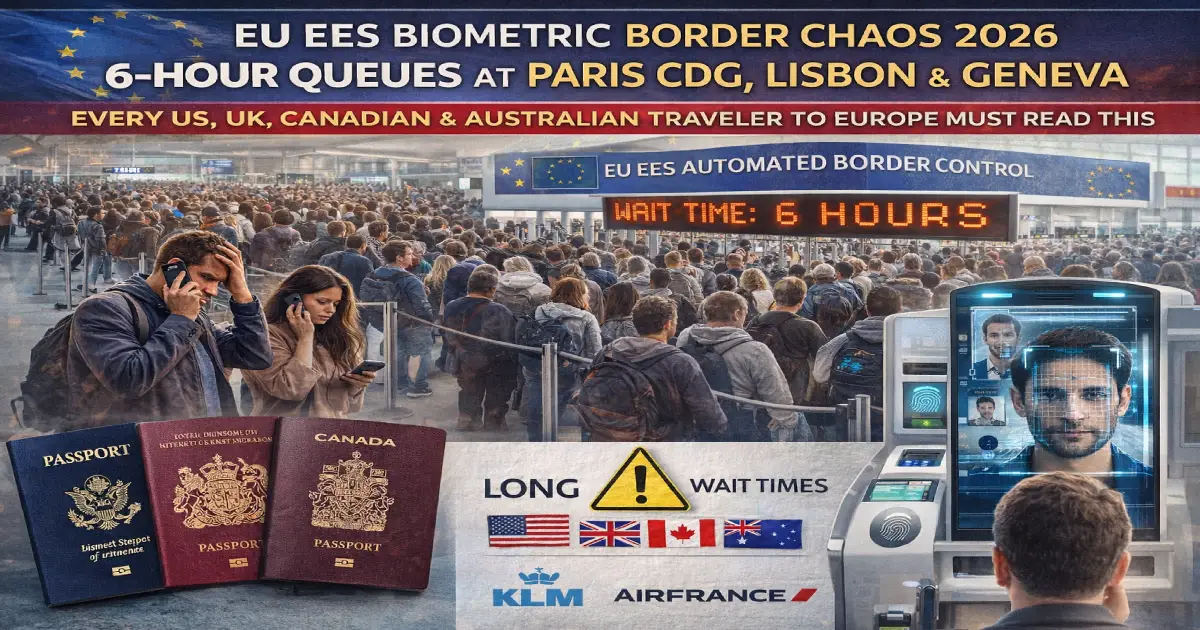
Published: February 21, 2026 System: EU Entry/Exit System (EES) — Launched October 12, 2025 Who Is Affected: ALL non-EU/non-Schengen travelers — US, UK, Canadian, Australian, and all other visa-exempt nationalities Current Rollout Level: 35% of eligible travelers being processed (as of January 9, 2026) Full Mandatory Date: April 10, 2026 (with summer flexibility until September 2026) Worst Queue Times Recorded: Up to 7 hours at Lisbon — 5 to 6 hours at Geneva — 3 hours at peak periods across Madrid, Barcelona, Paris CDG, Prague Processing Time Increase: Up to 70% longer than pre-EES border checks (ACI Europe) Key Alert: Lisbon Airport suspended EES entirely after 7-hour queues — Geneva, Paris CDG, Barcelona, Madrid, Prague all reporting major backlogs What’s Coming: Full mandatory EES compliance by April 10, 2026 — ETIAS pre-travel authorization launching later in 2026
Breaking: Europe’s airports are in biometric border chaos. Since October 12, 2025, the EU’s new Entry/Exit System (EES) has been forcing every US, UK, Canadian, and Australian traveler to register fingerprints and facial scans at European borders — triggering queues of up to 7 hours at Lisbon, 5 to 6 hours at Geneva, and 3-hour waits at Paris CDG, Madrid, Barcelona, and Prague. Airport authorities are sounding emergency alarms. Lisbon suspended the system entirely. ACI Europe — representing 600+ airports — warned of “serious safety hazards” if queues spill into airside areas. And the worst is still to come: full mandatory rollout hits April 10, 2026 — just 48 days away. Here is everything every non-EU traveler needs to know right now.
The EU Entry/Exit System — known as EES — is Europe’s new digital border management platform, launched in phased rollout on October 12, 2025. It replaces the traditional passport stamp system that has been used for decades with a biometric digital record system that captures and stores travelers’ data in a centralized EU database.
What EES records for every non-EU traveler:
The data is stored for three years in a centralized database managed by eu-LISA — the EU’s agency for large-scale IT systems in justice and home affairs — and shared across all 29 participating Schengen countries.
The stated purpose: Replace passport stamps with digital records to better track overstays, enforce the 90-days-in-180-days Schengen rule, and improve border security across the EU’s external borders.
The reality: A system that was supposed to speed up border processing has instead triggered the longest passport control queues in European aviation history.
Critical for UK travelers: Despite the UK being physically close to Europe and historically using EU lanes pre-Brexit, British passport holders are now fully classified as third-country nationals. Every UK traveler entering any Schengen country must complete EES registration.
Critical for US travelers connecting through Europe: If your itinerary involves a Schengen country — even as a layover where you clear immigration — EES registration is required.
| Metric | Figure |
|---|---|
| EES Launch Date | October 12, 2025 |
| Countries Participating | 29 (all Schengen + Iceland, Liechtenstein, Norway, Switzerland) |
| Current Processing Share | 35% of eligible travelers |
| Full Mandatory Date | April 10, 2026 |
| Processing Time Increase (ACI Europe) | Up to 70% longer |
| Peak Queue Times Recorded | Up to 7 hours (Lisbon) |
| Typical Peak Queue Times | 3–6 hours at major hubs |
| Airports That Have Suspended EES | Lisbon (3-month suspension after 7-hour queues) |
| Airports Reporting Major Backlogs | Paris CDG, Geneva, Madrid, Barcelona, Prague, Brussels |
| EU Pre-Registration Tool Available | January 9, 2026 (optional, not mandatory) |
| Full Mandatory Compliance | April 10, 2026 — 48 days away |
| Summer Flexibility Window | Up to September 2026 (member states may partially suspend) |
| ETIAS Launch (next system) | Late 2026 |
Lisbon holds the worst EES record in Europe. The airport was forced to completely suspend the EES system for three months after passport control queues reached seven hours — what airport authorities described as displaying “serious deficiencies” at border control. Lisbon’s suspension sent shockwaves through Brussels: if one of Europe’s major international airports cannot operationally handle EES at 10–35% rollout, what happens when 100% compliance becomes mandatory?
Lisbon has since been working to resolve staffing and kiosk configuration issues — but the suspension itself confirms that the EES as currently designed can, in real-world conditions, completely overwhelm an international airport’s border operations.
What this means for travelers through LIS: EES has been suspended — meaning manual processes are back temporarily. But this will change. Check Lisbon airport’s official communications before you travel.
Geneva became the most high-profile EES chaos story of winter 2026, with videos going viral on social media showing winding passport control queues stretching through the terminal as UK ski travelers returning from Swiss Alpine resorts faced biometric registration waits of 5 to 6 hours.
A Geneva Airport spokesperson confirmed EES has been “a major challenge for Swiss customs and Geneva Airport,” confirming that extra staff have been deployed to ease congestion. The problem: extra staff alone cannot solve the fundamental bottleneck — there are not enough kiosks, not enough configured border lanes, and the kiosk hardware itself has suffered technical outages.
For the UK traveler audience specifically — Geneva is one of the primary gateways for British ski holidays in the French and Swiss Alps. The 5 to 6 hour queues hit British travelers disproportionately hard.
Paris CDG and Orly are among Europe’s most significant EES failure points — not just because of queue times but because of a fundamental incompatibility issue: France’s Parafe e-gates — which use facial recognition to speed up passport control — still do not process UK or US passports under EES.
A legal expert from the Union of French Airports confirmed to The Connexion that the Parafe gates would not be fully compatible with EES until the end of March 2026 at the earliest. This means that until then, every US and UK traveler arriving at CDG or ORY must queue in the manual lane — regardless of whether they have previously enrolled in EES — because the automated gates are not yet configured to read their biometric data.
Paris CDG is handling approximately 67 million passengers annually. With the automated fast-track e-gates offline for US and UK passports, every non-EU traveler is being funneled into manual lanes that were never designed to absorb this volume.
Spain — which was among the first EU countries to activate EES at its major airports — has confirmed processing times at Málaga-Costa del Sol and Barcelona El Prat have increased by up to 70% at peak periods. Madrid Barajas, handling the highest volumes of transatlantic passengers from the US and Latin America, is recording consistent delays at passport control for non-EU arrivals.
Spain has responded by adopting a staggered EES rollout — implementing the system progressively across airports — to prevent a catastrophic simultaneous failure at all Spanish hubs. Airlines serving Spain’s busy UK and US markets are also dealing with a glitch-prone system that requires them to verify at check-in whether passengers have completed first-time biometric enrolment before boarding.
Prague became an early case study in EES operational failure. When EES kiosks at the Czech airport were unavailable or out of service, Czech border authorities instructed officers to collect biometric data manually at passport control — causing major terminal backlogs.
British traveler Hamilton Nash described “an hour to 90-minute-long queue” with “no machines operating.” Another traveler reported that officers started letting Australian and British passengers use EU lanes simply to reduce the crowd — an improvised solution that undermined the entire point of the EES system.
Czech authorities’ decision to press ahead with EES early — while simultaneously experiencing kiosk failures — turned Prague’s passport control into a case study of exactly what Brussels feared when ACI Europe issued its December emergency warning.
All four of these mega-hubs are recording elevated EES-related processing times, though none at the crisis levels seen in Lisbon, Geneva, and Paris. Amsterdam Schiphol and Frankfurt — two of Europe’s three busiest airports — are managing the transition more carefully through staged kiosk deployment and additional staffing, but both are warning that full April 10 compliance will test their operational limits.
The EES was designed around self-service biometric kiosks that travelers use to register fingerprints and facial images independently — theoretically speeding up border processing. In practice, airports do not have enough kiosks deployed, configured, and working simultaneously to handle peak arrival waves.
ACI Europe has urgently called for “EU-level standards for minimum kiosk-to-passenger ratios” — confirming that right now, no such standards exist. Individual airports are guessing how many kiosks they need, ordering hardware on their own timetables, and discovering at peak periods that they don’t have enough.
When kiosks are unavailable or break down — which is happening at airports including Prague, Geneva, and Paris — border officers must collect biometric data manually. Manual fingerprinting of hundreds of passengers simultaneously creates exactly the multi-hour queues being photographed and shared globally.
A core flaw in EES’s design: there was no advance pre-registration system available at launch for most travelers. Unlike US TSA PreCheck or Global Entry — where travelers enroll in advance and clear faster at the border — EES requires first-time biometric registration to happen at the border, upon arrival, with no prior appointment or digital enrollment.
An optional pre-registration portal opened January 9, 2026 — but awareness is extremely low, uptake has been minimal, and many airports are not yet configured to accept pre-registered travelers in separate lanes. The EU is aware of this gap and is developing solutions — but “developing” is not the same as “available” for travelers arriving right now.
Europe’s border agencies were already understaffed before EES launched. The system adds significant new workload to every passport control interaction: instead of a 30-second passport check and stamp, officers must now oversee biometric kiosk usage, troubleshoot technical failures, manage overflow queues, and manually collect data when hardware fails.
ACI Europe has explicitly warned that “there are not always enough trained border guards available to manage the added workload, especially during peak travel periods.” This is not a temporary teething problem — it is a structural mismatch between the staffing levels European border agencies have and the staffing levels EES requires to function without generating multi-hour queues.
French hubs including Paris CDG and Orly have reported that fingerprint scanners, cameras, and networking software have struggled to keep pace as more travelers are registered. The EES IT infrastructure — managed centrally by eu-LISA — has experienced outages and “technical configuration problems” across multiple member states simultaneously.
At Prague specifically, kiosk systems went offline during peak arrival waves — forcing manual workarounds that defeated the purpose of the digital system entirely. ACI Europe has called for “stabilisation of the core IT system” as its primary demand — an acknowledgment that the system, as currently operating, is not stable enough to be mandated at 100% of travelers.
Perhaps the most frustrating issue for US and UK travelers specifically: the automated e-gate technology that was supposed to make EES faster than traditional passport stamping does not yet work for American and British passport holders at key airports including Paris CDG.
France’s Parafe e-gates — installed throughout CDG and Orly — use facial recognition to expedite border processing. But as of February 2026, they are not configured to process US or UK passports under EES. British and American travelers must queue in the same manual lanes as every other non-EU traveler — regardless of how long they have been traveling to Europe, regardless of prior EES registration.
On April 10, 2026 — just 48 days from today — all 29 participating Schengen countries must have EES fully deployed at every external border crossing point. Every non-EU traveler — 100%, not the current 35% — must complete biometric registration.
This means queue times that are currently bad at 35% compliance will get significantly worse when 100% compliance kicks in — unless airports dramatically accelerate kiosk deployment, staffing, and IT stabilization between now and April 10.
In February 2026, the European Commission confirmed that after April 10, member states may partially suspend EES for up to 90 days (with a possible 60-day extension) during peak summer travel. This flexibility was always written into the EES legislation — but it is not a guarantee. Each country decides independently whether and when to invoke it.
For summer 2026 travelers: you may arrive at a French airport in July and find EES fully operational. Or you may find it partially suspended. Or you may find it inconsistently applied. The patchwork experience is the guaranteed experience of summer 2026.
EES is not the last new system. The European Travel Information and Authorization System (ETIAS) — a pre-travel online authorization requirement, similar to the US ESTA or UK ETA — is expected to launch later in 2026, with a grace period meaning it may not be strictly enforced until 2027.
ETIAS will require non-EU travelers from visa-exempt countries (including the US, UK, Canada, and Australia) to apply and pay online before traveling to Europe. The cost is expected to be €7 per application for travelers aged 18–70.
If EES without ETIAS is already generating 7-hour queues — ETIAS adds another layer of pre-travel compliance that non-EU travelers must navigate.
Step 1 — Passport Control Sign: Follow signs to “Non-EU / All Passports” lanes (do NOT use EU/EEA lanes — this can result in detention)
Step 2 — First-Time Registration (first visit after October 2025):
Step 3 — If Kiosks Are Not Available:
Step 4 — Subsequent Visits (already registered):
✅ Use the pre-registration portal if available for your nationality at your departure airport — eu-LISA’s voluntary pre-registration opened January 9, 2026 at travel-europe.europa.eu/ees
✅ Arrive early — very early: Budget an extra 60–90 minutes at passport control on top of your normal schedule at any Schengen airport through April 2026. At peak times and at airports with known issues (Geneva, Paris CDG, Madrid), budget 2–3 extra hours
✅ Travel off-peak if possible: Early morning flights and Tuesday/Wednesday departures face shorter passport control queues. Friday/Sunday peak travel waves are worst affected
✅ Avoid tight connections through Schengen hubs: If your itinerary connects through Frankfurt, Amsterdam, Paris, or Madrid — and you are a non-EU traveler clearing immigration — give yourself a minimum 3-hour connection buffer through April 2026
✅ Know which lane is yours: Non-EU travelers must use the “All Passports” lane. Using the EU lane is a serious border violation — do not do this even if a stressed officer waves you through
✅ Have your passport ready — chip side accessible: EES kiosks read the biometric chip in your passport. If your passport does not have a chip (older passports), manual registration will be required
✅ Traveling with children? Children under 6 are exempt from fingerprinting under EES. Children 6–11 may provide fingerprints but are not mandated. All children’s facial images are still captured
✅ UK travelers at Paris CDG specifically: Parafe e-gates do not yet process UK passports. Do not attempt to use the fast-track e-gates — you will be redirected and lose time. Join the manual “All Passports” queue directly
EES applies at all Schengen external borders — not just airports. This includes:
Eurostar: EES checks are conducted at London St. Pancras (UK Pre-Clearance) and at Brussels-Midi, Paris Gare du Nord, and Amsterdam Centraal on arrival. Eurostar has doubled border staff and expanded manual booths. Travelers can now board 30 minutes early to reduce gate congestion. Queue for EES early — Eurostar’s platforms are tight and there is no space for large holding queues
Channel Tunnel (Eurotunnel): EES applies at Folkestone and Calais terminals. Expect extended processing during peak departure periods
Ferry Crossings: EES applies at all ferry terminals with Schengen entry points — Dover-Calais, Hull-Rotterdam, Portsmouth-Caen, etc.
Olivier Jankovec, Director General of ACI Europe, has warned: “The EES cannot be about mayhem for travellers and chaos at our airports. If the current operational issues cannot be addressed and the system stabilised by early January, we will need swift action from the European Commission and Schengen Member States to allow additional flexibility in its roll-out.”
Tourism organizations have urged the EU to improve public awareness campaigns. ABTA’s Mark Tanzer called for “consistent communication across all member states” to avoid misinformation and anxiety among travelers.
Travel experts are urging passengers to prepare for delays, with Julia Lo Bue-Said of travel agent network Advantage Partnership warning simply: “Plan for the worst.”
| Question | Answer |
|---|---|
| Does EES apply to me (US/UK/CA/AU)? | Yes — all non-EU/Schengen passport holders |
| When did EES start? | October 12, 2025 (phased rollout) |
| When is it fully mandatory? | April 10, 2026 |
| Do I need to do anything before I travel? | Optional pre-registration available — not yet mandatory |
| Will my passport be stamped? | No — digital record replaces passport stamps |
| How long is my biometric data stored? | 3 years in EU central database |
| Does EES apply at Eurostar and ferries? | Yes — all Schengen external border crossings |
| Does EES apply on the way OUT of Schengen? | Yes — exit is recorded too |
| Can I use EU/EEA e-gates? | No — non-EU travelers must use “All Passports” lanes |
| What if kiosks are broken? | Manual registration by border officer |
| Does EES replace ETIAS? | No — ETIAS is a separate additional system coming in late 2026 |
| Can I be refused entry if I refuse biometrics? | Yes — biometric registration is mandatory for entry |
For More Resources:
Related Articles:
Posted By : Vinay
This article is provided for general informational purposes only and is based on information available at the time of publication. Travel advisories, airline schedules, airport operations, visa requirements, government regulations, and other travel-related information are subject to change without prior notice. While Travel Tourister makes reasonable efforts to verify information using official announcements, government publications, airline and airport communications, and other reliable sources, we cannot guarantee that all information remains complete, accurate, or up to date at all times. Readers should independently verify any information that may affect their travel plans with the relevant airline, airport authority, government agency, embassy, or other official source before making travel, financial, or other decisions. Travel Tourister shall not be liable for any direct or indirect loss, inconvenience, or damages arising from the use of or reliance on the information contained in this article. Nothing in this publication constitutes legal, immigration, financial, or professional travel advice. If you believe any information in this article is inaccurate or outdated, please contact our editorial team. We review all credible correction requests promptly and update our content whenever appropriate.
Lastest News
2nd Floor, 39, Above Kirti Club, DLF Industrial Area, Kirti Nagar, New Delhi, Delhi 110015



Travel Tourister is a leading Travel portal where we introduce travellers to trusted travel agents to make their journey hasselfree, memorable And happy. Travel Tourister is a platform where travellers get Tour packages ,Hotel packages deals through trusted travel companies And hoteliers who are working with us across the world. We always try to find new and more travel agents and hoteliers from every nook and corners across the world so that you could compare the deals with different travel agents and hoteliers and book your tour or hotel with the one you have chosen according to your taste and budget.
Copyright © Travel Tourister, India. All Rights Reserved

 Call
Call Enquiry