Published on : 28 Feb 2026
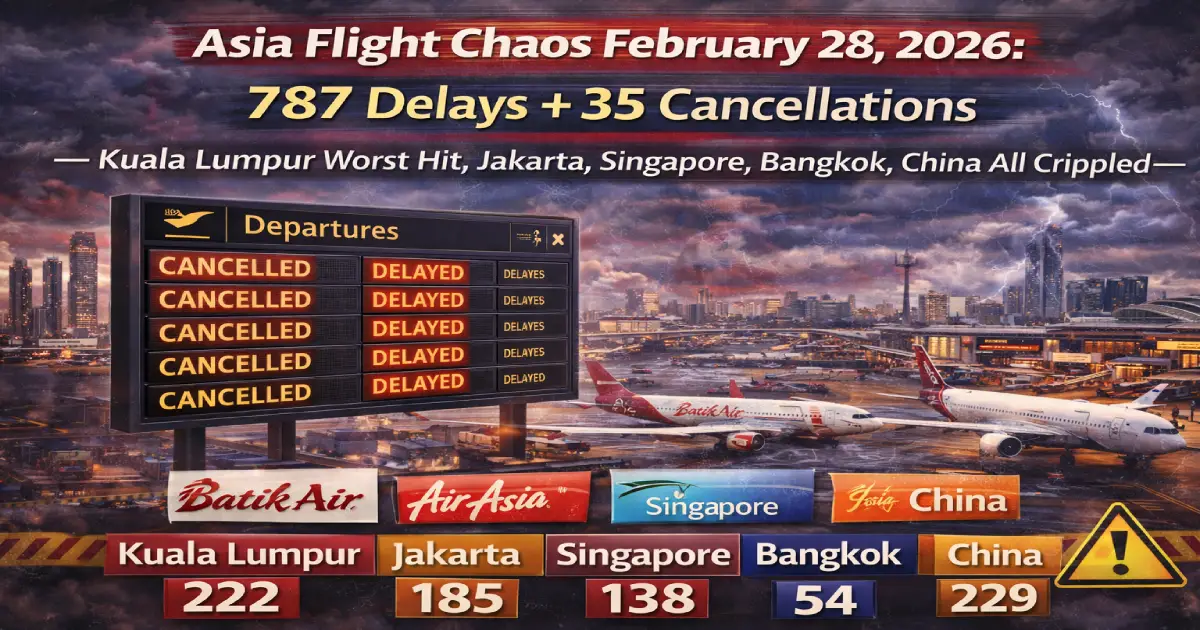
Asia’s aviation network is reeling again today, February 28, 2026, as 787 flight delays and 35 cancellations rip through major airports across Malaysia, Indonesia, Singapore, Thailand, China, and Japan — leaving thousands of passengers stranded at check-in counters, scrambling for rebooking options, and watching their Saturday travel plans collapse in real time.
This is not an isolated incident. It is the latest chapter in a relentless February that has seen Asia’s skies buckle under the combined weight of infrastructure strain, crew scheduling pressure, maintenance backlogs, and seasonal weather disruptions. For travellers connecting through Kuala Lumpur, Jakarta, Singapore, or any of the eleven airports caught in today’s chaos, the message is the same: build in extra time, download your airline app, and do not assume your departure board is telling the full story.
Here is everything you need to know about today’s disruption — airport by airport, airline by airline, and what to do if you are affected.
| Category | Count |
|---|---|
| Total Delays | 787 |
| Total Cancellations | 35 |
| Total Disruptions | 822 |
| Airports Affected | 11 |
| Countries Affected | 6 |
| Worst Airport (Delays) | Kuala Lumpur KUL — 202 delays |
| Worst Airport (Cancellations) | Jakarta CGK — 9 cancellations |
| Worst Airline (Delays) | AirAsia (KUL) |
| Worst Airline (Cancellations) | Batik Air (CGK + UPG) |
Countries affected: Malaysia, Indonesia, Singapore, Thailand, China, Japan
10 cancellations | 202 delays
Kuala Lumpur is today’s ground zero. Malaysia’s busiest international gateway — handling over 60 million passengers annually — is posting 202 delays and 10 cancellations, making it the single worst airport across all of Asia today by delay volume.
AirAsia and Batik Air bear the heaviest load. Both carriers dominate KUL’s schedule and both are facing the same cascading problem: aircraft are arriving late from earlier flights, triggering late departures on the next rotation. Passengers who arrived at the airport expecting a morning departure are finding themselves informed of hour-long — and in some cases half-day — delays only after they have already cleared check-in.
The disruption is hitting both domestic and international routes. For travellers with tight connections onward to Europe, Australia, the Middle East, or North America, the maths is brutal: a two-hour delay at KUL on a short regional hop can turn a manageable layover into a missed connection at Heathrow, Sydney, or Frankfurt.
Airlines most affected at KUL:
What to do if you are connecting through KUL today: Contact your airline immediately to identify rebooking options. KUL has a dedicated transfer assistance desk in the main terminal — go there before joining the general check-in queue. If your connection was booked on a single ticket, the airline is obligated to rebook you at no cost.
9 cancellations | 51 delays
Jakarta holds the unwelcome distinction of being today’s highest-cancellation airport. Indonesia’s largest international gateway is recording 9 outright cancellations and 51 delays — and the cancellation rate here is significant because CGK is a major hub for Batik Air and Garuda Indonesia, both of which operate dense domestic networks connecting Java with the outer islands.
Batik Air is the primary driver. The carrier is cancelling flights and posting rolling delays across domestic routes to Makassar, Denpasar (Bali), Medan, and Surabaya. Garuda Indonesia and Citilink are also caught in the ripple effect, with aircraft and crews displaced by earlier disruptions now out of position.
The practical impact for leisure travellers is significant. Many passengers flying Jakarta–Bali today are facing cancellations with next available seats pushed to tomorrow — a devastating outcome for those with fixed hotel check-in dates, tour departures, or short weekend breaks.
Airlines most affected at CGK:
Compensation note for Indonesian passengers: Under Indonesia’s aviation regulations (Minister of Transportation Regulation PM 89/2015), airlines must provide meals and refreshments for delays exceeding 60 minutes, accommodation for delays exceeding four hours, and full refunds or rebooking for cancellations within their control. Press your airline for these entitlements at the service desk.
3 cancellations | 32 delays
Makassar — eastern Indonesia’s aviation gateway — is recording secondary ripple effects from the CGK disruptions. Batik Air is again the primary carrier affected, with domestic routes across Sulawesi, Maluku, and Kalimantan posting delays as aircraft rotation problems from Jakarta cascade east.
The three cancellations here represent a serious problem for passengers in eastern Indonesia, where flight frequencies are lower and next available flights may be 24 hours away.
4 cancellations | 25 delays
Kota Kinabalu in Malaysian Borneo is a popular gateway for international visitors arriving from Kuala Lumpur, Singapore, and direct routes from Australia. Today’s 4 cancellations and 25 delays — primarily affecting AirAsia and Batik Air — are disrupting both domestic Malaysia routes and connections to key regional hubs.
For UK, Australian, and US travellers using BKI as a gateway to Sabah’s dive sites, rainforest lodges, and Mount Kinabalu, today’s disruptions represent a significant travel headache, with limited rebooking alternatives given the relatively thin schedule at this airport.
1 cancellation | 181 delays
Urumqi is today’s most alarming individual statistic: 181 delays from just a single cancellation. This delay-to-cancellation ratio indicates a severe operational bottleneck — aircraft are not being grounded, but they are barely moving on schedule.
Operational constraints, maintenance holds, and crew scheduling problems at this gateway into China’s far northwest are causing a domino effect throughout the day. Passengers have been reporting waits of up to six hours for rebooking information, with limited airline staff availability to manage the volume of affected travellers.
Airlines operating at Urumqi should be contacted via their official apps or hotlines — do not wait at the airport counter.
2 cancellations | 101 delays
Qingdao is recording over 100 delays today, driven by technical issues with regional aircraft and congestion spreading from other Chinese hubs. International routes are disproportionately affected, with passengers connecting Qingdao to Southeast Asian and Korean destinations facing significant schedule slippage.
Communication from airlines at TAO has been described as poor, with passengers on international routes left uncertain about whether their flights will depart the same day.
2 cancellations | 88 delays
Changsha adds 88 more delays to China’s growing disruption picture today. As a secondary hub connecting central China to both domestic cities and regional international routes, delays here ripple outward to connecting flights at Beijing Capital, Shanghai Pudong, and Guangzhou Baiyun.
1 cancellation | 61 delays
Even Changi — consistently rated among the world’s best-run airports — cannot escape today’s regional chaos. Singapore is recording 61 delays and 1 cancellation. The delays here are almost entirely the result of inbound aircraft arriving late from affected hubs, particularly Kuala Lumpur, Jakarta, and Bangkok. Changi itself is running smoothly operationally, but its schedule is at the mercy of upstream disruptions.
For passengers transiting Singapore to Australia, the UK, the US, or the Middle East, even a 60–90 minute delay at SIN from an inbound Southeast Asian feeder can create tight — or missed — connections on long-haul services.
Key Tier-1 routes affected by SIN delays today:
1 cancellation | 27 delays
Phuket is recording a further 27 delays and 1 cancellation, primarily affecting Thai AirAsia on domestic routes to Bangkok and secondary Thai cities. For tourists finishing their Phuket holidays and heading to connecting flights at Bangkok, today’s delays create a very real risk of missed onward connections to Europe, Australia, and beyond.
1 cancellation | 15 delays
Osaka adds 1 cancellation and 15 delays to Japan’s contribution to today’s chaos. ANA Wings is the primary carrier affected, with domestic and regional services posting disruptions. While the numbers are modest compared to the Southeast Asian airports, any disruption at a major Japanese gateway creates knock-on effects for passengers connecting internationally.
1 cancellation | 4 delays
Kagoshima records a single cancellation and four delays — small numbers but significant for passengers in southern Kyushu, where limited daily frequencies mean a cancelled flight may leave travellers stranded until the following morning.
AirAsia is today’s most delay-prone carrier across the network. Dominating the schedule at Kuala Lumpur, the budget carrier is seeing its tight rotation model — built around quick turnarounds and no slack — buckle under the pressure of cascading delays. When one aircraft in the rotation is late, every subsequent flight in that rotation is late. With AirAsia running over 200 movements per day from KUL alone, a morning disruption mushrooms quickly into an afternoon crisis.
Batik Air holds the highest cancellation count across the network today, with flights grounded at both Jakarta (CGK) and Makassar (UPG). The carrier operates a dense Indonesian domestic network and has been struggling throughout February with aircraft availability and crew scheduling pressure.
Garuda and its low-cost subsidiary Citilink are facing rolling delays at Jakarta, with domestic turnaround times stretched and aircraft displacement creating schedule gaps later in the day.
These carriers add to the disruption totals at Japanese and Chinese airports, with regional services posting delays attributed to a combination of maintenance holds and arrival-driven schedule slippage.
Today’s disruption is not a one-day anomaly. It is the latest episode in a structural crisis that has been building since Asia’s post-pandemic travel recovery dramatically outpaced the region’s airport and airline infrastructure.
Asia’s major airports were generally designed for passenger volumes from ten to fifteen years ago. Today they are handling significantly higher traffic — Jakarta was designed for 50 million annual passengers and is handling over 70 million; Kuala Lumpur built for 45 million is handling over 60 million. The maths simply does not work, and the cracks appear every single day in the form of ground delays, missed slots, and crew duty-time busts that trigger late-notice cancellations.
Budget airlines compound the problem. With AirAsia, Batik Air, and similar low-cost carriers controlling 60–70% of Asian seat capacity (versus 30–40% in Europe or North America), the model is built on zero buffer. There is no slack, no reserve aircraft parked waiting for an emergency, no extra crew standing by. When something goes wrong in the morning — a maintenance check that runs long, a late inbound from the overnight schedule — it cascades through the entire day’s operations.
Aviation analysts monitoring the region consistently warn that meaningful structural improvement is unlikely before late 2026 at the earliest, as new terminal expansions and runway projects reach completion. Until then, the disruption pattern that has defined February 2026 — with days recording between 800 and 4,000-plus disruptions — is expected to continue.
Under the Malaysian Aviation Consumer Protection Code 2016, airlines must provide meals for delays exceeding 3 hours and accommodation for delays requiring an overnight stay. Cancellations entitle you to a full refund or rebooking on the next available flight. Malaysian Aviation Commission (MAVCOM) is the regulatory body — file complaints at mavcom.my.
Under PM 89/2015, airlines must provide meals and refreshments for delays over 60 minutes, accommodation for delays over 4 hours, and full refunds or free rebooking for cancellations. Indonesia’s DGCA (Directorate General of Civil Aviation) handles complaints.
Singapore has no EU261-equivalent cash compensation regime, but airlines operating from Changi are contractually required to rebook on the next available flight (including on partner carriers) in the event of cancellation. The Civil Aviation Authority of Singapore (CAAS) oversees passenger protection.
Thai passengers are entitled to meals and accommodation for significant delays. The Department of Civil Aviation (DCA) governs complaints.
Japan’s compensation framework requires airlines to rebook at no cost and provide meals for significant delays. JCAB (Japan Civil Aviation Bureau) oversees the framework.
Under CAAC rules, airlines must offer meals or meal vouchers for delays of 4+ hours. The CAAC handles passenger complaints.
If your trip began in the EU or UK, EU Regulation 261/2004 or UK261 may still apply to the originating flight, even if the disruption occurs in Asia. Contact your originating carrier for compensation eligibility. Travel insurance is strongly recommended as the primary protection layer for disruptions originating outside regulated compensation zones.
If your flight is delayed at any affected airport:
The following international routes involving today’s affected airports are carrying the highest disruption risk for UK, Australian, and US travellers:
Kuala Lumpur connections: KUL → LHR, KUL → SYD, KUL → MEL, KUL → PER, KUL → LAX (via connections) Jakarta connections: CGK → SIN → onward, CGK → KUL → onward, CGK → DPS (Bali domestic feeds) Singapore onward: SIN → LHR, SIN → SYD, SIN → MEL, SIN → LAX, SIN → AKL Phuket to Bangkok connections: HKT → BKK → long-haul onward
If you are travelling any of these routes today and have a connection at one of these airports, add a minimum 90-minute buffer to your expected connection time — and if your connection is already under 90 minutes on a single ticket, contact your airline now about alternate routing.
Based on the current disruption pattern, partial recovery at most airports is expected by this evening (Saturday, February 28 local time) as airlines work through aircraft repositioning and crew rotations reset. However, flights delayed significantly today will create “day-after” disruptions through Sunday March 1 as the knock-on effects clear.
Kuala Lumpur and Jakarta — the two worst-hit airports — typically take 18–24 hours to fully absorb a day of significant disruption. Travellers flying these airports on Sunday March 1 should continue to monitor their flight status, as there may be residual delays from today’s backlog.
Posted By : Vinay
This article is provided for general informational purposes only and is based on information available at the time of publication. Travel advisories, airline schedules, airport operations, visa requirements, government regulations, and other travel-related information are subject to change without prior notice. While Travel Tourister makes reasonable efforts to verify information using official announcements, government publications, airline and airport communications, and other reliable sources, we cannot guarantee that all information remains complete, accurate, or up to date at all times. Readers should independently verify any information that may affect their travel plans with the relevant airline, airport authority, government agency, embassy, or other official source before making travel, financial, or other decisions. Travel Tourister shall not be liable for any direct or indirect loss, inconvenience, or damages arising from the use of or reliance on the information contained in this article. Nothing in this publication constitutes legal, immigration, financial, or professional travel advice. If you believe any information in this article is inaccurate or outdated, please contact our editorial team. We review all credible correction requests promptly and update our content whenever appropriate.
Lastest News
2nd Floor, 39, Above Kirti Club, DLF Industrial Area, Kirti Nagar, New Delhi, Delhi 110015



Travel Tourister is a leading Travel portal where we introduce travellers to trusted travel agents to make their journey hasselfree, memorable And happy. Travel Tourister is a platform where travellers get Tour packages ,Hotel packages deals through trusted travel companies And hoteliers who are working with us across the world. We always try to find new and more travel agents and hoteliers from every nook and corners across the world so that you could compare the deals with different travel agents and hoteliers and book your tour or hotel with the one you have chosen according to your taste and budget.
Copyright © Travel Tourister, India. All Rights Reserved

 Call
Call Enquiry