Published on : 14 Mar 2026
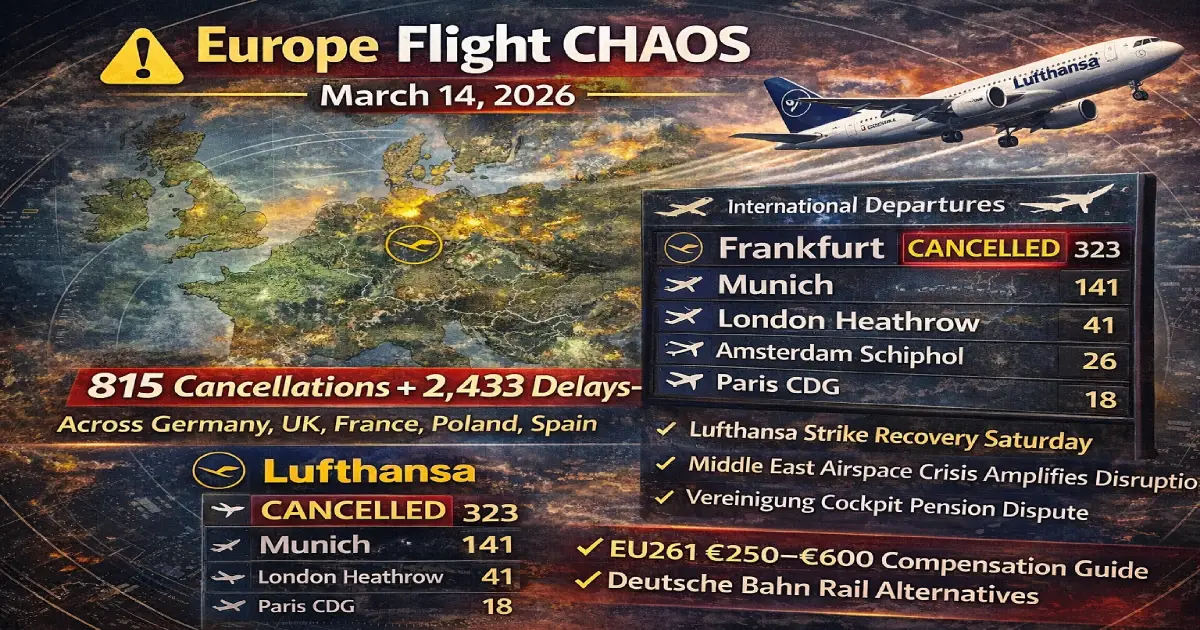
Breaking — European Aviation Paralysis: Thousands of European travelers are stranded or facing long waits after a wave of flight cancellations and delays swept across the continent on March 12 and 13, 2026 with 815 cancellations and 2,433 delays across Europe within two days according to FlightAware data as Frankfurt (323 cancellations), Munich (141), London Heathrow (41), Amsterdam Schiphol (26), and Paris Charles de Gaulle (18) are the worst-hit airports as of March 13–14, 2026 affecting passengers on Lufthansa, Ryanair, KLM, British Airways, Air France and more than a dozen other carriers while a 48-hour pilot strike at Lufthansa triggered by a pension dispute between the airline and Germany’s Vereinigung Cockpit union has combined with ongoing Middle East airspace disruptions to produce Europe-wide totals reaching 815 cancellations and 2,433 delays across Germany, the UK, France, Poland, and Spain creating 3,248 total disruptions (13-15% of European aviation operations) with Lufthansa Group passengers able to rebook for free on flights between March 10–23 and Deutsche Bahn rail alternatives available on select routes as the strike ended 11:59 PM March 13 and Lufthansa currently expects to largely return to the regular flight schedule from Saturday, 14 March 2026 onwards making today Saturday March 14 the critical RECOVERY DAY with delays expected as aircraft and crews reposition across Europe affecting connections spanning every major hub from London to Athens Dublin to Stockholm. Here is the complete March 14 breakdown every European traveler needs today.
Published: March 14, 2026 (Saturday — Strike Recovery Day 1) Strike Duration: 48 hours — midnight March 12 to 11:59 PM March 13 Europe-Wide Totals (March 12-13): 815 cancellations + 2,433 delays = 3,248 total disruptions Percentage of Operations: ~13-15% of European aviation operations Recovery Status: Lufthansa expects normal schedule from Saturday March 14 onwards Most Affected Airports: Frankfurt 323 cancellations (WORST), Munich 141, London Heathrow 41, Amsterdam 26, Paris CDG 18 Most Affected Airlines: Lufthansa 435 cancellations + 39 delays, Ryanair 12+293, KLM 11+152, British Airways Passengers Affected: ~455,000–550,000 (estimate 140 passengers/flight × 3,248 total) Root Causes: (1) Lufthansa pilot strike (Vereinigung Cockpit pension dispute), (2) Middle East airspace closures (US-Israel-Iran tensions) EU261 Compensation: €250–€600 per passenger (strike = airline responsibility, NOT extraordinary circumstance) Free Rebooking Window: March 10–23, 2026 (Lufthansa Group) Rail Alternatives: Deutsche Bahn available German domestic routes
March 14, 2026 marks the first recovery day after 48 hours of unprecedented chaos that saw 815 cancellations + 2,433 delays (3,248 total disruptions) across Europe.
Two crises converged:
A 48-hour pilot strike at Lufthansa — triggered by a pension dispute between the airline and Germany’s Vereinigung Cockpit union — has combined with ongoing Middle East airspace disruptions to produce 815 cancellations and 2,433 delays across Europe within two days.
What happened:
Why the strike occurred:
The strike is the result of failed negotiations between Lufthansa and the pilots’ union, Vereinigung Cockpit, over a pension dispute. The airline replaced pilots’ traditional company pension plans with a capital market-financed model that falls short of the previous benefits. Union officials say Lufthansa’s proposed changes to pilots’ pensions — switching from a defined‑benefit plan to a defined‑contribution model — transfers market risk to employees and undermines retirement security.
After months of unsuccessful talks, the union called for a strike, which started at 12:01 AM on March 12, 2026, and will continue until 11:59 PM on March 13, 2026.
This is NOT the first strike:
The strike is landing on top of an aviation network already under severe pressure from geopolitical instability in the Middle East. Escalating tensions involving the United States, Israel, and Iran have resulted in multiple Middle Eastern states closing their airspace to civilian traffic. Bahrain, Iraq, Israel, Kuwait, Qatar, and the UAE have all implemented airspace restrictions, forcing airlines to reroute or cancel Europe-Asia flights that previously transited through Gulf hubs. Dubai International, one of the world’s busiest airports, has been operating with drastically reduced traffic.
They are separate events but are occurring simultaneously:
Frankfurt (FRA) is the worst-hit airport with 323 cancellations; Munich (MUC) follows with 141.
Frankfurt’s 323 cancellations represent approximately 28% of daily operations — the worst single-airport disruption in Europe today.
Why Frankfurt matters:
Frankfurt Airport (FRA) is:
What passengers describe at Frankfurt:
Frankfurt, one of Europe’s busiest airports, has seen the highest number of cancellations and delays. The airport is not only a major hub for Lufthansa but also serves as a transit point for passengers heading to destinations in the Middle East, Europe, and beyond.
Terminal 1 (Lufthansa hub): “Our Frankfurt-New York flight cancelled. Customer service line 400+ people deep. Four-hour wait just to talk to agent. Lufthansa says next available transatlantic flight is March 16 — two days away. Business meeting Manhattan tomorrow. Lost.”
Terminal 2: “Connecting through Frankfurt from Budapest to Tokyo. Lufthansa cancelled Frankfurt-Tokyo leg. Stuck in Germany 24 hours. Hotel voucher provided but all nearby hotels full. Sleeping on terminal floor.”
Baggage claim: “Flight operated but bags didn’t make it. Lufthansa says ‘recovery backlog.’ Bags arriving ‘maybe March 16.’ Told to buy toiletries — Lufthansa won’t reimburse.”
Frankfurt (FRA) is the worst-hit airport with 323 cancellations; Munich (MUC) follows with 141.
Munich’s 141 cancellations represent approximately 18% of daily operations — second-worst in Europe.
Munich Airport (MUC):
Munich Airport reported 50 cancellations and 56 delays today, making it the second-largest disruption hub in Germany. Lufthansa and Lufthansa CityLine operations were heavily impacted at Munich as well, creating a dual-city bottleneck across Bavaria’s aviation infrastructure.
Why Munich hit hard:
The airport’s location as a major European air travel hub has meant that the disruptions affected numerous connecting flights, further complicating travel schedules for thousands of passengers.
Frankfurt (323 cancellations), Munich (141), London Heathrow (41), Amsterdam Schiphol (26), and Paris Charles de Gaulle (18) are the worst-hit airports as of March 13–14, 2026.
London Heathrow’s 41 cancellations = worst UK airport, affecting British Airways, Air India, Emirates, American Airlines.
Heathrow disruption breakdown:
London Heathrow recorded 31 cancellations and 114 delays today, with disruptions spread across multiple international carriers including British Airways, Air India, Emirates, and American Airlines.
Why Heathrow affected despite Lufthansa strike being German:
The UK’s largest airport, London Heathrow, is also facing substantial disruptions with 41 cancellations and 134 delays. British Airways, the UK’s flagship carrier, has been forced to cancel several flights, primarily affecting short-haul connections. Travelers in the UK should expect delays on both domestic and European routes.
Heathrow-Frankfurt/Munich connection dependency:
Frankfurt (323 cancellations), Munich (141), London Heathrow (41), Amsterdam Schiphol (26), and Paris Charles de Gaulle (18) are the worst-hit airports as of March 13–14, 2026.
Amsterdam Schiphol:
Amsterdam Schiphol and Paris Charles de Gaulle have both experienced severe delays and cancellations, adding to the congestion at these international hubs. Travelers flying to and from the Netherlands and France are urged to check their flights regularly.
KLM impact:
KLM (Netherlands): KLM is grappling with 11 cancellations and 152 delays, primarily affecting flights from its main hub in Amsterdam.
Frankfurt (323 cancellations), Munich (141), London Heathrow (41), Amsterdam Schiphol (26), and Paris Charles de Gaulle (18) are the worst-hit airports as of March 13–14, 2026.
Paris CDG may not be the worst for cancellations, but it leads today’s disruption table on pure delays:
Paris Charles de Gaulle Airport may not be the worst for cancellations, but it leads today’s disruption table on pure delays — 147 flights delayed with 12 cancelled. Air France accounts for the largest share of those delays, while Lufthansa and Qatar Airways recorded cancellations out of CDG. The volume of delayed Air France flights suggests operational issues within the carrier’s own schedule rather than external factors alone.
Paris CDG: 18 cancellations + 224 delays = 242 total disruptions
Air France issues:
This critical international gateway saw 18 cancellations and 224 delays, leading to further chaos for travelers.
Air France’s 224 delays suggest internal operational strain beyond just Lufthansa strike ripple.
Other airports like Barcelona, Berlin, Brussels, and Munich are also facing significant disruptions, with numerous flights either delayed or canceled.
Barcelona, Berlin, Brussels + 30+ other airports from Gdańsk to Athens all reporting significant disruption.
Notable airports:
Europe’s leading airlines have also been heavily affected by these widespread disruptions. Below is an analysis of the impact on some of the largest carriers:
Lufthansa (Germany): As the largest carrier in Germany, Lufthansa has faced 435 cancellations and 39 delays. The airline’s operations are significantly impacted, especially on long-haul routes.
Lufthansa’s March 12-13 strike impact:
Lufthansa CityLine (regional subsidiary):
What Lufthansa operated during strike:
Partial operations: Lufthansa states that more than half of scheduled flights will still operate, with roughly 60 % of long-haul services continuing through volunteer crews, aircraft swaps, and reroutes, particularly on key intercontinental routes that are less affected.
March 14 recovery:
Lufthansa currently expects to largely return to the regular flight schedule from Saturday, 14 March 2026 onwards.
Ryanair (Ireland): Known for its budget-friendly services, Ryanair has seen 12 cancellations and 293 delays, with a large portion of the delays affecting short-haul flights across Europe.
Ryanair not on strike but affected by:
KLM (Netherlands): KLM is grappling with 11 cancellations and 152 delays, primarily affecting flights from its main hub in Amsterdam.
KLM = Star Alliance partner with Lufthansa:
The UK’s largest airport, London Heathrow, is also facing substantial disruptions with 41 cancellations and 134 delays. British Airways, the UK’s flagship carrier, has been forced to cancel several flights, primarily affecting short-haul connections.
British Airways affected by:
This critical international gateway saw 18 cancellations and 224 delays, leading to further chaos for travelers.
Air France’s 224 delays = largest single-carrier delay count in Europe today, suggesting internal operational crisis beyond external strike factors.
Beyond passenger inconvenience, this level of disruption carries broader economic implications. Delays and cancellations not only increase operational costs for airlines but also affect tourism, cargo movements and business travel.
The effect on local businesses, including hotels, restaurants and tour operators, is expected to be substantial, as travellers adjust their plans, either cancelling their trips or seeking alternatives to avoid the chaos at the airports. Similarly, smaller cities like Bremen, Hanover and Stuttgart, which are often considered off-the-beaten-path destinations for tourists, will also feel the economic impact. Many tourists travelling through Germany’s major hubs often take advantage of domestic connections to explore these lesser-known cities. With fewer travellers making it through the airports, tourism revenue in these cities could suffer in the short term.
Estimated daily losses:
Germany, home to major airlines like Lufthansa, is seeing the largest impact. Frankfurt and Munich airports are at the center of the disruption, with hundreds of flights canceled and delayed. The strike at Lufthansa has exacerbated the situation, causing widespread operational strain on the airline and leading to significant passenger inconvenience.
Business meeting cancellations:
The strike covers mainline Lufthansa passenger and cargo operations.
Lufthansa Cargo affected:
Passengers holding tickets on Lufthansa Group airlines (including Swiss, Austrian, and Brussels Airlines) can rebook for free on flights between March 10 and March 23.
Lufthansa official policy:
Passengers holding tickets from Lufthansa, Austrian, Swiss, Brussels Airlines or Air Dolomiti, issued on or before 10 March 2026, and booked on Lufthansa-operated flights (including Lufthansa CityLine) on 12 or 13 March 2026, may:
How to rebook:
Lufthansa Group passengers can rebook for free on flights between March 10–23; Deutsche Bahn rail alternatives are available on select routes.
German domestic routes available:
How to get rail voucher:
Important: Please make sure to allow enough time for your connecting flight from Frankfurt or Munich when choosing your train.
CRITICAL: A strike by Lufthansa’s own staff is not classified as an extraordinary circumstance under EU law, which means Lufthansa is required to pay compensation under EU Regulation 261/2004.
Compensation amounts:
Who qualifies:
How to claim:
Timeline: Claims must be filed within 3 years (EU law)
Based on February 2026 strike precedent:
✈️ February 2026 strike: ~800 flights cancelled, 130,000 passengers affected ✈️ Recovery after February strike: Lufthansa returned to near-normal operations within 24–48 hours ✈️ Backlog clearance: Took 2–3 days for rebooking queues to fully clear at Frankfurt and Munich
March 14-17, 2026 recovery forecast:
Today (Saturday March 14):
Sunday March 15:
Monday March 16:
Tuesday March 17:
Official Lufthansa position:
Lufthansa currently expects to largely return to the regular flight schedule from Saturday, 14 March 2026 onwards.
Passengers cancelled today should expect recovery options to open up significantly from Saturday March 14, with the majority of the booking backlog cleared by Monday–Tuesday March 16–17.
The strike is landing on top of an aviation network already under severe pressure from geopolitical instability in the Middle East.
Ongoing since March 2, 2026:
Escalating tensions involving the United States, Israel, and Iran have resulted in multiple Middle Eastern states closing their airspace to civilian traffic. Bahrain, Iraq, Israel, Kuwait, Qatar, and the UAE have all implemented airspace restrictions, forcing airlines to reroute or cancel Europe-Asia flights that previously transited through Gulf hubs. Dubai International, one of the world’s busiest airports, has been operating with drastically reduced traffic.
Affected routes:
Lufthansa official policy:
Due to the current situation in the Middle East and the associated massive restrictions on air traffic, the airlines of the Lufthansa Group will suspend flights to and from Dubai and Abu Dhabi until March 15.
Guests holding LHG tickets to TLV, AMM, EBL, DMM, AUH und DXB issued on or before March 1, 2026, that have not been cancelled yet with original travel dates betwenn16 March 2026 and 26 March 2026, may refund their ticket.
Thousands of European travelers are stranded or facing long waits after a wave of flight cancellations and delays swept across the continent on March 12 and 13, 2026 with 815 cancellations and 2,433 delays (3,248 total disruptions = 13-15% European aviation operations) across Germany, UK, France, Poland, Spain as Frankfurt (323 cancellations WORST), Munich (141), London Heathrow (41), Amsterdam Schiphol (26), Paris Charles de Gaulle (18) are worst-hit airports affecting passengers on Lufthansa (435 cancellations + 39 delays), Ryanair (12+293), KLM (11+152), British Airways while 48-hour pilot strike at Lufthansa triggered by Vereinigung Cockpit pension dispute (switching from defined-benefit to defined-contribution model transfers market risk to employees) combined with ongoing Middle East airspace disruptions (US-Israel-Iran tensions closing Bahrain, Iraq, Israel, Kuwait, Qatar, UAE airspace) amplified disruption across European aviation network with Saturday March 14 = RECOVERY DAY as Lufthansa expects largely normal schedule from today onwards though 200-400 delays expected (aircraft/crews repositioning) with total recovery by Monday-Tuesday March 16-17 while passengers entitled to EU261 compensation €250-€600 per passenger (strike = airline responsibility NOT extraordinary circumstance) plus free rebooking March 10-23 and Deutsche Bahn rail alternatives on select German domestic routes.
Your Europe March 14 Survival Checklist:
✅ Lufthansa Group passenger? Free rebooking March 10-23 OR full refund, Deutsche Bahn rail vouchers German domestic routes ✅ Flight cancelled/delayed 3+ hours? EU261 compensation €250-€600 per passenger (strike = airline pays, file within 3 years) ✅ Flying today/tomorrow? Expect 200-400 delays (repositioning), <50 cancellations, check status every hour ✅ Frankfurt/Munich connection? Build 3-4 hour buffer (recovery backlog), consider alternative hubs (Vienna, Zurich, Amsterdam) ✅ Middle East destination? Dubai/Abu Dhabi suspended until March 15, Doha limited, reroute via Istanbul/Helsinki
Track European airports live:
Related Articles:
Posted By : Vinay
This article is provided for general informational purposes only and is based on information available at the time of publication. Travel advisories, airline schedules, airport operations, visa requirements, government regulations, and other travel-related information are subject to change without prior notice. While Travel Tourister makes reasonable efforts to verify information using official announcements, government publications, airline and airport communications, and other reliable sources, we cannot guarantee that all information remains complete, accurate, or up to date at all times. Readers should independently verify any information that may affect their travel plans with the relevant airline, airport authority, government agency, embassy, or other official source before making travel, financial, or other decisions. Travel Tourister shall not be liable for any direct or indirect loss, inconvenience, or damages arising from the use of or reliance on the information contained in this article. Nothing in this publication constitutes legal, immigration, financial, or professional travel advice. If you believe any information in this article is inaccurate or outdated, please contact our editorial team. We review all credible correction requests promptly and update our content whenever appropriate.
Lastest News
2nd Floor, 39, Above Kirti Club, DLF Industrial Area, Kirti Nagar, New Delhi, Delhi 110015



Travel Tourister is a leading Travel portal where we introduce travellers to trusted travel agents to make their journey hasselfree, memorable And happy. Travel Tourister is a platform where travellers get Tour packages ,Hotel packages deals through trusted travel companies And hoteliers who are working with us across the world. We always try to find new and more travel agents and hoteliers from every nook and corners across the world so that you could compare the deals with different travel agents and hoteliers and book your tour or hotel with the one you have chosen according to your taste and budget.
Copyright © Travel Tourister, India. All Rights Reserved

 Call
Call Enquiry