Published on : 21 Oct 2026
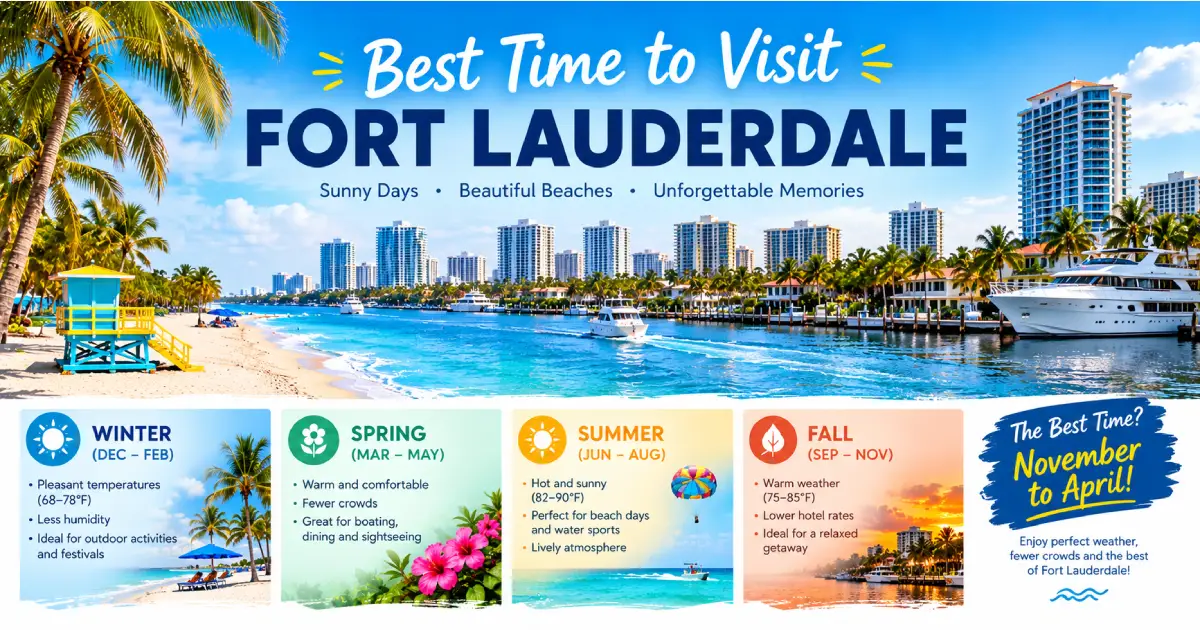
Fort Lauderdale sits at 26 degrees north latitude — comfortably within the tropics — and its climate reflects that position with a reliability that makes trip planning unusually straightforward. There are essentially two seasons: a warm, dry winter (November through April) that is among the most pleasant climates in the continental United States, and a hot, wet summer (May through October) with afternoon thunderstorms, high humidity, and the kind of heat that separates serious beach lovers from casual ones. The city averages 3,000 hours of sunshine per year — more than Miami, more than Los Angeles, more than any city on the US mainland outside of the Arizona desert — and that relentless sunshine is the foundation of everything Fort Lauderdale offers.
What makes Fort Lauderdale’s climate distinctive within South Florida is the moderating effect of the Atlantic Ocean. The beach sits on a barrier island with ocean on both sides — the Atlantic to the east, the Intracoastal and the New River to the west — and the sea breeze that flows off the Atlantic in the late morning is one of the city’s most valuable natural features. On the hottest July afternoons, when inland Broward County is a stagnant 95°F with 90% humidity, the Fort Lauderdale beachfront can feel 8–10°F cooler with the ocean breeze moving through. It doesn’t eliminate summer — nothing does in South Florida — but it makes the beach communities substantially more livable than the suburban interior during the hot months.
The best time to visit Fort Lauderdale is November through April, with February and March representing the peak of the perfect-weather window. These months deliver daily highs in the mid-70s to low-80s°F, low humidity, virtually no rain, and the full social energy of the city’s peak season — the Fort Lauderdale International Boat Show in late October/early November, the winter arts and performance calendar, and the outdoor dining culture of Las Olas at its most vibrant. If peak-season prices are a concern, November and early April offer nearly identical weather at significantly lower rates than January through March, making them the year’s best value windows.
| Factor | Details |
|---|---|
| Best Months | February, March |
| Runner-Up Months | November, April |
| Peak Season | December – April |
| Shoulder Season | November, May |
| Budget Season | June – September |
| Wettest Months | June, July, August |
| Driest Months | November, December, March |
| Hottest Month | August (avg high 91°F) |
| Coolest Month | January (avg high 76°F) |
| Hurricane Season | June 1 – November 30 |
| Annual Sunshine Hours | ~3,000 hours per year |
| Month | Avg High °F | Avg Low °F | Sunny Days | Rainfall (in) | Humidity | Crowds |
|---|---|---|---|---|---|---|
| January | 76 | 60 | 23 | 2.7 | Low | High |
| February | 78 | 62 | 23 | 2.6 | Low | High |
| March | 81 | 65 | 24 | 3.5 | Low-Med | High |
| April | 85 | 69 | 25 | 3.8 | Medium | Med-High |
| May | 88 | 73 | 23 | 6.2 | Med-High | Medium |
| June | 91 | 76 | 18 | 9.3 | High | Low-Med |
| July | 92 | 77 | 16 | 6.6 | High | Medium |
| August | 92 | 77 | 16 | 8.3 | High | Medium |
| September | 90 | 76 | 17 | 9.5 | High | Low |
| October | 86 | 72 | 21 | 6.7 | Med-High | Medium |
| November | 81 | 67 | 23 | 3.5 | Low-Med | Med-High |
| December | 77 | 62 | 22 | 2.9 | Low | High |
Best for: First-time visitors, beach lovers, snowbirds, families, special occasions
Fort Lauderdale’s winter and spring represent one of the finest sustained stretches of outdoor weather anywhere in the continental United States. From December through April, daily highs range from a comfortable 76°F in January to a warm 85°F in April. Humidity is at its annual low — the air has the clarity and lightness that makes South Florida in winter feel categorically different from the sweaty weight of summer. Rain is rare: Fort Lauderdale averages less than 3 inches per month from November through March, and many winter weeks pass without a single rainy day. The ocean water is cooler than summer (72–76°F January–March) but perfectly swimmable, and the beach is at its most beautiful — wide, clean, and filled with a mix of visitors and locals who have come specifically for this weather.
December opens with holiday events, the Winterfest Boat Parade (one of the most elaborate holiday boat parades in the country, drawing a million spectators along the Intracoastal), and the city’s cultural season in full swing at the Broward Center and NSU Art Museum. Hotel rates are elevated through New Year’s and then settle into January levels.
January and February are the absolute peak of snowbird season — the period when Fort Lauderdale fills with visitors from the Northeast, Midwest, and Canada who have timed their escape from winter precisely to these months. Hotels run at high occupancy and premium rates (expect to pay 40–60% more than summer rates for the same property). The tradeoff is fully justified by the weather: February is arguably the most perfect month in Fort Lauderdale’s climate calendar, with average highs of 78°F, virtually no rain, and the kind of clear, luminous light that makes the beach and the Intracoastal look extraordinary.
March brings college Spring Break to the beach communities, with the associated increase in younger visitors and the energy (positive and negative) that comes with them. The Fort Lauderdale International Film Festival typically runs in early spring. The Pompano Beach Seafood Festival (usually mid-April) is one of the region’s finest outdoor food events.
April is the last of the perfect-weather months — 85°F, low humidity, minimal rain — before May’s increasing humidity signals the approaching wet season. Early April (through around the 15th) retains full dry-season character; late April begins to feel warmer and more humid. April pricing is typically 20–30% below the February–March peak, making it an excellent value for quality weather.
Packing: Light cotton or linen clothing; one light sweater or jacket for January–February evenings when temperatures occasionally dip to the low 60s°F. Sunscreen essential year-round.
Best for: Value-seeking travelers, photographers, outdoor enthusiasts, repeat visitors
November is Fort Lauderdale’s most underrated month. The summer heat has broken definitively — highs drop from October’s 86°F to a comfortable 81°F — and the humidity has largely cleared. Rainfall is at its annual low (3.5 inches in November, one of the driest months on record). The Fort Lauderdale International Boat Show runs in late October into early November, bringing an extraordinary spectacle of global yachting to the Intracoastal — the world’s largest in-water boat show, and one of the most remarkable free-with-admission events in Florida. After the Boat Show, November settles into a quiet pre-peak period with good hotel values (prices haven’t yet climbed to December–February levels), excellent weather, and the city operating at a relaxed pace before the snowbird rush.
May is the other shoulder month — the final good-weather window before the summer heat becomes demanding. Early May (through around the 10th) retains April’s pleasant character; late May sees the first sustained afternoon storms of the pre-summer rainy season. May is the last month when outdoor evening dining on Las Olas is truly comfortable without the need to retreat from humidity, and the Gulf Stream fishing offshore reaches peak activity for mahi-mahi and wahoo as the warm current pushes inshore.
Best for: Budget travelers, families on school calendars, water sports, summer events
Fort Lauderdale’s wet season is South Florida’s summer — hot, humid, and punctuated by afternoon thunderstorms that develop with predictable reliability between roughly 2 and 5 PM daily. June through September brings daily highs of 90–92°F, humidity that makes the feel-like temperature reach 100°F or above, and rainfall concentrated in intense afternoon bursts rather than all-day drizzle. The morning hours — roughly 7 AM to noon — are frequently beautiful: clear skies, ocean breezes, warm but not brutal temperatures. The practical approach is to front-load outdoor activities into the morning, plan an indoor attraction or extended lunch for early afternoon, and return outside for the evening when the storms have cleared and the temperature drops a few degrees.
The Atlantic water reaches its warmest levels in July and August (82–84°F), making swimming, paddleboarding, and snorkeling outstanding from a water-temperature perspective. The Fort Lauderdale reef — accessible by short boat ride from the beach — is clearest in summer when the onshore winds that stir up the nearshore water in winter are absent. Hotel rates drop 30–50% from peak-season prices in June through August, creating a genuine value opportunity for travelers flexible enough to handle the heat.
Hurricane season (June 1–November 30) peaks in August and September. Broward County’s position on the southeast Florida coast makes it more vulnerable to Atlantic-track hurricanes than the Gulf Coast cities. The 2004 and 2005 seasons brought direct hits to South Florida; major hurricanes affecting Fort Lauderdale remain a real, if not frequent, risk. Monitor the National Hurricane Center (nhc.noaa.gov) if traveling in August through October, and consider travel insurance with trip cancellation coverage.
October deserves special mention as a transitional month with improving weather: the peak of hurricane season passes (most South Florida hurricane landfalls occur in August and September), temperatures begin dropping toward the 80s°F, and the Fort Lauderdale International Boat Show arrives in the final days of the month. If you can tolerate the residual heat and humidity of early October, the second half of the month is quite good — and the Boat Show is a genuinely extraordinary event.
Best: February–April for comfort; July–August for warmest water The best combination of comfortable air temperature and swimmable ocean is February through April (water 72–76°F, air 78–85°F, low humidity). For the warmest possible ocean water (82–84°F), July and August are the answer — though the air temperature and humidity require a morning beach strategy. October is an excellent compromise: water still warm from summer (78–80°F), air dropping to the mid-80s°F, humidity beginning to clear.
Best: June–August (school vacation), December–January (holiday travel) Summer aligns with school calendars; the beach is extraordinary in the morning hours, and the structured indoor attractions (MODS, Bonnet House tours, Water Taxi) fill the afternoon storm window effectively. December–January holiday travel is popular and requires advance booking.
Best: February–April The peak season brings Fort Lauderdale’s cultural calendar to full activity: Broward Center’s Broadway season, NSU Art Museum’s major exhibitions, Las Olas Art Fair in March, and the South Beach Wine and Food Festival (30 min south) in late February. The outdoor dining culture of Las Olas is at its most vibrant when the evenings are warm but not oppressive.
Best: June–August Hotel rates drop 30–50% from peak-season levels in June through August. The beach, Water Taxi, Riverwalk, and most of Fort Lauderdale’s best attractions are unaffected by heat for morning visitors. Lester’s Diner at 3 AM after a waterfront evening remains sublime year-round.
Best: November (Boat Show), February–March (ideal conditions), May–June (calm offshore waters) The Fort Lauderdale International Boat Show (late October–early November) is the obvious boating event. For on-water activities — kayaking the canals, sailing on the Intracoastal, reef diving and snorkeling — February through March offers the best combination of calm seas, clear visibility, and comfortable temperatures. May and June bring the calmest offshore conditions before summer storm season fully develops.
Best: November–February The low-angle golden light of November through February — combined with Fort Lauderdale’s extraordinary visual material (the Intracoastal at sunrise, the canal neighborhoods in afternoon light, the Atlantic beach at golden hour, Bonnet House’s tropical gardens) — produces the year’s finest photography conditions. The winter light has a clarity and warmth that the flat overhead light of summer simply cannot match.
Best: January–March (full season), November–April (extended) Fort Lauderdale is one of the premier snowbird destinations in the United States for exactly the reasons the February weather data shows. January through March represents the peak of the snowbird season, with full cultural programming, peak social energy, and the most stable weather of the year. Extended stay accommodations (furnished condos, monthly rentals) are widely available; book 3–6 months in advance for January–March availability.
Stone crab season shapes dining. Florida stone crab season runs October 15 through May 1 — the freshest and most prized of South Florida’s seasonal seafood is unavailable in summer. If stone crab is a priority (and at places like 15th Street Fisheries and Steak 954, it should be), plan your visit between mid-October and late April.
The Atlantic vs. Gulf: Fort Lauderdale’s beach faces the Atlantic, which is cooler and more energetic than the Gulf Coast. Winter water temperatures (68–72°F, January–February) are brisk for swimming by most standards; the Gulf side of Florida runs 5–8°F warmer in winter.
Sea turtle nesting season: Loggerhead sea turtles nest on Fort Lauderdale’s beaches from May through August; hatchlings emerge July through October. The Broward County Sea Turtle Conservation Program organizes guided night walks to observe nesting turtles (from a safe distance) during season. One of summer’s genuinely magical experiences.
Spring Break logistics: Fort Lauderdale Beach during Spring Break (mid-March through early April) is busy — not as overwhelming as Daytona or Panama City Beach, but beach parking fills early and hotel rates spike. Book 2–3 months in advance.
Sun protection: At 26 degrees north latitude, Fort Lauderdale’s UV index is high year-round. Apply SPF 50+ on beach days regardless of season; the winter sun is substantially more intense than the same angle of light in northern states.
Posted By : Vinay
Latest Article
2nd Floor, 39, Above Kirti Club, DLF Industrial Area, Kirti Nagar, New Delhi, Delhi 110015



Travel Tourister is a leading Travel portal where we introduce travellers to trusted travel agents to make their journey hasselfree, memorable And happy. Travel Tourister is a platform where travellers get Tour packages ,Hotel packages deals through trusted travel companies And hoteliers who are working with us across the world. We always try to find new and more travel agents and hoteliers from every nook and corners across the world so that you could compare the deals with different travel agents and hoteliers and book your tour or hotel with the one you have chosen according to your taste and budget.
Copyright © Travel Tourister, India. All Rights Reserved

 Call
 Enquiry