Los Angeles vs San Francisco: Which California City Is Better in 2026?
Published on : 09 May 2026
Los Angeles vs San Francisco — Beach Culture vs Hills & Fog: The Decision 30 Million Travelers Make Every Year
By Travel Tourister | Updated May 2026
Los Angeles and San Francisco are California’s two most iconic cities and represent opposite sides of the most fundamental California tourism question: do you want sprawling beach culture with Hollywood glamour, year-round sunshine, and car-dependent freedom spanning 503 square miles, or do you want compact walkable hills with Golden Gate Bridge views, foggy microclimates, and cable car charm condensed into 47 square miles? Los Angeles is Southern California personified — 4 million residents (13 million metro), 75 miles of Pacific coastline from Malibu to Long Beach, 292 sunny days annually, entertainment industry headquarters (Hollywood, Universal Studios, Warner Bros), and the most car-centric major US city where freeways define lifestyle. San Francisco is Northern California concentrated — 875,000 residents (7.7 million Bay Area), 43 hills creating dramatic topography, Golden Gate Bridge icon, cable cars (only manually-operated system remaining in world), and the most walkable major West Coast city where cars are optional downtown.
The weather question alone shapes millions of California travel decisions: Los Angeles averages 284 sunny days annually with 70-75°F year-round perfection enabling outdoor beach lifestyle, while San Francisco averages 259 sunny days but with infamous fog (“Karl the Fog”), microclimates varying 20°F within 10 miles, and Mark Twain’s alleged quote “the coldest winter I ever spent was a summer in San Francisco” reflecting foggy 55-65°F summer reality. But for the 50+ million combined annual visitors choosing between California’s two marquee cities, the comparison goes deeper — into beach access (LA’s 75 miles of coastline vs SF’s Ocean Beach and Baker Beach), cultural identity (Hollywood entertainment vs tech innovation Silicon Valley gateway), food scenes (LA’s 200+ global cuisines vs SF’s farm-to-table Michelin concentration), walkability (SF’s 7×7 mile walkable core vs LA’s 503 square miles requiring car), and cost (both expensive but SF 25-40% pricier for lodging/dining).
This guide breaks down every meaningful category honestly and delivers the clearest verdict on which California city is right for your specific trip priorities in 2026.
For complete guides, see our Things to Do in Los Angeles, Things to Do in San Francisco, and Best Places to Visit in California 2026 guides.
The Most Important Facts First
Key Fact
🌴 Los Angeles
🌉 San Francisco
Population (City)
4 million (2nd-largest US city)
875,000 (17th-largest US city)
Metro Population
13 million (2nd-largest US metro)
7.7 million Bay Area (5th-largest)
City Size
503 square miles (massive sprawl)
47 square miles (compact, walkable)
Distance Apart
383 miles / 6 hours driving (or 1.5 hours flight)
Annual Sunshine Days
284 days (year-round sunshine)
259 days (but famous fog)
Average Summer High
84°F (perfect beach weather)
67°F (cool, foggy “June Gloom”)
Average Winter High
68°F (mild, sunny)
57°F (cool, wet Nov-March)
Beaches
75 miles coastline (Santa Monica, Venice, Malibu, Manhattan Beach)
88/100 (2nd most walkable major US city after NYC)
Major Airport
LAX (3rd-busiest US, traffic nightmare)
SFO (7th-busiest US, BART-connected)
Iconic Landmark
Hollywood Sign (1923, Mount Lee)
Golden Gate Bridge (1937, International Orange)
Average Hotel (Mid-Range)
$180-280/night
$240-380/night (25-40% more expensive)
Primary Industry
Entertainment (Hollywood, film/TV production)
Technology (Silicon Valley gateway, tech HQs)
Food Scene Identity
200+ global cuisines, food trucks, taco culture
Farm-to-table, Michelin concentration, sourdough
Homelessness Crisis
~46,000 (visible Skid Row, Venice boardwalk)
~8,000 (visible Tenderloin, Civic Center BART)
Annual Visitors
~50 million (most-visited CA destination)
~25 million (half of LA’s tourism)
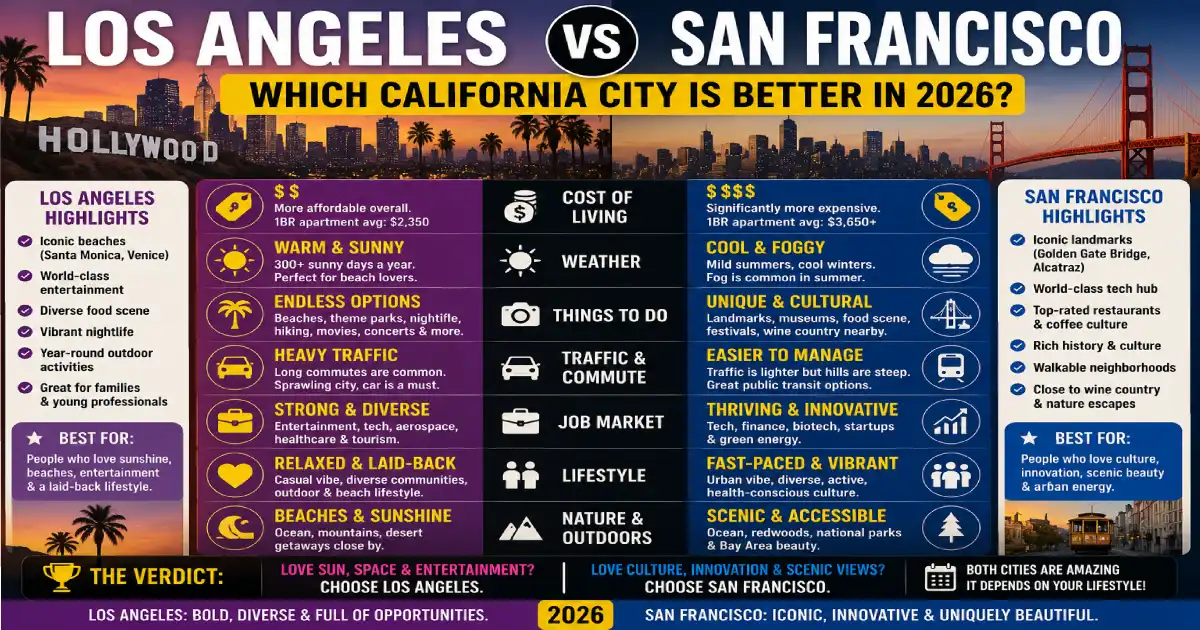
Quick Verdict: Los Angeles vs San Francisco
Category
🌴 LA Wins
🌉 SF Wins
Winner
Beach Weather & Access
✅ 75 miles coastline, 284 sunny days, swimmable water
Ocean Beach cold/foggy, not swimmable
🌴 Los Angeles
Year-Round Warm Sunshine
✅ 70-75°F year-round, reliable sunny weather
Cool foggy summers (55-65°F), SF microclimates
🌴 Los Angeles
Walkability Without Car
Car essential (503 sq mi sprawl)
✅ 88/100 walkability, excellent transit, 47 sq mi compact
🌉 San Francisco
Iconic Bridge/Landmark
Hollywood Sign (1923)
✅ Golden Gate Bridge (most photographed bridge globally)
🌉 San Francisco
Public Transportation
Metro expanding but inadequate for sprawl
✅ Muni, BART, cable cars, ferries — comprehensive
🌉 San Francisco
Theme Parks Major
✅ Universal Studios, Disneyland (Anaheim 35 miles), Six Flags
None (Pier 39 tourist trap only)
🌴 Los Angeles
Michelin Star Density
Good (multiple starred restaurants)
✅ Highest Michelin concentration per capita US
🌉 San Francisco
Global Cuisine Diversity
✅ 200+ cuisines, largest Koreatown, Thai Town, Little Ethiopia
Excellent but less diverse than LA
🌴 Los Angeles
Hills & Topography Dramatic
Some hills (Hollywood Hills, Mulholland)
✅ 43 hills creating dramatic city topography
🌉 San Francisco
Cable Cars Historic
None
✅ Only manually-operated cable car system in world
🌉 San Francisco
Hollywood/Entertainment
✅ Hollywood, studio tours, Walk of Fame, TCL Theatre
None (tech industry instead)
🌴 Los Angeles
Alcatraz Prison Tours
None
✅ Alcatraz Island (must-visit, book advance)
🌉 San Francisco
Affordability (Lodging/Food)
✅ 25-40% cheaper hotels/dining than SF
Among most expensive US cities
🌴 Los Angeles
Chinatown Authentic
Small Chinatown downtown
✅ Largest Chinatown outside Asia, oldest US Chinatown
🌉 San Francisco
Natural Beauty Compact
Spread across sprawl (Griffith Park, beaches distant)
✅ Golden Gate Park, bay views, hills in compact 7×7 miles
🌉 San Francisco
Los Angeles vs San Francisco: The Weather Difference
The weather question fundamentally shapes Los Angeles vs San Francisco comparison and determines visitor satisfaction more than any other single factor. The two cities sit 383 miles apart on California’s coast yet experience dramatically different climates defining distinct lifestyles and visitor experiences.
Los Angeles Weather — Year-Round Mediterranean Perfection
Los Angeles delivers the most consistently sunny and warm major US city weather — 284 sunny days annually (78% of days), average temperatures 70-75°F year-round with minimal seasonal variation, and beach-swimmable Pacific waters May-October (65-70°F, cold by tropical standards but swimmable). The infamous LA sunshine enables outdoor lifestyle 365 days — beach volleyball in January, hiking Runyon Canyon any month, rooftop bars year-round, and convertibles as practical daily drivers. Rainfall averages just 15 inches annually (concentrated December-March, minimal summer rain), creating the drought-prone climate requiring water imports but delivering the reliable sunshine that built Southern California’s outdoor recreation identity.
Summer (June-September) temperatures average 75-85°F at beach (Santa Monica, Venice) and 85-95°F inland valleys (San Fernando Valley, Pasadena), with occasional heat waves pushing 100°F+ inland but beach areas remaining cooler. Winter (December-February) rarely drops below 55°F even at night, with daytime highs 68°F average — the “cold” that keeps Angelenos indoors feels like perfect sweater weather to Midwest/East Coast visitors. The consistent warmth means packing light (no heavy coats required any season), outdoor dining year-round (patios dominate LA restaurant culture), and beach activities accessible 10+ months annually.
San Francisco Weather — Microclimates & Infamous Fog
San Francisco’s weather defines “complicated” — 43 hills creating microclimates where Mission District reaches 75°F while Ocean Beach sits 55°F with fog simultaneously, Mark Twain’s alleged quote about “coldest winter” reflecting summer fog reality, and the city’s compact 7×7 miles experiencing more temperature variation internally than LA’s entire 503 square miles. Average annual sunshine (259 days, 71%) misleads because fog obscures without technically counting as “overcast,” creating the gray marine layer that defines SF summer mornings.
Summer (June-September) is San Francisco’s COLDEST season — fog rolls through Golden Gate producing 55-65°F daytime highs, wind chills feeling colder, and tourists shivering in shorts they packed expecting California warmth. September-October (“SF’s actual summer”) provides the warmest clearest weather (70-75°F, fog dissipates, locals know this secret). Winter (December-February) brings rain (80% of annual 23 inches falls November-March) and cool temperatures (50-57°F average highs), but rarely freezes. Spring (March-May) transitions from wet to foggy, with April-May beginning the fog season locals call “June Gloom” (lasting through August).
The practical SF reality: ALWAYS pack layers (fleece/jacket essential even July), ignore what calendar says about “summer,” and check microclimate forecasts (SFGate weather differentiates neighborhoods). Ocean Beach remains too cold for swimming year-round (50-60°F water, strong currents dangerous), making SF fundamentally NOT a beach destination despite coastal location.
Weather verdict: Los Angeles wins decisively for warm sunshine and beach weather. LA’s 284 sunny days, 70-75°F year-round consistency, and swimmable beaches create the California sunshine experience most visitors expect. San Francisco’s cool foggy summers (55-65°F), dramatic microclimates, and Ocean Beach too cold for swimming require adjusting expectations — SF is beautiful but NOT reliably warm or beach-oriented. Choose LA for guaranteed sunshine and beach weather; choose SF despite its challenging weather for other attractions.
Los Angeles vs San Francisco: Beaches & Coastline
Los Angeles Beaches — 75 Miles of Pacific Coastline
Los Angeles owns California’s most extensive urban beach culture — 75 miles of Pacific coastline from Malibu’s celebrity enclaves through Santa Monica Pier’s iconic amusement park to Venice Beach’s bohemian boardwalk, Manhattan Beach’s volleyball culture, and Long Beach’s harbor. The specific best LA beaches:
Santa Monica Beach: LA’s most famous beach — Santa Monica Pier (1909, Pacific Park amusement rides, aquarium), 3.5-mile beach extending north from pier, lifeguards, volleyball courts, bike path (Marvin Braude Trail extends 22 miles to Torrance). Tourist-central but clean, safe, full-service.
Venice Beach: Bohemian beach culture — Venice Boardwalk with Muscle Beach outdoor gym, street performers, skaters, artists, and the most eccentric people-watching in California. Gritty authenticity, homelessness visible, but quintessential LA beach experience.
Malibu beaches: Zuma Beach (wide sandy beach, excellent swimming, less crowded), El Matador State Beach (dramatic rock formations, small coves, most photographed), Surfrider Beach (legendary surf break, Malibu Pier adjacent). Drive PCH (Pacific Coast Highway) connecting all.
Manhattan Beach: Local favorite — volleyball capital (AVP tournaments), clean family-friendly atmosphere, Manhattan Beach Pier, Strand bike path, upscale dining. Less touristy than Santa Monica, more residential vibe.
LA beach culture dominates lifestyle — beach volleyball (professional and pickup games daily), bike/skate path culture (22-mile Marvin Braude Trail from Malibu to Torrance), surf culture (year-round surfing, lessons available), and outdoor fitness (Muscle Beach legacy, beach yoga, running). Swimming season May-October (water 65-70°F, cold but tolerable with wetsuit/acclimation); winter water (55-60°F) deters most swimmers but surfers continue year-round.
San Francisco Beaches — Limited & Cold
San Francisco has beaches but they’re NOT beach destinations in LA sense — Ocean Beach (3.5 miles, city’s main beach) remains too cold for swimming year-round (50-60°F water, dangerous riptides, drownings occur), Baker Beach (Golden Gate Bridge views, popular photography spot, cold water), and China Beach (small cove, also cold). The fog rolling through Golden Gate keeps beaches 15-20°F cooler than inland SF neighborhoods, creating the windswept gray atmosphere that defines SF coast.
SF “beaches” serve different purpose than LA beaches — Ocean Beach sunset walks and bonfires (fire pits available, popular local activity), Baker Beach photography (Golden Gate Bridge framing), and Lands End trail coastal hiking rather than swimming/sunbathing. San Franciscans who want beach warmth drive 30+ miles to Half Moon Bay (still cold, 60°F water) or 1.5 hours to Santa Cruz (warmer, actual beach town). The honest SF assessment: beaches exist as scenic walking destinations, not swimming/sunbathing spots like LA.
Beach verdict: Los Angeles wins overwhelmingly. LA’s 75 miles of swimmable (May-October) beaches with year-round sunshine, beach volleyball culture, and iconic spots (Santa Monica Pier, Venice Boardwalk, Malibu) deliver the California beach experience most visitors expect. San Francisco’s Ocean Beach is too cold for swimming year-round, fog-shrouded, and wind-swept — beautiful for walking but fundamentally NOT a beach destination. Choose LA for beach vacation; SF offers bay views and coastal scenery without swimmable beaches.
Los Angeles vs San Francisco: Transportation & Car Necessity
Los Angeles — Car Absolutely Required
Los Angeles is America’s most car-dependent major city — 503 square miles of sprawl connected by 527 miles of freeways (more freeway miles than any other US metro), with attractions spread across vast distances making rental car mandatory for tourism. The Hollywood Sign (Griffith Park) sits 10 miles from Santa Monica Beach, which sits 15 miles from Downtown LA, which sits 35 miles from Disneyland (Anaheim), which sits 25 miles from Getty Center — distances impossible to navigate efficiently via public transit within typical vacation timeframes.
LA Metro (subway/light rail) expanded significantly (6 lines, 100+ stations) but remains inadequate for sprawling city — doesn’t reach Malibu, Beverly Hills mostly unserved, beach cities poorly connected, and station-to-destination “last mile” problem persists (trains don’t drop you AT attractions). The car reality: budget $60-100/day rental (economy to SUV), plus gas ($5-6/gallon California prices), plus parking ($15-40/day hotel valet, $5-20 attraction lots), and LA’s infamous traffic (average 28 minutes each direction commute, rush hours 7-10 AM and 3-7 PM gridlock). Uber/Lyft work for occasional trips ($25-50 across city) but cost-prohibitive for full-day sightseeing requiring multiple stops.
The LA driving experience: freeway navigation required (I-405, I-10, US-101, PCH memorize these), GPS essential, traffic planning mandatory (allow 1.5-2x Google Maps time during rush hours), and accept that sitting in traffic IS part of LA experience — locals joke about measuring distance in time rather than miles (“30 minutes away” means anything from 10 to 50 miles depending on traffic).
San Francisco — Car Optional, Walking Preferred
San Francisco is America’s 2nd-most walkable major city (88/100 Walk Score, only NYC higher) with compact 7×7 mile downtown core where most tourist attractions cluster within walking distance or short transit rides. Fisherman’s Wharf to Golden Gate Park = 4.5 miles (bikeable, bus-able, or $15 Uber). Union Square downtown shopping to Ferry Building = 1.2 miles (15-min walk). Cable car lines connect tourist areas (Powell-Hyde, Powell-Mason, California Street lines) operating as functional transit and tourist attraction simultaneously.
SF public transit comprehensiveness: Muni Metro (light rail + streetcars + buses covering entire city, $2.50 single ride or $5 day pass), BART (Bay Area Rapid Transit connecting SFO airport to downtown 30 minutes, Oakland, Berkeley), cable cars ($8/ride single direction, $24 day pass includes Muni), historic streetcars (F-line Market Street, vintage PCC cars from 1940s-50s), and ferries (Alcatraz, Sausalito, Oakland). The Clipper Card (reloadable transit card) simplifies all payment.
Having car in SF creates PROBLEMS: Hills so steep manual transmission cars roll backward at stoplights (wheel-curbing required by law when parking hills), street parking impossible tourist areas (residential permit zones, 2-hour limits, $70+ parking tickets aggressively enforced), hotel parking $45-75/night valet (most downtown hotels no self-parking), and traffic congestion (Market Street, Embarcadero, Van Ness during commute). Locals recommend: skip car entirely, use Uber/Lyft for trips beyond walking (Marin Headlands, Muir Woods require car/tour), rely on transit daily.
Transportation verdict: San Francisco wins decisively for car-free travel; LA requires car absolutely. SF’s compact walkable core, comprehensive transit (Muni, BART, cable cars), and car-as-hindrance reality make it America’s best major city for car-free tourism. LA’s 503-square-mile sprawl, inadequate Metro coverage, and freeway-connected attractions make rental car mandatory — budget $80-120/day including gas/parking. Choose SF for walking vacation; LA requires accepting driving as core activity.
Los Angeles vs San Francisco: Iconic Attractions
Los Angeles Attractions — Hollywood & Beaches
LA’s signature attractions span entertainment industry, beaches, and sprawling cultural institutions requiring car-based touring:
Hollywood Sign: 45-foot-tall letters (1923, Mount Lee), viewed from Griffith Observatory or hiked via Griffith Park trails (moderate difficulty, 5-7 miles roundtrip various routes). Most iconic LA photo op.
Griffith Observatory: Free admission (planetarium shows $7), city views, Hollywood Sign views, sunset destination. Parking nightmare (arrive early or Uber).
Universal Studios Hollywood: Working film studio + theme park — studio tram tour (backlot sets, King Kong 360 3D, Fast & Furious), Harry Potter Wizarding World, Jurassic World ride. Full-day attraction, $109-149 tickets.
Santa Monica Pier: 1909 pier, Pacific Park amusement rides, aquarium, street performers, Route 66 end marker. Free admission (rides separately priced), iconic LA beach landmark.
Getty Center: Art museum (free admission, $20 parking), stunning architecture (Richard Meier), gardens, city views. European art, photography, manuscripts. Half-day minimum.
Venice Beach Boardwalk: 2.5-mile oceanfront walk — Muscle Beach, street performers, skaters, vendors, bohemian culture. Free, people-watching spectacle.
Hollywood Walk of Fame: 2,700+ stars embedded sidewalk Hollywood Boulevard. Free, touristy, TCL Chinese Theatre (celebrity handprints), El Capitan Theatre (Disney premieres) nearby. Disappointing to some (dirty, commercial), but quintessential LA.
LA also includes: Disneyland (35 miles Anaheim, separate destination), Warner Bros Studio Tour (Burbank, working studio backlot), Griffith Park hiking, LACMA (urban lights installation), The Broad (contemporary art), and endless beach towns each with distinct character.
San Francisco Attractions — Compact Iconic Landmarks
SF’s attractions cluster walkably within compact 7×7 miles, emphasizing natural beauty and historical significance:
Golden Gate Bridge: 1.7-mile suspension bridge (1937, International Orange), most photographed bridge globally. Walk/bike across (toll-free pedestrians), views from Battery Spencer (Marin side), Fort Point (below bridge south). Free, iconic, must-see.
Alcatraz Island: Former federal prison (1934-1963), housed Al Capone, Machine Gun Kelly. Cellhouse audio tour (excellent, 2.5 hours), night tours available. Book 2-4 weeks advance (alcatrazcruises.com, $41 adults). SF’s most popular attraction.
Cable Cars: Only manually-operated cable car system in world (1873, National Historic Landmark), Powell-Hyde line most scenic (Russian Hill, Lombard Street, Hyde Street Pier), Powell-Mason, California Street lines. $8/ride, $24 day pass. Tourist attraction + functional transit.
Fisherman’s Wharf: Tourist district — Pier 39 (sea lions, shops, restaurants, touristy), Ghirardelli Square (chocolate factory), Boudin Bakery (sourdough), Musée Mécanique (vintage arcade free). Commercial, touristy, but San Francisco experience.
Golden Gate Park: 1,017 acres (larger than NYC Central Park), Japanese Tea Garden, de Young Museum, California Academy of Sciences (aquarium, planetarium, rainforest dome, $36), conservatory, bison paddock. Full-day exploring, bike rentals available.
Chinatown: Oldest Chinatown in US (1848), largest outside Asia, Dragon’s Gate entrance, Portsmouth Square, dim sum restaurants, herbal shops, historic alleyways. Free walking, lunch dim sum recommended.
Lombard Street: “Crookedest street in world” (8 hairpin turns, flower gardens), one-way downhill Hyde Street to Leavenworth. Drive down or walk (cable car stops top). Free, short visit.
SF also includes: Ferry Building Marketplace (gourmet food hall, farmers market Tuesdays/Thursdays/Saturdays), Coit Tower (Telegraph Hill, murals, city views), Haight-Ashbury (hippie history, vintage shops), Mission District murals (Balmy Alley, Clarion Alley), and Twin Peaks (best city views, sunset destination).
Attractions verdict: Tie — different styles equally iconic. LA wins for entertainment industry access (Universal Studios, Hollywood, studio tours), theme parks, and extensive beach culture. SF wins for compact walkable attractions (Golden Gate Bridge, Alcatraz, cable cars), natural beauty concentration, and historical significance. Both offer genuinely world-class iconic experiences — preference depends on Hollywood/beaches (LA) vs bridges/hills/history (SF) priorities.
Los Angeles vs San Francisco: Food Scenes
Los Angeles Food — 200+ Global Cuisines
Los Angeles claims America’s most diverse food scene — 200+ cuisines represented reflecting immigration patterns creating the largest Koreatown (outside Seoul), Thai Town, Little Ethiopia, Little Armenia, and historic Mexican food traditions predating American annexation. The specific LA food strengths:
Tacos & Mexican food: LA’s Mexican food is most authentic US outside border — Boyle Heights taquerias, East LA birria, street tacos $1.50-2.50, and debates over “best taco” defining local culture. Guisados, Leo’s Taco Truck, Sonoratown represent quality range.
Koreatown: Largest Korean population outside Korea — 24-hour KBBQ (Kang Ho Dong Baekjeong, Parks BBQ), Korean fried chicken (Kyochon), tofu soup (BCD Tofu House), and nightlife (karaoke, bars). Most vibrant 9 PM-2 AM.
Food trucks: LA pioneered gourmet food truck movement (Kogi BBQ 2008 Korean-Mexican fusion started trend), with hundreds operating nightly. Check apps/social media for locations.
Thai Town: Only officially designated Thai Town in US (Hollywood Boulevard east of Western), Northern Thai (Ruen Pair), boat noodles (Luv2Eat), khao soi. Authentic regional Thai unavailable most US cities.
Persian food: Largest Iranian population outside Iran (Westwood “Tehrangeles”), kebabs, tahdig (crispy rice), noon-o-paneer. Attari Sandwich Shop, Shamshiri Grill.
Ethiopian food: Little Ethiopia (Fairfax District), injera (spongy bread), wat (stews), coffee ceremony. Meals served communal platters. Rosalind’s, Meals by Genet.
LA also excels at: Japanese (sushi, ramen, Sawtelle “Little Osaka”), Chinese (San Gabriel Valley best Chinese food in America per Jonathan Gold), Armenian, Filipino, and California-style health food (Sweetgreen, Erewhon). The food truck scene, strip-mall hidden gems, and global authenticity create democratic food access where best meals often cost $10-15 rather than requiring reservations/expense.
San Francisco Food — Farm-to-Table & Michelin Concentration
San Francisco pioneered American farm-to-table movement (Alice Waters’ Chez Panisse 1971 Berkeley sparked revolution) and maintains highest Michelin star density per capita in US. The specific SF food strengths:
Michelin stars: Bay Area has 50+ Michelin-starred restaurants (more per capita than any US city), including three-stars Atelier Crenn, The French Laundry (Napa), Quince, Benu. Expensive ($200-400/person tasting menus) but world-class.
Ferry Building Marketplace: Gourmet food hall (Tue/Thu/Sat farmers market), Cowgirl Creamery (artisan cheese), Hog Island Oyster Co (oysters), Acme Bread, Blue Bottle Coffee (SF-originated). Lunch/snacking destination.
Dungeness crab: Seasonal (November-June), crab season Fisherman’s Wharf sidewalk vendors, crab cioppino (tomato-based seafood stew), crab Louis salad. Scoma’s, Sotto Mare.
Mission-style burritos: SF invented Mission burrito (La Taqueria, El Farolito), foil-wrapped, rice-included, different from traditional Mexican or Chipotle-style. La Taqueria won “America’s Best Burrito” debates.
Chinatown dim sum: Oldest Chinatown US, authentic dim sum (City View, Good Mong Kok), weekday lunch best value ($15-25/person), weekend crowded.
SF also excels at: Farm-to-table (Zuni Café, Nopa, Foreign Cinema), Italian (North Beach “Little Italy”), Japanese (Japantown, Rintaro izakaya), and Cal-Mediterranean fusion. The food scene emphasizes quality over quantity, local sourcing over global diversity, and willingness to pay premium prices ($18-28 entrees standard even casual).
Food verdict: LA wins for diversity and value; SF wins for Michelin concentration and farm-to-table quality. LA’s 200+ cuisines, $1.50 taco authenticity, and global immigrant communities create America’s most diverse food scene where best meals cost $10-15. SF’s Michelin star density, farm-to-table pioneering, and Northern California ingredient access create highest-quality concentration but at 40% higher prices. Choose LA for adventurous global eating; SF for refined farm-to-table and Michelin experiences.
Los Angeles vs San Francisco: Cost Comparison
Cost Category
🌴 Los Angeles
🌉 San Francisco
Cheaper?
Mid-Range Hotel
$180-280/night (Santa Monica, Hollywood)
$240-380/night (Union Square, Fisherman’s Wharf)
🌴 LA (25-40% cheaper)
Budget Hotel/Motel
$80-140/night (adequate options exist)
$120-200/night (limited budget options)
🌴 LA
Luxury Hotel
$400-700/night (Beverly Hills, Malibu)
$500-900/night (Four Seasons, Ritz-Carlton)
🌴 LA (slightly)
Casual Meal (Per Person)
$12-20 (tacos, food trucks, casual)
$15-28 (higher baseline prices)
🌴 LA
Mid-Range Restaurant
$25-45/person (no drinks)
$35-60/person (no drinks)
🌴 LA
Michelin/Fine Dining
$150-300/person (tasting menus)
$200-400/person (more Michelin options)
🌴 LA (slightly)
Rental Car (Per Day)
$60-100 (REQUIRED for LA travel)
N/A (not recommended, car hindrance)
🌉 SF (no car needed saves $400-700/week)
Public Transit Day Pass
N/A (Metro inadequate, car required)
$5 Muni day pass (excellent coverage)
🌉 SF
Uber/Lyft (Across City)
$25-50 (large distances, surge pricing)
$12-25 (compact city, shorter trips)
🌉 SF
Theme Park Admission
Universal Studios $109-149; Disneyland $104-194
None (no major theme parks)
N/A
Museum Admission
Getty free (parking $20); LACMA $20-25
de Young $15; California Academy $36
🤝 Comparable
Total 5-Day Trip
$1,600-2,400/person (midrange, car included)
$1,800-2,800/person (midrange, no car needed)
🌴 LA (slightly cheaper despite car rental)
Cost verdict: Los Angeles 15-25% cheaper overall despite car rental requirement. SF’s 25-40% higher lodging and 20-30% higher dining create most expensive major US city alongside NYC. LA’s larger accommodation supply, diverse food at all price points, and sprawl creating competition keep costs lower despite needing rental car ($400-700/week total car costs). Budget travelers: LA offers more affordable options. Both cities expensive compared to US average but LA provides better value.
Who Should Visit Los Angeles?
Choose Los Angeles if you:
Want guaranteed warm sunshine and beach weather — 284 sunny days, 70-75°F year-round, swimmable beaches May-October make LA the reliable California sunshine destination
Prioritize beach culture and coastline — 75 miles from Malibu to Long Beach, iconic beaches (Santa Monica Pier, Venice Boardwalk), beach volleyball, surfing create the California beach experience most visitors expect
Want Hollywood and entertainment industry access — Universal Studios, Warner Bros studio tours, Hollywood Walk of Fame, celebrity culture unavailable in SF
Love diverse global food — 200+ cuisines, authentic Koreatown/Thai Town/Little Ethiopia, $1.50 street tacos, food truck culture create America’s most diverse eating at all price points
Are traveling with car and comfortable driving — LA requires rental car, making it ideal for road trippers, families wanting flexibility, visitors comfortable navigating freeways
Want theme parks — Universal Studios (LA), Disneyland 35 miles (Anaheim), Six Flags Magic Mountain provide theme park access SF lacks
Prefer larger space and less crowded feeling — 503 square miles vs SF’s 47 square miles creates sprawl but also more breathing room, less urban density
Prefer walkable compact city without car — 88/100 walkability, excellent transit (Muni, BART, cable cars), 7×7 mile core lets you skip rental car entirely saving $400-700/week
Want Golden Gate Bridge and bay beauty — most photographed bridge globally, Alcatraz Island, dramatic 43 hills, bay views create natural beauty LA’s sprawl can’t match
Love hills and dramatic topography — SF’s 43 hills (Nob Hill, Russian Hill, Twin Peaks) create European-style city topography and views impossible in flat-sprawled LA
Prioritize farm-to-table and Michelin dining — highest Michelin concentration per capita US, farm-to-table pioneer, Ferry Building Marketplace offer food quality focus over LA’s diversity
Want historic cable cars and transit as attraction — cable cars (only manually-operated system in world) function as transit + tourist experience, vintage streetcars, ferry boats create transportation variety
Prefer compact sightseeing over sprawl — attractions cluster walkably (Golden Gate Park, Chinatown, Fisherman’s Wharf all within 4 miles) vs LA’s spreading requiring constant driving
Want authentic Chinatown — oldest and largest Chinatown outside Asia (since 1848) with dim sum, herbal shops, historic alleyways exceeds LA’s smaller Chinatown
Don’t mind cool foggy weather for other benefits — accepting 55-65°F foggy summers unlocks SF’s attractions; if weather flexibility exists, SF rewards with walkability/beauty LA can’t provide
Can You Visit Both Los Angeles and San Francisco?
Yes — and the combination is California’s most popular multi-city itinerary, connected by 383 miles / 6 hours driving (or 1.5 hours flying). The most efficient combinations:
7-10 Day California Coast Trip:
Days 1-3: Fly into Los Angeles (LAX) → Hollywood/Griffith Observatory, Santa Monica/Venice beaches, Getty Center, Universal Studios (choose 2-3)
Day 4: Drive PCH (Pacific Coast Highway) LA to SF (6 hours MINIMUM, 8-10 hours with stops) → stop Santa Barbara (lunch, beach walk), Big Sur (Bixby Bridge, McWay Falls), Carmel/Monterey (Monterey Bay Aquarium $50). Overnight Monterey or continue to SF.
Days 5-7: San Francisco → Golden Gate Bridge, Alcatraz (book advance), cable cars, Fisherman’s Wharf, Golden Gate Park, Chinatown dim sum
Day 8: Fly out San Francisco (SFO)
Alternative: Quick flight connection (1.5 hours): Skip PCH drive, fly LAX-SFO (6-10 daily flights, $80-150 each way), extending time in each city. More expensive but saves driving day, eliminates rental car one-way drop fees ($200-400 additional).
The PCH drive LA-to-SF is legendary American road trip — but requires FULL day (10 hours with Big Sur photo stops). Don’t attempt casually. Either dedicate full travel day to PCH experience, or fly between cities maximizing time at each destination.
Sept-Oct (warmest/clearest, “SF’s real summer”); April-May (spring flowers, less fog than June-Aug)
Worst Time
None terrible; July-Aug hottest inland valleys (90-100°F but beaches pleasant)
June-August (coldest, foggiest despite being “summer” — 55-65°F, pack layers)
Best Area to Stay
Santa Monica (beach access, walkable); West Hollywood (nightlife, central); Hollywood (attractions, budget)
Union Square (transit hub, walkable); Fisherman’s Wharf (touristy, family-friendly); North Beach (local vibe)
Don’t Miss
Santa Monica Pier sunset; Griffith Observatory dusk; Venice Beach morning people-watching; Tacos (find best via locals/reviews)
Golden Gate Bridge walk (Battery Spencer views); Alcatraz tour (book 2-4 weeks advance); Cable car ride (Powell-Hyde line); Ferry Building Sat farmers market
Avoid
Driving during rush hour (7-10 AM, 3-7 PM nightmare); Hollywood Walk of Fame (disappointing, dirty); Skid Row area (50-block homeless encampment downtown)
Fisherman’s Wharf restaurants (overpriced tourist traps, eat elsewhere); driving downtown (parking nightmare, hills scary); Tenderloin after dark (sketchy, visible homelessness)
Alcatraz tickets (2-4 weeks advance, alcatrazcruises.com); Michelin restaurants (1-2 months for French Laundry, Atelier Crenn)
Safety Notes
Skid Row (downtown 50-block area, avoid); Venice Beach at night (stick to boardwalk area, well-lit); car break-ins (don’t leave valuables visible)
Tenderloin (sketchy blocks around Civic Center BART); car break-ins epidemic (empty car completely, nothing visible); homeless presence Civic Center, parts of Mission
Packing Essentials
Sunscreen, sunglasses, light layers, swimsuit, comfortable walking shoes (even with car, walking at attractions)
LAYERS (fleece/jacket essential even July), comfortable walking shoes, backpack (hills = water breaks), weather app (check microclimates)
Frequently Asked Questions: Los Angeles vs San Francisco
Is Los Angeles or San Francisco better to visit?
The honest answer divides by priority: Los Angeles wins for warm sunshine and beach culture (284 sunny days, 75 miles coastline, swimmable beaches May-October, reliable warmth), Hollywood/entertainment access (Universal Studios, celebrity culture), diverse global food (200+ cuisines, Koreatown, authentic tacos $1.50), and 15-25% lower costs. San Francisco wins for walkability without car (88/100 score, excellent transit, compact 7×7 miles), Golden Gate Bridge icon and natural beauty (43 hills, bay views), historic cable cars, Alcatraz tours, and farm-to-table Michelin dining concentration. Both are genuinely world-class cities — choose LA for guaranteed sunshine and beaches, SF for walkable European-style city with dramatic topography despite cool foggy weather.
Do I need a car in Los Angeles vs San Francisco?
Los Angeles: CAR ABSOLUTELY REQUIRED — 503 square miles sprawl with attractions 10-35 miles apart (Hollywood to Santa Monica 15 miles, to Disneyland 35 miles, to Malibu 25+ miles), inadequate Metro coverage, and car-dependent culture make rental car mandatory. Budget $60-100/day plus gas/parking ($80-120 daily total). Uber/Lyft cost-prohibitive for full-day sightseeing ($150-300/day multiple stops). San Francisco: CAR NOT RECOMMENDED — compact walkable 7×7 miles, excellent transit (Muni, BART, cable cars), and car creates problems (parking $45-75/night hotels, impossible street parking, steep hills). Walk + transit + occasional Uber handles all tourist needs. Verdict: LA requires car (non-negotiable), SF works better without car (save $400-700/week rental costs).
Which has better weather, LA or San Francisco?
Los Angeles wins weather decisively: 284 sunny days annually (78% of days), average 70-75°F year-round with minimal seasonal variation, swimmable beaches May-October (65-70°F water), and reliable sunshine enabling outdoor lifestyle 365 days. Rainfall just 15 inches annually (concentrated Dec-March). San Francisco’s weather is complicated: 259 sunny days misleads because fog obscures without “overcast” classification, summer (June-August) is COLDEST season (55-65°F with fog, Mark Twain’s “coldest winter” quote), dramatic microclimates (neighborhoods vary 20°F simultaneously), and Ocean Beach too cold for swimming year-round. September-October is SF’s warmest clearest period (70-75°F). Choose LA for guaranteed warm sunshine; SF requires accepting cool foggy summers (55-65°F) for other city benefits.
Can you swim at beaches in San Francisco?
NO — San Francisco’s Ocean Beach remains too cold for comfortable swimming year-round (50-60°F water temperature, dangerous riptides causing drownings). Baker Beach, China Beach also cold (55-60°F). Locals don’t swim SF beaches — they’re for walking, bonfires, and photography (Golden Gate Bridge views) not swimming/sunbathing. San Franciscans wanting warm beach swimming drive 1.5+ hours to Santa Cruz (warmer but still cold 60-65°F) or fly to Southern California. Los Angeles beaches are swimmable May-October (65-70°F, cold by tropical standards but tolerable with acclimation/wetsuit). Verdict: LA for actual beach swimming, SF’s “beaches” are scenic coastal walks not swimming destinations.
Which city is more expensive, LA or San Francisco?
San Francisco is 25-40% more expensive overall: Hotels average $240-380/night SF vs $180-280 LA (mid-range), dining $35-60/person SF vs $25-45 LA (mid-range restaurants), and SF ranks as America’s most expensive city alongside NYC. However, LA requires rental car ($60-100/day plus gas/parking = $80-120 daily total, $560-840/week) while SF’s walkability + transit eliminates car need saving $400-700/week. Net result: SF still 15-20% pricier for equivalent 5-day trip ($1,800-2,800/person SF vs $1,600-2,400 LA midrange) despite LA’s car costs. Budget travelers: LA offers more value; both cities expensive but LA’s diverse food scene provides quality cheap eats ($1.50 tacos, $12-20 meals) harder to find SF.
How far apart are Los Angeles and San Francisco?
383 miles / 6 hours driving minimum (I-5 direct inland route, boring) or 8-10 hours via Pacific Coast Highway (PCH scenic coastal route with Big Sur stops). Alternative: 1.5 hours flying (6-10 daily flights LAX-SFO, $80-150 each way). The PCH drive (US-101 + CA-1) is legendary American road trip — Santa Barbara, Big Sur (Bixby Bridge, McWay Falls), Carmel, Monterey — but requires full day dedication (10 hours with photo stops). Many visitors fly between cities (faster, easier) or dedicate full travel day to PCH experience as attraction itself. Don’t attempt PCH casually — either commit full day or fly. Rental car one-way drop fees (returning SF car picked up LA) add $200-400 to fly-drive combinations.
Which city is better for families with kids?
Los Angeles wins for families: Universal Studios (theme park + studio tour, Harry Potter world), Disneyland 35 miles Anaheim ($104-194 tickets, 2-day minimum), warm beaches year-round (Santa Monica Pier rides, Venice boardwalk), Griffith Observatory (free, planetarium shows $7), and consistent sunshine enabling outdoor activities daily. San Francisco’s steep hills create stroller challenges, cool foggy weather (55-65°F summer) limits beach activities, and Alcatraz may bore young children despite excellent audio tour. SF works for older kids (10+) appreciating cable cars, Exploratorium (hands-on science $30), California Academy of Sciences (aquarium, planetarium, rainforest $36). Verdict: LA’s theme parks, beach culture, and guaranteed sunshine suit families better; SF’s walkability/transit advantages benefit adults more than kids.
What is the best time of year to visit each city?
Los Angeles: Year-round viable (mild all seasons). Best times: April-May (spring flowers, perfect 70-75°F weather, fewer crowds than summer), September-October (summer crowds gone, still warm, beach water warmest). Avoid: July-August inland valleys hot (90-100°F San Fernando Valley), but beaches remain pleasant. Winter (Dec-Feb) perfect for visitors escaping cold climates (68°F average, sunny). San Francisco: September-October BEST (warmest clearest weather 70-75°F, “SF’s actual summer,” locals know this secret), April-May good (spring flowers, less fog than summer). AVOID: June-August (coldest foggiest season 55-65°F, tourists pack shorts and freeze, “coldest winter” reality). Winter (Nov-March) rainy, cool (50-57°F), but fewer crowds.
Can you visit both cities in one week?
Possible but rushed — 7 days barely allows 3 days each city plus 1 full day PCH driving (or flying between sacrifices iconic coastal drive). Better: 10 days minimum for both cities (4 days LA, 4 days SF, 2 days PCH drive with Big Sur overnight). One-week itinerary: Days 1-3 Los Angeles (Hollywood, beaches, Universal Studios choose 2-3 attractions), Day 4 drive PCH to San Francisco (10 hours with stops, exhausting), Days 5-7 San Francisco (Golden Gate Bridge, Alcatraz, cable cars, Chinatown). This works but feels rushed sacrificing depth for coverage. Alternative: Choose one city thoroughly (5-7 days), save other for return California trip. Both cities deserve 4-5 days minimum appreciating sprawl (LA) or walkable depth (SF) properly.
Which city has better public transportation?
San Francisco wins overwhelmingly: Muni Metro (light rail, streetcars, buses covering entire city, $2.50 ride or $5 day pass), BART (connects SFO airport to downtown 30 min, East Bay), cable cars (Powell-Hyde, Powell-Mason, California Street lines), historic F-line streetcars, and ferries (Alcatraz, Sausalito) create comprehensive transit making car unnecessary. SF ranks 88/100 walkability (2nd-highest major US city after NYC). Los Angeles: Metro expanded (6 lines, 100+ stations) but inadequate for 503 square miles sprawl — doesn’t reach Malibu, Beverly Hills, beaches poorly connected, and station-to-destination “last mile” problem. LA ranks 69/100 walkability (car-dependent). Verdict: SF has excellent transit making car optional/hindrance; LA’s inadequate Metro makes car absolutely required.
Which city is safer for tourists?
Both cities have safety concerns requiring awareness: Los Angeles — avoid Skid Row (50-block downtown homeless encampment, dangerous after dark), Venice Beach at night (stick to boardwalk well-lit areas), and car break-ins epidemic (don’t leave ANYTHING visible in car). Tourist areas (Santa Monica, Hollywood, Beverly Hills) generally safe daytime with standard urban awareness. San Francisco — Tenderloin neighborhood (blocks around Civic Center BART, visible homelessness, drug activity, avoid after dark), car break-ins worst in nation (empty car completely, trunk included, thieves smash windows for loose change), and homeless presence downtown/Mission concerning but not dangerous. Tourist areas (Fisherman’s Wharf, Union Square, Golden Gate Park) safe daytime. Verdict: Both cities safe with awareness; avoid specific neighborhoods noted, exercise standard urban caution, never leave valuables in cars (SF car break-ins especially bad).
Final Verdict: Los Angeles vs San Francisco
Los Angeles and San Francisco serve genuinely different traveler priorities so completely that choosing between them is less “which is better” and more “which matches what you came for.” The most honest single-sentence verdict:
Choose Los Angeles if you want the California sunshine and beach experience most people picture when imagining California — the guaranteed warm weather (284 sunny days, 70-75°F year-round, reliable warmth enabling outdoor lifestyle 365 days), the 75 miles of Pacific coastline from Malibu’s celebrity beaches to Santa Monica Pier’s iconic amusement rides to Venice Beach’s bohemian boardwalk where street performers and Muscle Beach define beach culture, the Hollywood entertainment industry access where Universal Studios lets you tour working film sets and the Hollywood Walk of Fame’s 2,700+ stars embed celebrity culture into sidewalks, and the most diverse food scene in America where 200+ global cuisines create authentic Koreatown (largest outside Seoul), Thai Town, Little Ethiopia, and $1.50 street tacos rivaling Mexico City. Los Angeles does not have the Golden Gate Bridge. It does not have cable cars or Alcatraz. It does not have walkable 7×7 mile compact charm. What it has is the most specifically extraordinary combination of year-round sunshine, swimmable beaches, Hollywood glamour, and global food diversity accessible in any American city — and that combination, available to anyone willing to rent a car and navigate freeways connecting sprawling 503 square miles, is the most specifically Los Angeles and the most specifically California beach-sunshine experience most travelers expect when booking California vacation in 2026.
Choose San Francisco if you want America’s most European-style walkable city where natural beauty concentration and historic charm matter more than guaranteed sunshine — the Golden Gate Bridge spanning 1.7 miles of International Orange suspension cables creating the world’s most photographed bridge with views from Battery Spencer and walks across where fog rolls through creating dramatic atmospheric photography, the 43 hills (Russian Hill, Nob Hill, Telegraph Hill) creating San Francisco’s distinctive topography where cable cars (only manually-operated system remaining in world) climb impossibly steep grades that feel more European than American, Alcatraz Island’s former federal prison where Al Capone served time and audio tours bring 1960s cellblocks alive requiring 2-4 week advance booking, and the compact 7×7 mile core where everything clusters walkably (Chinatown dim sum, Ferry Building farmers market, Golden Gate Park’s 1,017 acres, Painted Ladies Victorian houses) enabling car-free tourism saving $400-700/week rental costs. San Francisco requires accepting cool foggy summers (55-65°F June-August when tourists arrive expecting California warmth) and paying 25-40% higher prices (hotels, dining, everything) than Los Angeles. And the destination that pioneered farm-to-table dining (Alice Waters’ Chez Panisse 1971), maintains America’s highest Michelin star concentration, and compresses more natural beauty and historic charm into 47 square miles than any American city creates the most specifically San Francisco experience — walkable, foggy, expensive, and absolutely worth every layer you’ll need to pack in July when Mark Twain’s “coldest winter” quote proves accurate despite calendar claiming summer.
The best California life includes both. Visit Los Angeles first — it delivers the sunshine-beach-Hollywood experience most people expect from California, rewards less planning (year-round good weather), and costs 15-25% less. Visit San Francisco next — embrace the fog as atmospheric, pack layers for July, walk the Golden Gate Bridge at sunrise before tourists arrive, book Alcatraz tickets the moment you commit to dates. Return to both as many times as the calendar and the appetite allow. They are 383 miles apart and entirely different California cities, and both are genuinely worth the 6-hour Pacific Coast Highway drive between them stopping at Big Sur’s Bixby Bridge and McWay Falls proving California’s coastline rivals any coast globally.
For the most current visitor information, attractions updates, public transit schedules, safety advisories, and travel planning resources for Los Angeles and San Francisco, consult these official government and tourism sources:
San Francisco Travel – Official San Francisco Tourism (SF Travel Association) — Official SF destination marketing organization covering Golden Gate Bridge visitor information, Alcatraz booking procedures, cable car routes and passes, Muni/BART transit integration, hotel listings, restaurant guides, and all official San Francisco visitor planning resources.
Golden Gate National Recreation Area – National Park Service — Official NPS site covering Golden Gate Bridge access, Alcatraz Island tours and tickets, Muir Woods National Monument, Marin Headlands trails, Fort Point, Baker Beach, and all federal park lands surrounding San Francisco Bay providing essential recreation information for the Golden Gate region.
About Travel TouristerTravel Tourister’s California cities specialists have extensively explored both Los Angeles and San Francisco — from Santa Monica Pier sunsets and Venice Beach morning people-watching to Hollywood’s studio tours and Griffith Observatory city views, from Golden Gate Bridge sunrise walks and Alcatraz cellhouse audio tours to cable car rides on Powell-Hyde line and Ferry Building Saturday farmers market dim sum — to deliver the most honest comparison available for travelers choosing between California’s two iconic cities 383 miles apart representing opposite California experiences.Need help planning your Los Angeles or San Francisco trip? Our specialists can help you build the optimal itinerary, decide between flying vs PCH drive connecting cities, book Alcatraz tickets the moment they open (2-4 weeks advance required), identify best beaches in LA avoiding tourist traps, plan San Francisco without car using Muni/BART/cable cars efficiently, and ensure you understand weather realities (LA’s year-round sunshine vs SF’s cool foggy summers) before booking hotels and packing bags.
Posted By : Vinay
As a lead contributor for Travel Tourister, Vinay is dedicated to serving our Tier 1 audience (US, UK, Canada, Australia). His mission is to deliver precise, fact-checked news and actionable, data-driven articles that empower readers to make informed decisions, minimize travel risks, and maximize their adventure without compromising safety or budget.
Travel Tourister is a leading Travel portal where we introduce travellers to trusted travel agents to make their journey hasselfree, memorable And happy. Travel Tourister is a platform where travellers get Tour packages ,Hotel packages deals through trusted travel companies And hoteliers who are working with us across the world. We always try to find new and more travel agents and hoteliers from every nook and corners across the world so that you could compare the deals with different travel agents and hoteliers and book your tour or hotel with the one you have chosen according to your taste and budget.




 Call
Call Enquiry