Miami vs New York: Which US City Should You Visit? (2026 Guide)
Published on : 09 May 2026
Miami vs New York — America’s Two Most Globally Recognized Cities, Finally Compared Honestly
By Travel Tourister | Updated May 2026
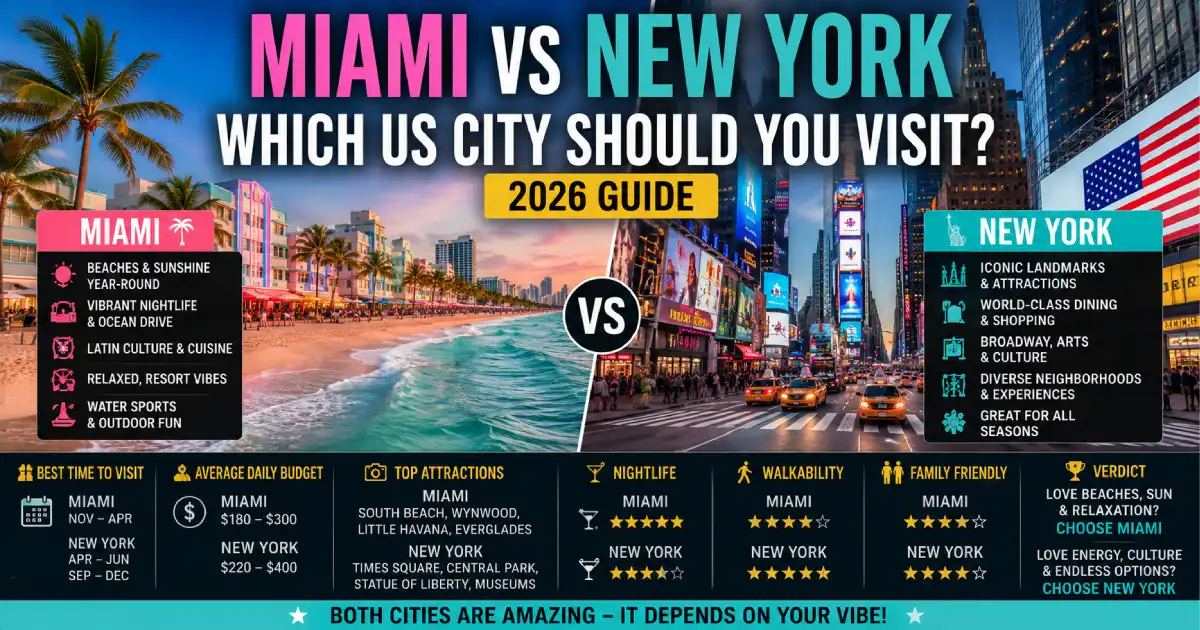
Miami and New York are the two most searched American city destinations by international visitors from Tier 1 markets — UK, Canada, and Australia — and for the most specific of reasons: both cities carry a global recognition that precedes any individual traveler’s first visit, both represent something specifically American that is available nowhere else on earth (Miami’s Latin Caribbean-American fusion culture; New York’s density of human ambition and cultural production per square mile), and both are genuinely extraordinary cities that reward serious exploration in ways that their tourist-corridor reputations consistently undersell. Miami is the most Latin, the most sun-drenched, the most beach-and-nightlife-forward, and the most Art Basel-adjacent major American city — a subtropical city of 2.7 million metropolitan residents built on Biscayne Bay and the Atlantic coast that has been simultaneously a Cuban exile capital, a cocaine-era crime story, a fashion industry hub, and America’s most genuinely international city in ways that New York’s diversity, for all its genuine cosmopolitanism, does not quite replicate. New York is the most culturally productive, the most architecturally dense, the most theater-and-museum-rich, and the most specifically urban of any American city — 8.3 million people in 302 square miles producing the most concentrated cultural output of any city in the Western Hemisphere, with the most consequential art museums, the most significant theater district, the most influential food scene, and the most specifically extraordinary skyline accessible anywhere in the United States.
Choosing between them for a first or second American city visit is the most consequential US city planning decision available to international travelers — because the two cities are genuinely different in climate, character, beach access, cultural depth, cost structure, and the specific experience of being in each city. This guide breaks down every meaningful category honestly and delivers the clearest verdict for the UK, Canadian, and Australian traveler choosing between America’s two most globally recognized city destinations in 2026.
For more US city comparisons, see our Dallas vs Houston and Dallas vs Austin guides.
The Most Important Facts First
Key Fact
🌴 Miami
🗽 New York
Population (Metro)
2.7 million
20 million
Climate
Subtropical — warm year-round; hot and humid June–September
Four seasons — cold winters (20–35°F), hot summers (80–90°F)
Beach Access
World-class — South Beach, Miami Beach, Key Biscayne
Coney Island (accessible); not a beach destination
Essential for beach + Latin culture; less “American iconic”
The most “must-see first USA city” — Statue of Liberty, Broadway, Central Park
🗽 New York
Miami vs New York: City Character
Miami — The Most Latin, Subtropical, and Visually Spectacular American City
Miami is the most genuinely international American city that is not New York — a subtropical city on Biscayne Bay whose cultural identity is the most specifically Latin Caribbean-American of any US metropolitan area: Spanish is spoken more widely than English in many Miami neighborhoods (Little Havana, Hialeah, Westchester), the Cuban exile community has shaped the city’s politics and food culture since 1959, and the more recent arrivals from Venezuela, Colombia, Nicaragua, and Brazil have added further Latin American layers to a city that is simultaneously an American financial capital, the Caribbean’s most important regional hub, and the most specifically photographed beach city in the United States. The Art Deco Historic District of South Beach — 960 buildings from the 1920s–1940s in pastel colors along Ocean Drive and Collins Avenue, the most intact and the most visually specific concentration of Art Deco architecture accessible in the world — produces the most cinematically extraordinary beach-city streetscape in America. The Wynwood Walls street art district, the Design District’s luxury retail and contemporary art galleries, and the Brickell financial district’s glass towers collectively present a city that is in simultaneous conversation with its Cuban exile heritage, its Latin American present, its global art market ambitions, and its subtropical beach identity in a way that no other American city quite replicates.
Miami is best for: Beach vacation combined with urban culture, Latin food and music immersion, winter sun escapes from cold-weather origins (UK, Canada), nightlife in the most globally recognized US club scene, Art Basel in December, Everglades access, and the most specifically subtropical and the most Latin-American-influenced US city experience.
New York — The Most Culturally Productive City in the Western Hemisphere
New York is the most culturally consequential and the most specifically urban city in the United States — a city of 8.3 million in 302 square miles that produces more significant theater, more significant visual art, more significant restaurant openings, more significant fashion, and more significant financial and media influence per square mile than any other city in the Americas. The specific superlatives that are genuinely accurate rather than merely promotional: the Metropolitan Museum of Art (the largest art museum in the Western Hemisphere and the most comprehensive single art institution in the world by collection breadth), Broadway (the most commercially significant and the most artistically demanding theater district in the English-speaking world, with 41 professional theaters producing the most consistently ambitious English-language theater accessible anywhere), Central Park (the most influential urban park design in American history and the most visited urban park in the United States at 42 million annual visitors), and the New York City subway system (the oldest and the most extensive subway network in the Americas, operating 24 hours per day 365 days per year — the most specifically enabling urban transit infrastructure accessible in any American city).
New York is best for: First-time USA visitors from international markets (the most iconic American city experience), museum and theater culture, the most diverse food city in the world, the most walkable major US city experience without a car, Brooklyn’s creative neighborhoods, and the most specifically “New York” urban energy that has been the subject of more films, novels, songs, and cultural references than any other city in American history.
Miami vs New York: Weather (The Most Decisive Factor for Many International Visitors)
For UK, Canadian, and Australian visitors — the Tier 1 markets most likely to be comparing Miami and New York — the weather difference between the two cities is the most practically consequential single factor in seasonal trip planning.
Miami Weather — Subtropical Year-Round
Miami’s subtropical climate produces the most consistently warm and the most specifically sun-guaranteed US city weather accessible in the Atlantic corridor — the November through April dry season (Miami’s peak tourist season for good reason) delivers 75–82°F daytime temperatures, low humidity, virtually no rain, and the specific perfect-beach-day combination that makes Miami the most popular US winter escape destination for visitors from cold-weather origins. December and January in Miami are genuinely extraordinary months — the driest and the most reliably beautiful weather accessible in any major American city, with afternoon temperatures of 75–78°F and the Atlantic water at 73–75°F (the most swimmable winter Atlantic water accessible without leaving the continental US).
Miami’s limitation: June through September is the most oppressively humid and the most hurricane-prone season — afternoon temperatures of 88–94°F with 80%+ humidity and daily afternoon thunderstorms make outdoor activity genuinely uncomfortable for sustained periods. The honest summer Miami assessment: the beach is beautiful but the heat is genuinely oppressive; indoor activities (museums, restaurants, nightclubs) dominate the itinerary by necessity.
New York Weather — Four Seasons at Their Most Specific
New York’s four seasons are the most specifically and the most dramatically differentiated of any major US city — the difference between a February morning (18°F, wind chill below zero, every New Yorker in the most specifically armored winter outerwear available) and a May afternoon (68°F, Central Park blooming, outdoor restaurant tables at capacity, the Hudson River glittering in the spring light) is the most extreme seasonal swing accessible in any US city that is not in the Northern Plains. The specific seasonal New York experiences:
Fall (September–November): The most celebrated New York season — Central Park’s foliage (the most visited urban fall foliage display in the United States), the most comfortable temperatures of the year (55–72°F), the most active theater and cultural season, and the most specifically “movie New York” atmospheric quality that has been the subject of more cultural romanticization than any other US city season. The most recommended New York season for first-time international visitors.
Spring (April–June): The second-finest New York season — the city emerging from winter produces the most socially energized and the most outdoor-activity-embracing urban population accessible in any American city; cherry blossoms in Central Park and Brooklyn Botanic Garden, the most outdoor dining of any New York season, and the most reliably pleasant temperatures (55–75°F) accessible without summer’s humidity.
Winter (December–February): The most dramatically atmospheric and the most challenging — Christmas in New York (the Rockefeller Center tree, the Fifth Avenue window displays, the Bryant Park holiday market, and the specific December energy that no other US city’s holiday season replicates) is the single most culturally specific seasonal event in any American city, and genuinely worth the 25°F temperatures for the visitor who dresses correctly and accepts the cold as part of the experience rather than a problem to be avoided.
Summer (June–August): The most outdoor-activity-rich and the most acoustically vibrant — free Shakespeare in Central Park (SummerStage productions, the most prestigious free outdoor theater in the US), the Governors Island ferry and art installations, the Coney Island boardwalk at full operation, and the most festive street culture accessible in any New York season — but with 85–92°F temperatures and humidity that makes the subway platforms the most specifically uncomfortable 90 seconds of any New York summer day.
Weather verdict: Miami wins for winter visits; New York wins for fall and spring. The UK, Canadian, and Australian visitor choosing between the two cities in December or January should choose Miami without hesitation — 78°F vs 28°F is not a preference comparison. The visitor choosing between them in September or October should strongly consider New York — the fall foliage season and the specific September-October New York energy are unavailable at any comparable quality in Miami’s more seasonally monotonous subtropical climate.
Miami vs New York: Beaches
This is the most asymmetric category in the entire comparison — Miami wins unconditionally and New York has no meaningful response.
Miami’s Beaches — South Beach and the Atlantic Coast
South Beach — the barrier island beach of Miami Beach, running 10 miles along the Atlantic coast with the Art Deco Historic District as its urban backdrop — is the most globally recognized and the most culturally specific urban beach in the United States. The specific South Beach experience: white sand, warm Atlantic water (73–82°F year-round), the Art Deco hotel facades in pastel colors visible behind the beach’s lifeguard stands, the Ocean Drive restaurant terrace facing the beach promenade, and the specific parade of bodies and fashions and languages that makes South Beach the most specifically cinematic beach scene accessible in any American city. The beach is wide, well-maintained, and free to access — the Art Deco backdrop produces the most architecturally specific beach photography accessible in the continental US.
Beyond South Beach: Key Biscayne (the most ecologically pristine urban-adjacent beach in Miami, accessible by causeway, with the most natural dune system visible from any Miami-area beach), Haulover Beach (the only clothing-optional public beach in Miami-Dade County, the most diverse-community beach accessible in the metro area), and the Venetian Pool in Coral Gables (the most architecturally extraordinary freshwater swimming pool in the United States — a 1923 coral rock quarry pool fed by artesian wells, the most specific and the most historically distinguished swimming facility accessible within Miami city limits).
New York’s Beaches — Coney Island and the Outer Boroughs
New York is not a beach city in any meaningful sense — Coney Island’s beach in Brooklyn (the most accessible ocean beach from Manhattan, 45 minutes by subway) is a wide, Atlantic-facing beach with cold water (the Atlantic off New York reaches 70°F only in July and August), the most specifically nostalgic and the most culturally embedded amusement park boardwalk in the US (Nathan’s Famous hot dogs, the Wonder Wheel, the Cyclone roller coaster), and the most specifically Brooklyn-in-August atmosphere accessible at any American beach. It is genuinely worth the subway trip for the boardwalk culture, the Nathan’s hot dog, and the Wonder Wheel. It is not South Beach and does not pretend to be.
The Rockaways, Fire Island (accessible by ferry from Bay Shore, Long Island), and the Hamptons (2–3 hours from Manhattan) are the most serious beach options accessible from New York — all require either a long transit commute or a specific day-trip commitment that makes them supplementary rather than primary New York attractions.
Beach verdict: Miami wins unconditionally. South Beach vs Coney Island is not a fair comparison and New York would not claim otherwise.
Miami vs New York: Food
Miami Food — Latin Diversity and the Finest Cuban Cuisine in America
Miami’s food identity is the most specifically Latin and the most genuinely Caribbean-influenced of any US city — a food culture built on Cuban exile cooking (the most historically specific and the most technically refined Cuban cuisine accessible outside Cuba), Colombian arepas and bandeja paisa, Venezuelan pabellón criollo, Peruvian ceviche in the most specifically Nobu-adjacent Peruvian-Japanese fusion tradition, Haitian griot and pikliz, and the most complete and the most competitive all-day Cuban breakfast café culture (the ventanita — the walk-up window serving coladas, pastelitos, and Cuban toast with the most specific pre-work Miami character accessible at any price) accessible in any American city.
Versailles Restaurant (Little Havana): The most historically specific and the most culturally embedded Cuban restaurant in the United States — the Cuban exile community’s political and social living room since 1971, where every significant Cuban-American political development since the Mariel boatlift has been discussed over Cuban coffee and black beans ($18–$28/person). The most specifically Miami dining experience accessible at any table in the city.
Calle Ocho (8th Street, Little Havana): The most culturally specific food corridor in Miami — the walk-up colada windows, the domino parks, the bakeries producing the most specifically Cuban pastry accessible in any US city outside of Miami’s Cuban community.
José Andrés restaurants (Miami Beach): The most nationally recognized fine dining accessible in Miami — the James Beard Award-winning chef’s Miami properties represent the most ambitions single-chef restaurant presence in the city.
Wynwood food scene: The most rapidly evolving and the most Instagram-specific food corridor in Miami — the street art district’s restaurant density has expanded alongside the gallery scene to produce the most creative casual dining accessible in any Miami neighborhood.
New York Food — The Most Diverse Food City in the World
New York’s food scene is the most internationally diverse and the most collectively ambitious of any city in the United States — the most genuinely accurate single food-related superlative available to any American city. The specific New York food advantages over Miami:
The bagel: The New York bagel (water-boiled, high-gluten flour, specific New York City tap water mineral content that the most devoted bagel scientists credit for the specific chew) is the most specifically New York single food product — Absolute Bagels on the Upper West Side, Russ & Daughters on the Lower East Side, and Ess-a-Bagel in Midtown produce the most consistently excellent examples of the single most New York food accessible at any price.
The New York slice: The $3–$4 cheese pizza slice from a New York street-facing pizzeria — the most specifically affordable and the most culturally embedded single meal accessible in any American city, available at 3 AM from the most reliable late-night food vendor in the city’s entire food landscape.
Chinatown (Manhattan and Flushing, Queens): The most diverse Chinese food accessible in any American city — the Manhattan Chinatown’s Cantonese dim sum and the Flushing Queens corridor’s Sichuan, Shanghainese, and hand-pulled noodle specialists collectively produce the most regionally diverse Chinese food landscape outside of China accessible in the United States.
The Michelin-starred tier: New York has more Michelin-starred restaurants than any US city — the concentration of James Beard Award winners, New York Times 4-star restaurants, and the most nationally discussed restaurant openings of any American city make New York’s fine dining landscape the most nationally and the most internationally recognized in the country.
The Halal cart: The Halal Guys at 53rd and 6th Avenue (the most celebrated single street food cart in the United States) — the white rice and chicken or gyro plate ($8–$10) with the white sauce and the hot sauce is the single most specifically New York street food accessible at the most specifically New York price.
Food verdict: New York wins on overall diversity and global range; Miami wins on Latin-specific and Cuban cuisine depth. The visitor who wants the most internationally diverse food city in the world: New York. The visitor who wants the most specifically Cuban, Colombian, and Caribbean Latin food accessible in any US city: Miami’s Little Havana and the Calle Ocho ventanitas.
Miami vs New York: Museums, Arts & Culture
Miami Arts — Art Basel, Wynwood, and the Pérez
Miami’s arts scene is the most rapidly growing and the most globally connected of any American city outside New York — driven by Art Basel Miami Beach (December, the most commercially significant contemporary art fair accessible in the Americas, held at the Miami Beach Convention Center with satellite fairs, pop-up galleries, and the most globally attended art week of any US city), the Pérez Art Museum Miami (PAMM — the most architecturally distinguished museum in Miami, designed by Herzog & de Meuron on Biscayne Bay, the most comprehensive collection of contemporary art accessible in Florida), and the Wynwood Walls (the most photographed outdoor street art destination in the United States — the curated murals produced by the most internationally celebrated street artists accessible in any US neighborhood, free to view from the street).
Art Basel Miami Beach (first week of December, 2026 dates: December 4–7) is the single most compelling reason to visit Miami in any specific month — the galleries, the satellite fairs (Art Miami, NADA, Untitled Art Fair, Scope Miami), the hotel art installations, and the specific global art world energy that descends on Miami Beach for one week per year make it the most culturally extraordinary week accessible in any US city outside of New York’s more distributed cultural calendar.
New York Arts — The Most Museum-Rich City in the Western Hemisphere
New York’s museum landscape is the most comprehensive and the most globally significant in the Americas — the specific institutions that make New York the most culturally indispensable US city for any arts-focused international visitor:
The Metropolitan Museum of Art (the Met): The largest art museum in the Western Hemisphere — 5,000 years of human artistic production across 17 curatorial departments in a Fifth Avenue building of 2 million square feet; the most comprehensive single art institution in the Americas and genuinely one of the 5 most important art museums in the world. Suggested admission $30/adult; free for NYC residents. The single building that most justifies a New York museum day.
Museum of Modern Art (MoMA): The most influential single museum in the history of modern art — the permanent collection (Van Gogh’s Starry Night, Picasso’s Les Demoiselles d’Avignon, Warhol’s Campbell’s Soup Cans, Monet’s Water Lilies) constitutes the most consequential 20th-century art collection accessible in any single building in the world. $30/adult; free Friday evenings 5:30–9 PM.
The Guggenheim: Frank Lloyd Wright’s 1959 spiral museum building on Fifth Avenue — the most architecturally specific museum building in New York and the most photographed museum exterior in the United States; the rotating exhibitions are consistently the most adventurously curated accessible at any New York museum. $30/adult.
The Whitney Museum of American Art: The most specifically American art-focused major museum in New York — Renzo Piano’s Meatpacking District building with the most complete collection of 20th and 21st century American art accessible in the United States. $25/adult; pay-what-you-wish Friday evenings.
Brooklyn Museum: The second-largest art museum in New York (and in the US) — the most accessible from Brooklyn’s most visited neighborhoods and the most community-integrated major museum in the city, with the most significant Egyptian art collection outside of Cairo.
Arts verdict: New York wins decisively on museums; Miami wins on Art Basel week specifically. The Met alone — with its 5,000 years of human art in a single building — is the most compelling single arts argument for New York over any American city outside Chicago and Washington DC. Miami’s Wynwood Walls and Art Basel are genuinely excellent; they are not the Met.
Miami vs New York: Nightlife
Miami Nightlife — The Most Famous Club Scene in America
Miami’s nightlife is the most globally recognized and the most specifically celebrity-and-DJ-forward club scene in the United States — LIV at the Fontainebleau Hotel (the most commercially successful nightclub in the United States by revenue, with the most consistently internationally celebrated DJ booking roster accessible at any American venue), E11EVEN Miami (the most uniquely 24-hour and the most production-heavy nightclub format accessible in Miami, with live circus performers, pole artists, and a Cirque du Soleil-adjacent visual production), and Komodo’s rooftop (the most scenically positioned and the most specifically Miami skyline-view nightlife experience in Brickell) collectively produce the most internationally recognized club-format nightlife accessible in any American city.
The honest Miami nightlife assessment: the South Beach and Brickell club scenes are genuinely world-class at the production and the celebrity-adjacency tier, and the specific Miami club energy (the Latin-influenced music programming, the international crowd composition, and the subtropical outdoor components) is the most distinctively Miami and the least replicable-elsewhere nightlife experience in the US. It is also the most expensive American nightlife — table service at LIV starts at $2,000–$5,000+ minimums, and the general admission queues produce the most specifically power-hierarchy-conscious velvet rope culture accessible in any American city.
New York Nightlife — The Most Diverse and the Most Culturally Layered
New York’s nightlife is the most diverse and the most culturally layered of any American city — not because any single New York venue matches LIV’s production scale or the Fontainebleau’s celebrity roster, but because the range of New York nightlife experiences (the jazz clubs of the West Village, the indie music venues of Williamsburg, the underground dance music scene of Brooklyn’s clubs, the comedy clubs of the West Side, the piano bars of Hell’s Kitchen, the rooftop bars of Midtown, and the after-hours culture of the most specifically nocturnal American city) is the most genuinely diverse nightlife landscape accessible in any US city at any time.
The specific New York nightlife institutions: the Blue Note Jazz Club (the most historically significant jazz venue in the United States, with the most consistently celebrated jazz booking accessible in any American club), the Comedy Cellar (the most legendary comedy club in the US — the venue that launched Jerry Seinfeld, Dave Chappelle, Louis CK, and the most specifically influential comedians of the last 30 years), and the Brooklyn club scene (Output, Nowadays, Elsewhere — the most internationally respected underground dance music venues in the United States, comparable to Berlin’s most celebrated club culture in their DJ booking ambition and their dancefloor community) collectively produce the most range-complete nightlife accessible in any American city.
Nightlife verdict: Miami wins for the club-format, celebrity-adjacency, and production-scale nightlife; New York wins for overall diversity, cultural range, and the most specific jazz and comedy club traditions accessible in any American city.
Miami vs New York: Iconic Landmarks & Attractions
Miami’s Most Essential Experiences
South Beach Ocean Drive at sunrise: The most cinematically specific street in Miami — the Art Deco facades in early morning light before the tourist traffic, with the Atlantic visible at the street’s end, is the most specifically Miami visual experience accessible at no cost at any hour
Wynwood Walls: The most photographed outdoor art installation in the United States — the curated mural complex in the Wynwood Arts District, free to view from the street, the most specifically Miami contemporary art experience accessible without museum admission
Little Havana (Calle Ocho): The most specifically Cuban-exile cultural immersion accessible in the United States — the domino park at Maximo Gomez Park (where the city’s elder Cuban exile community plays dominoes publicly every afternoon), the ventanita Cuban coffee windows, and the walk-up colada culture are the most irreplaceable Miami experiences for the visitor who goes beyond South Beach
Everglades National Park (40 miles): The most ecologically extraordinary US national park accessible as a day trip from any major American city — the airboat tours ($45–$65/person at the Big Cypress Gateway, not inside the park), the alligator viewing from the Anhinga Trail (the most accessible large-wildlife viewing in any US national park), and the specific subtropical wilderness of the largest subtropical wilderness in the United States
The Florida Keys (Key Largo 1 hour; Key West 3.5 hours): The most tropical and the most specifically Floridian day trip or overnight accessible from Miami — the John Pennekamp Coral Reef State Park (the most accessible snorkeling in the continental US), the Overseas Highway (the most dramatically sea-surrounded drive on the continental US road network), and Key West’s Duval Street and Hemingway House
New York’s Most Essential Experiences
Statue of Liberty and Ellis Island: The most globally recognized American landmark — the ferry from Battery Park ($24/adult, includes Ellis Island) delivers the most emotionally specific and the most historically weighted American icon accessible to any international visitor. The Ellis Island immigration museum is the most personally resonant American history museum for the most people — the records of 12 million immigrants who passed through between 1892 and 1954 are searchable online and include the ancestors of 40% of the current American population.
Central Park: The most influential urban park design in American history — 843 acres in the center of Manhattan, free always; the Bethesda Fountain, the Bow Bridge, the Great Lawn, Strawberry Fields, and the Conservatory Garden produce the most specific “New York in the movies” visual recognition accessible at any park in the United States
The High Line: The most influential urban park repurposing project in American history — the 1.45-mile elevated park on the former West Side elevated railway (opened 2009, the most awarded urban design project of the 21st century), free always, with the most specific Hudson River and Midtown skyline views accessible from any ground-level park in Manhattan
Brooklyn Bridge walk: The most specifically New York single free experience — the 1.3-mile walk across the 1883 suspension bridge, the most photographed bridge in the United States, with the lower Manhattan skyline visible from the bridge’s center span in the most specifically cinematically New York composition accessible at no cost
A Broadway show: The most culturally specific New York evening experience — 41 Broadway theaters producing the most ambitious English-language theater in the world; TKTS booth in Times Square for same-day discount tickets (25–50% off) on most shows; the Hamilton lottery ($10 digital lottery, available daily) for the most in-demand single show tickets accessible in any New York theater
Miami vs New York: Day Trips
Miami Day Trips
Everglades National Park (40 miles south, 45 minutes): The most ecologically unique US national park accessible as a day trip from any American city — alligator viewing on the Anhinga Trail (the most reliable large-wildlife viewing in any national park), the Shark Valley observation tower bicycle loop (the most productive alligator-per-mile landscape accessible at any US national park), and the airboat tours from the private operators on US-41 (Tamiami Trail) that access the river of grass ecosystem in the most dramatically visceral format
Florida Keys — Key Largo (1 hour): The John Pennekamp Coral Reef State Park’s glass-bottom boat tours and snorkel trips to the only living coral reef accessible in the continental United States — the most specifically and the most immediately accessible tropical reef snorkeling from any major American city
Palm Beach (1 hour north): The most specifically wealthy and the most Gilded Age-preserved American resort town — Worth Avenue’s luxury retail, the Breakers Hotel (the most elaborately maintained grand resort hotel on the US East Coast), and the Norton Museum of Art produce the most specifically Palm Beach day trip accessible from Miami
New York Day Trips
Hudson Valley (1.5–2 hours north): The most historically significant American landscape painting region — Dia:Beacon (the most impressive single-building contemporary art museum in the US Northeast, in a 1929 Nabisco box-printing factory on the Hudson River), the Catskill Mountains, and the most dramatic fall foliage accessible within 2 hours of Manhattan
Philadelphia (1.5 hours by Amtrak): The most historically specific American founding-era city — Independence Hall, the Liberty Bell, the Barnes Foundation (the most eccentric and the most specifically private-collection-to-public institution art museum in the US), and the Reading Terminal Market (the most complete American covered food market accessible within 2 Amtrak hours of New York)
Niagara Falls (6.5 hours by train or bus): The most visited natural attraction in North America — accessible from New York by Amtrak to Buffalo or by direct bus; the most dramatically scaled waterfall accessible from any US East Coast city as a day trip or overnight
Met $30 (suggested); MoMA $30; High Line free; Brooklyn Bridge free
🌴 Miami (more free landmarks)
Transit Cost (per day)
Uber/Lyft-dependent: $20–$45/day
NYC subway $2.90/ride; 7-day unlimited $34; most efficient
🗽 New York (subway vs Uber)
Broadway Show
Not available
$80–$350 (full price); $50–$150 (TKTS discount)
🗽 New York (has it)
7-Day Total (per person, midrange)
~$2,200–$3,400
~$2,800–$4,500
🌴 Miami (20–25% cheaper)
Cost verdict: Miami is 20–25% cheaper overall — the hotel differential ($100–$200/night less in Miami’s midrange vs Manhattan’s midrange) is the most consequential single cost factor, and over a 7-night stay represents $700–$1,400 in accommodation savings alone. New York’s subway system partially offsets the hotel premium through the elimination of the Uber/Lyft dependency that makes Miami’s transportation costs higher per day. Overall, Miami is the more affordable of the two major US East Coast city destinations for the budget-conscious Tier 1 international traveler.
Who Should Visit Miami?
Choose Miami if you:
Want beach access as a primary trip component — South Beach is the most globally recognized and the most architecturally specific urban beach in America, warm year-round, and free to access
Are visiting in winter (December–April) and want guaranteed warm weather — Miami’s dry season delivers 75–82°F perfection when London, Toronto, and Sydney are cold
Want the most Latin and the most Caribbean-influenced American city experience — Little Havana’s Versailles Restaurant, the Calle Ocho ventanitas, and the functionally bilingual Spanish-English city character are unavailable in any other US city at Miami’s scale
Are visiting for Art Basel Miami Beach (December) — the most commercially significant contemporary art week in the Americas, concentrated in Miami Beach for one week per year
Want Everglades access — the most ecologically extraordinary US national park accessible as a day trip from any major American city
Are on a tighter budget — Miami hotels run $100–$200/night less than comparable Manhattan properties; South Beach and Wynwood are walkable; Little Havana is the most affordable quality dining in any Miami neighborhood
Want the most internationally celebrated club nightlife in the United States — LIV at the Fontainebleau is genuinely the most commercially successful nightclub in America
Who Should Visit New York?
Choose New York if you:
Are making your first major US city visit from the UK, Canada, or Australia — New York is the most iconic, the most culturally consequential, and the most specifically American city experience accessible in the country; the Statue of Liberty, Broadway, Central Park, and the Brooklyn Bridge are the most universally recognized American cultural symbols and all are accessible from the same city
Want the most museum-rich single city in the Americas — the Met, MoMA, the Guggenheim, and the Whitney collectively constitute the most significant single-city art museum concentration in the Western Hemisphere
Want Broadway — the most significant English-language theater district in the world; nothing in Miami approximates the Hamilton lottery, the TKTS booth, or a Friday night in the Shubert Theatre
Want the most walkable major American city — the NYC subway’s 24-hour operation, $2.90 per ride, covering all five boroughs, is the most enabling urban transit accessible in any American city; no car, no Uber dependency required
Are visiting in fall (September–November) — Central Park’s foliage, the most active theater and cultural season, and the most specifically beautiful New York atmospheric conditions are concentrated in the fall
Want the most diverse food city in the world — the Chinatown dim sum, the Halal cart, the New York pizza slice, the Lower East Side Jewish deli, and the most Michelin-starred restaurant concentration in the country are all within subway reach of any Manhattan hotel
Are combining with other East Coast cities — New York is the most logistically central East Coast hub for Amtrak connections to Boston (3.5 hours), Philadelphia (1.5 hours), and Washington DC (2.5 hours)
Can You Visit Both Miami and New York?
Yes — and for the international visitor with 10–14 days in the United States, combining New York and Miami produces the most complete East Coast American city experience accessible in a single trip. The routing is simple and efficient:
10-day combination: New York 6 days (arrive JFK, subway to Manhattan hotel, Central Park, Met, MoMA, Brooklyn Bridge walk, High Line, Broadway show, Staten Island Ferry, Queens food tour) → fly or Amtrak to Miami ($80–$150 flight, 3 hours; or Amtrak Silver Star, 27 hours, $95–$180 — the most scenic coastal train journey accessible on the US East Coast) → Miami 4 days (South Beach, Wynwood, Little Havana, Everglades day trip)
Routing direction: Fly into JFK (New York) and out of MIA (Miami) — the open-jaw routing eliminates backtracking and is the most efficient single-ticket international routing for the 10-day East Coast combination from London, Toronto, or Sydney
The Amtrak option: The Amtrak Silver Star (New York Penn Station → Miami, 27 hours, scenic coastal route through Philadelphia, DC, Savannah, and Jacksonville) is the most specifically atmospheric and the most historically resonant way to connect the two cities — the overnight train arrives in Miami’s downtown station with the Biscayne Bay visible from the platform. Not the fastest option; genuinely the most romantically specific.
Miami vs New York: Practical Tips
Topic
🌴 Miami
🗽 New York
Best Time to Visit
November–April (dry season, perfect weather); December for Art Basel
September–November (best weather, fall foliage); April–June (spring bloom); December (Christmas, accept the cold)
January–February (coldest months; manageable with correct clothing but challenging for outdoor sightseeing)
Best Area to Stay
South Beach (beach access, Art Deco walkability, $175–$320/night); Brickell (business/nightlife, more affordable, $140–$240/night); Wynwood (arts district, most locally specific, $130–$220/night)
Midtown Manhattan (most central, most expensive); Upper West Side (Central Park access, slightly less expensive); Williamsburg Brooklyn (most affordable with great subway access, most creative neighborhood character)
Don’t Miss
Little Havana Sunday (domino park + Versailles + Calle Ocho ventanita colada); Wynwood Walls at sunset (free street view); Everglades Anhinga Trail (free, 40 min drive)
Staten Island Ferry at sunset (free, best Statue of Liberty view); TKTS booth same-day Broadway tickets; Met on a Friday evening (suggested admission — give less if budget-conscious)
Free Highlights
South Beach walk (free), Wynwood Walls street view (free), Little Havana walk (free), South Pointe Park (free), Brickell City Centre skyway walk (free)
Central Park (free), High Line (free), Brooklyn Bridge walk (free), Staten Island Ferry (free), Times Square walk (free), Grand Central Terminal interior (free)
Getting Around
Uber/Lyft essential for most Miami (car-dependent city); free Metromover in downtown Brickell core; South Beach walkable on foot or bicycle rental ($24/day Citi Bike)
NYC subway $2.90/ride, 7-day unlimited $34 — the only US city where a car is genuinely counterproductive; walking is the primary mode for most Manhattan activities
Tipping
20% standard; 22–25% at South Beach restaurants where service charge sometimes already added — check the bill; $1–$2 at the ventanita Cuban coffee window is customary
20% standard; 22–25% at fine dining; $1/item at bar (cash tip at bar is the most specifically New York bar culture standard); Halal cart: $1–$2 tip is customary; TKTS booth: no tip (it is a ticket booth)
Frequently Asked Questions: Miami vs New York
Should I visit Miami or New York first?
New York first — for the international visitor making their first major US city trip from the UK, Canada, or Australia. New York is the most iconic, the most culturally consequential, and the most specifically “American” city experience accessible in the country; the Statue of Liberty, Broadway, Central Park, and the Brooklyn Bridge are the most universally recognized American cultural symbols and all require New York specifically. Miami is the more relaxing and the more beach-forward follow-up city that rewards the visitor who has already processed the New York urban intensity and wants the subtropical sunshine and the Latin cultural immersion that the city delivers. The most efficient single US trip from London: fly into JFK (New York 6 days), fly New York to Miami (Miami 4 days), fly home from MIA. The open-jaw routing is the most logistically efficient and the most experientially complementary single US trip available to international travelers.
Is Miami or New York more expensive?
New York is more expensive — Manhattan hotel rates ($225–$420/night midrange) run $100–$200/night higher than comparable Miami properties, and the cumulative 7-night hotel cost difference ($700–$1,400) is the most consequential single budget factor in the comparison. Miami’s restaurant costs are comparable to New York’s at the casual and midrange tiers; Miami’s nightlife (South Beach club table service) is dramatically more expensive than New York’s at the highest tier. The transit comparison favors New York — the $34/week unlimited subway pass eliminates the $20–$45/day Uber dependency that makes Miami’s transportation costs the most significant single Miami budget disadvantage. Overall: New York is approximately 20–25% more expensive than Miami per 7-day trip from the East Coast market, driven primarily by the hotel differential.
Is Miami safe for tourists?
Miami is safe for tourists in the well-trafficked tourist areas — South Beach, Wynwood, the Design District, Brickell, Coral Gables, and Coconut Grove are all safe and well-policed for standard tourist activity. Miami has neighborhoods with elevated crime rates (Liberty City, Overtown, parts of Little Haiti) that tourists do not typically visit. Apply standard urban travel situational awareness: use rideshare at night between neighborhoods, keep possessions secure in crowded beach areas, and avoid unfamiliar areas after midnight without a specific destination and plan. The most specific Miami tourist safety note: South Beach beach theft is the most common tourist crime — do not leave valuables unattended on the beach; use the free locker facilities at the bathhouses or take valuables to the water in a waterproof pouch.
Which is better for a first-time USA visitor from the UK?
New York is the better first USA visit for UK travelers — the most direct flight from London (7 hours to JFK vs 9.5 hours to MIA), the most culturally iconic American city experience (the Statue of Liberty, Broadway, Central Park, the Met — the places that most UK visitors have seen in American films their entire lives before arriving), and the most walkable major US city (the NYC subway eliminates the car dependency that makes Miami challenging without a vehicle) collectively make New York the most efficient and the most rewarding single-city first USA visit for UK travelers. Miami is the more appropriate second or third US city visit — once the New York foundation is established, Miami’s Latin Caribbean culture, South Beach, and the Everglades access provide the most specifically different and the most complementary US city experience available on the East Coast. The most honest UK traveler recommendation: New York first, always. Miami second, when the calendar and the budget allow.
Final Verdict: Miami vs New York
Miami and New York are America’s two most globally recognized city destinations — different enough that choosing between them is a genuinely productive US trip planning decision, and both excellent enough that the visitor who makes an informed choice will not be disappointed. The most honest single-sentence verdict:
Choose Miami if you want the most Latin, the most subtropical, the most beach-forward, and the most winter-sun-guaranteed major American city experience — South Beach’s Art Deco ocean backdrop at 78°F in January, Little Havana’s Versailles Restaurant Cuban coffee at the ventanita window, the Wynwood Walls’ internationally commissioned murals in the most rapidly evolving arts neighborhood in the American South, LIV nightclub’s globally recognized DJ roster at the Fontainebleau, and the Everglades airboat 40 miles from the hotel — all in a city that is functionally bilingual, genuinely subtropical, and more specifically Latin Caribbean-American than any other major US city that does not require a passport to enter. Miami is not New York with a beach. It is its own city — the most Latin, the most sun-saturated, and the most specifically Caribbean-adjacent American metropolitan experience accessible without leaving the continental United States — and the visitor who arrives in January from London or Toronto and walks Ocean Drive at 78°F in the golden hour will understand immediately why Miami is, for many international travelers, the most specifically joyful American city experience available at any season.
Choose New York if you want the most culturally consequential, the most architecturally dense, the most museum-rich, the most specifically urban, and the most specifically iconic American city experience accessible in the world — the Statue of Liberty from the free Staten Island Ferry at sunset, the Met’s 5,000 years of human art on a suggested-admission Friday evening, Broadway’s Hamilton lottery for $10, Central Park’s fall foliage on a October Saturday, the $3 pizza slice at 2 AM from the closest open street-facing pizzeria, the Brooklyn Bridge walk with the lower Manhattan skyline framed in the East River mist, and the specific energy of 8.3 million people living at the most concentrated pace of human ambition accessible in any city in the Western Hemisphere. New York is not the most comfortable American city. It is not the warmest. It is not the cheapest. It is the most consequential — the city that has produced more significant cultural output, more meaningful artistic institutions, and more specifically extraordinary human experiences per square mile than any other American city in history. Go to New York. The subway will take you anywhere for $2.90. The bagel at Absolute Bagels costs $2. The Brooklyn Bridge is free at dawn. And the first time you see Manhattan from the Brooklyn Bridge at 7 AM on a clear October morning, you will understand why every American city comparison eventually returns to New York as the standard against which all others are measured.
Both cities are genuinely extraordinary. Miami is the more relaxing. New York is the more consequential. The best American life includes both — and the 3-hour flight between them costs less than a Broadway ticket and is worth considerably more.
—
For the most current visitor information, safety advisories, transit maps, and travel planning resources for Miami and New York, consult these official government sources:
Greater Miami Convention & Visitors Bureau — Official Miami Tourism — Official Miami-Dade County government-supported tourism authority covering hotel listings, event calendars including Art Basel Miami Beach, Wynwood and Little Havana neighborhood guides, Everglades access information, and all current Miami visitor resources.
NYC Tourism + Conventions — Official New York City Tourism — Official New York City government tourism resource covering Manhattan hotel listings, Broadway show information, NYC subway maps and MetroCard purchasing, Central Park events, free attraction listings, and all current New York City visitor resources.
Everglades National Park — National Park Service (Official US Federal Government) — Official NPS resource for Everglades National Park covering current entrance fees, trail conditions, wildlife viewing guidelines, visitor center hours, and all official park access information for the most ecologically extraordinary national park accessible as a day trip from Miami.
—
About Travel TouristerTravel Tourister’s US city specialists have extensively explored both Miami and New York — from Little Havana’s Versailles ventanita and South Beach at golden hour to the Met on a Friday evening and the Brooklyn Bridge at dawn — to provide the most honest and most specific comparison available for UK, Canadian, and Australian travelers choosing between America’s two most globally recognized and most genuinely different major city destinations.Need help planning your Miami or New York trip? Our specialists can help you build the optimal itinerary, choose the right neighborhood to stay in each city, time your Miami visit for Art Basel or dry season, plan the Everglades day trip, book Broadway show TKTS tickets, and identify the best food, culture, and activities for any visit length or travel style.
Posted By : Vinay
As a lead contributor for Travel Tourister, Vinay is dedicated to serving our Tier 1 audience (US, UK, Canada, Australia). His mission is to deliver precise, fact-checked news and actionable, data-driven articles that empower readers to make informed decisions, minimize travel risks, and maximize their adventure without compromising safety or budget.
Travel Tourister is a leading Travel portal where we introduce travellers to trusted travel agents to make their journey hasselfree, memorable And happy. Travel Tourister is a platform where travellers get Tour packages ,Hotel packages deals through trusted travel companies And hoteliers who are working with us across the world. We always try to find new and more travel agents and hoteliers from every nook and corners across the world so that you could compare the deals with different travel agents and hoteliers and book your tour or hotel with the one you have chosen according to your taste and budget.




 Call
Call Enquiry