Published on : 18 Jun 2026
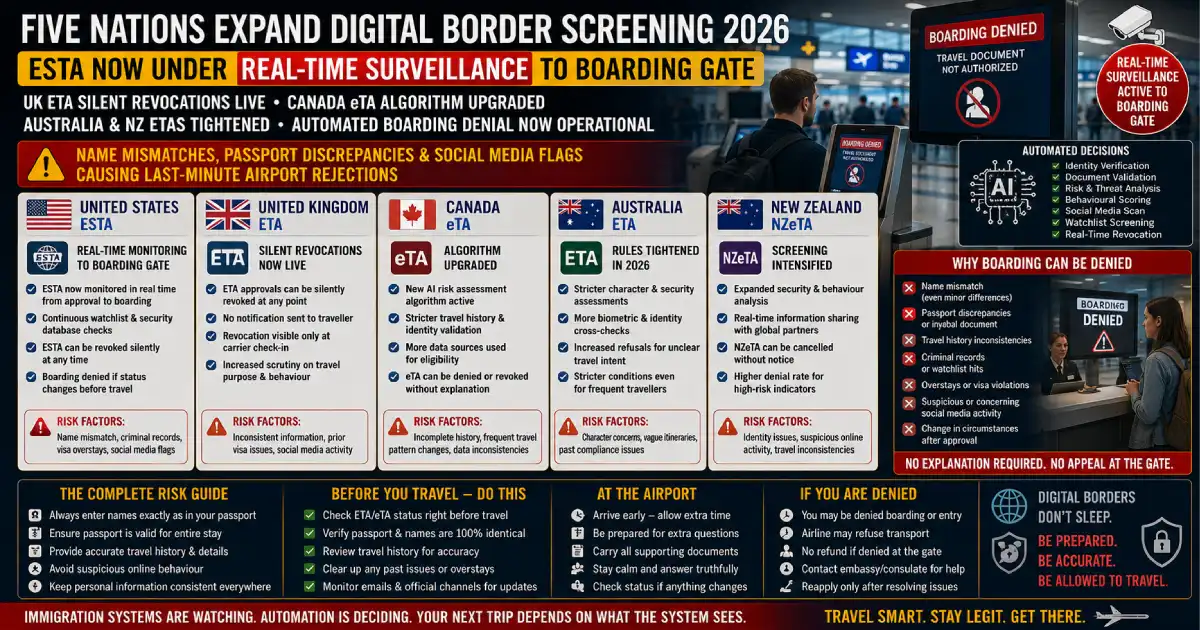
Published: June 18, 2026 Status: FULLY OPERATIONAL — all five systems live as of 2026 Nations covered: United States · United Kingdom · Canada · Australia · New Zealand Five travel authorisation systems affected:
Every one of your readers is affected by what is described in this article. If you are a UK citizen flying to the US on ESTA — your application is now being re-checked against government databases right up until the moment the aircraft door closes. If you are an Australian flying to the UK — your UK ETA can be silently revoked after approval without a notification being sent to you. If you are a Canadian with dual citizenship — your eTA algorithm may flag your routing in a way that triggers a hold the evening before departure. The five nations — the United States, United Kingdom, Canada, Australia and New Zealand — have simultaneously migrated from static, one-time pre-travel screening to continuous, real-time, algorithmically managed digital borders. The gate agent who scans your boarding pass can no longer override a government system flag. The window to fix a digital clearance error at the airport has shrunk to zero. This guide explains every change, every risk category, every nation’s system, and exactly what to do in the next 72 hours if you have an upcoming trip.
For over a decade, travellers from visa-waiver nations understood digital travel authorisations as a one-time administrative process. You submitted your details, paid a fee, received a green light, and the authorisation sat inertly in a government database until your travel date. The approval was static — it did not change unless you actively triggered a change by committing a disqualifying act.
That model is gone. As of 2026, all five nations have migrated to what security agencies describe as a “continuous monitoring” or “living document” framework for digital travel authorisations. Under this framework:
The transition to automated pre-clearance tracking has drastically elevated last-minute boarding risks for specific classifications of global travellers. Business professionals managing multi-leg global itineraries and leisure travellers using separate ticket bookings are uniquely vulnerable to sudden algorithmic flags. The window to correct an algorithmic error at an airport terminal has effectively shrunk to zero. If your electronic clearance is pulled by a government system two hours before your flight due to an unresolved back-end data anomaly, gate agents are completely unauthorised to override the system flag, leaving passengers stranded curbside without immediate legal recourse.
This is not a hypothetical risk. It is the operational reality of international travel in summer 2026.
For over a decade, travellers from visa-waiver nations viewed the Electronic System for Travel Authorization (ESTA) as a simple, procedural bureaucratic formality. Under enhanced travel security mandates, an ESTA is legally defined as a mere permission to board a commercial carrier, not a guaranteed right of entry. Even after receiving an initial approval email, an individual’s profile is subject to continuous background screening against global counter-terrorism, criminal, and public health ledgers right up until the aircraft door seals.
Starting in early 2026, disclosing your social media history is no longer optional — it is a mandatory requirement for all ESTA applicants. Under Executive Order 14161, you must provide the usernames (handles) for all social media platforms you have used in the last five years. US Customs and Border Protection uses this data to screen for potential security risks, inconsistent travel stories, or ties to prohibited groups. Failing to provide this information or providing false handles can result in an immediate ESTA denial.
Platforms covered: Instagram · X (formerly Twitter) · TikTok · Facebook · LinkedIn · YouTube · Snapchat · Reddit · Pinterest · Threads — and any other platform used in the past 5 years. The “not applicable” or “none” option has been effectively retired for most applicants.
What CBP looks for: Inconsistencies between your social media stated history and your ESTA biographical data. Posts indicating travel to restricted countries. Profile content flagged by AI screening algorithms for counter-terrorism indicators. Content inconsistent with your stated purpose of travel.
The practical risk: If your Instagram bio says you are based in a different city than your passport-registered address — even for historical reasons — this discrepancy can trigger a review flag. If you have ever posted content that mentions travel to a country on the restricted list, even years ago, the flag may activate on the continuous monitoring recheck.
New ESTA applications are moving exclusively to the ESTA Mobile App. The legacy website application is being retired. All new ESTA applications must be submitted via the CBP ESTA app, available on iOS and Android. Applications through third-party websites remain valid if the ESTA number was issued, but renewals and new applications require the app from 2026 onwards.
Critical warning: Multiple third-party websites charge fees to “assist” with ESTA applications. The official ESTA app is the only legitimate channel for new applications. The CBP fee is $21 USD. Any website charging more is a third-party intermediary, not an official government portal.
USCIS expanded AI vetting and FBI fingerprint checks as of April 2026, including social media screening for “anti-American” views, automated biometric matching with real-time criminal alerts, and added Department of State database checks. For ESTA travellers specifically, this means the biometric and criminal database checks that previously occurred only at the port of entry now begin at the point of airline check-in — before you board.
A sudden passport data mismatch, an unverified middle name, or a last-minute modification to an airline manifest can automatically trigger a silent suspension of your travel authorisation, culminating in unexpected terminal delays.
“Silent suspension” means your ESTA status changes from Authorisation Approved to Authorisation Pending or Authorisation Denied without any email, text or notification being sent to you. The first you know about it is when your boarding pass scan fails at the gate.
Common triggers for silent suspension:
What to do: Recheck your ESTA status at esta.cbp.dhs.gov within 72 hours of any flight to the US. Do not rely on a previously received approval email — check the live status in the system.
| You should recheck ESTA if: | Risk level |
|---|---|
| Your middle name is in your passport but not your ESTA | 🔴 HIGH — update immediately |
| You renewed your passport since getting ESTA | 🔴 HIGH — must update passport number |
| You changed your name since getting ESTA | 🔴 HIGH — new ESTA required |
| You travelled to Cuba, Iran, Iraq, Syria, North Korea, Sudan, Libya, Somalia or Yemen since 2011 | 🔴 HIGH — ESTA ineligible, need visa |
| Your ESTA is more than 2 years old | 🟠 MEDIUM — check status, may have expired |
| You have a new social media handle since applying | 🟠 MEDIUM — may need to update |
| Your ESTA was approved and nothing has changed | 🟢 LOW — recheck 72 hours before departure |
The UK ETA became mandatory for all visa-waiver nationals — Americans, Canadians, Australians, New Zealanders and citizens of all other eligible non-European countries — from January 8, 2025. The ETA costs £10 and is linked digitally to your passport, valid for two years or until your passport expires.
Since its introduction, the UK ETA system has generated significant disruption. The portal experienced heavy traffic from June 3, 2026 onwards, with queue times exceeding one hour on both the website and mobile app. Beyond the access issues, 2026 has introduced a new risk: silent revocation.
Unlike the original ETA system — which approved applications and maintained that approval until expiry — the 2026 enhanced UK system now conducts continuous background rechecks against UK Home Office, INTERPOL and Five Eyes (UK–US–Canada–Australia–New Zealand) shared intelligence databases.
If a recheck between ETA approval and travel date produces a new flag — a criminal record in any Five Eyes country, a name mismatch between your ETA and your airline booking, a passport data inconsistency — your ETA status can be silently changed to Pending or Revoked. Airlines execute strict, automated document sweeps, escalating last-minute boarding risks and potential terminal rejections for travellers with discrepancies.
Key UK ETA risks in 2026:
Recheck your UK ETA: gov.uk/check-travel-documents or the UK ETA app — within 72 hours of departure.
Canada’s Electronic Travel Authorisation (eTA) — mandatory for all visa-exempt foreign nationals flying to Canada — underwent a significant algorithm upgrade in early 2026. The upgraded system introduces:
Dual-citizenship routing flags: If you transit through a digital-border nation such as the UK or US on a dual-citizen passport combination that doesn’t exactly match your primary ticket booking, the airline’s automated system may isolate your profile for immediate denial of boarding. For Canada specifically, this means: if you are a UK citizen who also holds Canadian citizenship, you should always use your Canadian passport when travelling to Canada — not your UK passport. Using a UK passport to travel to Canada on an eTA when the system has a Canadian citizenship record for you can trigger an eTA denial.
24-hour pre-departure holds: The Canada eTA system can now issue travel holds within 24 hours of departure — a change from the previous system where holds typically came through 48–72 hours before travel. Late-night travellers have reported receiving hold notifications at 02:00 the morning of a 07:00 departure, with no government office open to resolve the issue.
Social media cross-referencing: Canada’s Immigration, Refugees and Citizenship Canada (IRCC) has expanded its use of social media data shared through the Five Eyes intelligence framework with USCIS, the UK Home Office, the Australian Department of Home Affairs and the New Zealand Immigration Service.
Apply at or recheck: canada.ca/en/immigration-refugees-citizenship/services/visit-canada/eta/check-status.html
Australia’s electronic travel permission system — the ETA (for passport holders from certain countries) and the eVisitor (for EU and other eligible nationals) — has been upgraded in 2026 with enhanced biometric cross-matching capabilities shared across the Five Eyes network.
The practical change: when you check in for a flight to Australia, the airline’s automated passenger information system now transmits your passport biometric data to the Australian Department of Home Affairs in real time. The Department’s system cross-references your biometric data against its immigration compliance database — checking for overstays, previous visa breaches, undisclosed criminal convictions, and passport data discrepancies.
Key Australia ETA risks in 2026:
Recheck Australian ETA/eVisitor status: eta.homeaffairs.gov.au or the Australian ETA app.
New Zealand’s Electronic Travel Authorisation (NZeTA) — mandatory for all visa-waiver visitors — now operates under an upgraded Immigration Instructions Compliance Programme (IICP) that shares real-time flag data with Australian and Five Eyes partners.
The NZeTA 2026 upgrade specifically targets:
Character requirement changes: New Zealand’s character requirements for NZeTA eligibility were tightened in 2025–26 to align more closely with Australia’s character provisions. Criminal convictions that previously fell below the NZeTA ineligibility threshold may now require disclosure.
Real-time INTERPOL database checks: NZeTA status is now rechecked against INTERPOL Red Notices and Five Eyes shared intelligence on a continuous basis between approval and departure — not just at the point of original application.
Australian biometric sharing: Travellers who have previously been subject to any New Zealand or Australian immigration enforcement action face a higher recheck frequency in the 2026 system.
Recheck NZeTA status: nzeta.immigration.govt.nz or the NZeTA app.
The single most common cause of digital border flag in 2026 is a middle name discrepancy. Most travellers from the UK, Australia, Canada and New Zealand have middle names in their passports. Most travellers completing ESTA, UK ETA and other digital authorisation applications either omit the middle name or include it differently from their passport record.
The rule: Every name on your digital travel authorisation must exactly match every name in your passport — including middle names, hyphenated surnames, and suffixes (Jr., Sr., III). If your passport reads “James Robert Smith” your ESTA must read “James Robert Smith.” “James Smith” will create a flag.
Action: Check your ESTA, UK ETA, Canada eTA, Australia ETA and NZeTA right now. If your middle name is missing, update your application.
Dual nationals carrying two passports face the highest single risk of algorithmic boarding denial in 2026. The five-nation shared database means that if your two passport identities have been linked — through previous visa applications, border crossings, or biometric matching — the system may generate a flag when the passport you present at check-in does not match the passport number linked to your travel authorisation.
The rule: Always use the same passport for your digital authorisation as for your airline booking and check-in. For travel to Canada: always use your Canadian passport if you have one. For travel to Australia: always use your Australian passport if you have one. For travel to the UK: use the passport under which you have a valid UK ETA.
Business and budget travellers who book multi-leg itineraries on separate tickets — for example, London → Dublin on Ryanair (ticket 1), then Dublin → New York on Aer Lingus (ticket 2) — face a specific algorithmic risk in 2026.
Business professionals managing multi-leg global itineraries and leisure travellers using separate ticket bookings are uniquely vulnerable to sudden algorithmic flags. When your two separate tickets are transmitted to the Advance Passenger Information system as independent bookings, the automated cross-reference may flag a discrepancy between the departure country on your ESTA (UK, if you checked in at London) and your actual embarkation country (Ireland, where the transatlantic flight departs). This routing flag has caused ESTA revocations on the day of travel.
The rule: For US-bound travel involving separate tickets crossing a border, ensure your ESTA matches the passport you will use at every check-in point and call CBP if there is any doubt: +1-877-227-5511 (US from abroad).
Marriage, divorce, and deed poll name changes all create a digital authorisation risk that millions of travellers are unaware of. If you changed your name after obtaining your ESTA, UK ETA or other digital authorisation — even if your new passport has been issued — the name on your travel authorisation may no longer match your passport.
The rule: A name change requires a new travel authorisation application — always. You cannot simply update a name on an existing ESTA or UK ETA. Apply for a new one under your current legal name and current passport details as soon as your name change is legally complete.
Passport renewal is the second most common cause of ESTA-related boarding denial after middle name issues. Your ESTA is linked to a specific passport number. When you renew your passport, your old passport number becomes invalid. If you travel on your new passport but your ESTA is linked to your old passport number:
Result: Your airline’s automated passenger information system transmits your new passport number to USCIS. USCIS has no ESTA linked to that number. You are treated as having no travel authorisation. Boarding denied.
The rule: When you renew your passport, update your ESTA with the new passport number immediately — before you travel. You do not need to pay for a new ESTA if you have a valid one. Go to esta.cbp.dhs.gov → Update your ESTA → add new passport details.
Run through this checklist within 72 hours of any departure to or from the US, UK, Canada, Australia or New Zealand:
| System | Country | Who needs it | Cost | Apply at | Recheck at |
|---|---|---|---|---|---|
| ESTA | United States | Visa Waiver Programme nationals (UK, AUS, NZ, EU, Japan + more) | $21 USD | esta.cbp.dhs.gov or ESTA app | esta.cbp.dhs.gov |
| UK ETA | United Kingdom | Non-EU visa-waiver nationals (US, AUS, CAN, NZ + more) | £10 | gov.uk/apply-uk-visas-immigration | UK ETA app |
| eTA | Canada | Visa-exempt foreign nationals (UK, AUS, NZ, EU + more) | CAD $7 | canada.ca/eta | IRCC status portal |
| ETA / eVisitor | Australia | Eligible passport holders (US, UK, CAN, NZ, EU + more) | AUD $20 (ETA) / Free (eVisitor) | eta.homeaffairs.gov.au | Australian ETA app |
| NZeTA | New Zealand | All visa-waiver visitors | NZD $17 + NZD $35 IVL | nzeta.immigration.govt.nz | NZeTA app |
Posted By : Vinay
This article is provided for general informational purposes only and is based on information available at the time of publication. Travel advisories, airline schedules, airport operations, visa requirements, government regulations, and other travel-related information are subject to change without prior notice. While Travel Tourister makes reasonable efforts to verify information using official announcements, government publications, airline and airport communications, and other reliable sources, we cannot guarantee that all information remains complete, accurate, or up to date at all times. Readers should independently verify any information that may affect their travel plans with the relevant airline, airport authority, government agency, embassy, or other official source before making travel, financial, or other decisions. Travel Tourister shall not be liable for any direct or indirect loss, inconvenience, or damages arising from the use of or reliance on the information contained in this article. Nothing in this publication constitutes legal, immigration, financial, or professional travel advice. If you believe any information in this article is inaccurate or outdated, please contact our editorial team. We review all credible correction requests promptly and update our content whenever appropriate.
Lastest News
2nd Floor, 39, Above Kirti Club, DLF Industrial Area, Kirti Nagar, New Delhi, Delhi 110015



Travel Tourister is a leading Travel portal where we introduce travellers to trusted travel agents to make their journey hasselfree, memorable And happy. Travel Tourister is a platform where travellers get Tour packages ,Hotel packages deals through trusted travel companies And hoteliers who are working with us across the world. We always try to find new and more travel agents and hoteliers from every nook and corners across the world so that you could compare the deals with different travel agents and hoteliers and book your tour or hotel with the one you have chosen according to your taste and budget.
Copyright © Travel Tourister, India. All Rights Reserved

 Call
Call Enquiry