Published on : 18 Jun 2026
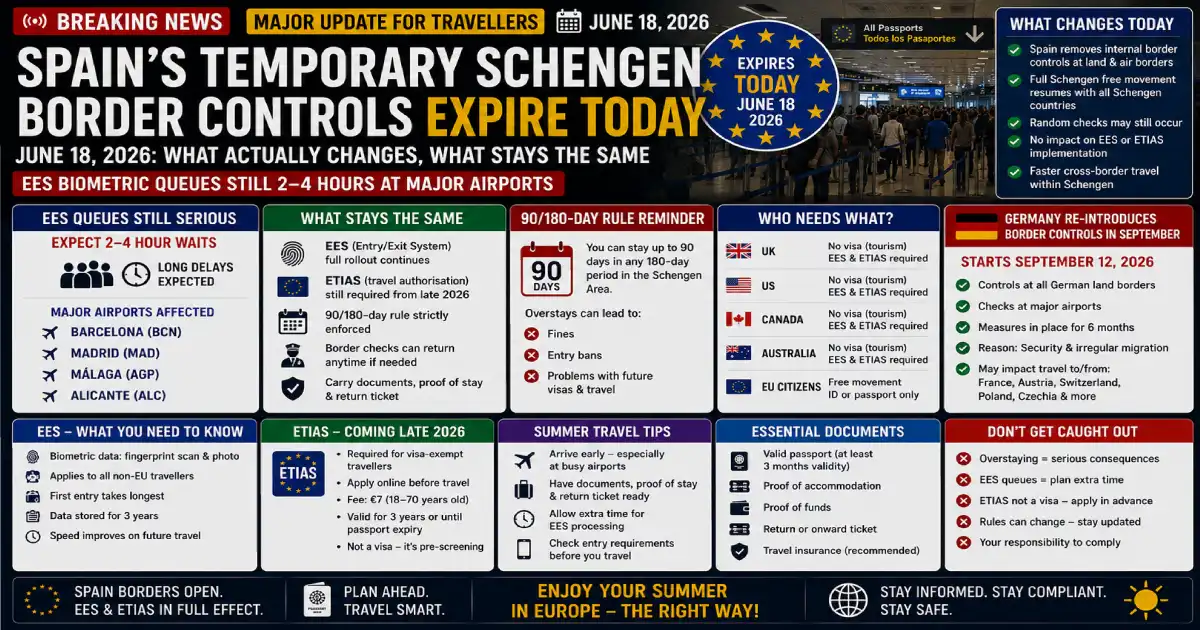
Published: June 18, 2026 — Thursday (Spain border controls: expired today) Spain temporary border controls: ✅ EXPIRED — 00:01 this morning, June 18, 2026 What expired: Temporary internal Schengen border controls requiring passport/ID checks at Spain’s land, air and sea crossings with other Schengen states Why Spain had them: Rising irregular migration flows, Franco-British border pressures, antisemitic threats, criminal network infiltration risk What DOESN’T change today:
Today is a good news / complicated news day for Spain travellers. The good news: Spain’s temporary internal Schengen border controls — the ones that required passport or national ID checks at Spain’s borders with France, Portugal and other Schengen neighbours — expire today, June 18, 2026. Free movement within the Schengen Area at Spain’s internal borders is fully restored from this morning. The complicated news: this changes very little of what you will actually experience at a Spanish airport this summer. The Entry/Exit System — the EU’s new biometric border registration programme that went live across all Schengen countries on April 10 — is still running at every Spanish international airport. Its queues are still reaching 2–4 hours for non-EU first-time registrants. The 90-day Schengen stay limit is still being enforced — now automatically by the EES database rather than by stamped passports that could be missed. Germany’s border controls are still active through September. And the ETIAS pre-travel authorisation system is still coming, now planned for late 2026. This article explains every layer — what changed today, what didn’t, and what UK, US, Canadian, Australian and other non-EU visitors to Spain this summer actually need to know.
Internal Schengen border checks have been in effect across multiple EU member states throughout 2025–26, with France, Germany, Italy, the Netherlands, Norway, Poland, Slovenia and Sweden maintaining temporary controls through at least September to December 2026. Spain’s specific internal controls were part of the same wave — temporary measures authorised under Article 25 of the Schengen Borders Code citing serious threats to public policy or internal security.
Spain’s justification for its temporary controls cited: persistent irregular migration flows toward the Franco-British border with associated risks of infiltration of radicalised individuals; rising violence among migrants in northern coastal areas including Dunkirk and Calais; expanding criminal networks facilitating irregular migration and smuggling across the Pyrenean land border; and the general security situation in the Middle East.
Under these controls, border guards at Spain’s crossings with France, Portugal, Andorra and at intra-Schengen arrival points at Spanish airports had the authority to request identification documents and perform detailed checks of travellers — even though the Schengen Agreement normally prohibits routine internal border checks.
The expiry of Spain’s internal border controls today means:
✅ What ends: The legal authority for Spanish border guards to conduct systematic passport or ID checks on travellers crossing from France, Portugal or other Schengen countries at internal crossing points. Random checks are no longer authorised under the temporary measures framework.
✅ What returns: Full Schengen free movement at Spain’s internal borders. A UK citizen driving from France into Spain, or a French national taking a domestic Schengen flight from Paris to Barcelona, is no longer subject to the internal border control checks that have been in force.
✅ Who benefits most: Travellers on land routes between France and Spain (the primary affected crossing), travellers on intra-Schengen flights to Spanish airports from Schengen departure points, and cruise passengers crossing internal Schengen sea borders.
Spain’s internal controls applied to crossings between Schengen member states. They had no effect on — and did not expire alongside — the controls that apply to travellers arriving from outside the Schengen Area. If you are flying from the UK, US, Canada, Australia or any non-Schengen country to a Spanish airport, you were never subject to the internal border controls, and today’s expiry changes nothing about your entry experience.
The border control you will experience at Barcelona, Madrid, Málaga or Alicante is the EU external border — governed by the Schengen Borders Code and, since April 10, 2026, implemented through the Entry/Exit System’s biometric registration. That system is entirely separate from the internal controls that have just expired.
Today’s border control expiry in Spain coincides with a second Schengen control expiry: Italy’s temporary border controls at its land border with Slovenia also expire on June 18, 2026. Italy had maintained these controls at its Slovenia land border as part of the broader wave of Schengen internal control measures citing irregular migration pressures.
The Italy–Slovenia border expiry is relevant for: travellers on the popular Trieste–Ljubljana route, cruise passengers crossing between the Adriatic coast and Slovenia, and road travellers on the Italo-Slovenian border corridor. From today, the routine passport checks at these crossings end and standard Schengen free movement is restored.
The expiry of Spain’s and Italy’s internal controls today should not create the impression that Schengen free movement is fully restored across Europe. The following countries continue to maintain internal checks at their borders through September–December 2026: France, Germany, Italy (other borders), the Netherlands, Norway, Poland, Slovenia and Sweden.
The most significant remaining controls for UK and international summer travellers:
Germany has extended all land border controls to September 15, 2026, covering its borders with Austria, Belgium, Czech Republic, Denmark, France, Luxembourg, Netherlands, Poland and Switzerland. Germany’s controls are the most comprehensive remaining in the Schengen Area — covering not just one or two specific crossings but every German land border.
Impact for UK travellers: Any road trip through Germany — whether driving from the Netherlands into Germany, crossing from France near Strasbourg, or entering from Austria after an Alpine holiday — may encounter passport checks at German land border crossings through September 15. Carry a valid passport or EU/national ID card at all times when crossing German land borders.
Impact for coach and rail travellers: Cross-border coach services (FlixBus, Eurolines) and rail services (ICE, Thalys, Eurostar connections) crossing into Germany may be subject to document checks by German border police. Allow extra time and carry documents.
France maintains controls at all internal borders — land, air and sea — in its most extensive internal control deployment of any Schengen state. The Franco-British border (Calais–Dover, Eurotunnel) is a primary focus, as is the Franco-Italian border and the Pyrénées crossings with Spain.
Impact for UK travellers: The French controls at Calais and the Channel Tunnel are separate from (and additional to) the UK’s own border arrangements. Passport checks on both the French and UK sides of the Channel remain in force. Expect delays at Dover–Calais and Folkestone–Coquelles crossings throughout summer 2026.
Austria and Denmark maintain internal border checks in effect through June–July 2026. Austrian controls affect travellers on the popular Salzburg, Vienna and Innsbruck road and rail routes from Germany, Hungary and Slovenia. Danish controls affect the Øresund Bridge crossing between Denmark and Sweden.
The Netherlands specifically includes intra-Schengen air border controls — affecting passengers on flights between Amsterdam Schiphol and other Schengen airports. Document checks on these typically document-free routes have surprised some travellers. Carry a valid passport or EU national ID on all Amsterdam-originating flights within Schengen.
Spain’s internal border control expiry is today’s headline. But for most UK, US, Canadian, Australian and non-EU travellers flying to Spain this summer, the Entry/Exit System is the more significant practical concern — and it is not expiring today or any time soon.
The EU’s Entry/Exit System became fully operational on April 10, 2026, replacing passport stamping and collecting biometric data — fingerprints and a facial scan — from all non-EU travellers entering the Schengen Area.
At Spanish airports — Barcelona El Prat, Madrid Barajas, Málaga-Costa del Sol, Alicante–Elche, Palma de Mallorca, Ibiza, Valencia, Seville, Bilbao and all others — the EES process applies to every non-EU arriving passenger. This includes:
The EES registration for a first-time visitor involves: passport scan (machine-readable zone) · facial photograph · all ten fingerprints. This takes 3–7 minutes per passenger at a biometric kiosk. Subsequent visits after the first registration are faster — the face check takes under 90 seconds at a functioning e-gate.
Spain’s airports are among the most congested EES processing points in Europe. The mathematics are straightforward: a wide-body aircraft carries 300–400 passengers. If 50–60% are non-EU first-time EES registrants (typical for a British, American or Australian holiday charter arriving at Málaga), that is 150–240 passengers each needing 3–7 minutes at a biometric kiosk. With 10 kiosks operational (the current typical installation at mid-sized Spanish airports), the processing time for the full aircraft is 45–168 minutes — before any other aircraft’s passengers join the queue.
At peak summer arrival windows — typically 10:00–14:00 and 17:00–21:00 at Málaga, Alicante and Palma — multiple aircraft arrive within the same 90-minute window. Queue times of 2–4 hours for first-time EES registrants are not exceptional. They are the norm.
| Airport | Code | Peak queue (first-time) | Off-peak queue | Busiest window |
|---|---|---|---|---|
| Barcelona El Prat | BCN | 🔴 3–4 hours | 🟠 1–2 hours | 08:00–12:00, 17:00–21:00 |
| Madrid Barajas | MAD | 🔴 2–3 hours | 🟠 1–1.5 hours | 09:00–13:00, 18:00–22:00 |
| Málaga-Costa del Sol | AGP | 🔴 2–3 hours | 🟠 45–90 mins | 10:00–14:00, 17:00–21:00 |
| Alicante–Elche | ALC | 🔴 2–3 hours | 🟠 45–90 mins | 10:00–14:00, 17:00–21:00 |
| Palma de Mallorca | PMI | 🔴 2–3 hours | 🟠 1–2 hours | 10:00–14:00 |
| Ibiza | IBZ | 🟠 1–2 hours | 🟢 30–60 mins | 12:00–16:00 |
| Valencia | VLC | 🟠 1–2 hours | 🟢 30–60 mins | 09:00–13:00 |
| Seville | SVQ | 🟠 45–90 mins | 🟢 20–40 mins | 09:00–12:00 |
| Gran Canaria | LPA | 🟠 1–2 hours | 🟢 30–60 mins | 10:00–14:00 |
| Tenerife South | TFS | 🟠 1–2 hours | 🟢 30–60 mins | 10:00–14:00 |
If you have already visited Spain or any other Schengen country since April 10, 2026 and completed your EES biometric registration, your subsequent entries use facial recognition only at the e-gate. This takes under 90 seconds. The 2–4 hour queues apply specifically to first-time registrations.
Practical tip: If you are flying to Spain from the UK via Amsterdam, Paris or Frankfurt first (as a Schengen hub connection), your EES registration occurs at the hub airport — not in Spain. By the time you land in Barcelona or Málaga, you are already registered and can use the fast e-gate lane.
The Schengen 90-day/180-day stay limit — which restricts non-EU visitors (including UK, US, Canadian, Australian and NZ passport holders) to a maximum of 90 days in any Schengen country within any rolling 180-day period — has been on the books for decades. What changed on April 10, 2026 is the enforcement mechanism.
The EES now calculates each traveller’s Schengen presence automatically. The days remaining are no longer a matter of mental arithmetic or trusting ink stamps — the number is in the system. This means overstays are flagged immediately and can trigger alerts before a person even tries to board a flight back.
In practice: when you attempt to board a flight home from a Spanish airport after an overstay, the airline’s Advance Passenger Processing system queries the EES database. The database returns your remaining Schengen days — if it shows you have exceeded 90 days, an alert is triggered. The gate agent cannot override it. You may be pulled from the flight and referred to Spanish border authorities.
The 90-day rule applies to ALL Schengen countries combined — not just Spain. A UK holidaymaker who spent 45 days in France in April–May and then travels to Spain in June has only 45 Schengen days remaining, not a fresh 90.
The rolling window explained: The 180-day window is not fixed (January to June). It rolls forward every day. To know how many days you have remaining today, you count backwards 180 days from today (June 18, 2026 → back to December 21, 2025) and count every day you spent in any Schengen country in that window. The result cannot exceed 90.
EES makes this automatic and unforgiving: Before EES, a traveller with 45 days of undocumented Schengen presence might slip through without the border officer noticing (many countries had inconsistent passport stamping). From April 10, every entry and exit is recorded biometrically. There is no ambiguity and no appeal to missing stamps.
90-day rule calculator: Use the official EU short-stay visa calculator at ec.europa.eu/assets/home/visa-calculator to check your remaining days before any Spain trip.
| Traveller type | Risk level | Why |
|---|---|---|
| UK retirees with Spain property doing multiple trips | 🔴 HIGH | Cumulative days accumulate without EES-era awareness |
| UK digital nomads working from Spain short-term | 🔴 HIGH | Multiple short stays add up faster than expected |
| UK families visiting Spanish-resident relatives | 🟠 MEDIUM | Extended family visit + previous holiday trip same year |
| US tourists doing Europe in summer | 🟠 MEDIUM | Multi-country itineraries accumulate Schengen days |
| Australians on extended Europe travel | 🟠 MEDIUM | Long Europe trips often approach the 90-day limit |
| Business travellers with frequent EU visits | 🟠 MEDIUM | Multiple short trips combine |
| First-time European holidaymakers | 🟢 LOW | Single trip rarely approaches 90 days |
ETIAS is expected to launch in the fourth quarter of 2026 and will only become mandatory for British passport holders in early 2027 at the earliest. Currently no application is required — you can travel to ETIAS-required countries visa-free under existing rules.
ETIAS (European Travel Information and Authorisation System) is a pre-travel electronic authorisation system similar to the US ESTA. It will apply to nationals of approximately 60 visa-exempt countries — including the UK, US, Canada, Australia and New Zealand — when visiting the Schengen Area. Once launched, travellers will need to obtain an ETIAS before booking flights or arriving at any Schengen airport.
What ETIAS will cost: €7 per adult (aged 18–70). Free for under-18s and over-70s. Valid for three years or until your passport expires.
What ETIAS will require: Similar to UK ETA — biographical data, passport information, travel history, and a security questionnaire. No biometrics required for the online application (biometrics are captured at the EES border point on arrival).
Key practical note: ETIAS approval does not guarantee entry — it is a pre-screening tool. Spanish and other Schengen border officers still make the final admission decision on arrival.
For your 2026 Spain holiday: No ETIAS application is needed. Travel as normal.
| Requirement | Status |
|---|---|
| Valid passport | ✅ Required — must be valid for your full stay, issued less than 10 years ago |
| EES biometric registration | ✅ Required on first Schengen visit since April 10, 2026 |
| ETIAS | ❌ NOT YET — Q4 2026 launch, mandatory from ~April 2027 |
| 90-day Schengen limit | ✅ Applies — automatically enforced by EES from April 10 |
| Spain internal border controls | ✅ EXPIRED TODAY — no longer applies |
| ESTA (for US entry) | Separate system — applies when entering the US, not Spain |
| UK ETA | Separate system — applies when entering the UK, not Spain |
EU and EEA citizens (including all EU passport holders) are not subject to EES. They pass through the EU/EEA passport lane and are not required to submit biometrics. They are also not subject to the 90-day rule — EU citizens have an unlimited right to reside anywhere in the EU.
For EU citizens: Today’s expiry of Spain’s internal border controls is the most directly positive change. The passport checks at French–Spanish crossings no longer apply. Free movement is fully restored.
British citizens post-Brexit are treated as third-country nationals for Schengen entry purposes — not as EU citizens. This means:
One specific British benefit today: British travellers who were considering driving from France to Spain through the Pyrenees or catching an intra-Schengen flight from Nice to Málaga (for example) were theoretically subject to Spain’s internal controls. Those are now lifted — though in practice, the EES external border check at your first Schengen entry point (France, in the land border scenario) still applies.
From today, crossing from Spain into France, Portugal or Andorra by road or on an intra-Schengen flight does not require Spanish border authority checks. However:
| Country | Control scope | Expiry date | Primary reason |
|---|---|---|---|
| Spain | Land, air, sea (all internal) | ✅ EXPIRED TODAY | Migration / Franco-British border security |
| Italy (Slovenia border only) | Land — Slovenia only | ✅ EXPIRED TODAY | Migration / Balkan route |
| Austria | Land borders | ~June–July 2026 | Migration |
| Denmark | Land borders + some sea | ~June–July 2026 | Migration |
| France | ALL internal (land/air/sea) | December 2026+ | Migration, terrorism, Franco-British border |
| Germany | ALL land borders | September 15, 2026 | Migration, terrorism, security |
| Italy (other borders) | Land (non-Slovenia) | September–December 2026 | Migration |
| Netherlands | Land + intra-Schengen air | September–December 2026 | Migration |
| Norway | Land borders | September–December 2026 | Migration |
| Poland | Land borders | September–December 2026 | Migration |
| Slovenia | Land borders (not Italy) | September–December 2026 | Migration |
| Sweden | Land + sea | September–December 2026 | Migration |
Posted By : Vinay
This article is provided for general informational purposes only and is based on information available at the time of publication. Travel advisories, airline schedules, airport operations, visa requirements, government regulations, and other travel-related information are subject to change without prior notice. While Travel Tourister makes reasonable efforts to verify information using official announcements, government publications, airline and airport communications, and other reliable sources, we cannot guarantee that all information remains complete, accurate, or up to date at all times. Readers should independently verify any information that may affect their travel plans with the relevant airline, airport authority, government agency, embassy, or other official source before making travel, financial, or other decisions. Travel Tourister shall not be liable for any direct or indirect loss, inconvenience, or damages arising from the use of or reliance on the information contained in this article. Nothing in this publication constitutes legal, immigration, financial, or professional travel advice. If you believe any information in this article is inaccurate or outdated, please contact our editorial team. We review all credible correction requests promptly and update our content whenever appropriate.
Lastest News
2nd Floor, 39, Above Kirti Club, DLF Industrial Area, Kirti Nagar, New Delhi, Delhi 110015



Travel Tourister is a leading Travel portal where we introduce travellers to trusted travel agents to make their journey hasselfree, memorable And happy. Travel Tourister is a platform where travellers get Tour packages ,Hotel packages deals through trusted travel companies And hoteliers who are working with us across the world. We always try to find new and more travel agents and hoteliers from every nook and corners across the world so that you could compare the deals with different travel agents and hoteliers and book your tour or hotel with the one you have chosen according to your taste and budget.
Copyright © Travel Tourister, India. All Rights Reserved

 Call
Call Enquiry