Published on : 05 Sep 2026
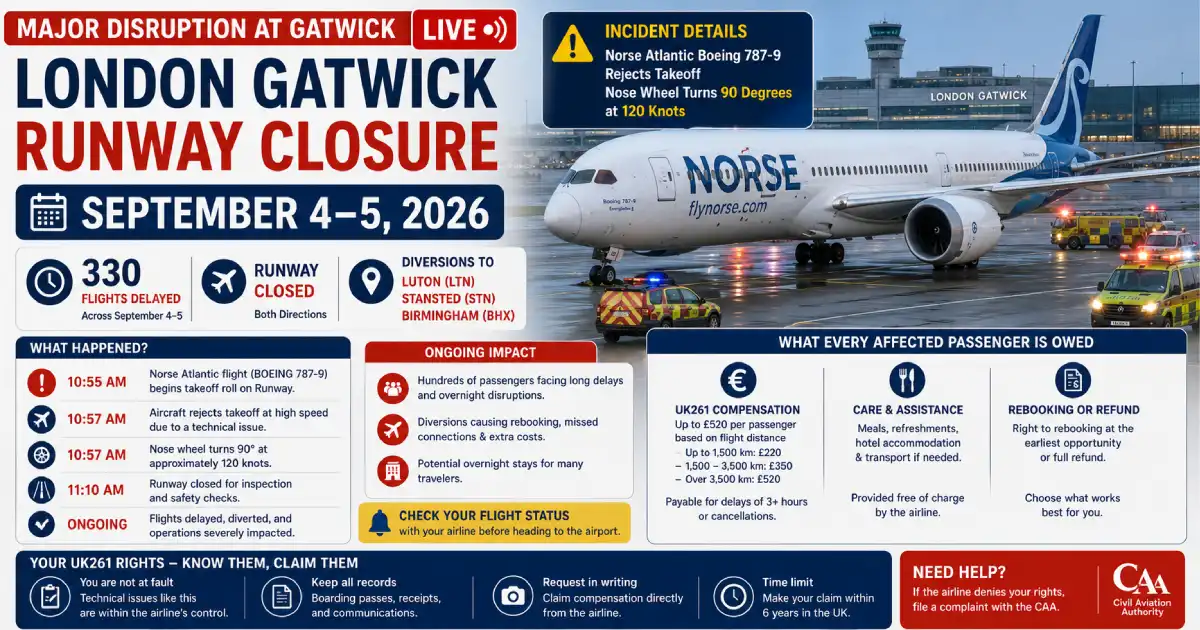
🚨 THE GATWICK CASCADE IS STILL RUNNING TODAY — SATURDAY SEPTEMBER 5. IF YOUR FLIGHT IS SHOWING DELAYED, THIS IS WHY. HERE IS EXACTLY WHAT YOU ARE OWED.
London Gatwick Airport descended into its worst single-afternoon disruption since July 2026 yesterday, Friday September 4, when Norse Atlantic Airways Boeing 787-9 Dreamliner G-CKOF — operating flight Z0701 from London Gatwick to New York John F. Kennedy International Airport — suffered a catastrophic nose landing gear failure during its takeoff roll and rejected its departure at approximately 120 knots on runway 26L. The nose wheels turned approximately 90 degrees, the aircraft came to a controlled stop on the runway and became disabled, unable to vacate under its own power. Emergency services surrounded the Dreamliner on the runway. No injuries were reported among the passengers or crew on board. But the operational consequences were immediate and severe. Because London Gatwick relies on a single main runway for all flight operations — one of the most acute structural vulnerabilities of any major international airport in Europe — the moment Norse Atlantic G-CKOF stopped on runway 26L, every single other aircraft at Gatwick was grounded. The runway was closed for 50 minutes while ground teams towed the Boeing 787-9 to a remote stand and conducted a full safety inspection of runway 26L for debris. Operations resumed at approximately 14:36 BST. But 50 minutes of total operational shutdown at one of Europe’s busiest airports, occurring during the heart of the Friday afternoon departure peak, produced a disruption cascade that 330 flights could not escape — with approximately 50% of Gatwick’s flights delayed according to Flightradar24. Multiple easyJet inbound services were diverted to London Luton and London Stansted. Other inbound aircraft were diverted to Birmingham. Those diverted passengers are now spread across three other airports, many needing ground transport of 1–3.5 hours to reach their original Gatwick destination. Today, Saturday September 5, the cascade from Friday’s incident is still propagating through Gatwick’s schedule as aircraft repositioning continues and recovery slots are worked through the congested summer weekend timetable. Rejecting a takeoff at 120 knots — close to the point where many wide-body jets commit to leaving the ground — is a manoeuvre crews train for regularly, and the Norse Atlantic crew performed it correctly. But the technical cause of the nose-wheel rotation to 90 degrees has not been officially declared by the airline and will be the subject of a formal Air Accidents Investigation Branch (AAIB) investigation. Here is everything confirmed about what happened, why Gatwick is structurally more vulnerable than any other major London airport, and exactly what every affected passenger is owed.
Published: September 5, 2026 — Saturday Incident: Norse Atlantic Airways Boeing 787-9 rejected takeoff, nose landing gear failure Aircraft: Boeing 787-9 Dreamliner, registration G-CKOF Flight: Z0701 LGW → JFK (London Gatwick to New York John F. Kennedy International) Incident Time: Shortly after 14:00 BST, Friday September 4, 2026 Location: Runway 26L, London Gatwick Airport (LGW) Rejected Takeoff Speed: Approximately 120 knots — high-speed rejection Technical Cause: Nose landing gear fault — nose wheels turned approximately 90 degrees — aircraft disabled on runway — could not vacate under own power Injuries: None reported — passengers and crew uninjured Runway Closure Duration: 50 minutes (14:00 BST approximate → 14:36 BST resumption) Timeline: UPDATE 14:30 BST — Aircraft taxied to remote stand | UPDATE 14:36 BST — Runway 26L operations resuming Flights Delayed: 330+ — Flightradar24: approximately 50% of all Gatwick flights delayed Flights Diverted: Multiple easyJet services + others → London Luton (LTN), London Stansted (STN), Birmingham International (BHX) Emergency Response: Multiple fire engines attended aircraft on runway — standard protocol for high-speed rejected takeoff with gear issue Investigation: Air Accidents Investigation Branch (AAIB) expected to investigate — technical cause of nose-wheel rotation not yet officially declared Historical Context: July 2026 — British Airways aircraft blocked Gatwick runway → multiple inbound flights declared low-fuel emergencies Today (September 5): Cascade still running — aircraft repositioning incomplete — residual delays expected through Saturday UK261 Compensation: If cause determined to be within airline control → £220–£520 per passenger applies Norse Atlantic Contact: 1-833-675-0764 (US toll free) | norseatlantic.com
The drama unfolded shortly after 2pm on Friday September 4, when Norse Atlantic Airways flight Z0701, a Boeing 787-9 Dreamliner bound for New York’s JFK airport, rejected its takeoff roll on runway 26L at around 120 knots. The aircraft had been accelerating normally along Gatwick’s sole operational runway when, at approximately 120 knots — roughly 138 mph, close to the rotation speed for a fully loaded 787-9 — something went wrong with the nose landing gear.
Reports said that the rejected takeoff followed a problem with the aircraft’s nose landing gear and that the nose wheels had turned about 90 degrees. At 120 knots, the effect of a nose wheel rotating 90 degrees to the direction of travel is immediate and severe — the aircraft cannot rotate normally, nose tyre integrity is compromised, and directional control is affected. The crew of flight Z0701 correctly applied the Rejected Takeoff procedure — maximum braking, reverse thrust, full rudder — and brought the Boeing 787-9 Dreamliner to a controlled stop on the runway.
The aircraft then stopped on the runway and became disabled. It could not vacate under its own power. It was physically blocked on Gatwick’s only operational runway. The moment that happened, every other aircraft at Gatwick — inbound, outbound, taxiing — was instantly grounded.
Because London Gatwick relies on a single main runway for its flight operations, the blockage forced an immediate ground stop. Emergency response vehicles rushed to the far end of the runway to reach the widebody Boeing 787-9 Dreamliner and assess the situation. Flight-tracking specialists and aviation enthusiasts posting to social media showed multiple fire engines surrounding the aircraft on the runway — standard protocol for any high-speed rejected takeoff involving a landing gear incident, where tyre fires, brake fires, and hydraulic fluid ignition are all potential risks.
No fires were reported. No injuries were reported. The aircraft was intact. But with 330+ other aircraft at Gatwick either waiting on taxiways, holding in the air, or queued for approach — and with every incoming flight unable to land while the runway was blocked — the disruption was escalating rapidly.
Numerous incoming easyJet flights were forced to divert to neighbouring hubs, including London Luton and London Stansted airports. Other aircraft, depending on their fuel state, were diverted to Birmingham. For each diverted aircraft, pilots needed to declare their intentions, receive clearance, land at an alternate, and arrange for passengers — and the cascade of those decisions was generating delays for aircraft far beyond the immediate Gatwick area.
UPDATE: At approximately 14:30 BST, the Norse Atlantic Boeing 787-9 G-CKOF was towed from its position on runway 26L to a remote stand at Gatwick Airport. The aircraft then moved to a remote stand, allowing runway operations to resume.
But operations did not resume immediately. Airport authorities must conduct a thorough safety inspection of runway 26L to clear any potential debris before reopening the airfield to normal traffic. Runway inspection after a high-speed rejected takeoff is mandatory — hot brakes and worn tyres shed debris, and any foreign object on a runway can cause catastrophic damage to subsequent aircraft. The inspection took the full remaining window to 14:36 BST.
UPDATE: At approximately 14:36 BST, Runway 26L was declared safe and flight operations resumed. The runway was closed for 50 minutes in total.
Resuming operations at 14:36 BST did not end the disruption. Airlines must re-sequence departures, reposition crews and in some cases re-time inbound flights to keep network schedules functioning, leaving travelers vulnerable to extended delays even after the immediate safety issue is resolved. 330 flights had already been delayed. Multiple aircraft had been diverted. Crews at those diverted aircraft needed ground transportation to return to Gatwick. Aircraft at remote stands around the airport needed repositioning. The cascade extended well into Friday evening.
Rejecting a takeoff at 120 knots, close to the point where many wide-body jets commit to leaving the ground, is a manoeuvre crews train for regularly. It happened correctly yesterday — the crew performed exactly as trained and brought the aircraft to a safe stop with no injuries. But at Gatwick, a correct and safe outcome for one aircraft is automatically a catastrophic operational outcome for every other aircraft using the airport.
London Gatwick is the world’s busiest single-runway commercial airport, handling approximately 46 million passengers annually. By comparison, Heathrow has two runways, Frankfurt has four, Amsterdam Schiphol has six, and Paris CDG has four. When one of Heathrow’s two runways is temporarily closed, the other continues handling traffic. When Gatwick’s single runway closes for 50 minutes — for any reason — the entire airport stops.
For the incident in July 2026, when a British Airways aircraft blocked the runway and forced a series of diversions, previous disruption at Gatwick including an event in July 2026 when a British Airways aircraft blocked the runway and forced a series of diversions has already underlined the vulnerability of single runway operations to even isolated technical problems. Published reports on that earlier incident described multiple inbound flights declaring low fuel emergencies while seeking priority landing at other airports in the London system.
Yesterday’s Norse Atlantic incident followed exactly the same pattern — with the same downstream consequence: hundreds of delayed passengers, diverted aircraft at three separate alternate airports, and a cascade that takes 24–48 hours to fully clear.
The incident occurred at approximately 14:00 BST on a Friday — the absolute worst time in the week for a Gatwick runway closure. Friday afternoon is peak departure time for the UK’s busiest leisure airport, with Ryanair, easyJet, Jet2, TUI, BA, and Norwegian all operating dense departure banks from 12:00 to 18:00. The 50-minute closure hit directly in the middle of this peak window, immediately backing up departures at every gate and holding inbound aircraft in stacks over the south of England.
| Category | Data |
|---|---|
| Incident aircraft | Norse Atlantic Boeing 787-9 G-CKOF, flight Z0701 LGW→JFK |
| Rejected takeoff speed | ~120 knots (approximately 138 mph) |
| Technical cause | Nose landing gear fault — nose wheels rotated ~90 degrees |
| Runway closed | 14:00 BST → 14:36 BST — 50 minutes total |
| Flights delayed (Friday) | 330+ — ~50% of all Gatwick flights (Flightradar24) |
| Diversions | Multiple easyJet + others → Luton (LTN), Stansted (STN), Birmingham (BHX) |
| Injuries | None reported |
| Emergency vehicles | Multiple fire engines attended on runway |
| Investigation | AAIB expected — cause of nose-wheel rotation not officially declared |
| Today (Saturday Sept 5) | Cascade continuing — aircraft and crew positioning incomplete |
| Gatwick runway status | Fully open — normal operations resumed |
| Norse Atlantic Z0701 status | Delayed/cancelled — passengers need to check norseatlantic.com |
Numerous incoming easyJet flights were forced to divert to neighbouring hubs, including London Luton and London Stansted airports. EasyJet is Gatwick’s largest single carrier, operating from both the North and South terminals and serving approximately 125 destinations. Multiple easyJet inbound services — from across Europe, the Canary Islands, and Mediterranean destinations — were unable to land at Gatwick during the runway closure and were diverted. One passenger confirmed their flight from the Isle of Man had been sent to Luton.
Passengers diverted on easyJet to Luton or Stansted should contact: ✅ easyJet app — check flight status and rebooking options ✅ easyJet UK: 0330 365 5000
The passengers on board the incident aircraft itself — the Norse Atlantic Z0701 bound for New York JFK — were on an aircraft with a serious technical fault. After the aircraft was towed to a remote stand, the flight was either significantly delayed or cancelled. The precise technical cause of the nose-wheel movement has not been officially declared by the airline, and the aircraft (G-CKOF) will have been grounded pending technical investigation. Norse Atlantic passengers with JFK bookings should check their booking status immediately.
Norse Atlantic customer service: ✅ norseatlantic.com → Manage My Booking ✅ Phone (US toll-free): 1-833-675-0764
All carriers operating to and from Gatwick on Friday afternoon experienced delays. Gatwick’s slot-based schedule means any major delay in one departure bank cascades into the next — aircraft that cannot depart at 14:00 are not available for their next scheduled turn until they have departed their delayed service first, meaning 15:00, 16:00, and 17:00 departures all suffer sequentially from the initial 50-minute shutdown.
The Norse Atlantic Boeing 787-9 G-CKOF suffered a nose landing gear failure at approximately 120 knots during the takeoff roll on runway 26L. Reports said that the rejected takeoff followed a problem with the aircraft’s nose landing gear and that the nose wheels had turned about 90 degrees. The precise technical cause of the nose-wheel movement has not been officially declared by the airline.
A Boeing 787-9’s nose landing gear consists of two wheels mounted in a dual-wheel configuration on the nose gear axle. During normal ground operations, the nose gear steers through hydraulic actuators — allowing the aircraft to turn on taxiways and align with the runway centreline. During the takeoff roll at high speed, the nose gear is locked straight ahead and the steering system is disengaged.
A nose wheel that rotates 90 degrees to the direction of travel is a catastrophic steering or locking failure. At 120 knots — approximately 138 mph — a 90-degree nose wheel deflection applies a massive lateral force to the nose gear assembly, the nose gear bay, and the forward fuselage structure. It also means the wheel is essentially dragging sideways across the runway at high speed, potentially destroying the tyre, generating large amounts of heat and rubber debris, and compromising the structural integrity of the landing gear assembly.
The crew’s decision to reject the takeoff was immediate and correct. Rejecting a takeoff at 120 knots, close to the point where many wide-body jets commit to leaving the ground, is a manoeuvre crews train for regularly, and no injuries were reported among the passengers or crew on board. The Boeing 787-9’s carbon composite brakes and Rolls-Royce Trent 1000 reverse thrust were applied to bring the aircraft to a stop within the available runway length. The aircraft then stopped on the runway and became disabled.
The Air Accidents Investigation Branch (AAIB) is the UK government body responsible for investigating civil aviation accidents and serious incidents. A high-speed rejected takeoff involving a landing gear malfunction on a Boeing 787-9 at a major London airport meets the definition of a serious incident under UK aviation regulations. An AAIB investigation is expected. The investigation will focus on: the technical cause of the nose-wheel rotation; the Boeing 787-9’s nose gear locking and steering systems; whether any maintenance actions contributed to the failure; and whether any systemic issues exist across the 787-9 fleet.
AAIB investigations typically take 6–18 months to publish a final report, with interim safety recommendations possible if urgent action is required.
Your airline diverted your inbound flight to Luton. You landed at Luton Airport (IATA: LTN), approximately 30 miles north of Gatwick. Luton is served by easyJet as a home base — easyJet aircraft and staff at Luton may be able to assist, but they cannot guarantee onward transport to Gatwick at airline expense if the diversion was weather or exceptional circumstance.
Getting from Luton to Gatwick:
Ask your airline to cover this cost. If your diversion was caused by the Norse Atlantic incident (an aircraft technical issue — a controllable event within the aviation system), your airline may be obligated under UK261 to cover reasonable onward transportation. Keep every receipt.
Stansted is approximately 32 miles northeast of central London — and significantly further from Gatwick by any route. Budget approximately 2–3 hours ground travel to reach Gatwick from Stansted.
Getting from Stansted to Gatwick:
Birmingham is the most distant diversion airport — approximately 120 miles from Gatwick. Ground transport will take 3.5–4 hours and cost significantly more.
Getting from Birmingham to Gatwick:
If you are stranded in Birmingham overnight: Your airline must provide hotel accommodation if the diversion means you cannot reach your original destination before the next day. Say: “My flight was diverted to Birmingham due to the Gatwick incident. I am requesting hotel accommodation tonight under my airline’s duty of care obligations and Article 9 of UK Regulation 261/2004.”
The Norse Atlantic Boeing 787-9 G-CKOF experienced a nose landing gear technical failure. Aircraft technical malfunctions are generally assessed under UK Regulation 261 (the UK equivalent of EU261 post-Brexit) as follows:
Key legal question: Was the technical failure within the airline’s reasonable control?
Under the precedent set in Wallentin-Hermann v Alitalia (ECJ C-549/07) — which UK courts continue to apply — airlines cannot classify technical failures as extraordinary circumstances merely by saying they are technical. A technical failure qualifies as extraordinary only if it is caused by events not inherent in the normal exercise of the airline’s activity — for example, hidden manufacturing defects revealed for the first time, or sabotage. A nose gear failure during a standard takeoff roll, if caused by inadequate maintenance, an overlooked service bulletin, or a component at the end of its service life, would not qualify as extraordinary circumstances. The precise technical cause of the nose-wheel movement has not been officially declared by the airline — meaning the extraordinary circumstances determination cannot yet be made definitively.
Practical advice for passengers: File your compensation claim now. Do not wait for the AAIB investigation. Claim £220–£520 per passenger depending on your route distance. If Norse Atlantic rejects citing extraordinary circumstances, escalate to the UK CAA. The investigation will establish the true cause — and if maintenance was a factor, the extraordinary circumstances defence will fail.
| Route Distance | Delay at Final Destination | Compensation |
|---|---|---|
| Under 1,500 km (e.g. Gatwick–Edinburgh, Gatwick–Amsterdam) | 3+ hours | £220 per passenger |
| 1,500–3,500 km (e.g. Gatwick–Canary Islands, Gatwick–Egypt) | 3+ hours | £350 per passenger |
| Over 3,500 km (e.g. Gatwick–JFK, Gatwick–Dubai) | 4+ hours | £520 per passenger |
Norse Atlantic Z0701 passengers (LGW→JFK = over 3,500 km): Every passenger on the incident aircraft is potentially owed £520 per person in compensation — in addition to a full cash refund or free rebooking.
Other affected airlines’ passengers (delayed 3+ hours controllable cause): £220–£520 per passenger depending on route distance.
| Right | Available? | Details |
|---|---|---|
| Full cash refund (if flight cancelled) | ✅ YES — unconditional | To original payment method — not a voucher |
| Free rebooking | ✅ YES | Next available flight on same airline |
| Meals and refreshments (2+ hours) | ✅ YES | From time of disruption — keep all receipts |
| Hotel accommodation (overnight) | ✅ YES | Airline must arrange or reimburse |
| Transport to/from hotel | ✅ YES | Taxi or shuttle at airline’s expense |
| Onward transport (diversion) | ✅ YES | Airline must cover reasonable cost to reach destination |
| £220–£520 compensation | ✅ VERY LIKELY | File now — await technical cause confirmation |
For Norse Atlantic passengers: File at norseatlantic.com → Contact Us → Compensation Claim
For easyJet diverted passengers: File at easyjet.com → Help → Claims → Flight disruption
For other affected carriers: File through your specific airline’s claims portal
If rejected: Escalate to UK Civil Aviation Authority: caa.co.uk/passengers
No-win-no-fee services: AirHelp (airhelp.com) | Flightright (flightright.eu) | CEDR Aviation (cedr.com/aviation)
The exact claim phrase: “My flight [number] on September 4/5, 2026 was [cancelled/delayed/diverted] as a result of the Norse Atlantic G-CKOF nose landing gear incident at London Gatwick. I am claiming UK261 compensation of £[220/350/520] per passenger. Under UK case law consistent with Wallentin-Hermann, a technical failure caused by maintenance factors does not constitute extraordinary circumstances. Please respond within 14 days or I will escalate to the UK CAA.”
The residual cascade from Friday’s 50-minute runway closure is still running today. Once the aircraft was removed and safety checks completed, operations began to resume, but with residual delays extending into later departures and continuing into the next morning.
Here is what Saturday looks like at Gatwick:
Aircraft positioning: Multiple easyJet aircraft that were diverted to Luton, Stansted, and Birmingham on Friday evening needed to be ferried back to Gatwick overnight or this morning. This repositioning takes time and crew rest hours. Until those aircraft are back at Gatwick, Saturday’s schedule is running with reduced aircraft availability.
Crew positioning: Pilots and cabin crew who were stranded at diversion airports yesterday have mandatory minimum rest requirements before they can fly again. Any crew member who was taken off-duty at Luton, Stansted, or Birmingham at 17:00 yesterday cannot fly again until at least this morning — meaning Saturday’s early departures may have crew availability issues.
Passenger rebooking queue: Passengers who were diverted yesterday and could not be rebooked last night are presenting at Gatwick this morning, creating additional customer service pressure. If you are among those affected, use airline apps for rebooking rather than standing in counter queues.
Checking your specific flight: ✅ Gatwick live departures: gatwickairport.com/flight-tracker ✅ Flightradar24: flightradar24.com — search your flight number ✅ Your airline’s app — always faster than any counter queue during disruption events
| Resource | Contact / Link |
|---|---|
| Gatwick Airport Live | gatwickairport.com/flight-tracker |
| Norse Atlantic Manage Booking | norseatlantic.com |
| Norse Atlantic Phone (US) | 1-833-675-0764 |
| easyJet Flight Status | easyjet.com |
| Ryanair Flight Status | ryanair.com/flight-status |
| Jet2 Flight Status | jet2.com |
| TUI Flight Status | tui.co.uk |
| British Airways | ba.com |
| UK CAA Passenger Complaints | caa.co.uk/passengers |
| AirHelp UK261 Claims | airhelp.com |
| Flightright UK261 Claims | flightright.eu |
| National Express Coaches | nationalexpress.com |
| Luton → Gatwick Train | nationalrail.co.uk |
| AAIB Aviation Incidents | gov.uk/aaib-reports |
| Flightradar24 (live tracking) | flightradar24.com |
London Gatwick Airport descended into its worst single-afternoon disruption since July 2026 on Friday September 4 after Norse Atlantic Boeing 787-9 Dreamliner G-CKOF rejected its takeoff at approximately 120 knots on runway 26L, with the nose landing gear wheels turning approximately 90 degrees, disabling the aircraft on the runway. The crew performed their emergency procedures correctly — no injuries were reported. But at a single-runway airport handling 46 million passengers annually, even a perfectly executed emergency stops every other aircraft in the system. The runway was closed for 50 minutes. More than 330 flights were delayed — approximately 50% of Gatwick’s schedule. Multiple easyJet inbound services were diverted to Luton, Stansted, and Birmingham. The cascade is still running today, Saturday September 5. The AAIB is expected to investigate. The technical cause of the nose-wheel rotation has not been officially declared — which means the extraordinary circumstances determination under UK261 has not yet been made. File your compensation claim now.
The six things every affected passenger must do:
For More Resources:
Related Articles:
Posted By : Vinay
This article is provided for general informational purposes only and is based on information available at the time of publication. Travel advisories, airline schedules, airport operations, visa requirements, government regulations, and other travel-related information are subject to change without prior notice. While Travel Tourister makes reasonable efforts to verify information using official announcements, government publications, airline and airport communications, and other reliable sources, we cannot guarantee that all information remains complete, accurate, or up to date at all times. Readers should independently verify any information that may affect their travel plans with the relevant airline, airport authority, government agency, embassy, or other official source before making travel, financial, or other decisions. Travel Tourister shall not be liable for any direct or indirect loss, inconvenience, or damages arising from the use of or reliance on the information contained in this article. Nothing in this publication constitutes legal, immigration, financial, or professional travel advice. If you believe any information in this article is inaccurate or outdated, please contact our editorial team. We review all credible correction requests promptly and update our content whenever appropriate.
Lastest News
2nd Floor, 39, Above Kirti Club, DLF Industrial Area, Kirti Nagar, New Delhi, Delhi 110015



Travel Tourister is a leading Travel portal where we introduce travellers to trusted travel agents to make their journey hasselfree, memorable And happy. Travel Tourister is a platform where travellers get Tour packages ,Hotel packages deals through trusted travel companies And hoteliers who are working with us across the world. We always try to find new and more travel agents and hoteliers from every nook and corners across the world so that you could compare the deals with different travel agents and hoteliers and book your tour or hotel with the one you have chosen according to your taste and budget.
Copyright © Travel Tourister, India. All Rights Reserved

 Call
Call Enquiry