Published on : 19 Jun 2026
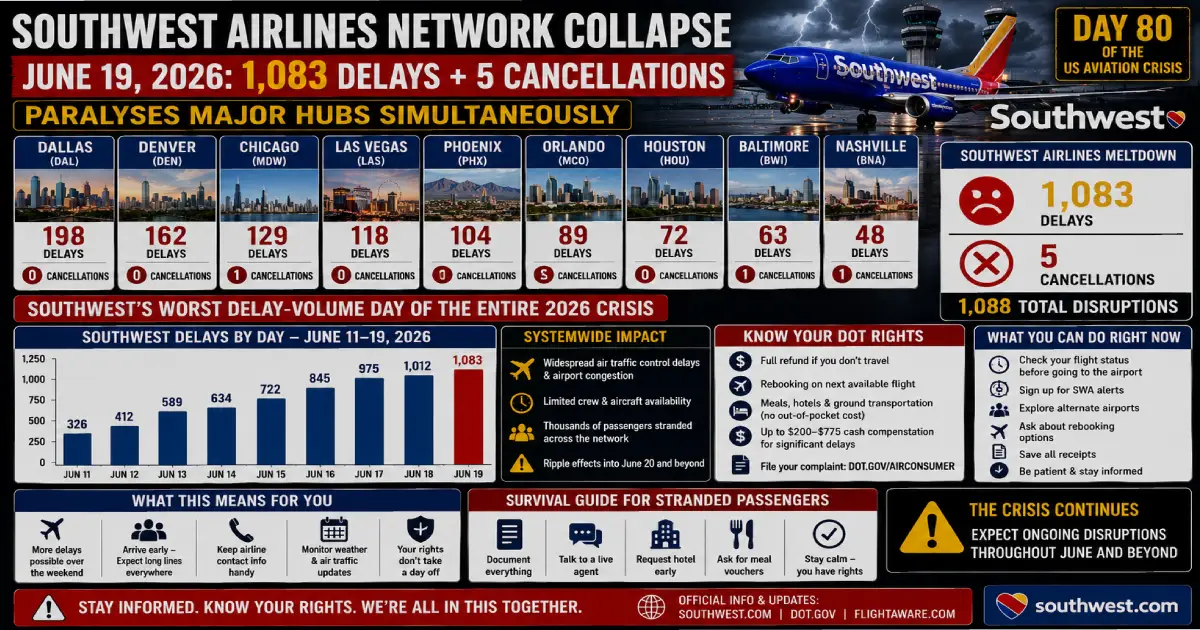
One airline. One day. Over a thousand delays. Southwest Airlines is not having a bad day at one airport — it is having a bad day at every airport it operates, simultaneously, all at once.
In a devastating operational breakdown that has instantly plunged the peak United States summer travel season into massive, nationwide travel chaos, Southwest Airlines has suffered a catastrophic network collapse, triggering relentless rolling delays and flight cancellations from coast to coast. Reported on June 19, 2026, the sweeping operational failure saw the carrier record 1,083 flight delays and five hard cancellations in rapid succession. Because Southwest utilizes a highly complex, interconnected point-to-point network, this massive wave of airport disruptions immediately paralyzed critical transit corridors in Dallas, Denver, Chicago, Las Vegas, Phoenix, and Orlando.
Flights connecting Dallas with Denver, Phoenix with Las Vegas, Chicago with Orlando, and Nashville with Houston represent important travel corridors for millions of passengers every year. The latest operational figures indicate that Southwest’s network experienced widespread delays while maintaining a relatively low number of outright cancellations.
Today is Day 80 of the US aviation crisis — and Southwest’s 1,083 delays represent the single largest delay-volume figure recorded by any one carrier on any one day throughout the entire 80-day crisis period. To put this number in context: 1,083 delays is more than the total disruption count of the worst single-airport days this crisis has produced. This is not a Chicago story, or a Dallas story, or a Baltimore story. It is a Southwest Airlines story — the airline’s entire national network, operating simultaneously under strain, everywhere, at once.
Published: June 19, 2026 — Friday (Day 80 · US Aviation Crisis · World Cup Day 9) Total Southwest delays nationwide: 1,083 Total Southwest cancellations: 5 Total network disruptions: 1,088 Primary affected hubs: Dallas Love Field (DAL) · Denver (DEN) · Chicago Midway (MDW) · Las Vegas (LAS) · Phoenix Sky Harbor (PHX) · Orlando (MCO) Secondary affected airports: Nashville (BNA) · Houston Hobby (HOU) · Baltimore (BWI) Significance: Southwest’s highest single-day delay figure of the entire 2026 crisis Context: Yesterday’s BWI article (Southwest 4 cancels + 53 delays) was a local symptom — today reveals the full national scope Cancellation rate vs delay rate: Extremely low cancellation count (5) relative to delay volume (1,083) — a distinctive Southwest pattern DOT refund right: ✅ Active for all 5 cancellations and any qualifying significant delays Live status: southwest.com → Flight Status
Every disruption article in this crisis so far has had a geographic centre — JFK, LaGuardia, SFO, Reagan National, Miami, San Diego, New Orleans, Atlanta. Today’s story has no single geographic centre. It has a corporate one.
Southwest Airlines operates a point-to-point network — fundamentally different from the hub-and-spoke model used by Delta, American, and United. Because Southwest utilizes a highly complex, interconnected point-to-point network, a localized issue is mathematically guaranteed to cascade across the entire system.
In a hub-and-spoke model, a disrupted hub (say, Atlanta for Delta) primarily affects flights touching that one hub — the rest of the airline’s network can, in theory, continue operating with reduced interference. In Southwest’s point-to-point model, there is no single hub to isolate the damage. Every city is connected to many other cities directly, and every aircraft completes multiple point-to-point legs per day across the network, not return trips to and from a single hub. When disruption strikes one node — say, Dallas Love Field, Southwest’s largest base — the affected aircraft and crews are not just stuck at Dallas. They were scheduled to continue to Denver, then Las Vegas, then Phoenix, then back to Dallas, all within the same operational day. A single morning delay at Dallas Love Field doesn’t stay in Dallas. It travels with the aircraft to every city on that aircraft’s route for the rest of the day.
This is precisely why Southwest’s disruption today produced 1,083 delays from a single carrier while maintaining just 5 cancellations. The point-to-point model means Southwest can usually avoid outright cancelling flights — it simply runs increasingly late across its entire network as the day progresses, the delay compounding at every subsequent stop on every aircraft’s daily rotation.
Dallas Love Field is Southwest Airlines’ founding airport and remains its most symbolically and operationally significant base — the airline was founded here in 1971 and continues to operate its largest concentration of daily departures from this single airport.
Southwest Airlines grounded seven flights and reported 70 delays at its Dallas hub yesterday — June 18 — making Love Field the most severely affected airport in the carrier’s network during that reporting cycle. Today’s continuation of severe delays at Dallas — now feeding into the broader 1,083 national figure — confirms that Dallas Love Field’s disruption has not resolved overnight, instead expanding into the network-wide event described today.
Dallas Love Field operates as Southwest’s primary Texas base, connecting to virtually every major Southwest destination nationwide. When Love Field disrupts, the knock-on effect touches every other Southwest base simultaneously, because so many Southwest rotations either originate, terminate, or pass through Dallas at some point in their daily cycle.
Dallas passengers: dal.fly2houston.com is not applicable — DAL operates independently. Check southwest.com → Flight Status. Southwest’s Love Field terminal: single-terminal operation, all gates accessible without significant walking distance.
The flight scheduling problems at Denver International Airport began mounting on June 18, 2026, primarily affecting the hub’s two dominant carriers. Southwest Airlines bore the brunt of the cancellations, grounding four scheduled services, with Southwest reporting 149 flight delays.
Denver’s disruption — which began building yesterday — has now fed directly into today’s national 1,083-delay figure. Denver International is Southwest’s largest mountain-region base, connecting the airline’s western network to its eastern and southern operations. Disruptions affected major hubs in Chicago, Indianapolis, Tucson, Dallas, Boston, Atlanta, Los Angeles, Las Vegas, Orlando, Minneapolis, Philadelphia, Phoenix, Seattle, San Francisco, Portland, Salt Lake City, San Diego, and Miami, with delay backlogs spreading to Canadian hubs like Vancouver and Montreal, as well as Mexican resort corridors like Cancun and Puerto Rico’s San Juan Airport.
The geographic spread from Denver alone — reaching Canada and the Caribbean through downstream connections — illustrates exactly how a point-to-point network amplifies a single hub’s problems into a truly national, even international, event.
Denver passengers: Southwest operates from Denver’s Concourse C/Concourse A area. Check southwest.com for real-time status. Denver’s light rail (A Line) connects DEN to downtown in 37 minutes for passengers needing alternative routing.
Chicago Midway, already operating at capacity as one of the busiest US airports, became the epicenter of a travel crisis yesterday (June 18) that touched major business hubs like Atlanta, New York City, Denver, and Dallas, plus leisure destinations including Miami, Las Vegas, and Orlando. Southwest cancelled 78 flights and delayed 128 at Midway on June 18 — the 128 delays compounding the problem, as delayed flights create cascading failures: missed connections, stranded crews, compounding schedule degradation that takes days to recover from.
This is the critical context for understanding today’s national collapse: Chicago Midway’s disruption was already severe yesterday, with 78 cancellations and 128 delays. Today’s Southwest network figure of 1,083 delays nationwide is the direct continuation and amplification of yesterday’s Midway crisis — exactly the kind of multi-day, non-recoverable degradation that point-to-point networks are most vulnerable to.
International destinations affected by the Midway disruption included Cancun (Mexico), Guadalajara (Mexico), and Punta Cana (Dominican Republic) — confirming that Southwest’s international leisure network is being hit alongside its domestic operations.
Chicago Midway passengers: Southwest operates from Concourse A at Midway. CTA Orange Line connects Midway to downtown Chicago in approximately 25-30 minutes if alternative routing is needed.
Las Vegas Harry Reid International is one of Southwest’s highest-frequency leisure destinations, connecting the airline’s entire national network to America’s most-visited leisure city. Today’s Las Vegas disruption affects passengers travelling for both leisure trips and the city’s enormous convention and conference business — Las Vegas hosts more major conventions than any other US city, meaning today’s Southwest disruption has significant business travel consequences alongside the leisure impact.
Phoenix Sky Harbor is one of Southwest’s founding-era bases and remains central to its Western network. Southwest experienced the highest concentration of delays at Albuquerque, with delays also recorded on routes linked to Phoenix Sky Harbor. Phoenix’s role as a connecting point between Southwest’s California, Texas, and Mountain West networks means today’s disruption here has wide downstream effects.
Orlando International is one of Southwest’s busiest leisure destinations — the gateway to Walt Disney World, Universal Orlando, and Central Florida’s enormous tourism economy. Today’s Southwest disruption at Orlando affects families on summer vacation, many of whom have pre-booked theme park tickets and resort reservations tied to specific arrival dates.
Nashville with Houston represent an important travel corridor for millions of passengers every year. Both Houston Hobby (Southwest’s primary Houston base, distinct from United’s Bush Intercontinental hub) and Nashville (a significant Southwest base for Southeast connectivity) are recording elevated delays today as part of the national network collapse.
Yesterday, June 18, this publication covered BWI’s disruption in detail: Southwest’s 4 cancellations and 53 delays at Baltimore, severing Caribbean holiday routes to Cancún, Montego Bay, Punta Cana, and San Juan. Today’s national 1,083-delay figure confirms that what appeared yesterday to be a Mid-Atlantic-specific BWI problem was, in fact, the leading edge of a much larger national network event that has now fully materialised.
Delays continued to rise across several key routes connecting major US cities such as Dallas, Phoenix, San Francisco, Austin, Baltimore, Denver, Las Vegas, Chicago, and Houston — Southwest experienced the highest concentration of delays.
If you were affected by yesterday’s BWI Southwest disruption and are still travelling today: Your situation has likely not improved. Today’s national figures suggest Southwest’s network-wide recovery has not occurred — if anything, the disruption has expanded in scope from a single airport story to a coast-to-coast event.
International network strain has spread delay backlogs to Canadian hubs like Vancouver and Montreal, as well as Mexican resort corridors like Cancun and Puerto Rico’s San Juan Airport.
Southwest’s international leisure network — its routes to Mexico, the Caribbean, and Central America — is bearing significant secondary impact from today’s domestic network collapse. Because Southwest’s international flights typically connect through its major domestic bases (Dallas, Houston, Orlando, Baltimore) before continuing internationally, a domestic delay at any of these bases directly delays the subsequent international departure.
For passengers with international Southwest connections today: If your domestic Southwest flight feeding into an international departure (Cancún, Montego Bay, Punta Cana, San Juan, or others) is delayed, contact Southwest proactively to confirm your international connection will be protected. Southwest’s policy for misconnections caused by its own delays is to rebook passengers on the next available service at no additional cost — but this requires active management on your part given today’s scale of disruption.
To understand the scale of 1,083 delays from a single carrier, compare it against the worst single-airport days recorded throughout this 80-day crisis:
| Comparison | Total disruptions |
|---|---|
| Southwest nationwide, today (June 19) | 1,083 delays |
| O’Hare, June 18 (multi-carrier, single airport) | 100+ cancellations (delay count separate) |
| LaGuardia, June 15 (multi-carrier, single airport) | 181 cancellations + 200+ delays |
| SFO, June 5 (multi-carrier, single airport) | 337 delays + 5 cancellations |
| Atlanta, June 19 (multi-carrier, single airport) | 624 delays + 17 cancellations |
The comparison reveals something important: most of this crisis’s worst days have been multi-carrier, single-airport events — many airlines disrupted at one location. Today’s Southwest story is the opposite: single-carrier, multi-airport. One airline’s entire network, spread across at least nine major cities, all degraded simultaneously.
This pattern is structurally significant for what it reveals about Southwest specifically. The airline’s point-to-point model — its core competitive advantage in normal operations, enabling high aircraft utilisation and frequent flights — becomes its greatest vulnerability during sustained network stress. There is no single hub to protect or prioritise. Every city matters equally, and disruption anywhere becomes disruption everywhere.
A distinctive and important pattern in today’s data: 1,083 delays against just 5 cancellations is an extraordinarily low cancellation-to-delay ratio. Most airlines facing network stress of this magnitude would be expected to cancel significantly more flights to “reset” their schedule and prevent unlimited compounding delay.
Southwest’s operational culture has historically prioritised completing flights over cancelling them — a philosophy rooted in the airline’s no-change-fee, customer-friendly brand positioning. The airline’s approach during network stress tends to be: keep flying, accept growing lateness, and avoid the harder customer-service consequence of outright cancellation wherever operationally possible.
The consequence for passengers is double-edged. On one hand, a low cancellation rate means most travellers will eventually reach their destination today rather than being stranded entirely. On the other hand, a network running 1,083 delays deep means almost every Southwest passenger today is experiencing some degree of lateness, and the compounding nature of delays means passengers travelling later in the day face increasingly severe delays as the accumulated lateness compounds hour by hour.
Practical implication: If you are flying Southwest today and your flight is scheduled for the afternoon or evening, expect a significantly longer delay than a passenger on an early morning Southwest departure. The compounding effect means lateness typically worsens as the day progresses.
Right 1 — Full cash refund: Southwest must refund the full fare to your original payment method — not Southwest travel funds — within 7 business days. Request specifically: “I am requesting a full cash refund under DOT regulations for my cancelled flight.”
Right 2 — Penalty-free rebooking: Southwest’s standard no-change-fee policy applies regardless of cause. Rebook on any available Southwest service at no additional charge via southwest.com → Manage Reservations.
Right 3 — Same-day standby: If your flight is significantly delayed and you want to try for an earlier departure, Southwest’s same-day standby policy allows you to list for an earlier flight at no charge — useful today given the scale of network-wide delay.
The DOT’s 2024 final rule creates a refund right for delays of 3+ hours (domestic) caused by controllable factors, even without outright cancellation. If your Southwest flight today is delayed 3+ hours and the cause is controllable (crew positioning, aircraft rotation, network management) rather than weather, you may choose to cancel and receive a full refund rather than wait.
Duty of care for controllable delays: Meal vouchers (3+ hour waits, controllable cause) and hotel accommodation (overnight, controllable cause, if your final destination cannot be reached today). Ask Southwest staff directly whether today’s specific delay is being classified as weather-related or operational — the distinction determines your duty of care entitlement.
Step 1 — Check status before leaving for the airport. Southwest’s app provides real-time gate and departure updates faster than airport departure boards.
Step 2 — If delayed 2+ hours, consider same-day standby for an earlier flight if one becomes available — though today’s network-wide congestion means earlier flights are also likely delayed.
Step 3 — If your flight is cancelled, rebook immediately online. Southwest’s phone lines will have extreme wait times today given the scale of disruption (1,083 delays + 5 cancellations affecting potentially hundreds of thousands of passengers).
Step 4 — If you have an international connection today, proactively confirm protection. Don’t wait for Southwest to notice — call ahead or use the app to verify your connecting flight is held or rebooked.
Step 5 — File a DOT complaint if your rights are not honoured. Southwest is under active DOT monitoring given the scale and recurrence of disruption throughout June 2026. airconsumer.dot.gov takes five minutes.
| Contact | Details |
|---|---|
| Southwest flight status | southwest.com → Flight Status (real-time) |
| Southwest rebooking | southwest.com → Manage Reservations → Change Flight |
| Southwest customer service | 1-800-435-9792 (expect extreme wait times today) |
| Southwest social media | @SouthwestAir on X — often faster response during mass disruption events |
| US DOT complaints | airconsumer.dot.gov · 1-202-366-2220 |
| Dallas Love Field | dallasfortworth.gov/love-field |
| Denver International | flydenver.com |
| Chicago Midway | flychicago.com/midway |
| Baltimore/Washington | bwiairport.com |
| Metric | Figure |
|---|---|
| Total delays nationwide | 1,083 |
| Total cancellations | 5 |
| Total network disruptions | 1,088 |
| Crisis day | Day 80 — US Aviation Crisis |
| Significance | Southwest’s worst single-day delay-volume figure of the entire crisis |
| Primary affected hubs | Dallas · Denver · Chicago Midway · Las Vegas · Phoenix · Orlando |
| Secondary hubs | Houston Hobby · Nashville · Baltimore |
| International reach | Canada (Vancouver, Montreal) · Mexico (Cancún) · Puerto Rico (San Juan) |
| Network model | Point-to-point — single disruption cascades to every connected city |
| Cancellation-to-delay ratio | Unusually low — Southwest prioritises completing flights over cancelling |
| DOT refund right | ✅ Active — all 5 cancellations + qualifying 3hr+ controllable delays |
Related Articles:
Posted By : Vinay
This article is provided for general informational purposes only and is based on information available at the time of publication. Travel advisories, airline schedules, airport operations, visa requirements, government regulations, and other travel-related information are subject to change without prior notice. While Travel Tourister makes reasonable efforts to verify information using official announcements, government publications, airline and airport communications, and other reliable sources, we cannot guarantee that all information remains complete, accurate, or up to date at all times. Readers should independently verify any information that may affect their travel plans with the relevant airline, airport authority, government agency, embassy, or other official source before making travel, financial, or other decisions. Travel Tourister shall not be liable for any direct or indirect loss, inconvenience, or damages arising from the use of or reliance on the information contained in this article. Nothing in this publication constitutes legal, immigration, financial, or professional travel advice. If you believe any information in this article is inaccurate or outdated, please contact our editorial team. We review all credible correction requests promptly and update our content whenever appropriate.
Lastest News
2nd Floor, 39, Above Kirti Club, DLF Industrial Area, Kirti Nagar, New Delhi, Delhi 110015



Travel Tourister is a leading Travel portal where we introduce travellers to trusted travel agents to make their journey hasselfree, memorable And happy. Travel Tourister is a platform where travellers get Tour packages ,Hotel packages deals through trusted travel companies And hoteliers who are working with us across the world. We always try to find new and more travel agents and hoteliers from every nook and corners across the world so that you could compare the deals with different travel agents and hoteliers and book your tour or hotel with the one you have chosen according to your taste and budget.
Copyright © Travel Tourister, India. All Rights Reserved

 Call
Call Enquiry