Published on : 06 May 2026
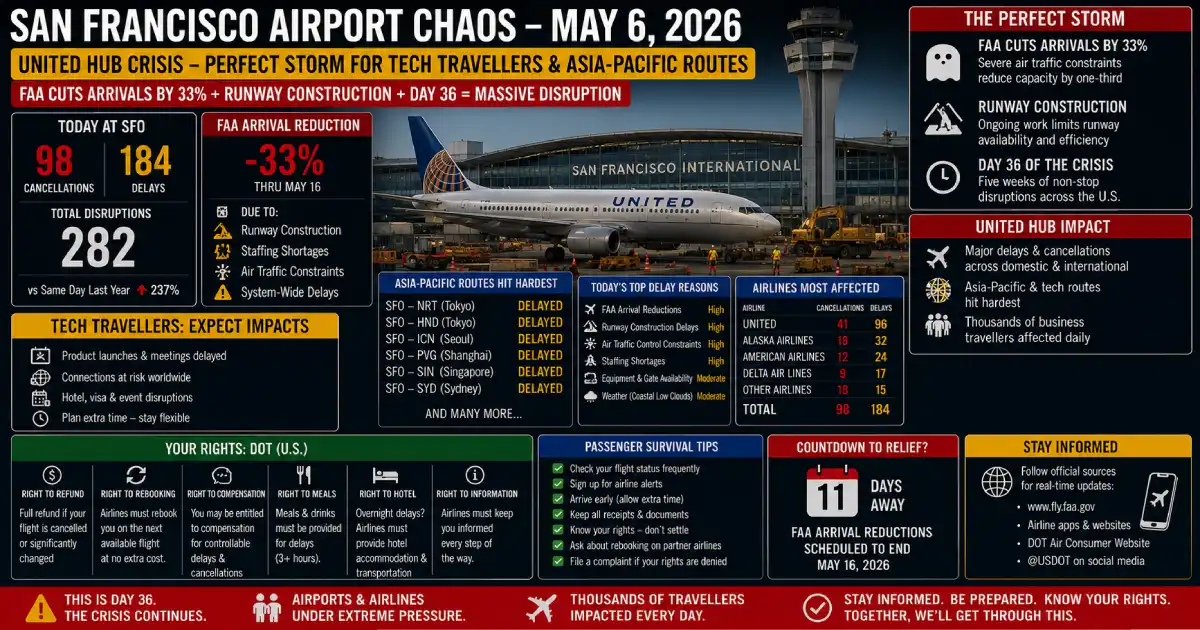
Breaking: San Francisco International Airport is today operating under the most constrained conditions in its history. Three crises are converging simultaneously on Wednesday May 6: the FAA has permanently cut SFO’s maximum arrival rate from 54 to 36 aircraft per hour — a 33% reduction — a six-month runway construction project is removing critical capacity through October, and the 36-day post-Easter national aviation crisis is cascading Chicago delays into United’s dominant SFO hub. Asia-Pacific routes to Tokyo, Shanghai, Seoul, and Sydney are all at elevated risk. Silicon Valley’s business travel corridor is absorbing delays that are pushing morning meetings into afternoon, and afternoon meetings into tomorrow.
Published: May 6, 2026 Airport: San Francisco International Airport (SFO) — California Day in Post-Easter Crisis: Day 36 — longest continuous US aviation disruption since post-9/11 Day Post-Spirit: Day 5 — Spirit displacement still flowing through system SFO Disruptions (pattern): 297 delays + 6 cancellations = 303 total (recent pattern — today follows same trajectory) SFO Rank Today: 3rd most disrupted US airport — behind ORD cascade and FLL post-Spirit Root Cause 1: FAA permanently cuts arrivals from 54 → 36 per hour — new parallel runway safety rule Root Cause 2: 6-month runway resurfacing project — reduced to October 2026 Root Cause 3: ORD May 5 ground stop cascade → United aircraft out of position coast-to-coast Root Cause 4: Bay Area coastal fog — further reduces FAA arrival rate below 36/hour during windows United Airlines: ~50% of all SFO passenger traffic — most exposed carrier Key Routes at Risk: Tokyo Narita/Haneda (NRT/HND) · Shanghai Pudong (PVG) · Seoul Incheon (ICN) · Sydney (SYD) · London Heathrow (LHR) · Frankfurt (FRA) · Singapore (SIN) · New York (JFK/EWR) Fog Risk Window: Early morning + late afternoon — SFO’s notorious coastal fog pattern Delay Average: 64–120 minutes during FAA ground delay programs FAA O’Hare Summer Cap: May 17 — 11 days away Rescue Fare Deadlines: JetBlue $99 EXPIRED yesterday · Southwest counter EXPIRES TODAY · United $199 through May 16 Silicon Valley Impact: SFO = gateway for Apple, Google, Meta, Netflix, Salesforce corporate travel Alternative Airports: Oakland (OAK) · San Jose (SJC) · Sacramento (SMF) DOT Rights: Full cash refund mandatory — 7 business days — all cancellations
Every other airport in America is experiencing the 36-day post-Easter crisis. Only San Francisco is experiencing it on top of a permanent structural capacity reduction and a six-month construction project simultaneously. Today’s SFO chaos is not just Day 36 of the same national story. It is the national crisis arriving at an airport that is already operating at its structural limits — with no recovery buffer.
San Francisco International Airport is bracing for a prolonged period of heavier delays as new Federal Aviation Administration limits on arrivals collide with runway construction, chronic Bay Area weather disruptions and United Airlines’ dominant hub schedule at the airport. Publicly available FAA information and recent news coverage indicate that San Francisco International Airport’s maximum arrivals have been reduced from 54 to 36 flights per hour after regulators moved to restrict parallel landings on the airport’s closely spaced east-west runways. The change, announced at the end of March 2026, is being described as a permanent safety-focused adjustment layered on top of a temporary runway construction project.
The mathematics are brutal. At 54 arrivals per hour — SFO’s previous maximum — the airport could handle its peak schedule with some buffer for weather-driven slowdowns. At 36 arrivals per hour — the new permanent limit — the airport is operating at 67% of its previous arrival capacity. On a clear day with no weather, this produces manageable delays. On a day with coastal fog (which reduces the arrival rate further), or a day when Chicago’s ground stop has left United aircraft scattered across the country, or both — it produces the kind of cascade that tech workers at Gate 82 are staring at right now.
Airport officials have previously forecast that about 25 percent of arriving flights could face delays of 30 minutes or more during the construction period. With the FAA’s new landing rules added to the mix, transportation analysts expect that proportion to climb, particularly during peak morning and evening banks popular with business travelers.
The Federal Aviation Administration has moved to ban simultaneous side-by-side landings on San Francisco International Airport’s closely spaced parallel runways. The change follows heightened scrutiny of runway operations nationally and adds a permanent constraint on how many aircraft can safely arrive at SFO in a given hour. Until now, SFO’s operations relied heavily on parallel approaches that allowed two aircraft to land at nearly the same time on runways separated by about 750 feet.
This is not a temporary COVID-style capacity reduction. This is a safety-driven permanent rule change. The FAA determined that SFO’s parallel runways — separated by approximately 750 feet — are too close for safe simultaneous landings under its new national standards. Until those runways are modified or expanded (which would require years of construction and environmental review), SFO operates permanently at a maximum of 36 arrivals per hour.
The runway construction project running through October 2026 compounds this: An ongoing resurfacing and taxiway project has taken one set of north-south runways out of service for much of 2026. The runway project is currently expected to run for roughly six months, with a reopening target in early October 2026. Until then, SFO will operate with significantly reduced flexibility.
The combined effect: SFO’s permanent arrival cap of 36/hour is further reduced during construction because the fewer available runways reduce the airport’s ability to sequence arrivals safely when conditions deteriorate. On a fog morning — when visibility drops below ILS Category I minimums — the FAA reduces arrival rates below 36. On a high-demand day — when the Chicago cascade sends more aircraft toward SFO than the reduced hourly rate can process — the queue builds from 7am and never recovers.
San Francisco International serves as United Airlines’ primary transpacific gateway as well as one of its largest domestic connecting hubs. Industry data and airport profiles show that United accounts for roughly half of all passenger traffic at SFO, making the carrier particularly exposed to any structural drop in the airport’s hourly capacity.
United is not just the biggest carrier at SFO. It is the carrier that makes SFO what it is. Half of every passenger who walked through SFO’s terminals last year was flying United. The United hub schedule at SFO is built around:
Morning bank (07:00–10:00): Domestic feeders arriving from across the West — Los Angeles, Seattle, Portland, Las Vegas, Phoenix, Denver — then connecting to Asia-Pacific departures Midday bank (11:00–14:00): Transcontinental arrivals from New York (JFK/EWR), Chicago (ORD), Washington (IAD), and Boston connecting to trans-Pacific Evening bank (17:00–21:00): Late domestic arrivals connecting to overnight Asia-Pacific departures — the critical departure bank for Tokyo, Shanghai, Seoul, Singapore, Sydney
Industry observers say United is also making greater use of alternate hubs such as Denver and Los Angeles to protect long-haul itineraries when San Francisco’s arrival rate falls well below its scheduled demand. In some cases, that may mean rebooking passengers onto connecting routings that bypass SFO entirely during severe weather events or peak congestion windows.
Today — Day 36 — United’s morning domestic feeders from Chicago are late because O’Hare ran a ground stop until 10pm last night. Late domestic feeders mean late connecting passengers for the midday bank. Late midday bank passengers miss trans-Pacific connections. Missed trans-Pacific connections mean late evening trans-Pacific departures as United attempts to protect booked passengers. By the time the Tokyo NRT departure bank rolls at 20:00–22:00, the morning’s Chicago ground stop has propagated all the way to Japan.
United’s recent travel waivers and customer guidance for FAA-related capacity cuts suggest a range of tools the airline deploys in San Francisco. These can include flexible rebooking windows, change-fee waivers and, in some cases, the ability to move trips several days earlier or later without additional fees.
The FAA’s 36/hour cap is the ceiling. The coastal fog is what repeatedly pushes SFO below that ceiling.
Weather conditions in California, particularly fog and low visibility, have been notorious for affecting flight schedules at SFO. The dense fog that frequently rolls in during the early morning and evening hours can severely reduce visibility for pilots, causing delays in both departures and arrivals.
Runway construction at SFO means reduced capacity expected to remain in place through much of 2026. Reduced arrival slots mean fewer opportunities to maintain tight turnaround times, impacting not just local flights but also global connections. Because San Francisco serves as a major gateway for transpacific and transcontinental routes, delays here can ripple across international networks.
The Bay Area’s summer fog pattern — called the “June Gloom” locally, though it runs from May through August — is one of the most predictable weather phenomena at any major US airport. Every morning from approximately May through August, marine fog rolls in from the Pacific overnight and sits over the Bay Area through mid-morning. Most days it burns off by 10am–noon. But during the burn-off window, SFO’s visibility drops below the minimums for standard IFR approaches — forcing the FAA to reduce arrival rates further, from 36 per hour to as low as 18–24 per hour under Category II/III instrument conditions.
Today, May 6, is in the first week of SFO’s summer fog season. The fog that rolled in overnight has extended the morning ground delay program. Early business travellers — the 07:00–09:00 departure bank that serves Silicon Valley’s Monday morning meeting culture — are sitting at gates watching departure boards flip from “On Time” to “Delayed” as the fog holds.
SFO is not just a US domestic hub. It is the United States’ primary Pacific gateway for the Bay Area, Silicon Valley, and Northern California. Today’s delays at SFO cascade internationally in ways that ORD, DFW, and ATL do not.
United operates multiple daily SFO–Tokyo Narita and SFO–Tokyo Haneda services — among the highest-revenue routes in its entire network. A delayed SFO departure tonight means a delayed Tokyo arrival tomorrow morning — after a 10-hour flight. Tokyo-based passengers connecting onward to Seoul, Shanghai, Singapore, or Bangkok absorb a 4–6 hour delay into their onward connections. A flight delay that started at Chicago last night has, by tomorrow morning, reached every major Asian business hub.
Silicon Valley’s relationship with Shanghai is one of the most commercially important aviation relationships in the world. Apple, Google, Meta, Tesla — every major Bay Area tech company has significant China operations. SFO–Shanghai is not a leisure route. It is a business lifeline. Today’s SFO delays on China routes are simultaneously disrupting deal meetings, factory visits, and product launches across the Pacific.
SFO–Seoul is operated by both United and Korean Air, with significant codeshare traffic. Korean Air’s SFO operations are today at elevated delay risk from the same FAA capacity constraints affecting United. Korean Air’s ICN hub is Southeast Asia’s primary connector — a delayed SFO–ICN arrival cascades into connections to Vietnam, Thailand, Indonesia, and the Philippines.
International travelers on airlines like China Airlines and Air Canada Rouge are also dealing with disruptions, which affect routes between Phoenix and major international hubs.
United’s SFO–Sydney service is one of the longest transpacific routes in its network — a 14-hour flight operated by a Boeing 787-9 Dreamliner. A delayed SFO departure tonight means Australian passengers arrive in Sydney tomorrow afternoon instead of morning — missing an entire day of business meetings.
For Australian passengers connecting from Sydney through SFO to continental US cities: today’s SFO delays are cascading into Sydney arrivals. If your United SYD–SFO–domestic connection involves a midday SFO arrival: allow maximum connection time. United’s domestic feeder from SFO to your final destination city is also delayed today from the morning’s fog and Chicago cascade.
SFO–London is operated by both United (daily 787) and British Airways (daily 777/787). A delayed SFO–LHR departure tonight reaches Heathrow tomorrow morning — adding to the Day 36 transatlantic cascade already arriving from JFK, EWR, and ORD. UK passengers connecting at Heathrow from a SFO overnight service should allow maximum connection time at LHR tomorrow morning.
San Francisco’s $10B+ tourism economy absorbs hits from SFO woes, as 60% of visitors arrive by air. Today’s chaos deters last-minute bookings, slashing hotel fills by 5-10% short-term.
But SFO’s economic impact goes far beyond tourism. The airport serves as the physical infrastructure for the world’s largest technology industry cluster — a 50-mile corridor stretching from San Francisco through Palo Alto to San Jose, housing Apple, Google, Meta, Netflix, Salesforce, Airbnb, Uber, Lyft, and hundreds of major tech companies.
The specific business travel patterns that make SFO’s disruptions uniquely costly for the US economy:
Monday morning departures to New York: The San Francisco–New York (JFK/EWR) corridor is one of the most heavily traveled business routes in US aviation. Monday 07:00–09:00 SFO departures to New York carry bankers, VCs, and tech executives to Monday morning meetings. Today’s fog-extended ground delay program has pushed the first departures back by 90+ minutes — turning Monday morning Wall Street meetings into Monday afternoon meetings.
Wednesday departures to Asia: Wednesday is the peak mid-week departure day for Bay Area executives traveling to Asia on overnight flights. A Wednesday evening SFO–Tokyo or SFO–Shanghai departure arrives Thursday morning local time — the optimum schedule for Thursday–Friday Asia business meetings. Today’s SFO chaos is directly disrupting that schedule pattern for thousands of tech and finance executives.
Airport alternative assessment for Silicon Valley: For tech workers and business travellers based in Silicon Valley who cannot absorb today’s SFO delays:
United managed 1 cancellation (0% rate) but 28 delays (6% of operations), impacting its SFO stronghold.
United is the carrier most exposed to SFO’s structural capacity constraints because it has built its entire West Coast transpacific hub around SFO’s historic arrival rate of 54/hour. Every planning assumption — bank spacing, minimum connection times, crew positioning, spare aircraft deployment — was calibrated for 54 arrivals per hour. At 36/hour, those assumptions are wrong by 33%.
United’s response has been to make greater use of Denver (DEN) and Los Angeles (LAX) for long-haul routings — reboarding passengers who would normally connect at SFO onto alternative hub connections. For passengers booked SFO–Tokyo today: United may rebook you via LAX–Tokyo or ORD–Tokyo if the SFO delay makes your booked connection unworkable.
United SFO rescue for delay-affected passengers: united.com → My Trips → Rebooking options | 1-800-864-8331 | United app
United rescue fares for Spirit passengers: united.com/specialfares — $199 one-way — through May 16. Still active.
Alaska Airlines operates a significant SFO presence with feeders from Seattle, Portland, and Pacific Northwest cities. Alaska’s SFO delays today are predominantly inherited from its Seattle (SEA) hub — which is itself absorbing the Day 36 national cascade — combined with SFO’s reduced arrival rate.
Alaska Airlines faced solely delays — 9 delays (11% of operations).
Contact Alaska: alaskaair.com | 1-800-252-7522 | Alaska app
Delta’s SFO operation connects its Atlanta hub to Pacific destinations. Delta’s SFO delays today are driven by Atlanta’s ongoing elevated disruption (103 cancellations + 261 delays May 4) cascading into SFO via Delta’s transcontinental services. Delta faced solely delays — 19 delays (12% of operations).
Contact Delta: delta.com | 1-800-221-1212 | Fly Delta app
American’s SFO operation is smaller than United’s or Alaska’s — but its Dallas/Fort Worth cascade is directly reaching SFO today. American Airlines topped issues with 4 cancellations out of roughly 67 flights (6%) and 10 delays (15%), signaling network strain.
Contact American: aa.com | 1-800-433-7300 | American app
Smaller carriers like ZIPAIR, Turkish Airlines, and Qantas each saw 1 delay (33–50% rates). International travelers on airlines with high delay percentages (50%) are facing compound Pacific disruption.
Most-affected international carriers at SFO today:
With federal safety measures, construction crews and airline schedulers all reshaping SFO’s operations at once, the airport is likely to remain a focal point in the broader national conversation about capacity, reliability and the limits of crowded hub airports during peak travel seasons.
With the runway project not expected to wrap up until early October 2026 and the FAA’s parallel-landing restrictions in place indefinitely, travelers transiting SFO this spring and summer should be prepared for heightened delay risk, particularly during the busy late afternoon and evening peak.
The summer outlook for SFO passengers is not encouraging. The construction project runs through October. The FAA parallel runway restriction is permanent. The Bay Area fog season runs May through August. Memorial Day weekend (19 days away) will test the reduced-capacity airport against its highest single-weekend passenger volume of the year.
For passengers with summer SFO bookings:
Southwest airport counter fares ($200/$300/$400 flat for Spirit passengers) expire TODAY May 6 at 11:59 PM CDT. This is your absolute last opportunity. Go to any Southwest ticket counter. Bring your Spirit confirmation number. Counter only.
After today: normal Southwest dynamic pricing returns.
Still available:
Any SFO flight cancelled for any reason — FAA capacity program, fog, mechanical, airline operational — entitles you to a full cash refund of your complete ticket price and all fees, returned to your original payment method within 7 business days. State explicitly: “I am requesting a full cash refund to my original payment method under the DOT refund rule.”
Domestic delay 3+ hours: full cash refund if you choose not to travel. International delay 6+ hours: same right applies.
✅ Meal vouchers — 3+ hour airline-caused delays (ask at United, Alaska, Delta, American desks) ✅ Hotel accommodation — overnight airline-caused cancellations ✅ Rebooking — next available flight for all cancellations ✅ United alternative hub rebooking — via LAX or DEN for trans-Pacific passengers when SFO capacity prevents SFO connection
EU261 applies to EU-operated flights (Lufthansa, Air France, etc.) departing from SFO. For United, Alaska, and American international flights from SFO: DOT rules apply. For connection disruptions caused by SFO delays that result in a missed EU261-covered connection at an EU airport: document the delay cause at SFO for your EU261 claim at the European end.
airconsumer.dot.gov | 1-202-366-2220 | Credit card chargeback = fastest practical remedy.
Step 1 — Check fog conditions before leaving home. flysfo.com live weather + FAA nasstatus.faa.gov. If a ground delay program is active at SFO, your morning departure is already delayed before you leave the house.
Step 2 — Track your inbound United aircraft. flightaware.com — search your flight number. If your United inbound from Chicago or New York departed late: your SFO departure is late regardless of Bay Area conditions.
Step 3 — Consider OAK or SJC if SFO shows 90+ minute delays. Oakland and San Jose are both operating without SFO’s structural constraints today. If your domestic route is served from OAK or SJC: check for available seats before committing to SFO delays.
Step 4 — For Asia-Pacific connections: build maximum buffer. 2.5 hours minimum connection at SFO for domestic feeder → trans-Pacific. If your domestic inbound is showing any delay: contact United immediately to be protected on the next trans-Pacific departure.
Step 5 — Go to Southwest counter TODAY for last Spirit rescue fares. Expires tonight at 11:59 PM CDT. Last call.
Step 6 — Request meal vouchers at 3 hours. United’s SFO customer service desks are in Terminal 3. Alaska is in Terminal 2. Ask explicitly — duty of care is not automatic.
Step 7 — Document everything. Screenshots of FAA ground delay program notices, departure board photos, airline app notifications. Keep all receipts for any expenses during your delay.
Posted By : Vinay
This article is provided for general informational purposes only and is based on information available at the time of publication. Travel advisories, airline schedules, airport operations, visa requirements, government regulations, and other travel-related information are subject to change without prior notice. While Travel Tourister makes reasonable efforts to verify information using official announcements, government publications, airline and airport communications, and other reliable sources, we cannot guarantee that all information remains complete, accurate, or up to date at all times. Readers should independently verify any information that may affect their travel plans with the relevant airline, airport authority, government agency, embassy, or other official source before making travel, financial, or other decisions. Travel Tourister shall not be liable for any direct or indirect loss, inconvenience, or damages arising from the use of or reliance on the information contained in this article. Nothing in this publication constitutes legal, immigration, financial, or professional travel advice. If you believe any information in this article is inaccurate or outdated, please contact our editorial team. We review all credible correction requests promptly and update our content whenever appropriate.
Lastest News
2nd Floor, 39, Above Kirti Club, DLF Industrial Area, Kirti Nagar, New Delhi, Delhi 110015



Travel Tourister is a leading Travel portal where we introduce travellers to trusted travel agents to make their journey hasselfree, memorable And happy. Travel Tourister is a platform where travellers get Tour packages ,Hotel packages deals through trusted travel companies And hoteliers who are working with us across the world. We always try to find new and more travel agents and hoteliers from every nook and corners across the world so that you could compare the deals with different travel agents and hoteliers and book your tour or hotel with the one you have chosen according to your taste and budget.
Copyright © Travel Tourister, India. All Rights Reserved

 Call
Call Enquiry