Published on : 19 Jun 2026
By Travel Tourister | Updated June 2026
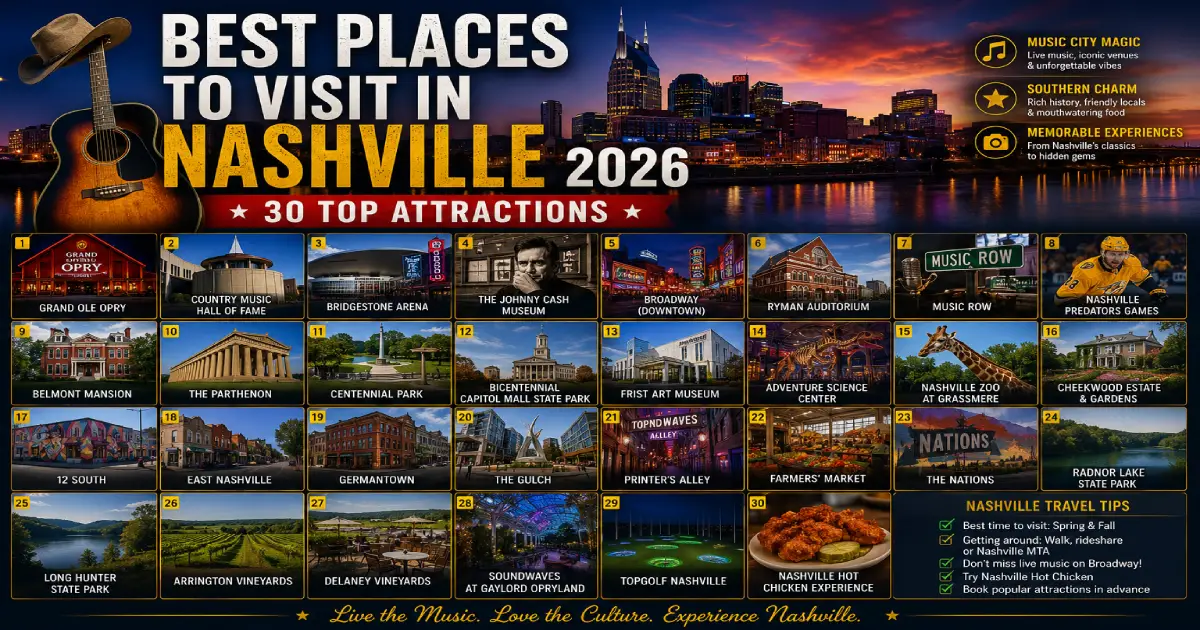
Nashville has earned its “Music City” nickname across nearly a century of country music history, but the best places to visit in Nashville in 2026 extend far beyond the honky-tonk bars and recording studios that built the city’s reputation — the Grand Ole Opry, Ryman Auditorium, and Country Music Hall of Fame anchor an extraordinary concentration of music history within a walkable downtown, while neighborhoods like 12 South, East Nashville, and Germantown have developed into nationally-recognized dining and lifestyle destinations that draw visitors with no particular interest in country music alongside those making pilgrimages specifically for Music City’s sonic heritage. Nashville receives over 16 million visitors annually, more than double the figure from a decade ago, reflecting a genuine transformation from a niche music-tourism destination into a broad-appeal American city that ranks among the most popular domestic travel choices for bachelorette parties, food tourism, corporate meetings, and general leisure travel.
What makes Nashville particularly rewarding to explore is the physical compactness of its most significant attractions relative to the city’s actual geographic spread — Lower Broadway’s honky-tonk strip, the Ryman Auditorium, the Country Music Hall of Fame, the Johnny Cash Museum, the Tennessee State Museum, and Fort Nashborough all sit within roughly a half-mile radius of each other in downtown Nashville, making a single concentrated morning or afternoon of walking capable of covering more cultural ground than a full day of driving between dispersed attractions in many other American cities. Beyond this downtown core, Nashville’s neighborhoods (the Gulch, 12 South, Germantown, East Nashville) each offer distinct characters worth dedicating specific time to, while outer-suburban attractions (The Hermitage, Belle Meade, Jack Daniel’s Distillery as a day trip) extend the city’s cultural offering for visitors staying multiple days.
This guide covers the 30 best places to visit in Nashville with practical details — entry costs, parking/transit information, best visiting times, and insider tips — organized to help first-time and returning visitors efficiently experience Music City’s remarkable concentration of music history, culinary innovation, and neighborhood character in 2026.
For complete guides, see our Things to Do in Nashville 2026, Best Restaurants in Nashville, and Best Time to Visit Nashville guides.
| Place | Area | Entry Cost | Best For | Time Needed |
|---|---|---|---|---|
| Lower Broadway | Downtown | Free | Honky-tonks, live music, atmosphere | 2–4 hrs |
| Ryman Auditorium | Downtown | $25–$30 (tour) / $40–$120 (show) | Music history, performances | 1–3 hrs |
| Country Music Hall of Fame | Downtown | $28–$45 | Music history, artifacts | 2–3 hrs |
| Grand Ole Opry House | Opryland | $45–$100+ (show) / $28 (tour) | Live radio show, country music | 2.5–3.5 hrs |
| Parthenon at Centennial Park | Midtown | Free (exterior) / $10 (interior) | Architecture, art, park | 1–1.5 hrs |
| Johnny Cash Museum | Downtown | $25 | Cash history, artifacts | 1–1.5 hrs |
| The Gulch | Downtown/South | Free | Murals, dining, street art | 1–2 hrs |
| 12 South | South Nashville | Free | Shopping, dining, murals | 2–3 hrs |
| Germantown | North Nashville | Free | Historic architecture, dining | 1–2 hrs |
| RCA Studio B | Music Row | $20–$30 (guided tour) | Recording history, Elvis | 1 hr |
| East Nashville | East Nashville | Free | Dining, arts, local vibe | 2–3 hrs |
| Belle Meade Historic Site | West Nashville | $22 | Plantation history, wine | 1.5 hrs |
| The Hermitage | Hermitage | $28 | Presidential history | 2–3 hrs |
| Bluebird Cafe | Green Hills | $0–$25 | Songwriter rounds | 2 hrs |
| Cheekwood Estate & Gardens | Belle Meade | $25 | Art, gardens, estate | 2–3 hrs |
| Radnor Lake State Natural Area | Oak Hill | Free | Hiking, wildlife, nature | 1.5–2 hrs |
| Gaylord Opryland Resort | Opryland | Free (public areas) | Architecture, gardens | 1–2 hrs |
| National Museum of African American Music | Downtown | $30 | Music history, culture | 1.5–2 hrs |
| John Seigenthaler Pedestrian Bridge | Downtown/East | Free | Skyline views, photography | 30 min |
| Musicians Hall of Fame | Downtown | $25 | Session music history | 1–1.5 hrs |
| Tennessee State Museum | Downtown | Free | State history, exhibits | 1.5–2 hrs |
| Fort Nashborough | Downtown | Free | Colonial history | 30 min |
| Frist Art Museum | Downtown | $15 | Contemporary/traveling art | 1.5–2 hrs |
| Marathon Village | Germantown-adjacent | Free | History, shopping, distillery | 1 hr |
| Nashville Farmers’ Market | Germantown | Free | Food, local produce, market | 1–2 hrs |
| Adventure Science Center | South Nashville | $20 | Families, science exhibits | 2–3 hrs |
| Bicentennial Capitol Mall State Park | Downtown | Free | State history monuments | 30–60 min |
| Music Row | Midtown | Free (exterior) | Recording studios, industry | 30–60 min |
| Station Inn | The Gulch | $20–$25 | Bluegrass, acoustic music | 2 hrs |
| Tennessee State Capitol | Downtown | Free | Government, architecture | 45–60 min |
Entry: Free | Location: Broadway between 1st and 5th Avenues, downtown | Best Time: Afternoon (2–6 PM, before peak night crowds) or late night
Lower Broadway is Nashville’s defining attraction — a concentrated five-block strip of honky-tonk bars, neon signs, boot shops, and continuous live music that has made Nashville one of America’s most visited cities and created a specific tourist culture that now shapes the entire city’s identity. Every venue on the strip features live bands playing multiple daily sets without a cover charge, with musicians working for tips — meaning visitors can walk in, listen to legitimate working musicians playing country, bluegrass, and rock, tip appropriately, and move on to the next bar, creating a self-guided live-music festival experience that’s unique among American tourist destinations.
The strip’s most historically significant venues include Tootsie’s Orchid Lounge (the purple-painted bar where country music’s greatest songwriters allegedly slipped out the back alley to pitch songs to Opry performers at the Ryman, the door of which opens directly into the alley behind Tootsie’s) and Robert’s Western World (which has maintained a commitment to traditional, pre-pop-country honky-tonk music even as surrounding venues have broadened toward more pop-influenced programming, earning devotion from traditionalist country music fans). The newer additions — multi-story rooftop honky-tonks including Honky Tonk Central (four floors, rooftop bar) and Nashville Underground (multiple levels, large stage) — cater to the broader party-tourism crowd with more elaborate production values than the older, more intimate honky-tonks.
The street itself has been pedestrian-friendly and closed to vehicles during certain evening hours for years, enabling the sidewalk-bar-hopping culture that defines a Broadway visit. The area has expanded eastward in recent years, with the “SoBro” (South of Broadway) neighborhood across the street adding venues and hotels, while the western end transitions toward the Convention Center and broader downtown.
Insider tips: Weekday afternoons (Tuesday through Thursday, 2-5 PM) deliver Broadway’s best balance of live music quality and manageable crowds — the same caliber of musicians perform to audiences of manageable size rather than the packed weekend evenings that make bar entry and movement between venues difficult. Avoid Lower Broadway between midnight and 2 AM on weekends if you’re not specifically seeking peak-party energy — the crowds become genuinely challenging for casual exploration, though this exact energy is what some visitors specifically come for.
Entry: Daytime self-guided tour $25–$30 | Evening shows $40–$120+ | Address: 116 5th Avenue North | Best Time: Evening performances; daytime tours on non-show days
The Ryman Auditorium, built in 1892 as Union Gospel Tabernacle by riverboat captain Thomas Ryman (who reportedly built it after a religious conversion experience at a revival meeting held by preacher Sam Jones), became country music’s most sacred performance space after the Grand Ole Opry moved its weekly radio broadcast there in 1943 — remaining the Opry’s home until the new Grand Ole Opry House opened in 1974, then sitting vacant for years before major renovation restored it to active performance use in the 1990s. The building’s original wooden pews (still in use as audience seating), stained-glass windows depicting the Confederate memorial that prompted Ryman’s original commission to build the structure, exposed brick, and remarkable acoustics (performers across genres consistently cite the Ryman as their favorite American venue to perform in specifically for acoustic quality) create an atmosphere unlike any other concert hall or music venue in America.
The backstage area (accessible on certain tours) includes the original dressing rooms used by decades of Opry performers, the stage itself (where visitors can stand during daytime tours), and historical exhibits covering the building’s tabernacle origins and its transformation into country music’s defining performance space. A notable historical detail: the building’s back alley, which opens directly into Tootsie’s Orchid Lounge on Broadway, reportedly allowed Opry performers to slip out for drinks between sets during the building’s Opry era — a connection that shaped both institutions’ histories.
Insider tips: Evening performances (check the current show calendar at ryman.com for upcoming events) provide the most complete Ryman experience — the combination of excellent acoustics and the building’s historical atmosphere creates genuinely memorable concert experiences regardless of the specific artist performing. Daytime tours (self-guided with included audio guide, available when no events/rehearsals are scheduled) allow access to the stage itself for photographs — the view from the Ryman’s stage, looking back at the original pews and stained-glass windows, is one of Nashville’s most striking and emotionally resonant visual experiences.
Entry: $28–$45 (various ticket tiers including studio tour bundles) | Address: 222 5th Avenue South | Metro/Parking: Downtown parking garages adjacent | Best Time: Weekday mornings
The Country Music Hall of Fame and Museum represents the definitive institutional history of country music — a purpose-built cultural institution (opened in its current building in 2001, extensively expanded since) housing exhibits spanning country music’s Appalachian folk and blues roots through contemporary country-pop, with artifacts including Elvis Presley’s “Solid Gold Cadillac” (a gold-plated 1960 Cadillac, the most eye-catching single object in the museum), Johnny Cash’s handwritten lyrics and stage costumes, Patsy Cline’s personal items, and thousands of additional objects representing the genre’s full history and the lives of its central performers, songwriters, and producers.
The Hall of Fame Rotunda (where inducted artists’ bronze plaques are permanently displayed, with new inductees added annually through a voting process — election to the Country Music Hall of Fame representing the genre’s highest institutional honor) carries particular emotional weight for country music fans — the full roster of inductees spans from Jimmie Rodgers and the Carter Family (inducted in the inaugural 1961 class) through contemporary artists, with plaques presented on rotating circular displays that create a genuinely impressive architectural space dedicated to the music’s honorees.
The museum’s architecture deserves attention independently — designed to incorporate musical symbolism throughout, with a section of the building’s curved exterior evoking a 1950s-era guitar tailpiece, a roofline section resembling piano keys, and the rotunda’s circular design referencing the iconic circular label on early country music 78 RPM records.
Insider tips: The combination ticket including the Historic RCA Studio B tour (departing from the museum on a scheduled shuttle) provides significantly more value than either experience independently — book this combination when purchasing to ensure a spot on the Studio B tour, as shuttle capacity is limited and these slots can sell out on busy days. Audio guides (included with some ticket tiers, or rentable separately) add substantial context to the permanent collection exhibits, particularly for visitors with less existing background in country music history.
Entry: Shows $45–$100+ | Daytime tours $28 | Address: 2804 Opryland Drive | Best Time: Attend a Tuesday, Friday, or Saturday evening show | Book: Weeks ahead for popular performances
The Grand Ole Opry House, opened in 1974 as the new home for the world’s longest-running live radio broadcast, seats 4,400 guests in a purpose-built auditorium designed specifically for the Opry’s unique format — multiple performers sharing a single evening, in a show that maintains its radio-broadcast structure and feel even as visual production values have been significantly enhanced over the decades. The famous “circle” — a 6-foot round section of the original Ryman Auditorium’s stage floor, preserved and embedded center-stage at the new venue when the Opry relocated — physically connects every performer who walks onstage at the Opry House to the building’s predecessor and to the century of performers who stood on that same wood before them.
Daytime tours (available most non-show days, sometimes even on show days through certain tour packages) provide access to the backstage areas, dressing rooms, the stage itself (including standing on the famous circle), and historical exhibits on the Opry’s broadcasting history and notable performances. The tours provide meaningful context that enhances an evening show attendance significantly — considering a daytime tour followed by an evening performance on the same visit provides the most comprehensive Grand Ole Opry experience available.
The Grand Ole Opry House’s location in the broader Opryland area (adjacent to the massive Gaylord Opryland Resort, with additional tourist infrastructure nearby) means it functions as a destination requiring specific transportation from downtown Nashville (approximately 10 miles, most visitors use rideshare or rental car) rather than being walkable from the downtown hotel/attraction cluster.
Insider tips: The Opry’s Tuesday evening show (less promoted than the Friday/Saturday shows) typically features a similar lineup caliber at lower ticket prices and with better availability for last-minute booking — worth considering for visitors with schedule flexibility. The show’s format (multiple performers rotating through the broadcast, with announcer interludes maintaining the radio-show structure) differs significantly from a standard concert — visitors expecting a single-artist show should understand this multi-performer format in advance, as it creates a different experience from typical music venue concerts.
Entry: Parthenon interior $10 (exterior and park free) | Address: 2500 West End Avenue | Best Time: Anytime; spring and fall for park grounds
Nashville’s full-scale Parthenon replica — the only one in the world, built originally in 1897 for Tennessee’s centennial exposition and subsequently rebuilt in permanent concrete during the 1920s-1930s — houses a 42-foot gilded replica of the ancient Athena Parthenos statue (one of the largest indoor sculptures in the Western Hemisphere, positioned at the far end of the building’s main hall with deliberate dramatic impact as visitors’ eyes adjust from the exterior light) alongside an art museum in the building’s lower level featuring rotating exhibitions primarily focused on American art.
The surrounding Centennial Park (133 acres, Nashville’s primary downtown-adjacent urban green space) offers walking paths, a lake, regular community events and festivals, and the kind of curated green space that larger American cities typically reserve for their central parks — a scale appropriate to Nashville’s size that provides meaningful respite from the downtown core’s commercial density. The park’s open lawns and tree coverage (particularly during Nashville’s spring when dogwoods and redbuds bloom across park grounds) create a genuinely pleasant setting around what might otherwise feel like an incongruously classical structure in a contemporary American city.
Insider tips: The Parthenon’s exterior columns and sculptural program (pediment sculptures based on scholarly reconstructions of the original Parthenon’s decoration, partially painted in colors reflecting current archaeological understanding of how ancient Greek temple sculptures appeared) repay close examination — this is one of the few places in the world where visitors can see these sculptures at full scale and at eye level, without the distance enforced at the actual Acropolis. The park’s lake (with rental paddleboats in summer) and walking paths make it easy to spend more time here than the monument alone might suggest.
Entry: $25 | Address: 119 3rd Avenue South | Best Time: Any time; allow 1-1.5 hours
The Johnny Cash Museum, located in a building directly adjacent to Lower Broadway, presents the most comprehensive single-artist museum in Nashville — covering Cash’s complete career arc from his 1950s beginnings at Sun Records in Memphis through his extraordinary late-career renaissance with producer Rick Rubin (whose “American Recordings” series produced some of Cash’s most critically acclaimed and commercially successful work in the final decade of his life, including the cover of Nine Inch Nails’ “Hurt” that became one of country music’s most viewed music videos). The collection spans stage costumes from across decades (the evolution of Cash’s famous all-black performance clothing is charted explicitly), instruments (including guitars from specific recording sessions), personal correspondence, handwritten lyrics, and multimedia installations incorporating audio and video from recordings and performances.
Particularly notable is the museum’s treatment of Cash’s personal struggles — his decades-long battle with amphetamine addiction, his religious faith, his marriage to June Carter Cash and the broader Carter Family musical legacy — presented with candor that avoids both hagiography and exploitation, creating a human portrait alongside the musical one. The museum’s exhibits covering Cash’s prison concerts (Folsom Prison, San Quentin) and their cultural impact represent some of the most historically significant programming within the collection.
Insider tips: The museum’s central downtown location makes it an efficient addition to a Broadway/Ryman/Hall of Fame walking circuit — all three are within easy walking distance of each other, allowing a single morning or afternoon to cover the core of Nashville’s downtown music-history museum cluster. The attached Nudie’s Honky Tonk bar (occupying the building’s ground floor and separate from the museum) is worth noting for visitors interested in the famous “Nudie suit” rhinestone-and-embroidery cowboy aesthetic that defined country music performance costuming from the 1940s through the 1970s.
Entry: Free | Location: Between downtown and 12 South, centered on 11th and 12th Avenues | Best Time: Daytime for street art; evenings for dining
The Gulch, Nashville’s first LEED-certified neighborhood (a designation for sustainable development standards), occupies a former railroad gulch (the depressed rail corridor that gives the neighborhood its name) that has been transformed over the past 20 years into one of the city’s densest concentrations of upscale dining, boutique hotels, and residential high-rises — the neighborhood’s most famous single feature being the “Wings” mural (a large pair of angel wings painted on an exterior brick wall, creating an “Instagram museum” in open-air format that has become one of Nashville’s most photographed single locations, with visitors lining up for the standard “spread your arms and appear to have wings” photograph that’s become nearly mandatory in Nashville travel photography).
Beyond the mural, the Gulch’s restaurant concentration (including some of Nashville’s most-reviewed and reservation-demanding fine dining alongside more casual concepts), the Station Inn’s bluegrass venue (see separately), and its transitional position between downtown and the 12 South neighborhood make it a natural walking connection point for visitors exploring Nashville’s south-of-downtown districts — the neighborhood’s walkability (relatively flat compared to Nashville’s broader terrain) enables efficient movement between its various dining and nightlife destinations.
Insider tips: The “Wings” mural (501 12th Avenue South side, on the back wall of a building) typically has a queue during peak weekend hours — visiting early on weekday mornings provides the best opportunity for an unobstructed photo. The Gulch’s restaurant scene is dense enough to merit specific research before arrival — walking in and choosing randomly from the visible options is less efficient than identifying specific target restaurants in advance, as several of Nashville’s most-discussed restaurants concentrate in this specific neighborhood.
Entry: Free | Location: 12th Avenue South, between Linden and Kirkwood Avenues | Best Time: Weekend afternoons; weekday mornings for café atmosphere
12 South represents Nashville’s most successful boutique retail and casual dining neighborhood — a roughly half-mile commercial strip that has transformed from a quiet residential side street into a nationally-recognized shopping and eating destination, while maintaining enough independent business character (compared to purely chain-dominated commercial strips) to remain genuinely interesting rather than feeling like a generic lifestyle retail district. The neighborhood’s anchor visual is the “I Believe in Nashville” mural (painted on the side of a building mid-strip, effectively a statement of local pride that became an ironic selfie destination for the visiting bachelorette parties and tourists who now constitute a significant portion of 12 South’s foot traffic alongside actual Nashville residents).
The neighborhood’s retail offerings (clothing boutiques, bookshops, artisanal food products, lifestyle goods) lean toward premium-independent rather than mass-market, while the dining options range from the original Burger Up (a locally-owned elevated burger restaurant that played a significant role in establishing 12 South as a dining destination) through numerous subsequent openings that have made the strip a legitimate restaurant row. Ice cream shops (Jeni’s Splendid Ice Creams, based in Nashville with this flagship store being one of Nashville’s most visited dessert destinations, particularly during summer months) complement the broader dining/shopping circuit.
Insider tips: Combining 12 South with the Gulch (a 15-20 minute walk north on 12th Avenue) creates an efficient south-of-downtown circuit covering Nashville’s two most prominent boutique neighborhood destinations — manageable as a half-day itinerary, with the neighborhoods’ dining options providing lunch/dinner anchors on either end of the walk.
Entry: Free | Location: North of downtown, between Jefferson Street and the Tennessee State Fairgrounds | Best Time: Weekend mornings (near Farmers’ Market); evenings for dining
Germantown, Nashville’s oldest residential neighborhood (settled originally by German immigrants in the mid-19th century, whose community built the churches, commercial buildings, and residential structures that still define the neighborhood’s historic architectural character), has undergone significant revitalization over the past decade — moving from a primarily industrial/underutilized district to one of Nashville’s most sought-after residential and dining neighborhoods, while retaining sufficient historic building stock (Federal-style row houses, converted warehouses, 19th-century commercial buildings) to create an architectural character genuinely different from Nashville’s newer neighborhood developments.
The neighborhood’s restaurant scene (which has positioned Germantown as one of Nashville’s most serious culinary destinations, with multiple critically-acclaimed restaurants concentrated within its relatively compact boundaries) and its proximity to the Nashville Farmers’ Market (on the neighborhood’s southern edge, adjacent to Bicentennial Capitol Mall State Park) make it a natural combined visit — the Farmers’ Market on weekend mornings followed by the neighborhood’s architectural exploration and lunch or dinner at one of Germantown’s destination restaurants creates a complete half-day neighborhood itinerary.
Insider tips: The Germantown neighborhood’s historic architectural character (19th-century brick commercial and residential buildings) photographs particularly well in the morning light, before the neighborhood’s restaurants open for lunch service and the foot traffic builds — early morning exploration on foot, noting specific buildings’ construction dates (often visible on building cornices) and architectural details, rewards the unhurried walker in a way that the neighborhood’s commercial strips don’t always suggest from a purely restaurant/retail orientation.
Entry: $20–$30 (typically bundled with Country Music Hall of Fame admission) | Address: 1611 Roy Acuff Place (Music Row) | Best Time: Book specific guided tour slot | Tours: Depart from Country Music Hall of Fame on scheduled shuttles
RCA Studio B, a modest single-story building on Music Row that served as one of America’s most important recording studios from 1957 to 1977, recorded an extraordinary concentration of definitive American popular music across its two decades of operation — more than 1,000 Elvis Presley recordings (more than any other location in the world, making this building the single most productive Elvis recording site in existence), alongside hits from Roy Orbison (“Oh, Pretty Woman,” recorded here), the Everly Brothers, Dolly Parton, Waylon Jennings, and dozens of other major artists whose recordings from this studio are now considered classics. The studio’s “Nashville Sound” production aesthetic (smooth, orchestrated country recordings created here during the late 1950s and 1960s that intentionally broadened country music’s commercial appeal) was arguably one of the most influential production approaches in the history of American popular music.
The guided tour (small groups, led by knowledgeable guides, lasting approximately one hour) takes visitors into the actual recording room — largely preserved from its operating era, including original equipment — with audio playback of specific songs recorded in the space (creating the unusual experience of hearing the original recordings while standing in the physical room where they were made). The intimacy of the studio space (smaller than most visitors expect, reflecting the recording technology of the era rather than modern large-format studio design) and the concentration of musical history within a single room create a visit that resonates differently from the broader museum-format experiences of the Country Music Hall of Fame.
Insider tips: Book the Studio B tour component when purchasing Country Music Hall of Fame tickets rather than attempting to add it on the day of visit — tour shuttle spots have limited daily capacity and can sell out during peak tourist season, particularly for specific desired departure times. The tour’s audio playback component (hearing original recordings in the room where they were made) is the experience’s most distinctive element — wearing headphones or in-room speakers depending on current tour format, the spatial experience of music-in-context is genuinely different from listening through normal channels.
Entry: Free | Location: East Nashville, across the Cumberland River from downtown | Best Time: Weekend afternoons and evenings
East Nashville functions as Nashville’s most fully-realized “creative neighborhood” — a collection of distinct commercial districts (Five Points intersection, Inglewood, Riverside Village) that have emerged over the past 15 years as counter-programming to downtown’s honky-tonk tourist culture, drawing artists, musicians (Nashville’s substantial non-country music community, from Americana to indie rock to experimental music), chefs, and young residents seeking neighborhood character distinct from the downtown hotel and entertainment district. The neighborhood’s recovery after a significant 1998 tornado (which damaged or destroyed substantial portions of the neighborhood, catalyzing a wave of rebuilding that attracted new residents and businesses drawn by relatively affordable real estate) has created a built environment mixing original 1920s-1940s bungalows with renovated commercial buildings and newer construction.
The restaurant scene (multiple nationally-recognized restaurants have opened in East Nashville, drawing visitors specifically across the Cumberland for meals) and bar culture (neighborhood bars with notably different character from Broadway’s honky-tonks — craft beer-focused, local-music-oriented, less overtly tourist-programmed) create a genuine alternative Nashville experience for visitors willing to venture beyond downtown.
Insider tips: Five Points intersection (at the corner of 11th Street and Meridian, Forrest, and Clearview) serves as the neighborhood’s commercial heart — from here, restaurants and shops radiate in multiple directions along connected residential streets, making it the logical starting point for East Nashville exploration. The Pedestrian Bridge walk from downtown to East Nashville (approximately 30-minute walk from Lower Broadway to Five Points) provides a scenic, zero-cost transition between downtown and East Nashville for visitors without a car.
Entry: $22 (house tours + grounds) | Address: 5025 Harding Pike | Best Time: Weekday afternoons, spring and fall | Transport: Car or rideshare required
Belle Meade Plantation, a National Historic Landmark property in Nashville’s affluent Belle Meade neighborhood (itself named for the historic estate), operated as one of the 19th century’s most significant thoroughbred horse breeding farms — the property’s stallions contributed bloodlines to several subsequent American champion racehorses, with genealogical connections to major 20th-century thoroughbred champions (including lines traceable to Secretariat) that have made Belle Meade significant in American horse racing history beyond its role as a plantation house museum.
The historic site’s current interpretation addresses the property’s history comprehensively — including the stories of the approximately 136 enslaved people who lived and worked at Belle Meade at the property’s peak, with ongoing archaeological research and interpretation that has shifted the site’s focus from purely the plantation-owner family’s perspective toward a more complete historical picture. A reconstructed slave cabin and dedicated interpretive programming on specific enslaved individuals represent the site’s evolving approach to this complex history.
The property’s more recent addition of a winery (Belle Meade Plantation Winery) has created a contemporary recreational element alongside the historical tour — wine tastings in the carriage house and grounds provide a pleasant complement to the house tour, appealing to visitors whose primary interest is historical as well as those drawn more specifically to the winery component.
Insider tips: The combination of historic house tour and winery tasting works efficiently as a 2-2.5 hour total visit — check current tour times before arrival, as guided house tours depart at specific scheduled intervals rather than allowing fully self-paced exploration of the main house. The property’s gardens and grounds (thoroughbred horse statues, mature trees, and 19th-century landscape elements) are worth exploring independently before or after the guided tour.
Entry: $28 adults | Address: 4580 Rachel’s Lane, Hermitage (eastern Nashville suburb) | Best Time: Weekday mornings, allow 2-3 hours | Transport: Car or rideshare required (approximately 20 minutes from downtown)
The Hermitage, Andrew Jackson’s plantation estate located in Nashville’s eastern suburbs, has been open as a historic site since 1889 (one of the earliest presidential historic sites to be preserved and opened to the public in American history) — the property encompasses the primary mansion (largely original to Jackson’s era, with period-accurate furnishings), Jackson’s formal garden (designed by Jackson’s wife Rachel, who died shortly before his inauguration as President), and Jackson’s tomb (located in the garden alongside Rachel’s). The mansion itself survived multiple fires and periods of deferred maintenance across its 200+ years of preservation, with ongoing restoration efforts addressing specific rooms and structural elements continuously.
The site’s interpretation addresses Jackson’s presidency (including the Trail of Tears, the forced removal of Native American populations that represents one of Jackson’s most contested and consequential presidential actions, presented with increasing directness in contemporary site interpretation) alongside the lives of the approximately 161 enslaved people who lived and worked at the Hermitage at Jackson’s death in 1845, with ongoing archaeological and historical research informing progressively more comprehensive interpretation of the property’s full human history.
Insider tips: The site’s distance from downtown Nashville (approximately 20 minutes by car, not accessible by public transit) means it functions best as a dedicated half-day excursion rather than a brief add-on — the property’s scope (mansion tour plus grounds, garden, and exhibit buildings) genuinely fills 2-3 hours for visitors engaging meaningfully with the interpretation rather than moving quickly through. Combination tickets covering multiple Nashville historic sites are sometimes available — check current offerings if planning to visit both the Hermitage and Belle Meade.
Entry: $25 | Address: 1200 Forrest Park Drive | Best Time: Spring (April-May bloom) or fall (October foliage) | Transport: Car or rideshare required
Cheekwood, built in the early 1930s by Leslie Cheek (whose family fortune derived from Maxwell House Coffee, developed partly through a Nashville business partnership) as a private Georgian-style mansion, was donated to the public in 1960 and has operated since as a combined art museum and botanical garden — the 55-acre property contains over a dozen distinct garden areas (Japanese garden, perennial gardens, seasonal color gardens, a woodland trail system), alongside the mansion-turned-museum housing both a permanent collection and rotating art exhibitions in historically-furnished rooms that provide context for the estate’s original private-residence function.
The property’s seasonal programming (spring bulb displays beginning in March, Easter weekend programming, summer sculpture trail installations, fall foliage, and the “Holiday Lights” winter event featuring elaborate light displays throughout the gardens from late November through early January) extends Cheekwood’s appeal across the full calendar year rather than limiting it to a single optimal visiting season — though spring (when the daffodil collection along the woodland trail reaches peak bloom) and fall (when Japanese maple foliage peaks in the Japanese garden) represent the most dramatically photogenic windows.
Insider tips: The property’s “Cheekwood in Bloom” spring daffodil display (typically beginning in March and peaking in early April) has developed into one of Nashville’s most anticipated seasonal events, drawing significant visitors specifically for the daffodil-lined woodland trail — if visiting during this period, expect more visitors than the property’s typically calm atmosphere, and consider weekday mornings for a more uncrowded experience. The “Holiday Lights” event (late November through early January, separate evening-only ticketing) has become one of Nashville’s premier holiday season activities — book tickets well in advance as evening slots sell out during the holiday peak.
Entry: Free | Address: 1160 Otter Creek Road | Best Time: Early morning, year-round | Parking: Arrive early, especially on weekends
Radnor Lake, Tennessee’s first state natural area (designated 1973 after a significant preservation battle prevented development of the property), encompasses 1,368 acres of hardwood forest and a 55-acre lake (originally created in 1914 as a water supply for Louisville & Nashville Railroad’s steam locomotives, then allowed to develop into a natural wildlife habitat after railroad operations ceased) within remarkably close distance of downtown Nashville — the area’s southern boundary begins approximately 6 miles from downtown, making it Nashville’s most accessible substantial natural environment.
The trail system covers approximately 5 miles of maintained paths ranging from the easy Lake Trail (2.6 miles around the lake’s perimeter, relatively flat, suitable for most fitness levels) through more substantial hiking on Ganier Ridge and connecting trails that offer genuine elevation change and forest immersion. Wildlife is abundant and regularly visible — white-tailed deer are commonly encountered on the Lake Trail, particularly in early morning when they emerge to the lake’s edge, while various waterbird species (herons, egrets, and numerous waterfowl) use the lake year-round.
Insider tips: The parking lot (limited capacity) fills extremely early on weekend mornings during spring and fall — arriving before 8 AM on weekends is essential for securing a parking space without significant wait or the need to park on adjacent streets. Weekday mornings offer dramatically better parking and trail conditions, with substantially fewer other hikers on the most popular Lake Trail. Dogs are not permitted in the natural area (a policy that surprises some visitors) due to wildlife protection concerns — check current regulations before planning a pet-inclusive visit.
Entry: Free (public areas accessible without hotel guest status) | Address: 2800 Opryland Drive | Best Time: Christmas season (November-January) or any year-round visit
The Gaylord Opryland Resort, one of the largest non-gaming resort hotels in America (nearly 3,000 rooms, 9 acres of climate-controlled indoor gardens and atriums covered by glass enclosures), represents a Nashville attraction that many visitors don’t realize is accessible without being a hotel guest — the public areas (primarily the three massive glass-enclosed garden atriums, including a “Delta” area with an actual river channel and flatboat rides, and the “Cascades” area with a 40-foot waterfall feature) can be walked through by visitors not staying at the property, creating a genuinely unusual experience of immense indoor tropical-garden environments within a Nashville suburb.
The property’s Christmas programming (November through January, featuring elaborate lighting installations throughout the atriums, Ice! [a walk-through ice sculpture attraction carved by artisans from China annually, admission-priced separately], and various holiday entertainment programs) has made Gaylord Opryland one of Nashville’s most popular holiday-season destinations, drawing visitors specifically during this period who don’t necessarily combine the visit with other Opryland-area attractions.
Insider tips: The Delta atrium’s flatboat rides (weather-independent given the indoor setting, available year-round, modest additional charge) provide a distinctively unusual Nashville experience — gliding through an indoor river channel within a hotel atrium is a genuinely unexpected activity. The property’s scale (navigating between atriums requires significant walking through hotel corridors and public spaces) means comfortable shoes and reasonable time allocation (1-2 hours for a thorough exploration of all major indoor areas) serve better than a rushed 20-minute walk-through.
Entry: $30 | Address: 510 Broadway | Best Time: Weekday afternoons | Allow: 2 hours
The National Museum of African American Music, opened in early 2021 after nearly two decades of planning and fundraising, occupies a prominent Broadway address that places it within the country music tourist district while explicitly dedicated to the African American musical traditions that created virtually every American popular music genre — from gospel and blues through jazz, R&B, soul, funk, and hip-hop, as well as the often-underacknowledged African American contributions to country music itself (a particularly pointed statement given the museum’s location within country music’s capital city).
The museum’s approach — interactive, immersive, and focused on experience as much as display — involves “culture keepers” (live musicians and guides positioned throughout the museum to perform and discuss specific musical genres and their histories) rather than purely static exhibit presentation. Visitors can record their own vocals in a vocal booth, explore a virtual “Road to Freedom” timeline connecting African American music to broader civil rights history, and experience the sound and context of specific genres through spatial audio installations.
Insider tips: The museum’s interactive elements (particularly the vocal recording booth and the interactive listening stations) reward visitors who engage fully rather than moving through quickly as a traditional museum walk — budget 2 full hours to experience the intended range of interactive content alongside the exhibits themselves. The museum’s Broadway address makes it a logical addition to a downtown music-museum circuit alongside the Country Music Hall of Fame (two blocks away) and Johnny Cash Museum (one block away).
Entry: Free | Address: 1000 Rosa L. Parks Boulevard | Best Time: Weekday mornings
The Tennessee State Museum, which reopened in its current purpose-built facility adjacent to Bicentennial Capitol Mall State Park in 2018 after operating for decades in the basement of a state office building, covers Tennessee’s complete history from prehistoric Native American cultures through the present day — a comprehensive collection including Civil War artifacts (the museum has one of the stronger Civil War collections in the South, reflecting Tennessee’s position as a border state with significant battles fought on its soil and divided loyalties among its population), Native American cultural materials, pioneer-era tools and domestic objects, and exhibits on Tennessee’s role in the suffrage movement (Tennessee was the 36th and deciding state to ratify the 19th Amendment in 1920, making it the state that effectively secured women’s voting rights nationally).
The museum’s free admission (rare for an institution of this scope and quality) and its complementary relationship to the Bicentennial Capitol Mall State Park (which can be explored as an outdoor extension of the museum’s thematic content) make it one of Nashville’s best value cultural experiences — meaningful historical context for visitors interested in understanding Nashville and Tennessee beyond the music-focused tourist narrative.
Insider tips: The Civil War galleries (one of the museum’s strongest and most extensive sections) cover Tennessee’s particularly complex Civil War experience with nuance appropriate to the state’s actual divided experience — a meaningful supplement for visitors who’ve covered Nashville’s music history thoroughly and want broader historical context during a multi-day visit.
Entry: $15 | Address: 919 Broadway | Best Time: Weekday afternoons
The Frist Art Museum, housed in Nashville’s stunning 1934 Art Deco post office building (itself an architectural landmark — the building’s exterior limestone facade, interior marble, and period-specific ornamental metalwork represent one of Nashville’s finest examples of New Deal-era public architecture), presents rotating exhibitions of traveling art shows alongside a permanent collection focused specifically on Tennessee art and artists — the museum’s model (primarily hosting major traveling exhibitions rather than maintaining a comprehensive permanent collection of its own) means the specific offerings change substantially on a 3-6 month cycle, making it worthwhile for both first-time visitors and Nashville repeat visitors who may encounter entirely different exhibitions on subsequent visits.
The building’s original architectural character (Art Deco details throughout the interior, the original stamp windows converted to ticketing facilities, and the mail-sorting area transformed into the museum’s primary exhibition hall) creates an aesthetic experience where the architectural setting matches or exceeds the art on display — a combination that rewards attention to the building itself alongside whatever exhibitions are currently mounted.
Insider tips: Check the museum’s current exhibition schedule before visiting — the traveling exhibition model means specific shows appeal differently to different visitors, and knowing in advance what’s currently on display allows realistic assessment of whether the visit matches your particular art interests.
Entry: Free | Address: 170 1st Avenue North | Best Time: Daytime, any season
Fort Nashborough, a reconstruction of the original 1780 settlers’ fort (Nashville’s founding structure, built by James Robertson and John Donelson’s party of settlers who established the first permanent European-American settlement on the site that would become Nashville) on a bluff above the Cumberland River, represents Nashville’s most direct physical connection to its pre-city origins — small wooden fort structures (reconstructed rather than original, as the original fort no longer survives) on the riverfront provide a sense of scale and defensive practicality that abstract historical accounts of frontier settlement rarely convey as effectively.
The site’s location on the Cumberland Riverfront (adjacent to the broader riverfront park system) makes it easily combinable with a walk along the river or the Pedestrian Bridge, while its small scale (the reconstruction doesn’t attempt to represent the full original fort complex) means it functions best as a 20-30 minute stop providing historical grounding rather than a primary destination requiring extended time.
Insider tips: The fort’s interpretive signage covers the settlement’s early history (the 1780 Battle of the Bluff, in which the fort’s settlers defended against a Native American attack that represented one of the settlement’s most significant early conflicts) in sufficient detail for a meaningful visit without a guide — a self-paced stop that rewards reading the full interpretive panels rather than simply photographing the wooden structures.
Entry: Free | Address: 600 James Robertson Parkway (between the Tennessee State Museum and the State Capitol) | Best Time: Any time
Bicentennial Capitol Mall State Park, a 19-acre outdoor park on the slope below the Tennessee State Capitol, was created in 1996 to commemorate Tennessee’s bicentennial and functions as an outdoor history museum — a 200-foot granite map of Tennessee (one of the most striking public art installations in Nashville, embedded in the park’s surface and showing topographic detail at significant scale), a World War II memorial, 31 fountains representing the state’s major rivers and their tributaries, and a 95-bell carillon that performs at specific times throughout the day. The park’s design (deliberately formal and monumental, with sightlines oriented toward the State Capitol above) creates an urban civic space that feels genuinely different from Nashville’s more commercial public spaces.
The park’s position between the Tennessee State Museum (immediately adjacent, making a combined visit extremely efficient) and the State Capitol (visible from the park’s upper end) creates a natural civic/historical walking circuit that provides significant historical orientation on Tennessee specifically alongside the broader American historical narrative covered in the State Museum.
Insider tips: The 200-foot granite Tennessee map (embedded in the park’s surface) rewards careful examination — the state’s geographical features (mountain ranges in the east, river valleys in the middle, flatter western terrain approaching the Mississippi) are rendered with detail that effectively communicates Tennessee’s geographic diversity in a way that conventional flat maps often fail to convey. The carillon performances (check current schedule for specific times) add an unexpected acoustic element to the park experience.
Entry: Free (public streets and exterior viewing) | Location: 16th and 17th Avenues South, between Wedgewood and Division | Best Time: Weekday business hours (active industry environment)
Music Row, Nashville’s working music industry district (a roughly 50-block area centered on 16th and 17th Avenues South containing recording studios, record label offices, music publishers, talent agencies, and various music-industry-adjacent businesses), represents the business infrastructure underlying the cultural experiences visible elsewhere in Nashville’s tourist landscape — visiting Music Row is less about specific visitor attractions (there are few formal tourist facilities within the working business district) and more about experiencing the physical environment where Nashville’s music industry actually operates on a daily basis.
The area contains numerous small recording studios (including RCA Studio B, covered separately), the historic Wesley Rose building (home of the Broadcast Music, Inc./BMI offices that have administered country music royalties for decades), and various label and publisher offices identifiable by their signage. The “Recording Studio Row” walking map available from various Nashville tourism sources identifies specific historically significant buildings for self-guided exploration.
Insider tips: Music Row’s primary tourism value is contextual — understanding that Nashville’s music industry occupies specific physical space within a recognizable urban district, rather than being an abstracted national/digital industry, helps frame the broader Nashville cultural experience. The most meaningful Music Row visit pairs with the Country Music Hall of Fame and RCA Studio B tour, which provide historical context for what the current working district has evolved from.
Entry: $20–$25 cover | Address: 402 12th Avenue South | Best Time: Any evening show | Book: Recommended
The Station Inn, occupying a squat cinderblock building in the Gulch neighborhood that looks more like a storage facility than a legendary music venue, has operated continuously since 1974 as Nashville’s — and arguably America’s — most important dedicated bluegrass and acoustic roots music club, booking essentially every major bluegrass act of the past five decades in a room that holds approximately 200 people and maintains an intentionally no-frills philosophy (the room’s function is entirely sonic and musical, with production values deliberately subordinated to acoustic performance quality and artist-audience proximity). Artists who have performed at the Station Inn include Bill Monroe (the acknowledged “Father of Bluegrass”), Ralph Stanley, Earl Scruggs, Alison Krauss, and virtually every other significant figure in the bluegrass tradition.
The Sunday night jam (a long-running informal gathering drawing both professional musicians and serious amateurs for collaborative music-making that observers are welcome to attend) offers perhaps the most authentic music experience available in Nashville — not a produced show, but genuine musicians choosing to spend Sunday evenings making music together in a room dedicated to that purpose for five decades.
Insider tips: The Sunday night jam typically begins in the early evening (check current timing) and continues for several hours, with the lineup of players and musical styles evolving throughout the night as different musicians arrive and join — the experience of watching a jam session’s organic development over several hours differs fundamentally from a ticketed show’s structured format, and rewards patience and an open approach to how the evening might unfold.
Entry: Free to explore | Address: 1305 Clinton Street | Best Time: Weekend afternoons
Marathon Village occupies the historically significant Marathon Motor Works factory (where the Marathon automobile was manufactured from approximately 1907-1914, representing an early chapter in American automobile manufacturing that Nashville’s current residents are largely unaware of) — a sprawling brick factory complex that has been converted into a mixed-use destination housing artisan makers, the Corsair Artisan Distillery, antique dealers, creative offices, and the Marathon Music Works venue (a mid-sized live music and event space within the complex that has become one of Nashville’s primary venues for independent and alternative music programming, hosting touring acts outside the country music mainstream that dominates Nashville’s official music-industry identity).
The complex’s industrial architecture (early 20th-century brick factory buildings with original structural elements preserved throughout) creates an atmospheric setting for the various businesses operating within, while Corsair Distillery’s presence (offering tours and tastings, see our Things to Do guide for details) adds a specific visitor-activity anchor within the broader complex.
Insider tips: Marathon Music Works’s event calendar (check marathonmusicworks.com for current programming) reveals a Nashville live-music scene that operates entirely outside the country-music-dominant tourist narrative — indie rock, hip-hop, electronic, and various other genres are regularly programmed here, reflecting Nashville’s actual musical diversity beyond what its tourist infrastructure emphasizes.
Entry: Free | Address: 900 Rosa L. Parks Boulevard | Best Time: Saturday mornings, April through November | Hours: Varies by vendor
The Nashville Farmers’ Market, operating in a permanent covered market hall adjacent to Germantown and directly across from Bicentennial Capitol Mall State Park, combines year-round indoor vendors (including the International Marketplace food hall, where vendors representing various immigrant communities — Mexican, Laotian, Ethiopian, and others — operate food stalls offering genuine examples of Nashville’s under-reported culinary diversity) with seasonal outdoor farmers stalls (produce, flowers, artisanal food products from Tennessee farms and producers, operating April through November with Saturday and Sunday offering the most robust vendor presence).
The market’s history (claiming operation in some form since 1828, though the current facility is obviously modern) and its position adjacent to Germantown and the State Museum create a natural multi-stop morning itinerary for visitors wanting a comprehensive experience of both Nashville’s local food culture and its historical/governmental core within a walkable geographic cluster.
Insider tips: The International Marketplace food hall (year-round, operating regardless of outdoor farmer stall season) offers an unusually authentic international food experience for Nashville — the food stalls here represent immigrant-community cooking operating primarily for Nashville’s own immigrant populations rather than specifically for tourists, resulting in food that reflects culinary traditions more directly than restaurants calibrated toward mainstream Nashville dining preferences.
About Travel Tourister Travel Tourister’s destination specialists have explored Nashville across its honky-tonk strips, music history museums, historic estates, and emerging neighborhoods — from sunrise hikes at Radnor Lake and songwriter rounds at the Bluebird Cafe to Grand Ole Opry shows and Germantown dinner trails — to deliver the most practical and honest guide to the best places to visit in Nashville for every type of 2026 visitor.
Posted By : Vinay
Latest Article
2nd Floor, 39, Above Kirti Club, DLF Industrial Area, Kirti Nagar, New Delhi, Delhi 110015



Travel Tourister is a leading Travel portal where we introduce travellers to trusted travel agents to make their journey hasselfree, memorable And happy. Travel Tourister is a platform where travellers get Tour packages ,Hotel packages deals through trusted travel companies And hoteliers who are working with us across the world. We always try to find new and more travel agents and hoteliers from every nook and corners across the world so that you could compare the deals with different travel agents and hoteliers and book your tour or hotel with the one you have chosen according to your taste and budget.
Copyright © Travel Tourister, India. All Rights Reserved

 Call
Call Enquiry