Published on : 12 Jun 2026
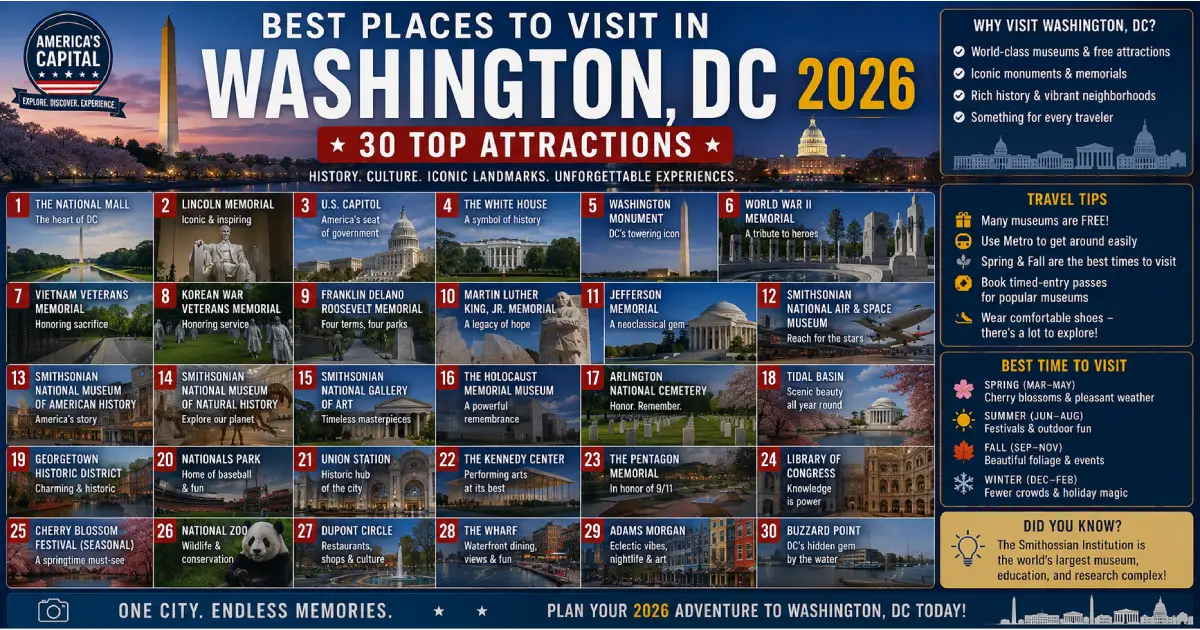
By Travel Tourister | Updated June 2026
Washington DC is the only major US capital city where the majority of its world-class attractions are completely free — the Smithsonian Institution operates 17 museums and the National Zoo in DC alone, all with $0 admission, alongside monuments and memorials covering American history from the Founding Fathers through the present day, all concentrated within a compact, walkable, Metro-connected core that makes DC one of the most efficient sightseeing cities in America. The best places to visit in Washington DC span the National Mall’s monuments (Lincoln Memorial, Washington Monument, Jefferson Memorial), world-renowned museums (National Air and Space Museum, National Museum of African American History and Culture, National Gallery of Art), the seat of American government (US Capitol, White House, Supreme Court), and neighborhoods (Georgetown, Adams Morgan, Capitol Hill) that offer dining, nightlife, and residential charm beyond the monumental core.
What separates Washington DC from other US capitals and major cities is this combination of free access and walkable density — the National Mall stretches roughly two miles from the Capitol to the Lincoln Memorial, with the Smithsonian museums lining both sides, meaning a visitor can move from dinosaur fossils (Natural History Museum) to the actual Wright Flyer and Apollo 11 command module (Air and Space Museum) to Vietnam Veterans Memorial reflections within a single afternoon’s walk, all without spending a dollar on admission. The DC Metro ($2-6/ride depending on distance and time) connects the Mall to neighborhoods, Arlington National Cemetery (technically in Virginia but Metro-accessible), and Reagan National Airport, while the city’s height restrictions (no building taller than the Capitol dome, roughly 130-160 feet depending on street width) preserve sightlines that make monuments visible from unexpected vantage points throughout the city.
The best places to visit in Washington DC divide naturally across zones: the National Mall and monuments (the core “must-see” concentration, free, walkable), the Smithsonian museum campus (also along the Mall, free, indoor alternatives for weather), Capitol Hill (US Capitol, Library of Congress, Supreme Court, plus a residential neighborhood with restaurants), Georgetown (historic neighborhood, shopping, waterfront, not Metro-accessible but reachable by bus/water taxi), and Arlington (technically Virginia, but Arlington National Cemetery and the Pentagon are essential DC-area visits). This guide covers 30 best places to visit in Washington DC with practical details — entry costs (mostly free), Metro directions, best visiting times, and insider tips — for first-time and return visitors planning 2026 trips.
For complete guides, see our Things to Do in Washington DC 2026, Best Restaurants in Washington DC, and Washington DC Trip Cost 2026 guides.
| Place | Area | Entry Cost | Best For | Time Needed |
|---|---|---|---|---|
| Lincoln Memorial | National Mall (West) | Free | Iconic landmark, reflection | 30–60 min |
| National Air and Space Museum | National Mall | Free (timed entry) | Aviation, space history | 2–4 hrs |
| US Capitol | Capitol Hill | Free (tour reservation) | Government, architecture | 1–2 hrs |
| Washington Monument | National Mall (Center) | Free (timed ticket) | Views, iconic obelisk | 30–60 min |
| National Museum of African American History and Culture | National Mall | Free (timed entry) | History, culture | 3–4 hrs |
| White House | Pennsylvania Ave | Free (advance request) | Presidential history | 30–60 min (exterior) |
| Jefferson Memorial | Tidal Basin | Free | Architecture, cherry blossoms | 30–45 min |
| National Gallery of Art | National Mall | Free | Art, masterworks | 2–3 hrs |
| Arlington National Cemetery | Arlington, VA | Free | History, reflection | 1.5–2 hrs |
| National Museum of Natural History | National Mall | Free | Dinosaurs, gems, science | 2–3 hrs |
| Vietnam Veterans Memorial | National Mall (West) | Free | History, reflection | 20–30 min |
| Smithsonian National Zoo | Woodley Park | Free | Wildlife, pandas | 2–4 hrs |
| Library of Congress | Capitol Hill | Free | Architecture, books | 1 hr |
| MLK Jr. Memorial | West Potomac Park | Free | History, civil rights | 20–30 min |
| Tidal Basin & Cherry Blossoms | West Potomac Park | Free | Spring photography | 1–2 hrs |
| National Museum of American History | National Mall | Free | Pop culture, history | 2–3 hrs |
| Georgetown | Georgetown | Free | Shopping, waterfront, history | 2–4 hrs |
| Smithsonian Castle | National Mall | Free | Architecture, visitor center | 20–30 min |
| Supreme Court Building | Capitol Hill | Free | Architecture, government | 30–60 min |
| FDR Memorial | West Potomac Park | Free | History, sculpture | 30–45 min |
| National Archives | Pennsylvania Ave | Free (timed entry) | Founding documents | 1–1.5 hrs |
| The Wharf | Southwest Waterfront | Free | Dining, waterfront, entertainment | 2–3 hrs |
| Hirshhorn Museum | National Mall | Free | Modern/contemporary art | 1–2 hrs |
| National Postal Museum | Near Union Station | Free | Quirky, family-friendly | 1 hr |
| Ford’s Theatre | Downtown | $3–$20 | Lincoln assassination history | 1–1.5 hrs |
| Korean War Veterans Memorial | National Mall | Free | History, reflection | 20–30 min |
| US Botanic Garden | Capitol Hill | Free | Gardens, plants | 1 hr |
| Dumbarton Oaks | Georgetown | $10–$15 (gardens) | Gardens, art collection | 1.5–2 hrs |
| Eastern Market | Capitol Hill | Free | Local market, food | 1–2 hrs |
| Kennedy Center | Foggy Bottom | Free (building) / $$ (shows) | Architecture, performing arts | 1 hr+ |
Entry: Free | Metro: Foggy Bottom-GWU or Smithsonian, then walk (15-20 min) | Best Time: Sunrise or evening (illuminated)
The Lincoln Memorial is the most recognizable monument in Washington DC — a Greek Doric temple-style structure (completed 1922) housing a 19-foot seated marble statue of Abraham Lincoln, flanked by inscriptions of the Gettysburg Address and Lincoln’s Second Inaugural Address, sitting at the western terminus of the National Mall with the Reflecting Pool extending toward the Washington Monument and Capitol beyond. The memorial holds deep significance in American civil rights history — Martin Luther King Jr. delivered his “I Have a Dream” speech from the steps in 1963 (marked by an engraved plaque), and the site has hosted countless subsequent demonstrations and gatherings central to American political life.
The memorial’s 36 columns represent the 36 states in the Union at the time of Lincoln’s death, while the interior murals (above the Gettysburg Address text) depict Unity, Immortality, and Brotherhood. The view from the steps — looking east across the Reflecting Pool toward the Washington Monument with the Capitol dome visible in the distance — is one of the most photographed sightlines in America, particularly dramatic at sunrise when the Reflecting Pool creates mirror symmetry, or at night when the memorial’s interior lighting creates a dramatic glow visible from across the Mall.
Insider tips: Visit at night (the memorial is illuminated and open 24 hours, with National Park Service staff present until late evening) for the most dramatic photography and significantly fewer crowds than daytime. The steps leading up to the memorial offer the iconic Mall view — climb to the top for the full Lincoln statue experience, but the view itself is equally striking from partway up. Combine with the adjacent Vietnam Veterans Memorial and Korean War Veterans Memorial (both within a 5-10 minute walk) for an efficient West Mall circuit.
Entry: Free (timed-entry passes required, book in advance via si.edu) | Metro: L’Enfant Plaza | Best Time: Weekday mornings, first entry slot
The National Air and Space Museum holds the largest collection of historic aircraft and spacecraft in the world — the original Wright Flyer (1903, the first successful powered aircraft), the Apollo 11 command module Columbia (which carried astronauts to the Moon and back in 1969), Charles Lindbergh’s Spirit of St. Louis, and Chuck Yeager’s Bell X-1 (the first aircraft to break the sound barrier) — all displayed in a building that itself reopened in 2022 after a major multi-year renovation that modernized exhibition spaces while preserving the museum’s status as one of the Smithsonian’s most popular destinations.
The renovated museum reorganizes exhibits into thematic galleries: “Early Flight” (Wright Flyer and pioneer aviation), “Destination Moon” (Apollo program artifacts including the actual command module), “America by Air” (commercial aviation history), and “Exploring the Planets” (space exploration beyond the Moon). The museum’s IMAX theater and planetarium (separate ticketed admission, $9-15) offer additional programming for visitors wanting extended experiences beyond the free exhibition galleries.
Since the main building’s renovation, timed-entry passes (free but required) have become necessary for visiting — these release on a rolling schedule via the Smithsonian’s website and can be claimed same-day if available, though popular time slots (particularly weekends and school holiday periods) can fill in advance.
Insider tips: Book timed-entry passes as soon as your visit date is confirmed — same-day passes are sometimes available but shouldn’t be relied upon during peak tourist seasons (spring school trips, summer). The museum’s companion facility, the Steven F. Udvar-Hazy Center near Dulles Airport in Virginia (also free, but requires a car or significant transit time), houses additional aircraft including the Space Shuttle Discovery — worth considering for aviation enthusiasts with extra time and transportation.
Entry: Free (visitor center always free; Capitol tours require advance reservation via your representative’s office or the Capitol Visitor Center) | Metro: Capitol South or Union Station | Best Time: Weekday mornings
The US Capitol Building has served as the meeting place of the US Congress since 1800 (with reconstruction after the 1814 burning during the War of 1812), its iconic cast-iron dome (added 1850s-1860s, topped by the Statue of Freedom) visible throughout much of central Washington DC due to height restrictions on surrounding buildings. The Capitol Visitor Center (free, no reservation required for the visitor center itself, though security screening applies) provides exhibits on Congressional history and access to Emancipation Hall, while guided tours of the Capitol building itself (free, but requiring advance reservation either through a Congressional representative’s office or directly via the Capitol Visitor Center website) take visitors through the Rotunda (housing historical paintings and the Statue of Freedom’s original plaster model), the Old Senate and House Chambers, and Statuary Hall (containing statues donated by each state representing notable figures from their history).
The Capitol grounds themselves (Capitol Hill, the elevated area surrounding the building) offer some of DC’s best Mall views — the West Front steps look directly down the National Mall toward the Washington Monument and Lincoln Memorial, a view often used for presidential inaugurations (held on these steps every four years).
Insider tips: Reserve Capitol tours well in advance (weeks to months for popular dates) — international visitors can request tours through the Capitol Visitor Center directly, while US citizens can often secure same or next-day reservations through their representative’s or senators’ offices, sometimes with shorter wait times than the general visitor center booking. The Capitol Visitor Center itself (Exhibition Hall, free, no reservation) provides substantial historical context even without a building tour, including a scale model of the Capitol dome’s interior structure.
Entry: Free (timed-entry tickets required for elevator to observation deck) | Metro: Smithsonian | Best Time: Clear days for views; sunset for photography
The Washington Monument, at 555 feet, was the tallest structure in the world upon its completion in 1884 and remains the tallest predominantly stone structure on Earth — a simple obelisk design (deliberately classical, honoring George Washington in the architectural language of ancient Egypt and Rome) that anchors the center of the National Mall, visible from virtually every elevated point in Washington DC due to height restrictions on surrounding buildings. The monument’s slightly different stone coloring partway up (visible on close inspection) marks where construction paused for over 20 years (1854-1877) due to funding issues and the Civil War — the upper portion uses marble from a different quarry than the lower section, creating a subtle but visible color variation.
The observation deck (500 feet, accessible via elevator, free timed-entry tickets required) provides 360-degree views of Washington DC — the National Mall stretching toward the Capitol and Lincoln Memorial, the Potomac River and Arlington beyond, and the broader DC cityscape constrained by height limits that make the monument’s perspective genuinely unique. The monument has experienced periodic closures for maintenance and earthquake-related repairs over the years — checking current status before planning a visit specifically for the observation deck is recommended.
Insider tips: Timed-entry tickets for the observation deck are free but limited — book via recreation.gov as soon as travel dates are confirmed, as same-day tickets (available in limited quantities at the kiosk near the monument) can run out, particularly during peak season. Even without observation deck access, the monument grounds themselves (16th Street and Constitution Avenue area) offer excellent photography of the obelisk against the sky, particularly during golden hour.
Entry: Free (timed-entry passes required) | Metro: Smithsonian or Federal Triangle | Best Time: Weekday mornings, allow extended time
The National Museum of African American History and Culture, opened in 2016 as the newest Smithsonian museum on the National Mall, occupies a distinctive bronze-colored, three-tiered corona-shaped building (designed by architect David Adjaye, inspired by Yoruban art and crowns) that stands out dramatically against the Mall’s classical architecture. The museum’s underground “History Galleries” (beginning with the transatlantic slave trade and continuing through Reconstruction, Jim Crow, the Civil Rights Movement, and into the contemporary era) represent one of the most comprehensive and emotionally powerful historical narratives presented in any American museum, while upper floors house “Community” and “Culture” galleries covering African American contributions to music, sports, military service, visual arts, and broader American culture.
Notable artifacts include a slave cabin from a South Carolina plantation, Nat Turner’s Bible, Emmett Till’s casket (displayed with appropriate context and content warnings), Chuck Berry’s Cadillac, and items from Michael Jackson, Muhammad Ali, and countless other cultural figures. The museum’s design intentionally creates a journey — visitors typically begin in the underground History Galleries (accessed via elevator, presented chronologically) before ascending through Culture and Community floors, with the building’s architecture itself (the corona’s bronze latticework, inspired by ironwork created by enslaved craftspeople in Charleston and New Orleans) carrying symbolic meaning throughout.
Insider tips: This museum requires significantly more time than most Smithsonian institutions — 3-4 hours minimum for a meaningful visit, with the History Galleries alone often taking 2+ hours given the density and emotional weight of content. Timed-entry passes are essential and can be more competitive than other Smithsonian museums given the museum’s popularity — book as early as possible. The museum’s Sweet Home Café (lower level) offers regionally-themed African American cuisine (Southern, Creole, Afro-Latin influences) as a notable dining option within the museum itself.
Entry: Free (self-guided tours require advance request through your member of Congress, US citizens only, several weeks to months processing time) | Metro: McPherson Square or Federal Triangle | Best Time: Daytime for exterior viewing
The White House has served as the residence and workplace of every US President since John Adams in 1800 (excepting a period of reconstruction after the British burned it during the War of 1812), and remains one of the most recognizable buildings in the world — the North Portico (Pennsylvania Avenue side) and South Lawn (visible from the Ellipse and E Street) represent the most commonly photographed exterior views, with security perimeters (Pennsylvania Avenue itself has been closed to vehicle traffic since the 1990s, functioning as a pedestrian plaza with excellent White House views) allowing close approach without entering White House grounds.
Interior tours (self-guided, covering portions of the East Wing and State Floor including the East Room, Green Room, Blue Room, and Red Room) require advance request through a US Senator or Representative’s office (for US citizens) or through one’s embassy (for international visitors) — processing times typically run 3 weeks to 6 months, and tours can be cancelled on short notice due to White House operational needs, so flexibility is essential for visitors hoping to secure interior access.
The White House Visitor Center (1450 Pennsylvania Avenue, in the Department of Commerce building, free, no reservation required) offers exhibits on White House history, architecture, and first families — providing substantial context even for visitors unable to secure interior tours of the residence itself.
Insider tips: For visitors without interior tour reservations, the Pennsylvania Avenue pedestrian plaza (north side) and the Ellipse/E Street area (south side, near the South Lawn) provide excellent exterior photography opportunities without any reservation requirement. If interior access matters to your trip, submit tour requests through your Congressional representative’s office as early as possible (months in advance) given processing times and the possibility of last-minute cancellations.
Entry: Free | Metro: Smithsonian, then walk (15-20 min) | Best Time: Cherry blossom season (late March-early April) or sunset
The Jefferson Memorial, completed in 1943, houses a 19-foot bronze statue of Thomas Jefferson within a domed, colonnaded structure inspired by the Pantheon in Rome and Jefferson’s own architectural designs (particularly Monticello and the University of Virginia rotunda, both of which Jefferson designed) — a fitting tribute given Jefferson’s significant architectural interests alongside his political legacy. The memorial’s interior walls feature excerpts from Jefferson’s writings, including portions of the Declaration of Independence, while the circular colonnade frames views across the Tidal Basin toward the Washington Monument.
The memorial’s location on the Tidal Basin’s southern shore places it at the heart of Washington DC’s cherry blossom display — the Tidal Basin’s approximately 3,800 cherry trees (a gift from Japan in 1912) bloom in a roughly two-week window typically falling in late March to early April, creating one of DC’s most visually spectacular and most crowded annual events (the National Cherry Blossom Festival). During peak bloom, the path between the Jefferson Memorial and the MLK Jr. Memorial (along the Tidal Basin’s southwest shore) becomes one of the most photographed locations in Washington DC.
Insider tips: Outside cherry blossom season, the Jefferson Memorial remains one of DC’s less-crowded major monuments — sunset offers particularly striking views back across the Tidal Basin toward the Washington Monument and Lincoln Memorial, with the memorial’s white marble catching golden-hour light. During cherry blossom season, early morning (before 8 AM) visits significantly reduce both crowds and the challenge of photography without other visitors in frame.
Entry: Free | Metro: Archives-Navy Memorial-Penn Quarter or Smithsonian | Best Time: Weekday afternoons
The National Gallery of Art houses one of the world’s premier art collections — spanning the West Building (classical architecture, housing European and American art from the medieval period through the early 20th century, including the only Leonardo da Vinci painting in the Americas, “Ginevra de’ Benci”) and the East Building (modern architecture by I.M. Pei, housing modern and contemporary art including significant Calder, Rothko, and Pollock works) — connected by an underground concourse and entirely free to enter, a rarity among world-class art museums of this caliber.
The West Building’s collection includes works by Vermeer, Rembrandt, Monet, Van Gogh, and an extraordinarily comprehensive American art collection (Gilbert Stuart’s iconic Washington portraits, Hudson River School landscapes, and American Impressionism). The East Building’s I.M. Pei-designed atrium (featuring a massive Alexander Calder mobile) represents one of DC’s most striking modern architectural spaces, while the Sculpture Garden (between the two buildings, also free) offers an outdoor space with significant sculptural works and a seasonal ice rink (winter) or fountain (summer).
Insider tips: The museum’s sheer size (combined with free admission) means strategic visitors choose specific collections rather than attempting comprehensive coverage — the West Building’s Dutch and Flemish galleries (including the Vermeer) and the East Building’s modern collection represent two genuinely different experiences worth treating as separate visits if time allows. The Sculpture Garden’s seasonal café and outdoor seating provide a pleasant rest point, particularly in good weather, situated directly on the National Mall.
Entry: Free | Metro: Arlington Cemetery (Blue Line) | Best Time: Weekday mornings, allow 2+ hours
Arlington National Cemetery, across the Potomac River in Virginia (but functionally part of any DC visit given Metro accessibility), serves as the burial site for over 400,000 active duty service members, veterans, and their families across 639 acres of rolling hills — the most significant military cemetery in the United States, containing the Tomb of the Unknown Soldier (guarded 24/7 by the Old Guard, with a Changing of the Guard ceremony occurring on a schedule that varies seasonally, typically every 30 minutes in summer and hourly in winter) and the graves of President John F. Kennedy (marked by an eternal flame) and other notable American historical figures.
The cemetery’s scale and the visual impact of uniform white headstones extending across hillsides in every direction creates one of the most visually and emotionally powerful landscapes in the Washington DC area — a place that functions simultaneously as active burial ground (funerals with military honors occur regularly, and visitors should be respectful of services in progress) and as a historical site drawing visitors interested in American military history broadly.
The cemetery includes a visitor center (near the entrance, with exhibits and an optional narrated tram tour, $15.40 adults, covering major sites including the Tomb of the Unknown Soldier, JFK gravesite, and Arlington House) — while walking is free and feasible for visitors with more time and mobility, the tram tour provides an efficient overview for visitors with limited time.
Insider tips: The Changing of the Guard ceremony at the Tomb of the Unknown Soldier represents the cemetery’s most consistently “scheduled” experience — check current timing (which varies by season) before visiting if this ceremony is a priority. The cemetery’s hillside terrain involves significant walking and elevation change — visitors with mobility considerations should strongly consider the tram tour option. Arlington House (Robert E. Lee’s pre-Civil War residence, on a hill within the cemetery, currently with exhibits addressing the site’s complex history including the enslaved people who lived and worked there) offers panoramic views back across the Potomac toward the National Mall.
Entry: Free | Metro: Smithsonian or Federal Triangle | Best Time: Weekday mornings, first entry
The National Museum of Natural History, one of the most-visited museums in the world, houses over 145 million specimens and artifacts across exhibits covering the full scope of natural history — the recently renovated Dinosaur and Fossil Hall (reopened 2019, featuring a 66-foot Tyrannosaurus rex skeleton posed devouring a Triceratops, alongside a comprehensive evolutionary timeline of life on Earth), the National Gem and Mineral Collection (housing the Hope Diamond, a 45.52-carat blue diamond with a storied ownership history including the Smithsonian’s most famous single object), and the Hall of Mammals, Ocean Hall, and Insect Zoo among numerous other exhibition spaces.
The museum’s Rotunda (main entrance from the National Mall side) features a massive African bush elephant specimen, while the Butterfly Pavilion (separate ticketed admission, $6, seasonal closures possible) offers a living tropical habitat with free-flying butterflies. The museum’s IMAX theater provides additional ticketed programming for visitors wanting extended experiences.
Insider tips: The Hope Diamond display (Gem Gallery, second floor) draws consistent crowds throughout the day — visiting first thing in the morning provides the best opportunity for unobstructed viewing. The Dinosaur and Fossil Hall’s 2019 renovation significantly modernized presentation compared to the museum’s historical reputation — even visitors who remember the “old” dinosaur hall from previous visits will find the current exhibition substantially different and worth revisiting.
Entry: Free | Metro: Foggy Bottom-GWU, then walk | Best Time: Any time, particularly powerful at dusk
The Vietnam Veterans Memorial, completed in 1982 and designed by Maya Lin (then a 21-year-old Yale architecture student, whose design was selected through a blind competition that initially generated significant controversy before becoming one of America’s most respected memorials), consists of two black granite walls set into the earth, inscribed with the names of over 58,000 American service members who died or remain missing from the Vietnam War, listed chronologically by date of casualty. The memorial’s design — walls that begin at ground level, descend to a point below grade at the vertex where the two walls meet, then rise back to ground level — creates a deliberately unmonumental, intimate experience distinct from the classical grandeur of nearby memorials.
The polished granite surface reflects visitors’ images alongside the inscribed names, creating a visual effect that has been widely interpreted as connecting visitors directly to the individuals memorialized — many visitors locate specific names (using directories available at the memorial or via the National Park Service website in advance) and create rubbings of names using paper and pencil, a practice the National Park Service accommodates and that has become part of the memorial’s visitor experience.
Insider tips: If visiting to locate a specific name, the National Park Service website allows advance lookup of panel and line numbers — locating names without this preparation, while possible via on-site directories, takes considerably longer given the memorial’s scale (over 58,000 names across the wall’s length). The memorial’s emotional weight is genuinely significant — visitors should approach with awareness that others may be having profound personal experiences, particularly near the directory stations and at name-rubbing locations.
Entry: Free (timed-entry passes may be required during peak periods) | Metro: Woodley Park-Zoo or Cleveland Park | Best Time: Morning, year-round (outdoor, weather-dependent)
The Smithsonian National Zoo, spread across 163 acres in DC’s Woodley Park/Cleveland Park area, represents one of the world’s leading zoological institutions with a research and conservation mission extending well beyond public exhibition — the zoo’s giant panda program (pandas have been a centerpiece attraction periodically since 1972, with the zoo’s relationship with China’s panda conservation program creating ongoing exhibits, subject to occasional gaps when pandas are returned to China per international agreements) represents one of DC’s most popular single attractions when pandas are present.
Beyond pandas, the zoo’s collection includes Asian elephants, great apes (a notable orangutan and gorilla habitat with an elevated trail system, the “O Line,” allowing animals to travel between buildings via overhead cables visible to visitors), big cats, and a comprehensive reptile and amphibian collection. The zoo’s hillside terrain (genuinely steep in sections) means visitors should expect significant walking with elevation change — comfortable footwear is essential.
Insider tips: Check the zoo’s current animal roster before visiting if specific animals (particularly pandas, given their periodic absence) are a primary motivation — the Smithsonian’s website maintains current information on major exhibit animals. The zoo’s position on a hillside means the walk from the Connecticut Avenue entrance (near Cleveland Park Metro) descends throughout the visit, while the Woodley Park entrance involves more uphill walking — planning your entry/exit points based on fitness level can meaningfully affect visit comfort.
Entry: Free | Metro: Capitol South or Union Station | Best Time: Weekday mornings
The Library of Congress, housed primarily in the Thomas Jefferson Building (completed 1897, an extraordinarily ornate Beaux-Arts structure that represents one of DC’s most architecturally spectacular interior spaces), holds the distinction of being the largest library in the world by collection size — over 170 million items including books, manuscripts, maps, recordings, and Thomas Jefferson’s personal library (which formed the seed collection after the original Library of Congress was destroyed when the British burned the Capitol in 1814).
The Great Hall (entrance level, Jefferson Building) features marble, mosaic, and mural work representing one of the most ornate interior spaces in American government architecture — comparable in visual impact to European palaces and cathedrals despite housing a working library and research institution. The Main Reading Room (visible from an overlook above, as the room itself is reserved for researchers with reader cards) represents the architectural and functional heart of the building — a domed, circular space surrounded by reference materials and research desks.
Insider tips: The Library of Congress’s proximity to the US Capitol (directly across from the Capitol’s east side) makes it a natural addition to a Capitol Hill visit — the Jefferson Building’s Great Hall alone justifies a visit even for those without specific research interests, given its status as one of DC’s most underrated architectural spaces. Free guided tours (check current schedule) provide additional context on the building’s symbolism and collections.
Entry: Free | Metro: Smithsonian, then walk | Best Time: Any time, particularly meaningful during civil rights commemorations
The Martin Luther King Jr. Memorial, dedicated in 2011, occupies a four-acre site on the Tidal Basin’s western edge — the memorial’s central feature, the “Stone of Hope,” depicts King emerging from a “Mountain of Despair” (two massive granite blocks split to create the larger sculpture), with a 30-foot relief of King’s likeness carved into the Stone of Hope itself. Surrounding inscription walls feature 14 excerpts from King’s speeches and writings, while the memorial’s positioning — along the same sightline connecting the Lincoln Memorial (where King delivered his “I Have a Dream” speech) and the Jefferson Memorial (representing the nation’s founding ideals of liberty) — creates intentional symbolic connections between the memorial and its neighbors.
The memorial’s design generated some controversy upon completion (particularly regarding a paraphrased inscription that was later corrected), but its location and scale have established it as an essential stop for visitors interested in civil rights history, situated naturally along the walking path between the Lincoln Memorial and Jefferson Memorial around the Tidal Basin.
Insider tips: The memorial’s position along the Tidal Basin walking path means it’s naturally encountered when walking between the Lincoln Memorial and Jefferson Memorial — allocate 20-30 minutes to read the inscription walls and view the Stone of Hope from multiple angles, as the sculptural composition is designed to be experienced while walking around and through it rather than from a single viewpoint.
Entry: Free | Metro: Smithsonian | Best Time: Late March–early April (cherry blossom peak bloom, varies by year)
The Tidal Basin, an artificial reservoir adjacent to the Potomac River, is surrounded by approximately 3,800 cherry trees gifted by Japan in 1912 (a gesture of friendship that has been commemorated and renewed multiple times over subsequent decades) — when these trees reach peak bloom (typically a window of 4-7 days falling somewhere between late March and mid-April, varying significantly year to year based on winter/spring temperatures), the Tidal Basin becomes one of the most visually spectacular and most visited locations in Washington DC, with the National Cherry Blossom Festival (a multi-week event surrounding the bloom period) drawing over 1.5 million visitors.
The 2.1-mile path around the Tidal Basin connects the Jefferson Memorial, MLK Jr. Memorial, and FDR Memorial, with the Yoshino cherry trees (the most common variety, producing pale pink/white blossoms) creating a canopy effect along significant stretches of the path — particularly the stretch near the Jefferson Memorial, which has become one of the most photographed cherry blossom locations in the world.
Insider tips: Peak bloom timing is genuinely unpredictable year-to-year — the National Park Service publishes bloom predictions starting several weeks in advance, but these predictions can shift based on weather patterns, so flexible travel dates significantly improve chances of catching peak bloom if this is a primary trip motivation. Early morning (before 8 AM) visits during peak bloom provide dramatically better photography conditions and crowd levels than any other time — by mid-morning during peak bloom weekends, the Tidal Basin path becomes extremely crowded.
Entry: Free | Metro: Smithsonian or Federal Triangle | Best Time: Weekday afternoons
The National Museum of American History houses some of the most recognizable artifacts in American popular and political history — the original Star-Spangled Banner (the flag that inspired the national anthem, displayed in a climate-controlled gallery with dramatic lighting), Dorothy’s ruby slippers from “The Wizard of Oz,” Abraham Lincoln’s top hat, the Greensboro lunch counter (a preserved section of the counter from the 1960 civil rights sit-in), and exhibits covering the American presidency, transportation history (including historic locomotives and automobiles), and everyday American life across multiple centuries.
The museum’s “American Stories” and “American Democracy” exhibits provide a chronological framework for understanding broader US history through specific objects, while specialized galleries (the First Ladies’ inaugural gowns collection, military history exhibits, and a substantial collection of presidential artifacts) offer depth for visitors with specific interests. The museum’s central location (between the Natural History Museum and the Washington Monument grounds) makes it a natural mid-Mall stop.
Insider tips: The Star-Spangled Banner gallery (lower level) uses deliberately dim lighting to protect the fragile artifact — allow eyes to adjust and expect a more subdued presentation than the museum’s other exhibits. The museum’s gift shop offers some of the more unique Smithsonian souvenirs given the breadth of pop-culture-adjacent artifacts (reproductions related to the ruby slippers, Star-Spangled Banner, etc.) compared to more science-focused Smithsonian gift shops.
Entry: Free to explore | Metro: Not directly accessible (nearest stations Foggy Bottom-GWU or Dupont Circle, both 20+ minute walks; DC Circulator bus or water taxi recommended) | Best Time: Weekend afternoons, evenings for dining
Georgetown predates Washington DC itself (established as a tobacco port in 1751, before the federal city was planned), and retains a distinct character from the rest of DC — cobblestone side streets, Federal-period row houses, M Street and Wisconsin Avenue’s dense concentration of shopping and dining, and a waterfront along the Potomac River (Georgetown Waterfront Park) that offers river views, the C&O Canal’s historic towpath (a National Historical Park extending 184.5 miles to Cumberland, Maryland, with the Georgetown section offering an easy walking/biking introduction), and proximity to Georgetown University’s campus.
The neighborhood’s lack of direct Metro access (a historical decision related to opposition from Georgetown residents during Metro planning) means visitors typically arrive via the DC Circulator bus (Georgetown-Union Station route, $1), a longer walk from Foggy Bottom or Dupont Circle Metro stations, or the Georgetown water taxi (seasonal, connecting to The Wharf and other Potomac waterfront points). This relative inaccessibility has, somewhat paradoxically, helped Georgetown maintain a more residential, less overtly “tourist district” character than its shopping/dining density might otherwise suggest.
Insider tips: The C&O Canal towpath (accessible from multiple points in Georgetown) offers a genuinely pleasant walking/jogging route along the canal’s historic locks — even a short 20-30 minute walk provides a different perspective on Georgetown’s history as a working port and canal terminus. Dumbarton Oaks (see #28) and its gardens are located in upper Georgetown, making the neighborhood a logical pairing for visitors interested in both shopping/dining and historic gardens.
Entry: Free | Metro: Smithsonian | Best Time: Brief stop, any time
The Smithsonian Institution Building, universally known as “The Castle” for its distinctive red sandstone Norman/Gothic Revival architecture (completed 1855, the first Smithsonian building), serves as the institution’s administrative headquarters and a visitor information center — while not a major destination in itself, the Castle’s distinctive architecture (a deliberate contrast to the classical white buildings dominating the National Mall) and its function as an orientation point make it a useful stop for visitors planning their broader Smithsonian museum visits.
The Castle’s south entrance opens onto the Enid A. Haupt Garden (a Victorian-style garden, free, providing a pleasant green space distinct from the Mall’s open lawns), while the building’s interior includes a small exhibit on Smithsonian history and the crypt of James Smithson (the British scientist whose bequest founded the Smithsonian Institution, despite never having visited the United States).
Insider tips: The Castle functions best as an orientation stop — pick up current maps and information here before beginning a Smithsonian museum circuit, and use the Haupt Garden as a brief rest point. The building’s distinctive architecture (genuinely different from the Mall’s classical buildings) makes for an interesting photography subject even for visitors not specifically interested in Smithsonian administrative history.
Entry: Free | Metro: Capitol South or Union Station | Best Time: Weekday mornings; oral arguments (when in session) require advance planning
The Supreme Court Building, completed in 1935 (the Court had previously met in various Capitol Building spaces for nearly 150 years), houses the highest court in the United States within a marble Neoclassical structure whose architecture deliberately evokes Greek temples — the building’s motto, “Equal Justice Under Law,” is inscribed above the main entrance’s columns. The building’s public spaces (Great Hall, with portrait busts of former Chief Justices, and the Courtroom itself, viewable via a roped-off area when the Court isn’t in session) are accessible to visitors, with informational lectures offered periodically in the Courtroom when the Court isn’t hearing cases.
When the Court is in session (typically October through June, with oral arguments on specific scheduled days), limited public seating is available for oral arguments — both a “full argument” line (for those wanting to observe an entire case) and a shorter “3-minute line” (allowing brief observation) operate on a first-come basis, with lines forming early (sometimes overnight for high-profile cases) for the full-argument seating.
Insider tips: For visitors interested specifically in observing oral arguments, checking the Court’s argument calendar (available on supremecourt.gov) before travel is essential — arguments occur on a limited schedule and require arriving very early (the building opens to the public line around 7 AM, with seating limited and high-profile cases generating overnight lines). For visitors simply interested in the building and its history, the Great Hall and Courtroom viewing (when not in session) provide a meaningful visit without scheduling complexity.
Entry: Free | Metro: Smithsonian, then walk | Best Time: Any time, particularly evening for less crowds
The Franklin Delano Roosevelt Memorial, dedicated in 1997, takes an unconventional approach compared to DC’s other presidential memorials — rather than a single structure, the FDR Memorial spans four outdoor “rooms” (each representing one of Roosevelt’s four presidential terms), connected by a series of waterfalls and incorporating sculptural representations of Depression-era Americans (a bread line sculpture has become particularly notable), Roosevelt’s dog Fala, and a relatively unusual (for the time of its creation) depiction of Roosevelt in his wheelchair, reflecting ongoing discussions about how to represent his disability.
The memorial’s design — using red South Dakota granite, extensive water features, and a sequence of spaces rather than a single monumental structure — creates a contemplative walking experience along the Tidal Basin’s western shore, situated between the Jefferson Memorial and the MLK Jr. Memorial on the Tidal Basin loop, making it a natural inclusion for visitors walking the full Tidal Basin circuit.
Insider tips: The memorial’s sequential “rooms” design rewards a slower walking pace than many visitors initially apply — each of the four sections includes inscriptions and sculptural elements specific to that presidential term, and rushing through misses much of the intended narrative structure. The memorial’s water features (multiple waterfalls) create a different acoustic environment than the open Tidal Basin path, offering a brief sense of separation from Mall crowds even during busy periods.
Entry: Free (timed-entry passes recommended, especially in peak season) | Metro: Archives-Navy Memorial-Penn Quarter | Best Time: Weekday mornings
The National Archives’ Rotunda for the Charters of Freedom houses the original Declaration of Independence, US Constitution, and Bill of Rights — documents foundational to American government, displayed in specially designed encasements that protect the documents (which have faded significantly over more than two centuries, particularly the Declaration of Independence, whose text is now difficult to read in person without prior knowledge of its content) while allowing public viewing. The Rotunda’s design (deliberately reminiscent of a shrine, with murals depicting the documents’ creation flanking the displays) creates a ceremonial atmosphere distinct from typical museum exhibition spaces.
Beyond the Charters of Freedom, the National Archives building houses extensive government records (accessible to researchers through separate research room processes, not part of the general visitor experience) and rotating exhibits drawing on the Archives’ broader collections — historical photographs, government documents, and materials illustrating American history through primary source documents.
Insider tips: The Declaration of Independence’s faded text means visitors often find the experience more meaningful with prior context about the document’s content and history — the Rotunda itself doesn’t provide extensive interpretive text given its ceremonial design. Timed-entry passes (free, via recreation.gov) significantly reduce wait times, particularly important given the National Archives’ relatively compact public viewing area compared to larger Smithsonian museums.
Entry: Free to explore | Metro: Waterfront or L’Enfant Plaza | Best Time: Evening, weekends
The Wharf, a major waterfront redevelopment along the Washington Channel (completed in phases beginning 2017), transformed a previously underutilized stretch of Southwest DC waterfront into one of the city’s most active dining, entertainment, and residential districts — restaurants (spanning casual seafood to upscale dining, many with water views), the historic Maine Avenue Fish Market (operating in some form since the 1800s, the oldest continuously operating open-air fish market in the US), live music venues (The Anthem, a major concert venue, and Pearl Street Warehouse for smaller acts), and a waterfront promenade with public art and seasonal activities (ice skating in winter, water activities in summer).
The Wharf’s relative newness compared to DC’s historic core gives it a different character — purpose-built for contemporary dining/entertainment use, with architecture reflecting current design trends rather than the classical/Federal styles dominant elsewhere in central DC. The district connects via water taxi to Georgetown and other Potomac waterfront points, offering an alternative transportation option distinct from Metro.
Insider tips: The Maine Avenue Fish Market (predating The Wharf’s broader redevelopment by well over a century) offers a genuinely different experience from the surrounding new development — fresh seafood, crab cakes, and a more workaday market atmosphere worth visiting specifically for contrast with the polished new construction nearby. Evening visits, particularly with live entertainment at The Anthem or smaller venues, showcase The Wharf’s role as a genuine nightlife district distinct from the monument-focused daytime DC experience.
Entry: Free | Metro: L’Enfant Plaza or Smithsonian | Best Time: Weekday afternoons
The Hirshhorn Museum, the Smithsonian’s dedicated modern and contemporary art museum, occupies a distinctive cylindrical concrete building (completed 1974, designed by Gordon Bunshaft, intentionally different from the Mall’s classical architecture) — housing a collection spanning late 19th-century through contemporary art, with particular strength in postwar American and European art (significant holdings of works by artists including Willem de Kooning, Francis Bacon, and rotating contemporary exhibitions that often represent some of the Smithsonian’s most experimental programming).
The adjacent Sunken Sculpture Garden (currently being renovated/redesigned in phases) provides outdoor sculptural display, while the museum’s circular design creates a distinctive interior experience — galleries arranged around a central courtyard, with the building’s elevated structure (raised on piers) creating a notable architectural silhouette on the Mall.
Insider tips: The Hirshhorn’s contemporary/experimental programming means exhibits change more frequently and substantially than some of the Mall’s other museums — checking current exhibitions before visiting helps set expectations, as the museum’s offerings can range from major retrospectives of established artists to immersive contemporary installations. The building’s distinctive architecture (genuinely unlike anything else on the Mall) makes for interesting exterior photography regardless of current interior exhibitions.
Entry: Free | Metro: Union Station | Best Time: Quick stop, any time, good for families
The National Postal Museum, located adjacent to Union Station (itself a significant Beaux-Arts train station worth a brief visit for its architecture), occupies the former City Post Office Building and houses the largest collection of stamps and philatelic material in the world alongside exhibits on postal history’s role in American development — the museum’s atrium displays historic mail planes and a Concord stagecoach used for mail delivery, while interactive exhibits allow visitors to sort mail in a simulated postal facility and explore the history of the Pony Express, airmail, and postal service evolution.
While smaller and less internationally famous than the Mall’s major Smithsonian museums, the Postal Museum’s combination of genuinely interesting historical content (the Pony Express operated for less than two years but became deeply embedded in American mythology; airmail’s development directly shaped early commercial aviation) and family-friendly interactive elements make it a worthwhile stop, particularly for visitors with children or specific interest in stamps/postal history, and particularly convenient given proximity to Union Station’s transportation hub.
Insider tips: The museum’s location directly adjacent to Union Station makes it a logical stop for visitors arriving/departing via train (Amtrak) or simply passing through Union Station, which itself (Beaux-Arts architecture, completed 1908, recently renovated) merits a few minutes of appreciation even without a Postal Museum visit. The museum’s relatively compact size (compared to major Mall museums) makes it achievable as a 45-60 minute visit without requiring a dedicated half-day.
Entry: $3–$20 (timed tickets, theatre + museum + Petersen House) | Metro: Metro Center or Gallery Place-Chinatown | Best Time: Morning, book tickets in advance
Ford’s Theatre, where President Abraham Lincoln was assassinated on April 14, 1865, operates today as both a functioning theater (hosting productions, particularly around Lincoln-related historical themes) and a National Park Service historic site — visitors can view the theater’s interior (including the presidential box where Lincoln was shot, preserved/recreated to reflect its 1865 appearance), an extensive museum in the theater’s basement covering Lincoln’s presidency and assassination, and the Petersen House across the street (where Lincoln died the following morning, also preserved with period-appropriate furnishings).
The site represents one of DC’s most significant historical locations outside the National Mall core, requiring paid admission (unlike most Smithsonian sites) but offering substantial historical depth — the museum’s artifacts include the actual weapon used in the assassination and items related to John Wilkes Booth’s escape and capture, while the theater itself (still an active performance venue) provides a tangible connection to a pivotal moment in American history.
Insider tips: Same-day tickets are sometimes available but advance booking (via the Ford’s Theatre website) is recommended, particularly during peak tourist season — tickets include specific timed entry to the theater itself (where park rangers provide brief talks on the assassination) as well as access to the museum and Petersen House, which can be visited at more flexible timing within your ticket’s validity. The site’s central downtown location (near Metro Center) makes it convenient to combine with other downtown attractions.
Entry: Free | Metro: Foggy Bottom-GWU, then walk | Best Time: Any time, particularly evening
The Korean War Veterans Memorial, dedicated in 1995, features 19 stainless steel statues of soldiers in ponchos moving through juniper bushes (representing the rugged Korean terrain), reflected in a polished granite wall that creates the illusion of 38 additional figures (referencing the 38th parallel, the demilitarized zone dividing North and South Korea) — a design that has drawn comparisons to the Vietnam Veterans Memorial’s reflective approach while creating a distinctly different visual and emotional effect through the statues’ three-dimensional presence.
The memorial’s Pool of Remembrance (a circular pool surrounded by trees, inscribed with statistics on casualties, MIAs, and POWs from the conflict) provides a contemplative space adjacent to the main statue grouping, while the memorial’s relatively compact size compared to the Vietnam and Lincoln Memorials means it’s often visited in conjunction with these nearby sites rather than as a standalone destination — though its visual impact (particularly the statues’ nighttime illumination, which creates dramatic shadows) rewards dedicated attention.
Insider tips: Nighttime visits to the Korean War Veterans Memorial offer a particularly striking experience — the statues’ lighting and the reflective wall create an atmosphere distinct from daytime visits, and the memorial’s proximity to the Lincoln Memorial (a 5-minute walk) makes combining both at night a logical itinerary choice for visitors prioritizing evening Mall exploration.
Entry: Free | Metro: Federal Center SW or Capitol South | Best Time: Any time, good weather alternative
The United States Botanic Garden, located at the base of Capitol Hill, has operated in some form since 1820, making it one of the oldest botanic gardens in North America — the current Conservatory (a glass and steel structure reminiscent of Victorian-era greenhouses) houses multiple themed garden rooms including a tropical rainforest (multi-story, with a canopy walkway), desert plants, orchids (a particularly extensive collection, with rotating displays), and a “Garden Primeval” room featuring plants representing prehistoric flora.
The garden’s location — directly adjacent to the Capitol Reflecting Pool, at the foot of Capitol Hill — makes it an easy addition for visitors exploring the Capitol/Mall eastern end, while its indoor conservatory spaces provide a genuinely useful weather-alternative activity (particularly valuable during DC’s hot, humid summers or cold winter days) that many visitors overlook in favor of the larger Smithsonian museums.
Insider tips: The Botanic Garden’s relatively small footprint (compared to major museums) makes it achievable as a 45-60 minute visit, useful for filling gaps in an itinerary or as a weather-driven alternative when outdoor Mall walking becomes uncomfortable. The rainforest room’s canopy walkway (an elevated walking path through the upper portions of the tropical plantings) offers a perspective distinct from ground-level garden viewing.
Entry: Gardens $10-15 (seasonal pricing, free in winter months typically); Museum free | Metro: Not directly accessible; Dupont Circle plus significant walk, or bus | Best Time: Spring/fall for garden displays
Dumbarton Oaks, a historic estate in upper Georgetown, combines 16 acres of formal gardens (designed by landscape architect Beatrix Farrand over several decades in the early-mid 20th century, considered among the finest examples of garden design in the United States) with a museum housing significant Byzantine and Pre-Columbian art collections — the gardens’ series of distinct “rooms” (each with different plantings, architectural elements, and seasonal character) create a horticultural experience genuinely different from DC’s more famous outdoor spaces (the National Mall, Tidal Basin), reflecting early 20th-century estate garden design at its highest level.
The estate’s history includes its role as the site of the 1944 Dumbarton Oaks Conference, which laid groundwork for the United Nations — a historical significance somewhat overshadowed by the gardens’ horticultural reputation but adding institutional weight to the site beyond its aesthetic value. The museum’s Pre-Columbian collection (housed in a distinctive Philip Johnson-designed pavilion, a series of glass-walled circular rooms) and Byzantine collection represent focused, high-quality holdings reflecting the specific collecting interests of the estate’s original owners (Robert and Mildred Bliss).
Insider tips: Garden admission fees vary seasonally (typically free or reduced in winter when plantings are dormant, with fees applying during peak spring/summer/fall display periods) — checking current seasonal pricing before visiting helps set expectations. The gardens’ “rooms” reward unhurried exploration — unlike DC’s more famous outdoor spaces designed for processional movement (the Mall, Tidal Basin), Dumbarton Oaks’ garden rooms are designed for discovery and contemplation, with hidden corners and varying character that benefit from wandering rather than direct point-to-point walking.
Entry: Free to browse | Metro: Eastern Market (Blue/Orange/Silver Lines) | Best Time: Saturday mornings (full market, including outdoor vendors)
Eastern Market, operating since 1873, represents one of DC’s oldest continuously operating public markets — the South Hall (a historic brick building, rebuilt after a 2007 fire using historically accurate reconstruction methods) houses food vendors (the blue crab cakes and breakfast offerings from various counter vendors have particular local renown), while weekend outdoor markets (Saturdays for a broader flea market/crafts market, Sundays with additional vendors) extend the market experience onto surrounding streets.
The market sits at the heart of Capitol Hill’s residential neighborhood, several blocks from the Capitol/Mall core, offering visitors a genuinely “local” experience distinct from the monument-focused central DC — Capitol Hill’s residential streets (rowhouses, tree-lined blocks) surrounding Eastern Market provide a neighborhood character that contrasts with the National Mall’s institutional grandeur, while remaining easily Metro-accessible.
Insider tips: Saturday mornings represent Eastern Market at its fullest — the indoor South Hall operates daily (Tuesday-Sunday) but the outdoor flea market and crafts vendors (extending along 7th Street SE) operate primarily on weekends, with Saturday generally offering the broadest vendor presence. Combining Eastern Market with a walk through surrounding Capitol Hill residential streets provides a neighborhood perspective on DC that the monument-focused Mall visit doesn’t offer.
Entry: Free (building, including daily guided tours and the Reach expansion) / Tickets vary for performances | Metro: Foggy Bottom-GWU (plus free shuttle) | Best Time: Free daily tours, or evening for performances
The John F. Kennedy Center for the Performing Arts, completed in 1971, serves as the United States’ national cultural center — a major performance venue (hosting the National Symphony Orchestra, Washington National Opera, touring Broadway productions, and a comprehensive performance calendar across multiple theaters) housed in a monumental building along the Potomac River, with a Grand Foyer (one of the longest rooms in the world, lined with crystal chandeliers gifted by various countries) offering river views and serving as a pre-performance gathering space.
The Center’s free programming includes the “Millennium Stage” (free daily performances, typically early evening, in the Grand Foyer or other spaces, showcasing a wide range of performers) and the REACH (a 2019 expansion housing additional rehearsal/performance spaces, free to explore, with river-facing terraces). Free guided tours of the building (covering its architecture, the various theater spaces, and the extensive collection of gifts from foreign nations displayed throughout) provide access even for visitors not attending ticketed performances.
Insider tips: The free Millennium Stage performances (typically 6 PM daily, check current schedule) offer genuine access to professional performing arts without ticket costs — arrive a bit early as seating is general admission and can fill for popular performers. The building’s river-facing terraces (including REACH terraces) offer Potomac views and, particularly at sunset, photography opportunities looking back toward Georgetown and across to Virginia.
About Travel Tourister Travel Tourister’s destination specialists have explored Washington DC across the National Mall, Capitol Hill, Georgetown, and Arlington — from sunrise Lincoln Memorial visits and cherry blossom mornings at the Tidal Basin to Smithsonian museum deep-dives and Eastern Market Saturday mornings — to deliver the most practical and honest guide to the best places to visit in Washington DC for 2026 visitors.
Posted By : Vinay
Latest Article
2nd Floor, 39, Above Kirti Club, DLF Industrial Area, Kirti Nagar, New Delhi, Delhi 110015



Travel Tourister is a leading Travel portal where we introduce travellers to trusted travel agents to make their journey hasselfree, memorable And happy. Travel Tourister is a platform where travellers get Tour packages ,Hotel packages deals through trusted travel companies And hoteliers who are working with us across the world. We always try to find new and more travel agents and hoteliers from every nook and corners across the world so that you could compare the deals with different travel agents and hoteliers and book your tour or hotel with the one you have chosen according to your taste and budget.
Copyright © Travel Tourister, India. All Rights Reserved

 Call
Call Enquiry