Published on : 03 Nov 2026
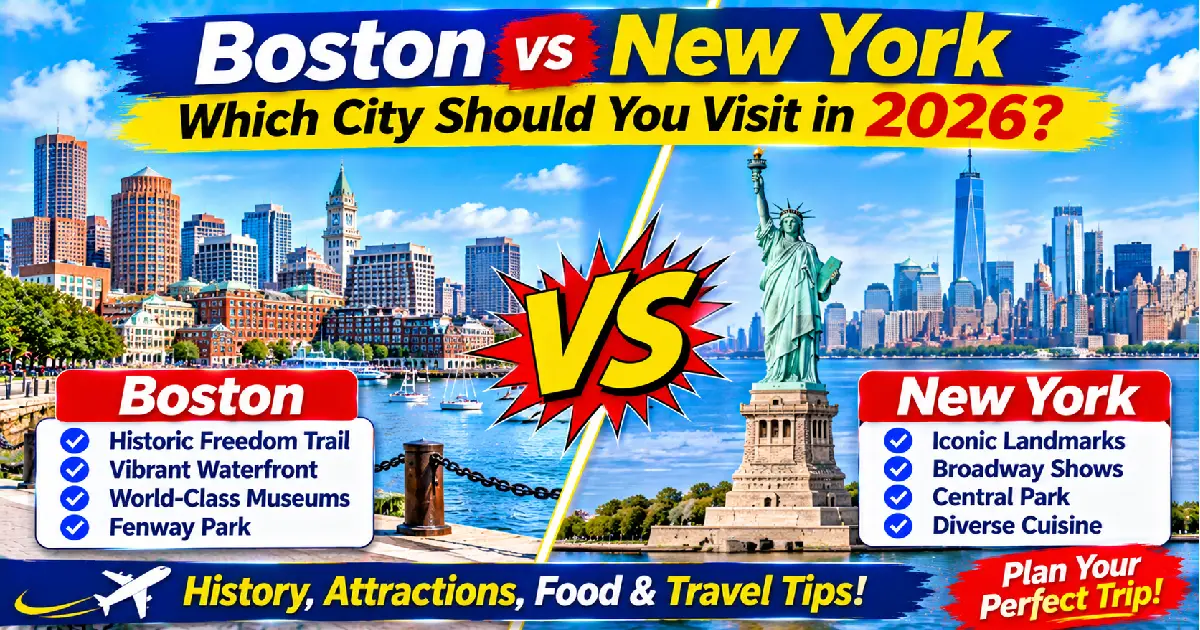
Boston and New York are the two oldest, most historically significant, and most intellectually productive cities in the United States — neighbors on the Northeast Corridor (215 miles apart, 3.5–4 hours by Amtrak Acela, $55–180 one way), bound together and opposed by a rivalry that predates the American Republic and reaches its most passionate modern expression on a baseball diamond. New York is the largest city in the Western Hemisphere — 8.3 million people in 302 square miles, the financial capital, the media capital, the cultural capital, the most visited city in North America. Boston is America’s oldest major city (founded 1630, five years before its first university, Harvard, was chartered in 1636), a compact, walkable city of 675,000 (4.9 million metro) built around a colonial-era street plan that predates the grid, home to the greatest concentration of universities in any metropolitan area in the world, and a sports culture so passionate that it has become a defining element of the city’s identity in a way unmatched by any other American city except possibly Green Bay.
The cities are more different than their proximity suggests. New York is maximalist — more of everything, bigger than everything, louder and more expensive and more overwhelming and more rewarding than anywhere else in America. Boston is human-scale — compact enough to walk across (3 miles from the North End to Fenway), possessed of a particular civic pride rooted in revolutionary history and intellectual tradition, and organized around neighborhoods (Beacon Hill, the North End, Back Bay, Cambridge, Somerville) that feel like genuine communities rather than demographic zones. Both are extraordinary travel destinations. The choice between them depends on what kind of traveler you are and what you want from a city.
| Category | Boston, Massachusetts | New York City, New York |
|---|---|---|
| Population | 675,000 (4.9M metro) | 8.3 million (20M metro) |
| Founded | 1630 | 1626 |
| Area | 48 square miles | 302 square miles |
| Universities in metro | 35+ (Harvard, MIT, BU, BC, Tufts, Northeastern…) | 10+ major (Columbia, NYU, Fordham…) |
| Getting around | MBTA + walking (very walkable) | Subway + walking (24-hr) |
| Average hotel | $200–340/night | $250–380/night |
| Average dinner | $50–80/person | $55–90/person |
| Top food experience | Lobster roll, clam chowder, seafood | Pizza, bagels, dim sum, everything |
| Top historic site | Freedom Trail, Paul Revere House | Statue of Liberty, 9/11 Memorial |
| Sports identity | Red Sox, Patriots, Celtics, Bruins (4 championships since 2001) | Yankees, Mets, Giants, Jets, Knicks, Rangers |
| Best season | June–October, late September foliage | April–June, September–October |
| Day trips | Cape Cod (1.5 hr), Salem (30 min), Newport (1 hr) | Hudson Valley (1.5 hr), Hamptons (2.5 hr), Philly (1.5 hr) |
Boston’s neighborhoods are among the most walkable and most historically intact in the United States — the result of a colonial-era street plan that was not razed and rebuilt in the 19th century grid, but instead expanded outward from the original Shawmut Peninsula through landfill and annexation.
Beacon Hill is the finest residential neighborhood in Boston — a 19th-century Federal and Greek Revival enclave of brick row houses on gas-lit cobblestone streets that climbs from the State House to the Charles River. Acorn Street (the most photographed street in Boston — a narrow cobblestone alley lined with 1820s Federal row houses, the finest single block in New England) is here. The Massachusetts State House (Beacon Street, the 1798 Charles Bulfinch building with its golden dome — free tours Monday–Friday, the finest Federal-era public building in America). The Public Garden (24 acres, America’s first public botanical garden, 1837 — the famous Swan Boats have paddled the lagoon every spring since 1877 at $4.50/adult, the Make Way for Ducklings bronze sculpture by Nancy Schön celebrates the Robert McCloskey book, the finest small urban park in New England) flows into the Boston Common (50 acres, the oldest public park in the United States, 1634, the starting point of the Freedom Trail).
The North End is Boston’s Italian neighborhood — the oldest continuously inhabited neighborhood in America, settled in the 1630s, home of the Italian immigrant community since the 1880s. The Paul Revere House (19 North Square, $6/adult — the oldest remaining structure in downtown Boston, built 1680, where Paul Revere lived when he rode to Lexington on April 18, 1775), Old North Church (193 Salem Street, $8/adult — the 1723 Anglican church where the sexton Robert Newman hung two lanterns in the steeple on April 18, 1775, signaling “by sea” to Paul Revere — “One if by land, two if by sea” — the most important single act in the American Revolution from a single building), and the best cannoli in America at Mike’s Pastry (300 Hanover Street — the North End cannoli wars between Mike’s and Modern Pastry (257 Hanover Street) are one of Boston’s finest food arguments, $4.50–6/cannoli, Mike’s line is longer and the cannoli is slightly larger, Modern’s is slightly less sweet and preferred by locals).
Back Bay (the most architecturally coherent neighborhood in Boston — a 19th-century landfill grid of brownstone row houses along Newbury Street (the finest outdoor shopping and café strip in Boston, 8 blocks from the Public Garden to Massachusetts Avenue, each block slightly edgier than the last), Boylston Street (the Copley Square intersection with Trinity Church (1877, H.H. Richardson’s Romanesque masterpiece, the finest Victorian church interior in America, $10 suggested), the Boston Public Library (the first large free municipal library in the US, 1895 McKim, Mead & White Beaux-Arts building — the finest library reading room in America, the Sargent Murals are an undervisited masterpiece, free), and the John Hancock Tower (now 200 Clarendon, the 60-story all-glass I.M. Pei tower that is the tallest building in New England).
Cambridge (across the Charles River via Harvard Bridge — the most intellectually dense square mile in the world: Harvard University (the oldest university in the Western Hemisphere, 1636 — Harvard Yard, the Harvard Natural History Museum $15/adult with the world-famous Glass Flowers collection, the Widener Library exterior, the graduate school of government and science campuses, free self-guided tour), MIT (Massachusetts Institute of Technology, just east of Harvard — the most important science and engineering university in the world, the MIT Museum $20/adult, the Stata Center by Frank Gehry the finest contemporary academic building in Boston, the Infinite Corridor on sunny days in November and May when the sun aligns perfectly — free self-guided tour)). Harvard Square (the finest concentration of independent bookshops — Harvard Book Store (1256 Massachusetts Ave, founded 1932, the finest independent bookshop in Boston), Raven Used Books — coffee roasters, foreign-language cinemas, and outdoor chess tables in any American city). Somerville (the most rapidly transforming neighborhood in the Boston area — Davis Square and the new Green Line Extension corridor have the finest concentration of new independent restaurants).
South End (the finest restaurant neighborhood in Boston — a Victorian brownstone district with the highest concentration of excellent independent restaurants per block in the city, centered on the SoWa Open Market (May–October Sunday, the finest outdoor art and food market in Boston) and the SoWa Art + Design District galleries). Jamaica Plain (the most politically progressive neighborhood in Boston — an early center of the craft beer movement (Samuel Adams Brewery free tours, the finest brewery tour in Boston), Victory Gardens, diverse Caribbean and Latin American food). Charlestown (home of the USS Constitution — “Old Ironsides,” the oldest commissioned warship afloat in the world (1797), free tours, berthed in the Navy Yard — and the Bunker Hill Monument (1843, 294 steps to the top, free — the finest view of Boston Harbor from any point in the city)).
New York’s neighborhoods are covered more fully in our New York vs Los Angeles guide, but the essential comparison points with Boston:
New York has more neighborhoods of more variety and more historical depth than Boston — Manhattan alone contains 25+ distinct neighborhoods (Greenwich Village, the East Village, Harlem, Washington Heights, the Upper West Side, the Upper East Side, Midtown, the Financial District, SoHo, Tribeca, Chelsea, Hell’s Kitchen, Inwood) and each of the outer boroughs (Brooklyn, Queens, the Bronx, Staten Island) adds more. The result is a city that rewards literally years of exploration and never fully reveals itself. Boston is compact enough to fully explore in a week — New York is not. The tradeoff is that Boston’s small scale makes it feel intimate, navigable, and comprehensible in a way that New York, despite its wonders, never quite does.
Boston has the deepest revolutionary history of any American city — the events that precipitated the American Revolution unfolded here in a concentrated sequence from 1770 to 1776 that is documented with extraordinary completeness.
The Freedom Trail (a 2.5-mile red-brick and red-painted-line walking route through 16 historic sites from Boston Common to Bunker Hill in Charlestown — the finest self-guided history walk in the United States. Key sites: Boston Common (1634, the oldest public park in the US, where British troops camped in 1775), Park Street Church (1809, William Lloyd Garrison gave his first antislavery speech here, 1829), Granary Burying Ground (1660, the graves of Paul Revere, Samuel Adams, John Hancock, the Boston Massacre victims, and the parents of Benjamin Franklin), King’s Chapel (1688, the first Anglican church in New England, the adjacent burying ground is the oldest in Boston, 1630), Benjamin Franklin statue and the site of the first public school in America (1635, Boston Latin School), Old Corner Bookstore (1718, where Hawthorne, Longfellow, Thoreau, and Emerson published), Old South Meeting House (1729, where 5,000 colonists met on December 16, 1773, and Samuel Adams gave the signal that ended the Boston Tea Party, $7/adult), Old State House (1713, the oldest surviving public building in Boston, where the Declaration of Independence was first read to Bostonians from the balcony in July 1776, $14/adult), Boston Massacre Site (the cobblestone circle marking the spot where British soldiers fired on colonists on March 5, 1770, killing five — the event that turned American opinion decisively against British rule), Faneuil Hall (1742, “the Cradle of Liberty” where Boston town meetings were held, free, now surrounded by the Quincy Market food hall), Paul Revere House and Old North Church (see Neighborhoods), Bunker Hill Monument (free)).
The Freedom Trail is the most complete and most walkable collection of American Revolutionary history anywhere, and it can be walked in a full day with stops at every site. The companion Black Heritage Trail (a 1.6-mile walk through Beacon Hill documenting the African American community that lived here from the 1700s — the African Meeting House (1806, the oldest Black church building in America, free), the Lewis Hayden House (a stop on the Underground Railroad where escaped enslaved people were sheltered) — documents a history that the Freedom Trail alone does not tell.
New York’s historical depth is broader and deeper than Boston’s but less concentrated in a single era. The 9/11 Memorial and Museum (free outdoor memorial, $33/adult for the museum — the most important and most moving memorial museum in the United States of the 21st century, the two reflecting pools in the footprints of the Twin Towers are among the finest memorial works of art in the world, allow 3+ hours). Ellis Island ($24.30/adult including ferry from Battery Park — the museum in the former immigration station where 12 million immigrants entered the United States between 1892 and 1954, the genealogy database, the Wall of Honor with 700,000 names) and the Statue of Liberty (same ferry, pedestal access $24.30, crown access $24.30 + additional $3, reserve 6+ months in advance — the finest single monument in the United States, a gift from France 1886, 354 steps to the crown, the view of New York Harbor is the finest from any point at sea level). The Brooklyn Bridge (1883, the first steel-wire suspension bridge in the world — walk the 1.1-mile pedestrian walkway from Brooklyn to Manhattan or vice versa, free, the finest 30-minute walk in New York City). Lower Manhattan contains the Fraunces Tavern (54 Pearl Street, where George Washington bid farewell to his officers in 1783, still operating as a bar and museum), Trinity Church (Broadway and Wall Street, Alexander Hamilton is buried in the churchyard, free), and Bowling Green (the oldest public park in New York, 1733).
The verdict on history: Boston wins for the depth and walkability of its Revolutionary-era history — the Freedom Trail is the finest concentrated historic walking route in the United States. New York wins for the breadth of its history across multiple eras and the emotional power of the 9/11 Memorial. Both are essential; neither substitutes for the other.
Boston’s food identity is built on the extraordinary seafood of the New England coast — the cold waters of the Gulf of Maine produce some of the finest shellfish, lobster, and white fish in the world, and Boston’s restaurant culture has been built around that larder for 250 years.
The definitive Boston food experiences: The lobster roll — the finest argument in New England food culture: do you prefer a cold lobster roll (chilled lobster claw and knuckle meat dressed with a small amount of Duke’s mayo, served in a toasted New England split-top hot dog bun — the Connecticut-style, preferred by purists) or a warm lobster roll (lobster meat warmed in butter, no mayo — the Maine-style). The definitive Boston lobster rolls: Neptune Oyster (63 Salem Street, North End — the finest cold lobster roll in Boston, the pile is generous beyond reason at $42, the warm butter roll is equally excellent, the wait for a table routinely exceeds 1.5 hours, arrive at opening or prepare to wait), James Hook & Co. (440 Atlantic Avenue, the no-frills waterfront shack that has been buying live lobsters off the boats since 1925, $28–34, cash and card, the most authentic experience), Island Creek Oyster Bar (500 Commonwealth Ave, Kenmore Square — the finest overall seafood restaurant in Boston, the raw bar is extraordinary, the clam chowder is the best in the city, $36–58 mains).
Clam chowder (the New England style — a cream-based soup with littleneck or quahog clams, potatoes, and salt pork, served in a bread bowl; the finest in Boston at Legal Sea Foods (Park Plaza, the city’s most beloved seafood chain since 1950, the clam chowder recipe has been served at every Presidential inauguration since 1981, $12/cup), Summer Shack (50 Dalton Street, chef Jasper White’s casual seafood palace, $11/cup), and Oceana (Faneuil Hall, tourist-facing but excellent quality, $12/cup)). Dunkin’ Donuts coffee (the most important cultural artifact in Boston food culture — Boston consumes more Dunkin’ per capita than any other American city, the original Dunkin’ opened in Quincy MA 1950, ordering “a large regulah” (large coffee with cream and two sugars) is a Boston rite of passage, $3.50 large). Sam Adams (the Boston Lager is the most important craft beer in American history, the Jamaica Plain brewery tours are free and excellent, the Sam Adams Taproom in the Seaport is the finest place to drink the full lineup).
Fine dining: O Ya (9 East Street, the most celebrated Japanese restaurant in Boston — omakase sushi and creative Japanese small plates, $185–225/person, the finest sushi tasting menu on the East Coast outside New York), Menton (354 Congress Street, the Seaport, the most acclaimed fine dining restaurant in Boston from James Beard winner Barbara Lynch, French-Italian, $175 tasting menu), Craigie on Main (Cambridge, the most influential kitchen in Boston for the past 15 years, whole-animal cooking and housemade charcuterie), Row 34 (383 Congress Street, Seaport, the finest oyster bar and casual seafood restaurant in Boston, $28–48).
Ethnic food: Boston’s ethnic food scene is less celebrated than New York’s but contains genuine excellence — Chinatown (the third-largest Chinatown in the US, the finest dim sum in New England at Hei La Moon (88 Beach Street, $4–7/plate, go with a group, the carts on weekends), Great Taste Bakery for the finest BBQ pork buns ($1.75 each)), and the finest Vietnamese food in the US outside of Houston, San Jose, and New Orleans in the Fields Corner neighborhood of Dorchester (the largest Vietnamese community in New England, Pho Hoa the standout, $12–16/bowl).
New York’s food scene is covered in full in our New York vs Los Angeles guide. The key comparison points with Boston: New York has more Michelin stars (70+ three-star restaurants in the NY metro vs. Boston’s 1), more cuisines (30,000+ restaurants across virtually every national cuisine on Earth vs. Boston’s 3,000+), more extraordinary cheap food (the $3.50 pizza slice, the $6 bodega breakfast sandwich, the $3 falafel on 53rd and 6th), and more iconic food experiences (the New York bagel, the New York cheesecake, the New York deli pastrami, the New York slice) than any other city in the world. The gap in food culture between New York and Boston is one of the largest in any comparison of two comparable American cities.
The verdict on food: New York wins comprehensively — more cuisines, more Michelin stars, more iconic dishes, and more value across every price point. Boston wins on New England seafood specifically — the finest lobster roll and the finest clam chowder are genuinely better in Boston, and the cold-water shellfish available in Boston restaurants surpasses anything available in New York.
This category belongs to Boston, and the margin is wide.
The Boston-Cambridge metro area contains Harvard University (1636, #1 or #2 globally in virtually every ranking — 8 US presidents, 50 Nobel Prize winners, the richest university endowment in the world at $53 billion), MIT (Massachusetts Institute of Technology — the most important science and engineering university in the world, more patents filed than any university, the birthplace of computing as we know it), Boston University (the fourth-largest private university in the US), Boston College (the finest Jesuit university in the Northeast), Tufts University, Northeastern University, Brandeis University, Wellesley College, Babson College, Emerson College, and 25+ others. The density of Nobel Prize winners, Fields Medalists, Pulitzer Prize winners, and MacArthur Fellows living and working within 10 miles of Harvard Square is unmatched anywhere in the world.
The Museum of Science (1 Science Park, $30/adult — the finest general science museum in New England, the Van de Graaff Generator demonstrations, the Planetarium, the butterfly garden), the Harvard Natural History Museum ($15/adult — the Glass Flowers (3,000 botanically accurate glass models of plant specimens created in Dresden 1887–1936, the most extraordinary scientific art objects in any American museum), the finest mineral collection in the Northeast), and the MIT Museum ($20/adult — robotic, holographic, and computing exhibitions) make the Cambridge museum landscape a genuine complement to the university visits.
New York has Columbia, NYU, Fordham, and the New School — excellent universities — but the concentration of intellectual life in Cambridge and the Boston metro is uniquely intense and uniquely accessible to visitors.
This is the most emotionally charged comparison in the guide, and the most personal.
Boston is the finest sports city in the United States by any objective measure of titles won per capita per decade since 2000. The Red Sox won the World Series in 2004, 2007, 2013, and 2018 — ending the 86-year “Curse of the Bambino” drought and then winning three more times. The Patriots won the Super Bowl in 2002, 2004, 2005, 2015, 2017, and 2019 — six championships in 18 years under Bill Belichick and Tom Brady, the finest dynasty in NFL history. The Celtics won the NBA championship in 2008 and 2024. The Bruins won the Stanley Cup in 2011. No other American city of Boston’s size has produced this volume of championship success in a 25-year period.
Fenway Park (4 Yawkey Way, open since 1912 — the oldest ballpark in Major League Baseball, the Green Monster (the 37-foot-tall left field wall 310 feet from home plate, the most famous feature in baseball), the Pesky Pole (the 302-foot right field foul pole named for Johnny Pesky), the hand-operated scoreboard, the red seat in Section 42 Row 37 Seat 21 that marks where Ted Williams hit the longest measured home run in Fenway history (502 feet, 1946) — a Red Sox game at Fenway is among the finest sporting experiences in America, $35–150/ticket, the park tours ($25/adult) are the finest stadium tour in the country for those who cannot get game tickets). TD Garden (Celtics and Bruins, 17,850 capacity, 100 Legends Way).
New York has the Yankees (the most successful franchise in baseball history — 27 World Series titles, Ruth, Gehrig, DiMaggio, Mantle, Jeter, the Yankee Stadium (2009, the finest modern baseball stadium in America, $Legends Suite $300–500, grandstand from $30)), the Mets (Citi Field, Flushing Queens, the most aesthetically pleasing modern stadium in the National League), the Giants and Jets (MetLife Stadium, East Rutherford NJ, shared stadium), the Knicks and Rangers (Madison Square Garden, “The World’s Most Famous Arena,” $75–500/seat). The volume of sports available in New York is unmatched — on any given weekend there may be a Yankees game, a Knicks game, a Rangers game, and a Mets game available simultaneously.
The verdict on sports: Boston wins on titles-per-capita and the emotional intensity of the fan culture — the Red Sox–Yankees rivalry is the finest in American professional sports, and a game at Fenway Park is among the finest sporting experiences available to a visitor in any American city. New York wins on volume and the Madison Square Garden mystique.
Boston is one of the most expensive cities to visit in the United States — driven by the university population (which creates year-round demand for hotels) and the tourism demand of a compact, highly walkable city with limited hotel inventory. Hotels in Back Bay, Beacon Hill, and the North End average $200–340/night for mid-range rooms; Cambridge (near Harvard and MIT) runs $180–290/night. Food is expensive: the lobster roll alone is $28–42, a good Back Bay dinner is $65–90/person with drinks. The MBTA (“the T,” America’s oldest subway system, 1897 — $2.40/ride, $11/day pass) is the most affordable transportation in the city and covers most tourist destinations.
Budget estimate per person per day: $190–300 (mid-range); $350–500 (comfortable); $90–130 (budget, staying in a Somerville or Allston hostel, eating Chinatown dim sum and North End cannoli).
New York is covered in full in the New York vs Los Angeles guide. The key comparison: New York averages $280–380/night for mid-range hotels in Manhattan (Brooklyn runs $130–200), $55–90/person for a mid-range dinner, and $2.90/ride or $34 for a 7-day subway pass. New York is meaningfully more expensive than Boston across hotels and food, but the subway’s 24-hour operation and the density of free or cheap experiences (free Central Park, free Staten Island Ferry, $3.50 pizza slices, pay-what-you-wish at the Met) make the gap smaller than the raw hotel and dinner prices suggest.
The verdict on cost: Boston is slightly more affordable than New York for hotels and comparable for food, but both cities are expensive by national standards. New York’s 24-hour subway and density of cheap food options partially offset its higher base costs.
Day trips from New York are covered fully in the New York vs Los Angeles guide. Key options: Philadelphia (1.5 hours by Amtrak), the Hudson Valley and Dia:Beacon (1.5 hours), the Hamptons (2.5 hours), the Berkshires (2.5 hours), and the Catskills (2 hours).
Choose Boston if:
Choose New York if:
The honest answer: If you have never been to the Northeast, visit both — they are 3.5 hours apart and complement each other perfectly (Boston for history and scale, New York for intensity and culture). If forced to choose one for a first visit: New York is the more extraordinary city by almost every objective measure of scale, cultural depth, and food variety. Boston is the more rewarding city for a visitor who wants to feel like they’ve truly understood a place — it is compact enough to explore fully, historically rich enough to reward deep curiosity, and human-scale enough to feel like a city rather than a phenomenon.
Posted By : Vinay
Latest Article
2nd Floor, 39, Above Kirti Club, DLF Industrial Area, Kirti Nagar, New Delhi, Delhi 110015



Travel Tourister is a leading Travel portal where we introduce travellers to trusted travel agents to make their journey hasselfree, memorable And happy. Travel Tourister is a platform where travellers get Tour packages ,Hotel packages deals through trusted travel companies And hoteliers who are working with us across the world. We always try to find new and more travel agents and hoteliers from every nook and corners across the world so that you could compare the deals with different travel agents and hoteliers and book your tour or hotel with the one you have chosen according to your taste and budget.
Copyright © Travel Tourister, India. All Rights Reserved

 Call
 Enquiry