Published on : 03 Jul 2026
Published: July 3, 2026 — Friday (Peak European Summer Holiday Season · EES Rollout Ongoing)
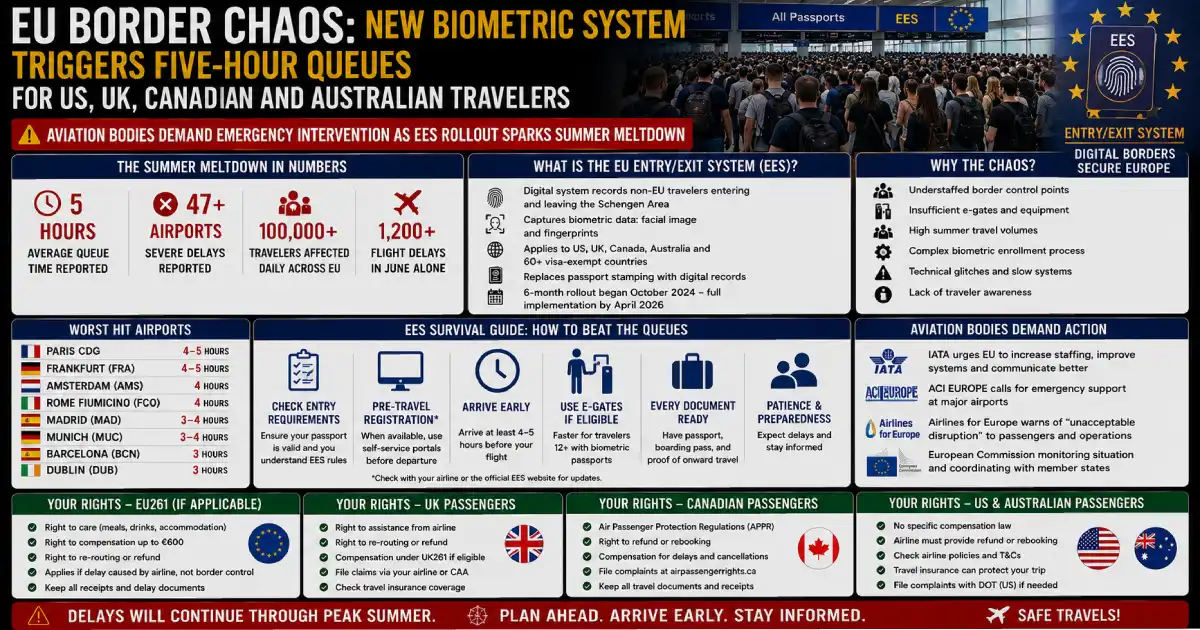
System causing disruption: EU Entry/Exit System (EES) — mandatory biometric border checks for non-EU arrivals Reported peak queue times: Up to 5 hours at some European gateways Border processing time increase: Roughly 4x standard pre-EES processing time per traveler Immediate consequence: Aircraft departing with empty seats as passengers remain stuck in immigration queues Industry bodies demanding action: Airports Council International (ACI) Europe, Airlines for Europe, International Air Transport Association (IATA) Who they’re appealing to: European Commission President Ursula von der Leyen European Commission’s position: Declining to pause or roll back the system; describes current impact as limited Who’s affected: All non-EU nationals, including US, UK, Canadian, Australian and New Zealand travelers Recommended arrival buffer: Minimum 4 hours before international departure Rebooking risk: ⚠️ High — summer flights are largely sold out, leaving missed-connection passengers stranded for days
Europe’s busiest holiday season has collided head-on with its newest border security system, and the result is a summer travel crisis serious enough that the continent’s top aviation trade bodies have made a formal, joint emergency appeal to Brussels. The EU’s Entry/Exit System — a mandatory biometric check that replaces the old passport stamp with facial scans, fingerprints and digital record-keeping for every non-EU arrival — has quadrupled per-passenger processing times at border control, according to aviation compensation specialist AirAdvisor. The practical result: queues stretching up to five hours at some gateways, aircraft departing half-empty because ticketed passengers are still stuck in line, and families facing steep unplanned rebooking costs with almost no available seats left this summer. If you’re a US, UK, Canadian, Australian or New Zealand traveler with a European trip booked, here’s what’s actually happening and how to protect your itinerary.
The EES replaces the traditional ink passport stamp with a fully digital, biometric border-crossing record for every non-EU citizen entering the Schengen Area. On arrival, border officials are now required to capture a traveler’s facial biometrics, fingerprints and identification details, building an electronic record instead of the manual stamp travelers have relied on for decades.
The policy goal is legitimate and long-planned: better tracking of overstays and improved security along the EU’s external border. But the rollout has exposed a basic infrastructure mismatch — terminal buildings built around fast manual stamp-checks simply don’t have the physical counter space or staffing to support four-times-longer biometric interviews at peak arrival volumes.
| Metric | Detail |
|---|---|
| System type | Mandatory biometric entry/exit recording for non-EU travelers |
| Data captured | Facial biometrics, fingerprints, identification details |
| Processing time change | Approximately 4x longer per traveler than manual stamping |
| Reported peak queue time | Up to 5 hours at affected gateways |
| Who’s exempt | EU/Schengen citizens and residents |
| Who’s affected | US, UK, Canada, Australia, New Zealand and other non-EU passport holders |
The border gridlock isn’t just an inconvenience at immigration — it’s actively breaking airline scheduling. Carriers operate under strict gate-departure windows, and when large blocks of ticketed passengers are still working through hours-long biometric queues at the moment of scheduled departure, airlines are increasingly forced to close the doors and depart without them rather than absorb further schedule-wide delays.
For affected passengers, the consequences compound quickly. Because European summer capacity is running near-full across most routes, there’s often no same-day or even same-week alternative flight available, leaving stranded travelers covering emergency accommodation and rebooking costs out of pocket while trying to find any seat home.
Industry pressure has reached the top level of EU governance. A joint appeal from ACI Europe, Airlines for Europe and IATA has gone directly to European Commission President Ursula von der Leyen, warning that continued unmitigated rollout risks derailing the continent’s entire peak summer travel season. ACI Europe’s president — who also runs Frankfurt’s transport hub — has publicly criticized Brussels for downplaying the severity of what terminal operators are experiencing on the ground, and industry groups are pushing for individual airports to get emergency authority to temporarily suspend biometric capture during periods of extreme congestion.
So far, the European Commission has held firm: officials maintain that recorded impacts remain limited across most airports, that all member states agreed to these security reforms well before launch, and that biometric data collection is non-negotiable for securing the bloc’s external border. The Commission has ruled out any permanent delay or rollback, though it has agreed to emergency meetings with airline leadership to address technical failures.
United States: If you have any European arrival this summer, treat the standard 2-hour arrival buffer as obsolete — build in a minimum of 4 hours before any tight onward connection, and confirm your airline’s specific policy on rebooking passengers who miss a flight due to border delays outside their control.
Canada: Canadian travelers connecting through major European hubs onto a second flight should strongly consider booking a longer layover than usual this summer, since a missed connection caused by EES queues may not qualify for standard airline rebooking assistance.
United Kingdom: UK travelers are non-EU citizens under EES and fully subject to these checks when entering the Schengen Area — this applies even for short weekend trips to popular destinations like Paris, Amsterdam or Rome.
Australia & New Zealand: Long-haul travelers arriving in Europe after 20+ hours of flying should be especially prepared for an additional multi-hour wait at immigration; carrying essentials (medication, chargers, snacks) in hand luggage is strongly advised given the extended queue times reported.
| Situation | Recommended Action |
|---|---|
| Any international arrival in the Schengen Area | Arrive prepared for up to 4-5 hour immigration queues; don’t rely on old timing assumptions |
| Tight onward connection after EU arrival | Rebook with a longer layover if possible, or split your journey with an overnight stop |
| Missed flight due to border delay | Contact your airline immediately — sold-out summer capacity means limited same-day options |
| General preparation | Carry physical copies of hotel bookings and travel insurance; pack medication and chargers in hand luggage |
Posted By : Vinay
This article is provided for general informational purposes only and is based on information available at the time of publication. Travel advisories, airline schedules, airport operations, visa requirements, government regulations, and other travel-related information are subject to change without prior notice. While Travel Tourister makes reasonable efforts to verify information using official announcements, government publications, airline and airport communications, and other reliable sources, we cannot guarantee that all information remains complete, accurate, or up to date at all times. Readers should independently verify any information that may affect their travel plans with the relevant airline, airport authority, government agency, embassy, or other official source before making travel, financial, or other decisions. Travel Tourister shall not be liable for any direct or indirect loss, inconvenience, or damages arising from the use of or reliance on the information contained in this article. Nothing in this publication constitutes legal, immigration, financial, or professional travel advice. If you believe any information in this article is inaccurate or outdated, please contact our editorial team. We review all credible correction requests promptly and update our content whenever appropriate.
Lastest News
2nd Floor, 39, Above Kirti Club, DLF Industrial Area, Kirti Nagar, New Delhi, Delhi 110015



Travel Tourister is a leading Travel portal where we introduce travellers to trusted travel agents to make their journey hasselfree, memorable And happy. Travel Tourister is a platform where travellers get Tour packages ,Hotel packages deals through trusted travel companies And hoteliers who are working with us across the world. We always try to find new and more travel agents and hoteliers from every nook and corners across the world so that you could compare the deals with different travel agents and hoteliers and book your tour or hotel with the one you have chosen according to your taste and budget.
Copyright © Travel Tourister, India. All Rights Reserved

 Call
Call Enquiry