Published on : 05 Aug 2026
By Travel Tourister | Updated Aug 2026
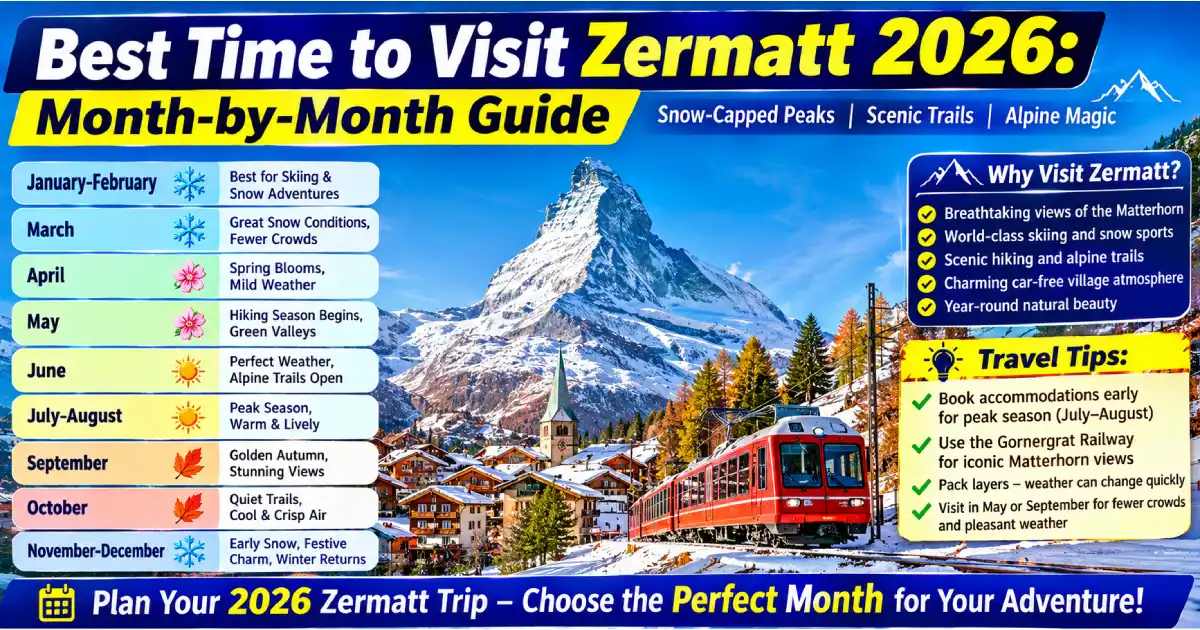
Zermatt is one of the very few Alpine destinations in the world that operates at genuine excellence across all four seasons — a year-round mountain resort where the question is not whether to visit in summer or winter (both seasons are extraordinary) but rather which specific combination of activities, weather, pricing, and crowd levels best matches your 2026 travel priorities. The best time to visit Zermatt depends almost entirely on what you want to do: December through April delivers the world-class ski resort experience that established Zermatt’s global reputation, with the Klein Matterhorn glacier providing year-round skiing above 3,500 meters extending the season into May and even June on the high terrain; June through October delivers the hiking season that reveals Zermatt’s alpine landscape as something quite different from and arguably more beautiful than the snow-covered ski resort — the Five Lakes Walk, the Zmutt Valley, the Findeln hamlet, and the Matterhorn’s alpenglow all reach their most accessible and most photographically spectacular during summer’s clear conditions; and the brief “shoulder” periods of May and November represent the most affordable visiting windows, when crowds and prices drop to their annual lows while specific activities remain available to visitors who research what’s open and accessible during these transitional months.
What makes Zermatt’s seasonal planning genuinely complex is the altitude factor — the village sits at 1,608 meters, but Zermatt’s activities span from this valley-floor elevation to 3,883 meters at the Matterhorn Glacier Paradise. This 2,275-meter elevation range creates dramatically different seasonal timing at different altitude bands simultaneously: the village streets may be dry and sunny in May while the high-Alpine trails above 2,500 meters remain snowbound until late June, while the glacier above 3,500 meters maintains skiing conditions year-round regardless of what any other month produces at lower elevations. The practical implication — understanding which specific activities are accessible at which altitude during which month — is the most important planning knowledge for a Zermatt visit, and this guide provides it month-by-month for 2026.
For specific Zermatt recommendations, see our Best Places to Visit in Zermatt 2026, Things to Do in Zermatt 2026, Best Restaurants in Zermatt 2026, and Zermatt Travel Guide 2026 guides.
| Month | Avg High/Low Village (°C) | Avg High/Low Village (°F) | Crowd Level | Hotel Prices | Best For |
|---|---|---|---|---|---|
| January | 2°C / -8°C | 36°F / 18°F | Very High | $$$$ | Peak skiing, deep powder, New Year energy |
| February | 3°C / -7°C | 37°F / 19°F | Very High | $$$$ | Best skiing conditions, Zermatt Unplugged prep |
| March | 6°C / -5°C | 43°F / 23°F | High | $$$ | Spring skiing, longer days, good value vs Feb |
| April | 9°C / -2°C | 48°F / 28°F | Medium | $$ | Zermatt Unplugged (April), spring, shoulder value |
| May | 13°C / 2°C | 55°F / 36°F | Low | $ (lowest) | Cheapest month, quiet village, glacier skiing |
| June | 17°C / 5°C | 63°F / 41°F | Medium | $$ | Hiking season opens, wildflowers begin |
| July | 20°C / 8°C | 68°F / 46°F | Very High | $$$$ | Peak hiking, Five Lakes Walk, maximum daylight |
| August | 19°C / 7°C | 66°F / 45°F | Very High | $$$$ | Peak hiking, warm days, wildflower peak at altitude |
| September | 15°C / 3°C | 59°F / 37°F | Medium–High | $$$ | Best hiking conditions, reduced crowds, autumn begins |
| October | 10°C / -1°C | 50°F / 30°F | Medium | $$ | Larch foliage, autumn photography, shoulder value |
| November | 3°C / -5°C | 37°F / 23°F | Low | $ | Quietest month, ski season preparing |
| December | 0°C / -8°C | 32°F / 18°F | High–Very High | $$$$ | Ski season opens, Christmas in Alps, magical |
Avg Temp Village: 0°C / 32°F | Snow at Village: Possible | Snow at 2,500m+: Reliable | Crowds: High → Very High (Christmas week) | Hotel Prices: $$$–$$$$ (Christmas/NYE = absolute peak)
December in Zermatt divides into two meaningfully different periods that experienced visitors specifically plan around: early December (December 1–20), when the ski season launches with excellent high-altitude snow conditions (the Klein Matterhorn glacier ensuring reliable skiing from day one of the season) but before the Christmas-week crowd and pricing peaks activate, and Christmas-New Year (December 20–January 2), when Zermatt experiences its highest visitor volumes and absolute highest prices of the entire year — hotel rates at Zermatt’s premium properties during Christmas week and New Year’s Eve regularly exceed CHF 2,000–4,000/night, and the village’s carrying capacity of approximately 20,000 visitor beds is essentially fully occupied simultaneously.
Early December’s specific advantage is clear: the ski area opens with typically excellent high-altitude conditions (the Klein Matterhorn glacier providing guaranteed snow above 3,500 meters from the season’s first day, and lower runs opening progressively through December as snowpack develops), the village’s Christmas atmosphere activates fully (decorations, the specific Zermatt festive light installations, and the mountain-village-in-Advent mood that the car-free environment makes particularly evocative), and accommodation pricing — while well above the summer shoulder rates — remains 30–50% below the Christmas-week peak.
The New Year’s Eve celebration in Zermatt (fireworks visible from the village against the Matterhorn’s snow-covered profile, the car-free village’s pedestrian streets packed with visitors, and the specific energy of one of Europe’s most dramatically located New Year celebrations) is one of Switzerland’s most celebrated single-night events — but requires accommodation booked 6–12 months ahead and budgets calibrated for the year’s absolute pricing maximum.
What to do: Early December — ski the Klein Matterhorn area (guaranteed snow regardless of lower-altitude conditions), the village’s Christmas atmosphere exploration (evening Bahnhofstrasse walk with festive lighting, the horse-drawn carriage rides in snow conditions, the traditional Valais fondue dinner at the Whymper Stube). Christmas–New Year — the above plus the specific celebrations, fireworks, and collective mountain-resort festivity that make Zermatt’s Christmas week one of the most sought-after Alpine experiences despite its extraordinary cost.
Insider tip: The December “sweet spot” is December 8–18 — after the ski area has fully opened (sufficient snowpack typically established by early December for the lower runs to complement the glacier) and before the December 20+ Christmas-week pricing and crowd activation. This specific two-week window provides full ski season conditions at 30–40% below Christmas-week rates with meaningfully reduced booking competition.
Avg Temp Village: 2°C / 36°F | Snow: Excellent at all elevations | Crowds: Very High | Hotel Prices: $$$$ (highest outside Christmas)
January represents Zermatt’s peak ski season at its most complete — full snowpack accumulated from December’s early-season development, a consistent crowd of serious skiers (the Christmas-week leisure visitors have departed, replaced by dedicated ski-week visitors who book specific January weeks for optimal conditions), and the Matterhorn’s January profile (snow-plastered from summit to mid-mountain, the northeast face alternating between sun-warmed orange in morning alpenglow and brilliant white in direct light) at its most dramatically photogenic. The specific combination of deep-established snowpack, reliable weather patterns (January tends toward clearer, colder conditions than December’s more variable early-season weather), and the ski area’s full operational capacity creates the conditions that experienced Alpine skiers specifically seek in a January Zermatt trip.
Hotel prices in January remain near December Christmas-week levels (the European ski-week culture — particularly strong in the UK, Germany, Netherlands, and Scandinavia — drives consistent January demand that differs from the holiday-travel driver of Christmas pricing but produces equivalent supply compression). Booking January accommodation 4–6 months ahead is the minimum preparation for preferred central properties; the most sought-after smaller hotels (the Backstage, The Omnia) require booking at or before 6 months ahead for January dates.
What to do: Skiing is the primary January activity — the Matterhorn Ski Paradise at full capacity, the cross-border Cervinia connection operational, the Klein Matterhorn glacier providing the highest-altitude skiing available in the Alps (up to 3,883 meters), and the specific morning powder conditions (Zermatt’s northerly aspects and high-altitude terrain retaining untracked powder longer into each morning than south-facing resort terrain) rewarding early first-lift arrivals. Non-skiing visitors can experience the Gornergrat rack railway (clear winter days providing extraordinary views of the fully snow-covered landscape), the Matterhorn Museum, and the village’s specific winter-resort atmosphere.
Insider tip: The Matterhorn’s January alpenglow (the pre-sunrise reddening of the peak’s summit) occurs at its most dramatic when viewed against a sky still deep blue-purple before dawn — the combination of the snowy north face catching the first reddish light and the surrounding valley in complete darkness creates a specifically winter version of the alpenglow experience that summer’s earlier sunrises (when the sky has already lightened before alpenglow peaks) cannot match.
Avg Temp Village: 3°C / 37°F | Snow: Excellent — typically the deepest snowpack of the year | Crowds: Very High | Hotel Prices: $$$$
February delivers what most experienced Swiss Alpine skiers identify as the ski season’s optimal conditions — the full snowpack accumulated from December and January, the longest daylight hours of the ski season (the February post-solstice lengthening of days extending afternoon skiing time beyond January’s shorter windows), and the specific “spring skiing preview” of late February (warmer afternoon temperatures beginning to produce the corn-snow texture on south-facing runs that experienced skiers specifically seek — fast, stable, and forgiving in a way that January’s colder, icier conditions don’t produce). The traditional school holiday periods (Fasching/Carnival in Germany and Austria, half-term in Britain, and various European country-specific school breaks) concentrate in February, creating the busiest weeks of the entire ski season for Zermatt’s European market.
Zermatt Unplugged (the annual acoustic music festival, typically held in mid-April — check specific 2026 dates at zermatt-unplugged.ch) is not a February event, but the winter ski season that February represents creates the context that makes April’s Unplugged timing (end of ski season + music festival) the most complete version of the Zermatt winter experience. Visitors specifically targeting Unplugged should note its April timing.
What to do: Full ski area access (the entire 360-kilometer Matterhorn Ski Paradise at maximum operational capacity, the cross-border Cervinia connection, and the Klein Matterhorn glacier providing guaranteed upper-mountain conditions), night skiing (select illuminated runs on the Sunnegga-Blauherd area on specific evenings — check the Zermatt Bergbahnen schedule), and the specific après-ski culture (the village’s bar and restaurant scene at its busiest and most social) combine into Zermatt’s most complete winter resort experience.
Insider tip: The European school holiday periods in February (which vary by country and by specific region within countries — German Fasching holidays typically fall in a different week than British half-term, and Swiss cantonal holidays add another wave) create distinct demand spikes within February’s overall peak — identifying the specific weeks of your country’s or target market’s school holidays and positioning a February visit either before or after those specific weeks provides meaningfully better availability and marginally lower pricing within the same month’s overall premium level.
Avg Temp Village: 6°C / 43°F | Snow: Good to excellent at altitude; lower slopes softening | Crowds: High (early), Medium (late) | Hotel Prices: $$$
March provides Zermatt’s best skiing value within the winter season — the established snowpack from January and February’s accumulation maintains excellent conditions at altitude while the longer days (the March equinox bringing 12 hours of daylight and post-solstice morning and evening light that extends the usable skiing day beyond January’s shorter windows) and warmer afternoon temperatures create the “spring skiing” conditions that experienced Alpine skiers specifically seek. Hotel prices in March (particularly in the second half, after the main European school holiday periods have concluded) drop noticeably from February’s peak — 20–35% reductions in comparable properties between peak February weeks and late March represent genuine value within what remains an overall premium destination month.
The specific March skiing pleasure — corn snow on south-facing slopes in the afternoon (warm, heavy, fast, and forgiving), deep powder retained on north-facing and high-altitude slopes through the morning, and the visual drama of the ski landscape transitioning from deep winter toward spring (the Matterhorn’s lower rock ridges beginning to emerge from snow cover in late March on the sun-exposed southern faces while the north face remains deeply plastered) — creates a skiing environment that many regular visitors specifically prefer to January’s colder, icier conditions.
What to do: Skiing specifically — March is pure ski season without the additional cultural programming that December and April bring. The Gornergrat sunrise train (first morning train providing summit arrival before the general public, in lengthening March daylight with the possibility of extraordinary clear-morning conditions that short January days don’t allow) and the Findeln mountain restaurant sun terrace visits (Chez Vrony and Findlerhof increasingly sunny on their south-facing terraces as March sun angle rises) provide non-skiing complementary experiences.
Insider tip: Late March (the last two weeks) consistently provides Zermatt’s best skiing value within the ski season — all the winter season’s skiing activity is available (the lift area fully operational, snow conditions at altitude still excellent, mountain restaurants in full swing) at prices 25–35% below February’s peak, with crowds reduced by the conclusion of European school holidays. For ski-focused visitors with scheduling flexibility, late March is the most rational month-of-year choice combining conditions, value, and experience.
Avg Temp Village: 9°C / 48°F | Snow: Excellent on glacier and high terrain; patchy below 2,500m | Crowds: Medium (plus Unplugged festival week) | Hotel Prices: $$
April is Zermatt’s most layered visiting month — the ski season in its final weeks (the glacier skiing above 3,500 meters remains excellent throughout April regardless of lower-slope conditions, while the lower village-approach runs transition from reliable piste to patchy or closed as April temperatures melt lower-altitude snow), the hiking season beginning to stir (the lowest trail access routes clearing of snow in late April, allowing the first tentative walking days of the year), and the Zermatt Unplugged music festival (typically mid-April — check specific 2026 dates at zermatt-unplugged.ch) providing the year’s most distinctive cultural programming in a mountain context.
Zermatt Unplugged (the annual acoustic music festival established 2007) transforms Zermatt’s traditional ski-resort character into a music destination for its duration — international artists performing acoustic sets in the village’s indoor venues and specially constructed outdoor stages, with a specific atmosphere (ski boots and concert wristbands, après-ski transitions into music sessions, the Matterhorn as permanent visual backdrop to every stage) that no lowland music festival can replicate. The combination of the festival’s final-weeks-of-ski-season timing (morning skiing on the glacier, afternoon festival sessions, evening indoor concerts) creates the most multi-dimensional single-week Zermatt experience of the year.
Hotel prices in April (outside the Unplugged festival week, which carries its own specific premium reflecting the event’s demand) drop toward spring shoulder rates — a meaningful reduction from March’s ski-season premium that makes April’s non-festival weeks genuinely good value for visitors who specifically want to access the glacier skiing or the beginning of the hiking season without peak-season pricing.
What to do: Zermatt Unplugged festival (book accommodation and festival tickets simultaneously, months ahead — the festival’s accommodation impact extends to all properties in the village during its week) for the combined skiing-and-music experience; glacier skiing in the Klein Matterhorn area for visitors specifically seeking extended ski-season access into spring; and the first hiking opportunities at lower elevations (the village walking trails, the Zmutt Valley lower sections) as April’s warming temperatures begin clearing snow from the lowest paths.
Insider tip: The Zermatt Unplugged free stages (outdoor performances on the public squares and village outdoor areas, accessible without festival wristband) provide access to the festival’s specific atmosphere without the premium ticketing cost of indoor concerts — the free outdoor programming has historically included performances of genuine quality rather than purely warm-up acts, making a non-wristband April visit during Unplugged week a legitimate strategy for visitors who want the atmosphere without the full festival investment.
Avg Temp Village: 13°C / 55°F | Snow: Glacier excellent; trails below 2,500m clearing | Crowds: Very Low | Hotel Prices: $ (lowest of year)
May is Zermatt’s quietest and most affordable month — the ski season has concluded for all but the glacier (the Klein Matterhorn glacier skiing continues into May and early June, operating with reduced lift system hours and a more limited piste network but providing genuine skiing for those specifically seeking it), the main hiking season hasn’t fully opened (most trails above 2,200 meters remain snowbound until late May or early June), and the visitor population drops to its annual minimum as the space between ski season and hiking season is occupied primarily by guests specifically seeking the quiet, the value, or the specific glacier skiing that May provides.
The practical reality of May Zermatt: hotel rates drop 40–60% below peak-season levels, restaurant reservations are available without advance planning that other months require, the village’s character shifts to its most genuinely residential (local residents reclaim the streets and restaurants that tourist peak seasons fill with visitors, creating a more authentic community atmosphere than any peak-season month provides), and the specific activities available (glacier skiing, lower-elevation walking, the Matterhorn Museum, the Mountaineers’ Cemetery, the village exploration) are genuinely rewarding for visitors who arrive with clear expectations about what’s accessible.
What to do: Glacier skiing at Klein Matterhorn (May conditions on the upper glacier are typically excellent — the spring sun stabilizes the snow surface without the spring-thaw softening that April’s lowest elevations experience, producing reliable skiing that the reduced lift hours and network constraint doesn’t significantly compromise for visitors focused on the glacier terrain), the village’s quieter character (the most leisurely Bahnhofstrasse walk, Chez Vrony accessible without weeks of advance booking, the Matterhorn Museum with essentially no queuing), and the first wildflowers appearing at lower elevations in late May (the protected south-facing lower slopes producing the season’s initial Alpine flower displays weeks before the higher terrain clears of snow).
Insider tip: May’s combined advantages (absolute lowest prices, minimum crowds, glacier skiing, quiet village atmosphere) make it specifically excellent for a particular traveler profile: experienced Zermatt visitors returning for a deliberately quieter version of a destination they know, skiers specifically seeking spring glacier conditions, and visitors whose priority is the Matterhorn itself (the mountain’s May presence — partially snow-covered, partially exposed rock, in the specific transition between full winter coverage and summer’s more exposed profile — creates photographic conditions different from any other month) over any specific activity infrastructure.
Avg Temp Village: 17°C / 63°F | Snow: Trails above 2,000m clearing; glacier operational | Crowds: Medium | Hotel Prices: $$
June marks Zermatt’s transition from spring quiet to summer animation — trails opening progressively through the month (lower-elevation routes clear by early June, mid-mountain paths by mid-June, the higher terrain above 2,500 meters by late June in average snowpack years), the mountain restaurant season launching (Chez Vrony and Findlerhof opening their terraces for the summer season, typically in mid-June as the trail access conditions allow reliable visitor reaching), and the cable car systems transitioning from winter ski-season to summer hiking-season operational modes (reduced maintenance closures, adjusted timetables, and the specific summer-service format that Zermatt’s lift network provides for hiking rather than skiing access).
Early June specifically provides excellent conditions for the Matterhorn Glacier Paradise (year-round operation, but June’s clear pre-haze air quality produces statistically strong summit visibility) and the Gornergrat railway (similarly benefiting from June’s clear conditions before summer’s afternoon cloud-build tendency develops), while the village’s hiking trail network opens progressively through the month as altitude-specific snow clearance proceeds.
What to do: Gornergrat and Matterhorn Glacier Paradise for the high-altitude experiences (both fully operational year-round, at their clearest in June’s pre-haze conditions), lower-elevation hiking trails as they clear through the month (the Zmutt Valley and Hinterdorf walks accessible from June 1st regardless of upper-trail conditions), and the season’s first mountain restaurant visits (checking Chez Vrony and Findlerhof specific opening dates for 2026 before planning a Findeln lunch visit in early-to-mid June).
Insider tip: June provides the summer season’s most favorable combination of available hiking (sufficient trails open for meaningful route options), pre-peak-season pricing (June hotel rates are noticeably below July–August’s summer ceiling), and the specific photographic quality of early-season snow on mid-altitude terrain (the remnant snowpatches on the slopes above 2,500 meters, visible against June’s vivid green lower meadow growth, create a specifically transitional landscape quality that neither full summer nor full winter produces).
Avg Temp Village: 20°C / 68°F | Snow: All hiking trails open; full Five Lakes Walk accessible | Crowds: Very High | Hotel Prices: $$$$
July is Zermatt at its summer peak — the Five Lakes Walk fully accessible (all five lakes snow-free, the Stellisee reflection at its most reliable, the wildflower display at lower trail elevations in full color), all mountain restaurants operational on their full summer schedules, the Matterhorn Glacier Paradise and Gornergrat at full summer service with maximum visitor numbers, and the village’s July atmosphere (warm evenings, the Matterhorn illuminated in alpenglow each morning and in sunset light each evening, the specific social energy of a world-famous resort in full season) representing the most complete version of summer Zermatt.
The practical challenge is straightforward: July is the single busiest month in Zermatt’s annual calendar, with hotel prices at their summer peak, mountain restaurants requiring reservations well in advance, and the cable car queues (particularly the Matterhorn Glacier Paradise sequence) at their longest of the year. Visitors who arrive without the advance planning that July requires consistently find the experience more logistically challenging than they expected — booking accommodation 3–5 months ahead, reserving Chez Vrony and Findlerhof simultaneously with accommodation confirmation, and planning Matterhorn Glacier Paradise cable car visits for morning departures to minimize queue times are the minimum preparation for a successful July Zermatt visit.
What to do: The complete Five Lakes Walk (July’s wildflower display at the mid-altitude hiking elevations peaks in late June to mid-July — arriving specifically during this window provides the most dramatically colorful version of the route), the Gornergrat sunrise experience (first train timing, arriving at the summit before the midday visitor volumes that peak in July), and Chez Vrony sun terrace lunch (with morning reservation confirmed well in advance).
Insider tip: The “Golden Week” of Japanese tourism and the German/French/Swiss school summer holidays overlap significantly in July–August, creating Zermatt’s most internationally diverse and most numerically concentrated visitor period simultaneously. Visitors from markets whose school holidays fall in August rather than July (some UK regions, various Asian markets) can specifically target early-to-mid July (before the August peak) for equivalent summer conditions with marginally lower crowd density than August’s absolute peak weeks.
Avg Temp Village: 19°C / 66°F | Snow: All trails fully open; wildflowers at highest elevations | Crowds: Very High | Hotel Prices: $$$$
August maintains July’s full summer conditions while adding the specific botanical peak of the highest-altitude wildflower season — the alpenrosen (Alpine rose, a rhododendron species that carpets Swiss hillsides at 1,800–2,200 meters) bloom period typically reaching its 2,000-meter elevation peak in July, while the true high-alpine flowers (edelweiss, gentians, various species specific to the terrain above 2,200 meters) reach their annual peak in August as the brief high-altitude summer concentrates growth into weeks rather than months. The Five Lakes Walk in August provides a slightly different wildflower display than July’s version — not better or worse, but specifically different in the species balance at different elevations along the route.
The Gornergrat area (2,500–3,089 meters) in August provides the most concentrated high-altitude wildflower display accessible by public transport in the Zermatt region — the meadows between the Riffelberg and Riffelalp stations on the Gornergrat Railway, and the trail circuits in the Rotenboden area around the Riffelsee, produce wildflower densities in August that professional Alpine botanical photographers specifically time visits around.
What to do: High-altitude wildflower hiking (the Riffelalp area, the trails in the Rotenboden-Riffelberg section, and the Five Lakes Walk for the mid-altitude version), the full Matterhorn Glacier Paradise and Gornergrat experiences at summer operational peak, and the mountain restaurant season at its most fully operational — all Zermatt mountain restaurants operating simultaneously in August creates the broadest dining choice of any month.
Insider tip: The slightly shortened August days (sunset by 9 PM rather than 9:20 PM in July at this latitude and longitude) don’t significantly affect the hiking or cable car experience, but the alpenglow timing shifts forward slightly — the Matterhorn’s alpenglow pre-sunrise lighting in August occurs correspondingly earlier than July, requiring alarm-setting to match the specific sunrise time for each August date rather than using a fixed July alpenglow schedule.
Avg Temp Village: 15°C / 59°F | Snow: First high-altitude snowfall possible from late September | Crowds: Medium–High | Hotel Prices: $$$
September is the month that experienced Zermatt hikers identify as the season’s finest — all trails from July and August remain fully open through early-to-mid September, the tourist crowd density drops perceptibly (European summer holidays concluded, the summer visitor wave subsiding), afternoon thunderstorm frequency decreases compared to July–August (the specific convective storm pattern that creates afternoon lightning risk on exposed ridge trails in summer reduces in September, extending the safe hiking window into afternoon hours that July and August walkers needed to avoid), and the autumn light quality (lower sun angle than summer, warmer color temperatures in the golden-hour light periods that frame the hiking day) creates photographic conditions specifically valued by landscape photographers who have visited Zermatt across multiple seasons.
The Matterhorn Glacier Paradise and Gornergrat railway continue full operations through September, while mountain restaurants maintain summer schedules until mid-to-late September closures begin as the summer season winds down. Chez Vrony and Findlerhof typically operate into late September or early October depending on trail conditions and demand — checking specific 2026 closing dates before planning a late-September Findeln lunch visit confirms access before making the ascent.
What to do: The Five Lakes Walk in September provides one of the route’s most rewarding versions — autumn light quality on the Matterhorn’s northeast face, the first hints of larch turning color visible in the tree line below the trail, and the relative trail quietude compared to July–August’s peak crowds create a hiking experience that the season’s opening months can’t match. The Zmutt Valley walk in September (the valley’s traditional hamlet and west-face Matterhorn views in early autumn light) and the Ried viewpoint alpenglow (with September’s later sunrise timing allowing a slightly more comfortable wake-up than July’s very early dawn) both represent September-specific hiking pleasures.
Insider tip: September’s first snowfall at altitude (typically occurring sometime in September or October, varying significantly by year — some years see first high-altitude snow in late August, others not until October) marks a specific seasonal transition that Zermatt regulars monitor closely. A September visit that coincides with the season’s first dusting of fresh snow on the Matterhorn’s upper ridges (while the lower hiking terrain remains completely clear and accessible) creates the specific visual effect — fresh white summit above still-green lower meadows — that distinguishes early-autumn Zermatt photography from any other period.
Avg Temp Village: 10°C / 50°F | Snow: Growing probability of significant snowfall at altitude; trails above 2,000m closing progressively | Crowds: Medium | Hotel Prices: $$
October is Zermatt’s autumn photographic season — the European larch forests covering the slopes between the village (1,608 meters) and the treeline (approximately 2,200 meters) transition from deep summer green through yellow to brilliant gold in October, creating the most dramatically colorful version of the Zermatt landscape of the year. The European larch (Larix decidua — the only deciduous conifer native to the Alps, dropping its needles each autumn after producing the golden color that defines Alpine autumn imagery) covers a significant proportion of Zermatt’s accessible mid-mountain terrain, creating swaths of golden color visible from the village and from the lower cable car stations against the permanent snow of the peaks above and the red-orange of the larches at different altitudes simultaneously.
The specific golden period (typically October 5–20 in average years, varying by temperature patterns — earlier in cold autumns, later in warm ones) represents one of the most sought-after photography windows in the Swiss Alps. The combination of the gold larch color (the trees in the Findeln and Riffelalp areas particularly well-represented), the autumn snow beginning to appear on the upper Matterhorn profile, and the October light quality (warmer, lower-angle, more directional than summer’s overhead light) creates conditions that professional mountain photographers specifically book annual visits around.
Hotel prices in October (significantly below the summer July–August peak while the village maintains a pleasant autumn character and meaningful activities remain accessible) represent the hiking season’s best value — the late-season shoulder pricing combined with the specifically beautiful larch color season creates an October value proposition that rivals any other month for visitors specifically interested in landscape photography or autumn Alpine character rather than maximum trail access.
What to do: Larch forest photography (the Findeln trail approach from the village, the Riffelalp area accessed by Gornergrat Railway, and the slopes visible from the Sunnegga area all provide concentrated larch color in October), lower-elevation hiking on trails that remain clear before higher-altitude closures (the Zmutt Valley, Ried, and lower Findeln approaches remaining accessible while trails above 2,200–2,400 meters progressively close with snowfall), and the first ski-season preparations visible in the village (ski service shops activating their season-opening services, early-season lift testing visible on the Klein Matterhorn glacier area).
Insider tip: The larch color peak timing (typically October 10–18 in average years) can be tracked on Swiss hiking websites (SchweizMobil reports and Zermatt Tourism’s website both typically publish autumn foliage condition updates) in the weeks before a planned October visit — the color window is brief enough (10–14 days of peak gold before the needles begin falling) that timing a visit around the specific peak year-to-year produces dramatically better results than fixed-date October planning.
Avg Temp Village: 3°C / 37°F | Snow: Village area possible; glacier operational | Crowds: Very Low | Hotel Prices: $ (approaching May’s annual low)
November is Zermatt’s second-quietest month — the larch forests have lost their needles (the bare grey-brown winter larch character replacing October’s gold), hiking trails above the village are largely closed by snow accumulation, the summer mountain restaurant season has concluded (Chez Vrony, Findlerhof, and most mountain eating establishments closed until December’s ski season opening), and the ski season hasn’t yet launched in its full resort form (the Klein Matterhorn glacier operates limited skiing for dedicated off-season skiers, but the full lift area’s winter season typically opens in late November or early December).
The advantages of November Zermatt are real but specific: hotel prices approach May’s annual minimum (the two quietest months producing the year’s lowest rates), the village’s permanent-resident character is more visible than any other month (with limited tourist infrastructure drawing visitors, the local community’s daily life occupies the restaurants and streets in a way that peak seasons preclude), and the specific beauty of the November Matterhorn (snow accumulating progressively on the mountain’s upper sections throughout the month, the village’s first-of-season atmospheric conditions in advance of the ski season’s visual and social energy) creates a landscape worth experiencing for visitors not dependent on specific activity infrastructure.
What to do: The Matterhorn Museum and Alpine Museum (both operating year-round), the village exploration (Hinterdorf, Winkelmatten chapel, Ried area alpenglow potential on clear mornings), limited glacier skiing at Klein Matterhorn for the specifically ski-motivated, and the restaurants and bars of the village that remain open through the transition months — the Walliserkanne’s fondue and raclette service continues year-round, making the traditional Valais dining available regardless of mountain restaurant closures.
Insider tip: November’s gradual transition from autumn to pre-ski-season creates a specific visual Zermatt — the village’s winter infrastructure (snow cannons visible on the lower runs, ski area maintenance crews working on lift equipment, the first winter-season hotel decoration beginning in late November) appearing in a village that still looks and feels like autumn rather than winter. This transitional character has its own quiet photographic interest for visitors who find the peak-season versions of Zermatt too dense for contemplative exploration.
Best months: January and February for optimal snowpack and full resort operations. March for spring skiing conditions at 15–25% lower prices than February’s peak. December 1–20 for early-season skiing with Christmas atmosphere at pre-peak pricing. April for final ski weeks combined with Zermatt Unplugged if timing aligns.
Best months: July and August for full trail access and wildflower peak at mid-altitudes. September for the best hiking conditions (trails open, reduced crowds, better weather window extension into afternoons). June for the season’s opening with pre-peak pricing and the first trail access. October for lower-elevation hiking with the added value of larch foliage color.
| Target | Best Month | Specific Timing |
|---|---|---|
| Alpenglow Matterhorn | Year-round | 20–30 min before sunrise, Ried area |
| Five Lakes Walk reflection | June–September | First morning cable car, before 10 AM |
| Larch forest gold | October | Peak typically October 10–18 |
| Winter Matterhorn in snow | January–February | Morning light, clear conditions |
| Spring transition | May | Fresh summit snow, green lower slopes |
| High-altitude wildflowers | August | Rotenboden/Riffelalp area |
| Riffelsee reflection | June–October | First morning Gornergrat train |
Best months: May (absolute lowest prices, glacier skiing available, village quiet), November (comparable pricing, very quiet, less activity access), and late March (25–35% below February’s peak with equivalent skiing conditions).
Best months: July and September. July provides the complete summer Zermatt experience (all trails, all mountain restaurants, full cable car system) in optimal conditions — the complexity of advance booking required is the tradeoff for the completeness of what’s available. September provides near-equivalent conditions with meaningfully reduced crowds and slightly lower prices, making it the more experienced traveler’s preferred first-visit month.
| Event | Month | Specific Dates |
|---|---|---|
| Zermatt Unplugged Festival | April | Mid-April (check zermatt-unplugged.ch for 2026) |
| New Year’s Eve | December 31 | Highest prices, book 6–12 months ahead |
| Christmas in the Alps | December 20–26 | Book 6–12 months ahead |
| Larch foliage peak | October | Typically October 10–18 (varies by year) |
| Summer wildflower peak | July–August | Late June at lower, August at high elevation |
| Ski season opening | Late November–December | Check Zermatt Bergbahnen for specific 2026 date |
Sturdy hiking footwear essential (the trail terrain above 2,000 meters involves genuine rock and uneven surface that athletic shoes don’t handle adequately). Layers for altitude temperature variation (the village may be 20°C while Sunnegga at 2,288 meters is 12°C and the Matterhorn Glacier Paradise at 3,883 meters is below freezing — a warm fleece and light waterproof jacket are essential for any cable car ascent regardless of village temperature). Sunscreen and sunglasses (UV exposure increases dramatically with altitude — sunburn risk at 3,000+ meters is genuinely severe even on overcast days). Trekking poles for the more demanding trails (Devil’s Bridge and Schwarzsee approach terrain benefits from pole support).
Ski or snowboard equipment (rental available in the village at multiple shops, typically CHF 40–65/day for good-quality equipment — bringing equipment from home is unnecessary and logistically challenging given the train-only village access). Technical ski/board clothing (waterproof outer layer, thermal base, insulating mid-layer — the Klein Matterhorn at 3,883 meters produces genuinely severe wind and cold that non-technical winter clothing doesn’t adequately address). Helmet (rental available; wearing one is strongly encouraged on Zermatt’s varied terrain). Après-ski layers (warm casual clothing for the village transition between mountain and restaurant — the car-free village’s pedestrian character means outdoor walking in ski boots is common and the temperature drop from midday sun to evening shadow is significant).
Variable conditions requiring genuine flexibility — the potential for both warm spring or autumn days (15°C, pleasant village walking in light layers) and genuine winter conditions (snowfall, temperatures below -5°C, mountain trails iced) within the same week demands packing for both scenarios rather than assuming consistent conditions. A proper waterproof layer capable of handling both rain and snow, and footwear adequate for potentially icy village streets, provides the minimum baseline for shoulder-season visits.
About Travel Tourister Travel Tourister’s destination specialists have visited Zermatt across all twelve months — from January’s deep powder days and February’s spring-skiing finales through July’s Five Lakes Walk wildflowers and October’s larch golden season to December’s Christmas alpenglow and May’s glacier-skiing quiet — to deliver the most practical and honest month-by-month guide for planning your 2026 Zermatt trip.
Posted By : Vinay
Latest Article
2nd Floor, 39, Above Kirti Club, DLF Industrial Area, Kirti Nagar, New Delhi, Delhi 110015



Travel Tourister is a leading Travel portal where we introduce travellers to trusted travel agents to make their journey hasselfree, memorable And happy. Travel Tourister is a platform where travellers get Tour packages ,Hotel packages deals through trusted travel companies And hoteliers who are working with us across the world. We always try to find new and more travel agents and hoteliers from every nook and corners across the world so that you could compare the deals with different travel agents and hoteliers and book your tour or hotel with the one you have chosen according to your taste and budget.
Copyright © Travel Tourister, India. All Rights Reserved

 Call
Call Enquiry