Published on : 04 Sep 2026
By Travel Tourister | Updated Sep 2026
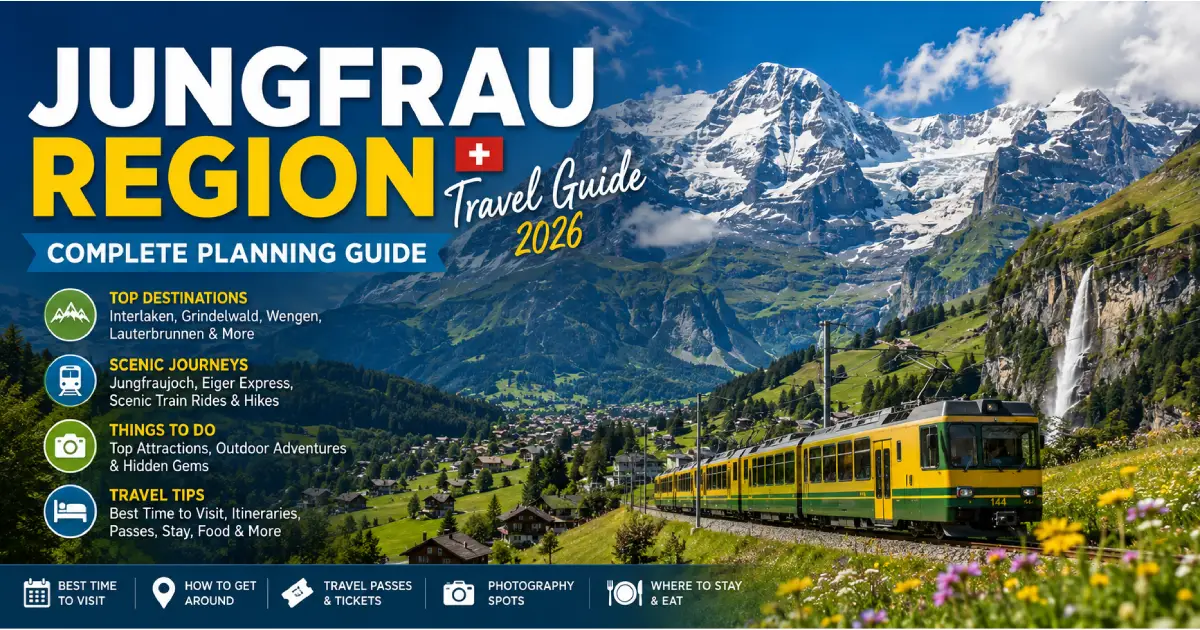
The Jungfrau Region — the collective name for the concentrated cluster of Bernese Oberland destinations centered on the Eiger (3,967m), Mönch (4,107m), and Jungfrau (4,158m) triumvirate and including the villages of Grindelwald, Interlaken, Wengen, Mürren, Lauterbrunnen, and Grindelwald — is simultaneously the most visited mountain destination in Switzerland, the largest ski area in the Bernese Oberland, and a UNESCO World Heritage Site whose specific landscape (the Jungfrau-Aletsch Protected Area, encompassing the Aletsch Glacier at 23 kilometers the longest in the Alps, the three high peaks above 4,000 meters, and the dramatic valley systems below) represents the most concentrated collection of Alpine natural heritage designated at the global level. Approximately 3 million visitor-days are spent in the Jungfrau Region annually — a statistic that simultaneously confirms the destination’s extraordinary appeal and creates the specific planning challenges (accommodation competition, mountain railway queuing, and the mountain weather assessment that determines whether any given visit sees the glacier panorama or an expensive cloud) that this guide addresses.
Planning a Jungfrau Region visit in 2026 requires understanding the region’s specific geographic and logistical structure — a system of inter-connected valleys, mountain railways, and villages at different altitudes that function as parts of a single landscape rather than as independent destinations: Interlaken (the lakeside gateway city at 568 meters), Grindelwald (the Eiger village at 1,034 meters, accessible by BOB train in 35 minutes from Interlaken), Wengen (the car-free south-facing village at 1,274 meters, on the slope above Lauterbrunnen), Mürren (the car-free highest-altitude village at 1,650 meters, on the Lauterbrunnen Valley’s western cliff wall), and the high mountain destinations (Kleine Scheidegg at 2,061 meters, the Männlichen ridge at 2,230 meters, the First at 2,168 meters, and the Jungfraujoch at 3,454 meters) all connected by the Jungfrau Railways network and the Swiss Travel Pass’s comprehensive coverage of the inter-village transport. Understanding this structure — and specifically which village base provides the most efficient access to which combination of the region’s experiences — is the foundational decision from which all other Jungfrau Region planning follows.
For specific destination guides, see our Jungfraujoch: Complete Visitor Guide 2026, Things to Do in Grindelwald 2026, Things to Do in Interlaken 2026, and Swiss Travel Pass Guide 2026.
| Category | Details |
|---|---|
| Main Villages | Interlaken (568m), Grindelwald (1,034m), Lauterbrunnen (796m), Wengen (1,274m), Mürren (1,650m) |
| Car-Free Villages | Wengen, Mürren, Kleine Scheidegg, Jungfraujoch |
| UNESCO Status | Jungfrau-Aletsch Protected Area (World Heritage since 2001) |
| Highest Accessible Point | Jungfraujoch — 3,454m (railway station); 3,571m (Sphinx Observatory) |
| Longest Glacier | Aletsch Glacier — 23 km (longest in the Alps) |
| Ski Area | Jungfrau Ski Region — 213 km marked runs |
| Primary Gateway | Interlaken Ost (SBB mainline station) |
| Mountain Railway Operator | Jungfrau Railways (Jungfraubahn) |
| Swiss Travel Pass Coverage | Very high — BOB, Wengernalpbahn, Schynige Platte included; 50% on Jungfraujoch, First, Männlichen |
| Best Visiting Months | June–October (hiking/summer); December–March (skiing) |
| Average Daily Budget (Mid-Range) | CHF 200–350/person |
| Emergency | 112 (universal); Mountain rescue: 1414 (REGA) |
The Jungfrau Region’s specific geography — the arrangement of valleys, ridges, and villages that creates the region’s characteristic structure — is the most important planning foundation, because the visitor’s experience of the region depends fundamentally on which valley they’re in and which direction they’re looking.
The Grindelwald Valley (northeastern approach): The Grindelwald Valley extends southeast from the junction at Zweilütschinen (where the BOB railway splits) toward the Grindelwald village and beyond toward the Grosse Scheidegg. The valley faces north-northwest, providing morning sun on the south-facing slopes where Grindelwald village sits and the characteristic long-afternoon shadow that the Eiger creates when the sun moves west. The specific visual identity of the Grindelwald Valley: the Eiger’s north face rising directly above the valley’s southern end (visible as a wall of dark limestone from any open position in the valley), the Wetterhorn’s distinctive rocky pyramid on the eastern horizon, and the Lower Grindelwald Glacier remnants visible in the valley’s upper reaches.
The Lauterbrunnen Valley (northwestern approach): The Lauterbrunnen Valley extends south from Zweilütschinen toward the Lauterbrunnen village and the Stechelberg area below the Trümmelbach Falls. The valley’s U-shaped glacial cross-section (300-meter vertical cliff walls on both sides, the valley floor only approximately 100 meters wide in its narrowest sections) creates the specific landscape character — 72 named waterfalls cascading from the cliff walls, the car-free villages of Wengen (on the eastern slope, 500 meters above the valley floor) and Mürren (on the western slope, 854 meters above the valley floor) accessible only by rack railway and cable car respectively.
Kleine Scheidegg (2,061 meters) sits at the junction between the two valleys — the ridge station where the Wengernalpbahn from Wengen (and thus from Lauterbrunnen) meets the Grindelwald direction, and from which the Jungfrau Railway departs into the Eiger’s interior toward the Jungfraujoch. Kleine Scheidegg is the Jungfrau Region’s most logistically significant single point — every visitor to the Jungfraujoch passes through it, the Eiger north face is at its most directly confrontational from this station’s platform, and the concentration of visitor traffic makes it simultaneously the region’s most crowded single point (during July–August midday peak periods) and the most rewarding (when experienced in the quiet of early morning before the main visitor wave or in the clear light of October before the crowds have fully departed).
Altitude: 568 meters | Character: International gateway city, adventure sports hub, grand hotel tradition | Best for: First-time visitors, day-trip itineraries, budget accommodation, adventure sports access | Car access: Yes (road terminus before the mountain railways)
Interlaken (see our Interlaken Travel Guide 2026 for full detail) provides the Jungfrau Region’s primary gateway function — the city between the two Bernese Oberland lakes (Lake Thun and Lake Brienz) where international visitors arrive by SBB intercity train and from which the mountain railway network (the BOB, departing from Interlaken Ost) distributes visitors into the surrounding Jungfrau landscape. The specific advantages of an Interlaken base: the widest accommodation range (from budget hostels at CHF 35/dorm to the Victoria-Jungfrau Grand Hotel at CHF 400+/night), the longest accommodation booking windows (properties available with shorter advance notice than Grindelwald or Wengen in most seasons), and the lake steamer access (Lake Thun and Lake Brienz both accessible by BLS steamer from Interlaken West and Ost piers respectively) that the higher-altitude villages don’t provide.
The specific disadvantage: the distance from the mountains. From Interlaken Ost, the Jungfraujoch requires 2 hours each way — a 4-hour round transport commitment that Grindelwald-based visitors reduce to 50 minutes each way. For visitors making the Jungfraujoch their primary objective and staying multiple nights, the Grindelwald or Wengen base consistently provides better value despite typically higher accommodation costs.
Altitude: 1,034 meters | Character: Switzerland’s most famous climbing village, ski resort, hiking base | Best for: Jungfraujoch access efficiency, skiing (First area and Kleine Scheidegg), serious hikers, photography | Car access: Yes (road to Grindelwald village; no cars on mountain sections)
Grindelwald (see our Things to Do in Grindelwald 2026 guide for full detail) provides the most efficient single base for the Jungfrau Region’s mountain experiences — the Eiger Express gondola to the Jungfrau Railway connection reduces the Jungfraujoch round trip to 50 minutes of transport (versus 2 hours from Interlaken), the First gondola provides the region’s most challenging hiking terrain from directly above the village, and the Männlichen gondola (from Grindelwald Ground, 15 minutes from the village) provides direct access to the ridge walk and the Kleine Scheidegg connection.
Accommodation in Grindelwald ranges from guesthouses (CHF 80–150/night) through mid-range hotels (CHF 150–300/night) to the resort-level properties (Romantik Hotel Schweizerhof, Grand Hotel Belvedere, and various other four-star establishments at CHF 250–500+/night). The village’s specific character — an actual community with bakeries, a supermarket, pharmacies, and the everyday infrastructure of a Swiss mountain village alongside the resort infrastructure — creates a more authentically Swiss atmosphere than the purely-tourism-infrastructure villages of Wengen and Mürren.
Grindelwald specific tip: The BOB station in Grindelwald is the end of the standard BOB service from Interlaken — visitors arriving from Interlaken by BOB can take a taxi (electric, available at the station) or walk (15 minutes) to the village center’s accommodation. The luggage forwarding service (Reisegepäck) allows sending bags from Interlaken station directly to Grindelwald hotels with next-day delivery, eliminating luggage management on the BOB.
Altitude: 1,274 meters | Character: Car-free, quiet, sun-facing, village atmosphere | Best for: Skiing (Lauberhorn area), relaxed visitors, families, those wanting quiet away from crowds | Car access: No — Wengen is accessible only by BOB rack railway from Lauterbrunnen
Wengen (1,274 meters, on the eastern slope above the Lauterbrunnen Valley, accessible only by the BOB rack railway from Lauterbrunnen — the road ends at Lauterbrunnen and no vehicles reach Wengen except the village’s own electric maintenance vehicles) provides the Jungfrau Region’s most specifically quiet and most genuinely village-character base — a community of approximately 1,300 permanent residents whose car-free character (all visitors arrive by train, all deliveries by rack railway) creates the specific Alpine village atmosphere that car-accessible resorts permanently sacrifice.
Wengen’s south-facing orientation (on the Lauterbrunnen Valley’s eastern slope, facing approximately southwest toward the afternoon sun) provides the longest sunshine hours of any Jungfrau Region village — the sun reaching Wengen’s slopes earlier in the morning and staying later in the afternoon than the north-facing Grindelwald slopes. For winter skiing specifically, this south-facing aspect creates the warmest possible skiing conditions at any Jungfrau Region altitude — spring skiing in Wengen (March–April) on sun-warmed corn snow with the valley’s characteristic 900-meter depth visible below creates a skiing atmosphere specifically appealing to those who find Grindelwald’s more dramatic north-facing terrain too cold and too shaded in the mornings.
The Lauberhorn ski race (held in January, the most celebrated event in the annual World Cup calendar) starts at the Lauberhorn summit above Wengen and finishes in Wengen village — making Wengen the ski racing world’s most specifically intimate race-village (the finish area is literally in the village’s residential streets, spectating from hotel balconies and street-level positions available to visitors who simply happen to be staying there that week).
Wengen accommodation: Wengen’s accommodation market runs from comfortable guesthouses (CHF 100–180/night) through the established hotel tier (Hotel Regina, Hotel Beausite, and various other family-operated properties at CHF 180–350/night) to the most prestigious property (Park Hotel Beausite at CHF 300–500+/night in peak season). The specific village character (no cars, quiet streets, the Lauterbrunnen Valley visible below from most room windows) differentiates Wengen’s accommodation experience from Grindelwald’s more resort-resort character.
Altitude: 1,650 meters | Character: Smallest, highest, quietest, most dramatically positioned | Best for: Serious hikers, skiers targeting the Schilthorn area, those wanting maximum village quietude | Car access: No — cable car from Lauterbrunnen to Grütschalp, then rack railway to Mürren
Mürren (1,650 meters, on the Lauterbrunnen Valley’s western cliff wall, accessible by cable car from Lauterbrunnen to Grütschalp and then rack railway to Mürren — no road, no cars, population approximately 450 permanent residents) provides the Jungfrau Region’s most dramatically positioned village base and its quietest — a community so small and so remote from road access that the specific Alpine village atmosphere is essentially complete rather than partially maintained.
The Eiger-Mönch-Jungfrau triumvirate appears directly across the Lauterbrunnen Valley from Mürren at eye level — not as a distant background but as a wall of mountains appearing at approximately equal altitude, creating the specific visual impression of the peaks filling the horizon at scale that lower-altitude viewpoints and more distant angles don’t produce. The walk from Mürren’s central Stager-Promenade toward the cliff edge (the village sits on the valley wall’s upper lip, the Lauterbrunnen Valley visible 854 meters directly below certain viewpoints) with the Jungfrau massif in full profile directly ahead constitutes one of the finest village-level Alpine views in the Bernese Oberland.
The Schilthornbahn (cable car from Mürren to the Schilthorn summit at 2,970 meters — the revolving Piz Gloria restaurant, the James Bond On Her Majesty’s Secret Service filming location, 50% Swiss Travel Pass discount) provides Mürren’s primary high-altitude extension — the Schilthorn’s panoramic view from 2,970 meters being one of the finest in the Bernese Oberland.
Mürren for skiing: The Schilthorn ski area (accessible from Mürren by the Schilthornbahn and various ski lifts below the summit) provides 53 kilometers of skiing within the Jungfrau Ski Region — smaller than the Grindelwald areas but with the Schilthorn’s specific high-altitude terrain (the Inferno race route, one of the longest ski races in the world at 15 km, descending from the Schilthorn to Lauterbrunnen) providing exceptional skiing for advanced visitors.
Altitude: 796 meters | Character: Transit village, valley access point, waterfall village | Best for: Budget base, families, visitors primarily using the valley’s transport connections | Car access: Yes (road terminus — cars park here before the car-free villages above)
Lauterbrunnen (796 meters, the Lauterbrunnen Valley’s main village and the transport hub from which the BOB rack railway to Wengen, the cable car to Grütschalp (and Mürren), and the Trümmelbach Falls bus/walk depart) provides the Jungfrau Region’s most affordable base within the mountain environment — accommodation prices in Lauterbrunnen consistently run 20–40% below equivalent quality in Grindelwald or Wengen, while the transport connections to both the Wengen/Kleine Scheidegg direction and the Mürren direction provide good mountain access for visitors willing to add the transport time.
The Staubbachfall (the 297-meter waterfall that descends directly above the Lauterbrunnen village, visible from the main street and accessible by a short walk to a viewing cave behind the falls) and the valley floor walk toward Stechelberg (with the valley’s full waterfall display visible from the path, all 72 waterfalls active in spring and early summer) provide genuine experiences at the Lauterbrunnen base level independently of any mountain railway expenditure.
Altitude: 2,061 meters | Character: Railway junction, Eiger close-range encounter, pre-Jungfraujoch base | Best for: Photographers targeting the Eiger north face at dawn or dusk, those wanting the highest practical overnight base without the Jungfraujoch cost | Car access: No — Wengernalpbahn from Wengen or Grindelwald Grund
Kleine Scheidegg (2,061 meters) offers overnight accommodation (the Bahnhof Hotel Kleine Scheidegg and the Grindelwaldblick restaurant-hotel, both small properties with limited room count — booking 2–4 months ahead for summer season and 3–5 months ahead for winter is minimum preparation) that provides the Jungfrau Region’s most specifically extraordinary photographic positioning: waking at the Eiger’s base, the north face visible from bedroom windows, and the ability to be at the Eigerwand viewpoint or the Jungfrau Railway departure before the Interlaken-based visitors have completed their morning BOB journey.
For photographers specifically targeting the Eiger north face in early-morning and late-evening light (the face illuminated by low-angle light creating shadow-and-detail conditions unavailable in midday overhead light), the Kleine Scheidegg overnight is the single most effective planning tool — placing the photographer at the north face’s closest accessible position during the best-light windows without the 1.5-hour transport from any valley base.
The Jungfrau Ski Region (combining the Grindelwald-First, Grindelwald-Männlichen-Kleine Scheidegg, and Mürren-Schilthorn ski areas under a single lift pass) covers 213 kilometers of marked runs across three distinct mountain zones, from 960 meters altitude at the lowest runs to 2,970 meters at the Schilthorn summit. The ski season typically runs December through April, with the peak snowpack occurring in January–February and spring skiing conditions (corn snow, longer days, warmer temperatures) developing from mid-March.
Grindelwald-First (eastern Grindelwald): The First ski area (accessible from Grindelwald by the First gondola, 50% Swiss Travel Pass discount — CHF 18–21 with pass discount) provides the region’s most varied terrain and the most consistent snow conditions (north-facing aspect, superior snow retention through the season). 46 kilometers of marked runs including several challenging black runs below the First summit area. Best for intermediate and advanced skiers who want the most demanding terrain in the Grindelwald area.
Grindelwald-Männlichen-Kleine Scheidegg (central Jungfrau Region): The largest connected ski area in the Jungfrau Region — the runs between Männlichen (2,230m), Kleine Scheidegg (2,061m), and Grindelwald Grund (943m) covering 110 kilometers of skiing including the legendary Lauberhorn Downhill course. The Eiger north face visible throughout from the Kleine Scheidegg runs. Best for intermediate skiers who want maximum run length and the Jungfrau Region’s most renowned ski terrain.
Mürren-Schilthorn (western approach): 53 kilometers of runs from the Schilthorn (2,970m) to Lauterbrunnen (800m) — the longest vertical descent available in the Jungfrau Region (2,170 meters, one of the longest in Switzerland). The Inferno race route (15 km, 2,170 meters vertical, the world’s longest ski race held annually in January) accessible as a recreational descent on non-race days. Best for advanced skiers who want maximum vertical and the Schilthorn’s specific dramatic terrain.
| Duration | Approximate Price | Notes |
|---|---|---|
| 1 day | CHF 72–90 | All three ski areas |
| 3 days | CHF 200–240 | Consecutive days |
| 6 days | CHF 350–400 | Best per-day value |
| Weekly (7 days) | CHF 400–450 | Full season flexibility |
Note: Ski passes are separate from and NOT included in the Swiss Travel Pass — they are purchased from Jungfrau Railways at jungfrau.ch/en-gb/skiing/ski-pass.
Regional connections: The Jungfrau Ski Region connects to the Kleine Scheidegg ski area on the Grindelwald side, allowing cross-valley skiing from Grindelwald to Wengen and back — one of the classic Bernese Oberland ski circuits, crossing the Kleine Scheidegg ridge with the Eiger north face as the permanent companion.
(See our complete Jungfraujoch guide for full detail)
Always check the Jungfraujoch summit webcam (jungfrau.ch/en-gb/planning/webcams) at 7:00 AM on the planned excursion morning before purchasing tickets or boarding the train. A cloudy summit webcam indicates a cloudy summit — the CHF 97–195 ticket cost, the 4-hour round transport from Interlaken (2 hours from Grindelwald), and the significant time investment justify this 30-second weather assessment as the most important single planning action of the visit.
The Good Morning Ticket (discounted early-departure Jungfrau Railway ticket — CHF 147 versus CHF 195 standard price, CHF 48 saving) requires boarding the first qualifying Jungfrau Railway departure from Kleine Scheidegg. Current 2026 validity window confirmed at jungfrau.ch — planning the departure from base accommodation to arrive at Kleine Scheidegg for this first departure is the specific logistical challenge that the Grindelwald base handles most efficiently (Grindelwald → Eigergletscher → Kleine Scheidegg in approximately 20 minutes total versus Interlaken → Lauterbrunnen → Wengen → Kleine Scheidegg in approximately 95 minutes).
50% discount on the Jungfrau Railway section (Kleine Scheidegg → Jungfraujoch) — the most financially significant Swiss Travel Pass discount available in the Jungfrau Region. All transport to Kleine Scheidegg (BOB, Wengernalpbahn, Eiger Express) is either included or 50% discounted.
Day 1 (clear day priority): Jungfraujoch 7:00 AM — Check summit webcam (jungfrau.ch) — if clear, proceed. 7:22 AM — Depart Interlaken Ost (BOB to Lauterbrunnen direction). 7:22 AM–9:06 AM — Lauterbrunnen → Wengen → Kleine Scheidegg → Jungfraujoch (Good Morning Ticket timing). 9:06 AM–12:00 PM — Summit: Sphinx terrace (Aletsch Glacier panorama), Ice Palace, glacier walk. 12:00 PM–2:30 PM — Descent via Grindelwald direction (Eiger Express experience). Afternoon — Grindelwald village exploration (30 min) + BOB return to Interlaken. Evening — Dinner on Interlaken Höheweg, Jungfrau alpenglow (sunset).
Day 2: Lauterbrunnen Valley + Harder Kulm 9:00 AM — BOB to Lauterbrunnen (22 min). 9:30 AM–12:00 PM — Trümmelbach Falls + Staubbachfall valley walk. 12:30 PM — Return to Interlaken. 1:30 PM — Harder Kulm funicular (free with Swiss Travel Pass). 3:00 PM — Return to Interlaken. Evening — Free for adventure sports booking follow-up or lake walk.
Day 1: Jungfraujoch via Eiger Express 7:00 AM — Check summit webcam. 7:15 AM — Eiger Express (Grindelwald → Eigergletscher, 15 min). 7:48 AM — Jungfraujoch summit arrival. 7:48 AM–11:00 AM — Summit activities. 11:00 AM–1:30 PM — Descent via Wengernalpbahn route (Kleine Scheidegg → Wengen → Lauterbrunnen → BOB to Grindelwald Grund → village walk). Afternoon — Rest + Glacier Gorge visit (CHF 8, 1 hour). Evening — Fondue at local mountain restaurant.
Day 2: First Area — Cliff Walk, Bachalpsee, Ridge Walk 8:30 AM — First gondola (first departure). 9:15 AM — Bachalpsee hike (45 min, reflection photography). 10:30 AM — First Cliff Walk + First Flyer (optional CHF 29). 12:30 PM — Lunch at Bergrestaurant First. 2:00 PM — Descent by gondola or hiking trail. Evening — Grindelwald village.
Day 3: Männlichen Ridge Walk + Kleine Scheidegg 9:00 AM — Gondola Grindelwald Grund → Männlichen (25 min). 9:30 AM — Männlichen summit (15 min for panorama). 10:00 AM — Ridge walk to Kleine Scheidegg (1.5 hrs). 12:00 PM — Kleine Scheidegg lunch (with Eiger north face directly above). 1:30 PM — Wengernalpbahn to Wengen (explore the car-free village, 1 hour). 3:00 PM — BOB Wengen → Lauterbrunnen (+ Trümmelbach Falls if not yet visited). 5:00 PM — Return to Grindelwald.
Add to the 3-day Grindelwald itinerary:
Day 4: Mürren and Schilthorn Morning — BOB to Lauterbrunnen → cable car to Grütschalp → rack railway to Mürren (45 min total from Grindelwald). Late morning — Mürren village walk (Stager-Promenade, Jungfrau panorama, village character). Midday — Schilthornbahn to Schilthorn summit (2,970m, 50% Swiss Travel Pass discount) → Piz Gloria revolving restaurant lunch → James Bond experience. Afternoon — Descent to Mürren → return to Grindelwald.
Day 5: Schynige Platte + Lake Brienz Morning — BOB from Grindelwald to Zweilütschinen → Interlaken Ost → Wilderswil → Schynige Platte Bahn (alpine botanical garden, double-lake panorama, free with Swiss Travel Pass). Afternoon — Descent to Wilderswil/Interlaken → BLS lake steamer on Lake Brienz (Giessbach Falls stop) → return to base.
From Zurich: Zurich HB → Interlaken Ost (direct or via Bern, approximately 2 hours). From Interlaken Ost, the BOB to Grindelwald (35 min) or Lauterbrunnen (22 min) provides the mountain access connection. All portions covered by Swiss Travel Pass.
From Bern: Bern → Interlaken Ost (57 min, direct RegioExpress). The most efficient connection from the national capital.
From Lucerne: Lucerne → Interlaken Ost (Brünig route direct RegioExpress, approximately 2 hours — a scenic mountain railway journey crossing the Brünig Pass). All portions covered by Swiss Travel Pass.
From Geneva: Geneva Cornavin → Bern → Interlaken Ost (approximately 3 hours total). All portions covered by Swiss Travel Pass.
By car: Drive to Interlaken (A8 motorway from Bern, exit at Interlaken or Spiez) or Grindelwald (road from Interlaken via Zweilütschinen — no motorway, scenic valley road). Park at Interlaken or Grindelwald — cars are not needed or useful within the mountain railway network.
The Jungfrau Railways network (operated by Jungfrau Bahn Holding AG as a unified system) provides the primary internal transport:
BOB (Berner Oberland-Bahn): Interlaken Ost → Grindelwald (35 min) and Interlaken Ost → Lauterbrunnen (22 min). Free with Swiss Travel Pass.
Wengernalpbahn (WAB): Lauterbrunnen → Wengen (14 min) → Kleine Scheidegg (38 min from Wengen). Free with Swiss Travel Pass.
Jungfrau Railway: Kleine Scheidegg → Jungfraujoch (33 min). 50% Swiss Travel Pass discount.
Gondelbahn Grindelwald–Männlichen: Grindelwald Grund → Männlichen (25 min). 50% Swiss Travel Pass discount.
Eiger Express: Grindelwald Terminal → Eigergletscher (15 min). 50% Swiss Travel Pass discount.
First gondola: Grindelwald → First (25 min). 50% Swiss Travel Pass discount.
Schilthornbahn: Stechelberg → Schilthorn via Gimmelwald, Mürren, Birg (45 min from valley). 50% Swiss Travel Pass discount.
Lauterbrunnen–Grütschalp cable car: Lauterbrunnen → Grütschalp (5 min, connection to Mürren rack railway). Free with Swiss Travel Pass.
The Jungfrau Region is Switzerland’s most expensive single mountain destination for active visitors — the mountain railway network’s pricing (the Jungfraujoch at CHF 97–195, the First gondola at CHF 36–42, the Männlichen gondola at CHF 35, the Schilthorn at CHF 50–65 from Mürren) adds up rapidly for visitors who want multiple mountain excursions over multiple days, creating a total mountain-access cost that even the Swiss Travel Pass’s 50% discounts substantially reduce but cannot eliminate.
For a 3-day Grindelwald-based visit including the Jungfraujoch, First Cliff Walk, and Männlichen Ridge Walk:
| Activity | Without Pass | With 3-Day Pass (CHF 244) |
|---|---|---|
| Zurich → Interlaken Ost (return) | CHF 120 | Free |
| BOB Interlaken → Grindelwald (return) | CHF 36 | Free |
| Eiger Express return | CHF 86 | CHF 43 (50% off) |
| Jungfrau Railway return | CHF 95 | CHF 47.50 (50% off) |
| First gondola return | CHF 78 | CHF 39 (50% off) |
| Männlichen gondola return | CHF 70 | CHF 35 (50% off) |
| Transport subtotal | CHF 485 | CHF 408.50 (CHF 244 pass + CHF 164.50 discounted) |
| Net saving | CHF 76.50 |
The 3-day Swiss Travel Pass saves approximately CHF 77 on this specific mountain itinerary — a genuine saving that rewards purchasing the pass. For longer stays (4–6 days) with additional mountain excursions, the savings increase proportionally.
Dining above the valley floor carries a consistent altitude premium throughout the Jungfrau Region — expect restaurant prices 30–50% above equivalent quality in Interlaken or Grindelwald village. Budget CHF 25–40/person for a lunch at a mountain restaurant (soup, main course, and drink) — a meaningful additional daily cost for visitors who spend full days on the mountain.
The most practical cost management strategy: supermarket provisions from Grindelwald’s Migros (bread, cheese, fruit, and a packed lunch from the village supermarket) allow mountain-access days without the restaurant premium, reserving restaurant spending for the specifically atmospheric mountain dining situations (Kleine Scheidegg with the Eiger above, Bergrestaurant First with the gondola panorama) that justify the premium cost.
The lower trails clear of snow in early June (Lauterbrunnen Valley floor, Grindelwald valley trails, and paths below 1,500 meters accessible from the season’s first clear days). The Schynige Platte opens in mid-to-late June; the First Cliff Walk opens when the First gondola activates for the hiking season. The Jungfraujoch operates year-round; the Männlichen gondola runs year-round. The wildflower display begins at lower altitudes in June — the Bernese Oberland’s lower meadows in their most vivid spring-green state, the first Alpine flowers appearing on the slopes above 1,200 meters.
Full hiking season — all trails open, all gondolas and railways at maximum summer frequency, the waterfall display at its summer-reduced (but still substantial) flow, and the accommodation and mountain railway infrastructure at its maximum capacity. The specific July–August tradeoffs: maximum access and maximum crowds and maximum pricing. The Good Morning Ticket strategy (earliest mountain departures), early trail starts, and specific advance booking for Chez Vrony/Findlerhof-equivalent mountain restaurants are essential management tools during this period.
September and October consistently provide the Jungfrau Region’s most recommended visiting conditions — reduced crowds (European school holidays concluded), maintained mountain access (all gondolas and the First Cliff Walk still operating), the autumn light quality (lower sun angle creating more dramatic shadow-and-highlight on the Eiger north face than summer’s overhead light), and in October the larch forests above Grindelwald transitioning to their golden-needle display (the European larch’s annual deciduous cycle creating the specific golden-autumn color that distinguishes October from any other Jungfrau Region season).
The Jungfrau Ski Region at full operation — the specific planning details (lift passes separate from Swiss Travel Pass, the Lauberhorn race in January requiring early accommodation booking, and the Good Morning Ticket timing continuing year-round on the Jungfraujoch). January and February provide the season’s deepest snowpack and the clearest winter-air visibility on the mountain excursions; March provides the spring skiing pleasure (corn snow, longer days) with the region’s most favorable weather patterns for summit visibility.
The most expensive single mistake available in the Jungfrau Region — purchasing a CHF 97–195 ticket for a summit wrapped in cloud. The 30-second webcam check (jungfrau.ch/en-gb/planning/webcams) at 7:00 AM eliminates this outcome.
Interlaken is the optimal base for day-visitors and for visitors whose priorities include the lake activities (Thun and Brienz steamers, lake swimming) alongside mountain excursions. For visitors whose primary objectives are the Jungfraujoch, Grindelwald hiking, and Bernese Oberland mountain experiences, a Grindelwald or Wengen base provides dramatically better time efficiency — the 2-hour Interlaken-to-Jungfraujoch transport versus the 50-minute Grindelwald equivalent eliminates 3 hours of daily transport that could be spent at the summit or on the trails.
Most visitors treat Kleine Scheidegg as a transit junction (wait for the next train connection) rather than as a destination. The Eiger north face from the Kleine Scheidegg platform — at 200 meters of horizontal distance from the wall’s base, the closest any non-climber stands to the most legendary climbing wall in Alpine history — and the station’s restaurant terrace with the face overhead constitute one of the Jungfrau Region’s most extraordinary single experiences, available at no additional cost to anyone passing through on the Jungfrau Railway. Building a 20–30 minute Kleine Scheidegg stop into the descent itinerary (rather than taking the immediately-connecting return train) produces a significantly more complete Jungfraujoch day.
See the Things to Do in Interlaken guide — the underground glacial waterfalls (CHF 13, 10 minutes from Lauterbrunnen station) are the single most consistently under-visited major attraction in the Jungfrau Region and the single most consistent regret of visitors who skip them.
The Jungfrau Ski Region day pass covers all three areas (Grindelwald-First, Kleine Scheidegg-Männlichen, and Mürren-Schilthorn) — visitors who purchase single-area passes (sometimes available at certain lift stations) may discover they cannot cross to adjacent areas. Purchasing the full Jungfrau Ski Region pass from the main Jungfrau Railways ticket counters provides complete coverage.
About Travel Tourister Travel Tourister’s destination specialists have planned and executed Jungfrau Region visits across all seasons and all village bases — from Interlaken gateway days and Grindelwald Eiger-base mornings through Wengen Lauberhorn ski week visits and Mürren cliff-village quiet evenings to Kleine Scheidegg overnight dawn photography and Jungfraujoch winter clarity excursions — to deliver the most comprehensive and practically honest Jungfrau Region planning guide for 2026 visitors.
Posted By : Vinay
Latest Article
2nd Floor, 39, Above Kirti Club, DLF Industrial Area, Kirti Nagar, New Delhi, Delhi 110015



Travel Tourister is a leading Travel portal where we introduce travellers to trusted travel agents to make their journey hasselfree, memorable And happy. Travel Tourister is a platform where travellers get Tour packages ,Hotel packages deals through trusted travel companies And hoteliers who are working with us across the world. We always try to find new and more travel agents and hoteliers from every nook and corners across the world so that you could compare the deals with different travel agents and hoteliers and book your tour or hotel with the one you have chosen according to your taste and budget.
Copyright © Travel Tourister, India. All Rights Reserved

 Call
Call Enquiry