Published on : 03 Sep 2026
By Travel Tourister | Updated Sep 2026
Switzerland has the densest railway network relative to land area of any country on Earth — 5,317 kilometers of track serving 1,800 stations in a country of 41,285 square kilometers, meaning a Swiss citizen is on average never more than 3 kilometers from a railway station. This extraordinary rail infrastructure, built across terrain that ranges from lake-level cities to 3,454-meter Alpine summits, has produced the most concentrated collection of spectacular scenic railway journeys available anywhere in the world — routes whose engineering (the spiral tunnels, the rack systems, the viaducts cantilevered over Alpine gorges) and landscapes (the glaciers, the vineyards, the medieval cities, the mountain passes) combine into travel experiences that the world’s other scenic railways — the Rocky Mountaineer, the Coast Starlight, the Trans-Siberian — compete with in duration or drama but not in density of extraordinary moments per kilometer.
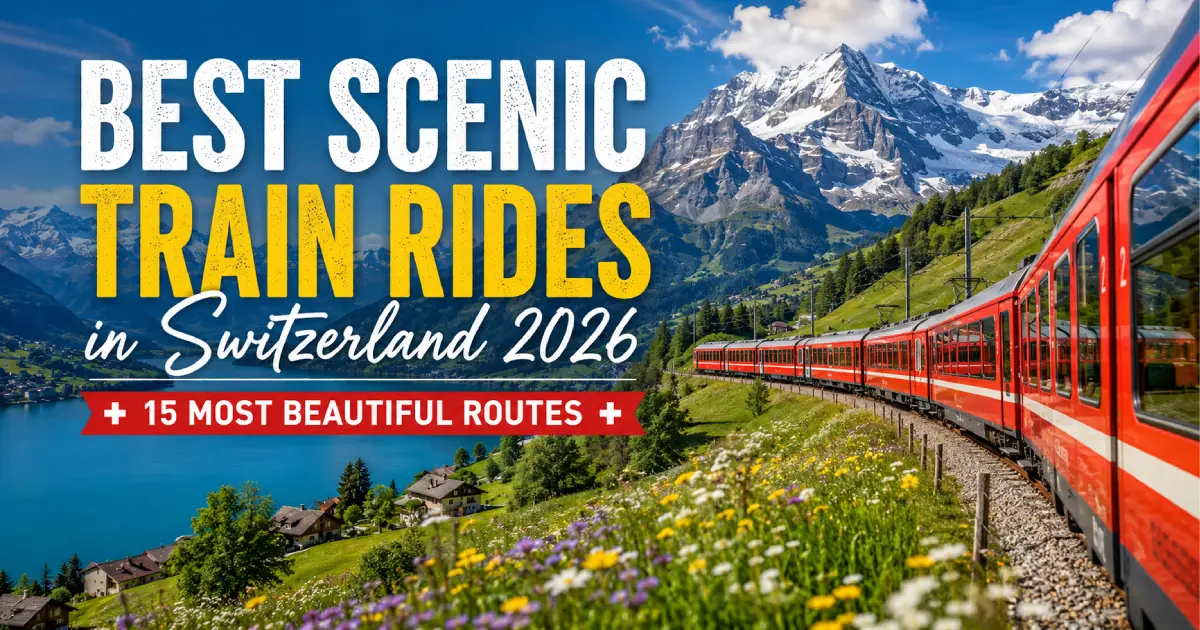
The best scenic train rides in Switzerland span the globally celebrated panoramic railways (the Glacier Express, the Bernina Express, the Golden Pass, and the Wilhelm Tell Express) through the specifically focused technical masterpieces (the Jungfrau Railway ascending inside the Eiger, the Pilatus-Bahn’s world-record gradient, the Brienz Rothorn Bahn’s steam operation) to the genuinely overlooked journeys that Swiss residents use daily without particularly noticing their extraordinary character (the SBB mainline along Lake Geneva, the Gotthard Panorama Express through Switzerland’s historic mountain crossing, the Appenzell regional railway through Switzerland’s most photogenic rolling hill landscape). This guide covers the 15 best scenic train rides in Switzerland — what makes each extraordinary, what the journey costs, how long it takes, what to watch from the window, and which Swiss Travel Pass coverage applies.
For planning context, see our Swiss Travel Pass Guide 2026, Glacier Express: Complete Guide 2026, Bernina Express: Complete Guide 2026, and Switzerland Travel Guide 2026.
| Train / Route | Route | Duration | Swiss Travel Pass | Best Season |
|---|---|---|---|---|
| Glacier Express | Zermatt ↔ St. Moritz | 7 hrs 45 min | Covered + CHF 13–49 reservation | June–Oct, Dec–Mar |
| Bernina Express | Chur/St. Moritz ↔ Tirano (Italy) | 2.5–4 hrs | Covered + CHF 14 reservation | June–Oct, Dec–Mar |
| Jungfrau Railway | Kleine Scheidegg → Jungfraujoch | 33 min | 50% discount | Year-round |
| Golden Pass Express | Montreux ↔ Interlaken ↔ Lucerne | 5 hrs (full) | Covered + CHF 10–19 reservation | May–Oct |
| Gotthard Panorama Express | Lugano ↔ Flüelen (boat + train) | 3.5 hrs | Covered | May–Oct |
| Pilatus-Bahn | Alpnachstad ↔ Pilatus Kulm | 30 min | 50% discount | May–Nov |
| Rigi Rack Railway (Vitznau–Rigi Kulm) | Vitznau ↔ Rigi Kulm | 30 min | 50% discount | Year-round |
| Lake Geneva SBB Mainline | Geneva ↔ Lausanne ↔ Montreux | 1.5 hrs | Covered | Year-round |
| Schynige Platte Bahn | Wilderswil ↔ Schynige Platte | 50 min | Covered | June–Oct |
| Wengernalpbahn | Lauterbrunnen ↔ Kleine Scheidegg | 38 min | Covered | Year-round |
| Brienz Rothorn Bahn (steam) | Brienz ↔ Rothorn | 1 hr | 50% discount | June–Oct |
| Appenzellerbahn | St. Gallen ↔ Appenzell | 45 min | Covered | Year-round |
| Brünig Route (SBB) | Lucerne ↔ Interlaken | 2 hrs | Covered | Year-round |
| Mont Blanc Express | Martigny ↔ Chamonix (France) | 1.5 hrs | CHF 40–55 (partial) | Year-round |
| Palm Express Bus-Train | St. Moritz ↔ Lugano | 4 hrs | Discount applies | May–Oct |
Route: Zermatt ↔ St. Moritz (or Davos) | Distance: 291 km | Duration: 7 hours 45 min | Bridges: 291 | Tunnels: 91 | Highest Point: Oberalp Pass (2,033m) | Swiss Travel Pass: Covered + mandatory seat reservation (CHF 13–49)
The Glacier Express (see our complete Glacier Express guide for full detail) is Switzerland’s most celebrated panoramic railway — crossing the Alps from Zermatt’s Matterhorn to St. Moritz’s Engadin valley in a 7 hour 45 minute journey through the Goms Valley, over the Oberalp Pass (Europe’s highest transalpine railway crossing without a summit tunnel), through the Rhine Gorge, and across the Albula Railway’s UNESCO World Heritage spiral tunnels and the Landwasser Viaduct. The journey’s specific characterization as “the world’s slowest express train” is self-aware — the deliberate leisureliness of a journey whose purpose is landscape observation defines its specific appeal.
What makes it extraordinary: The sheer diversity of landscape transitions — Valais mountain farming villages, the high-Alpine Oberalp Pass, Romansh-speaking Rhine Gorge communities, Graubünden medieval castle valleys, and the Engadin’s glamour-resort landscape — covered in a single continuous journey without repetition. No other Swiss scenic railway covers this range of Swiss geographic and cultural variety.
Best section: The Rhine Gorge (Ruinaulta, between Disentis and Ilanz) — the 13-kilometer limestone canyon where the train follows the base of 350-meter vertical cliff walls with the Rhine’s turquoise water visible below. The Glacier Express’s most consistently surprising section for first-time passengers who expected Alpine meadows rather than canyon terrain.
Insider tip: The journey’s most celebrated photograph — the Landwasser Viaduct (six curved arches entering a tunnel portal directly, 65 meters high) — requires positioning at the left-side window in the Zermatt → St. Moritz direction. The brief passage across the viaduct (approximately 30 seconds) and the preceding announcement by the onboard commentary system provide the only warning available — left-side window positioning before Tiefencastel eliminates missing this specific moment.
Route: Chur/St. Moritz ↔ Tirano, Italy | Distance: 122 km (St. Moritz–Tirano) | Duration: 2 hours 25 min | UNESCO Status: Both Albula and Bernina lines World Heritage | Highest Point: Bernina Pass (2,253m) | Swiss Travel Pass: Covered (Swiss section) + CHF 14 reservation
The Bernina Express (see our complete Bernina Express guide for full detail) covers the most extreme altitude-to-sea-level transition available on any European scenic railway — the descent from the Bernina Pass’s 2,253 meters (the highest non-tunnel transalpine railway crossing in the world) to Tirano’s 429 meters in a 2-hour journey that passes through every Alpine vegetation zone from permanent snow to Mediterranean palm trees. The Morteratsch Glacier’s blue-white face visible from the right-side window, the Lago Bianco’s white-blue water at the pass summit, the Palü Glacier above Alp Grüm station, and the Brusio Circular Viaduct’s complete-loop engineering achievement constitute four genuinely extraordinary moments within a single journey.
What makes it extraordinary: The transition density — four world-class landscape and engineering moments within 2.5 hours, the journey ending in Italy (a different country, a different language, a different climate) from its Alpine-glacier origin. The Bernina Express compresses more geographic drama per hour than any other scenic railway in Europe.
Best section: The Bernina Pass crossing (Ospizio Bernina station area) — the Lago Bianco’s milky white water on both sides of the train simultaneously, the Bernina massif visible above, and the continental watershed crossed (waters north flow to the Black Sea; waters south flow to Lake Como) creates the specific peak moment that the journey’s marketing images concentrate on. Arriving at this section on the right-side window seat (St. Moritz → Tirano direction) in morning light with the low sun illuminating the white lake surface is the Bernina Express at its most photogenically perfect.
Route: Montreux ↔ Interlaken Ost ↔ Lucerne | Duration: 5 hours (full route) | Key Challenge: Three different railway gauges requiring train change at Zweisimmen and Interlaken Ost | Swiss Travel Pass: Covered + seat reservation (CHF 10–19) | Season: Year-round
The Golden Pass Express (operational since 2022, finally solving the 100-year engineering challenge of connecting Lake Geneva’s French-speaking Montreux with German-speaking Central Switzerland through the Bernese Oberland in a single through-journey without requiring passengers to physically change trains) links three distinctly different Swiss landscapes — the Lake Geneva Riviera and Vaud wine country (Montreux to Zweisimmen), the Simmental’s pre-Alpine valley (Zweisimmen to Interlaken), and the Lake Brienz and Brünig Pass mountain landscape (Interlaken to Lucerne) — in a continuous panoramic journey.
The specific engineering achievement of 2022: the Golden Pass Express uses special “variable gauge” bogies (wheel-axle assemblies that can physically adjust their track-width to accommodate the three different rail gauges on the route — the MOB’s 1,000mm metre gauge, the BLS’s 1,435mm standard gauge, and the SBB’s standard gauge) allowing passengers to remain seated through the gauge changes at Zweisimmen and Interlaken. This gauge-change technology, previously unavailable in Switzerland, was the barrier that prevented through-running for a century.
What to watch: The Lake Geneva section (Montreux to Zweisimmen, passing through Château-d’Oex’s characteristic Bernese farmhouse country), the Simmental’s pre-Alpine valleys (Zweisimmen to Spiez, the valley whose specific character of wide-floor farming land hemmed by snow-topped ridges defines the “Bernese Oberland lowland” character), and the Lake Brienz section (Interlaken to Brienz and beyond toward Meiringen, the turquoise lake visible from the train’s right side in the eastward direction).
Best section: The Lake Geneva approach from Montreux — the vine-terraced Lavaux UNESCO vineyard slopes visible above the lake, the French Alps across the water, and the specific Belle Époque character of the Lake Geneva Riviera (the Montreux Chillon Castle visible briefly before the train turns inland) creates the Golden Pass’s most internationally-recognized opening landscape.
Insider tip: The Golden Pass’s specific panoramic cars (the MOB’s “Panoramic Express” cars with extra-large windows and specific domed ceiling sections providing upward viewing) provide the most complete landscape immersion of any regularly-scheduled Swiss scenic railway. Booking the first-class panoramic car (available through the GoldenPass website at mob.ch or through SBB) provides the most complete window experience, particularly valuable for the vineyards-over-lake section departing Montreux.
Route: Lugano → Flüelen (boat on Lake Lugano and Lake Lucerne) → Lucerne (or reverse) | Duration: 3.5 hours | Unique Feature: Switzerland’s historic north-south crossing, combining lake steamer with panoramic train | Swiss Travel Pass: Fully covered | Season: May–October
The Gotthard Panorama Express (combining the Lake Lugano-to-Flüelen boat journey with a panoramic train from Flüelen through the Gotthard Pass route to Lucerne — or the reverse) provides the most historically resonant scenic railway experience in Switzerland: the Gotthard route has been the primary commercial and military crossing point between northern Europe and Italy for over 700 years, and the Gotthard Railway (the world’s most technically ambitious Alpine railway when completed in 1882, requiring the 15-kilometer Gotthard Base Tunnel below the historic Gotthard Pass) follows the ancient trade route that has shaped Swiss history since the Middle Ages.
The boat journey on Lake Lugano (the southern Italian-speaking section, with palm trees and the lakeside villas of the Ticino landscape creating the Swiss-Italian atmosphere that the Bernina Express ends with) transitions at Flüelen to the panoramic train through the Reuss Valley and the Gotthard’s northern approach — the Uri Rotstock’s limestone cliffs above the narrow valley, the Devil’s Bridge (the Teufelsbrücke, the historic bridge over the Reuss gorge whose construction in the 14th century opened the Gotthard route to commercial traffic), and the Schöllenen Gorge creating a historically saturated landscape journey.
What makes it extraordinary: The combination of two transport modes (lake boat and panoramic train) in a single through-ticket experience, the Ticino-to-Uri cultural transition (from Italian-speaking Switzerland to German-speaking, within a single continuous journey), and the Gotthard route’s specific historical weight (the trading route that made Switzerland wealthy and the military route that made Switzerland strategically significant across 700 years).
Insider tip: The Gotthard Panorama Express runs May–October only — the winter version of the north-south journey (using the standard SBB intercity train through the Gotthard Base Tunnel) provides speed and efficiency rather than scenic character. Specifically planning the Lugano–Lucerne connection for May–October ensures the scenic route rather than the functional base-tunnel alternative.
Route: Kleine Scheidegg → Jungfraujoch | Distance: 9.3 km | Duration: 33 min | Tunnel length: 7.1 km | Highest station: 3,454 meters | Swiss Travel Pass: 50% discount
The Jungfrau Railway (see our complete Jungfraujoch guide for full detail) provides Switzerland’s most viscerally extraordinary mountain railway experience — not because of window views (7.1 km of the 9.3 km journey is in tunnel, including the complete interior of the Eiger and Mönch) but because of what it accomplishes: ascending from 2,061 meters at Kleine Scheidegg to 3,454 meters at the Jungfraujoch in 33 minutes through a tunnel bored at a period (1896–1912) when the technology available for such an undertaking was barely adequate to the challenge, with 30 construction workers killed in the process. The Eigerwand intermediate station (gallery windows cut into the Eiger’s north face, providing 2,000-meter downward views into the Grindelwald Valley below) is the specific extraordinary moment of the journey.
What makes it extraordinary: The engineering audacity (boring 7.1 km through solid Alpine granite and limestone at early 20th-century technology levels), the Eigerwand gallery’s specific vertigo (looking through a hole in the Eiger’s north face at the void below), and the arrival — emerging from the mountain’s interior directly into the high-Alpine world at 3,454 meters is a transition that no surface railway provides.
Route: Alpnachstad ↔ Pilatus Kulm | Distance: 4.6 km | Duration: 30 min | Maximum gradient: 480‰ (48%) | Swiss Travel Pass: 50% discount | Season: May–November
The Pilatus-Bahn from Alpnachstad to the Pilatus Kulm summit (2,132 meters) is the world’s steepest rack railway — its 48% maximum gradient requiring a unique rack system (the Locher rack, with teeth on both sides of the rack rail to prevent the carriages from sliding off the rack on the steepest sections) designed specifically for this line when it was built in 1889. The gradient’s physical effect on passengers (the carriages tilt backward at an angle that makes standing without holding on actively uncomfortable, and the view through the window appears to show an essentially vertical ascent) creates a specifically alarming impression of steepness that is genuinely extreme rather than Alpine-railway-standard.
The Pilatus route (from the SGV lake steamer pier at Alpnachstad on Lake Lucerne’s southern shore, through the forest and progressively more exposed mountain terrain to the summit’s 2,132-meter panorama) is most commonly done as part of the Pilatus Golden Round Trip from Lucerne (boat to Alpnachstad, rack railway to summit, aerial gondola and cable car descent to Kriens, bus to Lucerne) — the world’s steepest rack railway combined with a circuit that covers every transport mode from lake steamer to aerial cable car in a single half-day.
What makes it extraordinary: The physical experience of the gradient — the world-record steepness is perceptible rather than merely statistical, the body’s orientation in the tilted carriage and the window’s near-vertical view confirming what the numbers describe.
Route: Vitznau ↔ Rigi Kulm | Duration: 30 min | Opened: 1871 (Europe’s first mountain railway) | Summit: 1,797 meters | Swiss Travel Pass: 50% discount
The Rigi Vitznau–Rigi Kulm rack railway (opened May 21, 1871 — the first mountain railway in Europe, predating the Pilatus-Bahn by 18 years and establishing the pattern for the dozens of Alpine rack railways subsequently built across Switzerland and Austria) has the specific distinction of historical precedence: every Alpine mountain railway operating today descends intellectually and technically from the engineering principles demonstrated here first. Mark Twain’s celebrated account of his 1878 Rigi visit (including the famous account of his failed sunrise expedition to the summit, recounted in “A Tramp Abroad”) established the Rigi’s specific international cultural resonance that makes it simultaneously an active transport utility and a piece of living railway history.
The 30-minute ascent from Vitznau (accessible by SGV lake steamer from Lucerne — fully included in Swiss Travel Pass) provides a specifically unhurried relationship with the altitude gain — the rack railway’s distinctive cog-and-pinion sound audible throughout, the lake progressively visible below as the ridge is climbed, and the forest giving way to the open summit terrain in the final minutes before the Rigi Kulm station.
What makes it extraordinary: The specific combination of historical precedence (the first mountain railway in Europe — every subsequent Alpine rack railway is a descendant of this line’s engineering principles), the summit panorama (360 degrees, encompassing Lake Lucerne, Lake Zug, Lake Lauerz, and the Bernese Alps), and the Mark Twain connection (the most celebrated literary account of a Swiss mountain visit, associated with a specific railway that still operates identically to its 1871 opening).
Route: Wilderswil ↔ Schynige Platte | Duration: 50 min | Summit: 1,967 meters | Swiss Travel Pass: Fully included | Season: June–October | Opens: Operating since 1893
The Schynige Platte Bahn (from Wilderswil, one BOB stop from Interlaken Ost, to the 1,967-meter summit above the Bernese Oberland) is Interlaken’s most underrated mountain railway — a narrow-gauge rack railway operating since 1893 with original rolling stock maintained alongside newer additions, ascending through progressively dramatic terrain with the full double-lake panorama (Lake Thun and Lake Brienz simultaneously visible) appearing as the ridge is crested. The summit’s Alpine Botanical Garden (600+ mountain plant species, University of Bern-maintained since 1929) and the classic Bernese Oberland panorama (Eiger, Mönch, and Jungfrau directly across, both lakes below) constitute the journey’s destination — and the full inclusion in the Swiss Travel Pass (no discount, fully free) makes this Interlaken’s finest value mountain railway experience.
What makes it extraordinary: The combination of historic rack railway character (the original 1893 rolling stock’s specific sound and motion on the mountain terrain), the summit panorama’s comprehensiveness (the dual-lake view available nowhere else in the region at this accessibility level), and the complete Swiss Travel Pass inclusion that makes it free while the competing mountain railways charge 50% discount.
Route: Lauterbrunnen ↔ Kleine Scheidegg (via Wengen) | Duration: 38 min (Wengen to Kleine Scheidegg section) | Swiss Travel Pass: Fully included | Year-round
The Wengernalpbahn (WAB) — the narrow-gauge cog railway ascending from Lauterbrunnen through Wengen to Kleine Scheidegg, completing the connection to the Jungfrau Railway — provides one of Switzerland’s finest progressive mountain panorama experiences in a journey that most visitors treat purely as transport between the Jungfraujoch approach stages. The specific WAB section from Wengen to Kleine Scheidegg (approximately 38 minutes) traverses the high-altitude south-facing slopes of the Männlichen Ridge, with the Lauterbrunnen Valley visible below to the north and the Eiger-Mönch-Jungfrau triumvirate appearing progressively larger in the southern window as the train crosses the ridge and descends toward Kleine Scheidegg.
What makes it extraordinary: The specific panoramic reveal — the moment when the Wengernalpbahn crests the ridge above Wengen and the Bernese Oberland’s three most celebrated peaks appear simultaneously and at relatively close range across the Kleine Scheidegg plateau is one of the most satisfying “reveal” moments available on any Swiss railway journey, and it occurs on a route that is fully included in the Swiss Travel Pass at no additional cost.
Route: Geneva ↔ Lausanne ↔ Montreux | Duration: 1 hour (Geneva to Montreux) | Swiss Travel Pass: Fully included | Best Section: Lausanne to Montreux | Year-round
The SBB intercity mainline between Geneva and Montreux runs for its most celebrated section between Lausanne and Montreux along the shore of Lake Geneva beneath the Lavaux UNESCO World Heritage vineyard terraces — 30 kilometers of railway track running directly at lake level, with the Lavaux’s 12th-century stone-walled terraced vineyards rising above the track to the north and Lake Geneva’s full expanse (with the French Alps visible across the water) to the south. This specific corridor (between Lausanne’s Ouchy district and Montreux) is among the most consistently beautiful standard railway routes in Europe — a journey that Swiss commuters make daily while tourists specifically visit to experience.
What makes it extraordinary: The specific combination of the Lavaux’s terraced viticultural landscape (a form of agricultural heritage maintained with continuous effort across 800 years, the UNESCO designation recognizing both the visual quality and the human cultural continuity it represents) with the Lake Geneva panorama (the Jet d’Eau visible in the distance toward Geneva on clear days, the Chillon Castle appearing at the end of the lake as the train approaches Montreux) creates a landscape corridor of sustained quality exceeding most purpose-built scenic railways.
Insider tip: The right side of the train (Geneva to Montreux direction) provides the lake views throughout this section — the vineyard terraces require a slight backward-and-upward gaze from the same right-side window. A window seat on the right side booked for the Lausanne–Montreux departure provides both the lake and the vineyard terraces from the same position.
Route: Lucerne ↔ Interlaken Ost | Duration: 2 hours | Swiss Travel Pass: Fully included | Highest Point: Brünig Pass (1,002m) | Year-round
The SBB Brünig Route (operated by BLS as a narrow-gauge mountain railway despite using SBB timetables) connects Lucerne and Interlaken through the Brünig Pass — the only crossing between the Bern and Lucerne railway systems that doesn’t use a tunnel. The 2-hour journey covers the central Swiss foothills from Lucerne through Sarnen (the quiet Obwalden cantonal capital) and Giswil, ascending the Brünig Pass (1,002 meters, the route’s highest point — a rack-assisted section allows the gradient), and descending to Lake Brienz with its characteristic turquoise water visible as the train approaches Brienz and then Interlaken.
What makes it extraordinary: The Brünig’s specific transition character — crossing from the Central Swiss German-language landscape (Lucerne’s orbit) into the Bernese Oberland’s different cultural sub-region (Interlaken’s orbit) through a mountain pass that the railway crosses rather than tunneling beneath. The rack-assisted Brünig section (audible as the cog engages) and the Lake Brienz approach (the turquoise color appearing dramatically as the descent opens toward the lake) are the route’s specific high-value moments.
Route: St. Gallen ↔ Appenzell | Duration: 45 min | Swiss Travel Pass: Fully included | Year-round | Character: Rolling pre-Alpine hills, traditional Swiss countryside
The Appenzellerbahn (connecting St. Gallen with Appenzell, the capital of the smallest and most traditionally rural of Switzerland’s full cantons — Appenzell Innerrhoden maintained all-male Landsgemeinde voting until 1990, when the Swiss Federal Supreme Court mandated the inclusion of women) provides Switzerland’s most specifically “traditional Swiss countryside” railway experience — the Appenzell region’s rolling hills (the Voralpen, the pre-Alpine hill country between the Swiss Mittelland and the main Alpine chain) with their concentration of painted Appenzell farmhouses, the distinctive Appenzell cattle (visible from the train in summer, their large cowbells audible through the open windows), and the Säntis (2,502 meters) visible on clear days above the pastoral landscape creating the specific Switzerland-as-calendar-photograph landscape character.
What makes it extraordinary: The Appenzell region’s specific cultural concentration — the embroidery tradition (Appenzell’s historic cottage industry, the delicate white-on-white Biedermeier embroidery that made the region’s name across Europe in the 18th and 19th centuries), the Landsgemeinde democratic tradition (maintained in Appenzell Innerrhoden, where citizens still gather in the main square annually to vote on cantonal matters by show of raised hands), and the pastoral landscape’s photogenic pre-Alpine character create a Switzerland specifically different from the Alpine drama of the mountain railways.
Insider tip: The Appenzell village itself (the end of the Appenzellerbahn line) provides Appenzell’s specific regional culture in a concentrated form: the painted guild house facades of the Hauptgasse, the Landsgemeindeplatz (the square where the annual open-air democratic vote occurs), and the Appenzeller Schaukäserei (the cheese dairy whose Appenzeller cheese production can be observed live) all within 10 minutes’ walking from the station.
Route: Brienz ↔ Rothorn Kulm | Duration: 1 hour | Swiss Travel Pass: 50% discount | Season: June–October | Special Feature: One of Switzerland’s last steam-operated rack railways
The Brienz Rothorn Bahn — ascending from Brienz (on Lake Brienz’s northeastern shore, accessible from Interlaken by BLS lake steamer or regional train) to the Rothorn Kulm summit at 2,350 meters — is one of Switzerland’s last rack railways still operating with original steam locomotives in regular (non-tourist) service. The steam engines (original to the 1892 opening of the railway, maintained and operated continuously for over 130 years — a mechanical heritage achievement as remarkable as the railway’s landscape) produce the specific sounds (steam release, the rhythmic chuffing of the boiler, the whistle at tunnel approaches) and smells (coal smoke, hot oil) that electrically-operated rack railways have entirely replaced, creating a sensory railway experience unavailable anywhere else in Switzerland’s mainstream tourism circuit.
What makes it extraordinary: The steam operation’s specific sensory authenticity — riding a steam rack railway in 2026 on a machine operating continuously since 1892 creates a relationship with railway history that museum pieces and restored steam specials don’t provide. The Brienz Rothorn Bahn operates steam as a functional transport system rather than as heritage theater, and the difference is immediately perceptible.
Insider tip: The Brienz Rothorn Bahn specifically schedules which departures use steam locomotives versus the diesel/electric alternatives — checking the current 2026 timetable at brienz-rothorn-bahn.ch and booking specifically steam-scheduled departures ensures the authentic steam experience rather than a diesel alternative.
Route: Martigny (Switzerland) ↔ Chamonix-Mont Blanc (France) | Duration: 1 hour 15 min | Swiss Travel Pass: Covers Swiss section to Swiss-French border; French section requires additional ticket | Season: Year-round | Special: International mountain railway crossing
The Mont Blanc Express (connecting Martigny in the Valais with Chamonix in the Haute-Savoie of France) provides the most accessible Swiss-to-France mountain railway crossing available — a metric-gauge narrow-track railway ascending from the Rhône Valley through the Trient Gorge and over the Col de la Forclaz to France, arriving at Chamonix with the Mont Blanc massif (4,808 meters, the highest mountain in the Alps) visible above the town. The Swiss section (Martigny to the French border at Châtelard) provides the most dramatic terrain — the Trient Gorge viaducts and the steep valley-wall ascent constituting the journey’s engineering highlights.
What makes it extraordinary: The specific cross-border mountain railway experience — Switzerland to France through terrain that no road efficiently crosses, the border occurring at a mid-mountain railway station whose specific international character (Swiss and French infrastructure sharing the same platform) is a specific geopolitical curiosity of the Alpine boundary.
Route: Erstfeld → Bodio (tunnel section) | Duration: 17 minutes (tunnel section on standard SBB intercity trains) | Swiss Travel Pass: Fully included | Year-round | Special: World’s longest railway tunnel at 57.1 km, completed 2016
The Gotthard Base Tunnel — the world’s longest railway tunnel at 57.1 kilometers, completed June 2016 after 17 years of construction and 9.6 billion Swiss francs of expenditure, running through the Alps at a relatively flat gradient (the tunnel follows the base of the Alps rather than climbing over them, eliminating the rack railway and altitude changes that the historic Gotthard mountain route required) — is not a conventional “scenic” railway experience (17 minutes of complete tunnel darkness provide no window views of any kind) but constitutes the most extraordinary piece of railway engineering in human history, operational since December 2016.
The specific claim: 57.1 kilometers of bored tunnel at approximately 550 meters of depth below the Alpine surface, requiring 28 million tons of rock excavated, 19 workers killed during construction, and the most complex geological challenge ever completed in civil engineering. Traveling through the Gotthard Base Tunnel on the standard SBB intercity trains (Zurich–Lugano in 1 hour 40 minutes, compared to 3+ hours via the historic Gotthard mountain route) makes every Switzerland visitor a Gotthard Base Tunnel passenger without their typically being aware of the significance of those 17 minutes of darkness.
What makes it extraordinary: The scale of human engineering concentrated in those invisible 17 minutes — the depth (550 meters of Alpine rock above the train), the length (a tunnel that would span from central London to Heathrow Airport), and the technical achievement (maintaining a safe, dry, pressurized railway environment through 57 kilometers of geologically complex Alpine granite and limestone for 50+ years of operation) make the Gotthard Base Tunnel the most significant infrastructure achievement of the 21st century’s first two decades.
Insider tip: The SBB’s ICN tilting trains that operate through the Gotthard Base Tunnel specifically provide visible comfort advantages at the tunnel’s exit bends (the tracks curving to meet the existing infrastructure at both ends require high-speed curve negotiation that the ICN’s tilting capability handles smoothly) — the transition from tunnel to daylight at Erstfeld (northbound) or Biasca (southbound) at 200+ km/h is the closest approximation to an exciting moment in a journey whose extraordinary character is entirely invisible.
The most rewarding Swiss train itineraries combine multiple scenic routes into a coherent geographic progression:
The Alpine Arc (6–8 days): Zurich → Chur (standard IC) → St. Moritz (Albula Line, Bernina Express start) → Bernina Express to Tirano → return to St. Moritz or Chur → Glacier Express to Zermatt → Zermatt mountain railways (Gornergrat, Matterhorn Glacier Paradise) → Visp → Brig → Interlaken (Lötschberg route) → Jungfraujoch → Interlaken → Lucerne (Brünig route) → Pilatus Golden Round Trip → Zurich.
The UNESCO Railway Circuit (4 days): Chur → St. Moritz (Albula Line, UNESCO) → Bernina Express to Tirano (Bernina Line, UNESCO) → return to Chur → Glacier Express to Zermatt (Oberalp/Rhine Gorge/Albula, UNESCO sections) → return to start.
The Bernese Oberland Focus (3 days): Interlaken → Jungfraujoch (both ascending and descending routes) → Wengernalpbahn traverse → Schynige Platte → Lake Thun and Brienz steamer circuit → Pilatus Golden Round Trip from Lucerne (day trip). Fully covered by Swiss Travel Pass except 50% Jungfraujoch discount.
For visitors specifically targeting scenic railways, the Swiss Travel Pass provides the highest single-category value of any Switzerland visitor type — the Glacier Express and Bernina Express full-ticket coverage (both worth CHF 100–200+ in rail fare alone), the complete mountain railway inclusions (Schynige Platte, Wengernalpbahn, BOB network, Rigi from Vitznau via steamer connection), and the 50% discounts on Jungfraujoch, Pilatus, and Brienz Rothorn Bahn combine into savings that consistently exceed the pass price on any itinerary including 3+ scenic railway journeys.
About Travel Tourister Travel Tourister’s destination specialists have traveled every scenic railway in this guide — from Glacier Express rhine gorge afternoons and Bernina Express Lago Bianco mornings through Pilatus-Bahn gradient experiences and Brienz Rothorn Bahn steam ascents to Schynige Platte double-lake panoramas and Wengernalpbahn Eiger reveals — to deliver the most comprehensive and practically useful guide to Switzerland’s scenic railways for 2026 visitors.
Posted By : Vinay
Latest Article
2nd Floor, 39, Above Kirti Club, DLF Industrial Area, Kirti Nagar, New Delhi, Delhi 110015



Travel Tourister is a leading Travel portal where we introduce travellers to trusted travel agents to make their journey hasselfree, memorable And happy. Travel Tourister is a platform where travellers get Tour packages ,Hotel packages deals through trusted travel companies And hoteliers who are working with us across the world. We always try to find new and more travel agents and hoteliers from every nook and corners across the world so that you could compare the deals with different travel agents and hoteliers and book your tour or hotel with the one you have chosen according to your taste and budget.
Copyright © Travel Tourister, India. All Rights Reserved

 Call
Call Enquiry