Published on : 03 Sep 2026
By Travel Tourister | Updated Sep 2026
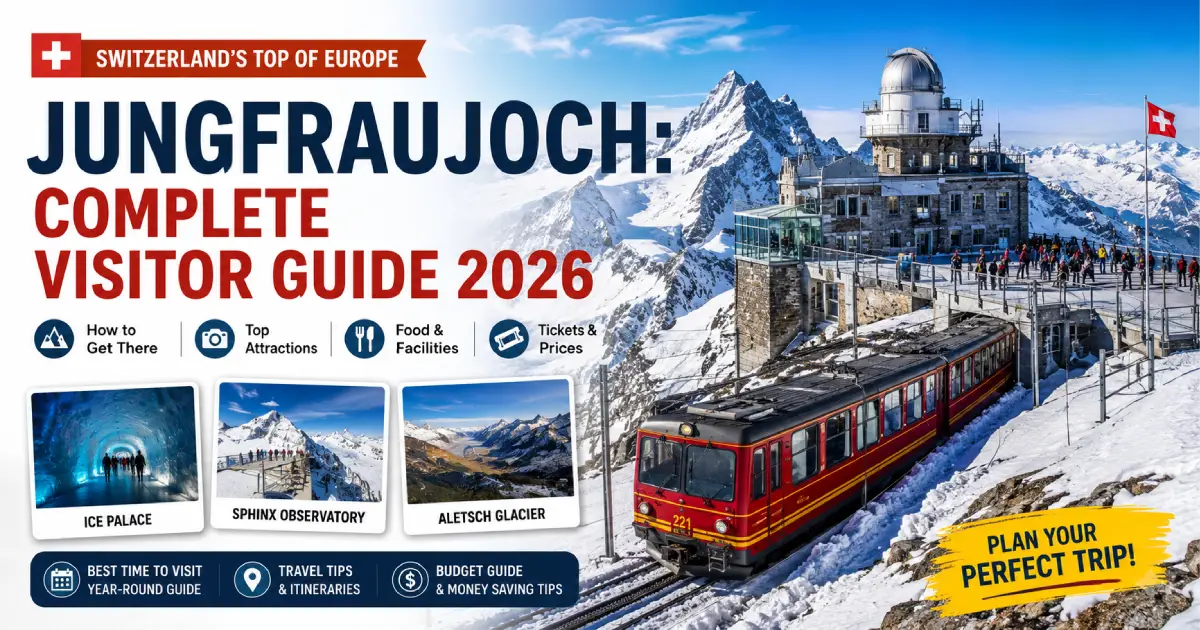
The Jungfraujoch — Europe’s highest railway station at 3,454 meters, accessible from Interlaken by the mountain railway sequence in approximately 2 hours, the site of the Aletsch Glacier (the longest glacier in the Alps at 23 kilometers), and the location of the Sphinx Observatory whose outdoor terrace at 3,571 meters constitutes the highest publicly accessible viewpoint in Europe reachable without mountaineering — is Switzerland’s single most visited tourist attraction and the Bernese Oberland’s defining experience. The “Top of Europe” (the Jungfraujoch’s marketing name, a claim that is technically accurate for the highest-altitude railway station on the continent) receives approximately 900,000 visitors annually and generates more railway revenue than any other single Swiss mountain railway destination despite its remote high-Alpine position between the Jungfrau (4,158 meters) and the Mönch (4,107 meters).
Planning a Jungfraujoch visit in 2026 requires specific knowledge that the destination’s marketing materials understate: the weather is the most important single variable (a cloudy summit eliminates the glacier panorama that constitutes the primary reason for the CHF 97–195 ticket price, and the weather at 3,454 meters frequently differs dramatically from the valley below — clear Interlaken weather does NOT guarantee a clear summit), the railway journey itself is as extraordinary as the summit (the Jungfrau Railway ascending through the interior of the Eiger and Mönch in a tunnel bored 1896–1912, with viewing windows cut into the Eiger’s north face providing downward views to Grindelwald 2,000 meters below), and the altitude produces genuine physiological effects on visitors arriving rapidly from low-altitude origins (headache, breathlessness, and reduced physical capacity are normal at 3,454 meters and require pacing rather than the energetic exploration that lower-altitude viewpoints allow). This complete guide covers every practical dimension of a 2026 Jungfraujoch visit — getting there from every major Switzerland base, ticket costs and the Good Morning Ticket discount, the weather assessment strategy, what to see and do at the summit, altitude management, and the two alternative routes that provide different visual experiences.
For related guides, see our Interlaken Travel Guide 2026, Things to Do in Interlaken 2026, Best Places to Visit in Switzerland 2026, and Swiss Travel Pass Guide 2026.
| Category | Details |
|---|---|
| Location | Bernese Oberland, between Jungfrau (4,158m) and Mönch (4,107m) |
| Altitude | 3,454 meters (railway station); 3,571 meters (Sphinx Observatory terrace) |
| Nearest Base Towns | Interlaken (2 hrs); Grindelwald (1.5 hrs); Lauterbrunnen/Wengen (1.5 hrs) |
| UNESCO Status | Adjacent to Jungfrau-Aletsch UNESCO World Heritage Site |
| Full Ticket Price (from Interlaken Ost) | CHF 195 (standard); CHF 147 (Good Morning Ticket, first departures) |
| Swiss Travel Pass Discount | 50% on Jungfrau Railway section only (Kleine Scheidegg → Jungfraujoch) |
| With Swiss Travel Pass | Approximately CHF 97–110 (BOB + WAB included; Jungfrau Railway 50% off) |
| Operating Season | Year-round |
| Summit Temperature | -10°C to +2°C (year-round — warm clothing essential regardless of season) |
| Altitude Health Effect | Normal — expect reduced energy and possible mild headache at 3,454m |
| Best Weather Assessment Tool | Jungfraujoch summit webcam (jungfrau.ch/en-gb/planning/webcams) |
| Best Months for Clarity | September, October, January, February, June |
| Journey Time from Interlaken Ost | Approximately 2 hours each way |
There are two main routes from Interlaken Ost to the Jungfraujoch, both arriving at the same destination (Kleine Scheidegg, where the Jungfrau Railway to the summit departs) but traveling through different landscapes and using different intermediate transport modes. Most visitors choose one route ascending and the other descending — creating a circular experience with maximum variety.
Transport sequence: Interlaken Ost → Grindelwald (BOB narrow-gauge train, 35 min) → Grindelwald Terminal → Eiger Express gondola (Grindelwald Terminal → Eiger Glacier, 15 min) → Jungfrau Railway (Eigergletscher → Jungfraujoch, 27 min) | Total ascending time: Approximately 1 hour 20 minutes from Interlaken Ost
The Eiger Express (the newest component of the Jungfraujoch access system, a large aerial gondola opened 2020 replacing the previous rack railway segment between Grindelwald Grund and Eigergletscher) is the faster of the two Kleine Scheidegg approaches — the 15-minute gondola ascent covering 1,240 meters of altitude with the Eiger north face visible directly across from the gondola cabin, the gondola’s specific exposure (large windows, the Bernese Alps visible in all directions) creating an aerial mountain experience as dramatic as the summit itself.
Swiss Travel Pass coverage on Route 1:
Visual highlights: The Grindelwald village (visible throughout the BOB ascent), the Eiger north face at close range from the Eiger Express gondola, and the transition from the gondola to the Jungfrau Railway tunnel at Eigergletscher.
Transport sequence: Interlaken Ost → Lauterbrunnen (BOB, 22 min) → Wengen (BOB rack railway, 14 min) → Kleine Scheidegg (Wengernalpbahn rack railway, 38 min) → Jungfraujoch (Jungfrau Railway, 33 min) | Total ascending time: Approximately 1 hour 50 minutes from Interlaken Ost
The Lauterbrunnen route provides a more gradual and more varied landscape progression — the valley floor and the Staubbachfall waterfall visible from Lauterbrunnen station, the Wengen rack railway ascent above the valley’s cliff walls with the Lauterbrunnen Valley visible 900 meters below, and the Wengernalpbahn’s high-altitude traverse across the south-facing slopes of the Männlichen Ridge with the Bernese Alps appearing progressively as the train crosses the ridge and descends toward Kleine Scheidegg. The Wengernalpbahn section (from Wengen to Kleine Scheidegg) provides one of the finest progressive mountain panoramas on any Swiss rack railway — the Eiger, Mönch, and Jungfrau appearing simultaneously on the southern horizon as the train crests the ridge.
Swiss Travel Pass coverage on Route 2:
Visual highlights: The Lauterbrunnen Valley’s waterfall landscape, the Wengen ascent’s valley views, and the Kleine Scheidegg panorama (the most spectacular open-air mountain-viewing position on the route, with the Eiger north face rising directly from the station area — a view worthy of a pause before entering the tunnel).
Kleine Scheidegg (2,061 meters), the junction where all routes converge before the Jungfrau Railway tunnel ascent, deserves specific attention as a destination in its own right rather than simply a transit point:
The Kleine Scheidegg station sits directly below the Eiger’s north face — the 1,800-meter vertical wall of dark limestone that is the most legendary technical climbing route in the Alps (the Nordwand, “Nordwand” meaning north face), first climbed in 1938, with approximately 64 fatalities since the first attempt in 1935 — in a position of such immediate confrontation with the wall’s scale that most visitors experience a physical response to the proximity. The Eiger’s north face from Kleine Scheidegg station (200 meters of horizontal distance from the wall’s base) is one of the most viscerally impressive single mountain views available without technical equipment in the Alps.
The station’s restaurant and sun terrace provide one of the Bernese Oberland’s finest outdoor viewpoints — the combination of the Eiger directly above, the Mönch and Jungfrau to the southwest, and the valley landscape visible in multiple directions creates a panorama that many visitors retrospectively identify as the journey’s finest single view, superior in emotional impact to the summit’s more dramatic altitude.
Insider tip: Spending 20–30 minutes at Kleine Scheidegg (before or after the Jungfraujoch ascent) in clear conditions — having a coffee or lunch on the station terrace while facing the Eiger north face — adds significantly to the journey’s emotional impact without requiring additional time beyond what a practical connection window allows.
Duration: 33 minutes (Kleine Scheidegg → Jungfraujoch) | Tunnel length: 7.1 km | Construction period: 1896–1912 | Altitude gained: 1,393 meters (from 2,061m to 3,454m)
The Jungfrau Railway (Jungfraubahn, opened 1912 after 16 years of construction by Swiss engineer Adolf Guyer-Zeller — a construction project involving drilling 7.1 km of tunnel through the solid rock of the Eiger and Mönch, a project that required 24-hour blasting operations and resulted in 30 construction worker fatalities before its completion) is as much the Jungfraujoch experience as the summit itself — the sense of ascending inside a mountain, the complete darkness of the tunnel broken only by the brief intermediate stations, and the specific sound of the rack railway mechanism in the confined tunnel space create a journey unlike any other in Swiss mountain transport.
The intermediate stations (inside the mountain):
Eigergletscher (2,320m): The first stop above Kleine Scheidegg, at the base of the Eiger Glacier and adjacent to the Eiger Express gondola arrival station — a brief pause before the train enters the main tunnel.
Eigerwand (2,865m): The first interior stop within the Eiger’s body — the train pauses for 5 minutes, allowing passengers to exit at a gallery cut into the Eiger’s north face. Windows in the north face provide downward views into the Grindelwald Valley 2,000 meters below — the specific vertigo of looking through a hole in the Eiger’s north face at the void below is one of the most viscerally disorienting experiences available on any Swiss public transport. The views from these windows (through which the north face’s actual angle is visible — the face’s steepness making the valley appear to be directly beneath the window with minimal foreshortening) are specifically extraordinary and worth the full 5-minute stop attention.
Eismeer (3,160m): The second interior stop, this time with windows facing the south-facing glacier — the Eismeer (“Sea of Ice,” the glacier on the mountain’s southern face) visible through carved galleries, a dramatically different visual environment from the north face’s Eigerwand gallery.
Insider tip: Position at the Eigerwand gallery windows (the views on the right side of the train as it ascends from Kleine Scheidegg — face direction of travel and look right when the Eigerwand station stop is announced) immediately on the doors opening — the galleries fill quickly during the 5-minute stop and early positioning provides the clearest unobstructed window view of the valley far below.
From Zurich (approximately 3 hours total): Zurich HB → Bern (InterCity, 57 min) → Interlaken Ost (RegioExpress, 57 min) → Jungfraujoch via either route above (approximately 2 hours). Depart Zurich by 7:00–7:30 AM to arrive at the Jungfraujoch by approximately 11:00 AM — adequate summit time before the afternoon’s potentially developing weather.
From Lucerne (approximately 3 hours total): Lucerne → Interlaken Ost (Brünig route direct RegioExpress, approximately 2 hours) → Jungfraujoch (2 hours further). Depart Lucerne by 6:30–7:00 AM for the most complete summit day.
From Bern (approximately 2.5 hours total): Bern → Interlaken Ost (RegioExpress, 57 min) → Jungfraujoch (2 hours). Depart Bern by 7:00–7:30 AM.
From Grindelwald (approximately 1.5 hours total): Grindelwald → Eigergletscher (Eiger Express gondola, 15 min) → Jungfraujoch (Jungfrau Railway, 33 min). The most efficient base for multiple Jungfraujoch visits or for visitors specifically targeting morning Good Morning Ticket departures with minimal journey time from base accommodation.
| Ticket Type | Price | Validity |
|---|---|---|
| Standard return (2nd class) | CHF 195 | Same day return |
| Standard return (1st class) | CHF 210 | Same day return |
| Good Morning Ticket (2nd class) | CHF 147 | First departures only (see below) |
| Good Morning Ticket (1st class) | CHF 163 | First departures only |
Good Morning Ticket: The most significant single Jungfraujoch cost-saving tool — a discounted ticket available for the first departures from Kleine Scheidegg toward the Jungfraujoch (typically the departures before 9 AM from Kleine Scheidegg — check current 2026 timetable at jungfrau.ch for the specific first-departure time and Good Morning Ticket validity window). The CHF 48 saving (CHF 195 → CHF 147) rewards early departures with both better pricing and better summit conditions (fewer visitors, maximum clarity before afternoon cloud development).
Good Morning Ticket practical requirements:
| Component | Standard Price | With Swiss Travel Pass |
|---|---|---|
| BOB (Interlaken → Grindelwald or Lauterbrunnen) | CHF 18–22 | Free |
| Eiger Express (Grindelwald → Eigergletscher) | CHF 43 return | CHF 21.50 (50% off) |
| WAB (Lauterbrunnen → Wengen → Kleine Scheidegg) | CHF 32 return | Free |
| Jungfrau Railway (Kleine Scheidegg → Jungfraujoch) | CHF 95 return | CHF 47.50 (50% off) |
| Total via Lauterbrunnen route | CHF 145 | CHF 47.50 |
| Total via Grindelwald/Eiger Express route | CHF 156 | CHF 69 |
Net saving with Swiss Travel Pass (Lauterbrunnen route): CHF 97.50 — nearly half the standard price. This single discount frequently justifies the Swiss Travel Pass’s entire cost for visitors whose itinerary includes the Jungfraujoch.
The Good Morning Ticket discount applies to the Jungfrau Railway section (Kleine Scheidegg → Jungfraujoch) — when combined with the Swiss Travel Pass’s 50% discount on the same section, the lower discount applies (you cannot combine both). The Good Morning Ticket provides a greater absolute discount (CHF 48 off) than the Swiss Travel Pass’s 50% (CHF 47.50 off) — virtually identical in this specific case, but the Good Morning Ticket is specifically a discounted ticket rather than a pass benefit, and their combination mechanics should be confirmed at jungfrau.ch for current 2026 terms.
The Sphinx Observatory — the highest building on the Jungfraujoch complex, accessible by an internal lift from the station tunnel system — provides the outdoor terrace at 3,571 meters that is the highest publicly accessible viewpoint in Europe reachable without mountaineering equipment. The panorama from the Sphinx terrace encompasses:
The Aletsch Glacier: The 23-kilometer Aletsch Glacier (the longest glacier in the Alps, extending south from the Jungfraujoch area through the Bernese Oberland UNESCO World Heritage landscape toward the canton of Valais) visible from the terrace in its full extent on clear days — the scale (4 kilometers wide at the top, 900 meters deep at the thickest point, containing approximately 27 cubic kilometers of ice) immediately comprehensible from the elevated terrace position in a way that valley-level views and photographs cannot prepare visitors for.
The 4,000-meter peaks: The Jungfrau (4,158 meters, immediately south — the summit approximately 700 meters above the terrace level, visible at close range), the Mönch (4,107 meters, northwest — the Jungfraujoch’s name literally translates as “Young Woman’s Neck,” referring to the pass between the Mönch and Jungfrau), and on exceptional clarity days the full panorama of Bernese, Valais, and Graubünden 4,000-meter peaks.
The extended panorama: On the clearest days (October, January, and February provide statistically the highest frequency of extreme clarity) the Bernese Oberland’s panorama extends to the Black Forest of Germany (150 kilometers), the Vosges Mountains of France (200 kilometers), and in the finest conditions Mont Blanc (300 kilometers) — verifiable by the distance markers on the terrace’s orientation circle.
Altitude physiology: The Sphinx terrace at 3,571 meters produces the most significant altitude effect of the visit — the reduced oxygen concentration (approximately 65% of sea-level oxygen at this altitude) means that physical exertion (climbing the external staircase to the terrace’s highest observation point) produces breathlessness disproportionate to the effort. Moving slowly, pausing frequently, and not competing with fellow visitors for position at the terrace railing provides a more complete and more comfortable terrace experience.
The Jungfraujoch provides the most accessible walk on an actual Alpine glacier available in Switzerland — a marked glacier trail descending from the Sphinx station complex onto the upper Aletsch Glacier surface, where visitors can walk on the actual glacier ice (with the appropriate footwear — crampon rentals available at the summit station for approximately CHF 10 if standard hiking shoes don’t provide adequate ice traction) and experience the specific environment of a major Alpine glacier at close range: the blue-white ice surface, the crevasse systems visible (the marked trail specifically avoids crevasse zones), the lateral moraines, and the specific cold airflow that the glacier’s mass generates.
The glacier walk (approximately 200–400 meters from the station onto the marked trail, allowing 20–30 minutes of glacier-surface time while remaining on the marked safe path) provides the Jungfraujoch’s most specifically active outdoor experience — visitors who spend their entire summit time indoors (in the Ice Palace, the tunnel system restaurants, and the station galleries) miss the specific outdoor glacier encounter that the summit’s position on the ice makes possible.
Safety notes: The marked glacier trail is maintained for visitor safety with ropes and signs indicating safe zones — departing from the marked trail onto unmarked glacier terrain is prohibited and genuinely dangerous (crevasse risk). Following the marked trail precisely and returning before the scheduled train departure ensures both safety and successful descent.
The Ice Palace (Eispalast) — a cavern system carved entirely within the glacier ice, accessed by descending stairs from the main Jungfraujoch station tunnel — contains approximately 1,000 square meters of ice chambers, corridors, and rooms decorated with ice sculptures (penguins, bears, and various Alpine animals carved directly from the glacier ice, maintained at constant below-freezing temperature by the surrounding glacier mass). The Ice Palace’s specific appeal: the blue-green light filtering through the translucent ice walls, the specific acoustic environment of an ice-walled space (sound absorption and reflection patterns different from any above-ground architectural equivalent), and the temperature (consistently -2°C to -5°C regardless of outside season) that produces a physical cooling effect immediately on entry.
The Ice Palace’s ice sculptures (maintained and updated annually — different sculpture themes appear in different years) and the specific geology visible in the tunnel walls (the Aletsch Glacier’s compacted ice structure, with layers of annual snowfall visible as distinct blue-grey strata in the ice walls) provide educational content appropriate to children’s engagement with the glacier environment.
The Jungfrau Plateau (the high-altitude snowfield accessible from the summit station) provides year-round snow activities — summer skiing (on the permanent glacier snowfield above 3,000 meters, with specific summer ski passes available from the Jungfraujoch station for visitors specifically wanting glacier skiing), summer sledding (on maintained sledding runs down the glacier slope, equipment rentable at the station), and the specific pleasure of standing on a snowfield in a t-shirt temperature at 3,500 meters altitude that creates the memorable summer experience of playing in snow while the Bernese Oberland’s valleys bake at 28°C below.
In winter (December–April), the Jungfrau Plateau’s skiing is integrated with the Jungfrau Ski Region’s piste network — the highest skiing in the Bernese Oberland at 3,454 meters, connecting to the Jungfrau Ski Region’s extensive lower-altitude network via the descent toward Kleine Scheidegg.
Crystal Restaurant: The main full-service restaurant at the Jungfraujoch (3,454 meters), providing hot meals (Swiss mountain restaurant standards — rösti, soups, pasta, and the standard warming mountain preparations) and the specific experience of eating a cooked meal at the highest railway station in Europe. Prices are premium (approximately 30–50% above valley restaurant equivalents) reflecting the logistics of supply — every ingredient reaches the summit by railway, making the food’s price a genuine reflection of transport cost rather than pure tourist markup.
Lindt Swiss Chocolate Heaven: A destination in its own right for chocolate enthusiasts — a Lindt-operated shop and interactive chocolate experience at the summit station, providing the marketing intersection of Swiss chocolate and Swiss altitude in a single location. The promotional angle (buying Swiss chocolate at the “Top of Europe” at 3,454 meters) is overt; the chocolate is genuine Lindt quality.
The Bollywood Connection: The Jungfraujoch maintains a specific relationship with Indian tourism (multiple Bollywood films have used the Jungfraujoch as a filming location, most notably the 1995 film “Dilwale Dulhania Le Jayenge” — one of the most commercially successful Bollywood films ever made — whose opening scenes on the Swiss snowfields, filmed partly at the Jungfraujoch, created a specifically Swiss Alps + romantic scenery association for Indian audiences that drives sustained Indian tourism to the destination). Indian cuisine is specifically available at the summit restaurant, reflecting the significance of this visitor market.
The Jungfraujoch’s most important practical reality — repeated throughout this guide because it is the single most consequential visitor planning element — is that summit weather at 3,454 meters is frequently radically different from valley weather at 568 meters (Interlaken) or 1,034 meters (Grindelwald). The specific weather dynamics:
The cloud inversion phenomenon: Warm moist air from the Swiss Mittelland (the central Swiss plateau) frequently rises and condenses against the Bernese Oberland’s mountains, creating cloud cover that sits at approximately 1,500–2,500 meters while leaving both the valley below and the summit above clear — a condition where the train literally passes through cloud during the ascent but emerges above the cloud layer at summit level. This condition (common in autumn and winter) can produce spectacular above-cloud-layer panoramas at the summit while Interlaken below is completely overcast.
The summit cloud phenomenon: The reverse is equally common — clear valley conditions with orographic cloud forming specifically on the high peaks, wrapping the Jungfraujoch summit in cloud while Interlaken basks in sunshine. This condition (frequent in summer) produces the expensive cloudy-summit experience that the weather assessment strategy is designed to avoid.
1. Check the Jungfraujoch summit webcam (jungfrau.ch/en-gb/planning/webcams) — the most direct and most reliable tool. The webcam at the summit shows actual current conditions rather than forecast approximations. Checking at 7:00–7:30 AM on the planned excursion day (before departing from base accommodation) provides the most relevant immediate visibility assessment.
2. Check MeteoSwiss for “Jungfrau” specifically (meteoswiss.admin.ch) — the Swiss national weather service’s mountain-specific forecasts distinguish between valley and summit conditions in a way that general weather apps don’t. The “Jungfrau” location forecast provides altitude-specific temperature, cloud base, and wind forecasts for the summit area.
3. The Jungfrau Railways weather rating: The Jungfrau Railways website (jungfrau.ch) maintains a current weather rating for the summit excursion (displayed on the homepage) — a simple “good/moderate/poor” rating updated regularly that reflects the summit’s actual current and forecast visibility. This rating is specifically designed for visitors deciding whether to make the excursion on a given day.
4. The flexible-day strategy: Building a Jungfraujoch excursion into a multi-day Interlaken or Grindelwald stay (where the excursion can be scheduled on the clearest available day rather than on a fixed date) consistently produces better summit experiences than single-day visits where the excursion must occur on a predetermined date regardless of conditions.
5. Clear-day characteristics: The clearest Jungfraujoch conditions typically occur in the 24–48 hours following a significant weather event (rain or snowstorm clearing overnight, leaving exceptional clarity the following morning), in the morning before afternoon convective cloud development begins (the Good Morning Ticket’s early departure timing specifically targets this morning-clarity window), and in autumn and winter (September–November and December–March statistically producing the highest frequency of excellent summit clarity in the annual cycle).
The Jungfraujoch ascends visitors from Interlaken’s 568 meters to 3,454 meters in approximately 2 hours — a vertical gain of 2,886 meters that most visitors accomplish without significant health issues but that produces noticeable physiological effects in virtually everyone regardless of age, fitness level, or prior altitude experience:
Breathlessness with minimal exertion: Walking briskly at 3,454 meters produces breathlessness equivalent to a sprint at sea level — the reduced oxygen concentration (approximately 65% of sea-level oxygen) means the cardiovascular system works significantly harder for the same physical effort. Walking slowly and resting frequently prevents escalation to more significant symptoms.
Mild headache: A tension-type headache appearing 30–60 minutes after arrival at altitude is the most common specific symptom — typically manageable with ibuprofen or paracetamol (over-the-counter pain relief, available at the summit station pharmacy if not carried) and not an indicator of serious altitude sickness.
Fatigue: A generalized sense of tiredness and reduced motivation — normal at this altitude, typically resolving within 30–60 minutes of return to lower altitude.
Nausea: Mild nausea occurs in some visitors, particularly those who arrived by the faster Eiger Express route (which reduces the acclimatization time compared to the slower Wengernalpbahn route). Moving to the outdoor air from the enclosed station areas typically provides relief.
Cold: Summit temperatures range from -10°C to +2°C year-round — the specific cold of 3,454 meters is sometimes underestimated by visitors arriving in summer. The Jungfraujoch station provides fleece jackets and additional layers for rental (CHF 5–10) for visitors inadequately prepared — planning to carry a warm layer regardless of valley temperatures is the standard preparation.
High-altitude pulmonary edema (HAPE) and high-altitude cerebral edema (HACE) are serious altitude sicknesses that can develop at 3,454 meters in susceptible individuals — rarer than the normal adaptation symptoms above but genuinely dangerous. Immediate descent is required if any of these symptoms appear:
Medical facility: The Jungfraujoch station maintains a medical service and emergency oxygen supply for altitude-related medical emergencies — the staff are trained in altitude medicine response. Any concerning symptoms should be reported to station staff immediately rather than attempting to manage independently.
Children: Children are generally as tolerant of altitude as adults but may be less able to communicate early symptoms — watching for unusual tiredness, pallor, or loss of appetite (beyond the general altitude effects) and responding with descent if symptoms concern you provides appropriate parental management.
Pre-existing cardiovascular or respiratory conditions: Visitors with heart conditions, severe asthma, or serious respiratory conditions should consult a physician before planning a Jungfraujoch visit — the reduced oxygen concentration places additional demand on compromised cardiovascular and respiratory systems that healthy individuals manage without difficulty.
Pregnancy: Current medical guidance generally recommends avoiding altitudes above 3,000 meters during pregnancy unless specific medical assessment has been completed — the Jungfraujoch’s altitude (3,454 meters) falls above this threshold.
7:00 AM — Depart Interlaken Ost (BOB to Lauterbrunnen) 7:22 AM — Lauterbrunnen (change to BOB rack railway to Wengen) 7:36 AM — Wengen (change to Wengernalpbahn) 8:14 AM — Kleine Scheidegg (20-minute pause for Eiger north face view and Good Morning Ticket boarding) 8:33 AM — Jungfrau Railway departs Kleine Scheidegg 9:06 AM — Arrive Jungfraujoch summit (Good Morning Ticket timing) 9:06 AM – 11:30 AM — Summit: Sphinx terrace (arrive before main midday crowds), glacier walk, Ice Palace, Crystal Restaurant lunch 11:30 AM — Begin descent (Jungfrau Railway to Kleine Scheidegg) 12:03 PM — Kleine Scheidegg (change to Eiger Express direction or Wengernalpbahn return) 1:30 PM — Arrive back at Interlaken Ost
Afternoon free: Lido lake swimming, Harder Kulm (funicular free with Swiss Travel Pass), or Old Town walk before dinner.
7:00 AM — Depart Grindelwald (Eiger Express gondola to Eigergletscher) 7:15 AM — Eigergletscher (board Jungfrau Railway) 7:42 AM — Arrive Jungfraujoch summit 7:42 AM – 10:00 AM — Summit in near-solitude (the 7:42 AM arrival is the earliest possible from Grindelwald, before the main visitor wave from Interlaken arrives by 9:30–10:00 AM) 10:00 AM — Begin descent 10:27 AM — Kleine Scheidegg (optional 30-minute pause for the Eiger view and refreshments) 11:30 AM — Back in Grindelwald
Afternoon: Grindelwald First Cliff Walk, Bachalpsee hike, or Grindelwald village exploration.
Ascent: Lauterbrunnen route (BOB + Wengernalpbahn — the slower, more scenic approach through the Lauterbrunnen Valley) Descent: Grindelwald route (Jungfrau Railway → Eiger Express gondola → BOB — the faster, more dramatic aerial descent with the Eiger north face visible from the gondola)
This circuit uses both routes, covering the maximum landscape variety in a single Jungfraujoch day — the Lauterbrunnen Valley’s waterfall landscape, the Wengernalpbahn’s ridge traverse, the summit experience, and the Eiger north face at close range from the Eiger Express on the return.
The single most common (and most expensive) Jungfraujoch mistake — purchasing a CHF 147–195 ticket and making a 4-hour round journey for a summit completely wrapped in cloud. The summit webcam check (jungfrau.ch/en-gb/planning/webcams) at 7:00–7:30 AM on the planned excursion morning takes 30 seconds and eliminates this outcome.
Summit temperatures are -10°C to +2°C year-round — a light cardigan is inadequate. A proper down jacket, warm hat, and gloves transform the Sphinx terrace experience from teeth-chattering discomfort into a comfortable 30-minute outdoor panorama. The summit station rents fleece jackets but warm hats and gloves must be carried or purchased.
The Eigerwand intermediate station (inside the Eiger, views through the north face windows 2,000 meters above Grindelwald) occurs for only 5 minutes during the Jungfrau Railway ascent — passengers who don’t position at the exit doors (right side of the train in the ascending direction) immediately as the stop is announced miss the gallery entirely and the views it provides.
The Jungfraujoch summit station’s indoor facilities (restaurants, shops, Ice Palace, tunnel galleries) provide comfortable weather-independent activities, but the outdoor glacier walk and the Sphinx terrace are the summit’s most specifically extraordinary experiences. Visitors who spend their entire summit time in the enclosed station miss both.
The junction at Kleine Scheidegg — directly below the Eiger north face, with a sun terrace and one of the finest mountain panoramas on the route — is typically traversed in the minimum connection time required to board the next train. The journey’s structure (the Eiger north face view is uniquely available at this specific junction) rewards a deliberate 20–30 minute pause on the return to allow the visual experience that the train doesn’t provide.
The Good Morning Ticket (CHF 48 discount on the standard price) requires boarding the first qualifying Jungfrau Railway departure from Kleine Scheidegg — the specific validity window is subject to change, and confirming current 2026 terms at jungfrau.ch before planning departure times around this discount prevents arriving at Kleine Scheidegg 10 minutes after the Good Morning Ticket window has closed.
About Travel Tourister Travel Tourister’s destination specialists have visited the Jungfraujoch across all seasons — from January’s crystal-clear glacier panoramas and February’s above-cloud-layer winter clarity through July’s glacier-walk-in-sunshine summer days and October’s autumn-sharp Aletsch visibility — applying the Good Morning Ticket strategy, testing both ascending routes, and experiencing the Eigerwand gallery in early-morning near-solitude to deliver the most practical and complete 2026 Jungfraujoch visitor guide.
Posted By : Vinay
Latest Article
2nd Floor, 39, Above Kirti Club, DLF Industrial Area, Kirti Nagar, New Delhi, Delhi 110015



Travel Tourister is a leading Travel portal where we introduce travellers to trusted travel agents to make their journey hasselfree, memorable And happy. Travel Tourister is a platform where travellers get Tour packages ,Hotel packages deals through trusted travel companies And hoteliers who are working with us across the world. We always try to find new and more travel agents and hoteliers from every nook and corners across the world so that you could compare the deals with different travel agents and hoteliers and book your tour or hotel with the one you have chosen according to your taste and budget.
Copyright © Travel Tourister, India. All Rights Reserved

 Call
Call Enquiry