Published on : 05 Sep 2026
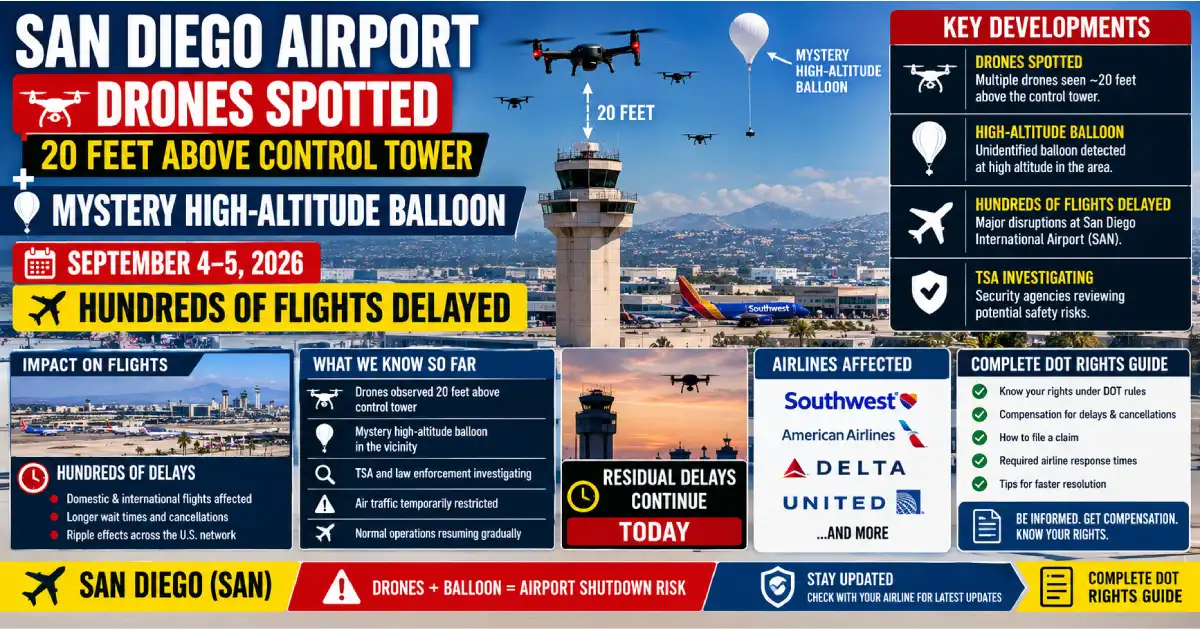
San Diego International Airport experienced one of the most bizarre and disruptive aviation incidents of the 2026 Labor Day weekend on Friday September 4, when multiple drones — including one described by witnesses as hovering approximately 20 to 25 feet above the airport’s air traffic control tower — triggered a ground stop that halted arrivals and departures for hours, leaving hundreds of passengers stranded on aircraft, at gates, and in holding patterns across the western United States. The disruption began at approximately 2:00 PM local time when multiple drones were spotted near the airfield. Around 2 p.m., the objects were spotted near the airport, prompting the FAA to temporarily pause arrivals and departures, San Diego Airport Public Information Officer Nicole Hall told NBC San Diego. The FAA classified the drone activity as a serious airspace hazard — the Federal Aviation Administration classifies much of the airspace around major airports as controlled and requires remote pilots to adhere to strict altitude and location limits — and the ground stop remained in effect until approximately 4:30 PM. By about 4:30 p.m., the FAA reported an all-clear and all airport operations have resumed, Hall said. But in the nearly two-and-a-half hours between the drone sightings and the all-clear, San Diego became one of the most delayed airports in the country, with some passengers citing waits of two to four hours for departing flights. Arriving aircraft were placed into holding patterns over the Pacific and Southern California coastline. Some San Diego-bound aircraft were diverted to alternate airports. And the wider West Coast aviation network absorbed the cascade.
Then the story got stranger. As the drone crisis was unfolding at ground level, residents across San Diego simultaneously observed a separate, entirely different object high above the city — a silvery, bright, stationary object at extreme altitude that initially caused widespread speculation about whether it was a military drone, an experimental airship, or something more exotic. Flight-tracking data identified the object as HBAL124, registration N519HB — a high-altitude balloon tracked at approximately 53,800 feet and traveling at around 53 knots over inland San Diego County. One Reddit user in North Park described seeing little more than a glint while looking north, but said the object appeared distinctly blimp-shaped through binoculars. This second object — at 53,800 feet — was entirely separate from the drones near the control tower. The two objects had nothing to do with each other. But together they created a chaotic Friday afternoon sky over San Diego that left passengers, airlines, and aviation authorities dealing with a scene that had no recent precedent. The drone activity is being investigated by the TSA law enforcement, Hall confirmed. Today, Saturday September 5, FAA volume programs remain active at San Diego during peak departure banks as the network continues to recover. Here is exactly what happened, what is happening today, and what every delayed or diverted passenger is owed.
Published: September 5, 2026 — Saturday Airport: San Diego International Airport (SAN / KSAN) Incident Dates: Friday September 4 (primary) → Saturday September 5 (residual) Primary Cause: Multiple drones near airfield + FAA ground stop Drone Location: Near or above the air traffic control tower — approximately 20–25 feet above the tower in witness accounts Ground Stop: Approximately 14:00 local time September 4 All-Clear: Approximately 16:30 (4:30 PM) — all operations resumed Duration: Approximately 2.5 hours of active FAA ground stop and traffic management Flights Affected: Hundreds delayed — SAN described as one of the most delayed airports in the US during the 2–4 PM window Passengers Impacted: Departures held at stands and on taxiways | Arrivals in holding patterns | Some diversions to alternate airports Second Object: HBAL124, registration N519HB — tracked at 53,800 feet, ~53 knots over inland San Diego County — separate from airport drones — blimp-shaped through binoculars Investigation: TSA law enforcement investigating drone activity | Airport Airfield Operations monitoring in coordination with FAA and local law enforcement Authority Statement: San Diego Airport PIO Nicole Hall: “Around 2 p.m., the objects were spotted near the airport, prompting the FAA to temporarily pause arrivals and departures. By about 4:30 p.m., the FAA reported an all-clear and all airport operations have resumed.” Today (Saturday Sept 5): FAA volume program still active at SAN — residual delays during peak departure banks SAN Airport Type: Single-runway — one of the busiest single-runway airports in the United States DOT Rights: Ground stop = government action = extraordinary circumstances → NO additional DOT cash compensation beyond refund rights DOT Refund Rule: Cancelled flight = full cash refund to original payment — mandatory, no vouchers
The most confusing aspect of Friday’s San Diego disruption was the simultaneous presence of two completely different unidentified aerial objects above the city — at radically different altitudes, with radically different implications.
The object that directly caused the ground stop was not one drone but multiple drones near the control tower at San Diego International Airport. Several accounts referenced two separate drones, including descriptions of a small unmanned aircraft hovering roughly 20 to 25 feet above the airport’s control tower. A second drone was also described by pilot reports from departing aircraft. At least one departing crew reported a drone close to the airfield before their departure was halted.
A drone hovering 20–25 feet above an air traffic control tower is not a fringe safety concern. It is an immediate and direct threat to aviation safety. Air traffic controllers work inside the tower with unobstructed sightlines to the runways — their visual monitoring of the airfield is essential to safe operations, particularly at a single-runway airport where every aircraft movement is choreographed through a single point. A drone at tower height, within the controlled airspace of one of California’s busiest airports, forces the FAA to halt all movements until the threat is neutralised and the airspace is confirmed clear. There is no other legally or operationally defensible choice.
The FAA classifies much of the airspace around major airports as controlled and requires remote pilots to adhere to strict altitude and location limits. Flying a drone within 5 miles of a controlled airport without authorization is a federal offence under FAA regulations. Flying a drone at tower height — literally hovering above the air traffic control facility — is among the most egregious violations of those regulations. TSA law enforcement is now investigating. Federal drone incursions at major airports are prosecuted under 49 U.S.C. § 46306 (operation of aircraft in violation of regulations) with penalties of up to $20,000 per violation and potential criminal prosecution where reckless endangerment is established.
Entirely separate from the drones near the control tower, residents across San Diego simultaneously observed a second object at extreme altitude. Departures at San Diego International Airport slowed significantly on Friday after pilots and passengers reported drones flying near the air traffic control tower and a silvery object consistent with a high-altitude balloon over the city.
Flight-tracking screenshots shared on Friday identified the high-altitude craft as HBAL124, registration N519HB, and classified it as a high-altitude balloon. The tracking data showed it near 53,800 feet and traveling approximately 53 knots over inland San Diego County. One Reddit user in North Park described seeing little more than a glint while looking north, but said the object appeared distinctly blimp-shaped through binoculars.
At 53,800 feet, HBAL124 is in the stratosphere — 10 miles above sea level, above the cruising altitude of commercial aircraft, and far outside the controlled airspace that caused the ground stop at San Diego airport. High-altitude balloons operating at that altitude under a valid registration and NOTAM (Notice to Air Missions) are legal and not uncommon — they are used for atmospheric research, telecommunications relay, and earth observation. HBAL124 appears to have been a registered balloon operating at legal altitude — but its simultaneous appearance above a city already alarmed by drone incursions below amplified the sense of chaos and generated enormous social media attention.
The two objects had nothing to do with each other. But together they created a Friday afternoon that no one in San Diego will forget quickly.
A FAA ground stop is a Traffic Management Initiative — a formal regulatory action that halts all movements at a specific airport or within a specific airspace volume. When a ground stop is active at San Diego International Airport, no aircraft may take off, no aircraft may land, and no aircraft may taxi into position for departure. Every aircraft already airborne bound for San Diego must either hold in a designated holding pattern or divert to an alternate airport.
Ground stops are issued by FAA Traffic Management Units and are communicated immediately to all air carriers through the FAA’s Air Traffic Control System Command Center. The moment a ground stop is issued, every airline operating to or from the affected airport immediately begins replanning its operation — holding departures at origin airports, rerouting inbound flights to holding patterns, and beginning contingency planning for diversions and rebooking.
San Diego International Airport is one of the busiest single-runway airports in the United States. A single-runway airport has none of the redundancy of multi-runway hubs like LAX (4 runways), SFO (2 runways), or Phoenix (3 runways). When the single runway at SAN is under a ground stop, there is no alternative movement corridor. The entire airport stops.
San Diego International is operating as a high-density single-runway airport serving a busy metropolitan region, and that configuration can magnify the effect of even modest schedule pressure. San Diego County Regional Airport Authority data shows passenger volumes tracking above many pre-pandemic comparables through 2026 — the airport is handling more passengers through a constrained infrastructure than at any point in its history.
The growing role of low-cost and network carriers at San Diego is also contributing to a busier schedule profile. Southwest Airlines, American Airlines, United Airlines, Alaska Airlines, Delta Air Lines, Frontier, and Spirit all operate significant schedules from SAN — all of them affected by Friday’s 2.5-hour disruption.
| Time (Local PDT) | Event |
|---|---|
| Early afternoon | Mysterious high-altitude object HBAL124 observed by San Diego residents — silvery, blimp-shaped — tracked at 53,800 feet, 53 knots |
| ~14:00 (2:00 PM) | Multiple drones spotted near San Diego International Airport — one described approximately 20–25 feet above control tower |
| 14:00 | FAA issues ground stop at SAN — all arrivals and departures halted |
| 14:00–16:30 | Departures held at gates and taxiways — arriving aircraft in holding patterns |
| 14:00–16:30 | SAN described as one of the most delayed airports in the country — some passenger waits 2–4 hours |
| 14:00–16:30 | FAA, TSA, and local law enforcement responding — airspace assessment ongoing |
| ~16:30 (4:30 PM) | FAA issues all-clear — all airport operations resume |
| 16:30 onward | Airlines begin re-sequencing — recovery delayed into evening from accumulated backlog |
| Friday evening | FAA volume program active at SAN — average arrival delays continuing |
| Saturday Sept 5 (TODAY) | FAA volume program remains active at SAN during peak departure banks — residual delays |
| Carrier | SAN Presence | Today’s Risk |
|---|---|---|
| Southwest Airlines | Largest SAN carrier — ~100+ daily departures | 🔴 High — most departures, most exposure |
| American Airlines | Major SAN carrier | 🔴 High |
| United Airlines | Major SAN carrier | 🔴 High |
| Alaska Airlines | Large SAN presence | 🟡 Moderate |
| Delta Air Lines | SAN hub connection | 🟡 Moderate |
| Frontier Airlines | Low-cost SAN routes | 🟡 Moderate |
| Spirit Airlines | SAN secondary operations | 🟡 Moderate |
Friday’s San Diego ground stop did not stay in San Diego. A 2.5-hour halt at a major West Coast airport during peak afternoon operations generates ripple effects that touch every major hub in the western United States.
Los Angeles (LAX and Burbank/BUR): Aircraft inbound from LAX to SAN were placed in holding or diverted. Aircraft due to depart LAX connections to SAN were held. The LAX-SAN corridor is one of the highest-frequency routes in the US — typically served by Southwest, American, United, and Alaska multiple times per hour.
San Francisco (SFO): Already under a volume ground delay program from the runway construction, SFO absorbed additional disruption from the SAN cascade as connecting passengers missed onward services.
Las Vegas (LAS): One of the busiest SAN connection points — Las Vegas-bound passengers connecting through SAN were delayed or stranded.
Phoenix (PHX): American Airlines and Southwest both connect SAN-PHX heavily — PHX absorbed knock-on delays from the SAN disruption across multiple afternoon banks.
National network cascade: Separate FAA airport status information indicates that even after the immediate restriction was lifted, a traffic management program remained in place for San Diego, with average arrival and departure delays continuing as airlines worked through the backlog. Passengers on later flights encountered residual disruptions, including missed connections and rebookings across several major carriers.
Today is Saturday September 5 — Labor Day weekend Day 2. The FAA volume program that was active Friday evening at SAN remains in place today during peak departure banks, as airlines work through the accumulated backlog from yesterday’s 2.5-hour ground stop. Travelers scheduled to fly into or out of San Diego over the next several days are encouraged to monitor flight status frequently, allow extra time at the airport and be prepared for schedule changes.
Check your SAN flight status: ✅ FAA National Airspace System: fly.faa.gov — shows active ground delay programs at SAN ✅ FlightAware: flightaware.com — search your specific flight number for real-time status ✅ Your airline’s app — fastest rebooking tool if your flight is delayed or cancelled
This is the most important legal question for every San Diego passenger affected yesterday and today: does the FAA drone-triggered ground stop entitle you to cash compensation under DOT regulations or EU261?
The short answer is no for cash compensation — but yes for a full refund if your flight was cancelled.
A FAA ground stop triggered by drone activity is a government regulatory action — not an airline operational decision. Under US DOT rules, airline cash compensation is tied to overbooking (denied boarding) situations. Weather and airspace restrictions — including drone-triggered ground stops — are treated similarly to weather events: the airline is not required to pay additional compensation per passenger for the delay. Under EU261/UK261, a drone-triggered ground stop by a government authority would also likely qualify as extraordinary circumstances, exempting the airline from the €250–€600 compensation.
However — and this is critical:
The DOT April 2024 Automatic Refund Rule is completely unconditional regardless of cause:
| Situation | Your Right |
|---|---|
| Flight cancelled — any cause including drone ground stop | Full cash refund to original payment — mandatory |
| Domestic flight delayed 3+ hours — you choose not to travel | Full cash refund right |
| International flight delayed 6+ hours — you choose not to travel | Full cash refund right |
The exact phrase: “Under the DOT’s April 2024 Automatic Refund Rule, I am requesting a full cash refund to my original payment method for this cancelled flight. I do not accept a travel credit or eCredit.”
Even without cash compensation for the delay itself, airlines must still provide:
| Right | Southwest | American | United | Alaska | Delta |
|---|---|---|---|---|---|
| Meal vouchers (significant delay) | ✅ | ✅ | ✅ | ✅ | ✅ |
| Hotel (weather/extraordinary) | ✅ Southwest provides even for extraordinary | ⚠️ Discretionary | ⚠️ Discretionary | ⚠️ Discretionary | ⚠️ Discretionary |
| Free rebooking | ✅ | ✅ | ✅ | ✅ | ✅ |
Southwest Airlines is the most generous of the major carriers on hotel accommodation — they provide hotels even for extraordinary circumstance disruptions. If you are stranded overnight at San Diego or at a diversion airport because of Friday’s ground stop, ask Southwest explicitly for hotel accommodation.
International passengers transiting San Diego — for example, arriving from Mexico, connecting to Europe, or on a codeshare connection — may have additional rights under EU261 or UK261 if their flight departed from the EU or UK. Contact your airline directly and ask whether your ticket was issued under EU261 jurisdiction.
Step 1 — Check fly.faa.gov before leaving for the airport The FAA National Airspace System status page (fly.faa.gov) shows every active ground stop and ground delay program in real time. A volume program is active at SAN today — check the current average delay before heading to the terminal.
Step 2 — Check your inbound aircraft on FlightAware Go to flightaware.com and search your specific flight number. Find where the aircraft scheduled for your rotation currently is. If it is still recovering from yesterday’s disruption, your departure today may be later than the published schedule.
Step 3 — Use your airline app — not the phone Southwest, American, United, Alaska, and Delta all have self-service rebooking apps that process changes in 3–5 minutes. Phone queues during Labor Day weekend disruption run 45–90 minutes.
Step 4 — If your flight is cancelled: demand a cash refund Not a travel credit. Not an eCredit. A cash refund to your original payment method. The DOT April 2024 rule is unconditional. The phrase: “I am requesting a full cash refund to my original payment method under the DOT’s April 2024 Automatic Refund Rule.”
Step 5 — Allow 3 hours at SAN today San Diego International’s single-runway layout magnifies any disruption. With the FAA volume program active today, standard connection windows are insufficient. Arrive early, check in early, and be at your gate early.
Step 6 — If you were diverted yesterday: contact your airline today for reimbursement If you were diverted to an alternate airport — Long Beach (LGB), Ontario (ONT), LAX, or another Southern California airport — and incurred hotel, taxi, or ground transport costs to reach your original destination, contact your airline’s customer service and ask for reimbursement of reasonable expenses. Keep every receipt.
| Resource | Contact / Link |
|---|---|
| FAA Ground Stop Status | fly.faa.gov |
| San Diego Airport Live | san.org/flights |
| FlightAware Live | flightaware.com |
| Southwest Airlines | southwest.com |
| American Airlines | aa.com/flightstatus |
| United Airlines | united.com/flight-status |
| Alaska Airlines | alaskaair.com |
| Delta Air Lines | delta.com |
| Frontier Airlines | flyfrontier.com |
| DOT Consumer Protection | airconsumer.dot.gov |
| TSA General Information | tsa.gov |
| FAA Drone Regulations | faa.gov/uas |
The San Diego incident is not isolated. It is part of a rapidly escalating national pattern of drone incursions at commercial airports. Federal rules treat unauthorised drone flights near commercial airports as a serious safety risk. A drone at 20–25 feet above the air traffic control tower is among the most dangerous possible positions — it directly threatens the visibility and functioning of the facility that coordinates all aircraft movements. The FAA has recorded thousands of drone incursion reports annually at US airports — the San Diego incident yesterday is among the most egregious in terms of proximity to critical infrastructure.
As drone use continues to proliferate and coastal weather patterns shift through late summer, aviation observers expect operational managers at San Diego and other large coastal airports to remain cautious when unexplained objects appear in controlled airspace. A single drone near an airport can ground hundreds of flights. The TSA investigation into Friday’s San Diego incursion will determine whether criminal charges are pursued against the operator or operators of the offending drones.
Friday September 4, 2026 at San Diego International Airport produced one of the most extraordinary disruption events of the 2026 Labor Day weekend — and one of the most bizarre aviation stories of the year. Multiple drones, including one hovering approximately 20–25 feet above the air traffic control tower, triggered a 2.5-hour FAA ground stop that left hundreds of flights delayed, arriving aircraft in holding patterns over the Pacific, and some aircraft diverted to alternate airports. Simultaneously, a completely separate high-altitude balloon — HBAL124, registration N519HB, tracked at 53,800 feet and 53 knots — was observed blimp-shaped above the city, adding to the surreal atmosphere. The FAA issued all-clear at 4:30 PM, but the residual cascade continued into Friday evening and is still producing volume program delays at SAN today, Saturday September 5. TSA law enforcement is investigating. Federal charges for commercial airport drone incursions carry penalties up to $20,000 per violation.
The five things every affected SAN passenger must do:
For More Resources:
Related Articles:
Posted By : Vinay
This article is provided for general informational purposes only and is based on information available at the time of publication. Travel advisories, airline schedules, airport operations, visa requirements, government regulations, and other travel-related information are subject to change without prior notice. While Travel Tourister makes reasonable efforts to verify information using official announcements, government publications, airline and airport communications, and other reliable sources, we cannot guarantee that all information remains complete, accurate, or up to date at all times. Readers should independently verify any information that may affect their travel plans with the relevant airline, airport authority, government agency, embassy, or other official source before making travel, financial, or other decisions. Travel Tourister shall not be liable for any direct or indirect loss, inconvenience, or damages arising from the use of or reliance on the information contained in this article. Nothing in this publication constitutes legal, immigration, financial, or professional travel advice. If you believe any information in this article is inaccurate or outdated, please contact our editorial team. We review all credible correction requests promptly and update our content whenever appropriate.
Lastest News
2nd Floor, 39, Above Kirti Club, DLF Industrial Area, Kirti Nagar, New Delhi, Delhi 110015



Travel Tourister is a leading Travel portal where we introduce travellers to trusted travel agents to make their journey hasselfree, memorable And happy. Travel Tourister is a platform where travellers get Tour packages ,Hotel packages deals through trusted travel companies And hoteliers who are working with us across the world. We always try to find new and more travel agents and hoteliers from every nook and corners across the world so that you could compare the deals with different travel agents and hoteliers and book your tour or hotel with the one you have chosen according to your taste and budget.
Copyright © Travel Tourister, India. All Rights Reserved

 Call
Call Enquiry