Published on : 03 Oct 2026
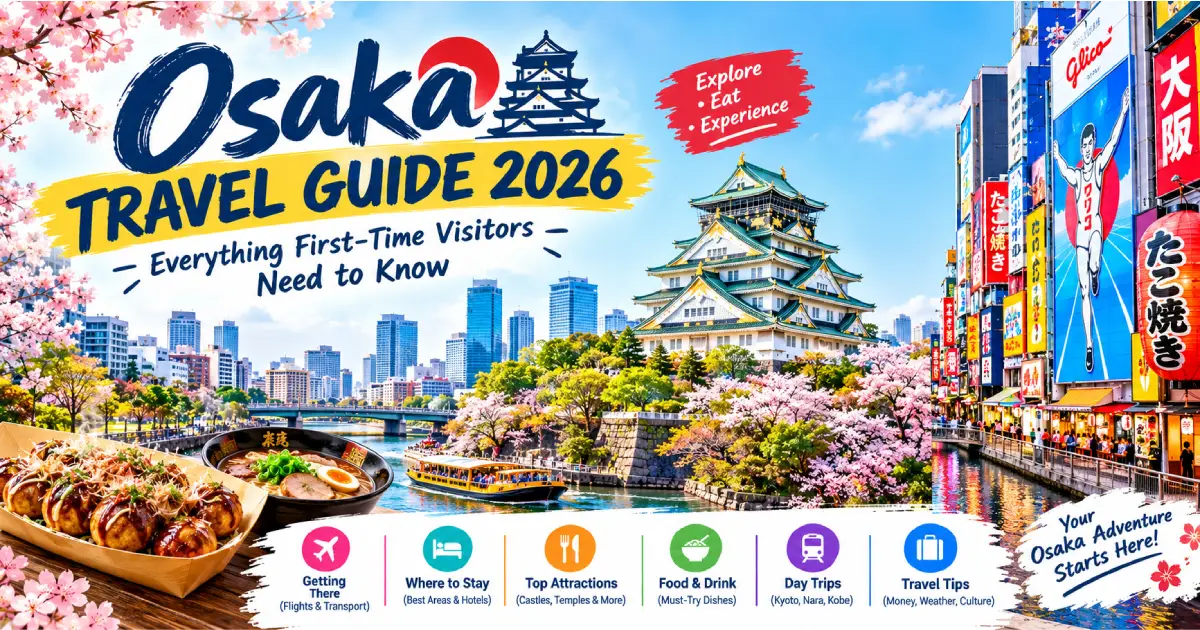
Osaka carries a specific reputation within Japan as the country’s most food-obsessed, most unpretentious, and most outwardly friendly major city — nicknamed “the nation’s kitchen” (tenka no daidokoro) historically for its role as Japan’s rice and seafood distribution hub, and known today for a street food culture, a more direct and talkative local personality than Tokyo’s or Kyoto’s, and a specific comic/entertainment heritage (Osaka is the historic home of Japanese manzai stand-up comedy) that gives the whole city a looser, livelier energy. For a tier-1 visitor who’s already spent time in Tokyo’s scale and Kyoto’s formality, Osaka reads as a genuine third register — less reserved, more immediately welcoming to strangers, and built around the specific, simple pleasure of eating extremely well without much ceremony.
This guide covers what a first-time visitor needs to plan an Osaka trip: the districts and what each is actually for, how to get in and around the city, where to base yourself, and the practical details that make a stay run smoothly. For day-by-day planning, see our Japan 14-Day Itinerary, which includes a dedicated Osaka base.
| Population | ~2.75 million (city); ~19 million (greater metro) |
| Language | Japanese; a distinct Kansai dialect (Osaka-ben) is widely spoken alongside standard Japanese |
| Currency | Japanese Yen (¥) |
| Best Time to Visit | Late March–early April (cherry blossoms), October–November (autumn, mild weather) |
| Closest Airports | Kansai International (KIX, ~50 min to central Osaka) and Osaka Itami (ITM, domestic flights) |
| Getting Around | Osaka Metro, extensive bus network — Osaka Amazing Pass covers transit plus attractions |
| Time Zone | Japan Standard Time (UTC+9), no daylight saving |
| Known For | Street food, comedy culture, a more direct and talkative local personality |
Osaka’s most famous entertainment and dining district, centered on the Dotonbori canal — the giant illuminated Glico Running Man sign, the mechanical crab above Kani Doraku, and the city’s highest concentration of takoyaki and okonomiyaki stalls, all packed into a neon-dense single strip that’s essential for any first-time visitor regardless of how long their stay runs.
Immediately surrounding Dotonbori, Namba is Osaka’s broader shopping and transit hub — Namba Station’s web of connections makes it a natural accommodation base, and the covered Shinsaibashi-suji shopping arcade extends the district’s retail options well beyond Dotonbori’s dining focus.
Osaka’s northern business and shopping center, home to the Umeda Sky Building’s Floating Garden Observatory and a dense cluster of department stores and underground shopping arcades — a more modern, corporate-feeling counterpart to Dotonbori’s entertainment-district energy, and the area around Osaka Station itself.
A small, deliberately retro-futurist district built in the early 20th century to evoke Paris and Coney Island simultaneously, centered on the Tsutenkaku Tower — Osaka’s historic home of kushikatsu (skewered, breaded, deep-fried food), with a specific old-Osaka character distinct from Dotonbori’s larger, more polished scale.
Home to Osaka Castle itself and its surrounding park — the current structure is a 1931 concrete reconstruction housing a museum, set within grounds that are especially striking under cherry blossoms, and a useful half-day stop that pairs naturally with nearby Kyoto given the short Shinkansen or JR connection.
A compact district of vintage clothing shops, street art, and youth fashion culture near Shinsaibashi — Osaka’s answer to Tokyo’s Harajuku, with a noticeably more skate-and-streetwear-oriented character than Harajuku’s broader fashion spectrum.
Home to the Abeno Harukas skyscraper (Japan’s second-tallest building) and Shitennoji, one of Japan’s oldest Buddhist temples — a less tourist-dense district offering both a modern observation deck and significant historic architecture within the same immediate area.
By air via Kansai International (KIX): Osaka’s main international gateway, connected to central Osaka (Namba) in roughly 50 minutes via the Nankai Limited Express Rapi:t, or to Shin-Osaka/Osaka Station via the JR Haruka Limited Express (JR Pass-covered).
By Shinkansen from Tokyo: Approximately 2 hours 30 minutes direct from Tokyo Station to Shin-Osaka.
By Shinkansen from Kyoto: A remarkably short 15-minute journey, making Osaka and Kyoto genuinely easy to combine as a single regional base — see our Kyoto Travel Guide for the reverse-direction planning logic.
The Osaka Metro covers the city comprehensively and is straightforward to navigate with English signage throughout. The Osaka Amazing Pass (available as a 1-day or 2-day pass) combines unlimited subway and bus travel with free or discounted entry to over 40 attractions, including Osaka Castle and the Umeda Sky Building — genuinely good value for a visitor planning to hit several paid attractions in a short stay. Most of central Osaka (Dotonbori, Namba, Shinsaibashi) is also comfortably walkable once you’ve reached the area, given its compact, dense layout.
| Area | Best For | Price Range (double, per night) |
|---|---|---|
| Namba/Dotonbori | First-timers, nightlife, central convenience | ¥8,000–¥25,000 |
| Umeda | Business travelers, shopping, Shin-Osaka Shinkansen access | ¥9,000–¥26,000 |
| Shin-Osaka | Shinkansen convenience for onward travel | ¥7,000–¥20,000 |
| Shinsekai | Budget travelers, retro atmosphere | ¥5,000–¥14,000 |
Namba offers the best balance of nightlife access and transit centrality for most first-time visitors; Shin-Osaka is the practical choice for visitors treating Osaka as a short stop between Kyoto and onward Shinkansen travel.
Late March through early April (cherry blossoms, particularly around Osaka Castle Park) and October through November (comfortable autumn weather) are Osaka’s most popular windows. Osaka’s summer runs hot and humid similar to the rest of the Kansai/Kanto region; winter is cold but dry, with noticeably thinner crowds and lower prices than peak season.
Osaka’s food identity centers on casual, street-level eating — takoyaki (octopus-filled batter balls), okonomiyaki (savory layered pancakes, distinct from Hiroshima’s style), and kushikatsu (skewered, breaded, deep-fried food) are all considered Osaka specialties, alongside a genuinely strong conveyor-belt-sushi and casual-dining scene. See our 25 Best Restaurants in Japan guide for specific Osaka and Dotonbori picks.
Kyoto (15 minutes by Shinkansen) offers Japan’s highest concentration of preserved historic temples and shrines — easily combined as a day trip or, more commonly, as a connected multi-night base.
Nara (approximately 45 minutes by train) offers Nara Park’s free-roaming sacred deer and Todai-ji’s Great Buddha.
Kobe (20–30 minutes by JR) offers genuine Kobe beef at its city of origin, the Kitano foreign settlement district’s Western-style architecture, and the Shin-Kobe Ropeway to Nunobiki Falls.
Universal Studios Japan sits within Osaka itself (a short train ride from central Osaka) and is one of Japan’s most significant theme park destinations, particularly given its Super Nintendo World expansion.
About Travel Tourister Travel Tourister’s destination specialists have based itineraries out of Osaka across multiple trips — from Dotonbori’s neon-lit takoyaki crawls to Shinsekai’s kushikatsu counters and Osaka Castle’s cherry blossom park — to deliver a practical, district-by-district Osaka guide for 2026 first-time visitors.
Posted By : Vinay
Latest Article
2nd Floor, 39, Above Kirti Club, DLF Industrial Area, Kirti Nagar, New Delhi, Delhi 110015



Travel Tourister is a leading Travel portal where we introduce travellers to trusted travel agents to make their journey hasselfree, memorable And happy. Travel Tourister is a platform where travellers get Tour packages ,Hotel packages deals through trusted travel companies And hoteliers who are working with us across the world. We always try to find new and more travel agents and hoteliers from every nook and corners across the world so that you could compare the deals with different travel agents and hoteliers and book your tour or hotel with the one you have chosen according to your taste and budget.
Copyright © Travel Tourister, India. All Rights Reserved

 Call
Call Enquiry