Published on : 30 Sep 2026
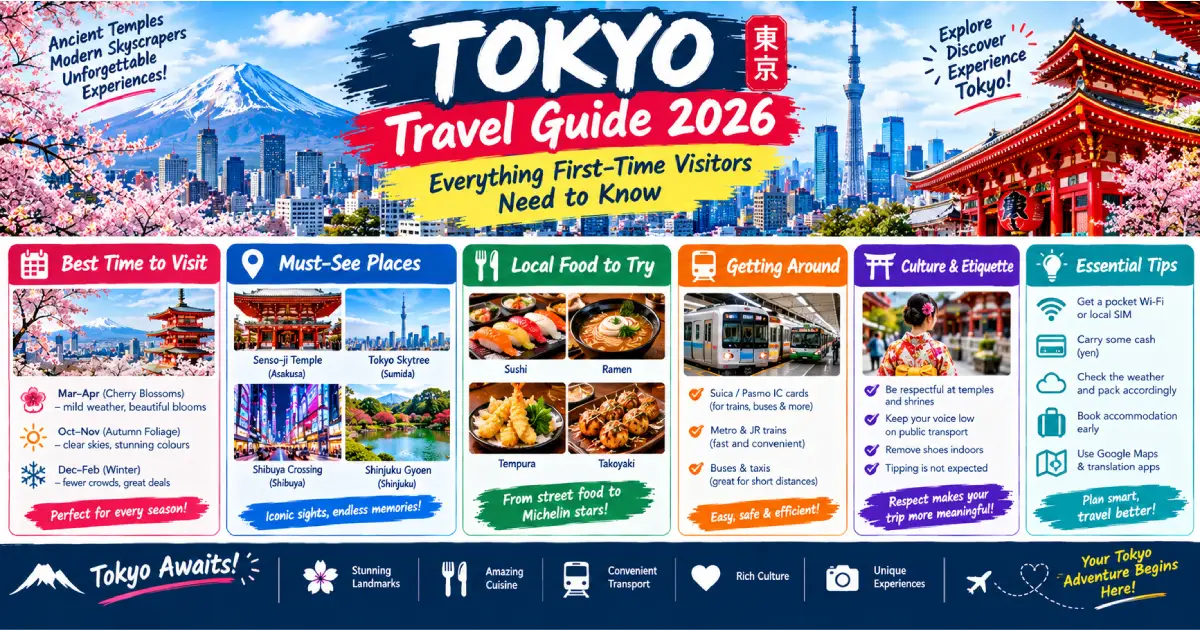
Tokyo is the world’s most populous metropolitan area — roughly 37 million people across its greater metro region — and yet it is, paradoxically, one of the easiest large cities on earth for a first-time tier-1 visitor to navigate: an obsessively punctual and comprehensive train network, English signage throughout nearly every station and major attraction, and a level of public safety that lets a visitor walk almost anywhere at almost any hour without the low-grade vigilance most Western tier-1 cities require. What actually challenges a first-time visitor isn’t logistics but scale and choice — Tokyo isn’t a single city center to be walked in an afternoon but a collection of a dozen or more genuinely distinct districts (Shinjuku, Shibuya, Asakusa, Ginza, Akihabara, and more), each with its own character, and the single biggest planning mistake first-time visitors make is trying to see all of them equally rather than choosing 2–3 to actually spend time in.
This guide covers exactly what a first-time tier-1 visitor needs to plan a Tokyo trip: the neighborhoods and what each is actually for, how to get into the city and around it once there, where to base yourself, and the practical details (money, connectivity, safety) that make the first 24 hours go smoothly. For day-by-day planning, see our Japan 7-Day Itinerary and Japan 14-Day Itinerary, both built around a Tokyo base.
| Population (Greater Tokyo) | ~37 million (world’s largest metro area) |
| Language | Japanese; English signage widespread in stations and major attractions |
| Currency | Japanese Yen (¥) |
| Best Time to Visit | Late March–early April (cherry blossoms), October–November (autumn) |
| Closest Airports | Narita (NRT, ~60km out) and Haneda (HND, ~20km out) |
| Getting Around | Tokyo Metro, Toei Subway, JR lines — IC card (Suica/Pasmo) recommended |
| Time Zone | Japan Standard Time (UTC+9), no daylight saving |
| Power Plugs | Type A/B, 100V (US-style plugs fit; bring a converter for UK/AU/EU devices) |
Tokyo’s busiest transit hub and a genuine district in its own right — Shinjuku Station alone handles over 3.5 million passengers daily, the busiest train station in the world. Above ground, Shinjuku splits into distinct characters: the neon-lit Kabukicho entertainment district, the tiny bar-lined alleys of Golden Gai and Omoide Yokocho, and the Shinjuku Gyoen national garden offering a genuine green escape minutes from the station chaos. A strong first choice for a hotel base given its transit centrality.
Home to the world’s busiest pedestrian crossing and Tokyo’s youth fashion and nightlife epicenter — Shibuya Crossing, the Hachiko statue meeting point, and the surrounding shopping and dining density make it one of the two or three districts every first-time visitor should build real time around rather than a quick photo stop.
Tokyo’s most traditional-feeling central district, built around Senso-ji, the city’s oldest Buddhist temple, approached through the Kaminarimon gate and Nakamise-dori shopping street. Asakusa offers the closest thing to “old Tokyo” atmosphere within the city center, and pairs naturally with a Sumida River walk toward the Tokyo Skytree.
Tokyo’s most upscale shopping and dining district — flagship stores for nearly every major global luxury brand, alongside some of the city’s most exclusive sushi and kaiseki restaurants (Sukiyabashi Jiro’s original counter sits in a Ginza basement). Worth an evening even for budget-conscious visitors, for the window-shopping and architecture alone.
Tokyo’s electronics-and-otaku-culture district — multi-floor electronics retailers, anime and manga specialty stores, retro and modern video game shops, and maid cafes concentrated into a dense, neon-heavy grid that’s genuinely worth experiencing after dark regardless of a visitor’s specific interest in anime culture.
Harajuku’s Takeshita Street is Tokyo’s most concentrated youth fashion and street-food strip, loud and crowded; immediately adjacent, Omotesando’s tree-lined boulevard offers the calmer, upscale-shopping counterpart, and Meiji Shrine’s forested grounds sit at the district’s edge as one of Tokyo’s most significant Shinto sites.
Tokyo’s most internationally oriented nightlife district, home to a large expat and international business community, upscale art museums (Mori Art Museum, 21_21 Design Sight), and a bar and club scene that runs later and looser than most of the rest of the city.
A reclaimed island in Tokyo Bay, purpose-built as an entertainment and shopping district — teamLab’s immersive digital art museums, a large Ferris wheel, shopping malls, and a view back across the bay toward the Rainbow Bridge make Odaiba a worthwhile half-day addition, particularly for visitors with children.
Narita Airport (NRT) sits roughly 60km from central Tokyo, connected by the Narita Express (N’EX, covered by the JR Pass, 60–90 minutes to Tokyo/Shinjuku/Shibuya) or the cheaper, slightly slower Keisei Skyliner. Narita handles the larger share of long-haul international flights from US, European, and Australian carriers.
Haneda Airport (HND) sits roughly 20km from central Tokyo, connected by monorail or train in 30–45 minutes, and is generally the more convenient arrival point given its proximity — an increasing number of tier-1 international carriers now serve Haneda directly, and it’s worth checking both airports when booking rather than defaulting to Narita.
Tokyo’s rail network — a combination of the Tokyo Metro, the Toei Subway, and JR East’s local lines — is comprehensive enough to reach virtually anywhere in the city, and the single most useful piece of practical infrastructure for a visitor is a Suica or Pasmo IC card: tap-to-pay across every train, subway, and bus line in the city, plus most convenience store and vending machine purchases, purchasable and rechargeable at any station machine (or set up digitally via the mobile Suica app on a compatible smartphone).
JR Pass note: The national Japan Rail Pass does not cover Tokyo Metro or Toei Subway lines — only JR East lines within the city (the Yamanote loop line being the most useful of these for visitors). Most Tokyo-only sightseeing will run on non-JR lines, making the IC card the more relevant day-to-day tool within the city itself, with the JR Pass earning its cost primarily on the longer Shinkansen journeys out of Tokyo.
Taxis are safe, immaculate, and driven with striking professionalism, but expensive relative to trains — reserve them for late-night trips after trains stop running (most lines close around midnight) or for groups splitting the fare.
| Area | Best For | Price Range (double, per night) |
|---|---|---|
| Shinjuku | First-timers, transit centrality | ¥10,000–¥28,000 |
| Shibuya | Nightlife, younger travelers | ¥12,000–¥30,000 |
| Asakusa | Budget travelers, traditional atmosphere | ¥6,000–¥16,000 |
| Ginza | Luxury, upscale shopping | ¥20,000–¥60,000+ |
| Tokyo Station area | Shinkansen convenience, business travelers | ¥12,000–¥30,000 |
Shinjuku and Tokyo Station-area hotels offer the best balance of transit access for a first-time visitor planning to eventually take the Shinkansen onward to Kyoto — see our Japan 7-Day Itinerary for how a Tokyo base fits into a larger trip.
Late March through early April (cherry blossom season) and October through November (autumn foliage) are Tokyo’s two most popular and most expensive windows — see our full Japan in Spring and Japan in Autumn guides for exact bloom and foliage forecasts. Tokyo’s summer (June–August) is hot, humid, and includes a rainy season in June; winter (December–February) is cold but dry and sees the thinnest crowds and lowest prices of the year, a genuinely underrated window for budget-conscious visitors comfortable with cooler weather.
Tokyo holds the world’s largest concentration of Michelin-starred restaurants, alongside an equally strong budget and mid-range dining scene — from Shinjuku’s Omoide Yokocho yakitori alleys to Tsukiji/Toyosu market sushi to Shinjuku Station’s Ramen Street-style noodle counters. See our 25 Best Restaurants in Japan for specific picks spanning every price point.
Hakone (90 minutes by Odakyu Romancecar) offers Mount Fuji views, the Owakudani volcanic valley, and onsen hot spring ryokan stays — the single most popular Tokyo day trip.
Nikko (2 hours by train) offers the elaborately gilded Toshogu Shrine complex and, in October, some of the earliest and most dramatic autumn foliage accessible from Tokyo.
Kamakura (1 hour by train) offers the Great Buddha of Kamakura, a coastal town atmosphere, and a genuinely easy half-day escape for visitors short on time.
About Travel Tourister Travel Tourister’s destination specialists have based dozens of Japan itineraries out of Tokyo — from Shinjuku’s Omoide Yokocho first nights to Asakusa’s dawn temple visits and Hakone day trips — to deliver a practical, neighborhood-by-neighborhood Tokyo guide for 2026 first-time visitors.
Posted By : Vinay
Latest Article
2nd Floor, 39, Above Kirti Club, DLF Industrial Area, Kirti Nagar, New Delhi, Delhi 110015



Travel Tourister is a leading Travel portal where we introduce travellers to trusted travel agents to make their journey hasselfree, memorable And happy. Travel Tourister is a platform where travellers get Tour packages ,Hotel packages deals through trusted travel companies And hoteliers who are working with us across the world. We always try to find new and more travel agents and hoteliers from every nook and corners across the world so that you could compare the deals with different travel agents and hoteliers and book your tour or hotel with the one you have chosen according to your taste and budget.
Copyright © Travel Tourister, India. All Rights Reserved

 Call
 Enquiry