Published on : 01 Oct 2026
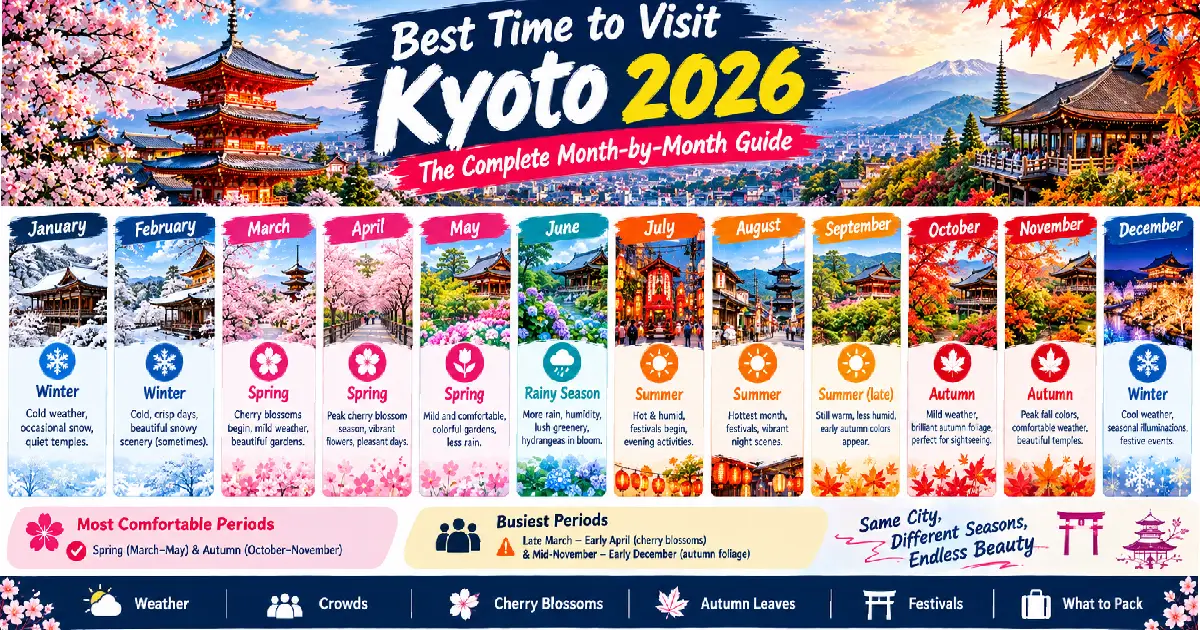
The best time to visit Kyoto is late March to early April (cherry blossoms) or mid-to-late November (autumn foliage) — Kyoto’s two most visually spectacular windows, when the city’s temples and gardens are framed by blossoms or blazing maple color. Both come with Kyoto’s highest prices and tightest hotel availability of the year, booked out 4–6 months in advance for the best properties. A visitor prioritizing a calmer, more contemplative Kyoto experience — walking temple grounds without fighting through tour groups — should look instead to early December, January–February, or June, when the city’s defining historical character is just as present without the peak-season crowds.
| Season | Months | Avg. Temp | Crowd Level | Price Level | Highlight |
|---|---|---|---|---|---|
| Spring | March–May | 10–21°C (50–70°F) | Highest (Mar–Apr) | Highest (Mar–Apr) | Cherry blossoms |
| Summer | June–August | 24–33°C (75–91°F), humid | Moderate | Moderate | Gion Matsuri, kawadoko riverside dining |
| Autumn | September–November | 15–25°C (59–77°F) | High (Nov) | High (Nov) | Autumn foliage |
| Winter | December–February | 2–9°C (36–48°F), occasional snow | Low | Lowest | Snow-dusted temples, thinnest crowds |
| Month | Avg. High/Low | What’s Happening |
|---|---|---|
| January | 9°C / 1°C (48°F / 34°F) | New Year temple visits, lowest prices, occasional snow on temple roofs |
| February | 9°C / 1°C (48°F / 34°F) | Plum blossoms, Setsubun festival (early Feb, bean-throwing ritual) |
| March | 13°C / 5°C (55°F / 41°F) | Cherry blossoms begin late month; crowds rising sharply |
| April | 19°C / 10°C (66°F / 50°F) | Cherry blossom peak (early April); Kyoto’s single busiest month |
| May | 23°C / 15°C (73°F / 59°F) | Comfortable, green; Aoi Matsuri (May 15), one of Kyoto’s three major festivals |
| June | 26°C / 19°C (79°F / 66°F) | Rainy season begins; hydrangeas bloom at several temples; thinner crowds |
| July | 31°C / 23°C (88°F / 73°F) | Hot and humid; Gion Matsuri, Kyoto’s most famous festival, runs all month |
| August | 33°C / 24°C (91°F / 75°F) | Peak heat; Daimonji Gozan Okuribi bonfire festival (Aug 16) |
| September | 29°C / 21°C (84°F / 70°F) | Still warm; typhoon risk; early autumn events begin |
| October | 23°C / 15°C (73°F / 59°F) | Comfortable; Jidai Matsuri (Oct 22), historical costume procession |
| November | 17°C / 9°C (63°F / 48°F) | Peak autumn foliage; Kyoto’s second-busiest month after April |
| December | 11°C / 4°C (52°F / 39°F) | Quiet, occasional snow; illuminated temple events continue into early month |
Spring is Kyoto’s single most in-demand season, built around a cherry blossom peak that typically arrives in early April — Maruyama Park’s illuminated weeping cherry and the Philosopher’s Path’s canal-side blossoms are Kyoto’s two most iconic spring scenes. For the full regional bloom forecast and viewing spots, see our Japan in Spring 2026 guide. The specific Kyoto trade-off: the city’s hotel supply is genuinely tighter relative to demand than Tokyo’s, making this the single tightest booking window anywhere in this guide — properties for the first week of April routinely sell out 4–6 months ahead.
Kyoto’s summer is notoriously hot and humid even by Japanese standards, thanks to the basin geography that traps heat across the city — but July delivers Gion Matsuri, arguably Japan’s most famous festival, a month-long celebration culminating in a parade of elaborately decorated wooden floats (yamaboko) through the city center. Restaurants along the Kamo River in Pontocho and Kibune set up kawadoko — dining platforms built directly over the water — specifically to make summer dining more bearable, a genuinely atmospheric and practical seasonal tradition worth timing a visit around if heat tolerance allows.
Kyoto’s autumn foliage typically peaks mid-to-late November, slightly earlier than Tokyo’s own late-November-to-December peak — Tofuku-ji’s maple-filled ravine and Eikando’s illuminated evening grounds are Kyoto’s most celebrated koyo destinations. For the full foliage forecast nationally, see our Japan in Autumn 2026 guide. October brings the Jidai Matsuri (Festival of Ages) on October 22 — a procession of over 2,000 participants in historically accurate costume spanning more than a thousand years of Kyoto fashion history, one of the city’s three major annual festivals alongside Gion Matsuri and Aoi Matsuri.
Winter is Kyoto’s best-kept secret among repeat visitors — genuinely cold, with occasional light snowfall that dusts temple roofs and rock gardens in a specific, quietly beautiful way that neither spring nor autumn can replicate, combined with the year’s thinnest crowds and lowest hotel prices. Kinkaku-ji under a light snow cover is one of Kyoto’s most photographed winter images, and the ability to actually experience temple grounds without navigating around tour groups is, by repeat-visitor consensus, worth the cold.
| Event | Timing | What It Is |
|---|---|---|
| Setsubun | Early February | Bean-throwing ritual at major temples and shrines to ward off evil |
| Aoi Matsuri | May 15 | A Heian-era costume procession, one of Kyoto’s three major festivals |
| Gion Matsuri | Throughout July | Japan’s most famous festival; month-long celebration with a major float parade |
| Daimonji Gozan Okuribi | August 16 | Giant bonfires lit in the shape of characters on the mountains surrounding Kyoto |
| Jidai Matsuri | October 22 | A 2,000-person historical costume procession spanning Kyoto’s full history |
First-time visitors wanting the classic Kyoto experience: Early April or mid-to-late November, accepting the highest crowds and prices as the trade-off for blossoms or foliage.
Budget-conscious or crowd-averse travelers: January–February or June, trading peak-season spectacle for genuinely quiet temple visits and the year’s lowest hotel rates.
Visitors interested in traditional festival culture: July specifically, for Gion Matsuri — Japan’s most historically significant single festival, worth planning an entire trip around for visitors with a serious interest in Japanese traditional culture.
Photographers prioritizing snow scenes: Mid-to-late January, for the best (though not guaranteed) odds of light snowfall dusting Kyoto’s temple rooftops and gardens.
About Travel Tourister Travel Tourister’s destination specialists have visited Kyoto across every season — from January’s snow-dusted Kinkaku-ji and July’s Gion Matsuri float parade to November’s Tofuku-ji maple ravine — to deliver an honest, month-by-month guide to the best time to visit Kyoto for 2026.
Posted By : Vinay
Latest Article
2nd Floor, 39, Above Kirti Club, DLF Industrial Area, Kirti Nagar, New Delhi, Delhi 110015



Travel Tourister is a leading Travel portal where we introduce travellers to trusted travel agents to make their journey hasselfree, memorable And happy. Travel Tourister is a platform where travellers get Tour packages ,Hotel packages deals through trusted travel companies And hoteliers who are working with us across the world. We always try to find new and more travel agents and hoteliers from every nook and corners across the world so that you could compare the deals with different travel agents and hoteliers and book your tour or hotel with the one you have chosen according to your taste and budget.
Copyright © Travel Tourister, India. All Rights Reserved

 Call
Call Enquiry