Published on : 01 Oct 2026
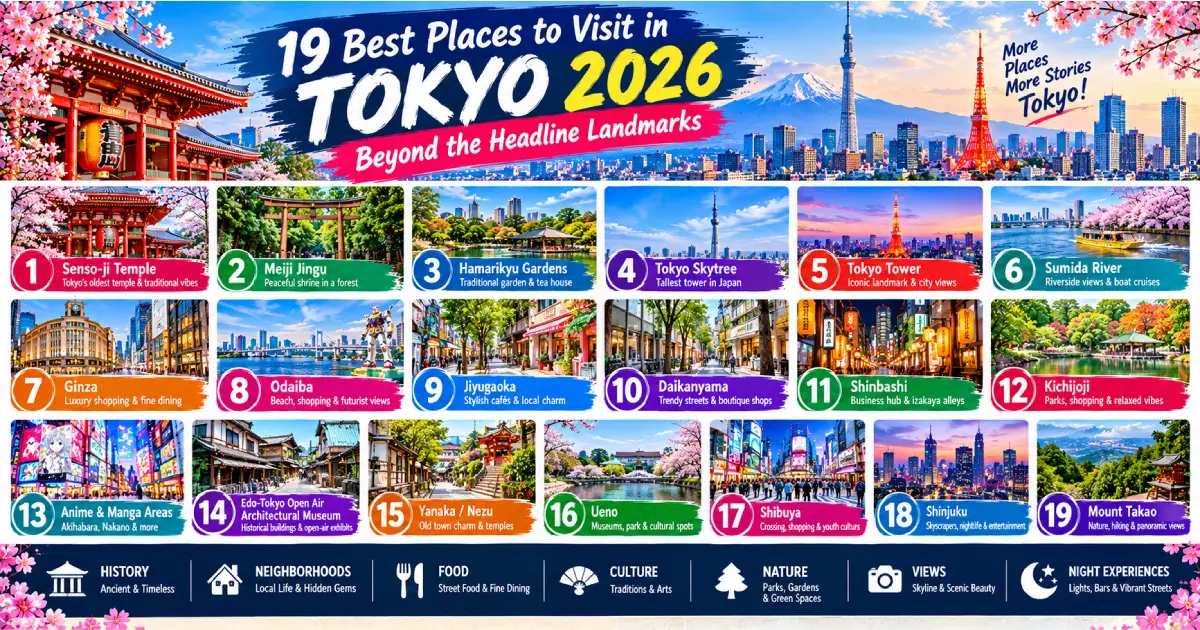
Most first-time Tokyo visitors arrive with the same five or six names already on their list — Shibuya Crossing, Senso-ji, Tokyo Tower, Akihabara (all covered in depth in our 24 Best Things to Do in Tokyo guide) — and those names earn their reputation. But Tokyo’s genuine character lives at least as much in the places that don’t make a first-pass checklist: a cemetery-adjacent shopping street where cats outnumber tourists, a landscaped Edo-period garden fewer visitors reach than Shinjuku Gyoen despite being arguably more beautiful, a former geisha quarter now known for French bistros tucked into century-old alleys. This guide covers 19 specific places — neighborhoods, gardens, and individual landmarks — organized to help a visitor who’s already planned the headline sights add genuine depth to a Tokyo itinerary.
| # | Place | Category | Best For | Best Time |
|---|---|---|---|---|
| 1 | Yanaka Ginza | Old Tokyo neighborhood | Shitamachi atmosphere, cats | Late afternoon |
| 2 | Yanaka Cemetery | Historic site | Quiet walks, cherry blossoms | Spring |
| 3 | Kagurazaka | Former geisha quarter | French-Japanese dining, atmosphere | Evening |
| 4 | Jimbocho | Bookstore district | Secondhand books, quiet browsing | Afternoon |
| 5 | Tsukishima | Food street | Monjayaki dinner | Evening |
| 6 | Rikugien Garden | Traditional garden | Fewer crowds than Shinjuku Gyoen | Autumn (illuminated maples) |
| 7 | Koishikawa Korakuen | Traditional garden | Edo-period landscaping | Spring, autumn |
| 8 | Hamarikyu Gardens | Tidal garden | Teahouse, skyline contrast | Any season |
| 9 | Nezu Shrine | Shrine & garden | Azalea tunnels (late April) | Late April |
| 10 | Nakameguro | Canal neighborhood | Cafes, cherry blossoms over water | Spring, any evening |
| 11 | Daikanyama | Boutique district | Upscale, quiet shopping | Afternoon |
| 12 | Kichijoji | Neighborhood + park | Inokashira Park, local favorite | Weekday afternoon |
| 13 | Koenji | Subculture neighborhood | Vintage fashion, indie music | Afternoon/evening |
| 14 | Nezu Museum & Garden | Museum + garden | Art and landscaped grounds combined | Any season |
| 15 | Tokyo Station Marunouchi | Architecture | Red-brick historic facade | Evening (lit up) |
| 16 | Zojoji Temple | Temple | Tokyo Tower backdrop photo | Sunset |
| 17 | Sumida River Cruise | Waterfront | Alternate city view | Late afternoon |
| 18 | Shinjuku Skyscraper District | Architecture | Free observation decks | Clear days |
| 19 | Yoyogi Park | Urban park | People-watching, weekend performers | Sunday afternoon |
Location: Yanaka, northeast Tokyo | Best For: Shitamachi (old downtown) atmosphere | Best Time: Late afternoon, when the local shopping street is busiest with residents
Yanaka is one of the few Tokyo districts to have survived both the 1923 earthquake and WWII bombing largely intact, preserving a genuinely old-Tokyo streetscape of narrow lanes, wooden shopfronts, and a slower pace that central Tokyo lost decades ago. Yanaka Ginza, its main shopping street, is known specifically for its large resident cat population (a neighborhood mascot of sorts) and old-fashioned shokupan bakeries, senbei cracker shops, and small family-run restaurants.
Location: Adjacent to Yanaka Ginza | Best For: Quiet walks, cherry blossom season | Best Time: Spring, for the cemetery’s own cherry-tree-lined central avenue
One of Tokyo’s oldest and most atmospheric cemeteries, final resting place to several notable historical figures, lined with a central avenue of cherry trees that makes it a genuinely peaceful, far-less-crowded alternative hanami spot during cherry blossom season — a specifically Tokyo paradox that a cemetery ranks among the city’s more serene spring destinations.
Location: Shinjuku ward, near Iidabashi Station | Best For: Atmosphere, French-Japanese dining | Best Time: Evening
A former geisha entertainment quarter whose narrow, stone-paved alleys (Hyogo Yokocho in particular) retain their Edo-period layout, Kagurazaka has reinvented itself over the past few decades into one of Tokyo’s most interesting dining neighborhoods — a specific concentration of French bistros and patisseries alongside traditional Japanese restaurants, a legacy of the district’s historical connection to Tokyo’s French community.
Location: Chiyoda ward | Best For: Secondhand bookstores, quiet browsing | Best Time: Afternoon
Home to the world’s largest concentration of secondhand bookstores — over 170 shops packed into a few city blocks, many specializing in rare prints, vintage magazines, or specific historical periods — Jimbocho rewards unhurried browsing even for visitors who don’t read Japanese, given the volume of English-language and visually interesting used books, prints, and ephemera.
Location: Chuo ward, near Tokyo Bay | Best For: Monjayaki, a Tokyo-specific savory pancake dish | Best Time: Evening
Tsukishima’s main street, Monja Street, is lined with roughly 70 restaurants serving almost exclusively monjayaki — a looser, more liquid relative of okonomiyaki, griddled tableside and eaten directly off the hot plate with a small spatula — a genuinely local Tokyo specialty dish with far less international tourist awareness than its Osaka and Hiroshima counterparts.
Location: Bunkyo ward | Best For: A quieter, arguably more beautiful alternative to Shinjuku Gyoen | Best Time: Mid-to-late November, for evening maple illuminations
Built in 1702 as the retirement garden of a feudal lord, Rikugien recreates 88 scenes from classical Japanese and Chinese poetry across its landscaped paths — widely considered by Tokyo residents themselves to rival or exceed Shinjuku Gyoen in beauty, while receiving a fraction of the foreign-visitor traffic, making it one of this guide’s strongest genuine “hidden gem” recommendations.
Location: Bunkyo ward, near Tokyo Dome | Best For: Edo-period garden design | Best Time: Spring and autumn
One of Tokyo’s oldest surviving Edo-period gardens (begun in 1629), combining Japanese and Chinese landscaping styles around a central pond, with the unusual modern contrast of Tokyo Dome’s stadium roof visible just beyond the garden walls — a specifically Tokyo juxtaposition of preserved history against the modern city pressing in at its edges.
Location: Chuo ward, near Tsukiji | Best For: A traditional teahouse experience with a skyline backdrop | Best Time: Any season; arrive by boat from Asakusa via the Sumida River for a scenic approach
A former shogunal duck-hunting ground turned public garden, Hamarikyu’s seawater pond (tidal, connected directly to Tokyo Bay) and its floating teahouse — serving matcha and traditional sweets with a view back across the pond toward the surrounding skyscrapers of Shiodome — makes for one of Tokyo’s most striking old-against-new photo compositions.
Location: Bunkyo ward | Best For: A tunnel of thousands of vermilion torii gates, on a smaller scale than Kyoto’s Fushimi Inari | Best Time: Late April, for the shrine’s azalea festival
One of Tokyo’s oldest shrines, Nezu’s own smaller-scale torii gate tunnel offers a genuine taste of the Fushimi Inari experience without leaving Tokyo, and its specific late-April azalea festival (roughly 3,000 shrubs blooming across a dedicated garden) is one of the city’s most photogenic and least internationally known seasonal events.
Location: Meguro ward | Best For: Canal-side cafes, cherry blossoms | Best Time: Spring (cherry blossoms over the canal) or any evening for the cafe scene
The Meguro River canal, lined with cherry trees for roughly a kilometer, turns Nakameguro into one of Tokyo’s most photographed (and most crowded) cherry blossom spots each spring, while year-round the surrounding streets hold a dense concentration of independent cafes, boutiques, and restaurants favored by Tokyo’s own design-and-fashion-conscious residents.
Location: Shibuya ward, adjacent to Nakameguro | Best For: Upscale, quiet boutique shopping | Best Time: Weekday afternoon
Tokyo’s most deliberately low-key upscale shopping district — the T-Site/Tsutaya bookstore complex (a genuinely beautiful piece of contemporary architecture functioning as both bookstore and cultural space) anchors a neighborhood of small design boutiques and cafes with noticeably fewer tourists than Omotesando’s comparable luxury shopping strip.
Location: Western Tokyo suburbs, near the Ghibli Museum | Best For: A genuinely local neighborhood favorite, consistently ranked Tokyo’s “most desirable place to live” in resident surveys | Best Time: Weekday afternoon, pairs naturally with a Ghibli Museum visit
Inokashira Park’s central pond (with rental rowboats), surrounded by Kichijoji’s dense cluster of independent shops, record stores, and restaurants, offers a specifically unpretentious, lived-in Tokyo neighborhood experience — worth combining with the nearby Ghibli Museum given their walking-distance proximity.
Location: Suginami ward | Best For: Vintage fashion and indie/punk music culture | Best Time: Afternoon into evening
Tokyo’s specific center of vintage clothing and underground music culture — dense with secondhand shops, small live-music venues, and a visibly younger, more subculture-oriented crowd than the more mainstream Harajuku scene, and home each August to the Koenji Awa Odori, one of Tokyo’s largest traditional dance festivals.
Location: Minami-Aoyama, near Omotesando | Best For: Combining a significant art collection with a landscaped garden | Best Time: Any season
Home to one of Tokyo’s finest private collections of pre-modern Japanese and East Asian art, the Nezu Museum’s real draw for many visitors is its surrounding garden — a genuinely tranquil landscaped space with teahouses and stone paths, sitting directly behind Omotesando’s high-fashion shopping strip, offering a striking contrast just steps from one of Tokyo’s busiest commercial streets.
Location: Chiyoda ward | Best For: Historic red-brick architecture | Best Time: Evening, when the facade is illuminated
Tokyo Station’s western Marunouchi facade — an early-20th-century red-brick building meticulously restored to its 1914 original design after wartime damage — is one of central Tokyo’s few surviving examples of pre-war Western-influenced architecture, and worth a specific stop even for visitors simply passing through the station on their way to a Shinkansen.
Location: Minato ward, at the base of Tokyo Tower | Best For: A temple-and-tower photo composition unique to Tokyo | Best Time: Sunset
A major Buddhist temple whose main gate frames Tokyo Tower directly behind it, Zojoji offers one of Tokyo’s most distinctive single photographs — centuries-old temple architecture set directly against the city’s mid-century modern icon — and historically served as the Tokugawa shogunate’s family temple.
Location: Departing from Asakusa or Hamarikyu | Best For: An alternate, waterborne view of the city | Best Time: Late afternoon
A boat cruise along the Sumida River connecting Asakusa to Hamarikyu Gardens or Odaiba offers Tokyo from a genuinely different vantage point — passing beneath a dozen distinctly designed bridges and beside the Asahi Beer Hall’s famously unusual “golden flame” building (officially representing a beer froth, though widely nicknamed otherwise by locals).
Location: West Shinjuku | Best For: Free skyline views, business-district architecture | Best Time: Clear days, or evening for illuminated towers
West Shinjuku’s cluster of high-rise towers (anchored by the free-to-visit Tokyo Metropolitan Government Building, covered in our Things to Do in Tokyo guide) offers a genuinely different architectural register from the rest of the city — a dense, Western-style business district that contrasts sharply with Shinjuku Station’s eastern, entertainment-focused side just a few minutes’ walk away.
Location: Shibuya ward, adjacent to Meiji Shrine | Best For: People-watching and weekend street performance culture | Best Time: Sunday afternoon
Tokyo’s large central park, immediately adjacent to Meiji Shrine’s forested grounds, is at its liveliest on Sunday afternoons, when street performers, cosplay groups, and amateur musicians gather informally throughout the park — a genuinely spontaneous, unscripted slice of Tokyo public life that contrasts well with the shrine’s quiet formality next door.
About Travel Tourister Travel Tourister’s destination specialists have wandered well beyond Tokyo’s headline landmarks — through Yanaka’s cat-filled shitamachi lanes, Rikugien’s quiet autumn illuminations, and Kagurazaka’s stone-paved alleys — to put together a genuinely differentiated list of places to visit in Tokyo for 2026 visitors who’ve already covered the basics.
Posted By : Vinay
Latest Article
2nd Floor, 39, Above Kirti Club, DLF Industrial Area, Kirti Nagar, New Delhi, Delhi 110015



Travel Tourister is a leading Travel portal where we introduce travellers to trusted travel agents to make their journey hasselfree, memorable And happy. Travel Tourister is a platform where travellers get Tour packages ,Hotel packages deals through trusted travel companies And hoteliers who are working with us across the world. We always try to find new and more travel agents and hoteliers from every nook and corners across the world so that you could compare the deals with different travel agents and hoteliers and book your tour or hotel with the one you have chosen according to your taste and budget.
Copyright © Travel Tourister, India. All Rights Reserved

 Call
Call Enquiry