Published on : 06 Oct 2026
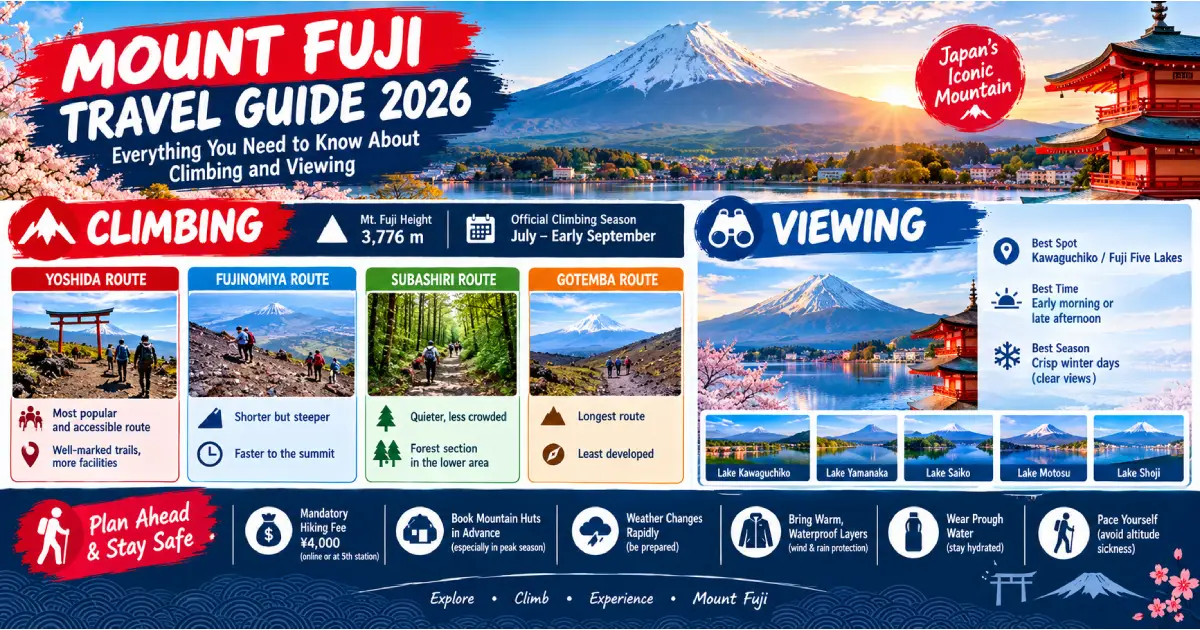
Mount Fuji, at 3,776 meters Japan’s tallest and most prominent peak, is the one landmark more tier-1 visitors recognize on sight than almost anything else in the country — and also the one most frequently misunderstood in terms of what a visit actually involves. The mountain has a strictly enforced official climbing season running only from roughly July 1 through September 10, meaning the vast majority of visitors photographing Fuji at any other time of year are viewing it from a distance rather than climbing it, and that distinction (climb vs. view) should be the first real planning decision for anyone building Fuji into a Japan trip, since the two experiences require completely different preparation, timing, and expectations.
Mount Fuji has also become the center of a genuinely significant overtourism response in recent years — “bullet climbing” (summiting overnight without a rest stop, chasing a sunrise photo) led to safety incidents serious enough that Yamanashi Prefecture introduced a mandatory climbing fee, a daily climber cap, and overnight gate closures starting in 2024, rules that have since been extended and unified across all four climbing trails for the 2026 season. This guide covers both halves of a Fuji visit: what climbing actually requires in 2026, and — for the much larger number of visitors who won’t climb — the best places to see Mount Fuji without setting foot above the fifth station.
| Height | 3,776 meters (12,389 ft) — Japan’s tallest mountain |
| Official Climbing Season 2026 | Yoshida & Subashiri trails: July 1–Sept 10; Fujinomiya & Gotemba: July 10–Sept 10 |
| Climbing Fee (2026) | ¥4,000 per person, uniform across all four trails |
| Daily Climber Cap | 4,000 climbers/day (Yoshida Trail only; no cap on the other three) |
| Climbing Outside Season | Prohibited by law above the 5th station |
| Best Non-Climbing Viewing | Chureito Pagoda, Kawaguchiko, Hakone — year-round, best in winter for clear air |
| Closest Access from Tokyo | ~2 hours to the Fuji Five Lakes region by direct bus or train |
This is the real first decision, and it’s worth being honest about: climbing Mount Fuji is a genuinely demanding, long physical effort (typically 5–7 hours up, 3–4 hours down, usually broken into an overnight stay at a mountain hut) rewarded primarily by the achievement itself and a sunrise view from the summit — the mountain’s famous silhouette, the image most people actually associate with “Mount Fuji,” is not visible while you’re standing on it. Most tier-1 visitors who want the classic photograph are better served by one of the viewing spots covered later in this guide, reserving the climb specifically for visitors with genuine hiking experience, the correct season availability, and an interest in the climb itself rather than the photo.
Mount Fuji’s climbing season is short and strictly enforced — climbing above the fifth station outside these dates is prohibited by law, not simply discouraged, due to serious winter conditions on the upper mountain:
Peak climbing season falls during Japanese school summer holidays, roughly July 20 through the end of August — expect the heaviest trail traffic and hut bookings during this specific window.
As of the 2026 season, a ¥4,000 per-person climbing fee applies uniformly across all four official trails (previously only the Yoshida Trail charged a mandatory fee). The fee funds trail safety and environmental management, and does not include mountain hut accommodation, which is booked and paid separately.
Yoshida Trail specific rules (the most heavily regulated route):
Shizuoka-side trails (Subashiri, Gotemba, Fujinomiya): No daily climber cap currently applies, though the same ¥4,000 fee and online pre-registration (via the Shizuoka Fuji Navi system) are required.
| Trail | Side | Best For | Key Detail |
|---|---|---|---|
| Yoshida | Yamanashi | First-time climbers | Most huts and services; most crowded; daily cap applies |
| Subashiri | Yamanashi/Shizuoka border | A quieter start, merging into Yoshida near the 8th station | Less crowded lower section |
| Gotemba | Shizuoka | Experienced hikers wanting a longer, quieter route | Longest trail, fewest huts |
| Fujinomiya | Shizuoka | The shortest distance to the summit | Steepest, most direct route |
The Yoshida Trail is the standard recommendation for first-time climbers given its greater number of mountain huts, clearer signage, and more established support infrastructure — though its popularity also means it carries the heaviest foot traffic of the four.
Altitude sickness is a genuine risk at Fuji’s summit elevation, and the single most effective prevention is a proper overnight mountain hut stay rather than a rushed overnight “bullet climb” straight to the summit — the extended rest allows better acclimatization and is also now the de facto requirement during the Yoshida Trail’s gate-closure hours. Weather on the upper mountain can shift rapidly even in summer, with temperatures dropping well below those at the base — proper rain gear and warm layers are not optional extras but checked requirements at the Yoshida trailhead.
For the large majority of visitors, a classic Mount Fuji photograph comes from one of these spots rather than the summit itself — and unlike climbing, these are accessible year-round.
The single most iconic Mount Fuji photograph in existence — a five-story pagoda framed against the mountain, spectacular with cherry blossoms in spring or autumn foliage in November — requires a moderate uphill walk (roughly 15–20 minutes via several hundred steps) from Shimoyoshida Station in the Fuji Five Lakes region, reachable in about 2 hours from Tokyo.
The most popular and accessible base for Fuji viewing, Lake Kawaguchiko offers classic reflected-lake Fuji photographs on calm, clear mornings, alongside a well-developed tourist infrastructure of hotels, onsen with mountain views, and the Kawaguchiko Ropeway for an elevated viewpoint. The broader Fuji Five Lakes area (Kawaguchiko, Yamanakako, Saiko, Shojiko, and Motosuko) each offer slightly different vantage points and a noticeably calmer pace than a Tokyo day trip.
Covered in more detail in our Day Trips from Tokyo guide, Hakone’s Lake Ashi cruise and the Owakudani ropeway both offer Fuji views on clear days, combined with onsen culture and volcanic scenery that Kawaguchiko doesn’t offer — the better choice for visitors who want Fuji viewing as part of a broader day trip rather than a dedicated Fuji-focused stop.
On exceptionally clear days (most common in winter), Mount Fuji is visible from several of Tokyo’s own observation decks — the free Tokyo Metropolitan Government Building in Shinjuku, Tokyo Skytree, and Shibuya Sky all occasionally offer a distant Fuji view, a genuine bonus for visitors without time for a dedicated Fuji Five Lakes trip.
A small, well-preserved village within the Fuji Five Lakes region, built around eight clear spring-fed ponds (originally formed by Mount Fuji’s own snowmelt filtering through volcanic rock over centuries) — a quieter, more village-atmosphere stop than Kawaguchiko’s more developed lakeside, with its own excellent Fuji backdrop.
By direct bus: The most straightforward option — direct highway buses run from Shinjuku Station to Kawaguchiko Station in approximately 2 hours, with no transfers required.
By train: The JR Chuo Line to Otsuki, transferring to the Fujikyu Railway, takes slightly longer than the direct bus but is JR Pass-covered for the Tokyo-to-Otsuki segment.
For climbing specifically: Access to the Yoshida Trail’s fifth station requires an additional bus connection from Kawaguchiko Station, or a direct seasonal bus from Shinjuku during climbing season.
Mount Fuji’s visibility is genuinely weather-dependent regardless of season, but winter (December–February) offers the year’s clearest, least humid air and the highest overall visibility rate — the mountain is also snow-capped during this period, arguably its most photogenic state. Spring (cherry blossoms framing the mountain at Chureito Pagoda specifically) and autumn (foliage, also at Chureito Pagoda and around the Fuji Five Lakes) offer the best combination of visibility and seasonal scenery — see our Japan in Spring and Japan in Autumn guides for exact bloom and foliage timing. Summer, somewhat counterintuitively, offers the lowest visibility rate of the year due to humidity and haze, despite being the only season when climbing is actually possible.
About Travel Tourister Travel Tourister’s destination specialists have both climbed Mount Fuji during the official season and photographed it from Chureito Pagoda’s cherry-blossom-framed steps and Kawaguchiko’s still morning waters, to put together a complete, currently accurate guide to both climbing and viewing Mount Fuji for 2026 visitors.
Posted By : Vinay
Latest Article
2nd Floor, 39, Above Kirti Club, DLF Industrial Area, Kirti Nagar, New Delhi, Delhi 110015



Travel Tourister is a leading Travel portal where we introduce travellers to trusted travel agents to make their journey hasselfree, memorable And happy. Travel Tourister is a platform where travellers get Tour packages ,Hotel packages deals through trusted travel companies And hoteliers who are working with us across the world. We always try to find new and more travel agents and hoteliers from every nook and corners across the world so that you could compare the deals with different travel agents and hoteliers and book your tour or hotel with the one you have chosen according to your taste and budget.
Copyright © Travel Tourister, India. All Rights Reserved

 Call
Call Enquiry