Published on : 27 Oct 2026
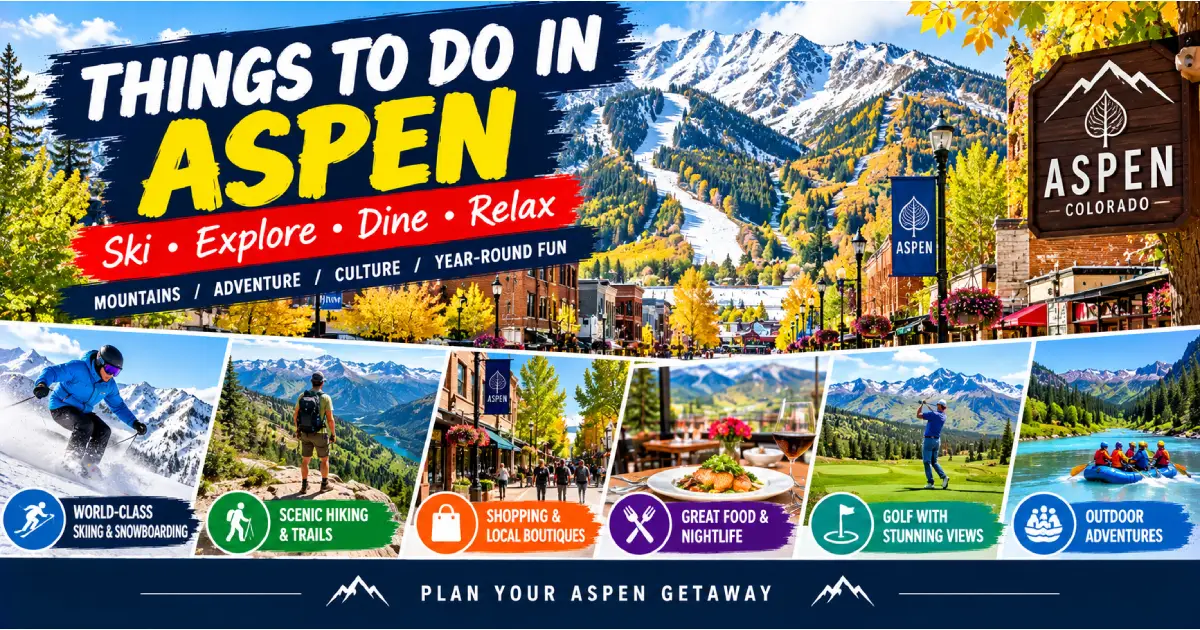
Aspen is one of the most complete resort destinations in the United States — a Victorian silver-mining town at 7,908 feet in the Elk Mountains of western Colorado that has spent the past eight decades reinventing itself, first as a postwar ski destination (the Aspen Skiing Company was founded in 1947 by Chicago industrialist Walter Paepcke, who also brought Albert Schweitzer, Dimitri Mitropoulos, and the Goethe Bicentennial to the Roaring Fork Valley in 1949), then as a cultural and intellectual hub (the Aspen Institute, the Aspen Music Festival, the Aspen Ideas Festival), and more recently as one of the finest summer outdoor recreation bases in the Rocky Mountains. The result is a town that genuinely offers more activities per acre than almost any other destination in Colorado — four ski mountains in winter, hundreds of miles of hiking and mountain biking trails in summer, a festival calendar dense enough to fill every weekend from June through October, and a restaurant and arts scene with no peer in rural Colorado.
What gives Aspen its particular character — distinct from Vail’s polished resort infrastructure or Breckenridge’s Victorian mining town mainstream — is the combination of genuine intellectual seriousness (the Aspen Institute has brought everyone from Henry Kissinger to Barack Obama to its campus for seminars) and a casual mountain-town ease that makes it possible to attend a world-class classical music concert in the afternoon and a three-day rafting trip the following morning. The town’s small scale (permanent population 7,000; no traffic lights) makes it walkable from any accommodation to any restaurant or activity; the gondola from the center of town to the top of Aspen Mountain runs year-round and connects the urban fabric of the Hyman Avenue mall directly to the alpine environment 3,000 feet above.
The four mountains of Aspen Snowmass — Aspen Mountain (Ajax), Aspen Highlands, Buttermilk, and Snowmass — offer the most varied ski experience in Colorado across a single interconnected season pass. In summer the same mountains become hiking and mountain biking terrain; the Maroon Bells (14 miles from town) are the most photographed mountains in Colorado and the centerpiece of one of the finest 1-day and multi-day hiking areas in the American West. This guide covers the 20 best things to do in Aspen across all seasons of 2026.
| Activity | Season | Type | Cost |
|---|---|---|---|
| Ski Aspen Mountain (Ajax) | Nov–April | Skiing | $189–$279/day |
| Hike to the Maroon Bells | June–October | Hiking | $16 shuttle |
| Ride the Silver Queen Gondola | Year-round | Scenic / Mountain access | $35 summer |
| Attend Aspen Music Festival | June–August | Classical music | Free–$200 |
| Hike Aspen Highlands Bowl | Summer / Winter | Hiking / Expert skiing | Free trail |
| Mountain bike the Rio Grande Trail | May–October | Cycling | Free |
| Raft the Roaring Fork River | May–July | Whitewater | $65–$95/person |
| Visit the Aspen Art Museum | Year-round | Contemporary art | Free |
| Hike the Four Pass Loop | July–September | Backpacking | Free (permit) |
| Attend Aspen Ideas Festival | June | Ideas / Culture | $1,500–$2,500 (public) |
| Fly-fish the Frying Pan River | Year-round | Fly fishing | $450/day guided |
| Explore the Grottos Ice Caves | June–October | Nature walk | Free |
| Take a ghost town jeep tour | June–October | History / Adventure | $150–$200/person |
| Cross-country ski at Ashcroft | December–March | Nordic skiing | $25/day |
| Dine on the Ajax Tavern sun deck | Year-round | Dining / Après-ski | $20–$45/dish |
| Snowshoe at Snowmass | December–March | Winter hiking | $28 rental |
| See the Maroon Bells at sunrise | June–October | Photography | $16 shuttle |
| Mountain bike Smuggler Mountain | May–October | Cycling | Free |
| Attend Telluride Bluegrass (day trip) | June | Music festival | Day trip only |
| Swim at Glenwood Hot Springs | Year-round | Swimming / Relaxation | $31/adult |
Season: Late November – April | Day Ticket: $189–$279 (book in advance) Pass: Ikon Pass (unlimited with pass) Access: Silver Queen Gondola from downtown Aspen (Durant Ave and Hunter St)
Aspen Mountain — known locally as Ajax — is the original Aspen ski area (opened 1947) and still the most distinctive: a mountain with no beginner terrain at all (there is no easy run from top to bottom; the easiest descent is a genuine intermediate), with the gondola base directly on the pedestrian mall of downtown Aspen, and with a combination of groomed expert runs, glades, and the legendary Walsh’s, Hyrup’s, and Pandora’s chutes that make it the most challenging accessible ski mountain in Colorado.
Key runs:
Silver Queen Gondola (summer operation, $35/adult): In summer the gondola runs 7 days a week (late June–early September) providing access to the summit at 11,212 feet for hiking, mountain biking descent, and the Sky Hotel lunch at the gondola top building. The 20-minute gondola ride from downtown is the finest mountain access experience in Aspen — step off the urban commercial street and onto an alpine ridge in 20 minutes.
Location: Maroon Lake, 14 miles southwest of Aspen on Maroon Creek Road Best Season: Late June – October; peak wildflowers mid-July; peak aspen color late September Shuttle: Required June 1 – October 1 ($16/adult round-trip from Aspen Highlands parking) Difficulty: Easy (Maroon Lake 0.6-mile loop), Moderate (Crater Lake 3.6 miles RT), Strenuous (Four Pass Loop 26 miles, 3–5 days)
The Maroon Bells — Maroon Peak (14,156 ft) and North Maroon Peak (14,014 ft), reflected in Maroon Lake at their base — are the most photographed mountains in Colorado and among the most visually arresting landscapes in the American West: two near-identical pyramid peaks of blood-red Maroon Formation mudstone rising above an aspen forest, framing the lake at dawn in a scene that seems almost too compositionally perfect to be unplanned. The mandatory shuttle (June 1–October 1; private cars allowed before 8 AM and after 5 PM for photographers) keeps the site from being overwhelmed; arriving on the 8 AM first shuttle puts you at the lake before the bulk of the day’s visitors.
Hikes from Maroon Lake:
Photography: Dawn at Maroon Lake (arrive before the 8 AM shuttle on the first private-car window, ideally parked by 6 AM) produces the finest light — the east-facing water reflects the warming peaks before direct sun hits the lake surface and destroys the reflection. Polarizing filter and a tripod are the two essential items for serious photography.
Location: Benedict Music Tent (1000 N Third St) and Harris Concert Hall (1000 N Third St) Season: Late June – late August (approximately 8 weeks) Tickets: Free (lawn seating at the tent) to $200 (reserved seating); aspenmusicfestival.com Founded: 1949 (one of the oldest summer classical music festivals in the United States)
The Aspen Music Festival and School is the most distinguished classical music festival in the Rocky Mountain West and one of the three or four finest summer classical music festivals in the United States — an 8-week program featuring more than 300 events (symphony concerts, chamber music, solo recitals, operas, student masterclasses) concentrated in a 5-block area of downtown Aspen. The festival was founded as part of Walter Paepcke’s original vision for Aspen as a cultural center; the Benedict Music Tent (2000, Harry Teague Architects — a fabric-and-steel structure in a meadow 2 blocks from the gondola) is the finest outdoor classical music venue in the American West.
What to attend:
Location: Aspen to Glenwood Springs, 42 miles one-way along the Roaring Fork River Best Season: May–October Difficulty: Easy (paved, minimal grade — the trail follows the old Denver and Rio Grande Western Railroad grade) Cost: Free; bike rental in Aspen $50–$80/day
The Rio Grande Trail is the finest paved multi-use trail in the Roaring Fork Valley — a 42-mile car-free path from downtown Aspen to Glenwood Springs following the abandoned rail corridor of the Denver and Rio Grande Western Railroad along the Roaring Fork River. The trail is almost entirely flat (the railroad grade averages 1%) and passes through the finest scenery of the Roaring Fork Valley: the red rock walls of Glenwood Canyon at the lower end, the cottonwood groves of the mid-valley, and the aspen forests and views of Capitol Peak and the Maroon Bells corridor from the upper valley near Aspen.
Best day-ride sections:
Location: Aspen Highlands, 5 miles west of Aspen on Maroon Creek Road Best Season: Summer (July–September for the hiking version; December–April for skiing) Difficulty: Strenuous (summer hike: 4 miles RT from Loge Peak lift top, 2,200 ft gain to 12,392-foot bowl rim) Cost: Free summer trail; $189–$279 lift ticket in winter (Ikon Pass included)
The Aspen Highlands Bowl is the finest hike-to ski terrain in Colorado in winter (a 15–20 minute bootpack from the top of Loge Peak to the 12,392-foot bowl rim, accessed from the highest chairlift at Aspen Highlands, descending into 1,000+ acres of above-treeline powder) and a genuinely spectacular above-treeline hiking destination in summer. The summer trail from the Highlands base (or from the top of the Loge Peak lift, accessed by hiking the ski runs) reaches the bowl rim with views of the Maroon Bells, Capitol Peak, and the full Elk Mountain range in a 360-degree panorama that rivals anything accessible from a hiking trail in the Aspen area.
Winter Highland Bowl: The bootpack begins at the top of the Loge Peak lift (11,675 ft) and follows the ridge north to the bowl rim at 12,392 ft. Boot-packing time: 15–25 minutes depending on conditions. The descent is up to 2,000 vertical feet of ungroomed terrain — powder after storms, variable hardpack between storms. Avalanche awareness essential; the bowl is avalanche-prone and the descent is through committed terrain. Helmets mandatory.
Location: Roaring Fork River (Aspen to Basalt section); Crystal River (Marble to Carbondale) Best Season: May–July (peak snowmelt flow); August for milder conditions Cost: $65–$95/person half-day; $110–$160/person full-day Operators: Blazing Adventures (blazingadventures.com), Aspen Kayak and SUP
The Roaring Fork River — the primary drainage of the Aspen basin — runs from the Independence Pass summit (12,095 ft) through Aspen and down the valley to its confluence with the Colorado River at Glenwood Springs, providing 70+ miles of whitewater ranging from Class II family floats to Class IV expert sections. Peak flow (May–June, driven by Elk Mountain snowmelt) produces the finest whitewater conditions in the Aspen area; the summer low-water season (August–September) creates more technically interesting but less powerful runs.
Lower Roaring Fork (Class II–III, Woody Creek to Basalt, 9 miles): The finest beginner-to-intermediate float in the valley — moving water, a few technical Class III rapids, excellent scenery through the Woody Creek canyon, and the finest bird-watching on the Roaring Fork (great blue herons, ospreys, and bald eagles in the cottonwood gallery). 3–4 hours; suitable for ages 7+.
Crystal River (Class III–IV, Marble section): A more technical river in a narrower canyon south of Carbondale — the Crystal River corridor passes by the ruins of the Crystal Mill (the most photographed ghost town structure in Colorado, a water-powered mill built in 1892 on a ledge above the river, accessible only by 4WD on the rough Crystal Road). Guided trips from Blazing Adventures include a stop at the mill; $140–$175/person.
Location: 590 N Mill St, downtown Aspen Hours: Tuesday–Sunday, 10 AM–6 PM; Thursday until 8 PM Admission: Free (no permanent collection; all programming is temporary exhibitions) Building: Shigeru Ban, 2014 (Winner of the Pritzker Architecture Prize in 2014, the year the museum opened)
The Aspen Art Museum is one of the finest small contemporary art museums in the American West and the most architecturally significant new building in Aspen — a 33,000-square-foot museum designed by Pritzker Prize-winning Japanese architect Shigeru Ban, with a woven wood façade (a custom-made screen of composite wood fiber that filters light into the galleries while creating a distinctive textured exterior visible from three blocks away), a rooftop sculpture garden with views to Aspen Mountain, and a commitment to presenting the most ambitious contemporary art programming available in any mountain town in the United States.
What to see:
Location: Grottos trailhead, Independence Pass Road (CO-82), 9 miles east of Aspen Best Season: June–October (ice caves accessible; CO-82 open) Difficulty: Easy (1.5 miles RT, 200 ft gain) Cost: Free
The Grottos are a series of ice caves, potholes, and sculptured granite formations on the Roaring Fork River — a geological feature where the river has carved through a granite intrusion, creating a short canyon of water-polished rock, ice caves (formed by meltwater that freezes in the sheltered granite alcoves; the caves retain ice through most of the summer even after the surrounding snowpack has melted), and natural swimming holes of extraordinary clarity.
The 1.5-mile trail from the trailhead (CO-82 mile marker 47) descends through aspen forest to the river level, where the carved granite formations begin. The ice caves (10–20 feet deep, with ice columns reaching 8 feet in early summer) are the most interesting geological feature on the trail; the swimming holes downstream of the caves are the finest cold-water swimming accessible from a short hike near Aspen (water temperature 50–60°F in summer — refreshing rather than dangerous for healthy adults).
Independence Pass connection: The Grottos trailhead is 9 miles from the summit of Independence Pass (12,095 ft) — the highest paved pass in the United States open year-round. A visit to the Grottos can be combined with a drive over the pass (open late May–October) for the finest half-day excursion from Aspen.
Location: Maroon Bells-Snowmass Wilderness, 14 miles from Aspen Distance: 26.5 miles | Gain: 7,800 ft cumulative | Duration: 3–5 days Best Season: July 15 – September 15 Permit: Free day-use; wilderness permit required for overnight (recreation.gov, opens in spring) Difficulty: Strenuous (all four passes above 12,000 ft; high altitude, exposure to afternoon storms)
The Four Pass Loop is the finest backpacking trip in the Elk Mountains and one of the finest wilderness backpacking loops in the Rocky Mountain West — a 26.5-mile circuit that crosses four mountain passes above 12,000 feet (Buckskin Pass, 12,462 ft; Trail Rider Pass, 12,420 ft; Frigid Air Pass, 11,980 ft; West Maroon Pass, 12,500 ft), passing through four distinct high-altitude valleys and visiting the Snowmass Lake basin (the finest high-altitude lake camp in the Elk Mountains). The loop begins and ends at the Maroon Lake trailhead.
Itinerary (clockwise, 4 days):
Logistics: Bear canister required (rental available in Aspen at the Ute Mountaineer, 308 S Mill St). The 8 AM shuttle from Aspen Highlands to Maroon Lake is the standard departure; car camping at Maroon Lake the night before is an option for those who prefer an early start.
Location: Frying Pan River, Basalt to Ruedi Reservoir (15 miles east of Basalt, 20 miles from Aspen) Best Season: Year-round (the Frying Pan is a year-round fishery thanks to the tailwater below Ruedi Dam) Cost: Colorado fishing license ($35.25/year, $15.25/day); guided trip $450–$550/day for 2 anglers Guides: Taylor Creek Fly Shops (taylorcreek.com), Roaring Fork Anglers (rfanglers.com)
The Frying Pan River below Ruedi Reservoir is one of the three or four finest dry-fly trout fisheries in the United States — a 14-mile tailwater with a consistent water temperature (40–50°F year-round, from the cold reservoir bottom release) that supports an extraordinary density of large wild rainbow and brown trout. The state record rainbow trout (20.5 lbs) was caught on the Frying Pan; the average trout in the upper section (from the dam to the Toilet Bowl) is 16–22 inches, with numerous fish in the 24–30 inch range.
The river is small (30–50 feet wide), heavily vegetated on the banks, and requires technical casting — the trout are sophisticated and leader-shy in the heavily fished sections. The most productive dry-fly season is the midge and baetis hatch (late September–November and March–April); the summer season (June–August) produces Blue-Winged Olive and Pale Morning Dun hatches. Guided trips are strongly recommended for first-time Frying Pan visitors.
Location: Aspen Highlands parking area, Maroon Creek Road Season: June 1 – October 1 (mandatory shuttle period) Cost: $16/adult round-trip; first shuttle departs 6 AM Photography tip: First shuttle arrives at Maroon Lake approximately 6:20 AM — 20–40 minutes of peak reflection light before the sun hits the water
The Maroon Bells at sunrise is one of the finest single photographic experiences in the Rocky Mountain West — the combination of the twin 14,000-foot peaks lit by the first horizontal east light, the dead-calm lake surface reflecting them perfectly (the lake surface is undisturbed until the wind picks up around 9–10 AM), and the aspen forest framing the scene in green (summer) or gold (late September) is the most photographically rewarding subject accessible from a paved road in Colorado.
Practical: The 6 AM shuttle is the crucial departure. The lake reflection is best 30–60 minutes after the sun clears the eastern ridge; in late September (peak aspen color) the golden trees add the third element to the classic composition. After 9 AM, the lake surface develops wind chop that destroys the reflection; the crowds also build significantly after the second shuttle. For the serious dawn photographer, bringing a tripod and a wide-angle lens (24mm equivalent or wider for full peak-plus-reflection), arriving on the 6 AM shuttle, and positioning on the north shore of the lake before 7 AM is the standard technique.
Location: 11040 Castle Creek Road, 12 miles south of Aspen Season: December – March Cost: $25/adult trail fee; $30 ski rental; ashcroftskitouring.com
Ashcroft Ski Touring is the finest Nordic ski center in the Aspen area — 35 kilometers of groomed trails in the Castle Creek Valley at 9,500–10,500 feet, surrounded by 14,000-foot peaks (Cathedral Peak, 13,943 ft; Hayden Peak, 13,561 ft) and the ghost town of Ashcroft (a genuine 1880s silver-mining ghost town visible from the trail system). The combination of groomed track, a historic ghost town, and above-treeline approach terrain makes Ashcroft one of the most distinctive Nordic ski experiences in Colorado.
Ashcroft Ghost Town: A cluster of 10 original 1880s log and timber structures preserved in the valley — the Hotel View, the assay office, and the general store — accessible from the Nordic trail system. The town was more populous than Aspen in 1882 (population 2,500) before the silver crash of 1893; it was abandoned by 1900. Self-guided tour brochure available at the Ashcroft Ski Touring lodge.
Pine Creek Cookhouse (12 miles from Aspen, $85–$110/person dinner): A backcountry dinner lodge accessible by cross-country ski or snowshoe (1.5 miles from the Ashcroft trailhead) — one of the finest wilderness dining experiences in Colorado. The 4-course menu is Colorado-sourced; the woodstove-heated log cabin in the snow-covered Castle Creek Valley is the setting. Reservations essential; book 2–4 weeks in advance for weekends.
Location: Independence, Ashcroft, and Lenado ghost towns accessible from Aspen Best Season: June–October (jeep roads open) Cost: $150–$200/person guided; self-guided in a rental 4WD ($100–$150/day) Operators: T-Lazy-7 Ranch (tlazy7.com), Blazing Adventures
The Roaring Fork Valley and its tributary drainages contain the finest concentration of accessible ghost towns in Colorado — the remains of 1880s silver-mining communities abandoned after the Sherman Silver Purchase Act repeal in 1893 crashed the silver market and emptied the mountain boomtowns almost overnight. Independence (12 miles east of Aspen on CO-82, near the Independence Pass summit) is the finest accessible ghost town on the pass — 20+ original log and timber structures, interpretive signage, and a setting at 10,860 feet with 14,000-foot peaks visible.
Independence Ghost Town (CO-82 eastbound, free, open June–October): A self-guided walking tour through the original townsite — the Hotel, the general store, cabins, and mine structures. The town was founded on July 4, 1879 (hence the name) and reached a peak population of 1,500 before the 1893 crash. The walking tour takes 45–60 minutes.
Lenado (12 miles northeast of Aspen on Woody Creek Road, 4WD recommended): The finest seldom-visited ghost town near Aspen — a small mining camp in the Woody Creek drainage with original log structures in good condition. No interpretive signage; the isolation and quiet are the attractions.
Location: 685 E Durant Ave, at the base of the Silver Queen Gondola Season: Year-round (ski season and summer) Cost: $20–$45/dish; cocktails $18–$22 Reservations: Strongly recommended for lunch during ski season; ajaxtavern.com
Ajax Tavern is the social center of Aspen’s ski culture — a sun-deck restaurant at the gondola base where the après-ski scene begins at 2 PM and where the combination of well-executed food (truffle fries, the finest burger in Aspen, fresh oysters), strong cocktails, and the parade of people exiting the gondola in ski boots has made it one of the most energetic outdoor dining experiences in the American ski world. The sun deck faces south and west, catching the full afternoon sun even in January; the combination of ski resort sun intensity and the altitude makes SPF 50 mandatory.
Summer operation: In summer the Ajax Tavern operates as a general patio restaurant without the ski culture overlay — still excellent, and with more table availability. The menu transitions to summer-appropriate lighter fare; the cocktail list stays consistent.
Location: Various Aspen venues, primarily the Aspen Meadows campus Season: Late June (approximately 5 days) Cost: $1,500–$2,500 for public passes (significant; the festival is primarily corporate and institutional) Website: aspenideas.org
The Aspen Ideas Festival is the annual convening of the Aspen Institute’s public programming — a 5-day event featuring heads of state, Nobel laureates, technology executives, scientists, artists, and journalists in a series of conversations, debates, and presentations on the major questions of the moment. The festival was established in 2005 and has grown into one of the most watched intellectual events in the United States; sessions are streamed online, and transcripts are published — for those who cannot attend, the festival’s online content is free and genuinely excellent.
Free access: Approximately 30% of festival sessions are free and open to the public (specific programs designated as “free and open” on the festival website); the Pitkin County Library hosts several satellite sessions with free admission. Checking the free-access programming a week before the festival begins is the best way to attend without the full registration cost.
Location: Snowmass Village, 12 miles west of Aspen Season: December – March Cost: $28 snowshoe rental; free trail access on designated routes Guided tours: Snowmass Mountain (snowmassvillage.com/activities, $45/person including rental)
Snowmass is the largest of the four Aspen mountains (3,354 acres) and offers the finest snowshoe trail network in the Aspen area — designated snowshoe routes on the mountain’s lower terrain that are separated from the ski runs, with views of the Snowmass Creek valley, Capitol Peak (14,130 ft), and the Maroon Bells visible from the upper routes. The Two Creeks area on the east side of the mountain provides the finest beginner snowshoe terrain; the Elk Camp area (mid-mountain, 9,975 ft) is the best intermediate option.
Snowmass Village Base: The Snowmass Mall (remodeled as the Base Village, opened 2018) is the finest mountain-base village infrastructure outside Vail in Colorado — the Westin Snowmass Resort, multiple restaurants, and the Snowmass Welcome Center. The Ullrhöffen restaurant at the base (lunch and après, German-Bavarian menu, excellent glühwein) is the finest après-ski on the Snowmass side.
Location: Smuggler Mountain Open Space, 0.5 miles from downtown Aspen Best Season: May–October Difficulty: Moderate (3 miles one-way to the summit, 1,600 ft gain) Cost: Free
Smuggler Mountain is Aspen’s most accessible mountain biking climb — a former mining road that switchbacks up the hillside directly behind downtown Aspen to the 9,000-foot summit ridge, with the finest view of the Roaring Fork Valley and the Elk Mountain range available from a moderate pedaling effort. The road is wide, well-maintained, and unpaved — a genuine workout for sea-level visitors at altitude, and a quick warm-up for acclimatized locals.
Summit views: The Smuggler Mountain overlook provides the finest single viewpoint accessible from Aspen without additional mechanical assistance — the full 4-mountain ski complex (Ajax, Highlands, Buttermilk, Snowmass ridgeline) visible simultaneously from the ridge. The 14,000-foot peaks of the Elk Mountains (Capitol Peak, the Maroon Bells, Pyramid Peak, Snowmass Mountain) are visible on the western horizon.
Midnight Mine Road: A 4-mile extension from the Smuggler Mountain summit ridge into the Hunter Creek Valley for mountain bikers comfortable on natural surface singletrack — the finest intermediate trail in the immediate Aspen area.
Location: 401 N River St, Glenwood Springs (45 miles northwest of Aspen on CO-82) Hours: Daily 7:30 AM–10 PM Cost: $31/adult (day pass); $21/child; hotspringspool.com Getting There: RFTA bus from Aspen ($5/trip, 55 minutes) or CO-82 drive (45 miles, 50 minutes)
The Glenwood Hot Springs Pool is the world’s largest geothermal hot springs pool — a 405-foot outdoor pool (the main pool, 90–93°F) and a 100-foot therapy pool (104°F) fed by the Yampah Springs, which produce 3.5 million gallons of mineral water daily at 122°F. The springs have been in use since the Ute Nation recognized their restorative properties, and the pool facility has operated continuously since 1891, making it the oldest continuously operating hot springs resort in the United States.
The RFTA bus connection from Aspen makes Glenwood Hot Springs the finest day trip from Aspen that doesn’t require a car — a 55-minute bus ride down the Roaring Fork Valley, a half-day of soaking, and a return bus in the late afternoon. The Vapor Caves (adjacent to the pool, $15 additional, marble steam caves carved into the hillside) are the finest sweat-lodge experience accessible from Aspen.
Location: 320 E Hyman Ave, downtown Aspen Season: Year-round Tickets: $25–$125; wheeleroperahouse.com Built: 1889 (restored 1984–1984; National Historic Landmark)
The Wheeler Opera House is Aspen’s most historically significant building and the finest intimate performance venue in the Colorado mountains — a 500-seat Victorian theater built in 1889 by Jerome B. Wheeler (of Macy’s department store wealth) that survived the silver crash, decades of disuse, and a 1984 restoration to become the cultural center of modern Aspen. The Wheeler presents a year-round calendar of concerts, theatrical performances, film screenings, and community events that are more accessible (in both price and formality) than the Aspen Music Festival or the Ideas Festival.
What’s on: The Wheeler calendar includes touring musicians (folk, jazz, classical, world music), theatrical touring productions, the Aspen Film documentary series, and the annual free Fourth of July concert. The building itself — the pressed-tin ceiling, the Victorian box seats, and the original gas-lamp-era sightlines — is the finest piece of Victorian theater architecture in Colorado.
Location: Trailhead: 0.5 miles west of the Aspen Highlands ski area on Maroon Creek Road Distance: 6.6 miles RT | Gain: 2,700 ft | Summit: 11,800 ft Best Season: July–September Difficulty: Strenuous (significant gain; altitude starts at 8,800 ft)
The American Lake Trail is the finest strenuous day hike accessible from Aspen — a 3.3-mile one-way climb through aspen forest, spruce-fir forest, and finally subalpine tundra to a remote alpine lake below the Elk Mountain ridgeline. The trail sees significantly fewer visitors than the Maroon Bells area despite beginning only 4 miles from Aspen, and the quality of the views from the upper basin (Capitol Peak, the back of the Maroon Bells massif, and the Snowmass Creek drainage) rivals the most celebrated viewpoints in the area.
What to see: The transition from aspen forest (finest in late September) to the subalpine zone begins at approximately 2 miles; the final mile crosses open tundra with 360-degree views before reaching American Lake at 11,780 ft. The lake holds small cutthroat trout; a fishing license is required. The upper basin is excellent for late-summer wildflowers (late July–mid-August) and the finest non-4-pass-loop above-treeline experience in the Aspen trail system.
By Air: Aspen/Pitkin County Airport (ASE), 3.5 miles from downtown — direct flights from Los Angeles (American, United), Denver (United), Dallas-Fort Worth (American), New York JFK (Delta/United), Chicago O’Hare (United), and seasonal non-stops from Atlanta and Houston. Summer and holiday periods book quickly; reserve 3–4 months in advance for peak dates.
By Road: 200 miles west of Denver (3.5–4 hours via I-70 and CO-82); the final 40 miles on CO-82 through the Roaring Fork Valley and over Independence Pass (12,095 ft, open late May–October) or via Glenwood Canyon (year-round but subject to rockfall closures). The Glenwood Canyon route (I-70 west to Glenwood Springs, then CO-82 south) is the year-round option.
By Bus: Greyhound/RFTA to Glenwood Springs, then RFTA to Aspen ($5–$8/trip) — the finest public transit option to a Colorado ski resort, operating year-round on a 1-hour schedule.
The Aspen Free Shuttle operates 4 routes within Aspen and between Aspen and Snowmass Village (15 minutes, free, year-round). The four mountains are connected to Aspen by free bus:
Aspen’s base elevation (7,908 ft) is high enough to cause altitude sickness in visitors from sea level; the ski mountain summits (Ajax at 11,212 ft, Snowmass at 12,510 ft, Highlands Bowl at 12,392 ft) are significantly higher. Standard advice: spend the first night in Denver (5,280 ft) before coming to Aspen, hydrate aggressively, avoid alcohol on the first night, and do not ski hard on the first day.
Posted By : Vinay
Latest Article
2nd Floor, 39, Above Kirti Club, DLF Industrial Area, Kirti Nagar, New Delhi, Delhi 110015



Travel Tourister is a leading Travel portal where we introduce travellers to trusted travel agents to make their journey hasselfree, memorable And happy. Travel Tourister is a platform where travellers get Tour packages ,Hotel packages deals through trusted travel companies And hoteliers who are working with us across the world. We always try to find new and more travel agents and hoteliers from every nook and corners across the world so that you could compare the deals with different travel agents and hoteliers and book your tour or hotel with the one you have chosen according to your taste and budget.
Copyright © Travel Tourister, India. All Rights Reserved

 Call
 Enquiry