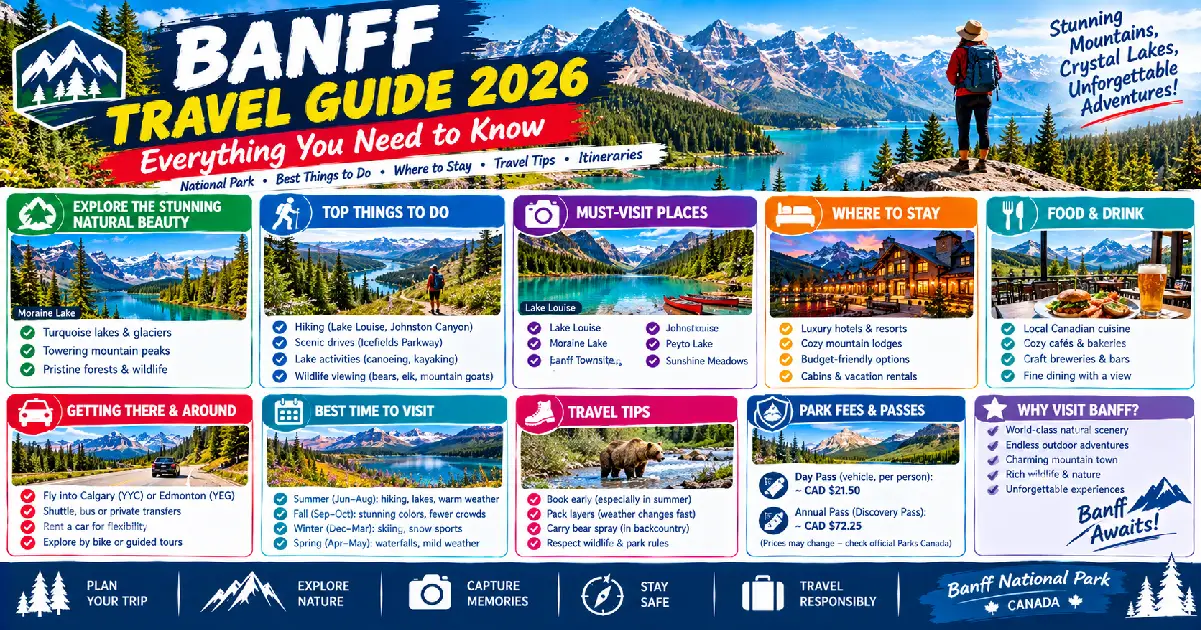
Banff Travel Guide 2026: Everything You Need to Know
Published on : 27 Oct 2026
Banff Travel Guide 2026 — Best Time to Visit, Lake Louise and Moraine Lake, Park Passes and Shuttles, Top Attractions, Where to Stay, Costs in CAD, Hikes, Wildlife, Day Trips, and Insider Tips for First-Time Visitors
By Travel Tourister | Updated October 2026
This Banff travel guide is built for visitors planning a first (or fifth) trip to Canada’s most famous mountain destination — a compact, walkable town of roughly 8,000 to 9,000 residents at about 1,383 meters elevation, set inside Banff National Park, which was established in 1885 as Canada’s first national park and forms part of the UNESCO-listed Canadian Rocky Mountain Parks World Heritage Site. Within a 45-minute drive you can ride a gondola to a summit boardwalk, soak in natural hot springs, walk catwalks bolted to a limestone canyon, and stand beside two of the most photographed glacier-fed lakes on Earth, Lake Louise and Moraine Lake, whose vivid turquoise color comes from fine rock flour suspended in the water.
What makes Banff both easy and tricky is that demand far exceeds supply in summer. The town itself is simple to navigate and can be explored on foot, but the best experiences are rationed by rules that visitors should understand before arriving: a Parks Canada pass is required for every visitor stopping in the park, Moraine Lake Road is closed to personal vehicles and reached by reserved shuttle or other transit, parking at Lake Louise and Johnston Canyon fills before most visitors are awake, and summer hotel rooms are among the most expensive in Canada. Hotel stays also carry Alberta’s tourism levy, which rose from 4 percent to 6 percent on April 1, 2026, and Alberta will add a 6 percent tax on passenger vehicle rentals from January 1, 2027.
This Banff travel guide covers everything needed to plan a 2026 or 2027 trip — quick facts, the best time to visit, park passes and shuttle rules with current fees, how to get to Banff and around, the 15 best attractions, where to stay, food, day trips, realistic costs in Canadian dollars, itineraries, safety and wildlife tips, and answers to the most common questions from first-time visitors. Fees, schedules, and opening hours change, so verify current information before you book.
For complete guides, see our Canada Travel Guide 2026, Canada 7 Day Itinerary, Best Time to Visit Canada, and Canada Trip Cost guides.
Quick Overview: Banff Travel Guide at a Glance
Topic
Quick Facts
Province
Alberta, in the Canadian Rockies
Elevation
About 1,383 meters (4,540 feet) in Banff townsite
Language
English
Currency
Canadian dollar (CAD); 5% GST is added at checkout; Alberta has no provincial sales tax
Time Zone
Mountain Time
Nearest Major Airport
Calgary International (YYC), about 130 km and 1.5 hours by road
Park Pass (2026 Fees)
Daily adult CAD 12.25; annual Discovery Pass CAD 83.50 adult, CAD 167.50 family or group; youth 17 and under free (verify)
Lake Louise and Moraine Lake
Parks Canada shuttle CAD 8 adult plus a CAD 3.50 reservation fee; Moraine Lake Road closed to personal vehicles
Banff Upper Hot Springs
Adult CAD 19.75 (2026; verify)
Best Time to Visit
Late June–September (lakes, hiking); late September (larches); December–March (skiing)
Ideal Stay
3–4 days (plus 1–2 days for the Icefields Parkway, Yoho, or Jasper)
Wildlife Rule
Keep 100 meters from bears and wolves, 30 meters from elk and other large animals
Emergency Number
911
Banff at a Glance: Top Highlights by Interest
If You Love…
Don’t Miss
Iconic lakes
Lake Louise, Moraine Lake, Peyto Lake, Lake Minnewanka
Views without a long hike
Banff Gondola, Mount Norquay, Surprise Corner, Vermilion Lakes
Hiking
Lake Agnes Tea House, Johnston Canyon, Sunshine Meadows, Larch Valley (September)
Hot springs and relaxation
Banff Upper Hot Springs, Radium Hot Springs (day trip)
History and culture
Cave and Basin National Historic Site, Banff Park Museum, Indigenous-led experiences
Wildlife
Bow Valley Parkway, Icefields Parkway, Vermilion Lakes
Skiing and winter
Lake Louise Ski Resort, Sunshine Village, Mount Norquay
Day trips
Icefields Parkway, Yoho National Park, Canmore, Kananaskis, Jasper
🗓️ Best Time to Visit Banff
The best time to visit Banff is late June to September for open trails and thawed, turquoise lakes, with July and August the warmest and busiest months, late September the favorite for golden larches and thinner crowds, and December to March the season for skiing and snowy mountain scenery.
Season
Typical Weather
Highlights
Drawbacks
Spring (Apr–May)
Highs about 5–14°C (41–57°F)
Lowest prices, wildlife in the valley, spring skiing
Lakes frozen, many trails snowy, shuttles not yet running
Summer (Jun–Aug)
Highs about 19–23°C (66–73°F), cold nights
Thawed lakes, open trails, Moraine Lake shuttle, long days
Highest prices, crowds, wildfire smoke risk
Fall (Sep–Oct)
Highs about 9–16°C (48–61°F)
Golden larches (late September), fewer crowds, elk rut
Early snow, shuttles end around October 12
Winter (Dec–Mar)
Highs about −5 to 2°C (23–36°F), with much colder nights
Skiing, hot springs in snow, quiet town
Short days, cold, winter-tire rules, lakes frozen
Insider tips: The Parks Canada shuttles to Lake Louise and Moraine Lake run on a seasonal calendar (for 2026, Lake Louise from mid-May and Moraine Lake from June 1, both ending October 12), and reservations are released in advance, so check the Parks Canada site early. For a nationwide view, see our Best Time to Visit Canada guide.
🎫 Banff Park Passes, Shuttles, and Entry Rules
Every visitor who stops in Banff National Park needs a valid Parks Canada pass, including for driving to Lake Louise, hiking, and visiting the town. Passes are checked at the park gates and at popular sites. The 2026 fees below were published by Parks Canada after a fee adjustment on January 1, 2026; verify current prices before you travel.
Pass or Service
2026 Fee (CAD)
Notes
Daily pass, adult
12.25
Per person; seniors 10.75; youth 17 and under free
Daily family or group pass
24.50
Up to seven people in one vehicle
Annual Discovery Pass, adult
83.50
Valid at Parks Canada places across Canada for 12 months; senior 71.50
Annual Discovery Pass, family or group
167.50
Pays for itself in roughly a week of park visits
Parks Canada shuttle, Lake Louise and Moraine Lake
8 adult, 4 senior, youth free
Plus a 3.50 non-refundable reservation fee per booking; park entry fee not included
Banff Upper Hot Springs
19.75 adult
Verify current fees
Free admission window: In 2026 Parks Canada ran a Canada Strong Pass program that waived entry fees from June 19 to September 7, 2026, but that window has ended, so standard fees apply (verify whether any similar program is announced for 2027).
Moraine Lake and Lake Louise access: Moraine Lake Road is closed to personal vehicles, and visitors reach the lake by Parks Canada shuttle (from the Lake Louise Park and Ride), by Roam public transit, or by a commercial tour. For 2026, Parks Canada released a share of shuttle tickets in April and the rest two days before departure, and popular dates sell out within hours. A Lake Connector shuttle links Lake Louise and Moraine Lake and is included in a shuttle reservation.
Insider tips: Buy your pass online ahead of time to skip the gate queue, keep proof of your shuttle reservation on your phone (cell service is weak at the Park and Ride), and arrive early at all popular sites.
✈️ How to Get to Banff and Around the Area
Getting there: Calgary International Airport (YYC) is the main gateway, about 130 kilometers and 1.5 hours from Banff by road. Shuttle buses such as the Banff Airporter and Brewster Express run from the airport to Banff and Lake Louise (typically roughly CAD 70 to 100 each way; verify), and rental cars are the most flexible option. Vancouver is about 850 kilometers (9 to 10 hours) away, and most visitors fly to Calgary instead.
Getting around: Banff townsite is walkable, and Roam Transit runs local routes within Banff and regional routes to Lake Louise and Johnston Canyon (verify fares and seasonal schedules). A rental car gives the most freedom for the Bow Valley Parkway, the Icefields Parkway, and early starts, but parking in town and at popular lakes is limited and fills early. In winter, winter tires or chains are required on some roads, so check conditions and rental terms.
Alberta vehicle rental tax: Alberta will introduce a 6 percent tax on passenger vehicle rentals picked up in the province from January 1, 2027, excluding GST and itemized insurance and fuel charges, which will add to rental costs for 2027 trips (verify details).
Insider tips: Book shuttles and rental cars early for summer, avoid driving into town at peak hours on summer weekends, and consider a Calgary airport shuttle if you do not want to drive in mountain conditions.
🏔️ Top 15 Things to See and Do in Banff
1. Lake Louise — The Turquoise Icon
Cost: Park pass; shuttle or parking | Best Time: Late June–September; sunrise | Time Needed: 2–4 hours
Lake Louise, about 45 kilometers from Banff, is a glacier-fed lake framed by peaks and anchored by the historic Fairmont Chateau Lake Louise. The flat lakeshore trail is easy for everyone, canoe rentals are available in summer, and the hike to the Lake Agnes Tea House, about 7 kilometers return with a steady climb, ends at a rustic tea house beside a mountain lake.
Insider tips: Arrive very early or use the shuttle, since parking at the lake fills early on summer days, and check ice conditions in early summer.
2. Moraine Lake — The Valley of the Ten Peaks
Cost: Park pass plus shuttle (CAD 8 adult plus a reservation fee in 2026) | Best Time: July–September | Time Needed: 1–2 hours
Moraine Lake, set beneath the Valley of the Ten Peaks, is one of the most photographed lakes in Canada, and the short Rockpile Trail delivers the classic postcard view within minutes. The lake is at its most vivid after the ice melts in summer.
Insider tips: Reserve a Parks Canada shuttle the moment bookings open, bring layers because it is cold at altitude, and respect closures for wildlife and avalanche safety.
3. Banff Gondola — Sulphur Mountain Views
Cost: Roughly CAD 70–90 (verify) | Best Time: Clear days; sunset | Time Needed: 2–3 hours
The Banff Gondola climbs Sulphur Mountain in about eight minutes to a summit boardwalk at roughly 2,281 meters, with 360-degree views of six mountain ranges and the Bow Valley.
Insider tips: Book the first gondola of the day or go near sunset for smaller crowds and better light, and check the weather first since cloud can hide the view.
4. Banff Upper Hot Springs
Cost: Adult CAD 19.75 (2026; verify) | Best Time: Evenings; winter | Time Needed: 1–2 hours
The Banff Upper Hot Springs are mineral-rich pools open to the sky, with mountain views that are especially atmospheric when snow falls around the steaming water. They make a perfect pairing after a day of hiking.
Insider tips: Visit after dinner or on weekday evenings for smaller crowds, and bring a swimsuit and towel or check rental options.
5. Johnston Canyon — Catwalks and Waterfalls
Cost: Park pass | Best Time: Early morning or after 5 PM | Time Needed: 2–4 hours
Johnston Canyon, about 25 kilometers west of Banff on the Bow Valley Parkway, has catwalks bolted into a limestone gorge leading to the Lower Falls (about 1.1 kilometers) and the Upper Falls (about 2.7 kilometers each way). It is one of the busiest trails in the park.
Insider tips: Go very early or late to avoid crowds, check Parks Canada for parking and shuttle arrangements, and use Roam Transit if parking is full.
6. Lake Minnewanka
Cost: Park pass; boat cruises extra (verify) | Best Time: Summer; fall | Time Needed: 2–3 hours
Lake Minnewanka, a large glacial lake a short drive from Banff, offers shoreline walks, boat cruises, and fishing, and is one of the best places for quiet views and wildlife sightings such as bighorn sheep.
Insider tips: Visit in the early morning or evening for calm water and wildlife, and bring layers since the wind can be cold.
7. Bow Falls and Surprise Corner
Cost: Park pass | Best Time: Morning; evening | Time Needed: 1–2 hours
Bow Falls is a short walk from town along the Bow River, and Surprise Corner offers one of the best free views of the Fairmont Banff Springs hotel with the valley behind it. Both are easy and good for families.
Insider tips: Walk from town along the river trail for a relaxed outing, and visit at sunrise or sunset for the best light.
8. Banff Avenue and the Townsite
Cost: Free to wander | Best Time: Evenings | Time Needed: 1–2 hours
Banff Avenue is the lively main street, with restaurants, shops, galleries, and mountain views at the end of every block. The town is compact and walkable, and most hotels are within a few minutes of the main strip.
Insider tips: Make dinner reservations ahead in summer, and use evenings for strolling since daytime crowds are heaviest.
9. Cave and Basin National Historic Site
Cost: Roughly CAD 12–20 (verify) | Best Time: Any day | Time Needed: 1–2 hours
Cave and Basin is the birthplace of Canada’s national park system, where hot springs discovered in 1883 led to the creation of Banff National Park. Visitors can see the cave and basin, exhibits, and boardwalk trails.
Insider tips: Combine it with a walk along the Marsh Loop or the Sundance Canyon trail.
10. Vermilion Lakes
Cost: Park pass | Best Time: Sunrise; sunset | Time Needed: 1–2 hours
The Vermilion Lakes, just outside Banff townsite, are a string of marshy lakes with reflections of Mount Rundle, excellent sunrise and sunset photography, and frequent wildlife sightings.
Insider tips: Go at sunrise for the calmest water, keep a safe distance from wildlife, and bring a telephoto lens.
11. Bow Valley Parkway — A Slower Scenic Drive
Cost: Park pass | Best Time: Dawn and dusk for wildlife | Time Needed: Half day
The Bow Valley Parkway (Highway 1A) is a quieter, slower alternative to the Trans-Canada Highway between Banff and Lake Louise, with pullouts, viewpoints, and good wildlife-spotting chances. Seasonal vehicle restrictions apply to parts of the parkway during certain periods to protect wildlife, so check Parks Canada before you go.
Insider tips: Drive slowly, keep your distance from animals, and never stop in the middle of the road.
12. The Icefields Parkway
Cost: Park pass; Columbia Icefield tours roughly CAD 90–150 (verify) | Best Time: June–September | Time Needed: 1 day
The 232-kilometer Icefields Parkway between Lake Louise and Jasper passes Bow Lake, the Peyto Lake viewpoint, Sunwapta Falls, and the Columbia Icefield, where a specially built Ice Explorer takes visitors onto the Athabasca Glacier.
Insider tips: Fill your tank before leaving Lake Louise or at Saskatchewan River Crossing, and check road and weather conditions since snow can fall in any month.
13. Mount Norquay and Sunshine Meadows
Cost: Lift tickets and sightseeing rides vary (verify) | Best Time: Winter (ski); summer (views and hiking) | Time Needed: Half day
Mount Norquay, just outside town, offers skiing in winter and a sightseeing chairlift in summer with views of Banff townsite. Sunshine Village, further west, offers one of the area’s highest ski bases in winter and alpine meadow hiking in summer.
Insider tips: Check season dates, book ahead for ski days, and check Parks Canada and resort info for summer access to Sunshine Meadows.
14. Yoho National Park — Emerald Lake and Takakkaw Falls
Cost: Parks Canada pass | Best Time: July–September | Time Needed: 1 day
Yoho National Park, just across the Alberta–British Columbia border, offers Emerald Lake with an easy loop trail, Takakkaw Falls (about 373 meters, among the tallest in Canada), and the Natural Bridge on the Kicking Horse River. The Burgess Shale fossils are visited on guided hikes.
Insider tips: Check Parks Canada for road opening dates, since the road to Takakkaw Falls is closed in winter and narrow, and combine Yoho with a Lake Louise day.
15. Canmore — A Quieter Base
Cost: Free to wander | Best Time: Year-round | Time Needed: Half day
Canmore, about 25 kilometers east of Banff, is a mountain town with restaurants, outdoor shops, trails, and generally lower accommodation prices than Banff, which makes it popular for travelers on a budget. It is also home to ÄNKÔR, ranked 25th in Canada’s 100 Best 2026.
Insider tips: Consider staying in Canmore to save on rooms, and note the extra driving time in the morning and evening.
🏨 Where to Stay in Banff
For first-time visitors, the best base is Banff townsite, which is walkable to restaurants, shops, the hot springs, and the gondola, while Lake Louise suits travelers who want to be near the lakes at dawn and Canmore suits those who want lower prices and a quieter town.
Base
Vibe
Best For
Notes
Banff townsite
Lively, walkable, mountain views
First-timers, dining, short stays
Highest prices; book 6–9 months ahead for summer
Lake Louise village
Quiet, close to the lakes
Early starts at Lake Louise and Moraine Lake
Limited options and premium prices
Canmore
Local mountain town, about 25 km east
Budget travelers, longer stays
Extra drive time to Banff and the lakes
Campgrounds (Parks Canada)
Basic to serviced sites
Budget travelers and families
Reservations open months ahead
Hostels
Social and budget-friendly
Solo travelers and groups
Book early for summer
Level
Peak Summer (Per Room, Before Taxes)
Shoulder Season (Per Room, Before Taxes)
Budget
CAD 250–400
CAD 150–250
Mid-Range
CAD 400–700
CAD 250–450
Luxury
CAD 800+
CAD 600+
Hotel taxes and fees: Banff hotel stays carry Alberta’s 6 percent tourism levy (up from 4 percent for bookings made on or after April 1, 2026), 5 percent GST, and a mandatory Banff Tourism Improvement Fee of roughly 2 to 3 percent, for roughly 13 to 14 percent on top of the quoted rate (verify with your hotel). Alberta has no provincial sales tax.
Insider tips: Book accommodation six to nine months ahead for July and August, consider Canmore to save 20 to 40 percent, and compare shoulder-season rates, which can be far lower than peak summer.
🍽️ Where to Eat in Banff
Banff Avenue has dozens of restaurants, from casual pubs and burger spots to elegant dining rooms, and prices are higher than in most Canadian cities because of the town’s remote location and tourist demand. Many visitors save money by picking up groceries and picnic supplies and eating one meal a day at a casual spot.
Banff dining: Expect mid-range dinners of roughly CAD 40 to 70 per person before drinks, plus 5 percent GST and a customary 15 to 20 percent tip.
Canmore: ÄNKÔR in Canmore ranked 25th in Canada’s 100 Best 2026, making it one of the best destination meals near Banff, and casual Canmore spots such as Sauvage also appear in the national recommendations.
Calgary: If you pass through Calgary, Eight (ranked ninth in Canada’s 100 Best 2026), DOPO, and The River Café offer some of the best dining in Alberta.
Peter Lougheed Provincial Park; separate Kananaskis conservation pass may apply (verify)
Kootenay National Park and Radium Hot Springs
About 1.5–2 hours
Marble Canyon, hot springs
Jasper
About 3–3.5 hours
Maligne Lake, dark-sky preserve
Calgary
About 1.5 hours
Stampede grounds, restaurants, airport
Insider tips: Start early, check road and weather conditions, and consider Jasper as an overnight trip via the Icefields Parkway. See our Canada 7 Day Itinerary guide for how Banff fits into a longer trip.
💰 How Much Does a Trip to Banff Cost?
The table below shows estimated costs per person per day in Canadian dollars in peak summer, assuming two travelers sharing a room and a rental car or shuttle use, and excluding international flights and hotel taxes. Shoulder-season trips can be 30 to 40 percent cheaper on rooms.
Cost Category
Budget
Mid-Range
Luxury
Accommodation (per room per night)
CAD 250–400
CAD 400–700
CAD 800+
Food (per person per day)
CAD 55–85
CAD 100–160
CAD 220+
Transport (car share, fuel, shuttles, parking)
CAD 40–70
CAD 60–110
CAD 150+
Park pass and attractions (per day)
CAD 20–50
CAD 60–130
CAD 250+
Estimated Daily Total (Per Person)
CAD 240–400
CAD 420–750
CAD 1,000+
Sample 3-Day Budget (Mid-Range, Peak Summer, Per Person)
Category
Estimated Cost (CAD)
Accommodation (3 nights, shared room, including taxes)
680–1,190
Food (3 days)
300–480
Transport (car share, fuel, shuttles, parking)
180–330
Park pass and attractions (gondola, hot springs, shuttle, a cruise or tour)
180–390
Estimated Total
1,340–2,390
A budget three-day summer trip typically totals roughly CAD 770 to 1,280, and a luxury trip CAD 3,150 or more. For a national view, see our Canada Trip Cost guide.
🗓️ How Season Changes Your Banff Trip Cost
Cost Category
🌸 Spring
☀️ Summer
🍂 Fall
❄️ Winter
Mid-range hotel (per night, before taxes)
CAD 180–300
CAD 400–700
CAD 250–450
CAD 250–450 (holidays 500+)
Flights
Lowest
Highest
Moderate
Mixed (holiday peaks)
Lake access
Limited; shuttles not running
Full; shuttles run mid-May–mid-October
Good until about October 12
Frozen lakes; ski season
Estimated mid-range daily total (before hotel taxes)
CAD 250–420
CAD 420–750
CAD 300–520
CAD 280–520
Spring and early winter are cheapest, September is the best value, and July and August are the most expensive.
💡 Hidden Costs to Include in Your Banff Budget
Cost
Typical Amount
Notes
Parks Canada pass
CAD 12.25 per adult per day, or CAD 83.50 for an annual Discovery Pass (2026)
Youth 17 and under are free; family or group pass CAD 24.50 per day
Shuttle reservation fee
CAD 3.50 per booking, plus CAD 8 per adult
For Lake Louise and Moraine Lake shuttles
Hotel taxes and fees
Roughly 13–14%
6% Alberta tourism levy, 5% GST, and a Banff Tourism Improvement Fee of about 2–3%
Alberta vehicle rental tax
6% from January 1, 2027
On passenger vehicle rentals picked up in Alberta, excluding GST, insurance, and fuel
Parking
Varies
Paid parking applies in Banff townsite and some popular lots (verify)
Bear spray
Roughly CAD 40–60
Strongly recommended for hikes
Tips
15–20%
Restaurants, tours, and taxis
eTA (if required)
CAD 7
Apply only on the official canada.ca website
Travel and medical insurance
Typically 3–8% of trip cost
Visitors are not covered by provincial health plans
Foreign transaction fees
2–3% per card purchase
Use a no-fee travel card
🧳 Sample Banff Itinerary
Day
Morning
Afternoon
Evening
Day 1: Banff Town
Bow Falls and Surprise Corner
Banff Gondola
Banff Upper Hot Springs and dinner on Banff Avenue
Day 2: Lake Louise and Moraine Lake
Moraine Lake by Parks Canada shuttle (reserve ahead)
Lake Louise lakeshore or Lake Agnes Tea House hike
Return via the Bow Valley Parkway for wildlife; dinner in Banff
Day 3: Canyons and Lakes
Johnston Canyon at opening time
Lake Minnewanka or a drive to Canmore
Farewell dinner (ÄNKÔR in Canmore if you can book ahead)
Alternative Day 3
Icefields Parkway to the Columbia Icefield
Peyto Lake and Bow Lake
Return to Banff
Winter version: Swap lake hikes for skiing at Lake Louise Ski Resort, Sunshine Village, or Mount Norquay, keep the hot springs, and check road conditions and winter-tire requirements before driving. For a longer plan, see our Canada 14 Day Itinerary guide.
🛡️ Safety and Wildlife Tips for Banff
Topic
Details
Bears and wolves
Keep at least 100 meters away; carry bear spray and know how to use it; make noise on trails
Elk, moose, bighorn sheep, and other large animals
Keep at least 30 meters away; never feed or approach wildlife
Driving
Drive slowly, never stop in the road for wildlife, and expect wildlife on the roads at dawn and dusk
Weather
Mountain weather changes fast; carry layers and rain gear even in July, and expect snow at high elevation in any month
Trail conditions
Check Parks Canada trail reports before you hike; some trails have group-size rules or closures
Winter driving
Winter tires or chains may be required; check conditions on the Icefields Parkway and other mountain roads
Wildfire smoke
Possible in July and August; check air-quality updates and keep a flexible day
Cell service
Limited outside the town; download offline maps
Drones and permits
Drones are prohibited in national parks without permits
Insurance
Medical insurance is essential because provincial health plans do not cover visitors
Emergency
Call 911 for police, fire, or ambulance
Frequently Asked Questions: Banff Travel Guide
How many days do I need in Banff?
Three to four days covers Banff town, Lake Louise, Moraine Lake, and a couple of hikes, and an extra day or two lets you add the Icefields Parkway, Yoho, or Jasper.
Is Banff worth visiting?
Yes. Banff combines accessible mountain scenery, turquoise lakes, hot springs, wildlife, and a walkable town, making it one of Canada’s best destinations, especially for first-time visitors.
What is the best time to visit Banff?
Late June to September is best for open trails and thawed lakes, late September is best for larches and fewer crowds, and December to March is best for skiing. Spring is cheapest but many trails and lakes are still snowy or frozen.
Is Banff expensive?
Yes, especially from July to August, when mid-range rooms often cost CAD 400 to 700 per night before taxes. Staying in Canmore, visiting in shoulder season, and booking early can reduce costs significantly.
Do I need a car in Banff?
Not strictly. You can use Roam Transit, shuttles, and tours, but a car gives much more flexibility for the Bow Valley Parkway, the Icefields Parkway, and early starts. Note that Alberta will add a 6 percent tax on vehicle rentals from January 1, 2027.
Do I need a Parks Canada pass for Banff?
Yes, for anyone who stops in the park. In 2026 the daily adult fee is CAD 12.25 and an annual Discovery Pass is CAD 83.50 for adults, with youth 17 and under free. Verify current fees before you travel.
How do I visit Moraine Lake?
Moraine Lake Road is closed to personal vehicles, so you reach the lake by a reserved Parks Canada shuttle from the Lake Louise Park and Ride, by Roam Transit connections, or by a commercial tour. Reserve as soon as booking opens, since popular dates sell out within hours.
Banff or Jasper: which is better?
Banff has more services, activities, and iconic lakes, making it better for first-timers and short trips, while Jasper is quieter, wilder, and better for wildlife and stargazing. Many travelers combine both via the Icefields Parkway.
How much does a day in Banff cost?
A mid-range day in peak summer costs roughly CAD 420 to 750 per person before hotel taxes, while shoulder-season days can cost 30 to 40 percent less on rooms.
Final Verdict: Banff Travel Guide
Banff is the easiest and most rewarding place in the Canadian Rockies for first-time visitors: compact enough to enjoy without a car in town, close enough to Lake Louise, Moraine Lake, and the Icefields Parkway for a full mountain trip, and well served by hotels, restaurants, and tours for every budget.
For most travelers, the best plan is to stay in Banff townsite (or Canmore to save money), spend one day on town highlights and the hot springs, one day on Lake Louise and Moraine Lake by shuttle, and one on Johnston Canyon, Lake Minnewanka, or the Icefields Parkway, and book accommodation and shuttle reservations as early as possible. Travel in late June to September (or September for larches), buy your Parks Canada pass in advance, carry bear spray, keep your distance from wildlife, and plan Banff as part of a longer Canadian adventure.
About Travel TouristerTravel Tourister’s destination specialists have explored Banff from the town’s hot springs and gondola to Lake Louise, Moraine Lake, Johnston Canyon, the Bow Valley Parkway, and the Icefields Parkway — to deliver the most practical and honest Banff travel guide for every type of 2026 traveler.Want help planning your Banff trip? Our specialists can help you choose the right season and base, book accommodation and shuttle reservations early, add Jasper, the Icefields Parkway, and Vancouver, and build a realistic budget before you commit to non-refundable bookings.
Posted By : Vinay
As a lead contributor for Travel Tourister, Vinay is dedicated to serving our Tier 1 audience (US, UK, Canada, Australia). His mission is to deliver precise, fact-checked news and actionable, data-driven articles that empower readers to make informed decisions, minimize travel risks, and maximize their adventure without compromising safety or budget.
Travel Tourister is a leading Travel portal where we introduce travellers to trusted travel agents to make their journey hasselfree, memorable And happy. Travel Tourister is a platform where travellers get Tour packages ,Hotel packages deals through trusted travel companies And hoteliers who are working with us across the world. We always try to find new and more travel agents and hoteliers from every nook and corners across the world so that you could compare the deals with different travel agents and hoteliers and book your tour or hotel with the one you have chosen according to your taste and budget.




 Call
 Enquiry