Published on : 02 Nov 2026
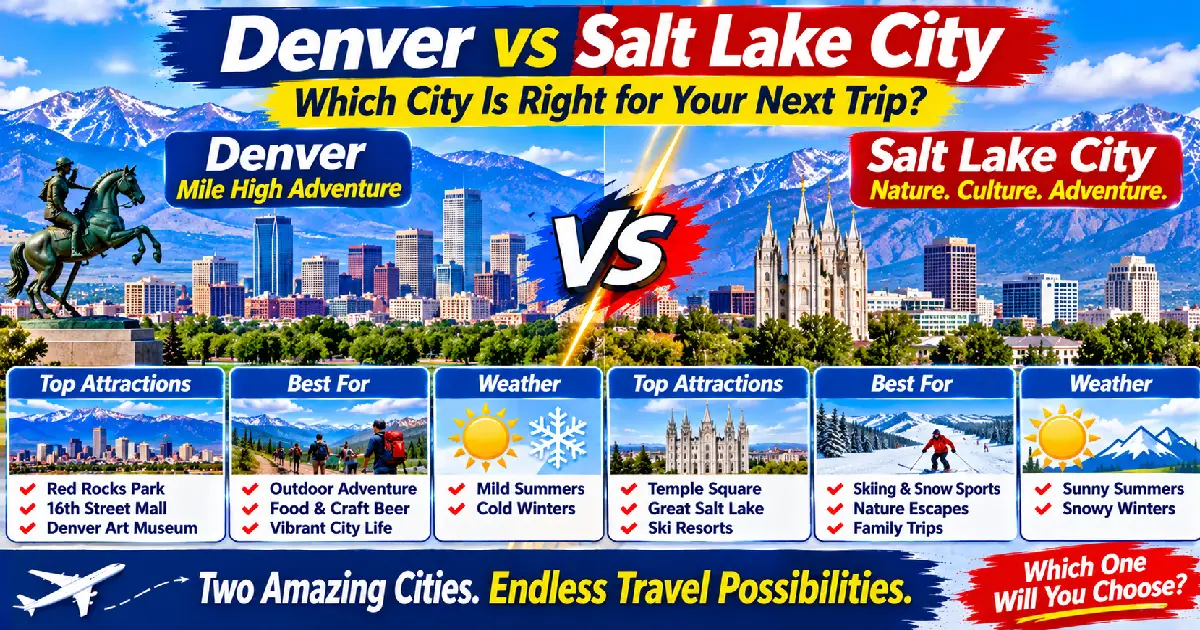
Denver and Salt Lake City are the two great gateway cities of the American Mountain West — the urban bases from which millions of travelers each year launch themselves into some of the most extraordinary outdoor terrain on the planet. They sit 525 miles apart along I-70 and I-15, at nearly identical elevations (Denver at 5,280 feet — exactly one mile above sea level, a figure the city celebrates with pride — Salt Lake City at 4,327 feet), and both are ringed by mountain ranges that offer world-class skiing, hiking, climbing, and mountain biking within an hour’s drive of downtown. But the two cities are profoundly different in character, culture, food, nightlife, and the texture of daily life — and understanding those differences is the most useful thing this guide can do for a traveler choosing between them.
Denver is a young, rapidly growing, deliberately cosmopolitan city of 730,000 people (3.3 million in the metro) that has remade itself since the 1990s from a cow-town gateway into a genuine cultural destination with world-class restaurants, a thriving craft beer scene, excellent museums, and a downtown that is genuinely walkable and lively. It is a secular, politically progressive, and notably hedonistic city for the Mountain West — recreational cannabis has been legal here since 2012, the craft brewery count exceeds 100, and the energy of a city that knows it has become desirable is palpable on every block of RiNo and Capitol Hill. Salt Lake City is smaller (210,000 people, 1.2 million metro), more conservative in its official culture (the Church of Jesus Christ of Latter-day Saints is headquartered here and shapes the city’s character in ways both profound and practical), and less celebrated as a food or nightlife destination — but it has changed dramatically in the past decade, now has an excellent restaurant scene, a genuine arts community in the Granary District, and serves as the single best ski hub on Earth: seven world-class resorts within 45 minutes of downtown, including Alta, Snowbird, Park City, and Deer Valley, all accessible on the same ski pass.
The choice between them is genuinely interesting, and it depends heavily on what you want from your trip. This guide compares both cities across every dimension that matters — skiing and outdoor access, neighborhoods, food, beer, cost, nightlife, museums, and day trips — and gives you a clear verdict at the end.
| Category | Denver, Colorado | Salt Lake City, Utah |
|---|---|---|
| Population | 730,000 (3.3M metro) | 210,000 (1.2M metro) |
| Elevation | 5,280 ft (1 mile exactly) | 4,327 ft |
| Ski resorts within 1 hr | 5 (Breckenridge, Keystone, A-Basin, Loveland, Echo Mountain) | 7 (Alta, Snowbird, Park City, Deer Valley, Solitude, Brighton, The Canyons) |
| Average snowfall (city) | 57 inches/year | 60 inches/year |
| Snowfall (nearest ski resort) | 300–400 inches | 500+ inches (Alta gets 547 avg) |
| Drive to nearest ski resort | 45–65 minutes (I-70) | 25–35 minutes (Little Cottonwood Canyon) |
| Average hotel | $150–250/night | $110–200/night |
| Average dinner | $45–75/person | $35–60/person |
| Craft breweries | 100+ | 30+ |
| Alcohol laws | Standard | DABC control state; beer <5% ABV in grocery stores (reforming) |
| Best for | Food, beer, nightlife, urban culture, road trip base | Skiing, Utah national parks, outdoor access, cost |
| Best season | May–Oct (city); Nov–Apr (ski) | Nov–Apr (ski); May–Oct (hiking/parks) |
This is the central comparison for most visitors, and the answer is more nuanced than it first appears.
Denver’s ski access runs primarily along the I-70 Mountain Corridor — the highway that climbs west from downtown through the Eisenhower Tunnel (11,013 ft, the highest tunnel on the US Interstate system) into the high Colorado Rockies. The drive from downtown Denver to Breckenridge Ski Resort (29 lifts, 2,908 acres, the highest lift-served terrain in North America at 12,998 ft) takes 1.5–2 hours in good conditions, rising to 2.5–4 hours on busy winter Fridays when I-70 turns into a parking lot. Keystone (1.5 hours, 3,148 acres) and Arapahoe Basin (1.5 hours, 1,428 acres, the longest season in Colorado — often open through June) are the two fastest options. Vail (100 miles, 2–2.5 hours, 5,317 acres — the largest ski resort in North America) is the most spectacular but the most traffic-prone drive.
The Colorado ski resorts accessed from Denver are globally celebrated for their terrain variety, mountain-town culture (Breckenridge and Vail are among the finest ski villages in the world), and consistently good snow — but the snowpack averages 300–400 inches per year, lower than Utah’s legendary totals. The Epic Pass ($900–1,000/season, $70–$84/day individual) covers Breckenridge, Keystone, Vail, Beaver Creek, and Park City (Utah) — the best ski value in North America.
Salt Lake City’s ski access is in a different category entirely. Little Cottonwood Canyon (25–35 minutes from downtown SLC) contains Alta Ski Area and Snowbird — two of the finest ski mountains in North America — within 3 miles of each other. Big Cottonwood Canyon (30 minutes) contains Solitude and Brighton. Park City (45 minutes via I-80 and UT-224, or 35 minutes on the new SkyLink gondola from Solitude) contains Park City Mountain Resort (7,300 acres, the largest ski resort in the US, Epic Pass) and Deer Valley (one of the finest groomed-terrain ski resorts in the world, skiers only, Ikon Pass). The Canyons is now merged with Park City.
The critical difference: Utah’s snowpack. Alta averages 547 inches of snow per year (45 feet) — more than any major ski resort in the continental US. This is the famous “Greatest Snow on Earth” — cold, dry, light powder that arrives in the night and sits waiting for you in the morning. A powder day at Alta or Snowbird after a 48-hour storm cycle is the finest skiing experience in the continental United States. The drive takes 25 minutes. The TRAX light rail ($2.50) runs from downtown SLC to the base of Cottonwood Canyon, where a free shuttle connects to the resorts — you can ski Alta without renting a car.
The verdict on skiing: Salt Lake City wins decisively for skiing. The combination of the world’s best snow (547 inches at Alta), the shortest drive from any major American city to world-class terrain (25 minutes), and the density of resorts (7 within 45 minutes) makes SLC the finest ski city on Earth. Denver’s ski access is world-class but requires a longer drive with more traffic risk on I-70.
Denver’s walkable neighborhoods are concentrated along a central core that has transformed dramatically in the past 15 years.
LoDo (Lower Downtown) is the historic heart — 19th-century brick warehouses converted into restaurants, bars, and the finest concentration of live music venues in the Rocky Mountain West, centered on Larimer Square (the oldest block in Denver, 1858, now the finest restaurant row) and the 16th Street Mall (free pedestrian shuttle along a 1.25-mile outdoor mall — the commercial spine of downtown). Coors Field (the MLB Colorado Rockies’ 1995 ballpark) anchors the northeastern edge; its opening catalyzed the neighborhood’s transformation.
RiNo (River North Arts District) is the city’s creative capital — a former industrial district along the South Platte River that has become the most vibrant urban neighborhood in Denver, with the highest concentration of craft breweries, street murals, independent restaurants, and music venues per block in the city. The Denver Central Market (16th at Denali, a food hall with 10 vendors in a converted warehouse), Zeppelin Station (a food hall and retail complex in a 1920s locomotive repair shop), and Finn’s Manor (outdoor beer garden) are the anchor experiences.
Capitol Hill is Denver’s most historically interesting residential neighborhood — Victorian mansions and 1920s apartment buildings on tree-lined streets around Cheesman Park, with a concentration of LGBTQ+ bars and restaurants along 13th and Colfax Avenues. East Colfax is the most genuinely gritty stretch — dive bars, 24-hour diners, independent record shops, and a community identity that resists gentrification with notable success. Congress Park and Cherry Creek (the finest upscale shopping in Denver, Cherry Creek Shopping Center and the outdoor Cherry Creek North district) round out the central neighborhoods.
Five Points is historically Denver’s African American cultural center — the “Harlem of the West,” once a destination for touring jazz and blues musicians during the segregation era (Miles Davis, Billie Holiday, and Nat King Cole all played here when they couldn’t stay in downtown hotels). The neighborhood is gentrifying rapidly, but the history survives in murals and the Five Points Jazz Festival (May, free).
Salt Lake City’s urban geography is defined by the Temple Square grid — Brigham Young’s 1847 city plan laid out in 10-acre blocks oriented to the cardinal points, with street names counting outward from Temple Square in all four directions (100 South, 200 South, 300 East, etc.) — a logical system that is initially confusing but makes navigation very simple once understood.
Downtown SLC is anchored by Temple Square (the world headquarters of the Church of Jesus Christ of Latter-day Saints — the 210-foot Salt Lake Temple under decades-long renovation, the Tabernacle home of the 360-voice Mormon Tabernacle Choir, the Church History Museum free, beautiful grounds free to walk, the most visited tourist site in Utah). The adjacent City Creek Center is a well-designed open-air mall with a retractable roof and a natural creek running through it. The Gateway is an older mixed-use development near the arena and stadium.
The Granary District (900 South to 1300 South, 200 West to 500 West) is SLC’s emerging arts and food neighborhood — a former flour mill and industrial area that has become the finest concentration of restaurants, galleries, and bars in the city over the past decade. 9th and 9th (900 East and 900 South) is the most walkable, most independent-bookshop-and-coffee-roaster neighborhood in SLC — the closest thing to a Portland or Seattle street corner in Utah. Sugar House (2100 South and 1100 East) is the most established bohemian neighborhood — record shops, used clothing, the finest coffee in the city at Publik Coffee Roasters, and Sugar House Park’s 110 acres along the Parley’s Creek corridor.
The Avenues (above North Temple, climbing into the foothills) are the Victorian residential streets that provide the finest historic architecture in SLC — a neighborhood that looks genuinely surprising in a western city of this age, with houses dating to the 1880s–1910s and mountain views from every block.
Denver’s food scene has elevated from adequate to genuinely excellent in the past decade, driven by a young professional population, an influx of chefs from coastal cities, and a farm-to-table ethos grounded in Colorado’s extraordinary agricultural bounty (Rocky Mountain lamb, Colorado beef, Palisade peaches and wine country in the western slope, San Luis Valley potatoes and green chiles from Pueblo).
The landmark restaurants: Fruition (Capitol Hill, farm-to-table New American, the restaurant that elevated Denver’s dining reputation when it opened in 2007, $38–65 mains, reservations essential), Acorn (Source Market Hall, RiNo, whole-animal wood-fired cooking, $28–52, one of the finest restaurants in Denver), Work & Class (RiNo, Latin-influenced comfort food — fried chicken, Cuban pork, smoked lamb — $18–28 mains, no reservations, cash preferred, the most beloved neighborhood restaurant in the city), Tammen’s Fish & Game (LoDo, contemporary seafood and game, the finest new restaurant in Denver, $45–75), El Tejado (Federal Boulevard, the most authentic Mexican food in Denver — Colorado’s largest Mexican-American community lives along Federal Boulevard and its surrounding neighborhoods, and the taquerias here are genuinely excellent, $8–16). Larimer Square restaurant row: Rioja (Mediterranean, $28–52, Jennifer Jasinski’s flagship), Bistro Vendôme (French bistro in the alley, finest outdoor dining in Denver), Stoic & Genuine (oyster bar and seafood).
The food hall scene: The Source (RiNo, 40,000 sq ft in a 19th-century foundry — Acorn restaurant, Crooked Stave brewery tap, New Belgium Hub, Mondo Market), Denver Central Market (also RiNo, 10 vendors, the finest tacos and pastries), Zeppelin Station (RiNo, pan-Asian food hall in a locomotive workshop).
Salt Lake City’s food scene has transformed more dramatically than any comparable American city in the past decade — driven partly by a growing non-LDS population, partly by an influx of tech workers, and partly by a generation of chefs who grew up here and came back after training elsewhere. The city now has a genuine restaurant culture that no longer requires apologizing for its alcohol laws.
The landmark restaurants: Pago (9th and 9th, the finest farm-to-table restaurant in Utah, the restaurant that most defines SLC’s new culinary identity, seasonal New American, $32–58, reservations essential), Forage (Capitol Hill area, Utah’s most acclaimed tasting menu, $95–115, seasonal ingredients sourced from local farms and foragers — the finest fine dining experience in Salt Lake City), The Rose Establishment (Granary District, the finest all-day café in SLC — exceptional breakfast and lunch), BTG Wine Bar (9th and 9th, the finest wine selection in Utah in a converted Victorian house), Pretty Bird (multiple locations, the finest hot chicken in the Mountain West — James Beard–nominated chef Viet Pham’s fast-casual operation), La Barba Coffee (multiple locations, the finest coffee roaster in Utah). Crown Burgers (multiple locations, the Utah regional chain with a cult following for its pastrami burger — a fried beef patty topped with sliced pastrami, the defining fast food of Salt Lake City, $7–10).
The alcohol question: Utah has historically had some of the most restrictive alcohol laws in the United States — a product of LDS influence on state government. In 2026, beer up to 5% ABV (previously 3.2%) can be purchased in grocery stores; liquor, wine, and stronger beer must be purchased at state-run DABC stores. Restaurants can serve full-strength cocktails, wine, and beer with a food order. The practical effect for visitors is minimal — every restaurant worth going to serves alcohol — but you cannot buy a six-pack of craft IPA at a 7-Eleven. The city’s bar scene has grown significantly, concentrated in the Granary District and along 300 South.
The verdict on food: Denver wins on diversity, density, and the sheer number of exceptional restaurants across every cuisine and price point. Salt Lake City wins on the remarkable quality of its small number of landmark restaurants relative to its size — Forage and Pago are genuinely world-class — and on overall value (comparable quality costs 20–30% less than Denver).
Denver is one of the great craft beer cities of the world. Colorado has the highest number of craft breweries per capita of any US state, and Denver proper has more than 100 craft breweries within the city limits — a density that makes brewery-hopping by foot or bike genuinely possible in RiNo and LoDo.
The essential Denver brewery experiences: Great Divide Brewing (LoDo original taproom, open since 1994, Yeti Imperial Stout and Titan IPA are the flagship releases — the Yeti is one of the finest imperial stouts produced in America), Wynkoop Brewing (LoDo, Colorado’s first craft brewery, 1988, John Hickenlooper co-founded it before becoming governor then senator, 3 floors of bars and billiards in a historic mercantile building), Breckenridge Brewery (Littleton south suburb, enormous campus with full restaurant, Colorado’s largest craft brewery), Crooked Stave (The Source, RiNo, the finest sour and wild-fermented ales in Colorado — Chad Yakobson’s brewery is one of the best in the world for this style, $6–10/pour), Our Mutual Friend (RiNo, the finest small-batch experimental taproom in Denver), Epic Brewing (LoDo, Utah-founded brewery that opened a Denver location specifically because of Colorado’s more permissive alcohol laws — their Big Bad Baptist imperial stout is famous).
The RiNo Brewery District along Larimer and Walnut Streets between 26th and 38th can be walked in a single afternoon — Black Shirt Brewing (red ales), Ratio Beerworks (music-inspired branding, excellent IPAs), Former Future (small-batch wood-fired styles), Stem Ciders (the finest cider taproom in Denver) — creating the finest brewery walk in the Mountain West.
Utah’s craft beer scene has grown significantly since the state’s ABV limit increased from 3.2% to 5% in 2019 and to the current threshold — though full-strength craft beers still require purchase at a DABC store rather than a grocery store. Salt Lake now has approximately 30 craft breweries, several of which are genuinely excellent.
Epic Brewing (South Salt Lake, the original location — founded 2010 as the first Utah brewery to exclusively produce high-ABV “Epic Ales” above the former 3.2% limit, required selling to specialty bars only; now available widely) produces some of the finest imperial stouts and double IPAs in the Mountain West. Bohemian Brewery (Midvale, Czech-style lagers and pilsners, the finest lager brewing in Utah), Uinta Brewing (the largest craft brewery in Utah, headquartered in SLC, Cutthroat Pale Ale is the flagship, 100% wind-powered brewery, widely distributed across the western US), Fisher Brewing (Granary District, small-batch, the finest taproom experience in SLC — a converted 1892 warehouse with outdoor space and excellent food from a kitchen trailer), Proper Brewing (Downtown, full restaurant and the best pub food in SLC, Hazel Imperial Porter is exceptional).
The verdict on beer: Denver wins comprehensively — 100+ breweries versus 30+, greater style diversity, and no residual alcohol law complications make Denver one of the finest craft beer cities on Earth. If craft beer is a primary reason for your trip, Denver is the obvious choice.
Denver has become significantly more expensive over the past decade as its population has surged. Hotels downtown average $150–250/night for a mid-range room; budget options exist in Capitol Hill and along East Colfax ($85–130/night) without sacrificing safety. Food spans from the $10 breakfast burrito at a Federal Boulevard taqueria to $120+ tasting menus; a typical mid-range dinner for two with drinks costs $90–140. Transport is the strength — the RTD light rail ($3/ride) connects Denver International Airport (DIA) to downtown in 37 minutes ($10.50), and the 16th Street Mall free shuttle covers the downtown core. A rental car is necessary for ski trips and most mountain excursions. Cannabis (legal since 2012) represents a meaningful additional spending category for some visitors — dispensaries are concentrated along Broadway south of downtown, prices are $8–15/gram, $35–50/eighth for premium flower.
Budget estimate per person per day: $180–280 (mid-range); $300–450 (comfortable with ski day); $90–130 (budget, hostel, street food and taquerias).
Salt Lake City remains one of the most affordable mid-size cities in the western United States for visitors — hotel and restaurant prices run 20–30% below comparable Denver options, the ski resort day tickets are comparable (Deer Valley $250+, but Brighton $95–120/day is the finest value ski resort near any American city), and the city’s compact scale means less transportation spending. Hotels average $110–200/night downtown; budget options exist in the Avenues and Sugar House ($75–120/night). Food is 20–30% less expensive than Denver for comparable quality. The TRAX light rail ($2.50/ride) is excellent for in-city movement and ski resort access.
Budget estimate per person per day: $150–240 (mid-range); $250–400 (comfortable with ski day at Brighton/Solitude); $80–110 (budget).
The verdict on cost: Salt Lake City is meaningfully more affordable for both hotels and food, and offers the world’s finest skiing at a lower price point than comparable resorts accessed from Denver. If budget is a factor, SLC is the better value.
Denver’s nightlife is anchored by a live music culture that punches well above its demographic weight — the city has produced or hosted more touring acts per capita than virtually any comparable American city, and its venue landscape spans every genre and scale.
Live music: Red Rocks Amphitheatre (Morrison, 15 miles from downtown, 9,525-person capacity carved into natural red sandstone formations at 6,450 ft — the finest outdoor concert venue in the world, consistently voted the best venue in America by Rolling Stone and Pollstar, $25–150/show, accessible by shuttle from Union Station May–October), Fiddler’s Green (Greenwood Village, 18,000 capacity), Mission Ballroom (RiNo, 3,950 capacity, the finest mid-size concert venue in Denver), Ogden Theatre (East Colfax, 1,600 capacity, the most beloved mid-size room in Denver — intimate, great sightlines, perfect acoustics), Bluebird Theater (East Colfax, 550 capacity, the finest small venue).
Comedy and performing arts: Comedy Works (LoDo original location and Greenwood Village — the finest comedy club in the Mountain West, has launched numerous SNL cast members and touring headliners), Denver Center for the Performing Arts (DCPA — 10 venues in the downtown arts complex, Broadway touring productions and original theater), Denver Art Museum ($18/adult, the Daniel Libeskind titanium Frederic C. Hamilton Building and the Martin Building together house one of the finest collections of American Indian art in the world).
Bars: Williams & Graham (LoHi neighborhood — accessed through a “bookshelf” secret door in a fake bookshop, consistently ranked among the 10 best bars in the United States, $14–18 cocktails, reservations only), Colt & Gray (LoHi, the finest upscale cocktail program in Denver), Tight End Sports Bar (East Colfax, the opposite end of the spectrum — dive bar with inexplicable loyalty).
Salt Lake City’s nightlife has grown significantly from its historically constrained reputation. The city now has a genuine late-night culture concentrated in the Granary District and along 300 South, though it is smaller and closes earlier than Denver.
Live music: Red Butte Garden (University of Utah foothills, 3,000-seat outdoor amphitheater against the Wasatch Mountains backdrop — the best outdoor concert experience in SLC), The Depot (downtown, 1,100 capacity in a converted train depot, excellent mid-size venue), Metro Music Hall (downtown, 700 capacity, the finest small venue), Dead Goat Saloon (the oldest bar in SLC, Crossroads area, the DNA of SLC’s bar culture).
Performing arts: Utah Symphony (Abravanel Hall, 2,800 seats, one of the finest symphony halls acoustically in the United States), Ballet West (Capitol Theatre), Pioneer Theatre Company. Temple Square also hosts nightly performances of the Mormon Tabernacle Choir (tickets free but competitive — apply 6 months in advance for Sunday morning broadcasts).
The verdict on nightlife: Denver wins convincingly — 100+ craft breweries, Red Rocks Amphitheatre (a genuine bucket-list venue), and a denser, later-running bar and music scene. Salt Lake City’s nightlife is adequate and improving but cannot match Denver’s scale or variety.
Denver Art Museum (DAM, 100 W 14th Avenue Pkwy, $18/adult — Daniel Libeskind’s titanium Hamilton Building is one of the finest contemporary museum buildings in the country; the collection of American Indian art is the finest in any art museum; the Western American art collection is exceptional). Denver Museum of Nature & Science ($18.95/adult, IMAX, Gates Planetarium — one of the finest natural history museums in the Mountain West). History Colorado Center ($14/adult — the finest state history museum in the Rocky Mountain region). Clyfford Still Museum ($12/adult — the complete collection of one major Abstract Expressionist painter in a purpose-built building, one of the finest single-artist museum experiences in America). Denver Botanic Gardens ($15/adult, 24 acres, the finest collection of plants adapted to the Rocky Mountain climate). Denver Zoo ($20/adult).
Natural History Museum of Utah (University of Utah campus, $17.95/adult — the finest collection of dinosaur fossils from the Colorado Plateau in the world, the building by Ennead Architects 2011 is among the finest natural history museum buildings in the US). Utah Museum of Fine Arts (University of Utah, $8/adult, the most underrated museum in SLC). Leonardo Museum (downtown, $14/adult, science and technology). Church History Museum (Temple Square, free — the most important museum for understanding Mormon history and the settlement of the American West). Gilgal Sculpture Garden (900 South — a genuinely bizarre privately created outdoor sculpture garden with stone carvings of the LDS prophet Joseph Smith in a Sphinx’s body and other theologically motivated stonework, free, one of the strangest art experiences in the United States).
Choose Denver if:
Choose Salt Lake City if:
The honest answer: Denver is the superior urban destination — it has better food variety, more nightlife, a vastly better craft beer scene, and Red Rocks. Salt Lake City is the superior outdoor base — it has better ski access, is closer to more national parks, costs less, and its best restaurants (Forage, Pago) match Denver’s finest. For a pure city trip, Denver. For a ski trip or national parks road trip, Salt Lake City.
Posted By : Vinay
Latest Article
2nd Floor, 39, Above Kirti Club, DLF Industrial Area, Kirti Nagar, New Delhi, Delhi 110015



Travel Tourister is a leading Travel portal where we introduce travellers to trusted travel agents to make their journey hasselfree, memorable And happy. Travel Tourister is a platform where travellers get Tour packages ,Hotel packages deals through trusted travel companies And hoteliers who are working with us across the world. We always try to find new and more travel agents and hoteliers from every nook and corners across the world so that you could compare the deals with different travel agents and hoteliers and book your tour or hotel with the one you have chosen according to your taste and budget.
Copyright © Travel Tourister, India. All Rights Reserved

 Call
 Enquiry