Published on : 30 Oct 2026
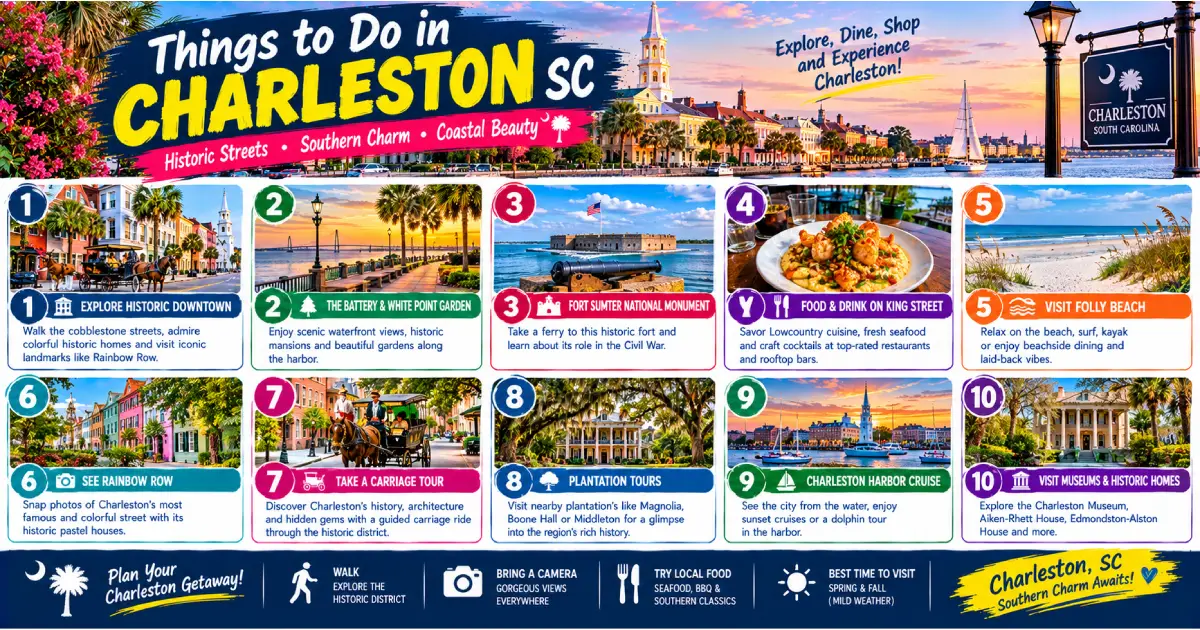
Charleston, South Carolina is one of the oldest and most beautifully preserved cities in the United States, a place where 350 years of history live not in museums but in the streets themselves. Founded in 1670 as Charles Town — the first permanent English settlement in the Carolinas — the city grew wealthy on the labor of enslaved Africans who cultivated rice, indigo, and cotton, leaving behind a dual legacy of architectural splendor and profound moral reckoning that Charleston is only now fully confronting. Walking the cobblestone lanes of the French Quarter or standing at White Point Garden where the Cooper and Ashley Rivers meet the harbor, you feel this weight and this beauty simultaneously, and that tension is precisely what makes Charleston unlike any other American city.
The food scene alone justifies a trip. Charleston is widely regarded as the finest dining city in the American South, and arguably one of the top five food cities in the entire country — a distinction driven by a generation of James Beard Award–winning chefs who have elevated Low Country cooking (shrimp and grits, she-crab soup, pimento cheese, Frogmore stew) into genuine culinary art. The Ordinary, FIG, Husk, and Rodney Scott’s BBQ have made King Street and its surrounding blocks a dining destination that draws food writers from New York and Los Angeles. Add the thriving craft cocktail scene, the rooftop bars overlooking church steeples, and the Saturday Farmers Market at Marion Square — one of the best in the South — and you could spend days eating your way through this city without once setting foot in a museum.
Beyond the plate, Charleston rewards the curious traveler at every turn. The plantation houses along Ashley River Road offer some of the most significant and sobering historical experiences in America, with Middleton Place, Drayton Hall, and Magnolia Plantation each telling different chapters of the Low Country story. Fort Sumter in the harbor is where the American Civil War began on April 12, 1861. The Sullivan’s Island beach and the wild barrier islands accessible only by boat offer Atlantic coast escapes within 30 minutes of downtown. And the Angel Oak Tree on Johns Island — estimated at 400 to 500 years old, with branches that spread 187 feet in circumference — is one of the most extraordinary living things you will ever stand beneath. This guide covers the 20 best things to do in Charleston SC, with the practical details you need to make the most of every hour.
| Category | Highlight | Cost |
|---|---|---|
| Best historical site | Fort Sumter National Monument | $28/adult |
| Best plantation | Drayton Hall (unrestored) | $30/adult |
| Most iconic street | Rainbow Row, East Bay Street | Free |
| Best beach | Sullivan’s Island | Free |
| Best restaurant | FIG or The Ordinary | $35–75/person |
| Best rooftop bar | Pavilion Bar at Market Pavilion Hotel | Free entry |
| Best free attraction | Angel Oak Tree, Johns Island | Free |
| Best neighborhood walk | South of Broad/Battery | Free |
| Best day trip | Hunting Island State Park | $8/vehicle |
| Best market | City Market / Saturday Farmers Market | Free entry |
| Best time to visit | April–May or October–November | — |
| Getting there | CHS Airport, 12 miles from downtown | — |
No site in Charleston carries more historical weight than Fort Sumter, the federal garrison in the middle of Charleston Harbor where Confederate forces opened fire at 4:30 AM on April 12, 1861, beginning the American Civil War. The battle lasted 34 hours before Union Major Robert Anderson surrendered the fort, and Confederate troops occupied it for nearly four years — through relentless Union bombardment that reduced the original five-sided brick structure to a sand-and-rubble heap — until the fall of Charleston in February 1865.
The only way to reach Fort Sumter is by ferry from Liberty Square Visitor Center downtown or from Patriots Point in Mount Pleasant. Fort Sumter Tours operates the official ferry service; tickets cost $28/adult and $18/children 5–11, with the crossing taking about 30 minutes each way. The guided tours on the island are included in the ferry price and led by National Park Service rangers. Allow a full half-day: the ferry schedule, 30-minute crossing, and 60–90 minutes on the island typically take 3 to 4 hours total. The Liberty Square Visitor Center has excellent exhibits on the bombardment and the broader context of the war’s origins — worth 30 minutes before boarding. Book tickets in advance at fortsumtertours.com, especially in spring and fall when they sell out; peak season runs April through October.
Pro tip: The return ferry at sunset offers one of the best views of the Charleston skyline and the harbor available anywhere — position yourself on the upper deck facing west.
The Battery is the southernmost tip of the Charleston Peninsula, where the Cooper and Ashley Rivers converge to form Charleston Harbor, and White Point Garden is the park at its point — one of the most atmospheric public spaces in the American South. Massive live oak trees draped in Spanish moss shade Civil War–era cannons and artillery pieces, monuments to Confederate officers, and benches facing the water where locals read newspapers on weekday mornings as they have for generations.
The promenade along the seawall — East Battery and Murray Boulevard — is lined with the grandest antebellum mansions in the city, including the Edmondston-Alston House (1825, open for tours at $15/adult, one of the finest Federal/Greek Revival homes in America), the Ravenel House, and a succession of single houses and double houses that represent the full spectrum of Charleston’s architectural tradition. Walking this promenade at golden hour, with the harbor light catching the pale yellow and pink stucco facades, is one of the most beautiful walks in America — entirely free and available at any hour.
The single house — Charleston’s distinctive vernacular architecture, one room wide with the narrow end facing the street and a side piazza running the full length — was developed specifically for the peninsula’s climate and lot sizes, and the Battery has some of the finest examples anywhere.
Rainbow Row is the most photographed streetscape in Charleston and one of the most recognizable in the American South: a stretch of 13 connected Georgian row houses on East Bay Street (numbers 99–107) painted in a spectrum of pastel colors — peach, yellow, pink, pistachio, coral, and powder blue — that has become the city’s visual signature. The houses date from the 1740s to 1790s and served as merchant warehouses and residences during Charleston’s colonial mercantile peak, when this section of East Bay Street was the commercial heart of one of the wealthiest cities in British North America.
The pastel color scheme is not original — the houses were painted in their current palette beginning in the 1930s by Susan Pringle Frost, who purchased and restored several of the buildings as part of the early historic preservation movement that eventually saved much of Charleston’s antebellum fabric. Today Rainbow Row is entirely private residential property; you can photograph from the street but cannot enter. The best light for photography is morning (the facades face east-southeast) between 8 and 10 AM. The surrounding French Quarter neighborhood — bounded roughly by Broad Street, Meeting Street, East Bay Street, and the harbor — is the most intact Colonial-era streetscape in the United States and worth at least an hour of wandering.
Three of the most significant plantation sites in America lie within 15 miles of downtown Charleston along Ashley River Road, each offering a distinct and important experience of the Low Country’s antebellum past.
Drayton Hall ($30/adult) is the most architecturally important: an unrestored, unfurnished 1738 Palladian mansion that has never been modernized — no electricity, no plumbing, no central heat — making it the finest surviving example of Georgian-Palladian architecture in America and a rare opportunity to see an 18th-century building exactly as time has left it. The guided tours, now explicitly centered on the enslaved people who built and maintained the house, are among the most thoughtful and rigorous historical interpretations anywhere in the South. Open Thursday–Monday.
Middleton Place ($30/adult grounds; $15 additional for house tours) features America’s oldest formally landscaped gardens (1741), designed in the French and English geometric tradition with terraced rice mill ponds, butterfly lakes, and allées of live oaks. The house museum focuses on the Middleton family — two generations signed the Declaration of Independence and the Articles of Secession — and the museum village has the most detailed interpretation of enslaved artisan life in the Low Country. The on-site restaurant serves the finest plantation lunch in the region ($18–32).
Magnolia Plantation and Gardens ($25/adult) has the oldest public garden in the United States (established 1676) and the most romantically overgrown setting — azaleas blooming in March and April make it one of the most spectacular flower displays in the country. The wildlife tour boat ($10 additional) goes through the blackwater cypress swamp for herons, egrets, alligators, and turtles.
Charleston’s French Quarter — the colonial core of the city — contains the highest concentration of pre-Revolutionary architecture in the United States, and walking its streets with a good guide (or a good guidebook) reveals layers of history invisible to the casual eye. The Old Exchange and Provost Dungeon (122 East Bay Street, $12/adult) is one of the most important surviving Colonial buildings in America: the Exchange Room on the second floor is where Charleston merchants ratified the Constitution, and the dungeon below held American patriots captured by the British during the occupation of 1780–82. The Heyward-Washington House (1772, $12/adult) is where George Washington stayed during his 1791 Southern Tour, furnished exactly as it was in the late 18th century with Charleston-made furniture considered among the finest American craftsmanship of the period.
The Old City Market (188 Meeting Street, free entry) has operated continuously since 1788 — though the current sheds date from the 1840s — and is best known today for the Gullah Geechee sweetgrass basket weavers who sell their work here, a craft tradition brought from West Africa that has been practiced continuously in the Low Country for over 300 years. Sweetgrass baskets range from $45 to several hundred dollars depending on size and complexity; buying directly from the weavers supports one of the most endangered folk traditions in America.
Self-guided walking tour maps are available free at the Charleston Visitor Center (375 Meeting Street), the best starting point for any first visit. The Charleston Strolls Walking Tour ($30/adult) and the Architectural Walking Tour of the Ansonborough neighborhood ($25/adult) are consistently rated the finest guided options.
In addition to the Ashley River plantations covered above, Boone Hall Plantation (1235 Long Point Road, Mount Pleasant, $28/adult) offers a third distinct experience: the longest and most photographed plantation oak avenue in America (Slave Street Avenue of the Oaks, three-quarters of a mile of towering live oaks), nine original slave cabins (the most intact slave street in the South) with a museum documenting the lives of the enslaved Gullah community, and a still-operating farm stand selling seasonal produce. Boone Hall appeared in the 1994 film Queen and the 1996 miniseries North and South, and its oak avenue is arguably the single most iconic landscape image in the Carolina Low Country. Open year-round Monday–Saturday 9 AM–5 PM, Sunday noon–5 PM.
The three Ashley River plantations together form a full day trip from Charleston; if choosing one, Drayton Hall offers the most architecturally and historically rigorous experience, Magnolia the most romantic setting, and Middleton Place the most comprehensive interpretation of plantation life.
On Johns Island, 12 miles southwest of downtown Charleston, the Angel Oak is estimated to be between 400 and 500 years old, making it one of the oldest living things east of the Mississippi River. The tree stands 66.5 feet tall, measures 28 feet in circumference, and has branches that spread 187 feet in every direction — some of the largest limbs dip to the ground and travel horizontally for 89 feet before rising again. Standing beneath it is one of those experiences that temporarily dissolves ordinary scale.
The Angel Oak is owned by the City of Charleston and is entirely free to visit, open daily 9 AM–5 PM Monday–Saturday and 1–5 PM Sunday. Parking is free. The site is small — the tree itself is the attraction — and visits typically last 20–30 minutes, though many people sit beneath the canopy for much longer. The best time to visit is early morning on a weekday when crowds are minimal; weekend afternoons can become crowded, particularly in spring. Combine with a drive through the Sea Islands or a visit to the Kiawah Island Beachwalker County Park (the only public beach access on Kiawah Island, $10/vehicle in peak season) to make a full day trip.
Charleston’s most accessible beaches are on the barrier islands northeast of the peninsula, reached by crossing the Arthur Ravenel Jr. Bridge or the Ben Sawyer Bridge. Sullivan’s Island (15 miles from downtown, free parking) is the more historically interesting: Fort Moultrie here repelled the first British naval attack of the Revolutionary War in June 1776 — the palmetto logs used in its construction absorbed British cannonballs without splintering, saving the fort and giving South Carolina its nickname, the Palmetto State — and Edgar Allan Poe was stationed here from 1827 to 1828, drawing on the island’s geography for “The Gold Bug.” The National Park Service maintains Fort Moultrie as a unit of the Fort Sumter National Monument (free admission), with excellent exhibits on the three forts built on this site between 1776 and 1947.
The beach itself is wide, clean, and less crowded than Isle of Palms; Middle Street’s collection of casual restaurants and bars — Poe’s Tavern (named for the writer, excellent burgers, $14–22) and Dunleavy’s Pub (a genuine neighborhood bar since 1980) — make it the more atmospheric beach destination. Isle of Palms (adjacent to Sullivan’s Island) offers the widest beach and Wild Dunes Resort if you want full resort amenities; Isle of Palms County Park ($10/vehicle in peak season) has the only designated parking area on the main beach.
The Gullah Geechee people — direct descendants of enslaved West and Central Africans who maintained distinctive language, foodways, music, and craft traditions on the Sea Islands of South Carolina, Georgia, and Florida — are the living cultural foundation of the Low Country, and understanding their contribution is essential to understanding Charleston. The Gullah Geechee Cultural Heritage Corridor (designated by Congress in 2006) extends from Wilmington, NC to Jacksonville, FL, with the most concentrated heritage sites in the Charleston area.
The McLeod Plantation Historic Site on James Island ($10/adult, open Thursday–Monday) is the most significant and honest plantation site in the region, presenting the full history of slavery, the Gullah community, Reconstruction, and the 20th-century African American experience on a single property without sanitizing any of it. The Avery Research Center for African American History and Culture at the College of Charleston (free, Monday–Friday) holds the most important archive of Gullah Geechee history in existence. Gullah Tours ($20/adult, walking and bus options) run by Alphonso Brown is the original Gullah heritage tour in Charleston, operating since 1991. The sweetgrass basket weavers at the City Market and along Highway 17 in Mount Pleasant represent the most visible continuation of this living tradition.
Charleston’s restaurant scene is arguably the finest in the American South and belongs in the national conversation about great American food cities. The culinary tradition runs deep — Low Country cooking developed over 300 years from the intersection of West African, European, and Native American foodways — and a generation of chefs have honored that tradition while pushing it forward in ways that have earned the city a remarkable concentration of James Beard Awards.
FIG (232 Meeting Street, $35–70/person, reservations essential 30 days in advance via Resy) is the restaurant most credited with defining modern Charleston cooking — chef Mike Lata’s James Beard Award–winning kitchen produces the finest vegetable-forward, ingredient-driven Low Country cuisine in the city, with a constantly changing menu built around relationships with local farms and fishermen. The Ordinary (544 King Street, $28–65/person) is FIG’s sibling, a converted 1920s bank hall transformed into the finest oyster bar and seafood hall in the Southeast — the plateau de fruits de mer and the shrimp and grits are exceptional. Husk (76 Queen Street, $28–58/person) under chef Sean Brock’s founding philosophy uses only ingredients sourced from the American South, serving in a beautiful 1893 Victorian house.
For more casual excellence: Rodney Scott’s BBQ (1011 King Street) — Rodney Scott won the James Beard Award for Best Chef Southeast 2018, and his whole-hog pit BBQ is the finest in the state. Bertha’s Kitchen (2332 Meeting Street, lunch only, cash preferred, $8–14) serves the most authentic Low Country soul food in Charleston — the lima beans, okra soup, and fried pork chop are transcendent. Lewis Barbecue (464 North Nassau Street, $12–18 by the pound) brings Texas-style Central Texas brisket and beef ribs to Charleston with extraordinary results.
King Street is Charleston’s main commercial spine, dividing naturally into three distinct zones: Lower King (Broad Street to Beaufain Street, antiques and galleries), Middle King (Beaufain to Calhoun, boutiques, restaurants, and bars), and Upper King (Calhoun to Spring Street, the most vibrant dining and nightlife district). The 30-block stretch from Broad to Spring is one of the most walkable and economically vital commercial streets in the American South, with almost no chain retail and a high concentration of locally owned businesses.
For cocktails, Charleston punches well above its population weight. The Gin Joint (182 East Bay Street) has been the standard-bearer for the city’s craft cocktail movement since 2010 — the bartenders are the most knowledgeable in the city and the seasonal cocktail menu is genuinely inventive. Husk Bar (76 Queen Street, same house as the restaurant) serves the finest bourbon selection in the Low Country. The Rooftop at the Vendue (19 Vendue Range, $14–18 cocktails, free entry) offers arguably the finest view of the church steeples and harbor in the city. Pavilion Bar at Market Pavilion Hotel (225 East Bay Street, $15–22 cocktails) is the most glamorous rooftop in Charleston, with a pool, panoramic harbor views, and a dress code — arrive before sunset for the best light.
The Charleston Museum (360 Meeting Street, $15/adult) holds the distinction of being the oldest museum in the United States, founded in 1773, and its collection spans the full arc of Low Country history from pre-Colonial Native American cultures through the Civil Rights era. The natural history collection, the silver and decorative arts, and the textile collection are the most significant in the state. Combination tickets with the historic house museums are good value.
The Nathaniel Russell House (51 Meeting Street, $15/adult, combination ticket with Aiken-Rhett $22) is one of the finest Federal-period houses in America — built 1808 for a Rhode Island merchant — with a free-flying elliptical spiral staircase that rises three stories without any visible means of support, considered one of the great engineering achievements of American domestic architecture. The Aiken-Rhett House (48 Elizabeth Street, $15/adult) is the most intact antebellum urban plantation complex in the country, with the main house, slave quarters, carriage house, and outbuildings all still standing in essentially unrestored condition — a haunting and essential visit.
The harbor and the tidal creeks of the surrounding Sea Islands offer some of the finest water-based experiences in the Low Country. Spiritline Cruises operates the Fort Sumter ferry and also runs a 90-minute sightseeing cruise ($30/adult) of the harbor, passing Fort Sumter, Castle Pinckney, the Ravenel Bridge, and the container terminal — one of the busiest ports on the East Coast. The sunset dinner cruise ($68/adult) is the most romantic option.
For active water recreation, the tidal creeks and marsh channels of James Island County Park, Folly Beach, and the ACE Basin (an 350,000-acre protected estuary 45 minutes southwest of the city — the largest undeveloped estuary on the East Coast) offer world-class kayaking. Half Moon Outfitters (280 King Street) rents kayaks and paddleboards ($50–65/half day) and offers guided tours to remote creeks. Charleston Kayak Company based at Charles Towne Landing runs the finest naturalist-guided kayak tour through the marsh ($55/person, 2.5 hours) with reliable dolphin and alligator sightings.
“South of Broad” — the residential neighborhood below Broad Street that occupies the southern tip of the Charleston Peninsula — is the most concentrated display of antebellum domestic architecture in America, and walking its streets is like walking through a living museum of Southern history. The neighborhood is entirely private residential but the streets are public, and the architectural density — double piazzas, ironwork gates, walled gardens overflowing with camellias and Confederate jasmine, single houses in every shade of pastel — makes every block a revelation.
The Calhoun Mansion (16 Meeting Street, $15/adult for guided tours of the interior) is the largest single private residence in Charleston, built in 1876 for a cotton merchant in extravagant Victorian excess — 35 rooms, 24,000 square feet, with original furnishings, a 45-foot domed ceiling in the great hall, and a rooftop belvedere with harbor views. The Miles Brewton House (27 King Street, private, not open for tours) is considered by architectural historians to be the finest Georgian Colonial mansion in America, built 1769 — the building has passed by inheritance and has never been sold. The Beth Elohim Synagogue (90 Hasell Street, free, call ahead) is the oldest continuously active Reform Jewish congregation in the world (founded 1749) and one of the finest examples of Greek Revival architecture in the city.
Fifty miles south of Charleston near Beaufort, Hunting Island State Park is one of the most spectacular natural environments on the East Coast and the most visited state park in South Carolina — a protected barrier island with 5 miles of undeveloped Atlantic beach, a 14,000-acre maritime forest of palmettos and live oaks, salt marsh, tidal lagoon, and a 19th-century lighthouse. The entrance fee is $8/vehicle.
The Hunting Island Lighthouse (1875, the only publicly accessible lighthouse in South Carolina, $2/adult additional) stands 136 feet tall with 181 steps; the view from the top — open Atlantic to the east, the Fripp Inlet and Sea Islands to the west — is one of the finest coastal panoramas in the South. The lighthouse is one of only a few in the United States designed to be disassembled and moved; its current location is its second, after erosion threatened the original site. The park’s cabin rentals ($100–175/night) are among the most sought-after in the South Carolina state park system, booking up 11 months in advance. Camping is $25–35/night. The park appeared in the 1994 film Forrest Gump, where it doubled for Vietnam.
Marion Square is Charleston’s central public green, a 10-acre park bounded by Calhoun, King, Radcliffe, and Meeting Streets that serves as the social and civic heart of the upper peninsula. The Charleston Farmers Market (mid-April through late November, Saturdays 8 AM–2 PM) is consistently rated one of the best in the South — 100+ vendors selling Low Country produce, artisan food, plants, crafts, and prepared food, with live music and an atmosphere that captures the city’s community character better than almost anything else. The South Carolina Artisans Center operates a booth here year-round.
The square is surrounded by several of Charleston’s most important cultural institutions: the Charleston Museum (adjacent), the Francis Marion Hotel (1924, 387 rooms, the grande dame of Charleston hotels), and the Embassy Suites. The Citadel (171 Moultrie Street, The Citadel campus, free to walk, Friday afternoon dress parades open to public during academic year at 3:45 PM) is just northwest of the square — the military college founded in 1842 whose Friday parades in the full-dress grey uniform are one of the most distinctly Charleston spectacles available for free.
The College of Charleston (founded 1770, the oldest municipal college in the United States) occupies the northern edge of the historic district, with a beautiful campus of antebellum buildings centered on Randolph Hall (1828) — one of the finest Greek Revival buildings in the South. The campus is open to the public and makes for a pleasant walk; the Addlestone Library holds the South Carolina Jewish Heritage Collection, and the Halsey Institute of Contemporary Art (free) presents some of the most interesting contemporary art exhibitions in the Southeast.
The surrounding Wraggborough and Radcliffeborough neighborhoods north of Calhoun Street are Charleston’s quietest and most authentically residential historic areas — less visited than South of Broad but filled with early 19th-century vernacular architecture, small parks, and the steeples of historic churches. The Kahal Kadosh Beth Elohim Reform Temple is here. The neighborhood around Cannon Street and Rutledge Avenue has Charleston’s best casual lunch spots, coffee shops, and independent bookstores.
Folly Beach — 11 miles south of downtown on a barrier island off James Island — is Charleston’s most laid-back and genuinely local beach community, a 6-mile-long island whose funky beach town character sets it apart from the more manicured resort beaches nearby. The main street (Center Street) is lined with surf shops, seafood shacks, tiki bars, and live music venues; the Chico Feo bar garden on the marsh side is the finest casual outdoor drinking spot in the Charleston area. The Folly Beach County Park at the western tip ($10/vehicle, April–September) has the widest beach and the best waves for surfing.
The Morris Island Lighthouse — a 161-foot cast-iron lighthouse built in 1876, now standing in the surf 100 yards offshore after a century of erosion — is visible from the east end of Folly Beach and is one of the most photogenic coastal landmarks in the South. It can be reached by kayak (launch from the Lighthouse Inlet Heritage Preserve at the eastern end of Folly Beach) for an extraordinary close-up view. George Gershwin spent the summer of 1934 on Folly Beach researching the Gullah culture and music of the Sea Islands for Porgy and Bess, which premiered the following year.
Charleston has been called the most haunted city in America — a designation it has earned through 350 years of yellow fever epidemics, earthquakes, hurricanes, fires, and the violence of war and slavery — and its ghost tour industry, whatever one thinks of the supernatural claims, is also a genuinely excellent vehicle for learning the darker chapters of the city’s history.
Bulldog Tours (various departure points, $25–35/adult) is the oldest and most historically rigorous operation, with guides who are trained historians as well as entertainers. Their Haunted Jail Tour ($35/adult, 21 and older recommended) explores the 1802 Old City Jail, where enslaved people were held, pirates were imprisoned, and Denmark Vesey was held before his execution in 1822 — one of the most disturbing and important buildings in America. The Colonial Park Cemetery (329 Broad Street, free, open daily until dark) is the oldest surviving burial ground in Charleston (1695), the final resting place of Button Gwinnett (signer of the Declaration of Independence), and the site of an 1865 incident in which Union soldiers rearranged gravestones and carved false epitaphs — some of the altered stones remain. Walking the cemetery at dusk, among the Spanish moss–draped live oaks and Revolutionary-era tablets, requires no ghost guide to feel genuinely atmospheric.
Getting there: Charleston International Airport (CHS) is 12 miles northwest of downtown, served by most major carriers. Downtown Charleston is compact and largely walkable; the historic peninsula from Broad Street to Calhoun Street covers about 1.5 miles. CARTA operates city buses, but most visitors find a combination of walking, rideshare (Uber/Lyft are abundant), and bicycle the most practical. Holy Spokes (holy-spokes.com) offers a free community bike system (membership-based). Several rental companies on the peninsula offer bikes and golf carts.
When to go: April and May are the finest months — azaleas and camellias in bloom, temperatures in the mid-70s°F, long daylight hours, and the full calendar of the Charleston Food + Wine Festival (March) and the Spoleto Festival USA (late May–early June, the largest performing arts festival in the country). October and November offer similar temperatures, the lowest humidity of the year, and fewer crowds. July and August are hot (90°F+), humid, and subject to afternoon thunderstorms; hotel rates drop significantly.
Where to stay: The Wentworth Mansion (149 Wentworth Street, $350–650/night) is the finest boutique hotel in Charleston — a magnificent 1886 mansion with 21 rooms, a rooftop with 360-degree city views, and a staff-to-guest ratio that provides genuinely personal service. The Zero George Street Hotel (16 rooms, $350–500/night) in the Ansonborough neighborhood is the most design-forward and quietly luxurious option. The Mills House Wyndham Grand (115 Meeting Street, $199–350/night) offers the best location and value for a full-service hotel. The Spectator Hotel (67 State Street, $265–450/night) has the finest bar in any Charleston hotel.
Posted By : Vinay
Latest Article
2nd Floor, 39, Above Kirti Club, DLF Industrial Area, Kirti Nagar, New Delhi, Delhi 110015



Travel Tourister is a leading Travel portal where we introduce travellers to trusted travel agents to make their journey hasselfree, memorable And happy. Travel Tourister is a platform where travellers get Tour packages ,Hotel packages deals through trusted travel companies And hoteliers who are working with us across the world. We always try to find new and more travel agents and hoteliers from every nook and corners across the world so that you could compare the deals with different travel agents and hoteliers and book your tour or hotel with the one you have chosen according to your taste and budget.
Copyright © Travel Tourister, India. All Rights Reserved

 Call
 Enquiry