Published on : 02 Nov 2026
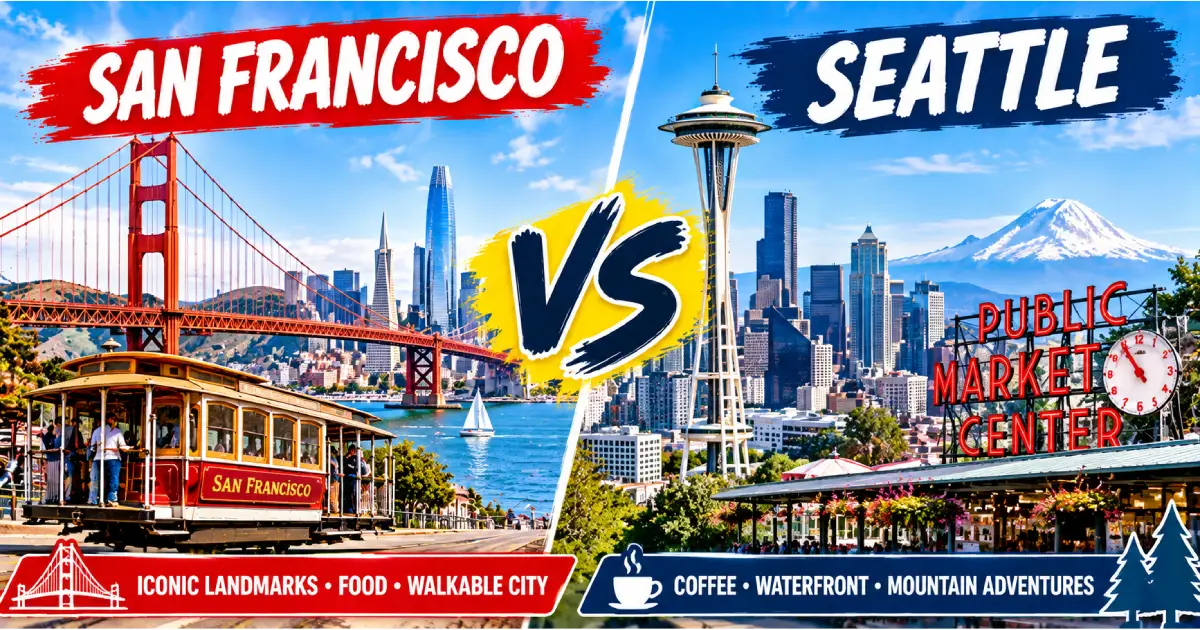
San Francisco and Seattle are the two great cities of the American Pacific Coast north of Los Angeles — neighbors in the broader geography of the West, linked by a shared culture of technology, coffee, progressive politics, and an almost religious devotion to locally sourced food, yet profoundly different in character, scale, and what they offer a traveler. San Francisco is one of the most physically beautiful cities in the world: 49 square miles of hills, bridges, bays, and Victorian painted ladies compressed onto a peninsula where the Pacific Ocean and San Francisco Bay meet, a city of extraordinary density and visual drama where every hill reveals another postcard view. Seattle is set on an isthmus between Puget Sound and Lake Washington, backed by the Cascade Mountains with Mount Rainier visible on clear days like a floating white island above the city — a younger, faster-growing city with the energy of a place that knows it is becoming something, the finest food market in America at Pike Place, and an outdoor access that rivals any urban area in the country.
Both cities have been shaped by technology in the past three decades — San Francisco by Silicon Valley and the dot-com and smartphone revolutions, Seattle by Amazon and Microsoft and the concurrent explosion of tech culture in the Pacific Northwest. Both have become expensive as a result, with housing costs that rank among the highest in the nation and a visitor economy calibrated to wealthy travelers. But they wear their prosperity differently: San Francisco is older, more layered, more architecturally complex, with neighborhoods that each carry a century of cultural history. Seattle is newer, more uniformly prosperous, and more physically organized around its extraordinary natural setting — the mountains, the water, the forests that begin within 20 minutes of downtown.
This guide compares both cities honestly and in detail across every dimension a traveler cares about — neighborhoods, food, coffee, weather, cost, outdoor access, culture, and day trips — and gives you a clear verdict at the end.
| Category | San Francisco | Seattle |
|---|---|---|
| Population | 874,000 (4.7M Bay Area metro) | 749,000 (4.0M metro) |
| Area | 49 square miles | 142 square miles |
| Elevation range | 0–938 ft (many steep hills) | 0–520 ft (gentler terrain) |
| Weather | 55–65°F year-round, fog | 45–75°F, rainy Oct–May |
| Sunny days/year | 260 | 152 |
| Getting around | MUNI + cable car + walking | Light rail + bus + walking |
| Average hotel | $220–350/night | $170–280/night |
| Average dinner | $55–90/person | $45–75/person |
| Coffee culture | Strong (Blue Bottle, Sightglass) | Birthplace of Starbucks; indie scene dominant |
| Top food experience | Mission burritos, dim sum, sourdough | Pike Place Market, seafood, izakayas |
| Day trips | Wine country (45 min), Big Sur (3 hr), Yosemite (3.5 hr) | Olympic NP (2 hr), North Cascades (2 hr), Vancouver BC (3 hr) |
| Best season | September–November | June–September |
San Francisco’s neighborhoods are among the most fiercely individual in any American city — each one a distinct world with its own history, character, and food culture, separated by hills that function as natural boundaries and create microclimates that differ block by block.
The Embarcadero and Financial District is the northeastern waterfront — the Ferry Building (1898, the finest food marketplace on the West Coast, 40+ local vendors including Acme Bread, Cowgirl Creamery, Blue Bottle Coffee, Boccalone Salumeria, open Tuesday/Thursday/Saturday farmers’ market — one of the finest in America), the Bay Bridge views, the start of the cable car lines. Chinatown (the oldest in North America, 1848, 24 blocks of Grant Avenue and Stockton Street — the most densely populated urban neighborhood in the United States, the finest roast duck and char siu in America outside New York’s Flushing) flows uphill into North Beach (the neighborhood where the Beat Generation was born — City Lights Bookstore at 261 Columbus Avenue, founded by Lawrence Ferlinghetti 1953, the most important independent bookshop in America, still selling the Howl first edition Ginsberg read here, open daily to midnight; Vesuvio Café next door where Kerouac and Ginsberg drank; Caffe Trieste 1956 the first espresso bar on the West Coast, Francis Ford Coppola wrote the Godfather screenplay here on weekends).
The Mission District is San Francisco’s most vibrant neighborhood — a historically Latino district (Irish first, then Mexican, now gentrifying with tech money but still anchored by taqueria culture) with the finest burritos in the world (La Taqueria, 2889 Mission, winner of multiple “best burrito in America” distinctions — the carne asada or carnitas burrito, no rice, $12, cash only; El Farolito, 24th and Mission, 24-hour, the best late-night burrito in the city; Taqueria Cancún, best for al pastor), the finest concentration of murals in any American city (Clarion Alley and Balmy Alley), Dolores Park (the finest people-watching park in SF on a sunny weekend — drag queens, dog walkers, tech workers, families, all in the same 15 acres), and the Mission Dolores (the oldest surviving structure in San Francisco, 1791, burial ground of the Ohlone and the first Spanish settlers).
The Castro (the first and most important gay neighborhood in American history — Harvey Milk’s camera shop at 575 Castro, the Castro Theatre 1922 with its Wurlitzer pipe organ, the Names Project AIDS Memorial Quilt archives) adjoins Noe Valley (the sunniest, most family-oriented, most expensive-stroller-per-capita neighborhood in the city). Haight-Ashbury (the intersection of Haight and Ashbury Streets — the epicenter of the 1967 Summer of Love, still trading on that history with vintage clothing, record shops, and a Grateful Dead house at 710 Ashbury that receives a constant pilgrimage). Hayes Valley (the finest small restaurant and boutique neighborhood in SF — one walkable strip between Franklin and Octavia that contains, per block, more excellent independent shops than almost anywhere else in America). The Sunset and Richmond (the fog-belt residential districts where SF’s Chinese-American, Russian-American, and Irish-American populations concentrated — Inner Richmond along Clement Street has the finest dim sum outside of Hong Kong’s airport).
Fisherman’s Wharf and Alcatraz: Fisherman’s Wharf is the city’s most tourist-heavy neighborhood — a clam chowder bread bowl (Boudin Bakery since 1849, the original sourdough starter is 177 years old) and Dungeness crab experience that is genuinely worth doing once. Alcatraz ($47.30/adult, reserve 2–3 weeks in advance at recreation.gov) is genuinely one of the finest museum experiences in California — the audio tour narrated by former guards and inmates is extraordinary — and the 15-minute ferry crossing gives the finest close-up view of the Bay.
Seattle’s neighborhoods are organized around water and hills in a way that gives each distinct visual character and access to the natural world.
Downtown and the Waterfront is being rebuilt after years of construction (the Alaskan Way Viaduct came down in 2019) and is now a genuine waterfront destination — the Seattle Aquarium ($34.95/adult), the Great Wheel ferris wheel over Elliott Bay ($16), and the ferry terminal where the Washington State Ferries ($9.85/walk-on, the finest ferry network in the US) cross to Bainbridge Island (35-minute crossing, a day trip unto itself — Victorian downtown, excellent wine tasting, Blackbird Bakery, and views of Seattle from the water). Pike Place Market (Pike Street and 1st Avenue, open since 1907 — the most important public market in America, 85+ farmers and 225 permanent vendors: fishmongers throwing salmon, Pike Place Chowder, Piroshky Piroshky Russian pastries, Rachel the Pig bronze sculpture, the original Starbucks at 1912 Pike Place which is a pilgrimage site and genuinely worth visiting for the original store design, the Post Alley gum wall below the market — 50 feet of gum-plastered brick that is either disgusting or magnificent depending on your orientation).
Capitol Hill is Seattle’s most important neighborhood — LGBTQ+ culture, independent music venues (Neumos, Chop Suey, Cha Cha Lounge), the finest concentration of restaurants and bars in the city (Pike/Pine corridor), the finest bookshop in Seattle (Elliott Bay Book Company, moved here from Pioneer Square, 150,000 titles in an independent shop that has hosted virtually every important American author of the past 30 years), Cal Anderson Park (community gathering, the finest urban park in Capitol Hill), and the density of coffee shops, vintage clothing, and creative businesses that make it feel like the most genuinely livable neighborhood in Seattle.
Pioneer Square is Seattle’s oldest neighborhood — the 1889 fire destroyed most of the original city, and the Victorian brick buildings that replaced it are the finest concentration of historic architecture in Seattle. The Seattle Underground Tour ($28/adult — guided walk through the original street-level storefronts that were abandoned when the city raised its streets after the fire, one of the finest quirky museum experiences in the Pacific Northwest) departs from here. International District/Chinatown borders Pioneer Square — the finest Vietnamese, Chinese, and Japanese food in Seattle, the Wing Luke Museum ($17.99/adult, the finest museum of Asian American history in the United States).
Fremont is Seattle’s self-declared “Center of the Universe” — the neighborhood with the finest independent character: the Fremont Troll (a 18-foot concrete sculpture under the Aurora Bridge eating a real Volkswagen Beetle — the finest public art in Seattle), the Fremont Sunday Market (the best outdoor flea market in the Pacific Northwest), the Lenin Statue (a 16-foot bronze of Vladimir Lenin hauled from a scrapyard in Czechoslovakia after the fall of communism — Seattle’s most debated public sculpture). Ballard (the old Scandinavian fishing village neighborhood now gentrified into the finest independent restaurant district in Seattle — Café Besalu for the finest croissant in the Pacific Northwest, The Walrus and the Carpenter for Pacific Northwest oysters, Stoup Brewing for some of the best beer in Seattle). Queen Anne (the finest views of the Space Needle and Puget Sound from the top of the hill, the Museum of Pop Culture at the base) and South Lake Union (Amazon’s global headquarters campus — the distinctive twin-tower headquarters “The Spheres,” three glass domes full of tropical plants that employees work inside, visible from outside for free).
San Francisco has one of the finest and most original food cultures in the United States — the direct ancestor of the California cuisine movement that Alice Waters began at Chez Panisse in Berkeley in 1971, and the city where farm-to-table, sourdough artisanship, forager-driven menus, and hyper-seasonal produce-driven cooking have been the default expectation rather than a trend for decades.
The definitive SF food experiences: The Mission burrito (a San Francisco original — a 12-inch flour tortilla wrapped around rice, beans, guacamole, sour cream, salsa, and your choice of meat, the construction perfected at La Taqueria, no rice version is the purist’s choice, $12). Dim sum in the Richmond or Chinatown (Ton Kiang on Geary Boulevard for the finest cart service; Yank Sing in the Financial District for the finest high-end dim sum, $45–65/person). Sourdough bread from Tartine Bakery (600 Guerrero, the most celebrated bread bakery in America — Chad Robertson’s country loaf has a cult following; arrives at 5 PM and sells out within 30 minutes, $14/loaf) and Acme Bread at the Ferry Building. The Ferry Building farmers’ market (Tuesday/Thursday 10AM–2PM, Saturday 8AM–2PM — the finest concentration of California artisan producers anywhere, the standout being Rancho Gordo heirloom beans, Cowgirl Creamery Mt. Tam cheese, and the Happy Quail Farm Farms stand). Dungeness crab (in season November–June) at Swan Oyster Depot (1517 Polk Street, open since 1912, lunch counter only, 12 stools, cash only, arrive before 9 AM to avoid a 2-hour wait — half Dungeness crab $48, Louie salad $38, the finest seafood lunch in SF).
Fine dining: Quince (Jackson Square — 3 Michelin stars, the finest Italian-influenced tasting menu in America, $375/person), Benu (SoMa — 3 Michelin stars, Corey Lee’s Korean-French-Californian cuisine, $395/person), Saison (SoMa — 3 Michelin stars, wood fire–driven tasting menu, $398/person), Zuni Café (Market Street, the beloved institution — the roast chicken for two ($92, 45-minute wait) in a wood-fired brick oven with warm bread salad is one of the finest single dishes in American restaurant history, no reservations needed), State Bird Provisions (Fillmore, dim sum–style California cuisine, the most influential restaurant in San Francisco of the past decade, $65–95/person, walk-in at opening or reservation lottery).
Seattle’s food scene is built around the extraordinary natural larder of the Pacific Northwest — wild salmon (Sockeye, King, Coho, Pink), Dungeness crab, Pacific oysters (the finest oyster-growing waters in the world — Kusshi, Kumamoto, Olympia), spot prawns, Walla Walla sweet onions, Washington State apples and cherries and wine, morel mushrooms and chanterelles, and Dungeness crab again. The city has the finest Japanese food outside Japan’s major cities in the United States (the result of the largest Japanese American community in the continental US before the WWII internment camps, a legacy that survived and rebuilt), and an izakaya and ramen scene that is genuinely world-class.
The definitive Seattle food experiences: Pike Place Market (the full market experience — a bowl of Pike Place Chowder New England clam ($8.25), a Piroshky from Piroshky Piroshky ($5–7), a salmon purchase from Pure Food Fish Market (the finest retail salmon in the city, whole wild King salmon $35–55/pound), Rachel the Pig photo, the fish throw). Pacific Northwest oysters at The Walrus and the Carpenter (Ballard, the finest oyster bar in Seattle — small, intimate, no reservations so arrive early, $3.50–4.50/oyster, wine by the glass $14–18; the Kusshi and the Olympia native oyster are the standouts). Ramen at Ramen Danbo (Capitol Hill, Hakata-style tonkotsu from a Fukuoka chain, the finest ramen in Seattle, $14–18 with noodle adjustments on a paper form like a Japanese ramen shop). Izakaya at Momiji (Capitol Hill) or Nishino (Madison Valley, the finest formal Japanese restaurant in Seattle, omakase $120–180). Seafood at The Walrus, Taylor Shellfish Farms (the raw bar in Capitol Hill, buy oysters by the dozen at market price, BYOB essentially), and Ivar’s Acres of Clams (the waterfront institution since 1938, the clam chowder is the finest in Seattle at $8.95 a cup, the fish and chips $16–22, sit at the outdoor counter over the water).
Fine dining: Canlis (Queen Anne, opened 1950, the most important fine dining restaurant in Pacific Northwest history — the restaurant that defined what upscale dining means in Seattle for 75 years, $155–200 tasting menu, the view over Lake Union is the finest from any restaurant in the city), Spinasse (Capitol Hill, the finest handmade pasta in Seattle, tajarin with butter and sage $28, the single best dish in the city), Nue (Capitol Hill, the most interesting global street food fine dining in Seattle), Bar Melusine (Eastlake, the finest wine-focused bistro in the city).
The verdict on food: San Francisco wins on historical depth, the Mission burrito (a genuinely original American food invention), the density of Michelin stars, and the farmers’ market culture. Seattle wins on raw seafood quality (the finest oysters in the country), ramen and izakaya, and the Pike Place Market experience. Both cities are exceptional; this is genuinely close.
This comparison has a clear winner and a nuanced reason.
San Francisco is the birthplace of the third-wave coffee movement in America — the philosophical and practical shift from commodity coffee (Folgers, Starbucks) to single-origin, terroir-driven, expertly roasted and brewed specialty coffee. Blue Bottle Coffee (founded Oakland 2002, James Freeman’s original kiosk served single-origin pour-overs before the term existed — the Mint Plaza location in SoMa is the spiritual home of West Coast specialty coffee, $5–8 for a single-origin pourover). Sightglass Coffee (7th and Folsom, SoMa — the finest café space in SF, a converted warehouse with 30-foot ceilings, roasting on-site, the best all-day coffee experience in the city). Ritual Coffee Roasters (multiple locations, Valencia Street original — the roaster that defined the SF specialty coffee aesthetic). Verve Coffee (Hayes Valley, the finest cold brew in the city). Equator Coffees (Ferry Building, excellent single-origin, the first US coffee company to achieve Fair Trade certification for 100% of its coffee).
Seattle is the birthplace of American coffee culture — period. Starbucks opened its first location at 1912 Pike Place in 1971 (the original store is still there, worth visiting for the design and history, $6–8 for a Pike Place Roast or a seasonal special). The Seattle coffee culture that Starbucks created has been wholly superseded in quality by an independent scene that is arguably the finest in the United States: Victrola Coffee (Capitol Hill, the roaster that most defines Seattle’s indie coffee culture — the Streamline blend is the house espresso, $4.50), Espresso Vivace (Broadway, the café that perfected espresso in America — David Schomer’s 1988 discovery of the optimal extraction temperature is credited with establishing the modern espresso standard; the rosetta latte art was invented here), Lighthouse Coffee (Capitol Hill, the finest pour-over program in Seattle), Elm Coffee Roasters (Pioneer Square, the finest single-origin roasting in Seattle, small-batch, the most technically precise coffee in the city), Anchorhead Coffee (downtown, the finest espresso bar for walk-in downtown visits).
The verdict on coffee: This is a genuine tie, which is the honest answer. San Francisco invented the third-wave movement; Seattle has Espresso Vivace and invented modern espresso. Both cities have extraordinary independent coffee cultures. Seattle has the slight edge in espresso technique; SF in single-origin pourover.
San Francisco has the most misunderstood weather in America. The city is famous for Mark Twain’s (misattributed) quote: “The coldest winter I ever spent was a summer in San Francisco.” The fog — driven by cold California Current upwelling that chills the Pacific air as it moves onshore — arrives reliably in summer, particularly in the western neighborhoods (the Sunset and Richmond), and can keep July and August grey and 55°F while the rest of California swelters. This is the phenomenon called “June Gloom,” and it peaks in July (the foggiest month in SF).
The actual best weather in San Francisco is September and October — the “Second Summer” or “Indian Summer” when the fog retreats, the city turns golden, temperatures reach 65–72°F, and the clarity reveals the full beauty of the bay and the hills. November through March brings the city’s modest rainfall (20 inches/year — less than New York, far less than Seattle), cooler temperatures (50–58°F), and the greenest hills of the year. The great advantage of SF’s weather: it never gets truly cold (the record low is 27°F, the average January low is 46°F) and never gets truly hot (the record high is 106°F on one extraordinary day; the average August high is 64°F). The city is always around 55–65°F — an eternal mild, often foggy autumn.
Seattle is the rainiest major city in the continental United States by number of rainy days — 152 sunny days per year, compared to SF’s 260. But the “Seattle rain” is a misnomer in one important way: Seattle’s rainfall is not heavy, it is persistent. The annual total (37 inches) is actually less than New York (46 inches) or Miami (61 inches) — it just arrives as grey drizzle over 9 months rather than dramatic summer thunderstorms. From October through May, Seattle is predominantly grey, drizzling, and overcast — temperatures in the 45–55°F range, reliable cloud cover, and the kind of weather that drives coffee culture, bookshop culture, and interior life. From June through September (peaking in July and August), Seattle transforms: 75–80°F, sunshine for weeks at a time, the mountains come out, Puget Sound gleams, the outdoor restaurant patios fill instantly, and the city reveals a summer beauty that is genuinely extraordinary. The July–August Seattle experience — the city against Mount Rainier on a clear day, kayaking on Lake Union, the rooftop bars in Capitol Hill — is among the finest urban summer experiences in America.
The verdict on weather: San Francisco wins on consistency — 260 sunny days per year and a year-round mild temperature make it more reliably pleasant. Seattle wins on summer peak — July–August in Seattle on a clear day is more spectacular than anything SF offers. Visit SF any time of year; visit Seattle specifically in summer (June–September) for the full experience.
San Francisco is one of the most expensive cities in the United States to visit — the product of the Bay Area’s technology economy driving hotel prices, restaurant prices, and taxi/rideshare fares to levels that rival New York. Hotels downtown average $220–350/night for a mid-range room; budget options exist in the Tenderloin ($100–150/night, requires comfort with a gritty neighborhood) and in the Mission ($130–180/night at smaller boutique hotels). Food is expensive relative to quality — the Swan Oyster Depot lunch is $50–80/person (worth every cent), dinner at a good Mission or Hayes Valley restaurant is $60–100/person with wine, and Michelin-starred dining begins at $200/person. Transport is the relative bright spot — the MUNI (bus and light rail, $3/ride, $21/day pass) is adequate, the cable cars ($8/ride, a tourist experience with a real function on the Clay and Powell Street hills) are genuinely useful for Fisherman’s Wharf and Nob Hill, and the city’s 49-square-mile size means many neighborhood experiences are walkable.
Budget estimate per person per day: $200–320 (mid-range); $350–500 (comfortable); $100–150 (budget, staying in a Mission hostel, eating taquerias and burritos).
Seattle is expensive by national standards but meaningfully more affordable than San Francisco. Hotels average $170–280/night for a mid-range downtown room; Capitol Hill and Ballard have options at $130–200/night with genuine neighborhood character. Food is 15–25% less expensive than comparable SF options — a fantastic Capitol Hill dinner runs $55–80/person with wine. Transport: the Link Light Rail ($3.25 one-way) connects SeaTac Airport to downtown in 38 minutes ($3.25) and is excellent for Capitol Hill; the bus system is functional but less comprehensive than MUNI.
Budget estimate per person per day: $170–250 (mid-range); $280–420 (comfortable); $90–130 (budget).
The verdict on cost: Seattle is 20–25% more affordable than San Francisco across hotels, food, and incidentals. For budget-conscious travelers, this is meaningful. Both cities are expensive by national standards.
San Francisco’s outdoor access within the city is remarkable for its urban density — Golden Gate Park (1,017 acres — larger than Central Park, containing the de Young Museum, the California Academy of Sciences, the Japanese Tea Garden, the Conservatory of Flowers, multiple lakes, a buffalo paddock with live bison, and 7 miles of bicycle trails), The Presidio (1,500 acres of former military base now National Park Service land — the finest urban park forest in America, the Golden Gate Bridge walkway, Baker Beach below the Bridge, the Andy Goldsworthy sculptures in the eucalyptus groves), Land’s End (the most dramatic coastal trail in the city — 3.4 miles along cliffs above the Pacific with views of the Marin Headlands and the remains of shipwrecks visible in low tide), and the Marin Headlands across the Golden Gate Bridge (accessible by bike over the bridge — the finest 1-day hike from downtown of any major American city, with views of the bridge, the bay, and the Pacific from trails 1,500 feet above the water).
Seattle’s outdoor access is extraordinary and integrated into the city’s daily life in a way that few American cities match. Discovery Park (534 acres in Magnolia — the finest urban park in Seattle, with 11 miles of trails through old-growth Douglas fir, a working lighthouse, beach access on Puget Sound, and views of the Olympic Mountains), Washington Park Arboretum (230 acres, 20,000+ trees and shrubs, the finest collection of temperate trees in the Pacific Northwest), Green Lake (a glacially formed lake in North Seattle with a 2.8-mile paved path — the most-used recreational path in Seattle, the center of the city’s outdoor jogging culture), and the Burke-Gilman Trail (27-mile paved trail along the Ship Canal and Lake Washington connecting Ballard to Redmond — the finest urban cycling trail in the Pacific Northwest). Kayaking on Lake Union (Downtown Waterfront Kayaking rents from the Center for Wooden Boats, $25–35/hour), sailing on Puget Sound, and the Washington State Ferries to Bainbridge Island, Vashon Island, and Whidbey Island expand the water-based outdoor options beyond any other city in the continental US.
The verdict on outdoor access: Both cities are extraordinary. San Francisco wins on dramatic scenery within city limits — the Golden Gate Bridge, Land’s End, the Marin Headlands hike. Seattle wins on water-based recreation — the ferry network, Lake Union kayaking, and Puget Sound sailing — and on the proximity to truly wilderness-scale outdoor experience (Olympic National Park, North Cascades National Park, and Mount Rainier are all within 2–2.5 hours).
San Francisco’s cultural institutions are world-class: the de Young Museum (Golden Gate Park, the finest collection of American art on the West Coast, the textile galleries and African art collection are exceptional, $30/adult, rooftop observation deck free), the San Francisco Museum of Modern Art (SFMOMA, $25/adult, the finest MOMA in the US outside New York — Richard Serra’s massive steel sculptures in the atrium, Frida Kahlo, Diego Rivera, and the most important photography collection of any American art museum), the California Academy of Sciences (Golden Gate Park, $36.95/adult, natural history museum + aquarium + planetarium + living roof with 1.7 million native plants in a Renzo Piano building — one of the finest all-in-one science institutions in the world), and the Asian Art Museum (Civic Center, $20/adult, the largest Asian art museum outside Asia, in a Gae Aulenti–renovated 1917 Beaux-Arts main library building).
Music and nightlife: The Fillmore (1805 Geary — the most storied rock music venue in America, home of Bill Graham’s legendary 1960s concerts, the venue where Jimi Hendrix, Janis Joplin, the Grateful Dead, Jefferson Airplane, and the entire psychedelic San Francisco sound was created; still operating as a 1,200-capacity rock venue, $30–80/show), the Great American Music Hall (O’Farrell Street, 1907 Barbary Coast–era supper club building, 470 capacity, the finest intimate venue in SF), the Castro Theatre (1922 Spanish Baroque movie palace, 1,400 seats, Wurlitzer pipe organ, the finest movie theater west of Chicago), and the LGBTQ+ nightlife concentrated in the Castro and SoMa (the SoMa leather and club district, The Endup the oldest gay dance club in SF since 1973).
Seattle’s cultural institutions are excellent for a city of its size: the Seattle Art Museum (SAM, $29.99/adult, the finest collection of Northwest Coast Indigenous art in the world, a significant collection of African art, the rooftop Olympic Sculpture Park free), the Museum of Pop Culture (MoPOP, Seattle Center, $35/adult, Frank Gehry building, the finest museum of rock and roll and science fiction and pop culture in the United States — the Jimi Hendrix gallery is extraordinary, the Nirvana: Taking Punk to the Masses permanent exhibition, the horror/sci-fi galleries), and the Chihuly Garden and Glass (Seattle Center, $32/adult, the most spectacular large-scale glass art installation in the world — Dale Chihuly was born near Tacoma and this is his definitive collection).
Music and nightlife: Seattle’s music scene is historically significant far beyond its size — Nirvana, Pearl Jam, Soundgarden, Alice in Chains, and Mudhoney all emerged from this city in 1989–1993 in one of the most concentrated creative explosions in rock history. The Crocodile (Capitol Hill, 500 capacity, the venue where Nirvana played some of their last shows, still the finest indie rock club in Seattle), Neumos (Capitol Hill, 650 capacity, the most consistently programmed mid-size venue), The Showbox (downtown, 1,100 capacity, the historic ballroom that has hosted every significant touring act since 1939), Paramount Theatre (downtown, 2,807-seat 1928 Baroque Revival theater). Bars: the Capitol Hill strip (Pike/Pine corridor — the densest concentration of bars per block in Seattle), Rob Roy (Belltown, the finest cocktail bar in Seattle), Canon (Capitol Hill, 3,000+ whisky bottles, the finest whisky selection in the western United States).
The verdict on culture and nightlife: San Francisco wins on the weight of its cultural institutions (SFMOMA, de Young, Asian Art Museum) and the historical significance of its music scene (the Fillmore, the Grateful Dead, the psychedelic era). Seattle wins on the Museum of Pop Culture (genuinely the finest popular culture museum in the country) and the concentrated energy of Capitol Hill’s bar scene.
Choose San Francisco if:
Choose Seattle if:
The honest answer: San Francisco is the more extraordinary city by almost every classical measure of urban beauty, cultural institution, and food depth — it is one of the 10 most beautiful cities in the world and its neighborhoods have a richness that Seattle, a younger city, has not yet fully matched. But Seattle has caught up dramatically in the past decade, offers better value, has more spectacular outdoor access, and in summer produces a light and a mountain-and-water beauty that makes it one of the finest urban experiences in America. Visit San Francisco for the city itself. Visit Seattle for the combination of city and extraordinary natural world.
Posted By : Vinay
Latest Article
2nd Floor, 39, Above Kirti Club, DLF Industrial Area, Kirti Nagar, New Delhi, Delhi 110015



Travel Tourister is a leading Travel portal where we introduce travellers to trusted travel agents to make their journey hasselfree, memorable And happy. Travel Tourister is a platform where travellers get Tour packages ,Hotel packages deals through trusted travel companies And hoteliers who are working with us across the world. We always try to find new and more travel agents and hoteliers from every nook and corners across the world so that you could compare the deals with different travel agents and hoteliers and book your tour or hotel with the one you have chosen according to your taste and budget.
Copyright © Travel Tourister, India. All Rights Reserved

 Call
 Enquiry