Published on : 12 Feb 2026
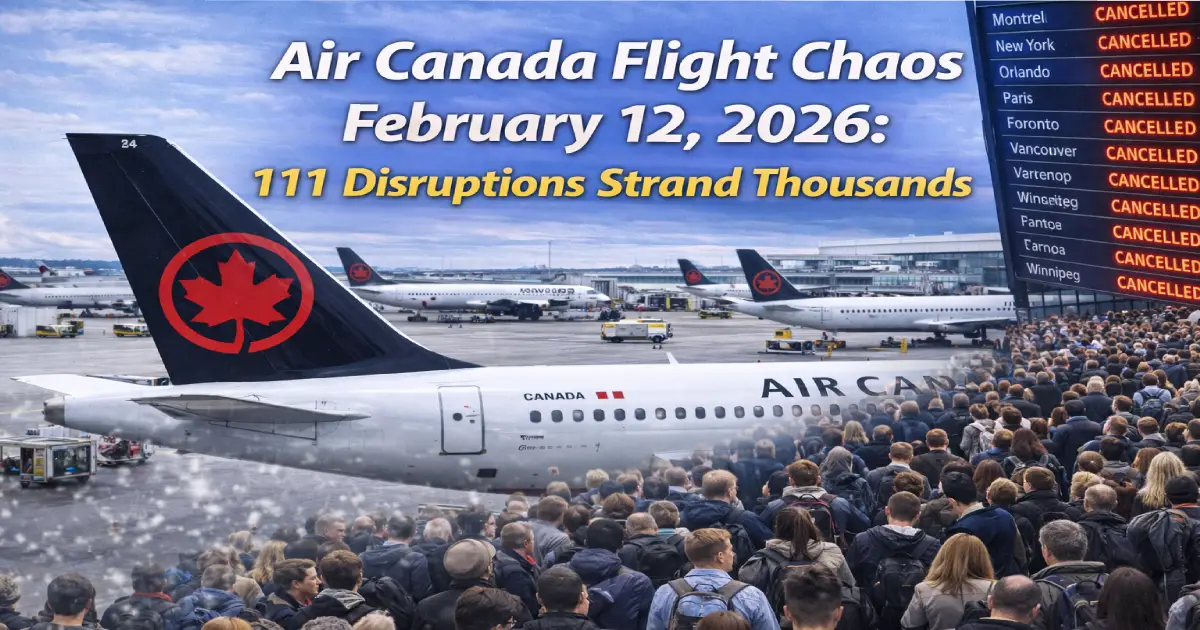
Breaking: Air Canada suffers catastrophic operational meltdown February 12, 2026 as 19 cancellations and 92 delays strand thousands across Toronto Pearson, Montreal, Halifax, and Calgary—with disruptions rippling to Boston, Miami, Newark, Toulouse, Cuba, and Punta Cana just 16 days before 5,800 customer service agents can legally strike. Here’s everything you need to know now.
Published: February 12, 2026 Event Status: ACTIVE (ongoing disruptions) Total Disruptions: 111 flights (19 cancellations + 92 delays) Operational Impact: 16% of Air Canada’s scheduled flights Passengers Affected: 8,000-12,000 estimated nationwide Strike Threat: February 28, 2026 (16 days away)
Air Canada—Canada’s largest airline operating 700+ daily flights—faces operational crisis February 12 with 111 total disruptions representing 16% of scheduled operations, far exceeding the 2-3% industry baseline and signaling systemic problems rather than isolated weather issues.
The crisis hits four major hubs simultaneously: Toronto Pearson International (YYZ) logged 7 cancellations and 54 delays, Montreal-Trudeau (YUL) reported 9 cancellations and 23 delays, Halifax Stanfield (YHZ) suffered 12 cancellations and 23 delays, and Calgary International faced operational strain across domestic and international networks—creating cascading delays affecting U.S. routes (Boston, Miami, Newark), transatlantic flights (Toulouse, France), and Caribbean destinations (Cuba, Punta Cana, Cancun).
The timing couldn’t be worse: Air Canada’s 5,826 customer service agents (represented by Unifor Local 2002) can legally strike starting February 28—just 16 days away—following contract expiration negotiations that began January 28, with union members demanding higher wages, predictable scheduling, and improved working conditions after experiencing operational chaos like today’s meltdown firsthand.
Key Numbers:
✈️ 19 cancellations + 92 delays = 111 total disruptions ✈️ 16% operational impact (vs. 2-3% industry baseline) ✈️ Toronto Pearson: 7 cancellations, 54 delays ✈️ Montreal-Trudeau: 9 cancellations, 23 delays ✈️ Halifax Stanfield: 12 cancellations, 23 delays ✈️ International routes hit: Toulouse (France), Cuba, Punta Cana ✈️ U.S. connections disrupted: Boston, Miami, Newark
Statistics: 7 cancellations, 54 delays Air Canada market share: Highest delay count of any carrier at Pearson today
Canada’s busiest airport became ground zero for Air Canada’s operational failure. The airline accounted for 7 of 19 total Pearson cancellations (37%) despite operating roughly 50% of flights—indicating operational problems, not random weather.
Major cancellations include:
ACA400: Toronto-Montreal widebody service (Boeing 787/Airbus A330)—flagship domestic route connecting Canada’s two largest cities cancelled, stranding business travelers and forcing rebooking onto competitor Porter Airlines/VIA Rail
ACA181/182: Toronto-Los Angeles widebody round-trip (morning departure 181, evening return 182)—critical transborder route for Canadian travelers heading to Southern California and connecting to Asia-Pacific flights via LAX hub
Los Angeles impact: Passengers with onward connections to Hawaii, Asia, Australia faced 24+ hour delays as next available Air Canada LAX flight not until February 13
Domestic disruptions: Multiple Toronto-Halifax, Toronto-Calgary, Toronto-Vancouver flights cancelled or delayed 2-6 hours, creating cascading problems across Air Canada’s hub-and-spoke network where Toronto delays trigger Montreal delays which cascade to Halifax delays
U.S. connection chaos:
50 delays and 7 cancellations involved U.S. routes according to airport data, meaning American travelers transiting through Toronto to Canadian destinations (Vancouver, Calgary, Montreal) or U.S. passengers connecting from Canada to U.S. cities faced significant rebooking challenges—and many discovered Air Canada won’t automatically rebook on competitor airlines (United, American, Delta) despite DOT/APPR regulations requiring “next available flight on any carrier.”
Statistics: 9 cancellations, 23 delays Air Canada dominance: 9 of 18 total Montreal cancellations = 50%
Quebec’s primary international gateway suffered disproportionate Air Canada impact compared to other carriers (WestJet reported 5 cancellations, Jazz Aviation 4 cancellations—both lower than Air Canada despite similar service levels).
International crisis:
ACA878/879: Montreal-Toulouse, France (both directions cancelled)—widebody Airbus A330 transatlantic service connecting French-speaking Quebec to southwestern France grounded, affecting February 12-13 travel plans for hundreds of passengers with no alternative direct service (next flight February 14)
Toulouse passengers stranded: Travelers heading to Toulouse for business (Airbus headquarters), tourism (Canal du Midi, Cité de l’Espace), or family visits faced 48+ hour delays, with Air Canada offering rebooking through Paris Charles de Gaulle (CDG) requiring additional connections and 6-8 hour journey time increase
Caribbean chaos:
Cuba routes: Multiple Montreal-Havana/Varadero cancellations affected February school break travelers (Quebec’s spring break earlier than rest of Canada)
Punta Cana disruptions: Montreal-Punta Cana delays exceeded 4 hours, causing missed resort check-ins and forfeited first-night hotel payments
U.S. impact: 19 Montreal delays and 4 cancellations involved U.S. routes (Boston, New York JFK, Newark), disrupting cross-border business travel and connecting flights
Statistics: 12 cancellations, 23 delays Cancellation concentration: Highest cancellation rate of any major Canadian airport today
Nova Scotia’s primary airport experienced “striking” disruption levels according to local aviation analysts, with 12 cancellations representing nearly 10% of Halifax’s total daily flights—catastrophic by normal standards.
Why Halifax hit hardest:
Atlantic Canada serves as Air Canada’s eastern hub for Maritime Provinces (Nova Scotia, New Brunswick, Prince Edward Island, Newfoundland), meaning Halifax disruptions affect isolated communities with limited alternative transportation (no VIA Rail service to many Maritime destinations, driving distances 4-8 hours).
Affected routes:
Halifax-Toronto: Multiple cancellations severed Canada’s primary east-west connection Halifax-Montreal: Business travelers and connecting passengers to international flights stranded Halifax-Ottawa: Government workers, civil servants facing rebooking chaos
U.S. connections: Halifax-Boston service (critical New England connection) faced delays, affecting American travelers visiting Canada and Canadian snowbirds returning from Florida via Boston hub
Statistics: Delays across domestic network, minimal cancellations
Western Canada hub avoided catastrophic failures seen in Eastern hubs, though ripple effects from Toronto/Montreal delays created 30-90 minute delays on Calgary-Toronto, Calgary-Montreal, Calgary-Halifax routes.
Today’s operational chaos occurs against backdrop of looming labor crisis:
Timeline to potential strike:
January 28, 2026: Unifor Local 2002 and Air Canada opened contract negotiations for 5,826 customer service agents February 28, 2026: Current collective agreement expires (16 days from today) Post-February 28: Parties can continue bargaining under Canada Labour Code, but union can request federal conciliation if no progress 60-day conciliation: Federal mediator attempts to facilitate agreement 21-day cooling-off period: After conciliation report filed Strike earliest date: Late April/Early May 2026 if all steps exhausted
What customer service agents do:
✈️ Check-in and ticketing at airports ✈️ Rebooking during disruptions (like today!) ✈️ Baggage services ✈️ Call center support ✈️ Customer relations and complaint resolution
The irony: Today’s chaos requires massive customer service agent intervention for rebooking thousands of passengers—yet these same agents are demanding better wages and working conditions while handling operational meltdowns that aren’t their fault.
Union demands (based on January 28 negotiations):
💰 Higher wages: Customer service agents claim wages haven’t kept pace with inflation, particularly acute in expensive cities like Toronto and Vancouver 📅 Predictable scheduling: Agents want advance notice of shifts rather than last-minute changes 👥 Improved staffing levels: Current staffing forces agents to handle 2-3x normal passenger volume during disruptions 🏥 Better working conditions: Agents cite stress, burnout, verbal abuse from frustrated passengers
Air Canada’s position:
The airline faces financial pressure from:
Adding customer service agent wage increases while maintaining profitability creates financial strain management argues.
What this means for travelers:
If customer service agents strike starting late April/early May 2026:
❌ Massive airport queues (no check-in staff) ❌ Rebooking nightmares (no call center agents) ❌ Baggage chaos (reduced staff) ❌ Flight cancellations (operational impossibility without agents)
Air Canada would likely implement massive proactive cancellations (similar to August 2025 flight attendant strike when airline cancelled 100+ flights before strike even began).
Unlike weather-driven disruptions (February 3 Canada snowstorm, February 9 U.S. chaos), today’s Air Canada crisis lacks obvious meteorological cause:
Weather check: Toronto (partly cloudy, 28°F, no precipitation), Montreal (clear, 25°F, no snow), Halifax (overcast, 32°F, no significant weather), Calgary (sunny, 18°F, normal winter conditions)
No weather excuse = operational failure
Possible causes (based on industry analysis):
Air Canada may be experiencing pilot/flight attendant unavailability due to:
Multiple unscheduled maintenance events could pull aircraft out of service:
Air Canada’s operational systems may have experienced glitches:
Air Canada may have proactively cancelled/delayed flights to:
Industry analyst assessment:
“16% operational disruption rate without corresponding weather emergency suggests systemic operational problems at Air Canada. When combined with impending labor negotiations, this pattern indicates airline is struggling to maintain reliable service with current staffing and resource levels.” — Aviation consultant (anonymous)
Canadian Air Passenger Protection Regulations (APPR) and U.S. Department of Transportation (DOT) rules govern compensation based on disruption cause:
Because today’s disruptions appear operational (no significant weather), Air Canada faces STRONGER obligations:
✅ Airlines MUST provide:
Rebooking on next available flight—INCLUDING COMPETITOR AIRLINES if Air Canada’s next flight is 6+ hours away (this means United, WestJet, Porter if they have earlier service)
Cash compensation for delays 3+ hours domestic, 6+ hours international:
Meal vouchers:
Hotel accommodation:
Communication updates every 30 minutes regarding new departure time
❌ Airlines NOT required:
Reimbursement for independently booked hotels/meals UNLESS airline vouchers unavailable
Compensation for consequential damages (missed cruise boarding, forfeited concert tickets, lost business meetings)
⚠️ Air Canada loophole warning:
Air Canada sometimes claims operational disruptions were “safety-related” (attempting to classify as uncontrollable), which would exempt compensation. However, if disruption stems from airline’s operational decisions (crew scheduling, maintenance planning), courts have ruled this IS controllable.
Immediate actions (at airport):
Follow-up actions (within 30 days):
Toronto-Los Angeles widebody cancellation:
Sarah Chen (Vancouver resident connecting through Toronto to LAX for Disneyland vacation with two children ages 6, 8): “We woke up 4:00 AM to make 7:00 AM Toronto-LA flight. Got to airport 5:30 AM. Checked bags. Went through security. At gate 6:45 AM, agent announces flight cancelled. No explanation. Gate agent couldn’t rebook us—computer system kept crashing. Waited in line 90 minutes. Finally got rebooked… on TOMORROW’s flight. We have non-refundable Disneyland tickets for today. Hotel reservation for tonight. Air Canada offered $15 meal voucher and said ‘sorry, weather delay’ even though it’s sunny in Toronto and LA. I asked to be put on United flight leaving 2:00 PM—agent said ‘we can only book Air Canada’ which is a LIE because APPR says they have to book competitor if earlier. I insisted, showed agent the regulation on my phone, agent called supervisor… supervisor approved United rebooking. We made it to LA 6 hours late instead of 24+ hours. But we lost entire first day, $400 hotel payment, and had to argue for 45 minutes to get rights we’re legally entitled to.”
Montreal-Toulouse transatlantic nightmare:
Jean-Paul Dubois (Montreal engineer traveling to Toulouse for Airbus meeting): “Flight ACA878 cancelled 2 hours before departure. I have critical meeting tomorrow morning 9:00 AM Toulouse time with Airbus executives. Air Canada offers rebooking via Paris with 8-hour layover, arriving Toulouse 36 hours from now—missing my meeting entirely. Alternative is Air France Montreal-Paris-Toulouse tomorrow, arriving barely in time but costing CAD $2,800 vs. my original CAD $1,200 ticket. Air Canada refuses to cover fare difference. Their position: ‘We’ll rebook you on our next flight (February 14) or you can buy your own ticket elsewhere.’ This is unacceptable. My company will probably sue Air Canada for business damages, but that takes months. Meanwhile I’m scrambling to find last-minute solution.”
Halifax stranded family:
Amanda Morrison (Halifax resident returning from Florida vacation with husband, two teenagers): “We flew Halifax-Fort Lauderdale last week for February break. Return flight today Halifax cancelled. Air Canada rebooks us… on February 14 flight (two days away). Hotel voucher? ‘Sorry, none available.’ Meal vouchers? ‘Only if you’re at airport.’ We already left airport before learning rebooking was 2 days out. Now we’re stuck in Fort Lauderdale with no hotel, limited cash, and Air Canada expects us to pay for 2 nights ourselves and ‘submit receipts for possible reimbursement.’ My husband’s job starts tomorrow—he’s going to miss work. Kids miss school. And Air Canada acts like this is normal.”
Air Canada’s 61 disruptions created cascading congestion:
Gate gridlock: Cancelled flights meant passengers remained at gates demanding rebooking while new arriving passengers needed those same gates, creating terminal bottlenecks
Customer service queues: Reports of 2-3 hour wait times at Air Canada service desks as agents manually rebooked thousands of passengers
Baggage mayhem: Cancelled flights meant checked bags needed retrieval, but passengers already departed terminal area, creating baggage claim chaos as agents tried to match orphaned bags with displaced passengers
Security re-screening nightmare: Passengers who cleared security for cancelled flights needed to exit secure area, rebook, then re-clear security (adding 45-90 minutes), creating TSA/CATSA queue overflow
International complications: Toulouse cancellation affected passengers with connecting flights in France (Toulouse-Paris-Asia, Toulouse-Barcelona-South America), creating multi-airline rebooking nightmares requiring coordination between Air Canada, Air France, and other carriers
Limited alternative transport: Maritime passengers facing cancellations had fewer options than Toronto/Montreal travelers:
Result: Passengers stuck overnight in Halifax with limited hotel availability (smaller city than Toronto/Montreal), creating accommodation crisis
Within next 6 hours:
✅ File Air Canada claim online (while details fresh) ✅ Screenshot all boarding passes, notifications ✅ Organize receipts in dedicated folder ✅ Email yourself timeline of events with timestamps
Within 30 days:
✅ Submit formal compensation claim to Air Canada ✅ File CTA complaint if denied ✅ Dispute credit card charge if appropriate ✅ Contact travel insurance provider (trip interruption coverage)
For flights in next 30 days:
⚠️ Consider rebooking on competitor airlines:
⚠️ Purchase travel insurance with “cancel for any reason” coverage (costs 5-7% of trip value, covers up to 75% of non-refundable costs)
⚠️ Book refundable fares (premium $50-150 over non-refundable, but provides flexibility)
⚠️ Monitor Air Canada labor negotiations:
For travel February 28-May 31 (strike window):
🚨 HIGH RISK PERIOD: If Unifor Local 2002 cannot reach agreement and exhausts conciliation, strike could occur April-May
Defensive strategies:
Book critical travel (weddings, cruises, business meetings) on airlines OTHER than Air Canada
If must fly Air Canada, build 2-3 day arrival buffer before critical events
Purchase maximum refund/change flexibility
Monitor news daily starting February 25 for strike notices
Have backup plans (alternative airports, ground transportation, accommodation)
Today’s chaos is latest in series of Air Canada operational failures:
August 2025: Flight attendants strike after contract negotiations collapse, causing 3-day system shutdown with 400+ cancellations
October 2025: Fall storms combined with crew shortages create week-long disruption affecting 10,000+ passengers
January 2026: Multiple smaller disruption events (50-100 delays/cancellations) indicating operational fragility
February 3, 2026: Canada-wide winter storm created 295 disruptions (55 cancellations), though primarily weather-driven versus today’s operational failures
February 12, 2026: Today’s 111 disruptions with no weather excuse
Pattern recognition: Air Canada averaged 8-12 major disruption events per year 2020-2024. So far in 2026 (just 43 days in), airline has experienced 5+ significant events, putting it on pace for 40+ disruption events annually—4-5x historical baseline.
Financial pressure: Air Canada faces:
The vicious cycle: Financial pressure forces operational cutbacks (reduced crew reserves, deferred maintenance, tighter schedules) → Operational cutbacks create disruptions → Disruptions anger passengers and employees → Angry employees demand better conditions → Better conditions cost money → Financial pressure increases → Cycle repeats
Air Canada’s problems reflect broader Canadian aviation challenges:
Labor unrest across sector:
Air Canada customer service agents (Feb 28 contract expiry) Air Canada mechanics (March 31 contract expiry) WestJet multiple work groups (2026 negotiations) Sunwing cabin crew (May 31 contract expiry)
Infrastructure strain:
Toronto Pearson capacity constraints (operating near maximum) Montreal-Trudeau expansion delayed (funding disputes) Aging air traffic control technology (Nav Canada modernization slow)
Regulatory gaps:
APPR (Air Passenger Protection Regulations) enforcement weak (CTA backlog 18-24 months) Airline accountability limited (fines rare, small when imposed) Consumer advocacy underfunded
Weather vulnerability:
Canadian airports struggle with winter operations despite decades of experience Climate change creating more frequent extreme weather Infrastructure investment inadequate for new climate reality
February 12, 2026 exposed Air Canada’s operational fragility just 16 days before 5,826 customer service agents can legally begin strike path.
For passengers:
Today’s crisis is operational, not weather = you deserve compensation. File claims aggressively and don’t accept Air Canada’s initial denials.
Upcoming travel February 28-May 31 carries HIGH RISK of strike disruptions. Book alternative airlines for critical travel.
Air Canada’s pattern of failures (August 2025 strike, October storms, January disruptions, February 3 weather, February 12 operational chaos) suggests systemic problems unlikely to resolve quickly.
For Air Canada:
Labor negotiations must succeed or risk crippling April-May strike during spring break / summer booking season.
Operational improvements essential to prevent passenger exodus to competitors.
Financial sustainability requires balance between cost control and service reliability—cutting too deep creates disruptions that cost more than savings.
For Canadian aviation:
Industry-wide labor crisis brewing across multiple carriers and work groups.
Infrastructure investment urgently needed to handle current traffic, let alone future growth.
Regulatory enforcement must strengthen to hold airlines accountable for operational failures.
The February 12 crisis will fade by February 14 as operations normalize. But the pattern it represents—operational fragility, labor unrest, passenger frustration—continues and likely worsens before improving.
Travelers warned: Canadian aviation winter 2025-2026 is historically turbulent. Plan accordingly.
How many Air Canada flights were actually cancelled versus delayed?
19 flights were outright cancelled, with 92 experiencing significant delays, creating 111 total disruptions representing 16% of Air Canada’s scheduled operations—far exceeding the 2-3% industry baseline for normal operations.
Will I get cash compensation for my cancelled Air Canada flight today?
Likely yes, IF disruption was operational (not weather). APPR requires CAD $400-1,000 compensation for operational delays 3+ hours depending on length. File claim at aircanada.com/compensation with documentation. Air Canada may initially deny claiming “safety” reasons, but if you have evidence of operational cause (crew shortage, maintenance), persist with claim and escalate to Canadian Transportation Agency if denied.
What’s the connection between today’s chaos and the February 28 strike threat?
Air Canada’s 5,826 customer service agents (represented by Unifor Local 2002) have collective agreement expiring February 28. Negotiations began January 28 with union demanding higher wages, better scheduling, improved conditions. Today’s operational chaos requires massive customer service agent intervention for rebooking—yet these same agents are fighting for better treatment. If negotiations fail and strike occurs (earliest April-May after conciliation/cooling-off), Air Canada would face system shutdown similar to August 2025 flight attendant strike.
Should I cancel my upcoming Air Canada booking and fly another airline?
For travel February 28-May 31: STRONGLY CONSIDER alternative airlines (United, WestJet, Porter) for critical trips (weddings, cruises, business meetings) due to strike risk. For travel after May 31: Monitor situation, but Air Canada’s pattern of operational failures (5+ major disruption events in first 43 days of 2026) suggests ongoing reliability problems. Book refundable fares if choosing Air Canada, purchase travel insurance, build arrival buffers.
Can Air Canada force me to wait 2 days for their next flight instead of rebooking me on a competitor?
NO. APPR regulations require airlines rebook passengers on next available flight—including competitor airlines if substantially earlier (typically 6+ hours). Air Canada gate agents may claim “we can only book Air Canada” but this violates regulations. Politely insist: “Canadian Air Passenger Protection Regulations require you to check ALL airlines, not just Air Canada. Please check United/WestJet/Porter for earlier options.” If agent refuses, ask for supervisor. Document refusal and file CTA complaint.
What happens if customer service agents actually strike?
If Unifor Local 2002 exhausts conciliation (60 days) and cooling-off period (21 days) after February 28, strike could legally occur April-May 2026. Impact would be catastrophic: No check-in staff at airports, no call center agents for rebooking, reduced baggage services, flight cancellations due to operational impossibility. Air Canada would likely implement massive proactive cancellations (similar to August 2025 when airline cancelled 100+ flights before flight attendant strike began). Travelers should avoid booking Air Canada March-June 2026 for critical travel.
Why did this happen today with no bad weather?
Air Canada claims “operational reasons” which could mean: crew shortages (sick calls, duty time violations, positioning problems), aircraft maintenance issues (unscheduled repairs, cold weather mechanical failures), system/technology failures (flight planning software, crew scheduling errors), or strategic decisions (consolidating passengers onto fuller flights, positioning aircraft). Unlike weather disruptions (uncontrollable), operational failures are airline responsibility = compensation required under APPR.
What should I do if I’m at the airport right now with a cancelled Air Canada flight?
Immediate sequence: (1) Open Air Canada app, attempt self-rebooking BEFORE joining service desk line. (2) Join service desk line as backup. (3) Ask agent to check ALL airlines (United, WestJet, Porter, American, Delta) for next available flight—don’t accept “Air Canada only” response. (4) Get written documentation of cancellation reason. (5) If no same-day options, request hotel voucher, meal vouchers, ground transportation. (6) If vouchers unavailable, self-book “reasonable” accommodation ($100-150/night 3-star airport hotel), keep receipts. (7) Screenshot everything—boarding pass, cancellation notice, delay notifications. (8) File claim within 30 days.
Is Air Canada going to keep having these problems or will it get better?
Based on 2025-2026 pattern (August strike, October storms, January issues, February 3 weather, February 12 operational chaos), Air Canada faces systemic operational fragility unlikely to resolve quickly. Contributing factors: Labor negotiations creating uncertainty (customer service agents Feb 28, mechanics March 31), financial pressure limiting operational reserves, infrastructure constraints at Toronto/Montreal hubs, winter weather vulnerability. Likely scenario: Disruptions continue through spring 2026, potential improvement summer IF labor agreements reached and operational investments made. No quick fix likely.
For More Resources:
Related Articles:
Posted By : Vinay
This article is provided for general informational purposes only and is based on information available at the time of publication. Travel advisories, airline schedules, airport operations, visa requirements, government regulations, and other travel-related information are subject to change without prior notice. While Travel Tourister makes reasonable efforts to verify information using official announcements, government publications, airline and airport communications, and other reliable sources, we cannot guarantee that all information remains complete, accurate, or up to date at all times. Readers should independently verify any information that may affect their travel plans with the relevant airline, airport authority, government agency, embassy, or other official source before making travel, financial, or other decisions. Travel Tourister shall not be liable for any direct or indirect loss, inconvenience, or damages arising from the use of or reliance on the information contained in this article. Nothing in this publication constitutes legal, immigration, financial, or professional travel advice. If you believe any information in this article is inaccurate or outdated, please contact our editorial team. We review all credible correction requests promptly and update our content whenever appropriate.
Lastest News
2nd Floor, 39, Above Kirti Club, DLF Industrial Area, Kirti Nagar, New Delhi, Delhi 110015



Travel Tourister is a leading Travel portal where we introduce travellers to trusted travel agents to make their journey hasselfree, memorable And happy. Travel Tourister is a platform where travellers get Tour packages ,Hotel packages deals through trusted travel companies And hoteliers who are working with us across the world. We always try to find new and more travel agents and hoteliers from every nook and corners across the world so that you could compare the deals with different travel agents and hoteliers and book your tour or hotel with the one you have chosen according to your taste and budget.
Copyright © Travel Tourister, India. All Rights Reserved

 Call
Call Enquiry