Published on : 06 Jul 2026
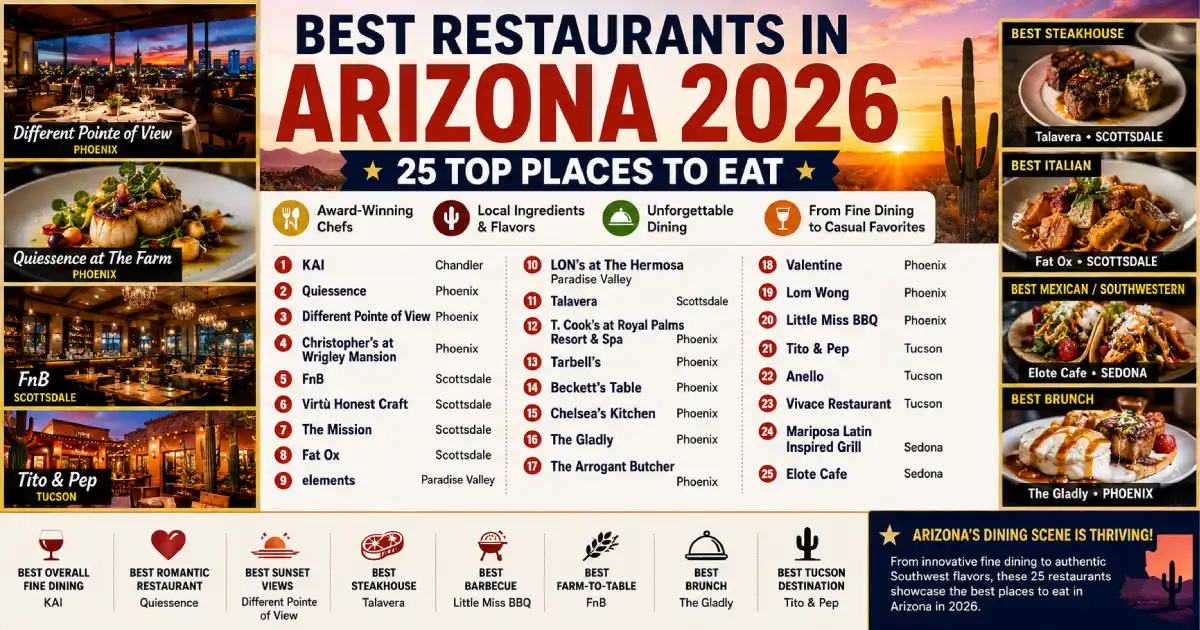
By Travel Tourister | Updated July 2026
Arizona’s restaurant scene is one of America’s most genuinely distinctive and most underappreciated — a culinary landscape shaped by three converging forces that exist nowhere else in the United States simultaneously: the Sonoran Desert’s specific borderland food culture (where Mexican, Native American, and Anglo culinary traditions have blended for centuries into a regional cuisine unlike standard Mexican-American restaurant fare found elsewhere in the country), a thriving contemporary fine-dining scene in Phoenix and Scottsdale that has produced multiple James Beard Award winners and nationally-recognized chef-driven restaurants, and the extraordinary ingredient sourcing available from one of America’s most agriculturally diverse states (Medjool dates from the Yuma Desert, Sonoran wheat revived from Native American seed banks, wild Arizona mushrooms, Navajo-churro lamb, and tepary beans from Tohono O’odham agricultural traditions). The best restaurants in Arizona reflect this layered identity — the century-old Sonoran institutions (Tucson’s El Charro Café, claiming to be America’s oldest Mexican restaurant in continuous family operation) sit alongside Michelin-recognized fine dining in Scottsdale and the UNESCO-recognized food traditions of Tucson, America’s first and only UNESCO City of Gastronomy.
What distinguishes Arizona’s food culture from the Mexican food found across the American Southwest is the specific Sonoran character — flour tortillas (the Sonoran borderlands are the heartland of the flour tortilla tradition, which originated here rather than in interior Mexico where corn tortilla traditions dominate), the Sonoran hot dog (a bacon-wrapped frankfurter served in a bolillo-style bun with beans, tomatoes, mayonnaise, and mustard, a street food unique to Tucson and the Sonora border region), carne seca (air-dried, spiced beef that functions as Arizona’s answer to beef jerky but with a specific flavor profile tied to Sonoran preparation methods), and dishes incorporating ingredients from Native American agricultural traditions that European-derived cuisines have largely ignored — tepary beans, quelites (wild greens), cholla cactus buds, and saguaro fruit syrup.
This guide covers the 25 best restaurants in Arizona organized by city and category — Tucson’s UNESCO food culture, Phoenix and Scottsdale’s fine-dining scene, Sedona’s destination dining, and the statewide standouts that reward visitors willing to seek them out — with practical details on cost, reservation requirements, and what to order for 2026 visitors planning where to eat across the Grand Canyon State.
For complete guides, see our Places to Visit in Arizona 2026, and Best Time to Visit Arizona guides.
| Restaurant | Cuisine | City | Price Range | Reservation |
|---|---|---|---|---|
| El Charro Café | Sonoran Mexican | Tucson | $15–$30 | Recommended |
| Elvira’s | Sonoran Mexican | Tucson | $20–$35 | Recommended |
| Café Poca Cosa | Contemporary Mexican | Tucson | $30–$50 | Required |
| BK Carne Asada & Hot Dogs | Sonoran Hot Dogs | Tucson | $5–$12 | No |
| Testal | Sonoran/Native American | Tucson | $15–$30 | No |
| Binkley’s Restaurant | American Tasting Menu | Cave Creek | $250+ | Yes (months) |
| Talavera at Four Seasons | Southwestern Fine Dining | Scottsdale | $80–$130 | Yes |
| Kai Restaurant | Native American Fine Dining | Chandler | $200+ (tasting menu) | Yes (months) |
| FnB | Farm-to-Table | Scottsdale | $50–$80 | Yes (weeks) |
| Virtù Honest Craft | Mediterranean | Scottsdale | $60–$90 | Yes |
| Hana Japanese Eatery | Japanese | Phoenix | $30–$55 | Yes |
| Pizzeria Bianco | Pizza | Phoenix/Tucson | $15–$30 | No (long waits) |
| Nobuo at Teeter House | Japanese | Phoenix | $60–$90 | Yes |
| Chula Seafood | Mexican Seafood | Scottsdale | $30–$55 | Recommended |
| Lon’s at the Hermosa | Southwestern American | Paradise Valley | $70–$110 | Yes |
| El Tovar Dining Room | American | Grand Canyon South Rim | $30–$55 | Yes (required) |
| Elote Café | Contemporary Mexican | Sedona | $35–$60 | No (call-ahead list) |
| Asylum Restaurant | New American | Jerome | $35–$55 | Recommended |
| Barrio Bread | Bakery/Bread | Tucson | $5–$15 | No |
| Bouchon Catering (pop-ups) | Farm-to-Table | Tucson | $20–$40 | Follow social media |
| Durant’s | Classic American Steakhouse | Phoenix | $60–$100 | Recommended |
| The Gladly | American | Phoenix | $40–$65 | Yes |
| Tratto | Italian | Phoenix | $40–$65 | Yes |
| Reforma | Mexican | Tempe | $25–$45 | Recommended |
| Barrio Queen | Regional Mexican | Scottsdale/Phoenix | $20–$40 | Yes |
Cuisine: Sonoran Mexican | City: Tucson | Price: $15–$30/person | Reservation: Recommended | Address: 311 North Court Avenue
El Charro Café claims the distinction of being the oldest continuously operating family-owned Mexican restaurant in the United States — founded in 1922 by Monica Flin, whose family has operated it across five generations, in a converted stone row house in Tucson’s historic El Presidio neighborhood. The restaurant’s contribution to American food culture extends beyond longevity — the carne seca (a Sonoran specialty of beef seasoned, formed into sheets, and dried in the desert sun in wire cages still visible on the restaurant’s rooftop, then shredded and incorporated into dishes) originated here in its current Americanized form, making El Charro one of the handful of restaurants in the United States that can genuinely claim to have created a dish rather than simply popularized one.
The menu reflects Sonoran Mexican traditions rather than the Tex-Mex or Cal-Mex interpretations that dominate most Mexican-American restaurant menus nationally — the flour tortilla’s primacy (over corn, reflecting Sonoran culinary tradition), the carne seca preparations (tacos, burritos, and the signature carne seca plate with beans and rice), chimichanga (a deep-fried burrito that El Charro also claims to have invented, a contested but spirited culinary origin debate), and sopapillas (pillowy fried bread served with honey) represent dishes whose Sonoran character is meaningfully different from Mexican food available in most of America.
What to order: Carne seca plate (the restaurant’s most historically significant and most distinctive dish — shredded dried beef with traditional accompaniments), and whatever the current sopapilla preparation is for dessert.
Insider tips: The original El Presidio location (the most historic and atmospheric of the several El Charro locations now operating in Tucson) is the correct destination for a historically grounded visit — the stone building’s architecture, rooftop carne seca drying cages visible from the street, and neighborhood context (El Presidio is Tucson’s oldest neighborhood, where the Spanish colonial presidio fort stood) add historical dimension that the newer locations don’t replicate.
Cuisine: Contemporary Mexican | City: Tucson | Price: $30–$50/person | Reservation: Required | Address: 110 East Pennington Street
Café Poca Cosa, helmed by chef Suzana Davila, represents Tucson’s most sophisticated and most nationally acclaimed Mexican restaurant — a contemporary approach to Mexican regional cuisine that rotates the menu daily (the specific dishes on offer aren’t published in advance; a chalkboard menu delivered to the table reveals what the kitchen has prepared that day, with roughly half the items changing daily based on ingredients and inspiration), drawing from Mexican regional traditions that extend beyond the Sonoran border cooking that defines most Arizona-area Mexican food. The restaurant’s approach — deliberately non-static, refusing to settle into the “signature dish” model that most successful restaurants adopt — has made it one of Tucson’s most exciting but also most unpredictable dining experiences.
The James Beard Award recognition (Davila has been a semi-finalist and finalist multiple times, representing Arizona in a category that has historically overlooked the Southwest’s Mexican-food traditions) reflects the restaurant’s contribution to reframing how American food culture categorizes and values Mexican cuisine — as a sophisticated, regionally diverse, and technically demanding culinary tradition rather than a category defined by casual chain restaurants.
What to order: Whatever the current chalkboard menu presents — the daily-changing format means trusting the kitchen’s current preparation is the correct approach, as the menu items available represent what the kitchen is currently most interested in cooking.
Insider tips: Arriving without knowing exactly what will be served is the intended experience — visitors who require menu certainty before committing to a reservation will be consistently frustrated by Café Poca Cosa’s format. For visitors comfortable with culinary discovery, the daily menu format creates genuine anticipation and repeated visit motivation that fixed menus cannot replicate.
Cuisine: Sonoran Mexican (seafood focus) | City: Tucson | Price: $20–$35/person | Reservation: Recommended | Address: 2445 North Oracle Road
Elvira’s brings the Sonoran coastline’s seafood traditions (the Gulf of California, or Sea of Cortez, borders the Mexican state of Sonora and provides shrimp, fish, and shellfish that are central to Sonoran coastal cuisine but rarely represented in Arizona restaurants focused on interior Sonoran food traditions) to Tucson in one of the city’s most beloved family-owned restaurant experiences. The restaurant’s aguachile (raw shrimp marinated in lime, chili, and cucumber in the style of the Mexican Pacific coast), various shrimp preparations reflecting Gulf of California traditions, and broader Sonoran menu items create a more seafood-forward Mexican dining experience than the landlocked Arizona border-food tradition typically provides.
The restaurant’s warm family-operation atmosphere and the quality of its seafood sourcing (maintained through specific relationships with Sonoran coastal suppliers) have established it as a Tucson institution that rewards visitors specifically seeking a fuller representation of Sonoran culinary identity beyond the land-based carne seca and bean preparations that dominate most Arizona Mexican restaurant menus.
What to order: Aguachile (raw shrimp preparation, a genuine test of the kitchen’s seafood freshness and lime/chili balance), any shrimp plate reflecting Gulf of California preparation traditions, and whatever the daily seafood special reflects from current sourcing.
Insider tips: Tucson’s distance from the Gulf of California (approximately 300 miles south) means the quality differential between restaurants that maintain genuine seafood supply relationships (like Elvira’s) and those using generic commercial seafood is particularly apparent — the freshness and preparation quality that distinguishes Elvira’s within Tucson’s Mexican food landscape directly reflects the sourcing investment.
Cuisine: Sonoran Hot Dogs | City: Tucson | Price: $5–$12/person | Reservation: No | Address: Multiple Tucson locations (Irvington Road original)
BK Carne Asada & Hot Dogs serves the single dish most specific to the Tucson food culture — the Sonoran hot dog, a bacon-wrapped frankfurter nestled in a soft, slightly sweet bolillo-roll bun, topped with pinto beans, diced tomatoes, mayonnaise, and yellow mustard, a construction that emerged from the Sonora-Arizona border region and remains genuinely unfindable at this quality level outside of Tucson and the Mexican state of Sonora. The dish sounds improbable on description but has converted essentially every skeptical first-time taster who approached it with an open mind — the combination of textures (snapping hot dog, soft bacon, yielding bun, creamy and acidic toppings) and flavors works in a way that description fails to predict.
BK (a Tucson institution with several locations, not to be confused with the national burger chain) represents the format at its most focused and most executed — the carne asada (grilled, seasoned beef) provides an additional ordering option for visitors who want more Sonoran protein alongside or instead of the signature hot dogs.
What to order: A Sonoran hot dog (the signature, essential, and most important order — at minimum two, as one rarely satisfies both curiosity and appetite), with carne asada as a secondary if the grilling visible from the ordering window looks compelling.
Insider tips: BK Carne Asada hot dogs are typically available from late morning through early evening (hours vary by location) — visiting during lunch hours when the grilling is most active and the buns are being freshly supplied ensures the optimal experience. The outdoor eating setup (picnic tables, casual atmosphere, the sensory experience of the carne asada smoke from the open grills) is part of the Sonoran hot dog experience and shouldn’t be viewed as a compromise relative to indoor restaurant seating.
Cuisine: Artisan Bread/Bakery | City: Tucson | Price: $5–$15 | Reservation: No | Address: 18 South Eastbourne Avenue
Barrio Bread, operated by baker Don Guerra (a James Beard Award winner for Outstanding Baker), has built a national reputation for bread that specifically incorporates ancient and heirloom grain varieties with deep connections to the Sonoran Desert’s agricultural history — particularly heritage Sonoran white wheat (a variety grown by the O’odham people of the Sonoran Desert for centuries before modern grain agriculture displaced it, recently revived through seed-saving efforts) that produces loaves with a distinctively sweet, nutty flavor profile and different gluten structure than modern commodity wheat. The bakery’s work represents both excellent bread-making and a commitment to regional grain diversity and agricultural heritage preservation that gives the food genuine cultural significance alongside its culinary quality.
The bakery’s limited production (Guerra operates at a scale that prioritizes quality and grain sourcing over volume expansion) and specific hours mean planning a visit specifically around the bakery’s schedule rather than treating it as an impulse stop — the bread (particularly the Sonoran heritage wheat loaves and the desert seed loaves incorporating Arizona-sourced seeds) sells out on a regular schedule.
What to order: The heritage Sonoran white wheat loaf (the bakery’s most historically and culinarily significant offering) and any current seasonal loaf incorporating desert-harvested ingredients (cholla buds, saguaro seeds, local nuts) that reflect the bakery’s broader commitment to Sonoran Desert ingredient sourcing.
Insider tips: Barrio Bread’s bread is also available at select Tucson farmers’ markets and through specific restaurant relationships — checking the bakery’s social media accounts for current availability locations and bake schedules (which can vary) is the most reliable way to ensure access to specific loaves.
Cuisine: Sonoran/Native American Inspired | City: Tucson | Price: $15–$30 | Reservation: No | Address: Various (check current location and format)
Testal, a Tucson restaurant concept built around Native American and Sonoran ingredients (tepary beans, cholla cactus buds, quelites wild greens, Sonoran wheat, and various desert-harvested foods) prepared in ways that honor their cultural origins while making them accessible in a contemporary dining context, represents Tucson’s most direct engagement with the indigenous agricultural traditions that the UNESCO City of Gastronomy designation specifically recognizes as central to the city’s distinctive food identity. The tepary bean (a drought-resistant legume cultivated by the Tohono O’odham people of the Sonoran Desert for thousands of years, nearly lost to agricultural modernization and currently being revived through both tribal and academic seed-saving efforts) appears here in preparations that reveal its genuinely distinctive flavor — nuttier, earthier, and more complex than the commodity pinto and black beans that dominate most Southwestern restaurant menus.
What to order: Any tepary bean preparation (the single ingredient most specific to this food tradition and most unavailable elsewhere), and whatever cactus or desert-harvested ingredient preparation is currently on the menu.
Insider tips: Verify the current restaurant format and location before visiting — smaller Tucson food businesses sometimes shift between brick-and-mortar and market/pop-up formats, and Testal’s specific operational model has evolved since its founding. Tucson’s farmers’ markets (particularly the Heirloom Farmers’ Markets at various locations) often provide access to similar ingredient traditions through multiple small vendors, providing a useful alternative or supplement to specific restaurant visits.
Cuisine: Native American Fine Dining (Two Forbes Stars, AAA Five Diamond) | City: Chandler (Gila River Indian Community) | Price: $200+/person (tasting menu) | Reservation: Required, months ahead | Address: Sheraton Grand at Wild Horse Pass, 5594 West Wild Horse Pass Boulevard
Kai (the O’odham word for “seed”) represents the most ambitious and most critically acclaimed Native American restaurant in the United States — a tasting-menu fine-dining experience within the Sheraton Grand at Wild Horse Pass resort on the Gila River Indian Community’s land south of Phoenix, drawing its menu exclusively from ingredients with connections to Gila River and O’odham agricultural and culinary traditions. The saguaro, tepary beans, cholla buds, mesquite pods, and Sonoran Desert mushrooms that appear on Kai’s menu aren’t decorative references to indigenous culture but genuinely sourced and prepared ingredients central to the culinary traditions the restaurant is specifically built to honor and advance.
The restaurant’s AAA Five Diamond rating (the highest designation in AAA’s hotel and restaurant evaluation system, awarded to fewer than 100 restaurants in North America) and consistent recognition as one of Arizona’s most significant fine-dining experiences make Kai genuinely notable within the national fine-dining conversation — a restaurant that has achieved the highest formal recognition levels while maintaining a specifically Native American culinary identity rather than assimilating toward European-influenced fine-dining norms.
What to order: The tasting menu is fixed and seasonal — the experience is built around the kitchen’s current interpretation of Gila River and O’odham culinary traditions through fine-dining technique and presentation.
Insider tips: The resort setting (the Sheraton Grand at Wild Horse Pass is itself an architecturally distinguished property reflecting Pima and Maricopa design traditions) means arriving early enough to explore the resort’s public spaces (including the exterior design and the Aji Spa, which also incorporates Sonoran Desert ingredients into treatments) adds context and value to the Kai experience beyond the meal itself. Reservations require planning months ahead for weekend dates — the restaurant’s combination of limited seating, significant reputation, and resort-destination setting creates genuine demand.
Cuisine: American Tasting Menu | City: Cave Creek (north of Scottsdale) | Price: $250+/person | Reservation: Required, months ahead | Address: 6920 East Cave Creek Road
Binkley’s, chef Kevin Binkley’s flagship restaurant in Cave Creek, represents Arizona’s most consistent and most technically sophisticated tasting menu experience — a multi-course progression (typically 20+ courses) that has earned Binkley James Beard Award nominations and sustained national recognition across multiple years of operation, demonstrating Arizona’s capacity to support genuine fine-dining ambition beyond the resort-hotel dining that historically dominated the state’s upscale restaurant landscape. The restaurant’s Cave Creek location (in a converted space that retains some of the area’s rustic cowboy-town character despite the kitchen’s extreme technical precision) creates an interesting tension between setting and cuisine that regular visitors find either charming or incongruous depending on expectations.
The menu’s seasonal rotation, wine pairing program, and the kitchen’s evident technical range (preparations drawing on both classical French technique and contemporary modernist approaches) create a tasting menu experience comparable to the best equivalent-format restaurants in larger American cities, validating Arizona’s growing fine-dining credibility.
What to order: The tasting menu is entirely fixed — the experience is built around the evening’s full progression with no à la carte alternative.
Insider tips: Cave Creek’s distance from central Scottsdale and Phoenix (approximately 30-40 minutes driving, no practical transit option) means planning transportation — including the return journey after a 3+ hour tasting menu dinner that includes substantial wine pairing — before arrival. Designated driver, rideshare reservation, or hotel accommodation near Cave Creek are the primary options.
Cuisine: Farm-to-Table American | City: Scottsdale (Old Town) | Price: $50–$80/person | Reservation: Required, weeks ahead | Address: 7125 East 5th Avenue
FnB (Food and Beverage), chef Charleen Badman’s Scottsdale institution, has received more consistent James Beard Award recognition than perhaps any other Arizona restaurant — Badman won the James Beard Award for Best Chef: Southwest in 2019, and the restaurant’s sustained presence on national food-media best-restaurants lists across multiple years reflects both the kitchen’s quality and its consistent execution over time. The menu’s explicit commitment to Arizona ingredient sourcing (a farm-to-table approach that goes beyond marketing language to actual documented sourcing relationships with specific Arizona farms and ranches) and Badman’s specific skill with vegetable preparations (the restaurant has been described as making some of America’s best vegetable cooking, a characterization the kitchen’s seasonal menu consistently supports) create a dining experience that’s distinctively Arizonan rather than generic “American fine casual.”
The Old Town Scottsdale location and the restaurant’s comfortable, not-overly-formal atmosphere (designed for repeat visits by neighborhood regulars as much as destination dining by visitors) create a dining environment that balances culinary ambition with accessibility.
What to order: Vegetable preparations specifically — Badman’s reputation for extraordinary vegetable cooking is the kitchen’s clearest distinction, and ordering broadly across vegetable-focused starters and sides rather than defaulting to protein-centered main courses reveals the kitchen’s most distinctive work.
Insider tips: FnB’s wine list (curated with specific emphasis on smaller-production natural and biodynamic wines by sommelier and co-owner Pavle Milic) has developed its own following independent of the food — visitors interested in wine specifically will find the list more educationally interesting than most comparable-priced restaurant wine programs.
Cuisine: Mediterranean | City: Scottsdale | Price: $60–$90/person | Reservation: Required | Address: 3701 North Marshall Way
Virtù Honest Craft, chef Gio Osso’s Mediterranean-focused restaurant in Scottsdale, has earned recognition as one of Arizona’s most technically precise and most Italy-influenced dining experiences — the menu draws on Southern European (particularly Italian and Spanish) culinary traditions, applied to both imported Mediterranean ingredients and local Arizona sourcing where appropriate parallels exist. The kitchen’s pasta program (handmade, reflecting genuine Italian pasta-making technique) and seafood preparations reflect Osso’s specific culinary background and training in Mediterranean cooking traditions.
The “Honest Craft” in the restaurant’s name reflects an explicit commitment to scratch cooking and classical technique over shortcuts — a positioning that appeals to diners specifically seeking evidence of genuine culinary skill rather than concept-driven restaurant experiences.
What to order: Handmade pasta preparations (the kitchen’s clearest technical strength and most Italy-influenced offering), and whatever fresh seafood preparation reflects current sourcing — the Mediterranean culinary tradition’s seafood emphasis translates into the Arizona desert context with surprising effectiveness given the quality of available sourcing.
Insider tips: Virtù operates in a Scottsdale gallery district adjacent to multiple contemporary art galleries — combining dinner here with an afternoon gallery walk creates a coherent Scottsdale cultural itinerary that engages both the visual arts community and the culinary scene that Old Town Scottsdale has developed.
Cuisine: Southwestern American Fine Dining | City: Scottsdale | Price: $80–$130/person | Reservation: Required | Address: Four Seasons Resort Scottsdale at Troon North, 10600 East Crescent Moon Drive
Talavera, the signature restaurant at the Four Seasons Resort Scottsdale, represents the finest expression of resort fine dining in Arizona — a menu drawing on Southwestern American culinary traditions (chiles, corn preparations, local beef and game, desert plant ingredients) presented with the technical execution and service standards that the Four Seasons brand requires globally, in a dining room with north-facing views of the McDowell Mountains and the surrounding Sonoran Desert that create a genuinely spectacular setting for dinner service, particularly as sunset colors the desert hillsides before darkness brings the restaurant’s candle and ambient lighting to full effect.
The kitchen’s approach (Southwestern ingredients and flavor profiles, European technique, resort-caliber execution) represents the specific category of Arizona fine dining where the combination of setting, service, and food quality creates an overall experience that neither the food nor the setting alone would fully deliver — the total experience being more than the sum of its parts.
What to order: Game preparations (venison, quail, and other proteins reflecting the Southwest’s hunting heritage) and any preparation incorporating Southwestern chiles or corn preparations that reflect the kitchen’s regional identity rather than purely generic luxury hotel cuisine.
Insider tips: Sunset seating (requesting tables with mountain views, arriving approximately 45 minutes before sunset) provides the most dramatic version of the Talavera experience — the combination of the desert landscape’s sunset colors visible through the restaurant’s windows and the dining room’s own warm lighting creates an atmosphere that justifies the resort pricing more fully than lunch or earlier dinner service.
Cuisine: Japanese | City: Phoenix | Price: $30–$55/person | Reservation: Required | Address: 5524 North 7th Avenue
Hana Japanese Eatery has maintained its position as Phoenix’s most consistently respected Japanese restaurant for years — a neighborhood-scale restaurant (small, without resort-level design ambition or tourist-oriented marketing) serving ramen, sushi, and Japanese home-cooking dishes at a quality level that regularly places it in Phoenix best-restaurant conversations alongside much more prominently positioned competitors. The ramen specifically (deeply developed broth, proper noodle texture, carefully composed toppings) has a devoted following that recognizes it as among the best available in Arizona regardless of cuisine category comparisons.
The restaurant’s north Phoenix neighborhood position (away from the restaurant-dense Scottsdale and downtown Phoenix concentrations) and modest physical presence have helped maintain a primarily local-regular clientele that gives it a genuinely neighborhood-restaurant atmosphere despite its regional culinary reputation.
What to order: Ramen (the kitchen’s most discussed and most consistently excellent offering), and any current sashimi selection that reflects fresh sourcing for the day.
Insider tips: The small dining room fills quickly on popular evenings — reservations are genuinely important, and calling ahead rather than attempting walk-in access on Friday or Saturday evenings specifically is strongly recommended.
Cuisine: Artisan Pizza | City: Phoenix (Heritage Square) and Tucson | Price: $15–$30/person | Reservation: No (Heritage Square location has bar seating; waits can be significant) | Address: 623 East Adams Street, Phoenix
Pizzeria Bianco, Chris Bianco’s wood-fired pizza restaurant in Phoenix’s Heritage Square, may be the single most influential American pizza restaurant of the past 30 years — Bianco’s approach (hand-shaped dough from carefully sourced flour, a wood-fired oven maintained at specific temperatures, toppings selected for quality and restraint rather than abundance, and an insistence on small-scale production that maintains quality across every pie) established a template for serious American pizza-making that has influenced hundreds of subsequent pizzerias nationally, while the restaurant itself has consistently been cited by food critics as among the best pizzas in the United States since it opened in 1994 in a small Heritage Square space.
The pies (wood-fired, with slight char, the Rosa [with red onions, Parmigiano-Reggiano, rosemary, and Arizona pistachios] being the most distinctive and most discussed signature item) reflect Bianco’s philosophy of restraint — the best ingredients, in the right combinations, simply prepared, without the elaboration or novelty that would dilute the foundational quality.
What to order: The Rosa (the restaurant’s signature and most distinctive pie — the Arizona pistachio topping creates a flavor combination specific to this restaurant that no chain or casual pizzeria replicates), and a classic Margherita for direct comparison of foundational quality.
Insider tips: The notorious waits that characterized Pizzeria Bianco’s original single-location era have been partially addressed by expansion (multiple Phoenix locations, the Tucson location) and refined operations — but arriving at opening time (the Heritage Square location’s specific opening hours should be verified) remains the most reliable strategy for minimizing wait times at the original location.
Cuisine: Japanese Fine Dining | City: Phoenix (Heritage Square) | Price: $60–$90/person | Reservation: Required | Address: 622 East Adams Street
Nobuo at Teeter House, chef Nobuo Fukuda’s Japanese izakaya-influenced fine-dining restaurant located in a historic Phoenix bungalow directly adjacent to Pizzeria Bianco in Heritage Square, presents Japanese small-plates (izakaya format — multiple courses of carefully prepared, beautifully presented small dishes in the social sharing tradition of Japanese tavern dining) with the technical refinement and ingredient quality that Fukuda’s James Beard Award (Best Chef: Southwest) validates. The restaurant’s historic-house setting (a preserved 1899 Victorian bungalow, creating a genuinely unusual juxtaposition of Japanese culinary ambition and Victorian American architecture) and the intimate scale (limited seating, reservation essential) create an environment that functions simultaneously as neighborhood treasure and destination dining.
What to order: The omakase or tasting menu option (allowing Fukuda and the kitchen to present their current best work) provides the most comprehensive Nobuo experience — à la carte ordering at the bar provides a more flexible approach for visitors wanting to sample selectively rather than commit to a full progression.
Insider tips: The Heritage Square location clusters Nobuo with Pizzeria Bianco and several other food-destination restaurants (Bar Bianco, Pane Bianco) in a pedestrian-friendly historic district — combining a Heritage Square dinner (Nobuo or Bianco) with exploration of the historic buildings and the adjacent Arizona Science Center makes a complete Phoenix evening.
Cuisine: Mexican Seafood | City: Scottsdale | Price: $30–$55/person | Reservation: Recommended | Address: 7340 East Shoeman Lane
Chula Seafood operates as both a retail seafood market (where the freshest available catch can be purchased for home cooking) and a restaurant serving Mexican-style seafood preparations with an emphasis on freshness and Gulf of California sourcing — the specific Sonoran and Baja California seafood traditions (aguachile, mariscos, fish tacos with specific preparation methods distinct from the Baja-style popularized nationally) represented at a quality level unusual for landlocked Arizona. The market component (fresh fish, shellfish, and prepared seafood items available for retail purchase alongside the restaurant service) creates a hybrid operation that demonstrates the kitchen’s sourcing confidence — a restaurant that also operates a retail seafood market is implicitly claiming exceptional freshness that most restaurant-only operations can’t verify as directly.
What to order: Aguachile (the fresh shrimp preparation in lime and chili, a test of both seafood freshness and technique), fish tacos with specific regional preparation rather than generic assembly, and whatever whole fish preparation reflects the day’s best available catch.
Insider tips: The market component makes Chula Seafood worth visiting even for visitors not dining in — checking the available retail seafood selection and asking the fishmongers about current sourcing provides useful context on what’s freshest for restaurant ordering, and the market’s prepared items (ceviche, marinated fish preparations for takeout) offer an alternative to full sit-down service.
Cuisine: Contemporary Mexican | City: Sedona | Price: $35–$60/person | Reservation: Call-ahead waitlist only (no traditional reservations) | Address: King’s Ransom Hotel, 771 State Route 179
Elote Café, chef Jeff Smedstad’s contemporary Mexican restaurant in Sedona, operates one of Arizona’s most distinctive reservation systems — no traditional advance reservations, but a call-ahead waitlist that opens on the day of service, requiring persistent phone attempts starting when the restaurant opens its phone lines to secure a position. This system (chosen deliberately to maintain a specific restaurant scale and atmosphere rather than to generate exclusivity for its own sake) creates a specific logistical challenge that visitors must account for in Sedona trip planning, but the restaurant’s consistent quality and Sedona’s limited fine-dining options make the effort worthwhile for food-motivated visitors.
The menu’s contemporary Mexican approach (corn preparations in multiple forms — the roasted street corn appetizer with lime, cotija, and chile that gives the restaurant its name being the signature starting point — alongside complex mole preparations, regional Mexican dishes beyond standard Tex-Mex categories, and genuinely excellent margaritas) creates Sedona’s most sophisticated and most culturally grounded dining experience within a town whose restaurant scene is otherwise heavily oriented toward resort hotel dining.
What to order: The elote (roasted corn, the signature dish and the restaurant’s namesake, an essential order regardless of what else is chosen), and whatever the current mole preparation is — the kitchen’s mole reflects genuine technique investment that distinguishes it from the premade mole sauces that most American Mexican restaurants rely on.
Insider tips: The call-ahead waitlist requires calling when the phone lines open (check current hours on the restaurant’s website) and being prepared to call multiple times if initial attempts connect to a busy signal — popular evenings require genuine persistence, and arriving in Sedona without securing a waitlist position before the lines open significantly reduces the probability of dining there that evening.
Cuisine: New American | City: Jerome | Price: $35–$55/person | Reservation: Recommended | Address: Jerome Grand Hotel, 200 Hill Street
Asylum Restaurant, located within the Jerome Grand Hotel (a converted 1926 hospital building — the former United Verde Hospital — that occupies a commanding position on Jerome’s hillside and maintains its institutional character in architecture while serving as the town’s most upscale accommodation), provides Jerome’s finest dining experience with views of the Verde Valley below that rank among the most panoramic from any restaurant in Arizona. The menu’s New American approach (seasonal ingredients, regional sourcing where available, preparations that don’t specifically limit themselves to Southwestern flavors despite the setting) and the historic building’s atmosphere (high ceilings, period architectural details, the specific character of a converted hospital — you’re eating in a former patient ward) create a dining experience that’s as much about place as about food.
What to order: The restaurant’s strength tends toward protein preparations (steaks, lamb, game birds) that reflect available Arizona-region sourcing, alongside starter preparations that showcase whatever seasonal produce the kitchen is currently working with.
Insider tips: The hotel itself (the Jerome Grand Hotel, staying as a guest) is one of Arizona’s most distinctively atmospheric accommodations — reputed to be haunted given its hospital history, and offering genuine historic character at prices significantly below Sedona’s resort options. The combination of a Jerome day trip (exploring the ghost-town arts community) with dinner at Asylum and potentially an overnight at the Jerome Grand creates one of Arizona’s more unusual and memorable travel experiences.
Cuisine: American | City: Grand Canyon South Rim Village | Price: $30–$55/person | Reservation: Required (sometimes months ahead for dinner) | Address: El Tovar Hotel, Grand Canyon Village
El Tovar Dining Room, within the El Tovar Hotel (built 1905, designed by Charles Whittlesey for the Fred Harvey Company, and designated a National Historic Landmark as one of the most significant historic resort hotels in the American West) on the Grand Canyon’s South Rim, provides the most historically significant restaurant experience available in Arizona’s national parks — a dining room where Theodore Roosevelt, Albert Einstein, and generations of Grand Canyon visitors have eaten since 1905, with original log-beam architecture, Mission-style decorative elements, and windows looking toward the canyon rim creating an atmosphere that no contemporary design could replicate.
The food (American hotel dining — steaks, salmon, pasta, and seasonal preparations reflecting the kitchen’s access to Arizona-sourced ingredients when available) represents competent but not remarkable cooking, with the historical setting and location contributing more to the overall experience than culinary ambition. The practical value is significant — El Tovar is the only full-service restaurant on the South Rim open for breakfast, lunch, and dinner, and its reservation-required dinner service can book out months ahead during peak season.
What to order: Whatever the current American menu presents that reflects Arizona or Southwest sourcing — the kitchen’s connection to regional ingredients varies, but canyon-region preparations (bison when available, Arizona-grown vegetables) represent the most contextually appropriate choices.
Insider tips: Dinner reservations should be made as early as possible (months ahead for summer and holiday visits) — the combination of limited seating and high visitor volume at the South Rim makes El Tovar dinner reservations genuinely competitive. Breakfast at El Tovar (somewhat easier to access than dinner, though reservations are still recommended) provides the historical atmosphere with less planning pressure.
Cuisine: Classic American Steakhouse | City: Phoenix | Price: $60–$100/person | Reservation: Recommended | Address: 2611 North Central Avenue
Durant’s, operating continuously since 1950 in a midtown Phoenix building where customers have always entered through the kitchen (a deliberate design choice by original owner Jack Durant that became the restaurant’s most distinctive and most discussed feature — patrons walk through the working kitchen, past the grill line and prep stations, to reach the dining room, providing an unusual and increasingly rare transparency into how a steakhouse actually operates at full service), represents Phoenix’s most historically authentic power-dining institution — an unchanged red-leather-booth, dark-wood-paneled environment where the Phoenix business and political communities have gathered for seven decades.
The menu (a classic American steakhouse — aged beef, classic sides including creamed spinach and hash browns, iceberg wedge salads) makes no pretense toward contemporary culinary trends, a consistency that functions simultaneously as limitation and asset — you know exactly what Durant’s is and what it offers, and the execution within that specific framework has been reliably excellent for decades.
What to order: A classic cut (the filet or the New York strip, both representing the steakhouse’s aged beef program at its clearest), and the creamed spinach as an essential classic side.
Insider tips: Entering through the kitchen (Durant’s inimitable approach) is disorienting on a first visit in the most charming possible way — the transition from Central Avenue’s midday glare through a busy professional kitchen to the red-leather dining room’s darkness creates a theatrical arrival that no other Phoenix restaurant replicates. Weekend dinner reservations are recommended; the kitchen entrance means arriving with reservation confirmation rather than attempting walk-in access during busy service.
Cuisine: Contemporary American | City: Phoenix | Price: $40–$65/person | Reservation: Required | Address: 2201 East Camelback Road
The Gladly, located in central Phoenix’s Camelback Corridor, has established itself as one of the city’s most reliably excellent and most consistently visited contemporary American restaurants — a menu that combines comfort-food approachability (the burger, the chicken preparations, familiar format dishes) with genuine kitchen ambition (technique-driven preparations, quality ingredient sourcing, a cocktail program that’s received specific recognition) in a warm, design-conscious dining room that draws both neighborhood regulars and destination visitors seeking a quality dinner without the commitment of a full tasting menu.
The restaurant’s position in Phoenix’s mid-to-upscale casual dining category makes it one of the city’s most useful “reliable excellent dinner” options — not the most ambitious or most discussed restaurant in Phoenix, but consistently delivering quality across a menu that accommodates varied dining preferences within a group more successfully than more concept-focused competitors.
What to order: The burger (a consistently cited Phoenix best-burger contender), any current seasonal preparations that reflect the kitchen’s ambition beyond the accessible format dishes, and cocktails from a program that’s received specific recognition independent of the food menu.
Insider tips: The Camelback Corridor location places The Gladly within an area dense with Phoenix’s mid-to-upscale dining options — combining a Gladly dinner with cocktails at a nearby bar or dessert at one of the area’s pastry-focused operations creates a complete Camelback evening without requiring multiple rideshare trips between distant neighborhoods.
Cuisine: Italian | City: Phoenix | Price: $40–$65/person | Reservation: Required | Address: 1505 East Warner Road
Tratto, chef Chris Bianco’s Italian restaurant (a sibling to Pizzeria Bianco, reflecting Bianco’s broader Italian culinary interests beyond pizza), has developed a following among Phoenix food enthusiasts specifically for the handmade pasta program and the kitchen’s commitment to Italian ingredient sourcing — the same philosophical approach that made Pizzeria Bianco nationally influential applied to a broader Italian menu beyond pizza. The pasta preparations (shapes and sauces rotating with ingredient availability and kitchen inspiration) represent the clearest demonstration of the kitchen’s technical investment, while the broader menu (antipasti, secondi, and dolci reflecting Italian meal structure) provides context for the pasta’s place within Italian culinary tradition.
What to order: Handmade pasta (the kitchen’s primary technical focus and clearest connection to Chris Bianco’s Italy-influenced culinary philosophy), and antipasti preparations that showcase the kitchen’s ingredient sourcing before the pasta courses.
Insider tips: Tratto’s South Phoenix location (away from the more-traveled Scottsdale and Old Town areas) means destination visitors need to specifically plan the trip rather than encountering it casually — but the quality level and the Bianco family connection make it worth the specific trip for visitors who’ve eaten at Pizzeria Bianco and want to understand the broader culinary vision.
Cuisine: Regional Mexican | City: Scottsdale/Phoenix/Chandler | Price: $20–$40/person | Reservation: Recommended | Address: Multiple metro Phoenix locations
Barrio Queen, a Phoenix-area restaurant group with multiple locations, represents the most consistent and most sophisticated regional Mexican dining available across the Phoenix metropolitan area without requiring the drive to Tucson — the menu’s focus on regional Mexican dishes beyond standard Mexican-American categories (preparations from Oaxaca, Veracruz, and other Mexican regional traditions, alongside the Sonoran standards) and the margarita program (a dedicated tequila and mezcal bar program reflecting the spirit traditions central to Mexican dining culture) create an experience that operates meaningfully above the chain-Mexican category without requiring the fine-dining commitment of Café Poca Cosa or the Kai experience.
What to order: Regional Mexican preparations that specifically reflect non-Sonoran Mexican regional traditions (Oaxacan mole preparations, Veracruz-style fish if available, dishes incorporating ingredients and preparation methods from interior Mexican regional cuisines) for the most distinctive experience relative to the Sonoran Mexican food readily available across southern Arizona.
Insider tips: The mezcal program (a dedicated selection of single-village and artisanal mezcals that extends well beyond the commodity mezcals appearing on most Arizona menus) rewards visitors with specific mezcal interest — asking for guidance from bartenders familiar with the program’s more distinctive bottles provides access to Mexican spirit traditions beyond the tequila/margarita default that most visitors default to.
Cuisine: Contemporary Mexican | City: Tempe | Price: $25–$45/person | Reservation: Recommended | Address: 1513 East Apache Boulevard
Reforma, a Tempe restaurant (adjacent to Arizona State University, in a neighborhood whose restaurant scene has developed significantly alongside the university’s growth) presents contemporary Mexican cooking with specific attention to regional diversity — the menu drawing on coastal, interior, and border-region Mexican culinary traditions to create a menu broader in reference than most Arizona Mexican restaurants that focus specifically on the local Sonoran tradition. The price point (more accessible than Café Poca Cosa or the Kai tasting menu while more ambitious than Barrio Queen’s casual format) and the Tempe location create a useful mid-range Mexican fine dining option for visitors based in the ASU area or willing to make a specific trip.
What to order: Fish and seafood preparations (reflecting the kitchen’s interest in coastal Mexican culinary traditions, a category underrepresented in Arizona’s landlocked food scene) and whatever the current rotating menu presents from non-Sonoran regional Mexican influences.
Insider tips: The Tempe location’s proximity to Arizona State University’s campus (and the adjacent Tempe Town Lake area) creates a natural combination with broader Tempe exploration — the university’s Nelson Fine Arts Center and the Tempe Center for the Arts both provide daytime cultural programming that pairs with a Reforma dinner for a complete Tempe day.
Cuisine: Southwestern American | City: Paradise Valley | Price: $70–$110/person | Reservation: Required | Address: 5532 North Palo Cristi Road, Paradise Valley
Lon’s at the Hermosa Inn, the signature restaurant of Paradise Valley’s historic Hermosa Inn (originally the 1930s adobe home and studio of cowboy artist Lon Megargee, whose paintings of Arizona landscape and cowboy life hang throughout the property), provides Arizona’s most atmospheric historic-ranch dining experience — the restaurant’s setting (low adobe ceilings, mesquite-wood beams, a working wood-fired grill visible in the open kitchen, a patio with saguaro-silhouetted Arizona sky views that has made it one of Phoenix’s most popular special-occasion dinner destinations) combines with menu preparations reflecting Southwestern American culinary traditions (mesquite-grilled proteins, Arizona-sourced ingredients, specific desert-plant flavors integrated into the kitchen’s approach).
What to order: Mesquite-grilled preparations (the restaurant’s wood-fired cooking method provides a specific smoke character that distinguishes its proteins from conventional oven or gas-grill preparations), and any seasonal preparation incorporating Arizona-sourced Medjool dates, citrus, or other desert-grown ingredients.
Insider tips: The patio dining (weather permitting, October–April specifically — Paradise Valley’s summer heat makes outdoor dining genuinely unpleasant from May through September) represents the most complete Lon’s experience, with Arizona’s night sky visible above the saguaro silhouettes in the property’s landscaped grounds. Requesting patio seating when reserving and confirming weather conditions before the reservation are both worthwhile.
Already covered above as #5. Worth reiterating that Don Guerra’s James Beard Award-winning bakery is one of Arizona’s most genuinely significant food destinations regardless of category, and planning a Tucson visit specifically to include a morning Barrio Bread purchase represents culinary tourism at its most authentic and most connected to Arizona’s specific agricultural and cultural heritage.
About Travel Tourister Travel Tourister’s destination specialists have eaten across Arizona — from Tucson’s El Charro carne seca and BK Sonoran hot dogs to Scottsdale’s Kai tasting menu and Sedona’s Elote Café call-ahead waitlist — to deliver the most practical and honest guide to the best restaurants in Arizona for every type of 2026 visitor and every budget.
Posted By : Vinay
Latest Article
2nd Floor, 39, Above Kirti Club, DLF Industrial Area, Kirti Nagar, New Delhi, Delhi 110015



Travel Tourister is a leading Travel portal where we introduce travellers to trusted travel agents to make their journey hasselfree, memorable And happy. Travel Tourister is a platform where travellers get Tour packages ,Hotel packages deals through trusted travel companies And hoteliers who are working with us across the world. We always try to find new and more travel agents and hoteliers from every nook and corners across the world so that you could compare the deals with different travel agents and hoteliers and book your tour or hotel with the one you have chosen according to your taste and budget.
Copyright © Travel Tourister, India. All Rights Reserved

 Call
Call Enquiry