Published on : 20 Jun 2026
By Travel Tourister | Updated June 2026
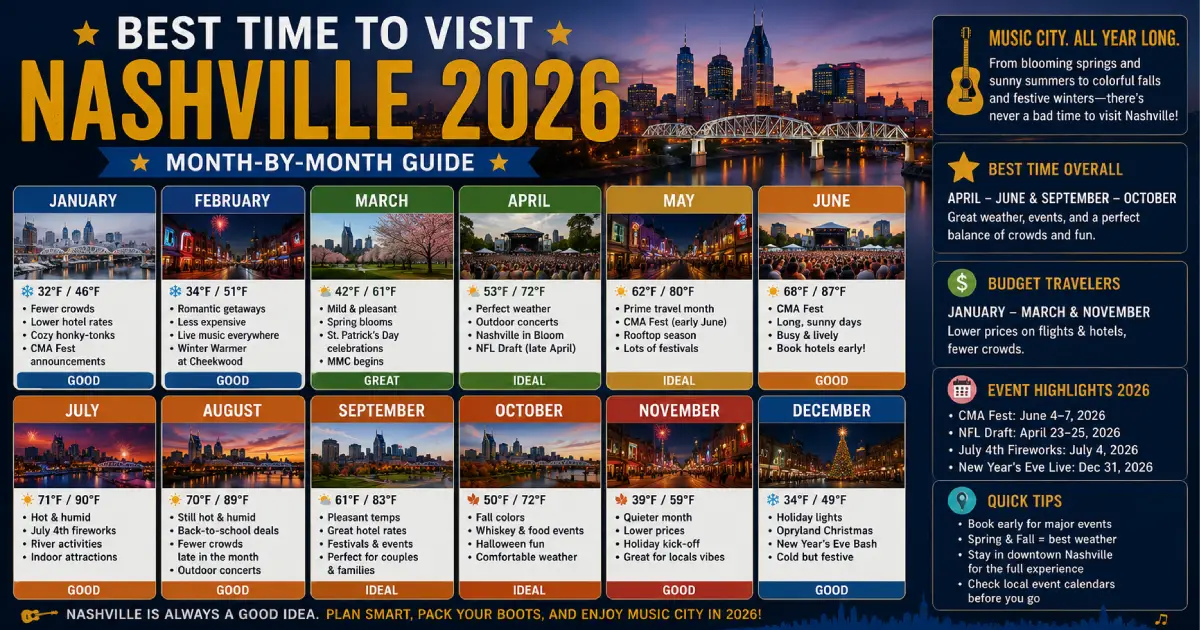
Nashville’s climate, crowd patterns, and event calendar create meaningfully different travel experiences across the twelve months of the year — spring (April–May) brings comfortable temperatures, the city’s most celebrated outdoor festivals, and moderate crowds before summer’s peak, summer (June–August) delivers the longest days and largest visitor numbers alongside genuine Tennessee heat and humidity, fall (September–October) offers arguably the city’s best overall visiting conditions with comfortable temperatures and significant events, and winter (November–February) provides the lowest hotel prices of the year alongside holiday programming and the rare but genuinely disruptive ice storms that characterize Nashville winters more than heavy snowfall. The best time to visit Nashville for most travelers is April through May or September through October — the shoulder seasons that combine comfortable weather (daytime temperatures in the 60s–70s°F) with manageable crowds and reasonable hotel pricing, while avoiding both summer’s heat/peak-season pricing and winter’s cold and reduced outdoor activity appeal.
Unlike coastal beach destinations or ski resorts where “best time” maps neatly onto weather suitability for a specific activity, Nashville functions as a year-round music and entertainment destination where the honky-tonks operate identically in January and July, Broadway bands play through rain and cold, and the Grand Ole Opry broadcasts on its Tuesday/Friday/Saturday schedule regardless of season. What changes meaningfully across Nashville’s calendar is how comfortably visitors can experience the outdoor components of the city (the Pedestrian Bridge, Centennial Park, neighborhood walking in East Nashville and 12 South, Radnor Lake hiking) and how significantly hotel pricing fluctuates — winter prices can drop 40–50% below summer peak, while major event weekends (CMA Fest in June, New Year’s Eve, bachelorette-party-heavy spring weekends) push both prices and crowds to extremes that can significantly affect the visitor experience.
This guide breaks down Nashville’s climate, crowd patterns, and pricing month-by-month — identifying optimal windows for specific traveler priorities (budget travelers, first-time visitors, music festival fans, outdoor enthusiasts, holiday-season seekers) and providing practical packing and planning advice for visitors booking 2026 Nashville trips from any of the world’s major source markets.
For specific Nashville recommendations, see our Places to Visit in Nashville 2026, Things to Do in Nashville 2026, and Best Restaurants in Nashville guides.
| Month | Avg High/Low (°F) | Avg High/Low (°C) | Crowd Level | Hotel Prices | Best For |
|---|---|---|---|---|---|
| January | 46°F / 28°F | 8°C / -2°C | Low | $ (lowest) | Budget travel, indoor music, winter quiet |
| February | 51°F / 31°F | 11°C / -1°C | Low | $ (low) | Budget, Valentine’s events, early spring hints |
| March | 61°F / 40°F | 16°C / 4°C | Low–Medium | $$ | Early spring, wildflowers, St. Patrick’s events |
| April | 71°F / 49°F | 22°C / 9°C | Medium | $$ | Best weather, festivals, cherry blossoms |
| May | 79°F / 57°F | 26°C / 14°C | Medium–High | $$$ | Ideal weather, outdoor events, pre-summer |
| June | 87°F / 66°F | 31°C / 19°C | Very High | $$$$ | CMA Fest (but crowded and expensive) |
| July | 91°F / 70°F | 33°C / 21°C | High | $$$ | Summer events, heat, longest days |
| August | 90°F / 69°F | 32°C / 21°C | High | $$$ | Late summer, outdoor concerts |
| September | 83°F / 62°F | 28°C / 17°C | Medium–High | $$$ | Ideal weather, fall food events, AmericanaFest |
| October | 71°F / 49°F | 22°C / 9°C | High | $$$ | Fall foliage, Halloween events, best weather |
| November | 60°F / 39°F | 16°C / 4°C | Medium | $$ | Thanksgiving, early holiday, shoulder pricing |
| December | 49°F / 32°F | 9°C / 0°C | Medium–High | Holiday events, CMA Awards, New Year’s Eve |
Avg Temp: 61°F / 16°C | Rainfall: Moderate to high (March averages among Nashville’s wettest months) | Crowds: Low–Medium | Hotel Prices: $$
March in Nashville occupies a transitional position — genuinely spring-like days (60s°F, sunshine, the city’s dogwoods and redbuds beginning to bloom in the latter half of the month) alternate with winter reversals (cold snaps, rain, occasional late-season ice events) in a pattern that makes packing decisions genuinely difficult. The unpredictability is March’s defining characteristic: three consecutive days in the 70s°F can be followed by a cold, rainy weekend dropping back into the 40s°F, and neither forecast nor historical averages reliably predict which conditions any specific week will deliver.
March advantages are meaningful despite the weather variability — hotel prices remain in shoulder-season territory significantly below summer peak, Lower Broadway operates at manageable crowds compared to summer’s bachelorette-party and CMA Fest intensity, and the early wildflower season (Radnor Lake’s woodland wildflowers typically beginning in late March, the dogwood and redbud bloom usually peaking in late March through early April) provides nature photography opportunities that later-season visitors miss. St. Patrick’s Day (March 17) brings downtown Nashville festivities that are noticeable but less overwhelming than Nashville’s major summer events.
What to do: Indoor music venues (the Ryman Auditorium, Station Inn, Bluebird Cafe) work exceptionally well given March’s weather unpredictability — building Broadway honky-tonk evenings and indoor shows as the core itinerary, with outdoor activities (Centennial Park, Radnor Lake) as weather-permitting additions rather than primary plans. Late March specifically — if warm days align with travel dates — can be Nashville’s single most pleasant weather period, when spring arrives without summer’s humidity.
Insider tip: Check the Ryman Auditorium’s March performance calendar before booking travel dates if seeing a specific show there is a priority — the Ryman’s booking tends to include significant programming in late winter/early spring, and aligning travel dates with a show that interests you adds substantial value to a March visit.
Avg Temp: 71°F / 22°C | Rainfall: Moderate | Crowds: Medium | Hotel Prices: $$
April is consistently Nashville’s most recommended visiting month — temperatures in the 60s–70s°F with low humidity (the humidity that defines Nashville summers hasn’t arrived yet), the city’s flowering trees (cherry, dogwood, redbud) at or near peak bloom, outdoor dining and park spaces fully operational, and a festival calendar beginning to activate without the overwhelming crowd levels that characterize summer. The combination of genuinely pleasant weather for walking Nashville’s neighborhoods and outdoor spaces with the still-manageable visitor volumes that summer brings makes April the sweet spot most seasoned Nashville travelers return to.
The Tennessee Craft Fair (held at Centennial Park in April, a major juried crafts exhibition drawing vendors from across the Southeast) and various neighborhood festivals beginning their season create specific event anchors, while the broader outdoor-activity calendar (Radnor Lake hiking, Centennial Park events, the Pedestrian Bridge walk for skyline photography) becomes fully accessible in comfortable conditions for the first time since the previous fall.
Hotel prices, while higher than winter’s low-season rates, remain below the summer peaks driven by CMA Fest and general vacation-season demand — April typically offers the best value combination of comfortable weather and reasonable pricing available in Nashville’s annual calendar.
What to do: Everything — April is the month where all Nashville’s activity categories (outdoor, indoor, music, food, neighborhood exploration) operate in genuinely ideal conditions simultaneously, with the city’s spring flowering providing additional visual appeal that other seasons don’t offer.
Insider tip: The Tennessee Craft Fair dates (typically late April at Centennial Park) can be checked through the Tennessee Association of Craft Artists website — timing a visit to coincide with this event adds a high-quality craft market to the available activities while creating no additional travel logistics given Centennial Park’s central Nashville position.
Avg Temp: 79°F / 26°C | Rainfall: Moderate | Crowds: Medium–High | Hotel Prices: $$$
May maintains most of April’s weather appeal (warm without summer’s oppressive heat, comfortable humidity levels compared to what June through August delivers) while bringing Nashville’s event calendar to a more active state — outdoor concerts beginning at various venues, the broader summer-event infrastructure activating, and the bachelorette-party and weekend-getaway visitor numbers beginning a seasonal uptick that won’t peak until June. The Memorial Day weekend (last weekend of May) marks a significant crowd and pricing increase — the holiday weekend draws visitors in volumes that affect hotel availability and Lower Broadway congestion meaningfully.
Late May specifically (the week or two before Memorial Day) often represents the most overlooked sweet spot in Nashville’s annual calendar — May’s genuinely comfortable weather combined with lower-than-Memorial-Day crowds and pre-summer-peak pricing. Visitors who can schedule a mid-May trip often encounter near-ideal conditions: warm temperatures, outdoor activities fully operational, manageable Broadway crowds, and hotel pricing not yet at the summer ceiling.
What to do: Outdoor Nashville at its best — Centennial Park events, Radnor Lake hiking before summer heat makes early-morning departures necessary, the Pedestrian Bridge walk for skyline views in pleasant evening conditions, and outdoor dining at the neighborhood restaurants that activate full sidewalk-seating capacity from late April onward.
Insider tip: Book hotels for May travel (particularly the Memorial Day weekend) earlier than the price-to-crowds ratio might suggest — hotel rates increase more sharply in the weeks before Memorial Day than month-by-month averages convey, and early booking (2–3 months ahead for the holiday weekend) provides meaningful savings over waiting.
Avg Temp: 87°F / 31°C | Rainfall: Moderate | Crowds: Very High | Hotel Prices: $$$$ (highest of the year during CMA Fest week)
June represents Nashville’s most complex visiting proposition — the city’s most celebrated annual event (CMA Fest, the Country Music Association’s four-day fan festival that fills Nissan Stadium and multiple downtown venues simultaneously with country music performances, artist meet-and-greet opportunities, and associated programming that transforms downtown Nashville into the most concentrated country music event in America) occurs in early-to-mid June, creating a week when hotel prices reach their annual peak, Lower Broadway becomes genuinely overwhelming, and visitors either experience exactly what they came for (if CMA Fest is the trip’s purpose) or find Nashville harder to navigate than any other week of the year (if CMA Fest was unexpected or its crowd impact was underestimated).
Outside CMA Fest week specifically, June’s temperatures (high 80s°F, rising humidity) begin the heat-and-humidity combination that characterizes Nashville summers and that makes outdoor activity less comfortable than spring and fall — not prohibitive, but requiring heat-management strategies (early morning or evening outdoor time, air-conditioned museum visits during midday peak heat) that aren’t necessary during cooler months. Lower Broadway’s honky-tonks operate in air-conditioning and remain perfectly functional destinations in summer heat — the indoor nature of most Broadway bar activity means June visits for music specifically remain quite viable.
What to do: CMA Fest (if attending — book tickets and hotels months in advance, as both sell out completely for the festival week), indoor music venues and museums during midday heat, and early morning outdoor activities (Radnor Lake before 8 AM offers genuinely pleasant conditions even in June) before temperatures peak in the afternoon.
Insider tip: If visiting Nashville in June specifically for CMA Fest, book hotel accommodations and festival tickets simultaneously 6–9 months in advance — the festival’s popularity means both accommodations within reasonable distance and official ticket packages sell out significantly ahead, and third-party/resale pricing for last-minute arrangements during CMA Fest week represents one of the most significant travel cost escalations in American music tourism.
Avg Temp: 91°F / 33°C | Rainfall: Moderate (afternoon thunderstorms common) | Crowds: High | Hotel Prices: $$$
July is Nashville’s hottest month — average highs reaching the low 90s°F with humidity that pushes “feels like” temperatures meaningfully above actual readings during peak afternoon hours, making extended outdoor sightseeing genuinely uncomfortable for visitors unaccustomed to humid Southern summers. The July 4th holiday brings patriotic celebrations across the Nashville area (including a notable riverfront fireworks display and various downtown events), with the holiday weekend creating a crowd and pricing peak comparable to (if slightly below) CMA Fest week.
The afternoon thunderstorm pattern (common throughout Tennessee summers, with afternoon convective storms developing rapidly and delivering significant rainfall before clearing, often within 30–60 minutes) affects outdoor planning — not a reason to avoid summer visits, but a reason to monitor forecasts and plan outdoor activities for morning windows rather than afternoon peak-heat periods.
July’s crowds, while high, are slightly more manageable than June specifically because the CMA Fest concentration has passed — Lower Broadway functions (packed on weekends but not the same overwhelming density of festival-week June), and major attractions operate without the additional festival-programming complexity that June brings.
What to do: Indoor activities during midday hours (Country Music Hall of Fame, Johnny Cash Museum, National Museum of African American Music — all fully air-conditioned and perfectly enjoyable regardless of outdoor temperature), evening outdoor dining and honky-tonk visits when temperatures drop and outdoor spaces become comfortable again, and early morning outdoor activities for visitors specifically wanting Nashville’s parks and green spaces.
Insider tip: Nashville’s hotel prices in July (high but slightly below June CMA Fest week peaks) and the relative manageability of crowds compared to CMA Fest make July a reasonable summer visit for visitors specifically wanting Nashville’s summer energy without the festival-week intensity — just arrive with heat-management expectations and a willingness to structure outdoor activities around the day’s temperature curve rather than treating all hours as equivalent.
Avg Temp: 90°F / 32°C | Rainfall: Moderate | Crowds: High (slightly below July) | Hotel Prices: $$$
August maintains July’s heat profile while bringing a subtle but perceptible shift in visitor volume — families with school-age children begin returning home as the academic year approaches, and Nashville’s tourist numbers ease slightly from July’s peak levels. The heat remains genuine (90°F+ highs throughout the month, humidity making outdoor conditions genuinely challenging for extended midday activity), making August perhaps the least appealing of Nashville’s twelve months for visitors without specific tolerance for hot, humid Southern summers.
Late August occasionally brings the first hints of the fall transition — an evening in the low 70s°F, a morning that feels genuinely different from summer’s oppressive humidity — though these are brief previews of September rather than a reliable August characteristic.
What to do: Same heat-management strategies as July apply throughout August — indoor cultural institutions during peak heat (2–6 PM particularly), evening outdoor dining and Broadway visits, early morning nature activities. The Tomato Art Fest (East Nashville, typically early August, a quirky neighborhood arts and music festival centered around the tomato as both vegetable and artistic subject, a distinctively Nashville-specific event that draws East Nashville regulars and curious visitors) provides a specific outdoor event worth considering for visits in early August.
Insider tip: Visitors specifically sensitive to heat (elderly travelers, young children, those with heat-related health considerations) should seriously consider alternative months for Nashville visits — August’s combination of peak heat, high humidity, and active afternoon thunderstorm pattern creates outdoor conditions that require meaningful adaptation for comfortable sightseeing.
Avg Temp: 83°F / 28°C | Rainfall: Moderate | Crowds: Medium–High | Hotel Prices: $$$
September represents the most pleasant transition in Nashville’s annual calendar — early September maintains August’s lingering heat, but the month’s second half brings a genuine and welcome shift toward fall conditions (temperatures dropping from the 80s°F into the 70s°F, humidity decreasing measurably, evenings becoming comfortable for outdoor dining and walking for the first time since May). The AmericanaFest (Americana Music Association’s annual festival and conference, typically held in mid-to-late September), Nashville’s most critically serious music festival, brings performers and industry figures from the Americana/roots music world that sits adjacent to country music’s mainstream — a different crowd and different energy from CMA Fest’s more mainstream country focus, and generally a more manageable, less overwhelming festival experience given the smaller official visitor numbers.
September’s combination of improving weather, significant music programming (AmericanaFest plus the resumption of full fall entertainment calendars at all major venues), and still-active outdoor dining and activity seasons creates one of Nashville’s most well-rounded visiting months — the city is genuinely busy but not at June’s overwhelming peak, and the conditions reward the fuller range of Nashville activities rather than requiring summer’s heat-avoidance strategy.
What to do: AmericanaFest programming if that genre interests you (multiple venues across Nashville, various ticket tiers from wristbands covering multiple events to individual show tickets), outdoor Nashville as temperatures become comfortable for afternoon walking again, and the beginning of the fall neighborhood restaurant scene as menus shift toward seasonal ingredients.
Insider tip: AmericanaFest’s showcase format (multiple artists performing short sets at various venues across several nights) creates an immersive experience across Nashville’s mid-sized music venues that’s genuinely different from single-artist concerts — a useful introduction to the Americana music spectrum for visitors less familiar with the genre, and a concentrated opportunity for devotees to see multiple favorite artists in a single week.
Avg Temp: 71°F / 22°C | Rainfall: Moderate | Crowds: High | Hotel Prices: $$$
October is Nashville at its most visually spectacular — fall foliage arriving across the city’s substantial tree canopy (Centennial Park’s mature trees, Radnor Lake’s hardwood forest, the residential streets of East Nashville and Germantown, and the broader urban landscape all transition through yellows, oranges, and reds in a progression that typically peaks in mid-to-late October), temperatures consistently pleasant (daytime 60s–70s°F, evenings requiring a light jacket but entirely comfortable for outdoor activity), and the city’s event calendar densely populated with outdoor and indoor programming.
The Nashville Film Festival (typically October), various neighborhood Halloween events (East Nashville’s particularly notable Halloween street celebrations, where the neighborhood’s arts-community character produces creative costumes and block-party energy), and the general fall-entertainment-season programming at the Ryman Auditorium and other major venues create an October calendar that rivals June for Nashville event density without June’s heat or CMA Fest crowds.
Hotel prices in October remain at or near summer levels (the season’s popularity drives pricing comparable to peak summer despite more comfortable conditions) — early booking (3–4 months ahead for popular October weekends) is genuinely important for securing reasonable rates.
What to do: Radnor Lake fall foliage hiking (one of Nashville’s most rewarding October activities — the Lake Trail’s hardwood canopy at peak color creates photography conditions that rival anything in Tennessee’s more formally celebrated fall foliage destinations), East Nashville and Germantown neighborhood walks (both neighborhoods’ mature residential trees providing excellent urban-canopy foliage color), and the full range of Nashville’s music, food, and cultural programming in genuinely ideal weather conditions.
Insider tip: Fall foliage timing at Radnor Lake typically peaks in mid-to-late October — the specific peak varies year to year based on temperature patterns (earlier in cooler falls, later in warmer ones), and visiting slightly before expected peak (when colors have begun developing but haven’t yet hit maximum intensity) often provides better photography conditions than the crowded peak-color weekend when parking fills before 8 AM.
Avg Temp: 60°F / 16°C | Rainfall: Moderate | Crowds: Medium | Hotel Prices: $$
November provides Nashville’s best combination of reasonable pricing and still-manageable weather — daytime temperatures in the 50s–60s°F allow outdoor activity in appropriate layers, the fall foliage lingers into early November before Nashville’s trees shed their leaves, and the holiday season begins activating (the Gaylord Opryland Resort’s Christmas programming typically launches in mid-to-late November, and the broader holiday entertainment calendar begins filling) without the full intensity of December’s holiday peak.
Thanksgiving week creates the predictable holiday-travel crowd surge — the days immediately surrounding Thanksgiving see significant visitor numbers as domestic travelers use the holiday as a leisure travel anchor, with Lower Broadway handling holiday crowds in a festive but manageable way that differs from summer’s saturation. Hotel prices during Thanksgiving week specifically rise from November’s general shoulder-season levels — the surrounding weeks (before and after Thanksgiving) maintain more favorable pricing.
The CMA Awards (Country Music Association’s annual awards broadcast, typically held at Bridgestone Arena in early November) brings a specific influx of country music industry and fan visitors that creates one of November’s two significant crowd events alongside Thanksgiving — checking CMA Awards broadcast dates before booking can help identify or specifically seek this event depending on your interests.
What to do: Early holiday programming (Gaylord Opryland Resort’s “Christmas at Opryland” typically begins mid-November, with the property’s massive Christmas tree and seasonal decorations activating the resort’s holiday identity months before Christmas itself), continued fall foliage opportunities in early November, and full indoor Nashville programming (all music venues, museums, and restaurants operating normally throughout November regardless of weather).
Insider tip: The CMA Awards broadcast week (check specific dates as they vary year to year) represents one of Nashville’s most distinctive November experiences for country music fans — artists, executives, and industry figures are visibly present throughout downtown Nashville during awards week in a way that differs from Nashville’s normal music-city atmosphere, with increased Broadway activity and a palpable industry-event energy distinct from typical tourist-season Nashville.
Avg Temp: 49°F / 9°C | Rainfall: Moderate (possible ice/snow) | Crowds: Medium–High | Hotel Prices:
–$December Nashville offers a specific and genuinely appealing holiday atmosphere centered on the Gaylord Opryland Resort (whose “Christmas at Opryland” programming — including “ICE!” the walk-through ice sculpture attraction, holiday light displays throughout the nine-acre atrium complex, and various performance programming — represents one of the American South’s most elaborate holiday tourist attractions), the broader downtown holiday programming (Nashville’s Christmas parade, holiday lighting along key commercial streets), and a music calendar that includes particularly strong Ryman Auditorium programming during the holiday season.
New Year’s Eve in Nashville has developed into a significant event — the downtown “Nash Bash” celebration draws visitors for a Times Square-style countdown experience on Lower Broadway, with honky-tonks operating at maximum capacity and various ticketed events across the city. This is Nashville at its most celebratory and most crowded for a single evening, with hotel prices for December 31 reaching or exceeding June CMA Fest week levels.
The practical consideration that distinguishes December from Nashville’s other winter months is the genuine possibility of ice storms — Nashville’s position in a climatic transition zone means winter precipitation falls most commonly as freezing rain rather than snow, creating road conditions that can dramatically affect mobility even when air temperatures aren’t extremely cold. This is infrequent but genuine, and distinguishes December visits from months where winter precipitation is primarily a comfort consideration rather than a logistics one.
What to do: Gaylord Opryland’s Christmas at Opryland experience (book ICE! tickets well in advance, as the most popular evening slots fill weeks ahead during December), the Ryman Auditorium’s holiday programming calendar (typically featuring particularly strong bookings in December), and Lower Broadway’s holiday atmosphere (the combination of honky-tonk neon, holiday decorations, and cooler temperatures creates a more comfortable Broadway experience than summer’s heat-and-crowds combination).
Insider tip: ICE! at Gaylord Opryland (the walk-through ice sculpture attraction carved annually by artisans from China, maintained at 9°F / -13°C within a dedicated refrigerated space) provides one of Nashville’s most unexpected and memorable holiday experiences — the sculptures (thematic and elaborate, changing designs year to year) and the temperature contrast (entering a 9°F space from Nashville’s December ambient temperatures) create a genuinely memorable sensory experience. Book specific evening time slots weeks in advance; early-evening weekday slots sell out less rapidly than weekend evenings.
Avg Temp: 46°F / 8°C | Rainfall: Moderate (ice possible) | Crowds: Low | Hotel Prices: $ (lowest of the year)
January represents Nashville’s lowest hotel prices and lowest visitor volumes — the post-holiday lull that drops both crowds and pricing to their annual minimums, creating ideal budget-travel conditions for visitors whose primary priorities are lower costs and more personal access to Nashville’s music venues and restaurants. Lower Broadway in January (particularly on weekday evenings) has an intimacy impossible in June — the same bands playing to audiences a fraction of the summer size, with easy access to front-row positions at venues that require arriving hours early in peak season.
The practical tradeoff is genuine cold (mid-40s°F daytime, below freezing at night) combined with the continuing possibility of Nashville’s ice-storm winter weather events — outdoor activities require appropriate winter clothing, and ice events (while infrequent) can be genuinely disruptive when they occur. Indoor Nashville (the music venues, museums, restaurants) remains fully functional and provides substantial programming throughout January regardless of weather.
The Country Music Marathon (sometimes held in late January or early April — check specific 2026 dates) draws runners to Nashville in numbers that create a specific January crowd event if dates align, but otherwise January maintains its low-crowd character throughout the month.
What to do: The most intimate Lower Broadway honky-tonk experiences available in Nashville’s annual calendar — January weeknight Broadway visits, when bands play to audiences a fraction of peak-season size, represent the clearest connection to the honky-tonk tradition’s local-music-venue origins before the tourism economy transformed the district into its current tourist-concentrated form.
Insider tip: The January hotel price drop is genuine and significant — researching specific hotel prices for equivalent properties across January versus June often reveals differences of 40–60%, making January the clearest budget-travel window in Nashville’s annual calendar. Visitors willing to layer appropriately for cold weather can experience the full range of Nashville’s indoor cultural programming (all music venues, museums, and restaurants operating normally) at the year’s most favorable price point.
Avg Temp: 51°F / 11°C | Rainfall: Moderate | Crowds: Low | Hotel Prices: $ (low)
February maintains January’s low-price, low-crowd advantages while bringing Valentine’s Day programming (romantic dining events at Nashville’s fine-dining restaurants, special programming at various music venues) and the first tentative hints of approaching spring in late February — occasional warm days in the 60s°F, the earliest spring bulbs beginning to emerge in protected garden microclimates, and a general sense that winter is approaching its end even when February’s daily reality remains genuinely cold.
The convergence of Valentine’s Day restaurant demand and February’s generally low-crowd conditions creates a specific booking consideration: fine-dining restaurants (The Catbird Seat, Audrey, Rolf and Daughters) see elevated reservation demand specifically around February 14, with popular restaurants booking out for Valentine’s Day itself weeks in advance even during February’s otherwise calm season. Booking fine-dining reservations 3–4 weeks ahead for Valentine’s Day specifically — and remaining flexible about the specific date if the 14th is important — improves outcomes significantly.
What to do: Valentine’s Day fine-dining (book early for the specific date), continued indoor Nashville programming, and late February walks on warmer days in neighborhoods (East Nashville, Germantown) that show early signs of spring before downtown’s more urban environment reflects seasonal change.
Insider tip: February 13 and 15 (the days immediately surrounding Valentine’s Day) offer fine-dining restaurant availability comparable to normal February low-demand conditions, with pricing typically identical to surrounding non-holiday dates — the Valentine’s demand concentrates specifically on the 14th, making adjacent dates a practical alternative for romantic dinners without reservation competition.
Best months: April, October
First-time visitors benefit most from Nashville’s most comfortable weather windows, when the full range of activities (outdoor, indoor, music, food, neighborhood exploration) operates without either summer’s heat-management requirements or winter’s cold and ice concerns. April delivers this combination with the bonus of spring flowering (dogwoods, redbuds, cherry trees across the city), while October adds fall foliage. Both months come with moderate pricing (not winter’s budget-travel rates but below summer’s premium) and manageable crowds.
Best months: January, February, early March
Winter pricing in Nashville (January specifically) drops hotel rates to their annual lows — often 40–60% below summer peak — while all of Nashville’s indoor cultural programming (Lower Broadway honky-tonks, the Ryman, country music museums, fine-dining restaurants) operates normally. The tradeoff is genuine cold requiring appropriate clothing and the occasional ice-storm disruption, manageable for visitors who research Nashville’s winter weather characteristics before arrival.
Best months: June (CMA Fest), September (AmericanaFest), November (CMA Awards)
CMA Fest (June) represents the ultimate Nashville country music experience — four days of stadium concerts, Fan Fair meet-and-greets, and wall-to-wall country music programming that’s unmatched globally in its concentration of the genre’s major artists in a single event. AmericanaFest (September) offers a complementary experience focused on roots/Americana music at Nashville’s mid-sized venues. The CMA Awards broadcast (November, Bridgestone Arena) provides a different kind of country-music-industry immersion.
Best months: April (spring wildflowers), October (fall foliage)
Radnor Lake hiking, Centennial Park outdoor activities, and Nashville’s neighborhood walking circuits are all most rewarding in April (spring wildflower season, comfortable temperatures) and October (fall foliage, crisp hiking conditions). Summer’s heat makes midday outdoor activity uncomfortable, winter’s cold requires significant layering, and the shoulder seasons offer conditions closest to ideal for extended outdoor time.
Best timing: Mid-November through late December
Nashville’s holiday season activates meaningfully from mid-November (Gaylord Opryland’s Christmas at Opryland begins) through New Year’s Eve, with the city’s holiday programming (ICE!, Ryman holiday shows, Christmas lighting, New Year’s Lower Broadway celebration) peaking in December. Early-to-mid December (before the Christmas week peak specifically) provides much of the holiday atmosphere at slightly lower pricing and crowd density than the final pre-Christmas weeks.
Light layers essential — temperatures swing 20–30°F between morning and afternoon, particularly in March and April. A medium-weight jacket for evenings, lighter options for warm afternoons, and a compact umbrella or light rain layer for March and April’s frequent rain events. Comfortable walking shoes (Nashville’s neighborhood exploration involves significant walking on varied surfaces).
Lightweight, breathable fabrics for heat and humidity management. Sunscreen essential for outdoor activities. A light layer for air-conditioned indoor spaces (honky-tonks and museums run cold air conditioning that can feel chilly after outdoor heat). Compact umbrella or rain layer for afternoon thunderstorm possibility.
Medium layers — September can still feel summer-like in the first half, while October evenings require genuine jacket. Comfortable walking shoes for fall leaf-viewing walks. Light rain layer for October’s generally moderate rainfall.
Genuine winter clothing — a proper winter coat, hat, gloves, and layers for sustained outdoor exposure in temperatures regularly below freezing at night and in the 40s–50s°F during the day. Ice-storm possibility (Nashville roads can become genuinely dangerous during ice events) means monitoring weather forecasts and having indoor activity alternatives for days when road conditions deteriorate.
About Travel Tourister Travel Tourister’s destination specialists have visited Nashville across every season — from January’s empty honky-tonks and CMA Fest’s June intensity to October’s Radnor Lake fall foliage and December’s Gaylord Opryland Christmas programming — to deliver the most practical and honest month-by-month guide for planning your 2026 Nashville trip.
Posted By : Vinay
Latest Article
2nd Floor, 39, Above Kirti Club, DLF Industrial Area, Kirti Nagar, New Delhi, Delhi 110015



Travel Tourister is a leading Travel portal where we introduce travellers to trusted travel agents to make their journey hasselfree, memorable And happy. Travel Tourister is a platform where travellers get Tour packages ,Hotel packages deals through trusted travel companies And hoteliers who are working with us across the world. We always try to find new and more travel agents and hoteliers from every nook and corners across the world so that you could compare the deals with different travel agents and hoteliers and book your tour or hotel with the one you have chosen according to your taste and budget.
Copyright © Travel Tourister, India. All Rights Reserved

 Call
Call Enquiry