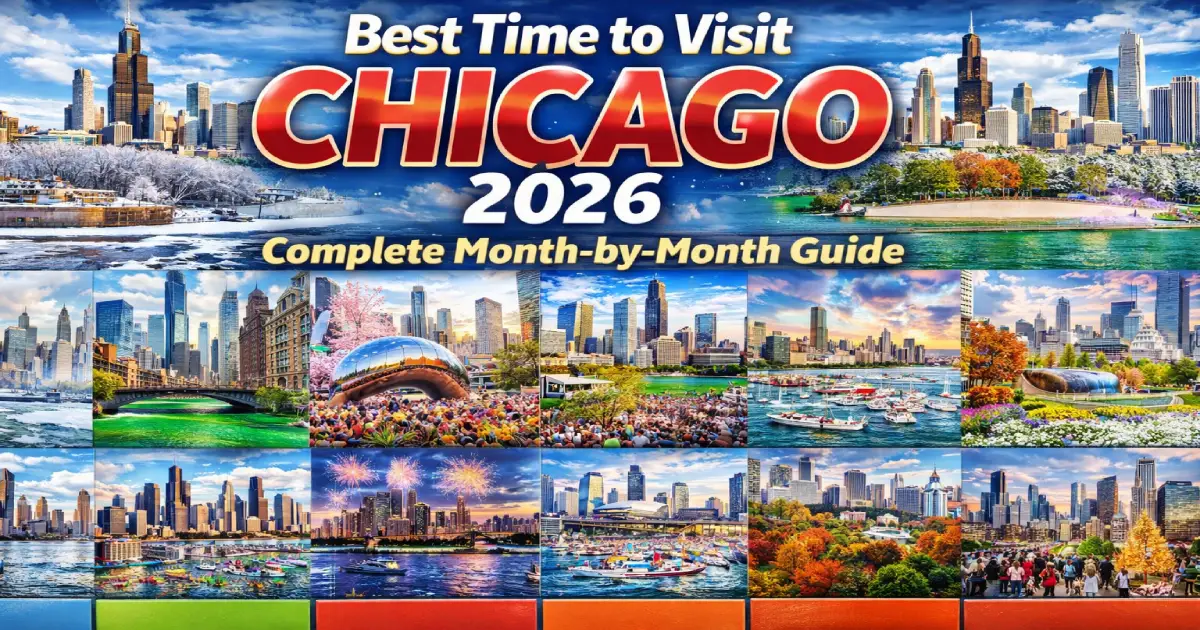
Best Time to Visit Chicago 2026: Complete Month-by-Month Guide
Published on : 21 Mar 2026
Best Time to Visit Chicago — Navigating the Most Dramatically Seasonal American City
By Travel Tourister | Updated March 2026
Chicago’s seasons are the most dramatically different of any major American city — a place where the difference between a July visit and a January visit is the difference between cycling a sun-drenched 18-mile lakefront trail in 82°F warmth and navigating a -20°F wind chill that freezes exposed skin in under 10 minutes. No other city in the continental United States swings between such extremes while maintaining a full-calendar cultural life that makes every month worth visiting for the right traveler. The Chicago that invented deep-dish pizza eats it year-round. The Green Mill jazz club opens every night at 7 PM regardless of what the thermometer says. The Art Institute is equally magnificent in January and July. The question is simply what you want to do when you get there — and whether you’re prepared for what Chicago’s weather will ask of you in return.
I’ve visited Chicago across every season and most months — the July architecture boat tour when the buildings glow and the river is alive with kayakers, the October afternoon when the lakefront trees are gold and the crowds have thinned and the city feels most fully itself, the February Saturday when Millennium Park’s skating ribbon was open and the skyline was a crystalline blue and the hot chocolate at the Millennium Park Café was the finest hot chocolate on earth, and the March morning when the Chicago River ran emerald green and 300,000 people lined the bridges despite 38°F temperatures because this is Chicago and the river is green and that is that. Each visit confirmed that every Chicago season has genuine rewards — and genuine costs that honest planning must acknowledge.
This comprehensive 2026 guide breaks down Chicago’s best and worst visiting times using current weather data from National Weather Service Chicago, event calendars, hotel pricing patterns, and honest assessments of what each month actually delivers. We cover every month in detail, identify the best times for specific activities, flag the major events that make specific weeks uniquely rewarding or uniquely crowded, and give you the complete strategic intelligence to choose the right Chicago window for your specific trip priorities.
Whether planning a summer lakefront festival visit, a fall architecture and food tour, a budget winter cultural immersion, or a spring trip timed to the St. Patrick’s Day river dyeing, this guide gives you the honest, month-by-month picture of what Chicago is actually like throughout the year — and what it demands from the visitor willing to meet it on its own terms.
Chicago: Quick Season Overview
Season / Month
Weather
Crowds
Hotel Prices
Best For
January
18–29°F, very cold, snow
Very Low
$95–$145
Budget, museums, jazz, skating
February
22–34°F, cold, snow possible
Very Low
$95–$150
Budget, Chicago Restaurant Week
March
32–46°F, variable, rain/snow
Low–Moderate
$110–$175
St. Patrick’s Day, green river
April
42–58°F, improving, rainy
Moderate
$130–$200
Cherry blossoms, spring events
May
52–67°F, pleasant, some rain
Moderate–High
$155–$240
Outdoor activities, boat tours begin
June
62–76°F, warm, occasional storms
High
$175–$275
Blues Festival, outdoor dining, lakefront
July
70–84°F, warm, humid
Peak
$200–$340
Lollapalooza, beaches, 4th of July
August
68–82°F, warm, occasional storms
Peak
$200–$340
Air & Water Show, outdoor events peak
September
58–72°F, excellent, clear
Moderate–High
$170–$265
Best overall value, Chicago Marathon
October
48–62°F, crisp, fall color
Moderate
$145–$225
Best overall month, fall foliage
November
36–50°F, cold, rain/early snow
Low
$110–$175
Museums, restaurants, budget
December
26–38°F, cold, festive, snow possible
Moderate (holiday week high)
$120–$200
Christkindlmarket, skating, holiday events
Best Overall Times to Visit Chicago
1. October — THE BEST MONTH TO VISIT CHICAGO
Why October Is Perfect: Chicago locals consistently identify October as the city’s finest month — and the data supports them entirely. October delivers the ideal balance: crisp 48–62°F temperatures perfect for walking the lakefront and exploring neighborhoods, spectacular fall foliage along Lake Shore Drive and in Lincoln Park, hotel prices 30–35% below summer peak, the summer crowds fully cleared, the architecture boat tours still operating in their final weeks, the Cubs playoffs (in good years), and the Chicago Marathon (second Sunday of October) bringing the city’s most energetic sports weekend. The light in October — low, golden, raking across the limestone and glass buildings at angles impossible in summer — makes Chicago more photogenic than any other month.
October Highlights:
Chicago Marathon (second Sunday of October): One of the six World Marathon Majors — 45,000 runners from 100+ countries through all 77 Chicago neighborhoods, free to spectate anywhere along the 26.2-mile course. The most exhilarating free sporting event in Chicago.
Fall foliage: Lincoln Park, Millennium Park, the North Shore lakefront communities, and the Chicago Riverwalk are at their most beautiful in mid-to-late October — the ginkgo trees on Michigan Avenue turn simultaneously gold in an annual spectacle
Architecture boat tours in final weeks: The architecture boat tours typically run through late October — the fall light on the buildings is the finest of the year
Cubs playoffs (when applicable): Wrigley Field in the playoffs is one of the finest sporting experiences in America — check the MLB postseason schedule against your travel dates
Restaurant availability: All of Chicago’s finest restaurants (Alinea, Ever, Smyth) have far greater availability in October than in summer peak — 2-week lead times where July required 2 months
Average temperatures: 48–62°F; 8–10 rain days; wind increasing toward month’s end
Hotel rates: $145–$225/night — 30–35% below summer peak
2. September — Best Value Month
Why September Works Brilliantly: September is the smart traveler’s Chicago month — summer warmth persists into the first two weeks (72°F average highs in early September), hotel prices drop 15–20% immediately after Labor Day, the summer festival crowds thin dramatically, the architecture boat tours continue at full operation, the Cubs and White Sox pennant races peak, and the Chicago Jazz Festival (Labor Day weekend) fills Millennium Park with the finest free jazz event in the city’s calendar. September delivers 85% of summer’s outdoor appeal at a meaningfully lower price and with significantly fewer crowds.
Chicago Jazz Festival (Labor Day weekend, Millennium Park): The oldest free jazz festival in the country — four days of world-class jazz in Millennium Park, free admission, the finest free music event in Chicago after the Blues Festival
Chicago Marathon registration opens: The October race’s training peak — September is when Chicago feels the pre-marathon energy building
Post-Labor Day crowd drop: Hotel prices fall within 48 hours of Labor Day; architecture boat tours have reasonable advance availability again; restaurant reservations open up
Lake Michigan swimming: Lake Michigan reaches its warmest temperature in late August–September (68–72°F) — the finest Lake Michigan swimming of the year, with fewer beach crowds than July
Hotel rates: $170–$265/night dropping post-Labor Day to $155–$230
3. June — Best Summer Month
Why June Is Peak Summer Quality: June delivers Chicago’s summer without the July–August humidity and heat peaks — temperatures of 62–76°F, the Chicago Blues Festival (second weekend, largest free blues festival in the world), the lakefront fully activated with cyclists and swimmers, the architecture boat tours at full schedule, and the outdoor restaurant patios of the city’s finest neighborhoods filled with the first genuine summer warmth after Chicago’s long winter. June is summer done right.
Chicago Blues Festival (second weekend of June): The largest free blues festival in the world — four days in Grant Park, the finest free outdoor music event in Chicago ($0)
Navy Pier fireworks (Wednesday and Saturday evenings): Free fireworks from Memorial Day through Labor Day — best viewed from the pier’s east end or from the Lakefront Trail north of Navy Pier
Architecture boat tours at full capacity: The CAF River Cruise at its most frequently scheduled — book 1–2 weeks ahead for summer weekends
Outdoor restaurant and bar culture: Chicago’s outdoor dining season at its genuine beginning — the rooftop bars and garden patios of Wicker Park, Logan Square, and Andersonville filling for the first time since autumn
Hotel rates: $175–$275/night — below July–August peak
4. Late February — Chicago Restaurant Week
Why Late February Is Worth Considering: Chicago Restaurant Week (typically last two weeks of February) is the finest value window in Chicago’s dining calendar — 400+ restaurants offer prix-fixe lunch ($25), brunch ($30), and dinner ($45–$55) menus, providing access to Michelin-starred and James Beard Award-recognized kitchens at 40–60% of normal pricing. Hotel rates are among the year’s lowest ($95–$150/night). The trade-off is February’s cold (22–34°F, possible snow, reliable wind) — but Chicago’s world-class indoor culture makes this entirely manageable for the visitor who plans accordingly.
Prix-fixe access to Alinea, Ever, Smyth, and the city’s finest restaurants at $45–$55/person for dinner
Hotel rates at near-annual lows — the most budget-friendly sustained window
Museums, the Art Institute, Symphony Center, and the Lyric Opera fully programmed with no summer crowds
Skating ribbon at Maggie Daley Park open through February — the most underrated winter activity in Chicago
Month-by-Month Breakdown
January: The True Chicago Winter
Weather: 18–29°F average high; wind chill regularly produces feels-like temperatures of -10°F to -20°F; snow likely; Lake Michigan effect produces additional lake-enhanced snow on the North Shore; the shortest daylight days of the year (9 hours)
What’s Great:
Lowest hotel prices of the year — $95–$145/night for hotels that cost $280+ in July
Museum visiting at its absolute best — the Art Institute, Field Museum, Shedd Aquarium, and Museum of Science and Industry at their least crowded; the Thorne Miniature Rooms with no one standing between you and the glass
Green Mill jazz: The best jazz months are when Chicago is too cold to do anything else — the Tuesday night Jazz Orchestra fills the booth where Al Capone once sat with the city’s genuine jazz devotees
Buddy Guy’s January residency: Buddy Guy performs his annual January run of shows at Buddy Guy’s Legends — the single finest blues event accessible from Chicago in any month
Maggie Daley Park skating ribbon: Open November–March, $15/skate rental — the most distinctly Chicago winter activity, the skyline visible throughout
The Pedway: Chicago’s underground pedestrian network becomes genuinely life-improving in January — exploring the 40-block tunnel system between hotel and museum keeps you indoors and warm
What’s Challenging: The cold is genuinely extreme — wind chills of -20°F are not unusual in January, and exposed skin freezes in under 10 minutes in those conditions. Proper layering (thermal base, insulating mid-layer, wind-resistant outer shell, insulated boots, face covering, and mittens rather than gloves) is not optional. Architecture boat tours are not operating. The lakefront is ferocious in January wind.
What to Pack: Thermal base layer, insulating fleece or down mid-layer, waterproof and windproof outer shell, insulated waterproof boots rated to -20°F, wool hat covering ears, neck gaiter or balaclava, mittens over gloves. This is not a precaution — it is required equipment.
Verdict: Excellent for visitors who specifically want indoor Chicago — museums, jazz, blues, symphony, opera, theater — at the lowest prices of the year; genuinely challenging for outdoor activity expectations
Average hotel rate: $95–$145/night
February: Cold, Culture, and Restaurant Week
Weather: 22–34°F; wind chill -10°F to -15°F possible; some moderation from January’s worst; snow possible throughout; 9–10 hours of daylight by month’s end
What’s Great:
Chicago Restaurant Week (typically last two weeks of February): The finest value dining event in Chicago’s annual calendar — 400+ restaurants offering prix-fixe menus at $25 (lunch), $30 (brunch), and $45–$55 (dinner). Access to Michelin-starred restaurants at 40–60% of normal pricing. This specific event alone justifies a late-February Chicago visit for serious food travelers.
Hotel prices remain near-annual lows: $95–$150/night — the same hotel that costs $300 in August
Valentine’s Day week: Restaurant special menus; the most festive winter dining week in Chicago
Chicago Symphony Orchestra February programming: The most ambitious orchestral programming of the season — February typically features the major symphonic works
Skating ribbon at Maggie Daley Park: Still open through February — the winter skating continues
What’s Challenging: Still cold — February is Chicago’s second coldest month. The cold management required in January remains essential in February. Architecture boat tours still not operating.
Verdict: Excellent for food travelers (Restaurant Week) and indoor culture devotees; the cheapest sustained hotel pricing of the year
Average hotel rate: $95–$150/night
March: St. Patrick’s Day and the Green River
Weather: 32–46°F; highly variable — March can deliver a 60°F sunny day and a snowstorm in the same week; rain increasingly likely; the Midwestern spring is technically arriving but has not yet committed
What’s Great:
Chicago River dyeing (Saturday before St. Patrick’s Day): The most uniquely Chicago annual tradition — the Chicago River dyed emerald green by the Chicago Journeymen Plumbers Union, the formula kept secret since 1962. 300,000+ spectators line the Michigan Avenue and Wabash Avenue bridges from 8 AM. The dyeing takes approximately 45 minutes beginning around 9 AM. This specific event is worth visiting Chicago specifically for in March — it is genuinely unlike anything available in any other American city.
Chicago St. Patrick’s Day Parade (same Saturday, afternoon): Downtown Columbus Drive parade — free, one of the largest St. Patrick’s Day parades in America
Architecture boat tours beginning: The CAF River Cruise typically reopens in mid-to-late March — the first boats of the season with smaller crowds than summer
Chicago Bulls and Blackhawks: Both NBA and NHL home games in March — the most active sports month in the United Center calendar
What’s Challenging: March weather is genuinely unpredictable — plan indoor backup for every outdoor activity; St. Patrick’s Day weekend drives hotel price spikes and advance booking is essential (4–6 weeks ahead)
St. Patrick’s Day booking note: Hotel rates for the St. Patrick’s Day weekend spike significantly — book 4–6 weeks ahead for reasonable pricing. Weekday stays immediately before or after the holiday weekend are dramatically cheaper.
Verdict: Essential for the river dyeing experience; challenging for general outdoor activities
Average hotel rate: $110–$175/night (St. Patrick’s Day weekend significantly higher)
April: Chicago’s Uncertain Spring
Weather: 42–58°F; rain frequent (10–12 days); occasional late cold fronts; the first genuinely warm days appear by late April; lakefront still cold and windy; but the city’s green spaces begin activating
What’s Great:
Cherry blossoms in Lincoln Park and the Japanese Garden in Jackson Park — peak bloom typically first two weeks of April (check Chicago Park District for current bloom status)
Opening of Chicago restaurant patios — the first outdoor dining of the year, universally celebrated by Chicagoans who have been waiting since October
Architecture boat tours in full spring operation — smaller crowds than summer, excellent docent availability
Chicago White Sox and Cubs opening day (late March or early April) — the most festive sports event of the Chicago spring calendar
Hotel prices rising but still below summer peak — reasonable value before the summer surge
What’s Challenging: Rain is frequent and the cold can return; the Lake Michigan wind remains fierce on the lakefront; some outdoor events have not yet launched for the season
Verdict: Good for architecture tours and the spring cultural season; acceptable for outdoor activities with rain flexibility built in
Average hotel rate: $130–$200/night
May: Chicago Awakening
Weather: 52–67°F; rain still possible but increasingly sunny; the definitive Chicago spring arrives in earnest by mid-May; Lake Michigan warms from the 45°F of April toward 58°F by month’s end; outdoor activity becomes genuinely comfortable
What’s Great:
Chicago Spring Awakening (Electronic Music Festival, late May): Humboldt Park electronic music festival — 30,000+ attendees, emerging and established electronic artists
Navy Pier summer season launches (Memorial Day weekend): Fireworks begin, summer programming launches, the pier transitions to full summer operation
Lakefront Trail fully activated: Cyclists, runners, and rollerbladers on the full 18-mile trail for the first time since October — the lakefront’s social energy returns
Green City Market opens (Lincoln Park, Wednesday and Saturday): The finest farmers market in the Midwest resumes its outdoor season — the most celebrated chef’s market in Chicago
Architecture boat tours at full spring schedule: Book 1 week ahead for May weekends — excellent availability before summer peak crowds
What’s Challenging: Memorial Day weekend drives hotel price spike (25–30% above early May); occasional cold snaps still possible in early May; Lake Michigan water too cold for comfortable swimming until July
Verdict: Excellent pre-summer month — good weather, lower prices than summer, excellent outdoor activity access
Average hotel rate: $155–$240/night (Memorial Day weekend higher)
June: Summer Begins — Blues and Lakefront Peak
Weather: 62–76°F; warm and pleasant; occasional severe thunderstorms (Chicago’s spring storm season extends into June); Lake Michigan 55–62°F; humidity building but not yet oppressive; excellent outdoor conditions
What’s Great:
Chicago Blues Festival (second weekend): The largest free blues festival in the world — four days of world-class blues in Grant Park and Millennium Park, free admission, 500,000+ attendees over the weekend. The absolute finest free music event in Chicago.
Navy Pier fireworks (Wednesday and Saturday evenings, Memorial Day through Labor Day): Free fireworks visible from the pier and the Lakefront Trail north of Navy Pier — the most consistent free summer event in Chicago
Chicago Pride Fest (Boystown, mid-June) and Chicago Pride Parade (last Sunday of June): One of America’s largest Pride celebrations — the parade down Halsted Street draws 1 million+ attendees; Pride Fest is the neighborhood festival the week before
Ravinia Festival begins (Highland Park, June): The outdoor music pavilion 30 miles north of Chicago — a summer of classical, jazz, and popular music on the suburban lawn, accessible by Metra train ($7 each way)
What’s Challenging: Hotel prices rising significantly from spring; architecture boat tours now require 1–2 week advance booking; severe thunderstorm risk (outdoor events occasionally interrupted)
Verdict: Excellent — the finest combination of summer weather and major events before July’s peak crowds and prices
Average hotel rate: $175–$275/night
July: Peak Chicago Summer
Weather: 70–84°F average; humidity rising (dew points 65–70°F make it feel warmer); Lake Michigan 62–68°F — comfortable for swimming; occasional severe thunderstorms; 15 hours of daylight at solstice
What’s Great:
Lollapalooza (early August — but July preparation energy fills the month): Grant Park’s 170-act, four-day music festival is the defining summer event
4th of July Navy Pier fireworks: The city’s most spectacular fireworks show — 20-minute display best viewed from the Lakefront Trail north of the pier or from the Adler Planetarium peninsula
Taste of Chicago (4th of July week, Grant Park): The world’s largest food festival — 50+ Chicago restaurants serving portions at fair prices, free admission to the park (food tickets required)
Lake Michigan swimming: North Avenue Beach and Oak Street Beach at peak summer energy — volleyball tournaments, lifeguarded swimming, and the most social beach culture in the Midwest
Chicago Cubs afternoon games: Wrigley Field in the afternoon sun in July is one of the finest American sports experiences
What’s Challenging: Peak hotel prices ($200–$340/night) — the most expensive month; Lollapalooza weekend (early August but hotel impact begins July) drives prices even higher; architecture boat tours sell out 2+ weeks ahead; severe thunderstorm risk; humidity can make outdoor activities uncomfortable
Verdict: Best weather month; highest cost; plan 6–8 weeks ahead for all major bookings
Average hotel rate: $200–$340/night
August: Summer Peak Continues
Weather: 68–82°F; typically slightly less humid than July by late August; Lake Michigan at its warmest (68–72°F) — the finest Lake Michigan swimming of the year; occasional severe thunderstorms; days shortening but still long (13+ hours)
What’s Great:
Lollapalooza (early August, Grant Park): Four days, 170 acts, eight stages — the largest and most celebrated music festival in the Midwest ($125–$175/day, $350–$400/4-day pass). Grant Park is transformed; the entire downtown area activates around it.
Chicago Air and Water Show (third weekend of August): The largest free air show in the United States — two days of Blue Angels, Thunderbirds, and civilian aerobatics above Lake Michigan, viewed free from North Avenue Beach (arrive by 8 AM for front-row beach positions)
Lake Michigan at its finest: Water temperature at annual peak (68–72°F), the finest swimming conditions of the year at North Avenue Beach and Oak Street Beach
Chicago Riverwalk at peak operation: All Riverwalk restaurants, bars, and kayak rentals operating at maximum capacity — the finest season for the Riverwalk’s social culture
What’s Challenging: Lollapalooza weekend (early August) drives hotel prices to annual peaks — expect $350–$500+/night near Grant Park that specific weekend; the Air and Water Show weekend is the most crowded lakefront event of the year; humidity remains significant
Lollapalooza hotel strategy: Book 3–4 months ahead for Lollapalooza weekend or stay in neighborhoods (Wicker Park, Wrigleyville) away from Grant Park where the specific event premium is lower.
Verdict: Excellent outdoor and event month; expensive; Lollapalooza weekend requires specific advance planning
Average hotel rate: $200–$340/night (Lollapalooza weekend $350–$500+ near Grant Park)
September: The Connoisseur’s Month
Weather: 58–72°F in early September, dropping toward 50–62°F by month’s end; generally clear and pleasant; humidity declining; the finest sustained weather of the Chicago outdoor calendar begins in mid-September
What’s Great:
Chicago Jazz Festival (Labor Day weekend, Millennium Park): The oldest free jazz festival in the country — four days of world-class jazz in Millennium Park, free admission, a more intimate and less crowded experience than the Blues Festival in June
Post-Labor Day crowd and price drop: Hotel prices fall 15–20% within days of Labor Day; architecture boat tours have excellent availability; the city returns to residents-first energy
Architecture boat tours in finest light: September’s lower sun angle produces warm, golden light on the buildings — the architectural photography conditions of September rival October
Lake Michigan swimming continues: Water temperature remains excellent through September (65–70°F) — the warmest-water swimming with the fewest crowds of any summer month
Chicago Restaurant Week (late September): A second Restaurant Week in late September — additional access to Chicago’s finest restaurants at prix-fixe pricing
What’s Challenging: Labor Day weekend is still expensive and crowded — the final summer surge before the post-holiday drop; architecture boat tours typically stop operating in late October (check architecture.org for current season end date)
Verdict: The best value month for most travelers who want good weather — excellent outdoor conditions, dropping prices, fewer crowds, and major free events
Average hotel rate: $170–$265/night dropping post-Labor Day to $155–$230
October: The Best Month — Chicago’s Finest
Weather: 48–62°F; crisp, clear, increasingly dry; fall foliage builds through the month; wind increasing toward Halloween; the occasional warm spell (Indian Summer) delivers extraordinary clarity and 65°F days in mid-October
What’s Great:
Chicago Marathon (second Sunday): One of the world’s six Marathon Majors — 45,000 runners from 100+ countries through all 77 Chicago neighborhoods, free to spectate anywhere along the course. The neighborhoods through which the course passes (Lincoln Park, Chinatown, Bronzeville, Back of the Yards) are at their most accessible and most festive on Marathon morning.
Fall foliage: The most beautiful month on the Chicago lakefront — the ginkgo trees on Michigan Avenue turn simultaneously gold, Lincoln Park’s maples and oaks deliver brilliant color, and the Lakefront Trail has never been more beautiful or less crowded
Architecture boat tours final weeks: The last architecture cruises of the season, typically through late October — the fall light on the buildings is the finest of the year
Restaurant reservation accessibility: The summer reservation backlog clears completely in October — Chicago’s finest restaurants (Alinea, Ever, Smyth + the Owner) have realistic availability with 1–3 weeks advance booking
Indian Summer windows: The occasional October warm spell (65°F+, clear sky) delivers the finest outdoor Chicago day of the year — the specific combination of fall color, reduced crowds, and unexpected warmth
What’s Challenging: Chicago Marathon weekend (second Sunday) drives hotel price spikes citywide — book 6–8 weeks ahead for Marathon weekend; wind picking up toward month’s end; evenings require a proper jacket
Verdict: The best overall month to visit Chicago for most travelers — excellent weather, spectacular fall color, major events, reduced crowds, and excellent fine dining access
Average hotel rate: $145–$225/night (Marathon weekend higher)
November: Entering Winter — Indoor Season Launches
Weather: 36–50°F; cold and increasingly raw; rain and early snow possible; the first genuinely cold days of the season; Thanksgiving week brings the first real freeze; architecture boat tours typically closed
What’s Great:
Full cultural season launching: The Lyric Opera, Chicago Symphony, Joffrey Ballet, and all major Chicago theater companies launch their winter programming in October–November — the finest month for performing arts in Chicago
Chicago Christkindlmarket (late November through December 24, Daley Plaza): The largest authentic German Christmas market in the United States — artisan goods, German food, Glühwein, and the most festive downtown atmosphere of the year ($0 entry)
Hotel prices dropping significantly: $110–$175/night — 40–50% below summer peak, with full access to the city’s finest restaurants and cultural institutions
Thanksgiving week: Macy’s on State Street Thanksgiving Day parade (free from the sidewalk) and the most accessible restaurant reservations of the fall season
What’s Challenging: Architecture boat tours closed; outdoor activities significantly less appealing; Thanksgiving week drives brief hotel price spikes; the first genuine Chicago cold has arrived
Verdict: Excellent for indoor culture, the Christkindlmarket, and budget travel; challenging for outdoor activity visitors
Average hotel rate: $110–$175/night
December: Holiday Chicago
Weather: 26–38°F; cold, possible snow, the shortest days of the year (9 hours); wind chill making it feel significantly colder; but the Christkindlmarket glows and the skating ribbon at Maggie Daley Park curves through a snowy park and the city’s holiday decorations are genuinely beautiful
What’s Great:
Christkindlmarket (through December 24, Daley Plaza): The finest German Christmas market in the United States — 60+ vendors selling handcrafted European goods, traditional German foods (schnitzel, käsespätzle, strudel), and Glühwein that makes the cold feel intentional rather than punishing. The most atmospheric free winter event in Chicago.
Maggie Daley Park skating ribbon: Open November through March — the 606-foot winding skating ribbon through the park, skyline visible throughout, $15 skate rental
Millennium Park ice skating (free): The McCormick Tribune Ice Rink in Millennium Park is free to skate — bring your own skates or rent at the adjacent skate rental ($13). The Cloud Gate as a backdrop for winter skating is one of Chicago’s most photographed winter scenes.
Chicago Symphony and Lyric Opera holiday programming: The most accessible and most beloved annual performances — the CSO Holiday Concerts, Handel’s Messiah at Symphony Center, and the Lyric Opera’s December productions
Early December budget window: December 1–20 delivers reasonable hotel prices before the holiday week premium — festive atmosphere without holiday week crowding
What’s Challenging: Holiday week (December 22–January 1) — the most expensive hotel week in Chicago (some years more expensive than summer peak); O’Hare airport among the busiest in the world during holiday travel; the cold is serious and requires serious preparation
Verdict: Excellent in early-to-mid December for holiday atmosphere and budget rates; expensive and crowded during the holiday week itself
Average hotel rate: $120–$200/night (holiday week $250–$400+)
Best Times for Specific Activities
Best Time for Architecture Boat Tours
Optimal: September–October — the fall light angle produces warmer and more dramatic illumination on the buildings than summer’s direct overhead sun; boat capacity is lower; docents are more focused with smaller groups; and the architecture itself is at its most photogenic. The CAF River Cruise operates May through late October (check architecture.org for exact seasonal close date).
Good: May–June (excellent light, full season beginning, reasonable crowd levels); July–August (full schedule, peak crowds, book 2+ weeks ahead)
Avoid: November–April (boat tours not operating; the walking architecture tours offered by the CAF are available year-round and are the cold-weather alternative)
Best Time for the Chicago Blues Festival
Exact timing: Second weekend of June — always. The festival runs Thursday through Sunday in Millennium Park and Grant Park, free admission. The headline sets at the Petrillo Music Shell are best experienced Friday–Sunday evenings when the finest artists perform. The smaller satellite stages Thursday afternoon are the most intimate blues experience at the festival.
Best Time for Outdoor Activities and the Lakefront
Optimal: July–August for beach swimming (water 62–72°F, lifeguarded); June and September for cycling and trail activities (ideal temperature, fewer crowds than July–August). October for fall color walks (the most beautiful lakefront month). May for the season’s opening energy when locals return to the trail after winter.
Avoid for outdoor activities: November through April — the lakefront in winter is magnificent in the way that a storm at sea is magnificent: impressive, beautiful, and genuinely inhospitable for leisurely activity
Best Time for Fine Dining
Optimal: January–February (Chicago Restaurant Week, easiest reservations at the city’s finest restaurants); October–November (post-summer reservation backlog clears, fall menus at their most ambitious); late September (second Chicago Restaurant Week, good reservation availability).
Most difficult reservations: July–August — Alinea and the city’s most celebrated restaurants book 2–3 months ahead in peak summer; October–November reservation windows drop to 2–4 weeks for the same restaurants.
Best Time for Budget Travel
Optimal: January–February — hotel rates 40–55% below summer peak with full access to museums, jazz, blues venues, symphony, opera, and the city’s finest restaurants (at Chicago Restaurant Week pricing in February). The cold is the cost; the savings are genuine.
Strategy: Avoid specific price spike events: Lollapalooza weekend (early August, +$150–$200/night near Grant Park), Chicago Marathon weekend (second Sunday of October, +$50–$100/night citywide), St. Patrick’s Day weekend (third Saturday of March, +$50–$80/night), and the holiday week (December 22–January 1, +$100–$200/night). These specific weekends within otherwise moderate-priced months represent the most significant hotel price spikes in Chicago’s calendar.
Best Time for Wrigley Field
Optimal: May–September afternoon games — Wrigley Field in afternoon sunshine is one of the finest American sports experiences. September for pennant race drama. October for the possibility of playoff games. Avoid April (cold, often raining, players and fans miserable equally). The Cubs home opener (late March or early April) is a Chicago tradition but requires serious cold-weather preparation.
Chicago Timing: Practical Tips
Topic
What to Know
The Winter Reality
Chicago’s winter is the most consequential weather variable in US urban travel planning. January wind chills of -20°F to -30°F are real, not exaggerated. Exposed skin freezes in under 10 minutes at -20°F. The “Windy City” nickname understates the Lake Michigan wind effect on winter temperatures. Required winter equipment: thermal base layer, insulating mid-layer, windproof outer shell, insulated waterproof boots (-20°F rated), wool hat over ears, neck gaiter or balaclava, mittens. This is not optional — it is survival equipment in January Chicago.
Architecture Boat Tour Booking
Book the CAF River Cruise immediately upon finalizing Chicago travel dates if visiting May–August. Summer weekend evening tours (the finest light) sell out 2–3 weeks ahead. September and October tours are easier to book (1 week ahead sufficient) and deliver superior fall light on the buildings. Tours depart from the Chicago Architecture Center, 111 E. Wacker Drive. Book at architecture.org — the CAF is the authoritative operator; other river operators vary in quality.
Major Events to Plan Around
Events requiring specific advance hotel booking (4–8 weeks): Lollapalooza (early August — the single highest-demand hotel weekend), Chicago Marathon (second Sunday of October), St. Patrick’s Day weekend (third Saturday of March), Chicago Pride Parade (last Sunday of June), and the holiday week (December 22–January 1). Events worth planning a trip around: Chicago Blues Festival (second weekend of June, free), Chicago Jazz Festival (Labor Day weekend, free), Chicago Restaurant Week (February and September), Chicago Marathon (October — free to spectate).
Getting Around Seasonally
Summer (May–October): CTA ‘L’ train covers 90% of tourist destinations ($2.50/ride, day pass $5), Divvy bike-share for lakefront and neighborhood exploration ($3.50/30 min), walking for the Magnificent Mile, River North, and Museum Campus. Winter (November–April): CTA ‘L’ is heated, reliable, and the most important transit choice; the Pedway connects downtown buildings underground; walking in serious cold requires wind-block clothing and purpose. Taxis and Uber for cross-neighborhood travel in any season.
What to Pack by Season
Summer (June–August): Light clothing, sunscreen, hat, sunglasses — Chicago’s summer is warm but not oppressive; a light jacket for evenings. Fall (September–October): Layering essential — temperatures swing 20°F between morning and afternoon; a medium-weight jacket for evenings, light layers for afternoons. Spring (March–May): Rain jacket, layers, waterproof footwear — Chicago spring is unpredictable. Winter (November–February): The full winter equipment list described above — do not underequip for Chicago winter.
Hotel Booking Strategy
The Loop and River North are most convenient for major attractions; Wicker Park and Logan Square for neighborhood character at lower prices. Lollapalooza (book 3–4 months ahead, stay in Wicker Park/Wrigleyville rather than Grant Park area for lower event premium). Chicago Marathon (book 6–8 weeks ahead). Standard summer (book 3–4 weeks ahead). Fall and spring (1–2 weeks sufficient). January–February (book 1 week ahead — maximum availability, minimum demand).
Frequently Asked Questions: Best Time to Visit Chicago
What is the best month to visit Chicago?
October is the best single month to visit Chicago — delivering the ideal balance of pleasant weather (48–62°F, crisp and clear), spectacular fall foliage along the lakefront and in Lincoln Park, hotel prices 30–35% below summer peak, the Chicago Marathon (free to spectate, one of the finest free sporting events in the city’s calendar), the final architecture boat tours of the season in their finest light, and restaurant reservation accessibility that July and August cannot offer. For visitors prioritizing absolutely best weather over value, July and August deliver Chicago’s finest outdoor conditions. For visitors prioritizing the Chicago Blues Festival (the world’s largest free blues festival), the second weekend of June is non-negotiable. For the finest fine dining value, Chicago Restaurant Week in February is the specific window. October serves the largest number of visitor priorities simultaneously.
What is the worst time to visit Chicago?
January is the most challenging month for most visitors — wind chills of -20°F to -30°F, architecture boat tours not operating, the lakefront genuinely inhospitable, and daylight running to only 9 hours. That said, January Chicago delivers something that no other month offers: the world’s finest urban jazz venues (the Green Mill, Andy’s Jazz Club), the Buddy Guy January blues residency (the finest blues event available in Chicago), the Lyric Opera and Chicago Symphony at full programming, and the city’s museums at their emptiest and most contemplative — all at the lowest hotel prices of the year. For the visitor who specifically wants these indoor experiences, January is not the worst month; it is the most specific month. The genuinely worst months for most visitor types are those that combine cold with high prices and no specific seasonal payoff: early November (cold, no summer events, expensive holiday season not yet arrived) or late March (cold, rainy, unpredictable — the green river is worth it but the surrounding days are challenging).
How cold does Chicago actually get in winter?
Chicago’s winter cold is severe and should be taken seriously by any visitor. Average January high temperatures are 29°F; average lows are 15°F. However, the relevant number for planning purposes is the wind chill temperature, which the Lake Michigan wind regularly pushes to -10°F to -20°F and occasionally to -30°F or colder. At -20°F wind chill, exposed skin can freeze in under 10 minutes. At -30°F, frostbite risk is immediate. These are not exaggerations for dramatic effect — they are documented conditions that Chicago residents have developed a comprehensive infrastructure to manage (the Pedway underground system, fully heated CTA trains, and a culture of layering and wind-blocking clothing). Visitors who arrive in January with insufficient cold-weather clothing are not uncomfortable; they are potentially in danger. Pack for the worst case, not the average.
Is Chicago good to visit in summer?
Summer Chicago is genuinely excellent — the city’s transformation from winter severity to summer warmth is total and dramatic. The 18-mile lakefront trail fills with cyclists and swimmers; the 580 parks activate; the architecture boat tours run at full schedule; Lollapalooza fills Grant Park; the Chicago Blues Festival provides four days of world-class free music; Cubs afternoon games at Wrigley Field deliver one of America’s finest summer sporting experiences; outdoor dining on every restaurant patio in Wicker Park, Logan Square, and Andersonville operates at full swing; and the Navy Pier fireworks illuminate Lake Michigan every Wednesday and Saturday evening from Memorial Day through Labor Day. The challenges: July–August hotel prices are the year’s highest ($200–$340/night), architecture boat tours require 2+ weeks advance booking, and the summer festival schedule (particularly Lollapalooza weekend in early August) drives specific hotel demand to extraordinary levels. Visit in June or September for summer quality at better prices.
What are the biggest events in Chicago’s calendar?
Chicago’s most significant annual events, organized by calendar impact: (1) Lollapalooza (early August, Grant Park) — 170 acts, four days, $125–$175/day; highest hotel demand weekend of the year; (2) Chicago Marathon (second Sunday of October, free to spectate) — 45,000 runners, citywide route, the most exhilarating free sporting event in Chicago; (3) Chicago Blues Festival (second weekend of June, free) — largest free blues festival in the world, 500,000+ attendees; (4) St. Patrick’s Day river dyeing (third Saturday of March, free) — the most uniquely Chicago annual tradition; (5) Chicago Jazz Festival (Labor Day weekend, Millennium Park, free) — oldest free jazz festival in the country; (6) Chicago Pride Parade (last Sunday of June, free to watch) — 1 million+ attendees on Halsted Street; (7) Chicago Air and Water Show (third weekend of August, free) — largest free air show in the US; (8) Taste of Chicago (4th of July week, Grant Park, free entry) — world’s largest food festival; (9) Christkindlmarket (late November–December 24, Daley Plaza, free entry) — finest German Christmas market in the US; (10) Chicago Restaurant Week (February and September) — 400+ restaurants at prix-fixe pricing.
When are hotel prices lowest in Chicago?
January and February deliver the absolute lowest hotel prices — $95–$150/night for mid-range downtown hotels that cost $250–$340 in July–August. The specific cheapest days are typically Tuesday–Thursday in mid-January, when the combination of post-holiday departure, pre-Restaurant Week quiet, and winter cold minimizes demand to its annual floor. Beyond January–February, the best budget windows are: early November (post-fall culture season but pre-Thanksgiving); early December (Christkindlmarket atmosphere without holiday week pricing); and the post-Labor Day September window (summer prices drop immediately and significantly). The most important price spike events to avoid: Lollapalooza weekend (early August, the most expensive single weekend), Chicago Marathon weekend (second Sunday of October), and the holiday week (December 22–January 1, which can rival or exceed summer peak pricing for specific nights).
What should I pack for a Chicago trip?
Packing for Chicago requires more season-awareness than almost any other American city destination. Summer (June–August): Light breathable clothing, sunscreen (Chicago’s lakefront UV is high), sunglasses, a light jacket for evenings (Lake Michigan creates a cooling effect on the lakefront even in summer). Fall (September–October): Layering is essential — temperatures swing 20°F between a 55°F morning and a 72°F afternoon; a medium-weight jacket for evenings is mandatory; comfortable walking shoes waterproofed or rubber-soled for rain. Spring (March–May): Waterproof jacket and rain-resistant footwear — Chicago spring is genuinely unpredictable; a 70°F day can precede a freezing rain event. Winter (November–March): The comprehensive winter kit: thermal base layer top and bottom; insulating mid-layer (fleece or down); windproof and waterproof outer shell; insulated waterproof boots rated to -20°F; wool hat that covers the ears; neck gaiter or balaclava; mittens (warmer than gloves for serious cold). This packing list is not cautious — it is the required equipment for outdoor movement in Chicago’s winter.
Final Thoughts: Finding Your Chicago Season
After years of visiting Chicago across every month and every season — the architecture boat tour in September light, the Green Mill in January cold, the Blues Festival in June heat, the Marathon in October gold — three principles emerge for choosing the right time for a Chicago trip:
1. Chicago’s winter is not a liability for the visitor who embraces it — it is the access key to the city’s most authentic indoor culture. The Green Mill is better in January than in July, because in January the room belongs to people who came specifically for the music rather than people who came because it was the thing to do on a summer night. The Art Institute in January is quieter and more contemplative than the Art Institute in July. The restaurant reservation that takes 8 weeks in August takes 1 week in February. The Buddy Guy January residency — the last living master of Chicago blues performing at his own venue every January — is available only in January. The visitor who refuses to engage Chicago in winter is refusing the city at its most genuinely itself. Pack for the cold, embrace the Pedway, sit in the Green Mill’s Al Capone booth with a Champagne Velvet, and understand that this is also Chicago — perhaps the most essentially Chicago Chicago that exists.
2. The Chicago Marathon weekend in October is the finest single weekend in the Chicago annual calendar for most visitors — and it is free to attend. 45,000 runners from 100+ countries moving through all 77 Chicago neighborhoods on a second-Sunday-of-October morning that typically delivers the finest weather of the year (55°F, clear, low wind) creates a city-wide public event of extraordinary energy and accessibility. You can stand anywhere along the 26.2-mile course at no charge. The neighborhoods the course passes through — Lincoln Park at mile 9, Chinatown at mile 21, Bronzeville at mile 24 — are at their most festive and most accessible. The post-race lakefront park celebration extends through the afternoon. The hotel prices, while elevated from October’s already-reasonable baseline, are far below summer peak. The architecture boat tours are in their final weeks in their finest light. The fall color is at or approaching peak. No other single weekend in Chicago delivers this combination of free major sporting event, excellent weather, beautiful city, and reasonable hotel value.
3. September and October are the months that Chicago keeps for itself — and the months most worth planning around. The tourists of summer have gone. The architecture boat tours run in their finest light with their most attentive docents. The restaurants that were booked 8 weeks ahead in August are available with 2 weeks notice. The lakefront trail has returned to the cyclists and runners who use it every morning rather than the summer festival crowds. The Jazz Festival fills Millennium Park on Labor Day weekend with the city’s serious jazz devotees rather than the casual summer event attendees. The Marathon brings the most internationally diverse crowd of any Chicago weekend. And the falling leaves and the golden light and the 58°F afternoon that requires nothing but a jacket and a willingness to walk — these are the months when Chicago is most completely available to anyone who shows up with the intention of seeing it whole.
Chicago is the American city that refuses to be anything other than what it is in every season — brutally cold in January, magnificently alive in July, contemplatively beautiful in October, festively defiant in December. Pick the season that matches what you came for. Prepare properly for the weather it demands. And when you’re sitting in the Green Mill at midnight listening to the Jazz Orchestra in whatever month you choose, the city will be entirely, completely, unreservedly itself. That is always worth the trip.
For current event schedules, hotel availability, and Chicago visitor information, consult Choose Chicago, National Weather Service Chicago for seasonal forecasts, and Chicago Architecture Center for current boat tour season schedules and walking tour alternatives.
—
—
About Travel TouristerTravel Tourister’s Chicago specialists provide honest seasonal guidance based on extensive year-round exploration of the city’s neighborhoods, lakefront, music venues, museums, and cultural institutions. We understand that Chicago’s seasons serve different travelers and that the “best time” to visit depends entirely on whether you came for the architecture boat tour, the Blues Festival, the Marathon, the Green Mill, or the Restaurant Week — and whether you’re prepared for what Chicago’s weather asks in return.Need help choosing the right time for your Chicago visit? Contact our specialists who can recommend optimal travel windows based on your specific interests — from Chicago Marathon spectating strategy to Blues Festival stage access to Lollapalooza hotel booking to Chicago Restaurant Week reservation planning. We help travelers find their perfect Chicago season.
Posted By : Vinay
As a lead contributor for Travel Tourister, Vinay is dedicated to serving our Tier 1 audience (US, UK, Canada, Australia). His mission is to deliver precise, fact-checked news and actionable, data-driven articles that empower readers to make informed decisions, minimize travel risks, and maximize their adventure without compromising safety or budget.
Travel Tourister is a leading Travel portal where we introduce travellers to trusted travel agents to make their journey hasselfree, memorable And happy. Travel Tourister is a platform where travellers get Tour packages ,Hotel packages deals through trusted travel companies And hoteliers who are working with us across the world. We always try to find new and more travel agents and hoteliers from every nook and corners across the world so that you could compare the deals with different travel agents and hoteliers and book your tour or hotel with the one you have chosen according to your taste and budget.




 Call
Call Enquiry