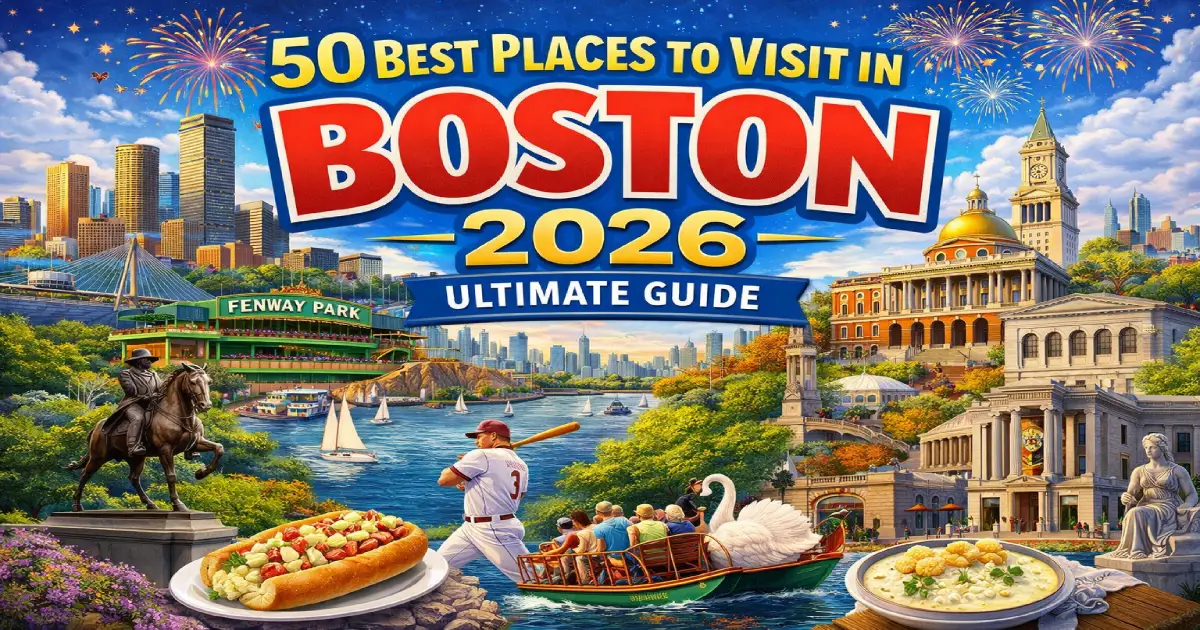
50 Best Places to Visit in Boston 2026: Ultimate Guide
Published on : 23 Mar 2026
Places to Visit in Boston — America’s Most Walkable Historic City, Fully Explored
By Travel Tourister | Updated March 2026
Boston’s places to visit span a range that is unique among American cities — uniquely compact (you can walk from the site of the Boston Massacre to Paul Revere’s house in 20 minutes), uniquely historic (more consequential events of American democratic history occurred within a 2-mile radius here than in any other American city), and uniquely distributed between the globally recognized and the specifically extraordinary. The Freedom Trail’s 16 Revolutionary-era sites are known to every American school child; the Isabella Stewart Gardner Museum’s glass-roofed courtyard with its will-mandated flowers and its empty Vermeer frame is known only to those who have sought it. Fenway Park’s Green Monster appears in a thousand films; Acorn Street’s gas-lit cobblestones are photographed by everyone who discovers them and genuinely unchanged since the 1820s. Boston’s best places reward equally the visitor who follows the red line and the visitor who wanders from it — which is the most generous thing a city of 400 years of American history can do for any traveler willing to walk its neighborhoods.
I’ve built a mental map of Boston’s best places across years of visits spanning every season and every neighborhood — the Granary Burying Ground at 8 AM in October when the maple trees are turning and Paul Revere and Samuel Adams are the only names on the headstones, the Gardner Museum’s courtyard in February when forced narcissus bloom under the glass ceiling and the rest of the city is frozen, the Fenway bleachers on a September Tuesday when the pennant race is alive and the crowd is entirely people who actually follow baseball, the Old South Meeting House where Samuel Adams said the words that sent the Sons of Liberty to Griffin’s Wharf on December 16, 1773, and the Arnold Arboretum on Lilac Sunday in May when 281 acres of Harvard’s botanical collection smells like no other single place in the city. Each place added to the map confirmed the same truth: Boston’s finest places are available to anyone who shows up with walking shoes and the willingness to go where the red line doesn’t necessarily lead.
This comprehensive 2026 guide covers Boston’s 50 best places using verified information from Greater Boston Convention & Visitors Bureau, years of neighborhood expertise, and honest assessments of which places deliver genuinely memorable experiences. We organize places by category — iconic landmarks, neighborhoods, museums and cultural institutions, outdoor and waterfront places, academic and intellectual places, entertainment venues, food destinations, hidden gems, and day trip destinations — with realistic visit times, costs, and strategic advice for building a Boston itinerary that captures the full city.
Whether visiting for 48 hours or two weeks, for a first-time American history pilgrimage or a return trip reaching deeper into Boston’s cultural life, this guide gives you the honest, experience-backed intelligence to find Boston’s best places — the ones that reveal why this compact, cold, opinionated, beautiful city has been producing Americans worth knowing about for 400 years.
Boston Places by Category
Category
Top Places
Best Area
Cost Range
Iconic Landmarks
Freedom Trail sites, Fenway Park, USS Constitution
Downtown, Charlestown, Fenway
Free–$45
Neighborhoods
Beacon Hill, North End, Back Bay, Cambridge
Citywide
Free to explore
Museums & Culture
Gardner Museum, MFA, Harvard Art Museums
Fenway, Copley, Cambridge
Free–$27
Outdoor & Waterfront
Public Garden, Esplanade, Harbor Islands
Downtown, Waterfront
Free–$23
Academic & Intellectual
Harvard Yard, MIT Campus, Harvard Square
Cambridge
Free–$20
Day Trips
Salem, Lexington & Concord, Cape Cod, Newport
30 min–2 hours from Boston
$7–$30
Iconic Landmarks & Must-See Places
1. The Freedom Trail — THE MOST IMPORTANT WALK IN AMERICA
Why It’s Essential: The Freedom Trail is the finest self-guided historical walking experience in the United States — a 2.5-mile red brick line (or painted red stripe) connecting 16 sites of American Revolutionary significance through Boston’s most historic neighborhoods. No other walk in any American city compresses this much consequential history into this walkable a geography. The sites — the Massachusetts State House, Granary Burying Ground, King’s Chapel, Old South Meeting House, Old State House, the Boston Massacre site, Faneuil Hall, Paul Revere’s House, the Old North Church, and the USS Constitution — represent the physical locations where American democracy was argued into existence, where the first armed resistance to British authority was organized, and where the events were set in motion that produced the Declaration of Independence and the Constitution.
The 16 Freedom Trail Sites:
Massachusetts State House (Beacon Street): Charles Bulfinch’s 1798 golden dome — the most important state capitol building in New England, free tours of the interior including the Hall of Flags
Granary Burying Ground: Paul Revere, Samuel Adams, John Hancock, the victims of the Boston Massacre — the most historically consequential cemetery in America ($0)
King’s Chapel and Burying Ground (1688): Boston’s oldest surviving burying ground — the grave of John Winthrop, first governor of Massachusetts Bay Colony
Old South Meeting House: Where 5,000 Bostonians voted for independence and Samuel Adams triggered the Boston Tea Party on December 16, 1773 ($7/adult)
Old State House (1713): Where the Declaration of Independence was first read in Boston — the oldest surviving public building in the city, with the Boston Massacre site marked on the traffic island outside ($12/adult)
Faneuil Hall: “The Cradle of Liberty” — the meeting hall where Samuel Adams and the Sons of Liberty argued for independence; NPS rangers give free talks in the upper meeting room ($0)
Paul Revere House (1680): The oldest remaining structure in downtown Boston — the home Paul Revere lived in when he rode to Lexington on April 18, 1775 ($6/adult)
Old North Church (1723): “One if by land, two if by sea” — the steeple where Robert Newman hung the two lanterns signaling the British march ($5 suggested donation)
USS Constitution (1797): The world’s oldest commissioned warship afloat — free tours by US Navy crew ($0)
Cost: Free to walk; individual site admissions $0–$12; guided tours $16/adult (thefreedomtrail.org)
Best time: Weekday mornings before 10 AM; September–October for weather and crowds
2. Fenway Park
Why It’s America’s Most Essential Ballpark: Fenway Park (1912) is the oldest active Major League Baseball stadium in the world and the most historically and architecturally irreplaceable sports venue in America. The Green Monster (the 37-foot left field wall, 310 feet from home plate), the hand-operated scoreboard, the manually operated pitch counter, the right field Pesky’s Pole, and the specific density of the park — every seat is close to the field in a way that modern stadiums cannot replicate — combine into a baseball experience that is simultaneously the sport at its most authentic and Boston’s identity at its most concentrated.
The Green Monster: The most famous single feature in American sports architecture — standing in the Monster seats (Section 37–39) and looking down at the field 37 feet below is the most distinctive sports viewing experience in any American city
The hand-operated scoreboard: The only manually operated scoreboard in Major League Baseball — workers inside the wall change the numbers by hand during the game; the mechanism has been in continuous operation since 1934
Non-game day tours: Daily tours of the park ($22/adult) that include access to the Green Monster seats, the press box, and the warning track — the most intimate Fenway experience available without purchasing game tickets
The neighborhood: Lansdowne Street and Yawkey Way (now renamed Jersey Street) surrounding the park constitute the most sports-dense commercial block in Boston — the murals, statues, and bars are worth exploring before or after any game or tour
Cost: $25–$150/game ticket; $22/adult tour; 4 Jersey Street, Fenway
3. The Granary Burying Ground
Why It’s the Most Moving Single Place on the Freedom Trail: The Granary Burying Ground on Tremont Street is the third oldest burying ground in Boston (1660) and the most historically concentrated cemetery in America — Paul Revere, Samuel Adams, John Hancock, Benjamin Franklin’s parents, the five victims of the Boston Massacre (including Crispus Attucks, the first American killed in the Revolution), and the parents of Benjamin Franklin all buried within a single city block of 18th-century headstones. The specific proximity of these names — the people who argued American democracy into existence buried in the same 2-acre plot where Boston schoolchildren walk on field trips — makes this one of the most affecting free places in the United States.
Paul Revere’s grave: Marked with a large monument at the rear of the ground — the silversmith, the midnight rider, buried with his neighbors
The Boston Massacre victims: A single monument marks the five killed on March 5, 1770 — including Crispus Attucks, a free Black man of Native American and African descent whose death helped ignite the Revolution
John Hancock’s tomb: The largest single monument in the ground — the Declaration of Independence signer and first governor of Massachusetts
The most historically significant single building in the American Revolution — on December 16, 1773, 5,000 Bostonians (the largest political meeting in colonial American history) crowded this building and the surrounding streets to hear the final debate over the tea tax. When negotiations failed, Samuel Adams rose and said “this meeting can do nothing more to save the country” — the signal that sent the Sons of Liberty to Griffin’s Wharf to dump 342 chests of tea into Boston Harbor
The Voices of Protest audio installation: Recordings of historical debates about the tax acts — the most effectively educational exhibit on the Freedom Trail; hearing the voices argue the same issues that produced the Declaration of Independence makes the history immediately present
The building: Built 1729, the largest building in colonial Boston — the fact that it survives while most of its colonial Boston contemporaries were demolished makes it one of the most significant surviving pre-Revolutionary buildings in America
Cost: $7/adult; osmh.org; 310 Washington Street, Downtown
5. USS Constitution and Charlestown Navy Yard
The world’s oldest commissioned warship afloat — “Old Ironsides,” launched 1797, never defeated in combat, undefeated in 42 engagements through the War of 1812, currently crewed by active US Navy sailors who give free guided tours of the ship
The Charlestown Navy Yard: The terminus of the Freedom Trail — 30 acres of the original 1800 Navy Yard with dry docks, ropewalk, and the USS Cassin Young (a WWII destroyer) alongside the Constitution
USS Constitution Museum (adjacent): Free museum documenting the ship’s history — the finest free naval museum in New England; the hands-on exhibits allow visitors to haul lines and fire cannons in simulation
The ship tour: US Navy sailors in period-appropriate uniforms lead free 30-minute tours of the weather deck and below-deck spaces — the most historically authentic free tour experience in Boston
Cost: FREE (ship and museum); Charlestown Navy Yard, Constitution Road
6. Boston Common and Public Garden
America’s oldest public park (Boston Common, 1634) adjacent to the finest ornamental Victorian garden in New England (Public Garden, 1837) — together forming the 50-acre democratic heart of Boston
Swan Boats (Public Garden, April–October): The pedal-powered Swan Boats on the lagoon have been a Boston family tradition since 1877 — $4.50/adult, operated by the Paget family continuously for nearly 150 years
Make Way for Ducklings sculptures: Nancy Schon’s eight bronze ducklings — the most photographed family destination in Boston, based on Robert McCloskey’s 1941 children’s book, annually dressed in seasonal costumes by the city
Frog Pond (Boston Common): Outdoor skating rink in winter, splash pad in summer — free to use year-round, the most accessible free outdoor activity in downtown Boston
The Parkman Bandstand: Free outdoor concerts through the summer — the most accessible free music venue in the Boston park system
Why It’s Boston’s Most Essential Neighborhood: Beacon Hill is the most architecturally intact and most atmospherically complete 19th-century neighborhood in America — gas-lit cobblestone streets (the gas lamps are real, maintained by the city, and among the last functioning gas street lamps in the United States), Federal-style red brick townhouses designed by Charles Bulfinch, the Massachusetts State House’s golden dome dominating the summit, and Acorn Street (the most photographed cobblestone street in America) create a neighborhood that genuinely looks unchanged from 1840. Walking Beacon Hill at dawn, when the gas lights are still lit and the brick is wet with overnight rain and the tourist map is irrelevant, is one of the finest free walks in any American city.
Acorn Street: The most photographed cobblestone street in America — 100 feet of gas-lit brick, Federal-period townhouses, and 19th-century atmosphere that requires no restoration because it was never significantly changed ($0)
Massachusetts State House (Beacon Street): Charles Bulfinch’s 1798 masterwork — the golden dome visible from most of downtown Boston, free interior tours including the Hall of Flags and the Senate Chamber
Charles Street: The neighborhood’s commercial spine — the finest collection of independent antique shops in Boston, excellent cafés, and the neighborhood’s most walkable commercial block
The gas lamps at night: The specific amber glow of working gas street lamps on cobblestone in a neighborhood of Federal-period brick is available in this specific form in only a handful of places in the world; Beacon Hill is the most accessible of them
Best time: Dawn or dusk on a weekday; Sunday morning for the quietest neighborhood experience
Cost: Free to walk; State House tours free
8. The North End
Why Essential: The North End is Boston’s oldest neighborhood and its most fully preserved Italian-American community — a dense grid of narrow streets between the waterfront and Hanover Street where the Freedom Trail’s most visited sites (Paul Revere’s House, the Old North Church) sit within the same blocks as the finest Italian bakeries, pastry shops, and restaurants in New England. The North End is the place where Boston’s immigrant history and its Revolutionary history occupy the same cobblestone streets.
Hanover Street: The North End’s main commercial corridor — outdoor café tables, restaurant aromas, and the specific sensory experience of a neighborhood that has been Italian for 130 years
Mike’s Pastry (300 Hanover Street): The most visited North End destination — cannoli filled to order, sfogliatelle, ricotta pie, and the most debated pastry in Boston ($4–$6 per pastry)
Modern Pastry (257 Hanover Street): The neighborhood institution that North End residents prefer — less crowded than Mike’s, equally excellent cannoli, and the torrone that is the neighborhood’s finest confection
Paul Revere’s House (19 North Square): The oldest remaining structure in downtown Boston (1680) — the home Paul Revere occupied at the time of his midnight ride ($6/adult)
Cost: Free to walk; pastries $4–$8; Paul Revere House $6
9. Back Bay
The finest Victorian urban neighborhood in America — the Back Bay’s alphabetical grid of streets (Arlington to Hereford) was filled in from 1857–1882 in one of the largest land-reclamation projects in American history, producing 450 acres of consistent Victorian brownstone architecture centered on Commonwealth Avenue’s tree-lined mall
Commonwealth Avenue Mall: The most beautiful urban boulevard in Boston — a tree-lined median with public sculpture, free to walk, at its finest in late April (flowering trees) and October (fall color)
Newbury Street: Eight blocks of independent boutiques, galleries, and restaurants in street-level brownstones — the finest outdoor commercial walking in downtown Boston
Trinity Church (Copley Square): Henry Hobson Richardson’s 1877 masterwork — the most important single building of the American Romanesque Revival, free to enter, reflects in the glass of the adjacent John Hancock Tower
Boston Public Library (Copley Square): The finest public library building in New England — the 1895 McKim, Mead & White building with John Singer Sargent murals in the upper gallery (free to view), a free public courtyard garden, and the most beautiful public reading room in Boston
Cost: Free to walk; Trinity Church $7 suggested; Boston Public Library free
10. Cambridge (Harvard Square Area)
The most intellectually dense neighborhood in New England — Harvard Square’s concentration of the world’s most significant university, the finest independent bookshops in Greater Boston (Harvard Book Store, Brattle Book Shop), excellent cafés, and the MIT campus 1 mile east creates an atmosphere of intellectual energy unavailable anywhere else in the city
Harvard Book Store (1256 Massachusetts Avenue): The finest independent bookshop in Greater Boston — new books upstairs, the “basement bargain books” (used and remainders at $3–$7) downstairs, author events of national significance throughout the year
Brattle Book Shop (9 West Street, Downtown Boston): The finest used bookshop in New England — open-air used book stalls on the exterior wall ($1–$5), three floors of used and rare books inside
The Coop (Harvard Cooperative Society, Harvard Square): The university bookshop-department store that has been a Harvard Square anchor since 1882 — the finest selection of Harvard insignia and the largest academic bookshop section in Cambridge
Getting there: Red Line to Harvard Station ($2.40); Cost: Free to explore
11. The Seaport District
Boston’s most transformed neighborhood — the former waterfront industrial district south of Downtown is now Boston’s most restaurant-dense neighborhood, with the Institute of Contemporary Art (ICA), the Boston Children’s Museum, the finest harbor views from any Boston neighborhood promenade, and the most actively developing cultural scene in the city
ICA Boston: The Diller Scofidio + Renfro building cantilevered over Fort Point Channel — the finest contemporary art museum in Boston, with a permanent collection of 21st-century art and the most dramatic waterfront building in the Seaport ($20/adult, free Thursday evenings)
Seaport waterfront walk: The promenade from the World Trade Center to the Children’s Museum — the finest harbor-level Boston skyline view available from dry land
Fort Point neighborhood (adjacent): The artists’ district within the Seaport — independent galleries, excellent restaurants, and the most concentrated creative community in Boston
Cost: Free to walk; ICA $20/adult, free Thursday evenings
12. Charlestown
The neighborhood at the terminus of the Freedom Trail — Charlestown’s Bunker Hill Monument (the 221-foot granite obelisk marking the site of the first major battle of the American Revolution), the Charlestown Navy Yard (USS Constitution, USS Cassin Young), and the neighborhood’s well-preserved Federal-period architecture make it the most historically concentrated neighborhood outside downtown Boston
Bunker Hill Monument: The 221-foot granite obelisk on Breed’s Hill — 294 stairs to a panoramic view of Boston Harbor, the Charles River, and the downtown skyline. Free to enter; the Bunker Hill Museum at the base documents the June 17, 1775 battle ($0)
Monument Square: The residential square surrounding the monument — one of the finest preserved Federal-period residential environments in Boston, free to walk
Cost: Free; Bunker Hill Monument open daily 9 AM–5 PM
Museums & Cultural Institutions
13. Isabella Stewart Gardner Museum — BOSTON’S MOST EXTRAORDINARY PLACE
Why It’s Irreplaceable: The Isabella Stewart Gardner Museum is the most personal and most emotionally resonant museum in America — a 1903 Venetian palace built around a glass-roofed courtyard planted with flowers that Gardner specified by variety in her will (never to be changed), housing 2,500 objects including Vermeer’s The Concert (stolen in 1990 in the largest art theft in history, the empty frame still hanging on the wall as Gardner’s will requires), Titian’s Europa, Rembrandt’s Self-Portrait, and Sargent’s El Jaleo. The museum must be exactly as Gardner left it — no loans, no rehanging, no new acquisitions, no changes. It is both a museum and a legal document. It is the most specifically Boston cultural place in the city.
The courtyard: The glass-roofed inner courtyard planted with seasonal flowers according to Gardner’s will — forced narcissus in winter, azaleas in spring, nasturtiums in summer, chrysanthemums in fall. The most beautiful room in any Boston museum, included with admission.
The Dutch Room (empty frame): The frame where Vermeer’s The Concert hung before the March 18, 1990 theft — left in place as Gardner’s will requires; the most valuable empty frame in the world and the most potent symbol of an unsolved crime in the history of art
Sargent’s El Jaleo (1882): A 12-foot by 23-foot painting of a Spanish flamenco dancer — the largest and most physically commanding single painting in Boston
Titian’s Europa (c. 1562): One of the finest Renaissance paintings in North America — Peter Paul Rubens called it the greatest painting in the world
Free for visitors named Isabella: Gardner’s specific and enduring policy — anyone named Isabella enters the museum free, always
Cost: $20/adult; free for under 18, free for Isabellas; gardnermuseum.org; 25 Evans Way, Fenway; closed Tuesday
Time needed: 2–3 hours; the upper floor galleries are the most visited but the courtyard and the Blue Room require equal time
14. Museum of Fine Arts Boston (MFA)
One of America’s great encyclopedic art museums — the MFA Boston’s permanent collection includes the finest Japanese art outside Japan at any American museum, extraordinary ancient Egyptian artifacts, an excellent Impressionist gallery, and John Singer Sargent’s spectacular mural cycle in the Rotunda and Staircase Hall (the most ambitious decorative painting commission in American museum history)
John Singer Sargent murals: The rotunda and staircase hall murals — a 15-year commission completed in 1925, the finest decorative painting in any Boston museum, free with admission
Japanese art collection: 7,000+ objects representing every medium of Japanese visual culture — the most significant Japanese art collection in the Western Hemisphere
Ancient Egyptian collection: Objects from joint MFA/Harvard excavations in Egypt (1905–1942) — one of the most significant Egyptian collections at any North American museum
Why It’s More Than a Library: The 1895 McKim, Mead & White building in Copley Square is one of the finest public buildings in America — the Dartmouth Street facade (inspired by the Bibliothèque Sainte-Geneviève in Paris), the Bates Hall reading room (the most beautiful public reading room in New England), the Sargent Gallery (John Singer Sargent’s Triumph of Religion mural cycle, free to view), and the Italian Renaissance courtyard garden (one of the finest free outdoor spaces in Back Bay) combine into a building of extraordinary public generosity.
Bates Hall: The grand reading room — barrel-vaulted ceiling, long reading tables, and the specific hush of serious scholarship in a room designed to make reading feel consequential ($0)
John Singer Sargent Gallery: Sargent’s most ambitious mural work — the Triumph of Religion cycle in the upper gallery, free to view with library access
The courtyard garden: An Italian Renaissance courtyard with a central fountain — one of the finest free outdoor spaces in Back Bay, accessible through the Dartmouth Street entrance ($0)
Cost: FREE; 700 Boylston Street, Copley Square; open Monday–Saturday
16. New England Aquarium
One of the finest urban aquariums in the United States — the centerpiece Giant Ocean Tank (a 200,000-gallon cylindrical coral reef tank viewed from a spiral ramp circling from base to top), the penguin colony, and the whale watching cruises operated from Central Wharf make the NEAQ the finest family cultural institution on the Boston waterfront
Giant Ocean Tank: The 200,000-gallon four-story coral reef — sharks, sea turtles, moray eels, and 2,000+ reef species visible from every level of the continuous spiral ramp. The most immersive single aquarium exhibit in New England.
Climate change exhibits: The NEAQ’s ocean science programming is among the finest in the country — the exhibits on ocean warming and coral bleaching are the most scientifically rigorous free public science education available in the Boston waterfront district
Cost: $34/adult, $23/child; neaq.org; Central Wharf, Boston waterfront
17. Harvard Art Museums
Three museums under one Renzo Piano-designed roof in Harvard Square — the Fogg Museum (European and American masters), the Busch-Reisinger Museum (German-speaking European art), and the Arthur M. Sackler Museum (Asian and Islamic art) combined in the finest university art museum complex in America
The Calderwood Courtyard: Renzo Piano’s 2014 skylit central courtyard — one of the most beautiful museum interior spaces in New England, visible from the galleries on all four surrounding levels
Free for Harvard ID holders and Cambridge residents on Sundays: The most accessible free museum opportunity in Cambridge
The Harvard Natural History Museum and the Peabody Museum of Archaeology and Ethnology share a single building — together forming the most intellectually rich museum complex accessible from Harvard Square, anchored by the Glass Flowers
The Ware Collection of Blaschka Glass Models of Plants (Glass Flowers): 4,300 hand-crafted glass models of 847 plant species made by Leopold and Rudolf Blaschka between 1887 and 1936 — the most technically extraordinary objects in any Greater Boston museum, individually indistinguishable from real plants at first glance, made from glass at 1:1 scale. The single most surprising exhibit in any Boston-area museum.
The Great Mammal Hall: Victorian-era natural history display cases — the most atmospheric single room in the museum, unchanged from its 1890s configuration
Cost: $15/adult (combined with Peabody); hmnh.harvard.edu; 26 Oxford Street, Cambridge
19. Museum of Science
One of the finest general science museums in the United States — the Theater of Electricity (Van de Graaff generator lightning demonstrations, the most reliably popular 10 minutes in any Boston family museum visit), the Hayden Planetarium, the Omni IMAX Theater, and the Hall of Human Life
Theater of Electricity: The 2.5-million-volt Van de Graaff generator produces the world’s largest indoor lightning bolts in a theatrical demonstration — the single most crowd-pleasing science demonstration in New England
Cost: $30/adult, $23/child; mos.org; Science Park, Charles River dam
20. Old State House (1713)
The oldest surviving public building in Boston — the building where the Massachusetts Assembly met from 1713 to 1798, where the Declaration of Independence was first read in Boston from the east balcony on July 18, 1776, and where the Boston Massacre occurred on the traffic island directly outside
The Boston Massacre site: Marked by a circle of cobblestones on the traffic island at the intersection of Washington and State Streets, directly outside the Old State House — the site where British soldiers killed five colonists on March 5, 1770
The museum inside: The most comprehensive collection of Boston Revolutionary-era artifacts at any single site on the Freedom Trail
Cost: $12/adult; bostonhistory.org; 206 Washington Street, Downtown
Outdoor & Waterfront Places
21. The Charles River Esplanade
Why It’s Boston’s Finest Outdoor Place: The 3-mile riverfront park along the Boston side of the Charles River is the finest urban waterfront promenade in New England — the Hatch Shell outdoor concert venue (free Boston Pops July 4th concert, 400,000 people, cannon fire for the 1812 Overture), Community Boating’s sailing and kayaking operations, and the continuous Harvard and MIT Cambridge skyline across the water create the most reliably excellent outdoor experience accessible on foot from Back Bay.
Hatch Shell: The outdoor band shell where the Boston Pops performs the July 4th concert — the most attended free event in Boston’s annual calendar; also hosts free summer concerts throughout July and August
Community Boating: The oldest public sailing facility in the United States (1941) — kayak, paddleboard, and sailboat rentals May–October
The Arthur Fiedler footbridge: The pedestrian bridge connecting Back Bay to the Esplanade — the Arthur Fiedler Memorial (the Boston Pops conductor from 1930 to 1979) stands at the bridge’s Back Bay end
Cost: FREE; Community Boating kayak $25–$35/hour; Hatch Shell concerts free
22. Boston Harbor Islands State Park
The most undervisited outstanding outdoor destination accessible from downtown Boston — 34 islands accessible by ferry from Long Wharf, with Spectacle Island (swimming beach, harbor views, the finest Boston skyline view from water), George’s Island (Civil War Fort Warren, the most atmospheric historical fort in the harbor, free to explore after ferry), and Peddocks Island (salt marshes, World War II fortifications) all within 45 minutes of downtown
Spectacle Island: A former city garbage dump (completed landfill closure 1996, opened as park 2006) transformed into a 114-acre island park — 5 miles of trails, a swimming beach with downtown skyline as the backdrop, and the finest harbor views available from any land accessible from Boston. The most extraordinary transformation in Boston’s recent environmental history.
Ferry from Long Wharf: $23/adult round trip, seasonal May through Columbus Day weekend
Harvard University’s 281-acre botanical garden in Jamaica Plain — the finest free botanical experience in New England, with 7,000+ plants representing 3,800+ species from around the temperate world in a landscape designed by Frederick Law Olmsted (the arboretum is the southernmost link in Olmsted’s Emerald Necklace)
The lilac collection: 450 plants representing 190 varieties — the largest lilac collection in North America, blooming simultaneously in the third week of May in the most aromatic natural experience in the Boston park system
Lilac Sunday (third Sunday of May): The one day per year when picnicking is permitted — the annual celebration of the lilac bloom peak, the most beloved free outdoor event in Jamaica Plain, drawing 50,000+ visitors
The Bussey Brook Meadow: The arboretum’s most naturalistic section — stream-side meadow restoration in an urban woodland setting
Cost: FREE always; arboretum.harvard.edu; 125 Arborway, Jamaica Plain; T Orange Line to Forest Hills
24. Copley Square
The finest public square in Boston — Trinity Church (1877, H.H. Richardson), the Boston Public Library (1895, McKim Mead & White), and the John Hancock Tower (1976, I.M. Pei) arranged around a square that is simultaneously Boston’s finest architectural composition and its most accessible outdoor public gathering place
The Trinity Church reflection in the Hancock Tower: The most widely photographed architectural image in Back Bay — the Romanesque Revival stone of Richardson’s church reflected in the mirrored glass of Pei’s modernist tower demonstrates Boston’s 100-year architectural conversation more completely than any other single viewpoint
Copley Square Farmers Market (Tuesday and Friday, May–November): The most conveniently located farmers market in Back Bay — excellent produce and prepared food vendors in the square’s north end
Cost: FREE; open daily; 560 Boylston Street, Back Bay
Academic & Intellectual Places
25. Harvard Yard
Why It’s Essential: Harvard University’s original 9-acre yard — enclosed by the university’s oldest surviving buildings (Massachusetts Hall, 1720, the oldest building still in academic use in the US; University Hall, 1814; Holden Chapel, 1742) and anchored by Daniel Chester French’s John Harvard statue and Harry Widener’s memorial library — is the most historically significant academic courtyard in America. The Yard has been the physical center of American intellectual life since 1636; walking through it in October, when the maple trees are turning and the undergraduates are hurrying between buildings with the specific purposefulness of people who know they are in a significant place, connects the present to 390 years of continuous American scholarship.
Massachusetts Hall (1720): The oldest building in active academic use in the United States — originally used to house soldiers during the Revolutionary War, now the university president’s office
Widener Library: The largest university library building in the world — 3.5 million volumes in a neoclassical building named for Harry Elkins Widener, who donated his 3,300-volume personal collection to Harvard before dying on the Titanic
John Harvard Statue (Daniel Chester French, 1884): The “statue of three lies” — the wrong John Harvard, the wrong founding date (1636, not 1638 as inscribed), and it’s not even a portrait of John Harvard (the real likeness was never recorded; French used a student as a model)
Cost: FREE; Massachusetts Avenue, Cambridge; Red Line to Harvard Station
26. MIT Campus and the Stata Center
The Massachusetts Institute of Technology’s 168-acre Cambridge waterfront campus — the most architecturally diverse major university campus in New England, with buildings by Frank Gehry (Stata Center, 32 Vassar Street), Alvar Aalto (Baker House, 1949), I.M. Pei (Earth Sciences building), and Eero Saarinen (Chapel and Kresge Auditorium, 1955)
Frank Gehry’s Stata Center (32 Vassar Street, 2004): The most distinctive building in Cambridge — titanium, brick, aluminum, and unconventional angles housing the Computer Science and Artificial Intelligence Laboratory, the linguistics department, and the philosophy department in a building that looks intentionally on the verge of collapse
Eero Saarinen’s MIT Chapel (1955): A cylindrical brick chapel surrounded by a moat — the most serene single building on the MIT campus, its interior lit entirely by natural light reflected off the moat water through a skylight
The MIT Museum ($17): The history of MIT’s scientific achievements — holograms, robotics, and the most accessible science museum in Cambridge
Cost: Free campus; Stata Center exterior free; MIT Museum $17; Kendall/MIT Red Line stop
27. Harvard Square
The most intellectually energized commercial district in New England — the 4-block radius around the Harvard Square T station contains the Harvard Book Store, the Brattle Theatre (the finest independent cinema in Cambridge), the Cambridge Common (where George Washington took command of the Continental Army on July 3, 1775), and the most reliable concentration of serious academic conversation available at a café table anywhere in the United States
Brattle Theatre (40 Brattle Street): The finest independent cinema in Cambridge — foreign films, classics, and the Harvard Film Archive screenings in a 1890 theater that has been a Cambridge cultural institution since 1953
Cambridge Common: The historic green where Washington assumed command of the Continental Army — a plaque marks the exact site; the Common is free, open, and contains one of Boston’s finest collections of mature elm trees
Cost: Free to explore; Brattle Theatre $15; budget $20–$50 for food and books
Hidden Gems & Local Favorites
28. The Mapparium (Mary Baker Eddy Library)
Why This Is Boston’s Most Surprising Place: The Mapparium at the Mary Baker Eddy Library on Massachusetts Avenue is a 30-foot diameter walk-through stained glass globe built in 1935 — a globe of the world as it was in 1935 (complete with period political boundaries), viewed from the inside from a glass bridge through the globe’s equator, with a specific acoustic phenomenon that allows a whisper from one end of the bridge to be heard perfectly clearly at the other end 30 feet away. It is simultaneously a piece of historical cartography, a stained glass artwork, an acoustic curiosity, and one of the most genuinely surprising single experiences available anywhere in Boston.
The globe: 608 stained glass panels arranged in a perfect sphere, internally illuminated — the world as it appeared in 1935, with country names and borders reflecting the colonial-era political geography that was already beginning to change when the globe was built
The acoustic phenomenon: Stand at one end of the glass bridge and whisper — the curved glass surface reflects the sound across 30 feet with perfect clarity, the most reliably surprising visitor experience in any Boston museum
Cost: $8/adult; marybakereddylibrary.org; 200 Massachusetts Avenue, Back Bay
29. Acorn Street (Beacon Hill)
The most photographed cobblestone street in America — a 100-foot-long gas-lit alley of Federal-period townhouses on the south slope of Beacon Hill, unchanged in its essential character since the 1820s. The cobblestones are original; the gas lamps are functional; the townhouses were built for artisans and coachmen who served the wealthy families on the streets above
Best time: Dawn or dusk when the gas lamps are lit and the tourist cameras are absent; after rain when the cobblestones reflect the lamplight
The specific irony: One of the most photographed streets in America contains private residences whose owners are occasionally irritated by the photography. Visit respectfully.
Cost: FREE; between West Cedar and Willow Streets, Beacon Hill
30. King’s Chapel Burying Ground
Boston’s oldest burying ground (1630) — older than the Granary by 30 years, containing the grave of John Winthrop (the first governor of Massachusetts Bay Colony), Mary Chilton (the first Mayflower passenger to step ashore at Plymouth), and the tombstone used by Nathaniel Hawthorne as the inspiration for Hester Prynne’s grave in The Scarlet Letter
The headstones: 17th-century Puritan grave art — the death’s heads, the winged hourglasses, and the weeping willows of Boston’s earliest stone-carvers, some of the finest examples of colonial American funerary art in the country
Cost: FREE; 58 Tremont Street, Downtown; open daily
31. Boston Public Library Courtyard
The Italian Renaissance courtyard of the 1895 McKim, Mead & White building — accessible free through the Dartmouth Street entrance, with a central fountain, loggia surrounding the courtyard, and the quiet of an outdoor space that is simultaneously in the heart of Copley Square and entirely removed from it
The courtyard café: Light lunch and café service in the courtyard during business hours — the most civilized affordable lunch in Back Bay
The most beautiful free outdoor space in the Back Bay, available to anyone who opens the library’s Dartmouth Street door
Cost: FREE; 700 Boylston Street, Copley Square
32. Trinity Church Reflections in the Hancock Tower
The architectural composition in Copley Square where H.H. Richardson’s 1877 Romanesque stone church reflects in the mirrored glass of I.M. Pei’s 1976 John Hancock Tower — 100 years of American architectural history visible in a single glance
The best viewing position: From the Copley Square fountain, facing northeast — Trinity Church centered in the Hancock Tower’s glass, the BPL’s McKim building on the left, the Copley Plaza Hotel on the right
The Hancock Tower itself: The tallest building in New England (62 floors, 790 feet) — notable both architecturally and for the 1970s construction crisis when the windows began falling out (the windows were replaced with redesigned versions; the originals were stored in a warehouse in New Hampshire for decades)
Cost: FREE to view; Trinity Church entry $7 suggested
33. Bunker Hill Monument
The 221-foot granite obelisk on Breed’s Hill in Charlestown — the site of the first major battle of the American Revolution (June 17, 1775), where colonial militia demonstrated that they could inflict casualties on trained British regulars at the cost of 450 American dead, validating the decision to fight. The monument is free to enter and climb (294 stairs, no elevator) to a panoramic view of Boston Harbor, the Charles River, and the downtown skyline from the most historically significant hill in the Boston area.
Bunker Hill Museum (at the base, free): The most comprehensive documentation of the battle — paintings, weapons, and the full tactical story of how 1,400 militia held against 2,200 British regulars until they ran out of ammunition
Cost: FREE; Monument Square, Charlestown; open daily 9 AM–5 PM
34. The Emerald Necklace
Frederick Law Olmsted’s 1,100-acre chain of parks connecting Boston Common to Franklin Park — the finest urban park system in New England, running 7 miles from the Back Bay Fens through the Riverway, Olmsted Park, Jamaica Pond, the Arnold Arboretum, and Franklin Park in Roxbury
Jamaica Pond: A 60-acre natural glacial kettle pond with a 1.5-mile walking path, the Jamaica Pond Boathouse (rowboat and sailboat rentals, $15/hour), and the most peaceful outdoor space in Boston proper
Olmsted Park: The most naturalistic section of the Necklace — the Leverett Pond and Ward’s Pond connected by the Muddy River, with Olmsted’s original planting design most visible here
Cost: FREE; Arnold Arboretum free; Jamaica Pond boating $15/hour
Day Trip Destination Places
35. Salem (30 Minutes North)
Why Essential: Salem is simultaneously the site of the 1692 witch trials (the most cautionary tale in American civic history), the most significant seaport in early American maritime trade (the Peabody Essex Museum’s collection was built from the goods that Salem merchants brought from every corner of the world), and the finest preserved Federal-period maritime commercial district in New England. October in Salem is the most atmospheric single month in any New England city — the costumed streets, the haunted tours, and the Haunted Happenings festival transform the city into the most specifically Halloween place in America.
Peabody Essex Museum: One of the finest art and maritime museums in the Northeast — the Yin Yu Tang house (a 200-year-old Chinese merchant’s house transported from Anhui Province and reconstructed inside the museum) is the single most extraordinary artifact at any New England museum ($25/adult)
The Salem Witch Trials Memorial (Charter Street): 20 stone benches inscribed with the names of the 1692 victims — the most affecting single free site in Salem, adjacent to the Charter Street Cemetery (one of the oldest surviving burying grounds in Massachusetts)
Salem Heritage Trail: The red line equivalent of Boston’s Freedom Trail — a self-guided walk connecting all major Salem historical sites ($0)
Cost: MBTA Commuter Rail $7–$9 each way from North Station; Peabody Essex $25; Salem Witch Museum $15
36. Lexington and Concord (30–45 Minutes West)
The Minuteman National Historical Park — the North Bridge in Concord (where “the shot heard round the world” was fired on April 19, 1775) and the Lexington Battle Green (where the first eight American casualties of the Revolution died) preserve the landscape where American independence was first fought for
North Bridge (Concord): The most historically significant single spot in the American Revolution — the granite arch bridge over the Concord River, Daniel Chester French’s Minuteman statue (the original), and the British soldiers’ grave on the opposite bank, all free ($0)
The Battle Road Trail: A 5.5-mile walking/cycling trail following the approximate route of the British retreat from Concord to Lexington — the most immersive Revolutionary War historical walk in Massachusetts
Cost: Free park; MBTA bus from Alewife station or car; 30–45 minutes from Boston
37. Newport, Rhode Island (1.5 Hours South)
The Gilded Age mansion capital of America — Bellevue Avenue’s “cottages” (The Breakers, Marble House, Rosecliff) are the most extravagant domestic architecture in American history, alongside the finest colonial-era architecture in Rhode Island and the most beautiful racing yacht harbor in New England
The Breakers (1895, Cornelius Vanderbilt II): The most spectacular Gilded Age mansion in America — 70 rooms in a 13-building Italian Renaissance palazzo style, $26/adult tour
The Cliff Walk: 3.5 miles of coastal walking trail along the Atlantic Ocean cliffs below the mansion row — free, the finest coastal walk accessible from Boston
Cost: Peter Pan bus from South Station $20–$25 each way; The Breakers $26; Cliff Walk free
38. Plymouth (45 Minutes South)
The site of the Pilgrims’ 1620 landing — Plymouth Rock (the underwhelming physical symbol of America’s most mythologized arrival, sheltered under a 1920 granite portico), the Mayflower II (a full-scale replica of the original ship, restored), and Plimoth Patuxent (the finest living history museum in New England) constitute the most significant pilgrim heritage sites in America
Plimoth Patuxent: The living history museum recreating the 1627 Plimoth Colony and the Wampanoag Homesite — costumed interpreters in the English village speak only in 17th-century English, creating the most immersive colonial American experience in New England ($32/adult)
Cost: Plymouth & Brockton bus from South Station $22 round trip; Plimoth Patuxent $32; Plymouth Rock free
Entertainment & Sports Places
39. Symphony Hall (Back Bay)
The home of the Boston Symphony Orchestra — one of the finest orchestras in the world, performing in a 1900 McKim Mead & White building that is simultaneously the finest concert hall in New England and one of the three finest concert hall acoustics in the world (alongside Vienna’s Musikverein and Amsterdam’s Concertgebouw)
Rush tickets: $9–$20 at the box office 2 hours before performances — the finest performing arts value in Boston, access to a world-class orchestra at a fraction of advance pricing
The building: The neoclassical facade, the coffered ceiling, and the specific balance of reflected and absorbed sound that makes Symphony Hall acoustically extraordinary — worth visiting for the architecture even without a performance ticket ($0 to view exterior)
Cost: Rush tickets $9–$20; advance $35–$145; bso.org; 301 Massachusetts Avenue, Back Bay
40. TD Garden (Downtown)
The home of the Boston Celtics (NBA) and Boston Bruins (NHL) — two of the most successful and most passionately supported franchises in American professional sports history, sharing a downtown arena that is accessible by North Station commuter rail and the Green and Orange MBTA Lines
The Celtics: 18 NBA Championships — the most of any franchise; the Garden’s atmosphere during a Celtics playoff game is the most intense sporting environment in New England
The Bruins: The NHL’s Original Six; the Stanley Cup banner collection hanging in the rafters alongside the Celtics’ championship banners forms the most impressive collection of professional sports hardware visible from any single American arena
Already described in the Freedom Trail section — worth its own entry as a place: the 1742 Faneuil Hall is one of the oldest continuously operating public buildings in America, combining the Meeting Room (upper floor, free, NPS ranger talks) where Samuel Adams argued for independence with the ground-floor market that has been selling goods since 1742 and the adjacent Quincy Market (1826) that is now the most visited food and retail destination in downtown Boston
The NPS ranger talks (upper meeting room): Among the finest free historical education experiences in Boston — 20-minute talks throughout the day on the building’s history and the arguments for independence made within it
Cost: FREE upper floor; market and restaurants vary; Congress and North Streets, Downtown
Food Destination Places
42. The North End (Italian Food Corridor)
Already described as a neighborhood — worth its own food destination entry: the North End’s Hanover Street, Salem Street, and the surrounding blocks contain the finest concentration of Italian bakeries, pastry shops, and restaurants in New England, in a neighborhood that has been Italian since the 1880s and shows no sign of changing
The Mike’s vs Modern debate: Boston’s most heated pastry argument — Mike’s Pastry (300 Hanover Street) for the most celebrated cannoli in Boston; Modern Pastry (257 Hanover Street) for the neighborhood institution that North End residents prefer. Visit both. Form an opinion. The debate is the point.
Cost: Free to walk; pastries $4–$8; restaurants $30–$70/person
43. Quincy Market (Faneuil Hall Marketplace)
The 1826 granite market building in the Faneuil Hall complex — 22 food vendors in the colonnaded hall, from Boston Chowda to Regina Pizzeria to The Salty Dog seafood, with the most concentrated and most accessible sampling of Boston’s food traditions available at any single location
The rotunda: The circular central hall under the copper dome — the most atmospheric single food space in downtown Boston, with vendors on both sides and the Boston street life visible through the Market Street doors
Cost: Free to enter; food stalls $8–$20/person
44. Newbury Street
Eight blocks of independent boutiques, galleries, and restaurants in the ground-floor brownstones of Back Bay — the finest outdoor commercial walking in downtown Boston, with Tatte Bakery & Café (the most photogenic café space in Back Bay), L’Espalier (one of Boston’s finest restaurants), and dozens of excellent independent food and retail operations in a continuous walkable block from Arlington Street to Massachusetts Avenue
Best time: Tuesday–Thursday midday when the tourist-weekend traffic is absent; summer and fall afternoons for the outdoor dining scene
Cost: Free to walk; dining $35–$90/person at the street’s finest restaurants
45. Eastern Standard Kitchen and Drinks (Kenmore Square)
The pre- and post-Fenway bar restaurant that has been the anchor of Kenmore Square’s food culture since 2005 — excellent cocktails, an exceptional raw bar, and the most reliably excellent food in the blocks surrounding Fenway Park, in a room of brasserie warmth that is as comfortable before a Red Sox game as after
The oyster program: The finest oyster selection within walking distance of Fenway Park — Pacific Northwest and New England varieties, properly iced, properly shucked
Boston is the most walkable major American city — the Freedom Trail, Beacon Hill, North End, Back Bay, and Seaport are all connected on foot. The MBTA T covers the rest: Red Line to Cambridge (Harvard, MIT), Green Line to Fenway and the MFA, Blue Line to the Aquarium and waterfront, Orange Line to Jamaica Plain (Arnold Arboretum, Franklin Park). Charlie Cards (reloadable, $2.40/ride) save $0.85 vs single-ride. Bluebikes bike-share $3.50/30 min. Do not rent a car for in-city navigation — Boston’s street layout (medieval cow-path pattern) defeats every GPS.
Geographic Clustering
Group places geographically: Freedom Trail cluster (starts at Boston Common, ends at Charlestown Navy Yard — full day on foot). Back Bay cluster (Commonwealth Ave, Newbury Street, BPL, Copley Square, Trinity Church, Symphony Hall — half day walk). Fenway cluster (MFA, Gardner Museum, Fenway Park — full day). Cambridge cluster (Harvard Yard, Harvard Art Museums, Harvard Museum of Natural History, Harvard Square, MIT — full day via Red Line). Waterfront cluster (Seaport, ICA, Aquarium, harbor cruise or islands — half to full day). Each cluster is complete without significant transit.
Free Places
Freedom Trail (self-guided walk), Boston Common and Public Garden, USS Constitution and museum, Faneuil Hall Meeting Room (NPS talks), Granary Burying Ground, King’s Chapel Burying Ground, Copp’s Hill Burying Ground, Massachusetts State House tours, Beacon Hill walk (Acorn Street), Arnold Arboretum, Charles River Esplanade, Harvard Yard, MIT campus (Stata Center exterior), Boston Public Library (Bates Hall + courtyard + Sargent murals), Bunker Hill Monument, Cambridge Common, Copley Square, and the Freedom Trail’s outdoor sites. An extraordinary Boston week requires minimal admission spending.
Museum Free Days
MFA Boston: Free Friday evenings 4–9:45 PM; ICA Boston: Free Thursday evenings; Harvard Art Museums: Free Sundays for Cambridge residents; Harvard Museum of Natural History: Free Sundays for Massachusetts residents; Boston Children’s Museum: $1 Fridays 5–9 PM; MFA: Free for Boston residents on Wednesdays (verify current schedule). The Gardner Museum offers free admission for visitors named Isabella. The USS Constitution Museum, Faneuil Hall upper floor, and Arnold Arboretum are always free.
Freedom Trail Strategy
Walk the trail on a weekday morning, starting at Boston Common by 9 AM — the most crowded sections (Faneuil Hall, Paul Revere House, Old North Church) are significantly more navigable before 11 AM. The official start is the Visitor Center at 148 Tremont Street; the trail map is free at the center. The guided tours ($16/adult) are worth the cost if you want the historical narrative — the costumed guides are knowledgeable and entertaining. The USS Constitution at the trail’s end (Charlestown) is worth the water taxi or Orange Line + walk rather than walking the full 2.5-mile trail to Charlestown in one day if time is limited.
Gardner Museum Booking
The Isabella Stewart Gardner Museum is closed on Tuesdays and requires timed-entry tickets in advance (especially on weekends and holiday periods) — book at gardnermuseum.org before your visit. Weekday visits are available with shorter lead times and less competition for the courtyard’s finest views. The museum’s Thursday evening programming (music in the Tapestry Room, $15–$25) is the most atmospheric version of the Gardner experience — live music in Gardner’s original concert space surrounded by her collection.
Frequently Asked Questions: Places to Visit in Boston
What are the must-see places in Boston?
Five places are genuinely non-negotiable for any Boston visit: (1) The Freedom Trail — the 2.5-mile self-guided walk connecting 16 American Revolutionary sites, free, the finest historical walk in America; (2) Fenway Park — the oldest active ballpark in America, the Green Monster, the hand-operated scoreboard, and the most intimate major league baseball experience in the United States; (3) The Isabella Stewart Gardner Museum — the glass-roofed courtyard, the empty Vermeer frame, and a will-mandated collection that must never change, the most emotionally resonant museum in Boston; (4) Beacon Hill — Acorn Street, the gas lamps, the Massachusetts State House, and 19th-century cobblestone streets that are exactly as they appear because they were never significantly changed; (5) The Charles River Esplanade — the finest outdoor waterfront promenade in New England, free, with the Cambridge skyline across the water and the Hatch Shell concerts as the finest free cultural event in the Boston park system. These five places, visited carefully, give a more complete picture of Boston than any week of hotel-corridor tourism.
What is the most beautiful place in Boston?
The Isabella Stewart Gardner Museum’s courtyard — the glass-roofed inner courtyard planted with seasonal flowers according to Gardner’s will, with Renaissance stonework, climbing vines, and the specific quality of filtered light through a glass ceiling that changes with the season — is the most beautiful single room in Boston. Acorn Street at dawn in October, when the gas lamps are lit and the cobblestones are wet with overnight rain and the Federal-period brick is precisely the color of New England autumn, is the most beautiful single outdoor experience. The view of Trinity Church reflected in the Hancock Tower from Copley Square fountain is the finest architectural composition. And the Granary Burying Ground in October, when the maple trees are turning amber and the 18th-century headstones are the most beautiful objects in any Boston park, is the most specifically New England beautiful place in the city. Boston’s beauty is distributed — available in the right light at the right time from specific positions that the city’s 400 years have identified for anyone willing to look for them.
What places in Boston are free?
An extraordinary number: the Freedom Trail (self-guided, 2.5 miles of American history), Boston Common and Public Garden, USS Constitution and museum, the Granary Burying Ground, Faneuil Hall Meeting Room (NPS ranger talks), Massachusetts State House (free tours), Beacon Hill (Acorn Street), the Arnold Arboretum (Harvard’s 281-acre botanical garden), the Charles River Esplanade, Harvard Yard, the MIT campus (including Stata Center exterior), the Boston Public Library’s Bates Hall reading room and Sargent murals and courtyard garden, Bunker Hill Monument, the Copley Square architectural composition, and the Boston Marathon (free to spectate the entire 26.2-mile course). Free museum evenings: MFA on Fridays (4–9:45 PM), ICA on Thursdays, Harvard Art Museums on Sundays for Cambridge residents. A complete and extraordinary Boston cultural week is achievable at minimal admission cost.
What is unique to Boston that you can’t find elsewhere?
Several Boston places are genuinely singular: (1) The Isabella Stewart Gardner Museum’s will-mandated collection — the empty Vermeer frame, the courtyard flowers specified by a woman who died in 1924 and whose will prevents any change ever, available nowhere else in the form of a museum that is also a legal document; (2) The Granary Burying Ground — Paul Revere, Samuel Adams, John Hancock, and the Boston Massacre victims buried in the same 2-acre plot in the middle of a functioning city, free and open to anyone who opens the gate; (3) The Mapparium’s acoustic phenomenon — a 30-foot walk-through stained glass globe where whispers travel 30 feet with perfect clarity, a curiosity available nowhere else; (4) Fenway Park’s hand-operated scoreboard — the only manually operated scoreboard remaining in Major League Baseball, changed by hand during every game since 1934; (5) The Freedom Trail itself — 2.5 miles connecting 16 sites where the specific events that produced American democracy physically occurred, in a city where the street patterns have changed so little that the walk resembles the walk Paul Revere took on April 18, 1775.
How do you spend one perfect day in Boston?
The optimal single-day Boston itinerary: 7:30 AM — Granary Burying Ground (open 9 AM but the gate is unlocked earlier; arrive for dawn to have Paul Revere and Samuel Adams entirely to yourself, free); 9 AM — Freedom Trail core (Boston Common → Old State House → Faneuil Hall, 1.5 miles, 90 minutes, free); 10:30 AM — North End (cannoli at Mike’s or Modern, $5; walk to the Old North Church via Paul Revere’s House); 12 PM — lunch in the North End (Neptune Oyster lobster roll if budget allows, or a North End café sandwich, $15–$40); 1:30 PM — Gardner Museum (timed entry, book ahead; the courtyard + the empty Vermeer frame + Sargent’s El Jaleo, 2 hours, $20); 3:30 PM — Fenway Park neighborhood walk or non-game day tour ($22) or afternoon game (April–September); 6 PM — Back Bay walk (Copley Square, Trinity Church reflection, Commonwealth Avenue Mall, $0); 7:30 PM — dinner on Newbury Street ($40–$80); 9 PM — Beacon Hill by gas light (Acorn Street at night, the most atmospheric free walk in Boston, $0). Total paid admission approximately $45–$70 for an extraordinary day.
What are the best places near Boston for day trips?
Boston’s day-trip geography is exceptional: Salem (30 minutes north on the MBTA Commuter Rail, $7–$9 each way) — the 1692 witch trial history, the Peabody Essex Museum, and October’s atmospheric Halloween month; Lexington and Concord (30–45 minutes west by MBTA bus or car) — the North Bridge where “the shot heard round the world” was fired, the Battle Road Trail, free; Newport, Rhode Island (1.5 hours south on Peter Pan bus, $20–$25 each way) — The Breakers mansion, the Cliff Walk, the finest colonial commercial architecture in Rhode Island; Plymouth (45 minutes south) — Plymouth Rock, the Mayflower II, and Plimoth Patuxent; Cape Cod (1–2 hours south, accessible by the Cape Flyer seasonal train) — Race Point Beach, the Cape Cod Rail Trail, the Outer Cape’s finest Atlantic beaches; and the White Mountains (2 hours north in New Hampshire) — Mount Washington, the Kancamagus Highway, and the finest fall foliage drive accessible from Boston by car.
Final Thoughts: Boston’s Places Reward the Walker
After years of building a complete mental map of Boston’s places — from the Granary Burying Ground’s 18th-century headstones to the Gardner Museum’s 20th-century courtyard, from Acorn Street’s gas lamps to the North Bridge at Concord, from the Fenway bleachers to the Mapparium’s acoustic whisper — three principles emerge for visiting America’s most historically consequential walkable city:
1. Boston’s finest places are on foot, and the Freedom Trail is the essential orientation before everything else. No other walk in any American city compresses this much consequential history into this walkable a geography — from the Massachusetts State House to the USS Constitution in 2.5 miles, passing through the physical locations where American democracy was argued into existence. Walk the trail on your first morning. Arrive at the Granary Burying Ground at 9 AM when the gate opens and the tourists have not yet arrived and Paul Revere and Samuel Adams and John Hancock are available for quiet company. The trail gives the subsequent Boston experience its framework — the Isabella Stewart Gardner Museum, the Harvard Yard, the Arnold Arboretum, and the bleacher seats at Fenway all make more sense when they are organized around the understanding of a city that has been consequential for 400 years and knows it.
2. The Isabella Stewart Gardner Museum is the most important single building in Boston for the visitor who wants to understand what this city is at its most specifically itself. The courtyard’s flowers — specified by Gardner’s will, changed with the season, growing under a glass ceiling 28 feet above a 1903 Venetian palace in the Fenway neighborhood — are available nowhere else. The empty frame in the Dutch Room where Vermeer’s The Concert hung before the 1990 theft is the most specific and most moving single object in any Boston museum. The fact that the museum must be exactly as Gardner left it in 1924 — the arrangements unchanged, the objects in the positions she placed them, the courtyard planted as she directed — makes it simultaneously a museum, a legal document, and a monument to the idea that a single person’s vision, completely and irrevocably expressed, can produce something worth experiencing 100 years after the vision was formed. The cost is $20. It is 15 minutes from downtown on the Green Line. Book the ticket. Go on a weekday. Stay for at least two hours. The courtyard in winter, when the forced narcissus are blooming under the glass roof while the rest of Boston is frozen, justifies the entire trip.
3. Beacon Hill at dawn, when the gas lamps are still lit and the cobblestones are wet and no one has yet arrived with a camera, is the most available and most overlooked place in Boston. The gas lamps on Mount Vernon Street and Acorn Street are real — functioning gas lamps, maintained by the city, among the last operational gas street lamps in the United States. They burn all night. They are visible at 6 AM in October before the first tourist arrives. Walking Beacon Hill in that specific light — the amber glow on wet brick, the Federal-period houses exactly as they were built in the 1820s because the neighborhood’s prosperity prevented demolition and replacement — is the most freely available extraordinary experience in Boston, costing nothing and requiring only the willingness to set an alarm for early and walk west from the Park Street T stop into a neighborhood that is most completely itself when no one is watching it.
Boston is the most democratic of America’s great cities in one specific sense: its finest places — the Freedom Trail, the Granary Burying Ground, Beacon Hill, the USS Constitution, the Arnold Arboretum, Bunker Hill, the Esplanade, the Boston Public Library’s Bates Hall and courtyard — are free to anyone who shows up and opens the gate or follows the red line. The city that argued most forcefully for the idea that democracy requires access — that public space belongs to the public, that the history of the republic belongs to anyone willing to walk through it — has organized its finest places accordingly. The red line leads to the places where America began. It costs nothing to follow it. That is Boston. That is enough.
For current hours, timed-entry ticket requirements, and Boston visitor information, consult Boston USA, the Freedom Trail Foundation for current tour schedules and historical site hours, and individual museum websites for current exhibition and free admission schedules.
—
—
About Travel TouristerTravel Tourister’s Boston specialists provide honest place recommendations based on extensive exploration across every neighborhood, historical site, museum, waterfront, academic institution, and day-trip destination the city and surrounding New England offer. We understand Boston rewards walkers who follow both the red line and the roads that diverge from it — and that the city’s finest places are as likely to be free as to require advance booking.Need help planning your Boston places itinerary? Contact our specialists who can recommend optimal Freedom Trail timing, Gardner Museum timed-entry booking strategy, neighborhood walk clustering, Cambridge academic campus combinations, Salem and Concord day-trip planning, and Fenway Park ticket strategies for any visit length or travel style. We help travelers find the Boston that most visitors miss — starting with Beacon Hill at dawn.
Posted By : Vinay
As a lead contributor for Travel Tourister, Vinay is dedicated to serving our Tier 1 audience (US, UK, Canada, Australia). His mission is to deliver precise, fact-checked news and actionable, data-driven articles that empower readers to make informed decisions, minimize travel risks, and maximize their adventure without compromising safety or budget.
Travel Tourister is a leading Travel portal where we introduce travellers to trusted travel agents to make their journey hasselfree, memorable And happy. Travel Tourister is a platform where travellers get Tour packages ,Hotel packages deals through trusted travel companies And hoteliers who are working with us across the world. We always try to find new and more travel agents and hoteliers from every nook and corners across the world so that you could compare the deals with different travel agents and hoteliers and book your tour or hotel with the one you have chosen according to your taste and budget.




 Call
Call Enquiry