Published on : 21 Oct 2026
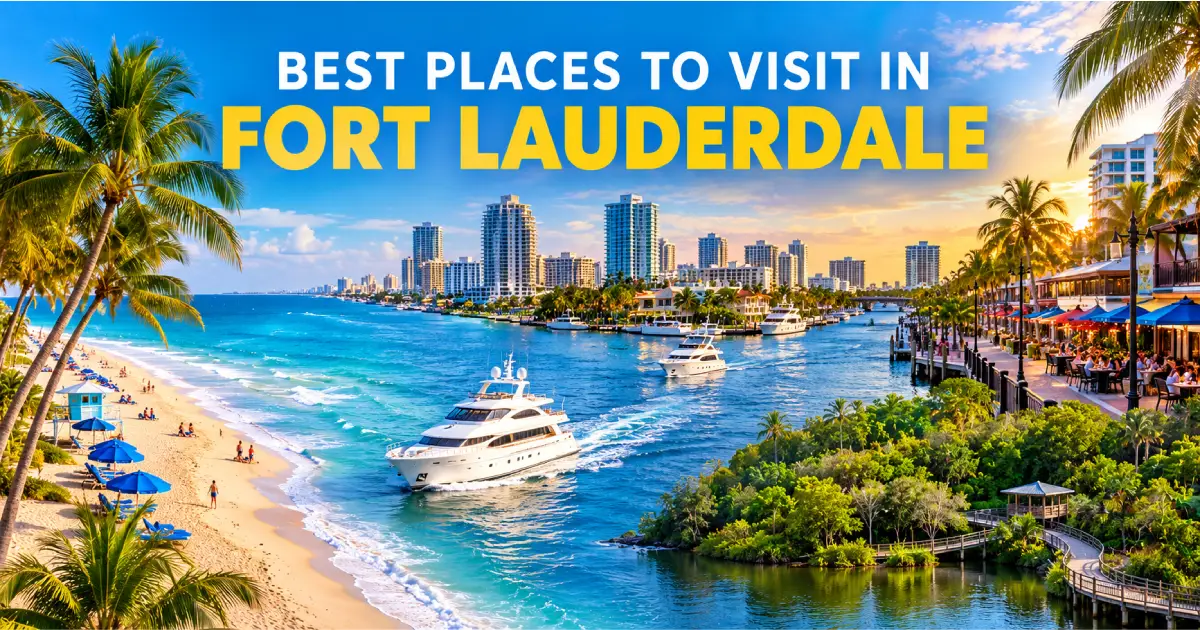
Fort Lauderdale’s appeal is easier to feel than to describe. It is a city built on water — 165 miles of navigable canals threading through residential neighborhoods, the New River cutting through downtown, the Intracoastal Waterway running its entire length, and 24 miles of Atlantic beach forming the city’s eastern edge. That water is not decorative; it is the organizing principle of daily life, the reason the city exists in its current form, and the primary lens through which Fort Lauderdale is best experienced. To understand the city is to understand that a significant portion of its residents commute, socialize, and travel by boat, and that the waterfront — seen from the water rather than from the road — is where the city reveals its most interesting character.
Beyond the waterways, Fort Lauderdale has assembled a set of cultural and natural attractions that places it well above the typical beach-destination checklist. The Bonnet House Museum is one of Florida’s genuinely irreplaceable historic properties — 35 acres of eccentric artist estate sandwiched between the Intracoastal and the Atlantic, preserved intact in the middle of high-rise beach development by sheer force of will and legal protection. The NSU Art Museum holds an American Impressionist collection of international importance. The Everglades begin 30 miles west. Lauderdale-by-the-Sea preserves an authentic 1950s Florida beach-town character that the rest of South Florida largely demolished decades ago. And the neighborhoods of Flagler Village, Victoria Park, and Rio Vista are worth exploring on their own terms — as places where people actually live in a city that earns genuine affection.
This guide covers the 20 best places to visit in Fort Lauderdale — the famous and the overlooked, the natural and the built, the day trips that justify the drive and the neighborhood streets that reward an afternoon of wandering without a destination.
| Factor | Details |
|---|---|
| Top Attraction | Fort Lauderdale Beach and Promenade |
| Best Free Experience | Las Olas Boulevard + Riverwalk |
| Best Historic Site | Bonnet House Museum and Gardens |
| Best Cultural Institution | NSU Art Museum Fort Lauderdale |
| Best Natural Escape | Hugh Taylor Birch State Park / Everglades |
| Best Day Trip | Everglades National Park or Key West |
| Best Neighborhood | Flagler Village / Victoria Park |
Free | A1A between Las Olas Blvd and Sunrise Blvd | Open daily
The city’s centerpiece attraction and the reason most first-time visitors come: a 24-mile Atlantic beach with a wide, well-maintained promenade running the full length of the developed shoreline. The sand is white and generously wide; the water is warm and clear (80–84°F in peak summer, 68–72°F in winter); the promenade is designed for both cycling and walking, with a separated bike lane and a pedestrian path. The beach is backed by a strip of restaurants, watersports rental operators, and beach bars along A1A — more varied and genuinely better than most Florida beach strips. Lifeguards are stationed at regular intervals sunrise to sunset. The two-mile stretch between the Las Olas intersection and Sunrise Boulevard is the most active; north of Sunrise the beach becomes quieter and more residential, and the stretch near Lauderdale-by-the-Sea (5 miles north) is significantly less crowded. Come at sunrise for the most extraordinary light and the most deserted beach.
$20 adults | 900 N Birch Rd | Tue–Sun 10 AM–4 PM
The finest historic property in Fort Lauderdale and one of the most remarkable surviving examples of old Florida in any South Florida city, Bonnet House is a 35-acre artist’s estate preserved between the Intracoastal Waterway and the Atlantic Ocean — a piece of real estate that would be worth hundreds of millions of dollars if developed, saved intact by the Florida Trust for Historic Preservation. The estate was developed from 1920 onward by Chicago muralist Frederic Clay Bartlett and his second wife Evelyn Fortune Bartlett, also a painter, who lived here until Evelyn’s death in 1997 at age 109. The main house is an eccentric, joyful accretion of rooms decorated with the Bartletts’ own murals, folk art collected from their travels, hand-painted ceilings, and the general atmosphere of two artists who used their home as a canvas for seven decades. The grounds include a freshwater lagoon, a resident colony of wild Bahama pintail ducks, a functioning 1920s swimming pool, orchid house, and a family of Barbary macaque monkeys living wild on the estate. The guided house tour (included in admission) is essential; the self-guided garden walk adds another hour. Plan for 2–3 hours total.
$16 adults | 1 E Las Olas Blvd | Wed–Mon 11 AM–5 PM
Fort Lauderdale’s major art institution occupies a 1986 Edward Larrabee Barnes building — a graceful, understated Modernist box — at the corner of Las Olas Boulevard and Andrews Avenue, where it anchors the downtown cultural district. The permanent collection has two areas of international distinction: the William Glackens Collection is the world’s largest and most comprehensive gathering of work by the American Impressionist painter (500+ works, including paintings, drawings, and archival materials that make this the definitive Glackens resource), and the CoBrA Collection presents a major holding of works from the postwar European avant-garde movement — Karel Appel, Asger Jorn, Pierre Alechinsky, and their colleagues who formed CoBrA in 1948 in response to both academic tradition and Surrealism. The Latin American art holdings are substantial, particularly the mid-20th century Cuban and Caribbean modernism section. Rotating exhibitions bring in significant international loans regularly. Free on the second Sunday of each month.
Free | Downtown Fort Lauderdale to the Beach
The social and commercial spine of Fort Lauderdale, Las Olas runs 2 miles east from downtown to the Atlantic, and the stretch between SE 6th Avenue and the beach is lined with independent restaurants, galleries, boutiques, sidewalk cafés, and the mature ficus trees that give the boulevard its distinctive canopy. Las Olas is simultaneously a destination (specific galleries, restaurants, and shops worth visiting) and a place to simply be — to walk, sit at an outdoor café table, watch the street life, and understand why Fort Lauderdale residents love their city. The Riverwalk at the boulevard’s western end provides waterfront access to the New River. The NSU Art Museum and Broward Center anchor the downtown terminus. On weekend evenings, Las Olas becomes one of South Florida’s most vibrant pedestrian environments — a genuine boulevard culture that Miami’s Brickell and Biscayne corridors, despite their ambitions, haven’t quite achieved.
$32/day pass | Multiple stops | Daily 10 AM–midnight
Fort Lauderdale’s 165 miles of navigable canals and the Intracoastal Waterway are best understood from the water — and the Water Taxi day pass ($32/adult) provides the most enjoyable access. The 20+ stop network covers the beach, Las Olas River House, the Riverwalk, Shooters Waterfront, Coconuts, the Bahia Mar Marina, and numerous Intracoastal hotels. From the water, Fort Lauderdale reveals its most extraordinary feature: the residential canal neighborhoods of Las Olas Isles, Seven Isles, and the Intracoastal islands where multi-million dollar yachts dock behind waterfront mansions, manicured gardens slope to the water’s edge, and the ordinary signage of a road-based city is entirely absent. Dolphins follow the water taxi through the Intracoastal. Pelicans perch on pilings. Drawbridges lift with theatrical effect. The Water Taxi is simultaneously useful transportation and the city’s best waterborne sightseeing tour.
$6/vehicle | 3109 E Sunrise Blvd | Daily 8 AM–sunset
One of the most unexpected natural experiences in South Florida, Hugh Taylor Birch State Park preserves 180 acres of coastal freshwater ecosystem — a rare tidal lagoon, cypress hammocks, and native plant communities — sandwiched between Fort Lauderdale Beach and the Intracoastal Waterway. The park was donated by Chicago attorney Hugh Taylor Birch in the 1940s, having been purchased in the 1890s as a private estate. Today the park offers a 1.5-mile paved loop road (excellent for cycling), canoe and kayak rentals on the lagoon ($10/hour), and some of the most accessible wildlife viewing in Fort Lauderdale — gopher tortoises amble along the loop road, wading birds fish in the lagoon margins, and the hammock vegetation creates a complete sensory separation from the beach resort towers visible over the tree line. A 30-minute visit feels like leaving the city entirely. Combine with a morning at the adjacent beach for a perfect Fort Lauderdale half-day.
$22 adults | 335 SE 6th Ave | Wed–Mon 10 AM–5 PM
The oldest standing structure in Broward County, the Stranahan House was built in 1901 by Frank Stranahan — a trading post operator who became one of Fort Lauderdale’s founding citizens — on the north bank of the New River. The simple Dade County pine building has weathered every major hurricane to hit South Florida for 125 years, a testament to the legendary hardness and decay-resistance of the wood. Frank Stranahan’s wife Ivy Julia Cromartie Stranahan was one of Broward County’s first schoolteachers and a lifelong advocate for the Seminole people; the couple’s complex relationship with the Seminole community — simultaneously exploitative as traders and genuinely protective as advocates against federal assimilation policies — is central to the site’s interpretive story. Guided tours bring this history to life in a setting that feels remarkably intact. The New River waterfront setting, beneath enormous banyan trees, is beautiful. A Water Taxi stop is directly adjacent.
Free | N Andrews Ave between NE 6th and NE 9th Sts
Fort Lauderdale’s most vital creative neighborhood, Flagler Village has transformed from an underused industrial area into the city’s premier arts district over the past decade, driven by a combination of low rents attracting artists and studios, progressive city investment in street infrastructure, and the natural energy of a creative community taking root. The monthly ArtWalk (first Saturday, 6–10 PM, free) is the neighborhood’s social centerpiece: gallery openings, artist studio tours, food trucks, live music, and thousands of participants filling N Andrews Avenue and the surrounding streets. The murals covering building facades throughout the district constitute one of Florida’s finest collections of outdoor public art — rotating as walls become available, maintained by a curation process that prioritizes scale and ambition. Independent restaurants, craft breweries, and creative businesses have established year-round density. Flagler Village is the Fort Lauderdale that residents are most proud of showing visitors.
$35/vehicle | Park entrance 90 miles south via US-41 | Dawn to dusk
The largest subtropical wilderness in North America begins 30 miles west of Fort Lauderdale’s beach and extends 60 miles south to the park’s main entrance near Homestead. A full Everglades day trip from Fort Lauderdale is one of Florida’s most rewarding natural experiences: the Anhinga Trail (0.8 miles, exceptional wildlife — anhinga, great blue heron, American alligators at arm’s reach) and the Gumbo Limbo Trail (0.4 miles, old-growth tropical hammock) near the park’s main entrance offer extraordinary wildlife access with minimal effort. The Pa-hay-okee Overlook provides a panoramic view of the “river of grass” that is the Everglades’ defining landscape. In winter (December–March), wildlife concentrations in the drying sloughs are extraordinary. For a closer to Fort Lauderdale introduction, the Everglades airboat operators on US-27 near Sawgrass provide 45-minute rides into the saw grass prairie — a worthwhile half-day without the full park drive.
Free | Ocean Dr, Hollywood | 20 min south
Hollywood — the city immediately south of Fort Lauderdale — offers one of Florida’s finest beach boardwalk experiences: a 2.5-mile pedestrian and cycling promenade running the full length of Hollywood Beach, lined with casual restaurants, ice cream shops, rental stands for bikes and surreys, and a multigenerational, genuinely festive atmosphere. The beach itself is wide, clean, and less crowded than Fort Lauderdale Beach; the boardwalk’s culture is older Florida — unpretentious, family-oriented, the kind of scene that existed up and down the Florida coast in the 1960s and 1970s before high-rise development changed everything. The Margaritaville Hollywood Beach Resort is the boardwalk’s major anchor; the ArtsPark at Young Circle just inland hosts free outdoor concerts and events. Hollywood Beach rewards a half-day, particularly for visitors who find Fort Lauderdale Beach’s more commercial scene overstimulating.
Varies by event | 201 SW 5th Ave | On the New River Riverwalk
Fort Lauderdale’s cultural anchor, the Broward Center is consistently among the top-grossing performing arts venues in the United States and one of the Southeast’s foremost stages for Broadway touring productions, major concerts, and visiting ballet and opera companies. The main Au-Rene Theater (2,700 seats) hosts the large-scale programming; the Amaturo Theater (590 seats) presents more intimate productions. The building sits on the New River Riverwalk, making it accessible by Water Taxi from the beach and Las Olas. For visitors with any interest in live performance, checking the Broward Center calendar (browardcenter.org) before finalizing travel dates is worthwhile — a Broadway production or major concert on the same evening as a waterfront dinner creates an exceptional Fort Lauderdale evening.
Free | 5 miles north on A1A
A small, self-contained beach community surrounded on all sides by Fort Lauderdale’s larger footprint, Lauderdale-by-the-Sea preserves the character of Florida beach towns as they existed before the 1970s development boom: a compact commercial center of 4 or 5 blocks, free parking in most areas, a fishing pier extending into the Atlantic (Anglin’s Pier), and the Town Square Reef immediately offshore — one of South Florida’s best shore snorkeling sites, with coral heads, tropical fish, and occasional sea turtles in 8–15 feet of clear water. The pace is deliberately slow; the restaurants are independently owned and genuinely good (Blue Moon Fish Co., the legendary Cap’s Place accessible only by boat); and the atmosphere is what travelers who are exhausted by South Florida’s relentless commercialism are specifically looking for. A half-day in Lauderdale-by-the-Sea — pier walk, snorkel, lunch at a waterfront café — is one of the most restorative things you can do in Broward County.
$22 adults | 401 SW 2nd St | Daily 10 AM–5 PM
Located in the Riverwalk Arts District adjacent to the Broward Center, MODS is one of Florida’s better science museums for the depth of its Florida ecology exhibits. The Florida EcoScapes permanent exhibit recreates five native Florida habitats with live animals — a living coral reef tank (featuring species from the Florida Reef Tract directly offshore), a freshwater river ecosystem with largemouth bass and gar, a mangrove estuary, a sea turtle display, and an upland pine flatwoods section with gopher tortoises and indigo snakes. The AutoNation IMAX Theater runs 40-minute nature documentaries on a six-story screen. A solid 2-hour family attraction that holds genuine interest for adult visitors with any interest in Florida’s ecological complexity.
$15 adults | 1527 SW 1st Ave, Downtown | Mon–Fri 10 AM–4 PM
One of Fort Lauderdale’s most overlooked attractions, the Antique Car Museum houses one of the finest collections of Packard automobiles in the United States — 22 Packards from 1900 to 1940, along with a remarkable collection of Packard memorabilia, company literature, and associated artifacts. The collection occupies a converted 1930s warehouse and is presented with the care and knowledge of a private collector who has spent a lifetime assembling it. The cars themselves are in immaculate condition: a 1929 Packard 8 roadster, a 1934 Packard 12 convertible coupe, and a 1940 Packard Custom Super 8 One Eighty limousine are among the standouts. Admission also includes a gallery dedicated to Franklin D. Roosevelt (Packard was Roosevelt’s preferred automobile). Small, specialized, and deeply satisfying for anyone with any interest in the design and engineering culture of the American automotive golden age.
Free | South of the New River, adjacent to the 17th Street Causeway
One of Fort Lauderdale’s most beautiful residential neighborhoods, Rio Vista occupies the south bank of the New River between downtown and Port Everglades. The residential streets are lined with Mediterranean Revival and Colonial Revival homes from the 1920s–1940s, mature royal palms and banyan trees, and the canal-front lots that give many properties direct Intracoastal or New River access. Rio Vista is not a tourist destination per se — it’s a neighborhood of private residences — but walking its streets (SW 15th Street and the surrounding grid) provides a vivid picture of what Fort Lauderdale looked like before the high-rise era and why the city’s early boosters called it the “Venice of America.” The Las Olas Isles to the north offer similar architectural pleasure with the added drama of larger canals and more spectacular yachts.
Free (beach); Lighthouse Point park: $3/vehicle | 10–15 miles north
Two communities north of Fort Lauderdale with distinct appeals. Pompano Beach offers an uncrowded Atlantic beach, the Pompano Beach Pier (one of South Florida’s finest fishing piers, with an excellent restaurant at its base), and the Fisherman’s Wharf area where fresh-off-the-boat seafood — particularly the pompano fish the city is named for — is sold daily. Lighthouse Point is a quiet residential community built around the canals and the Hillsboro Inlet, where the Hillsboro Lighthouse (1907, one of the most powerful on the East Coast) watches over the inlet that boats use to transit between the Intracoastal and the Atlantic. The inlet itself — boats continuously passing in both directions, the lighthouse visible on the north bank — is a meditative and beautiful spot to spend an afternoon with no agenda.
Free | 12801 W Sunrise Blvd, Sunrise | Daily
The largest outlet mall in the United States, Sawgrass Mills is a genuine destination rather than merely a mall — a 2.4-million-square-foot complex with over 350 stores, including outlet locations for virtually every major luxury and premium brand (Versace, Gucci, Burberry, Ralph Lauren, Coach, Michael Kors) alongside mid-range and value outlets. For visitors interested in shopping, Sawgrass Mills is incomparable in scale and brand diversity. The complex is organized in a loop format that takes 3–4 hours to walk completely; wear comfortable shoes. Located 15 miles west of downtown Fort Lauderdale via Sunrise Boulevard; free parking. The adjacent The Colonnade at Sawgrass adds full-price retail and dining.
Free to visit | 801 Seabreeze Blvd, Fort Lauderdale Beach
The headquarters and primary venue of the Fort Lauderdale International Boat Show (late October–early November, the world’s largest in-water boat show), Bahia Mar Marina is also the permanent home of over 250 boats and yachts, the Jungle Queen Riverboat, and several waterfront bars and restaurants. John D. MacDonald’s fictional detective Travis McGee kept his houseboat The Busted Flush at Bahia Mar in the 21 Travis McGee novels (1964–1985) — a fact Fort Lauderdale is justifiably proud of, and which has made the marina a literary pilgrimage destination for fans of the series. The marina is publicly accessible; walking the docks (where access is permitted) provides close views of the vessel diversity that makes Fort Lauderdale the “yachting capital of the world.”
Ferry: $135/adult round trip | 200 miles south via US-1 | Drive: 3.5 hr OR Key West Express ferry from Fort Lauderdale
The southernmost city in the continental United States, Key West is reachable from Fort Lauderdale by car (US-1 south through the Florida Keys, one of America’s great drives) or by the Key West Express high-speed ferry from Fort Lauderdale Beach. The ferry option (~$135 round trip, 3.5-hour crossing each way) turns Key West into a true day trip — arrive midday, explore the historic district (Duval Street, Mallory Square sunset celebration, the Hemingway Home), have lunch at one of the open-air restaurants, and return by evening. The drive offers the additional experience of the Overseas Highway — 42 bridges connecting the Keys, with ocean visible on both sides — and allows stopping at Islamorada, Marathon, and Big Pine Key along the way. Key West from Fort Lauderdale requires an overnight stay to be fully worthwhile; the ferry option is the best day-trip version.
$2/person | 751 Sheridan St, Hollywood | Daily 9 AM–5 PM
The largest urban mangrove ecosystem in Broward County, West Lake Park encompasses 1,500 acres of mangrove forest, freshwater marsh, and tidal estuary in Hollywood, 20 minutes south of downtown Fort Lauderdale. The Anne Kolb Nature Center within the park offers a five-story observation tower with panoramic views over the mangrove canopy to the Atlantic Ocean, a small aquarium with native Florida marine species, canoe and kayak rentals ($10–15/hour) for paddling the park’s 15 miles of waterways, and nature trails through the mangrove forest. The park is one of the few places in the Fort Lauderdale metro area where the pre-development South Florida landscape — vast, silent, extraordinarily biologically productive — is still visible and accessible. A $2 entry fee for 1,500 acres of mangrove ecosystem and one of Broward County’s best wildlife-watching opportunities is one of South Florida’s best value experiences.
Posted By : Vinay
Latest Article
2nd Floor, 39, Above Kirti Club, DLF Industrial Area, Kirti Nagar, New Delhi, Delhi 110015



Travel Tourister is a leading Travel portal where we introduce travellers to trusted travel agents to make their journey hasselfree, memorable And happy. Travel Tourister is a platform where travellers get Tour packages ,Hotel packages deals through trusted travel companies And hoteliers who are working with us across the world. We always try to find new and more travel agents and hoteliers from every nook and corners across the world so that you could compare the deals with different travel agents and hoteliers and book your tour or hotel with the one you have chosen according to your taste and budget.
Copyright © Travel Tourister, India. All Rights Reserved
 Call
 Enquiry