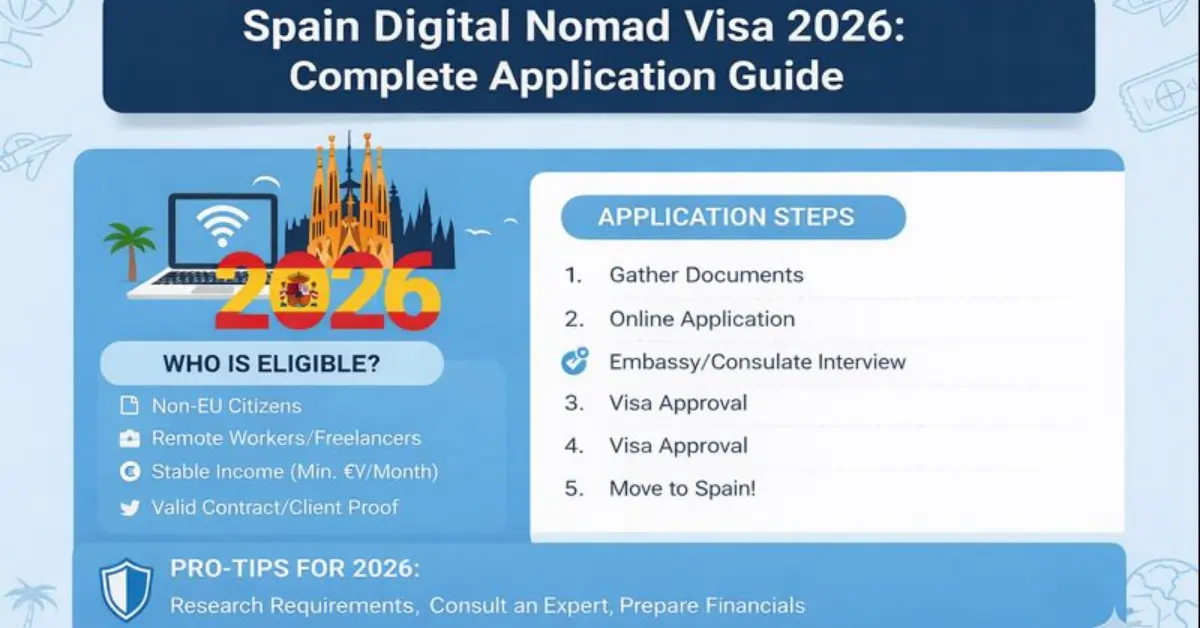
Spain Digital Nomad Visa 2026: Complete Application Guide
Published on : 27 Dec 2025
Imagine sipping café con leche on a sunlit Barcelona terrace while your laptop hums with productivity. Or perhaps you’re finalizing a project from a beachside café in Valencia, the Mediterranean breeze drifting through open windows. For digital nomads and remote workers from the US, UK, Canada, and Australia, this isn’t just a daydream—it’s an increasingly accessible reality thanks to Spain’s Digital Nomad Visa.
Launched in January 2023 under Spain’s progressive Startup Act, the Spain Digital Nomad Visa (officially called the Telework Visa) has quickly become one of the most popular pathways for remote workers seeking European residence. With Spain ranking #1 for digital nomads in multiple 2025 surveys, over 28,000 people have already relocated through this program.
This comprehensive guide walks you through everything you need to know about Spain’s Digital Nomad Visa in 2026: eligibility requirements, income thresholds, required documents, application process, tax benefits, and the best Spanish cities for remote work.
Whether you’re a freelance designer in Chicago, a software developer in London, a marketing consultant in Toronto, or a content creator in Sydney, this guide will help you determine if Spain’s Digital Nomad Visa is right for you—and exactly how to get it.
What Is the Spain Digital Nomad Visa?
The Spain Digital Nomad Visa (officially the “Telework Visa”) is a residence permit that allows non-EU citizens to live and work remotely in Spain for up to five years. It’s specifically designed for remote employees and freelancers who work for companies or clients outside of Spain.
Key features:
Initial validity: 1 year (when applied from consulate) or up to 3 years (when applied from within Spain)
Total duration: Extendable up to 5 years
Work flexibility: Work from anywhere in Spain
Family-friendly: Bring your spouse/partner, children, and even elderly parents
Tax advantages: Access to the “Beckham Law” for significantly reduced tax rates
Pathway to permanence: Counts toward permanent residency and eventual citizenship
Schengen benefits: Visa-free travel to 27 EU countries
Unlike a standard tourist visa (which limits you to 90 days in any 180-day period across the Schengen zone), the Digital Nomad Visa gives you legal residency, allowing you to establish a home base in Spain while maintaining your remote career.
Who Qualifies for Spain’s Digital Nomad Visa?
Basic Eligibility Requirements
To qualify for Spain’s Digital Nomad Visa, you must meet ALL of these criteria:
1. Nationality:
Be a non-EU/EEA/Swiss citizen
Citizens of EU countries don’t need this visa (you already have freedom of movement)
2. Age:
Be at least 18 years old
3. Professional Status:
Remote employee working for a foreign (non-Spanish) company, OR
Freelancer/self-employed professional with international clients
Can earn up to 20% of income from Spanish clients (as a freelancer)
4. Professional Qualifications (one of these):
University degree or higher education diploma, OR
Professional certificate in your field, OR
3+ years of documented work experience in your profession
5. Work History:
Minimum 3 months with your current employer OR with your current freelance clients
Must prove continuous work relationship
6. Clean Record:
No criminal convictions in Spain or your home country
Not previously deported from Spain
No illegal residence in Spain in past 5 years
No Schengen visa refusals that would make you “undesirable”
Who Is NOT Eligible?
EU/EEA citizens (you already have residence rights)
Those working primarily for Spanish companies (more than 80% of income)
Those without remote work capability (traditional in-office roles)
Digital nomads without consistent income (must meet monthly minimums)
Those with recent criminal convictions
Income Requirements for 2026
One of the most critical aspects of Spain’s Digital Nomad Visa is proving you have sufficient income to support yourself (and any family members) without needing Spanish social assistance.
Minimum Income Thresholds
The income requirement is tied to Spain’s SMI (Salario Mínimo Interprofesional), or minimum wage, which adjusts annually. For 2026, requirements are projected based on recent SMI increases:
Family Size
Monthly Income Required
Annual Income Required
Single applicant
€2,760 – €2,800
€33,120 – €33,600
Applicant + spouse/partner
€4,140 – €4,200
€49,680 – €50,400
Applicant + spouse + 1 child
€4,830 – €4,900
€57,960 – €58,800
Applicant + spouse + 2 children
€5,520 – €5,600
€66,240 – €67,200
Breakdown formula:
Main applicant: 200% of Spanish minimum wage (~€1,380 x 2 = €2,760)
Spouse/partner: +75% of SMI (~€1,035)
Each dependent child: +25% of SMI (~€345)
Elderly dependent parents: +25% of SMI per parent (~€345)
Important Income Details
Gross vs. Net Income: Spanish authorities assess gross income (before taxes), not your take-home pay. Make sure your documentation shows gross amounts.
Consistent Income Required: You must demonstrate this income level consistently over at least the past 6 months. One-time payments or irregular income may not count.
For Remote Employees: Your employment contract must clearly state your salary meets or exceeds the threshold. Include:
Employment contract with salary details
6 months of pay stubs
6 months of bank statements showing salary deposits
Letter from employer confirming remote work arrangement
For Freelancers/Self-Employed: You’ll need to prove this income through:
Client contracts or agreements
Invoices showing work performed (clearly stating services are remote)
6 months of bank statements showing client payments
Tax returns (if available)
Portfolio or proof of ongoing client relationships
Why the Minimum Wage Matters: Spain adjusts its minimum wage almost annually, which means the Digital Nomad Visa income threshold increases regularly. For context:
2023: €2,520/month required
2024: €2,646/month required
2025: €2,750/month required
2026: Estimated €2,760-€2,800/month
Pro tip: If you’re close to the threshold, it’s better to wait until you have a buffer (10-15% above the minimum) to strengthen your application.
Required Documents Checklist
Gathering the right documentation is crucial for a successful application. Missing or incorrect documents are the #1 reason for visa denials. Here’s your complete checklist:
1. Personal Documents
Valid passport with at least 6 months validity beyond your planned arrival date
Two recent passport photos (color, white background, taken within last 6 months)
Completed national visa application form (Form EX-00 for visa applications)
Copy of passport (biographical page + any previous Schengen visas)
2. Proof of Remote Work
For Remote Employees:
Employment contract with remote work clause clearly stated
Letter from employer confirming:
Your remote work arrangement
Your position/title
Your salary
Length of employment (minimum 3 months)
Company’s willingness to continue employing you from Spain
Company registration documents (to prove the company exists and is legitimate)
For Freelancers/Self-Employed:
Business registration (if applicable in your country)
Client contracts showing remote services provided
Portfolio or website demonstrating your professional activity
Proof of ongoing client relationships (emails, invoices, project agreements)
3. Financial Documents
6 months of bank statements showing:
Regular income deposits
Balance consistently above minimum requirements
Financial stability
Pay stubs or invoices for the past 6 months
Proof of income meeting the threshold (calculated as outlined above)
Tax returns (if available, though not always required)
4. Professional Qualifications
Choose ONE of these:
University degree/diploma (original + apostilled copy + Spanish translation)
Professional certificate relevant to your field (apostilled + translated)
Detailed CV showing 3+ years of professional experience in your field
5. Criminal Record Certificate
Police clearance/criminal record from your home country
Criminal record from any country where you’ve lived 180+ days in the past 5 years
Apostille on all criminal record certificates
Official Spanish translation by a certified translator (required!)
Important: Criminal records must be issued within the last 90 days of your application. Plan accordingly as obtaining apostilles can take weeks.
6. Health Insurance
Private health insurance from a Spain-authorized provider
Must provide comprehensive coverage equivalent to Spanish public healthcare
ZERO copays (policies with copayments are not accepted)
Must cover all family members included in your application
Must be valid for at least 1 year
Recommended providers:
Sanitas
Adeslas
DKV
Cigna Global
AXA
Cost: Expect €50-150/month per person, depending on age and coverage level.
7. Proof of Accommodation in Spain
Choose ONE of these:
Rental agreement for 12+ months (most common)
Property deed (if you own property in Spain)
Hotel booking letter confirming long-term reservation
Letter of invitation from a Spanish resident (if staying with someone initially)
Pro tip: Many applicants secure short-term accommodation (Airbnb, hotel) for the first month, then provide a signed 12-month rental agreement. You don’t need to have physically moved to Spain yet—just proof of where you’ll live.
8. Additional Required Documents
Proof of payment for visa fee (€73-90)
Cover letter explaining your reasons for applying (optional but helpful)
Marriage certificate (apostilled + translated) if bringing spouse
Birth certificates for children (apostilled + translated)
Proof of financial dependency for elderly parents (if bringing them)
Application Process: Step-by-Step
There are two ways to apply for Spain’s Digital Nomad Visa, each with different advantages:
Option A: Apply from Your Home Country (Spanish Consulate)
This is the traditional route and works well if you’re still in your home country.
Step 1: Prepare All Documents Use the checklist above to gather every required document. Double-check that:
All documents are original or certified copies
Criminal records are recent (within 90 days)
Translations are official and certified
Apostilles are attached where required
Step 2: Contact Your Local Spanish Consulate Find the Spanish consulate in your jurisdiction (search “Spanish consulate [your city/state]”). Email them to:
Confirm they process Digital Nomad Visas
Request any additional requirements specific to your consulate
Ask about appointment availability
Step 3: Book Your Appointment Most consulates require appointments booked weeks or months in advance. When booking, specify:
Visa type: “Digital Nomad Visa” or “Telework Visa”
Number of applicants (if applying with family)
Step 4: Attend Your Consulate Appointment Bring:
All original documents + photocopies
Passport
Visa fee payment (usually €73-90, check with your consulate)
What happens at the appointment:
Consular officer reviews your documents
You may be asked questions about your work and plans in Spain
Officer collects documents and fee
You receive a receipt/reference number
Step 5: Wait for Processing
Average processing time: 15-45 days (varies by consulate)
Some consulates are faster (2-3 weeks), others slower (2-3 months)
You may be contacted for additional documentation
Step 6: Collect Your Visa Once approved, you’ll be notified to collect your visa (usually have ~30 days to pick it up). Your passport will have:
National visa sticker (Type D visa)
Valid for 1 year
Allows multiple entries into Spain
Step 7: Enter Spain & Get Residence Card After arriving in Spain:
Within 30 days: Register at your local town hall (empadronamiento)
Within 1 month: Apply for your TIE (Tarjeta de Identidad de Extranjero) residence card at the local immigration office
Option B: Apply from Within Spain (Immigration Office)
This option allows you to apply while already in Spain on a tourist visa or visa-free entry (if you’re from a visa-exempt country like the US, UK, Canada, Australia).
Advantages:
Can get a 3-year residence permit directly (vs. 1-year visa from consulate)
Faster in some regions
Avoid consulate appointment scheduling issues
Can explore Spain before committing
Disadvantages:
Stricter income verification sometimes required
Must complete application before your tourist stay expires (90 days)
If denied, must leave Spain immediately
Steps:
Step 1: Enter Spain Legally Enter on a tourist visa or visa-free entry (Americans, Canadians, Australians, Brits get 90 days visa-free in Schengen).
Step 2: Gather Documents While in Spain Use the same checklist as above. You can obtain some documents in Spain:
Open a Spanish bank account
Secure rental accommodation
Purchase Spanish health insurance
Register at town hall (padrón)
Step 3: Submit Application at Immigration Office Go to your local Oficina de Extranjería (Immigration Office) or Policía Nacional station.
Book an appointment online (usually via the government’s cita previa system)
Submit all documents in person
Pay processing fee (if applicable)
Step 4: Wait for Processing Processing times vary by region:
Madrid: 1-3 months
Barcelona: 2-4 months
Smaller cities: Sometimes faster
Step 5: Collect Your TIE (Residence Card) If approved, you’ll receive a TIE card valid for 3 years. This is your official residence permit.
Which Application Method Should You Choose?
Factor
Apply from Consulate
Apply from Within Spain
Initial permit length
1 year
Up to 3 years
Processing time
15-45 days
1-4 months
Travel required
Must be in home country
Must be in Spain
Appointment wait
Can be long
Can be long
Income verification
Standard
Sometimes stricter
Best for
Those wanting certainty before moving
Those wanting to explore first
Our recommendation: If you’re certain about moving to Spain and want the longest initial permit, apply from within Spain. If you prefer certainty before relocating, apply from your home consulate.
Key Benefits of the Spain Digital Nomad Visa
1. Legal Residence in Spain for Up to 5 Years
Unlike tourist visas that limit you to 90 days, the Digital Nomad Visa gives you:
1-3 year initial residence
Renewable up to 5 years total
Pathway to permanent residency after 5 years
Pathway to citizenship after 10 years of legal residence
2. Visa-Free Schengen Travel
Your Spanish residence permit allows you to travel visa-free throughout the Schengen Area (27 EU countries) for up to 90 days per 180-day period. Explore:
France, Italy, Germany, Portugal, Greece
Netherlands, Belgium, Austria, Sweden, Denmark
And 17 other European countries
3. “Beckham Law” Tax Benefits
This is one of the most attractive features of Spain’s Digital Nomad Visa. The Beckham Law (officially Ley de Impatriados) offers:
Flat 24% tax rate on income up to €600,000
Only Spanish-sourced income is taxed (foreign income often exempt)
Applies for first 6 years of residence
Massive savings vs. standard progressive Spanish tax (up to 47%)
Example savings:
Standard Spanish tax on €60,000: ~€18,000
Beckham Law tax on €60,000: ~€14,400
Savings: €3,600/year
To qualify for Beckham Law:
Must not have been a Spanish tax resident in the previous 10 years
Must apply within 6 months of obtaining residence
Consult a Spanish tax advisor to apply
4. Family Reunification Rights
Bring your loved ones:
Spouse or registered partner
Dependent children (under 18, or under 21 if studying)
Elderly parents (if financially dependent on you)
Family members get residence permits with the same validity as yours.
5. Access to Spanish Healthcare
Spain has one of the best healthcare systems in the world:
World-class public healthcare
Affordable private healthcare (€50-150/month)
Comprehensive coverage for all medical needs
No waiting lists in private system
6. High Quality of Life
Spain consistently ranks as one of the best countries for quality of life:
300+ days of sunshine annually (in many regions)
Mediterranean lifestyle (work-life balance, late dinners, siestas)
Affordable cost of living (€1,200-2,500/month depending on city)
Safety: One of Europe’s safest countries
World-renowned cuisine
Strong expat communities in all major cities
Excellent coworking spaces and digital infrastructure
7. Work Flexibility
Work from anywhere in Spain (beaches, mountains, cities)
Can earn up to 20% from Spanish clients (as a freelancer)
No restrictions on remote work for foreign companies
Spain encourages remote work with supportive infrastructure
Common Mistakes & How to Avoid Them
1. Weak or Inconsistent Income Documentation
Mistake: Providing only 3 months of bank statements, or statements showing irregular deposits.
Solution:
Provide full 6 months of bank statements
Ensure income is consistent and clearly exceeds thresholds
For freelancers: Show regular invoices matching bank deposits
Highlight deposits in your statements if needed
2. Missing the 3-Month Work History Requirement
Mistake: Applying right after starting a new job or with a brand-new client.
Solution:
Wait until you’ve been with your employer for at least 3 months
For freelancers: Show 3+ months of continuous work with clients
Provide employment start date or client contract dates as proof
3. Health Insurance with Copays
Mistake: Purchasing a budget health insurance policy that includes copayments (copays).
Solution:
Verify your policy has zero copays before purchasing
Use Spain-approved providers: Sanitas, Adeslas, DKV, AXA, Cigna
Confirm coverage is comprehensive (equivalent to Spanish public healthcare)
Get written confirmation from your insurer if needed
4. Criminal Record Without Apostille or Translation
Mistake: Submitting criminal records without the required Apostille seal or official Spanish translation.
Solution:
Obtain your criminal record from the appropriate authority
Get it apostilled (usually through your state’s Secretary of State or equivalent)
Have it officially translated to Spanish by a certified translator
Note: This process can take 4-6 weeks, so start early!
5. Vague or Unclear Freelance Invoices
Mistake: Submitting invoices that don’t clearly state services are provided remotely or don’t specify the nature of work.
Solution:
Ensure all invoices clearly describe remote services
Include phrases like “remote consulting,” “remote design services,” “online coaching”
Make sure client locations are outside Spain (or within the 20% limit)
If needed, add cover letters explaining your work
6. Not Living in Spain for 183+ Days/Year (for Renewal)
Mistake: Leaving Spain for extended periods and not maintaining the required physical presence for renewal.
Solution:
Track your entries and exits carefully
Spain requires you to be physically present for at least 183 days per year to maintain residence
Use a spreadsheet or app to track your days
Plan travel carefully to stay within limits
7. Missing the Padrón (Municipal Registration)
Mistake: Not registering at your local town hall within 30 days of arrival.
Solution:
Within 30 days of arriving in Spain, go to your local Ayuntamiento (town hall)
Register at the Padrón Municipal (municipal registry)
Bring: passport, rental agreement, completed registration form
This is legally required and needed for your TIE application
8. Submitting Expired Documents
Mistake: Submitting documents (like criminal records) that have expired by the time of application.
Solution:
Criminal records must be issued within 90 days of application
Passport must have 6+ months validity
Health insurance must be currently active
Time your document collection carefully
Total Cost Breakdown
Understanding the full cost of obtaining Spain’s Digital Nomad Visa helps you budget appropriately.
Citizens of Latin American countries, Andorra, Philippines, Equatorial Guinea, or Portugal: 2 years
Sephardic Jews: 2 years
Refugees: 5 years
Note: Spain generally does not allow dual citizenship for most countries, though there are exceptions (Latin American countries, Andorra, Philippines, Portugal). Americans, Canadians, Brits, and Australians typically must renounce their original citizenship.
Frequently Asked Questions (FAQs)
1. Can I work for a US/UK/Canadian/Australian company with the Spain Digital Nomad Visa?
Yes! That’s exactly what this visa is designed for. You can work remotely for any company based outside of Spain while living in Spain. Your employer doesn’t need to have any presence in Spain.
2. Can I work for Spanish clients as a freelancer?
Yes, but limited. As a freelancer, you can earn up to 20% of your total income from Spanish clients. The other 80% must come from clients/companies outside Spain.
3. How long does the Spain Digital Nomad Visa application take?
From consulate: Typically 15-45 days, though some consulates take 2-3 months.
From within Spain: Usually 1-4 months, depending on the region. Madrid and Barcelona tend to be slower; smaller cities can be faster.
4. What’s the minimum income requirement for 2026?
For a single applicant, the estimated requirement is €2,760-2,800 per month (approximately €33,120-33,600 annually). This is 200% of Spain’s minimum wage, which adjusts annually.
For families, add:
Spouse/partner: +€1,035/month
Each child: +€345/month
5. Can I bring my family on the Digital Nomad Visa?
Yes! You can bring:
Your spouse or registered partner
Dependent children (under 18, or under 21 if studying)
Elderly parents (if financially dependent on you)
Family members receive residence permits with the same validity as yours.
6. Do I need to speak Spanish to get the visa?
No. There’s no Spanish language requirement for the initial Digital Nomad Visa application. However, you will need basic Spanish (DELE A2 level) if you apply for:
Permanent residency (after 5 years)
Citizenship (after 10 years)
7. Can I apply from within Spain as a tourist?
Yes! This is actually a great option. You can:
Enter Spain on a tourist visa (or visa-free if you’re American, Canadian, British, Australian)
Apply for the Digital Nomad Visa at the local Immigration Office (Oficina de Extranjería)
If approved, you receive a 3-year residence permit directly (vs. 1-year if applying from consulate)
Important: You must submit your application before your tourist stay expires (within 90 days).
8. What’s the difference between applying from the consulate vs. within Spain?
Application Route
Consulate (Home Country)
Within Spain
Initial permit length
1 year
Up to 3 years
Where you must be
In your home country
In Spain (as tourist)
Processing time
15-45 days
1-4 months
Risk
Lower (approved before moving)
Higher (must leave if denied)
9. Is health insurance mandatory?
Yes, absolutely. You must have private health insurance that:
Provides comprehensive coverage (equivalent to Spanish public healthcare)
Has ZERO copays (copayments not accepted)
Covers all family members on your application
Is from a Spain-authorized provider (Sanitas, Adeslas, DKV, AXA, Cigna)
Cost: €50-150 per person per month.
10. What’s the Beckham Law tax benefit?
The Beckham Law (Ley de Impatriados) is a special tax regime for new Spanish residents that offers:
Flat 24% tax rate on income up to €600,000 (vs. progressive rates up to 47%)
Only Spanish-sourced income taxed in many cases
Valid for 6 years
To qualify:
Must not have been a Spanish tax resident in previous 10 years
Must apply within 6 months of getting residence
Potential savings: €3,000-10,000+ annually depending on income.
11. Can I work from anywhere in Spain?
Yes! Your Digital Nomad Visa allows you to live and work remotely from anywhere in Spain. You’re not restricted to one city or region. Many digital nomads:
Split time between cities
Spend summers in coastal areas
Winter in warmer southern regions
Explore different regions regularly
12. Can I travel to other Schengen countries?
Yes! Your Spanish residence permit allows visa-free travel to all 27 Schengen countries for up to 90 days per 180-day period. Visit:
France, Italy, Germany, Portugal, Greece, Netherlands, Belgium, Austria, Sweden, Denmark, and more
13. How do I prove I work remotely?
For remote employees:
Employment contract stating remote work arrangement
Letter from employer confirming remote work
Pay stubs showing regular salary
Company registration documents
For freelancers:
Client contracts/agreements
Invoices clearly stating “remote services”
Portfolio or website
Bank statements showing client payments
14. What if I’m self-employed/freelance?
Freelancers are fully eligible! You must show:
Consistent income meeting the threshold (€2,760+/month)
Client contracts or agreements
Invoices for services rendered
6 months of bank statements
Proof of 3+ months working with current clients
Professional qualifications (degree, certificate, or 3+ years experience)
Remember: Maximum 20% of income can come from Spanish clients.
15. Do I need a Spanish bank account?
Not for the visa application, but you’ll need one soon after arrival for:
Spanish immigration lawyers: €500-2,000 for full application support
Document review consultation: €100-200
Translation Services:
Sworn translators (for official documents): €30-50 per document
Find certified translators through your local Spanish consulate
Your Action Plan
3 Months Before Application:
Request criminal record certificates from all relevant countries
Start gathering 6 months of bank statements
Research health insurance options
Contact Spanish consulate or research applying from within Spain
2 Months Before Application:
Get criminal records apostilled
Arrange official Spanish translations
Secure employment letter or client contracts
Research accommodation options in Spain
1 Month Before Application:
Purchase health insurance
Book consulate appointment (if applying from abroad)
Prepare all document copies
Arrange proof of accommodation
Application Month:
Submit application with all documents
Pay visa fee
Wait for processing
After Approval:
Book flights to Spain
Secure first month’s accommodation
Within 30 days: Register at town hall (padrón)
Within 30 days: Apply for TIE card
Within 90 days: Open bank account, set up life in Spain
Final Thoughts: Is Spain’s Digital Nomad Visa Right for You?
Spain’s Digital Nomad Visa has quickly become one of the most popular routes for remote workers seeking European residence—and for good reason. With generous tax benefits, world-class quality of life, affordable living costs, and a straightforward application process, it’s an incredibly attractive option for Americans, Canadians, Brits, Australians, and digital nomads worldwide.
Spain’s Digital Nomad Visa is ideal if you:
✅ Work remotely for a foreign company or have international freelance clients
✅ Earn at least €2,760/month consistently
✅ Want legal residence in Europe with Schengen travel benefits
✅ Value sunshine, culture, and quality of life
✅ Are interested in eventual permanent residency or citizenship
✅ Want significant tax savings (Beckham Law)
It may NOT be right if:
❌ Your income is irregular or below the threshold
❌ You work primarily for Spanish companies (80%+ income)
❌ You’re an EU citizen (you already have freedom of movement)
❌ You prefer a faster path to citizenship (consider Portugal’s 5-year route)
The bottom line: If you’ve been dreaming of the digital nomad lifestyle in Europe, Spain offers one of the best combinations of affordability, quality of life, legal clarity, and long-term potential. With careful preparation and the right documentation, your Spanish adventure could begin in just a few months.
Start gathering those documents, research your ideal Spanish city, and take the first step toward your new life under the Mediterranean sun.
¡Buena suerte! (Good luck!)
Save This Guide
Bookmark this page and share it with fellow digital nomads considering Spain. The application process can feel overwhelming, but with the right preparation and this comprehensive guide, you’ll be well-equipped to navigate Spain’s Digital Nomad Visa successfully.
Have questions? Double-check official government resources and consider consulting with a Spanish immigration lawyer for personalized advice.
Ready to start your Spanish adventure? The sunshine, tapas, and remote work lifestyle await!
Posted By : Vinay
As a lead contributor for Travel Tourister, Vinay is dedicated to serving our Tier 1 audience (US, UK, Canada, Australia). His mission is to deliver precise, fact-checked news and actionable, data-driven articles that empower readers to make informed decisions, minimize travel risks, and maximize their adventure without compromising safety or budget.
Travel Tourister is a leading Travel portal where we introduce travellers to trusted travel agents to make their journey hasselfree, memorable And happy. Travel Tourister is a platform where travellers get Tour packages ,Hotel packages deals through trusted travel companies And hoteliers who are working with us across the world. We always try to find new and more travel agents and hoteliers from every nook and corners across the world so that you could compare the deals with different travel agents and hoteliers and book your tour or hotel with the one you have chosen according to your taste and budget.




 Call
Call Enquiry