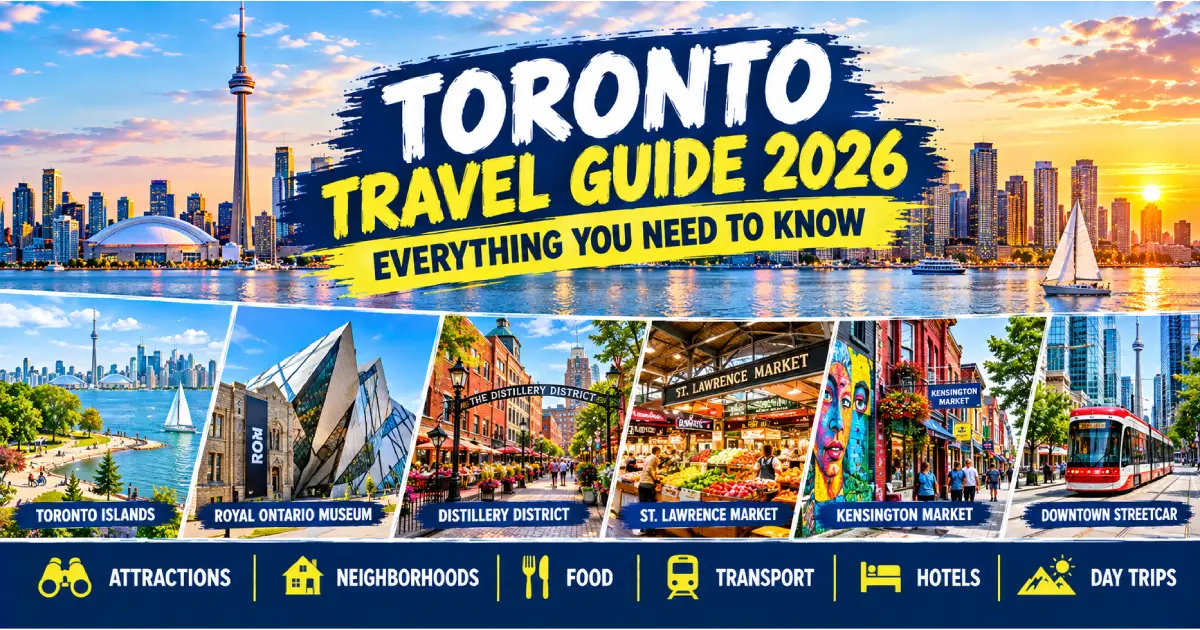
Toronto Travel Guide 2026: Everything You Need to Know
Published on : 12 Oct 2026
Toronto Travel Guide 2026 — Best Time to Visit, Top Attractions, Neighborhoods, Transit, Where to Stay, Costs in CAD, Food, Day Trips, and Insider Tips for First-Time Visitors
By Travel Tourister | Updated October 2026
This Toronto travel guide is built for visitors planning a first (or fifth) trip to Canada’s largest city — a lakefront metropolis of about three million people (more than six million across the Greater Toronto Area) where a 553-meter tower dominates a glass-and-brick skyline, a ferry ride away from the busiest downtown core in the country lie car-free island beaches, and nearly half of all residents were born outside Canada, which is why the city’s food, festivals, and neighborhoods feel like a dozen countries layered into one. Toronto is also the most convenient gateway to Eastern Canada, with Niagara Falls 90 minutes away by car, Montreal five hours by train, and Ottawa and Algonquin Park within a half-day trip, so it works equally well as a destination in its own right and as the first stop on a longer Canada itinerary.
What makes Toronto easy for visitors is how compact and well connected its core is. The airport train (UP Express) reaches Union Station in about 25 minutes, the subway and streetcar network (TTC) connects every major attraction for a flat fare of CAD 3.30 with a two-hour transfer, the waterfront, CN Tower, aquarium, and Hockey Hall of Fame sit within walking distance of Union Station, and the PATH — a network of underground pedestrian walkways — keeps downtown comfortable in winter. At the same time, the city rewards slow exploring: Kensington Market and Chinatown for street food and vintage shops, the Distillery District for Victorian industrial architecture, Queen West for boutiques and galleries, and the Beaches for a summer afternoon on the sand all feel very different from the downtown core.
This Toronto travel guide covers everything needed to plan a 2026 trip — quick facts, the best time to visit, how to get from the airport and around the city, the 15 best attractions, a neighborhood guide, where to stay, food, day trips, realistic costs in Canadian dollars, itineraries, safety and practical tips, and answers to the most common questions from first-time visitors. Prices, schedules, and opening hours change, so verify current information before you book.
For complete guides, see our Canada Travel Guide 2026, Best Restaurants in Canada, Canada 7 Day Itinerary, and Canada Trip Cost guides.
Quick Overview: Toronto Travel Guide at a Glance
Topic
Quick Facts
Province
Ontario, on the northwest shore of Lake Ontario
Population
About 3 million (city); more than 6 million (Greater Toronto Area)
Language
English (widely multilingual city)
Currency
Canadian dollar (CAD); sales tax (HST) of 13% is added at checkout
Time Zone
Eastern Time
Airports
Toronto Pearson (YYZ, main international airport) and Billy Bishop (YTZ, downtown island airport for short domestic and regional flights)
Airport to Downtown
UP Express to Union Station in about 25 minutes (adult fare about CAD 12.35; cheaper with PRESTO or tap-to-pay; verify)
Local Transit
TTC adult fare CAD 3.30 with two-hour transfer; PRESTO day pass CAD 13.50 (verify current fares)
Best Time to Visit
June–September (festivals, patios, islands); September and early October (best balance of weather, crowds, and price)
Ideal Stay
3–4 days (plus 1–2 days for Niagara Falls and day trips)
Tipping
15–20% in restaurants and bars; not included in the bill
Emergency Number
911
Toronto at a Glance: Top Highlights by Interest
If You Love…
Don’t Miss
Skyline and views
CN Tower, Toronto Islands ferry, Harbourfront
Food
St. Lawrence Market, Kensington Market, Chinatown, Michelin-recognized restaurants
Museums
Royal Ontario Museum, Art Gallery of Ontario, Casa Loma
Neighborhood wandering
Distillery District, Queen West, Kensington Market, the Beaches
Families
Ripley’s Aquarium, Toronto Islands (Centreville), Hockey Hall of Fame
Nature
High Park, Evergreen Brick Works, Scarborough Bluffs, Toronto Islands
Sports and nightlife
Blue Jays, Raptors, Maple Leafs, Entertainment District
Day trips
Niagara Falls, Niagara-on-the-Lake, Hamilton waterfalls, Prince Edward County
🗓️ Best Time to Visit Toronto
The best time to visit Toronto is June to September for warm weather, patios, festivals, and island beaches, with September and early October offering the best balance of comfortable temperatures, fall color, and lower hotel rates after Labour Day.
Season
Typical Weather
Highlights
Drawbacks
Spring (Apr–May)
Highs about 10–19°C (50–66°F)
High Park cherry blossoms, fewer crowds, lower prices
Unpredictable weather; patios and island ferries ramp up late
Summer (Jun–Aug)
Highs about 24–27°C (75–81°F)
Toronto Islands, patios, Pride, Caribbean Carnival, outdoor events
Hot and humid spells; highest hotel prices
Fall (Sep–Oct)
Highs about 15–22°C (59–72°F)
Toronto International Film Festival (September), fall color, harvest menus
Cold, grey days; wind chill; some outdoor attractions closed
Insider tips: Book hotels well ahead for the film festival in September and for major sports or concert weekends, and pack layers in every season. Winter visitors should plan indoor attractions and use the PATH underground walkway between Union Station and the CN Tower area. For a nationwide view, see our Best Time to Visit Canada guide.
✈️ How to Get to Toronto and Around the City
Getting there: Most international visitors fly into Toronto Pearson (YYZ), which serves direct flights from North America, Europe, Asia, and beyond. Billy Bishop Toronto City Airport (YTZ) sits on the Toronto Islands just minutes from downtown and serves shorter domestic and regional routes, making it convenient for trips to Montreal or Ottawa. VIA Rail connects Toronto’s Union Station to Montreal (about 5 hours), Ottawa, and Niagara Falls corridors, and GO Transit and intercity buses cover the wider region.
From Pearson to downtown: The UP Express train runs every 15 minutes from Terminal 1 to Union Station in about 25 minutes, with a one-way adult fare of roughly CAD 12.35 (and lower with PRESTO or tap-to-pay; verify). A taxi or rideshare costs far more and can take much longer in traffic.
Getting around: The TTC runs subways, streetcars, and buses. The adult fare is CAD 3.30 with a two-hour transfer when you tap the same card or phone each time, contactless credit, debit, and mobile wallet payments are accepted at the gates, and a PRESTO day pass (about CAD 13.50) pays off if you plan four or more rides in a day. Streetcars such as the 501 Queen and 504 King are handy for neighborhoods and downtown. The core is also very walkable, and bike share and rideshare are widely available.
Insider tips: Tap on and off with the same card to keep your two-hour transfer, avoid driving downtown because parking is expensive and congestion heavy, and use the Toronto Islands ferry from the Jack Layton Ferry Terminal for a car-free escape. Fares change, so confirm current prices on the TTC and Pearson websites.
🏙️ Top 15 Things to See and Do in Toronto
1. CN Tower — Toronto’s Iconic Skyline Landmark
Cost: General admission roughly CAD 45+; EdgeWalk roughly CAD 200–250 (verify) | Best Time: Clear days and sunset | Time Needed: 2–3 hours
The 553-meter CN Tower, opened in 1976, held the title of the world’s tallest freestanding structure for more than three decades and remains the symbol of Toronto. Visitors can step onto the glass floor, dine at the revolving 360 Restaurant, or take the EdgeWalk, a hands-free walk around the outer rim of the main pod about 356 meters above the ground. Views stretch across Lake Ontario on clear days, and sunset is the most spectacular time to go.
Insider tips: Book a timed ticket online for weekends and summer, check the weather before you go since low cloud blocks the view, and consider combining it with the nearby Ripley’s Aquarium.
2. Toronto Islands — Car-Free Beaches and the Best Skyline View
Cost: Ferry roughly CAD 9–10 return (verify) | Best Time: May–September | Time Needed: Half day
A short ferry ride from the Jack Layton Ferry Terminal reaches the Toronto Islands, a car-free archipelago with beaches, bike paths, picnic lawns, the Centreville amusement park for young children, and the best free skyline photo in the city. Ferries run to Centre Island, Hanlan’s Point, and Ward’s Island.
Insider tips: Go early on summer weekends to avoid ferry queues, rent a bike on the island, and take the late-afternoon ferry back for golden-hour skyline views.
3. St. Lawrence Market — Peameal Bacon and Market Food
Cost: Free to enter; food extra | Best Time: Saturday morning for the bustle | Time Needed: 1–2 hours
St. Lawrence Market is a large public food market in the historic core, famous for its peameal bacon sandwich (cornmeal-crusted back bacon on a soft roll), cheeses, pastries, seafood, and prepared foods from around the world. Saturday also brings a farmers’ market.
Insider tips: The main South Market is typically closed Sundays and Mondays (verify hours), and arriving before 10 AM avoids the heaviest lines.
4. Royal Ontario Museum (ROM)
Cost: Admission roughly CAD 25–35 (verify) | Best Time: Weekday mornings or rainy days | Time Needed: 2–4 hours
The ROM is Canada’s largest museum of world cultures and natural history, with dinosaur skeletons, Egyptian and East Asian collections, and a crystalline addition designed by Daniel Libeskind. It sits at the edge of Yorkville, making it easy to pair with boutique shopping and cafes.
Insider tips: Check for evening free or discounted admission programs, and focus on two or three galleries rather than trying to see everything.
5. Art Gallery of Ontario (AGO)
Cost: Admission roughly CAD 30; free for visitors 25 and under (verify) | Best Time: Weekday afternoons | Time Needed: 2–3 hours
The AGO is a major art museum redesigned by Frank Gehry, with a strong collection of Canadian art (including the Group of Seven), European masters, and a large Henry Moore collection. It is a short walk from Chinatown and Kensington Market.
Insider tips: Pair the AGO with Kensington Market and Chinatown for lunch, and check special exhibitions before booking tickets.
6. Distillery District — Victorian Industrial Charm
Cost: Free to wander | Best Time: Daytime and evenings; November–December for the Christmas Market | Time Needed: 1–2 hours
This pedestrian-only neighborhood of restored Victorian industrial buildings hosts galleries, boutiques, cafes, and restaurants on cobblestone lanes, and it is one of the most photogenic spots in the city. In winter, the Toronto Christmas Market transforms it into a festive village.
Insider tips: Visit on a weekday morning for a quieter experience, and combine it with St. Lawrence Market in the same half day.
7. Kensington Market and Chinatown
Cost: Free to explore | Best Time: Afternoons and weekends | Time Needed: 2–3 hours
Kensington Market is a bohemian neighborhood of vintage shops, bakeries, cheese and spice sellers, and street art, while neighboring Chinatown (centered on Spadina Avenue and Dundas Street) offers dim sum, bakeries, and noodle shops. Together they are the best place in the city to sample Toronto’s global food scene on foot.
Insider tips: Come hungry and share small plates, bring cash for small vendors, and check for pedestrian-only Sundays in summer.
8. Casa Loma — A Gothic Revival Castle
Cost: Admission roughly CAD 35–40 (verify) | Best Time: Daytime; holiday season for special events | Time Needed: 2–3 hours
Built between 1911 and 1914 for financier Sir Henry Pellatt, Casa Loma is a Gothic Revival castle with towers, secret passages, a grand library, and gardens overlooking the city. The adjacent Spadina Museum shows how a well-off Toronto family lived in the early 20th century.
Insider tips: Take the subway to Dupont and walk up the hill, and visit the gardens in spring and summer.
9. Ripley’s Aquarium of Canada
Cost: Admission roughly CAD 45–55 (verify) | Best Time: Weekday mornings | Time Needed: 2–3 hours
Ripley’s Aquarium sits at the foot of the CN Tower and is known for its underwater shark tunnel with a moving walkway, jellyfish galleries, and touch tanks. It is a family favorite and a rainy-day winner.
Insider tips: Book timed tickets online and combine the aquarium with the CN Tower, since they are adjacent.
10. Harbourfront Centre and the Waterfront
Cost: Free to walk; events and boat tours vary | Best Time: Summer evenings | Time Needed: 1–3 hours
Harbourfront Centre is a lakeside cultural campus with free outdoor events, craft studios, and cafes, and the surrounding waterfront trail offers bike rentals, harbor cruises, and views of the islands. In winter, the Harbourfront skating rink is a local favorite.
Insider tips: Check the events calendar before you go, because many summer concerts and festivals are free.
11. High Park — Cherry Blossoms and Nature
Cost: Free | Best Time: Late April–early May (cherry blossoms) and summer | Time Needed: 2–4 hours
High Park is Toronto’s largest public park, with trails, a pond, gardens, a zoo, and a famous cherry-blossom display in spring. It is easy to reach by subway and ideal for a break from downtown.
Insider tips: Blossom timing varies by weather, so check local updates, and go early on weekends to avoid crowds.
12. Evergreen Brick Works
Cost: Free to enter; market and events vary | Best Time: Saturday mornings (farmers’ market) | Time Needed: 2–3 hours
This former industrial brick factory in the Don Valley is now a community environmental center with a weekend farmers’ market, cafes, gardens, and walking trails connecting to the Don Valley ravine system.
Insider tips: Combine the market with a ravine hike, and check shuttle and transit options from the subway.
13. The Beaches — Boardwalk and Lakefront
Cost: Free | Best Time: June–September | Time Needed: Half day
The Beaches neighborhood in Toronto’s east end offers sandy shoreline, a long boardwalk, and a village-like main street of cafes and shops along Queen Street East. It is a good escape on hot summer days.
Insider tips: Take the streetcar from downtown, and pair a beach walk with an ice cream stop along Queen Street.
14. Hockey Hall of Fame
Cost: Admission roughly CAD 25–30 (verify) | Best Time: Any day | Time Needed: 1–2 hours
The Hockey Hall of Fame, in downtown Toronto, houses the Stanley Cup, memorabilia, and interactive exhibits, and it is a must for hockey fans.
Insider tips: Combine it with the nearby Union Station and Harbourfront for an easy half day.
15. Catch a Game: Blue Jays, Raptors, or Maple Leafs
Cost: Tickets vary widely | Best Time: Baseball in summer; basketball and hockey from fall to spring | Time Needed: Evening
Toronto is a major sports city. The Blue Jays play at Rogers Centre next to the CN Tower, and the Raptors (basketball) and Maple Leafs (hockey) play at Scotiabank Arena beside Union Station. Even non-fans enjoy the atmosphere of a live game.
Insider tips: Buy tickets through official channels, check schedules before you book flights, and arrive early to explore the surrounding area.
🗺️ Toronto Neighborhood Guide
Neighborhood
Vibe
Best For
Good Base?
Downtown and Harbourfront
Skyline, waterfront, major attractions
CN Tower, aquarium, Union Station access
Yes, best for first-timers
Entertainment and Financial Districts
Theatres, sports arenas, restaurants, nightlife
Games, shows, dining
Yes, but can be noisy
Old Town and Distillery District
Historic, cobblestoned, market food
St. Lawrence Market, galleries
Yes, charming and walkable
Queen West and West Queen West
Boutiques, galleries, bars
Shopping, nightlife, street art
Yes for boutique stays
Kensington Market and Chinatown
Bohemian, multicultural, street food
Food, vintage shops, culture
Day visit or hostels
Yorkville
Upscale shopping, luxury hotels
ROM, designer shops, fine dining
Yes for luxury
The Annex and Koreatown
University area, casual eats
Bars, budget food
Yes for value
Little Italy and Little Portugal
Patios, bistros, nightlife
Dining and evening strolls
Yes for local flavor
Danforth (Greektown)
Greek restaurants and patios
Casual dining
Day or evening visit
The Beaches
Beach and boardwalk village
Summer relaxation
Seasonal stay
Scarborough Bluffs
Lakeside cliffs and parks
Views and nature
Day visit
🏨 Where to Stay in Toronto
For first-time visitors, the best base is Downtown or Harbourfront, close to Union Station, the CN Tower, the waterfront, and the subway. Yorkville suits luxury travelers, Queen West suits boutique and nightlife seekers, and the Annex or Koreatown suit travelers who want better value and a local feel.
Level
Typical Nightly Rate (Per Room)
Notes
Budget
CAD 110–180
Hostels (dorm beds roughly CAD 40–80), budget hotels, and small guesthouses
Mid-Range
CAD 200–350
Three- and four-star hotels downtown
Luxury
CAD 450+
Five-star hotels in Yorkville, downtown, and on the waterfront
Rates rise sharply during the Toronto International Film Festival in September, major sports and concert weekends, and the summer high season, and a municipal accommodation tax and sometimes a destination fee are added to hotel stays (verify with each hotel).
Insider tips: Book early for September and summer, stay near a subway station to save on transit and rideshare, and check whether parking is included if you plan to drive.
🍽️ Where to Eat in Toronto
Toronto is one of the world’s great multicultural food cities, and the Michelin Guide’s 2026 Toronto and Region selection lists 111 restaurants, including 15 starred restaurants. Canada’s 100 Best 2026 ranked Quetzal fourth, Edulis fifth, Alo seventh, and Restaurant 20 Victoria tenth, and Michelin’s 2026 Bib Gourmand picks for good value included Antylia, Golden Horseshoe Barbecue, and The Lunch Lady of Saigon.
Must-try bites: Peameal bacon sandwich at St. Lawrence Market, dim sum in Chinatown, butter tarts from local bakeries, Jamaican patties, and Caribbean roti.
Food neighborhoods: Chinatown and Kensington Market for street food; Greektown on the Danforth; Little Italy and Little Portugal for patios; Koreatown on Bloor; the Gerrard India Bazaar; and Roncesvalles for Polish food.
Splurge: Book Quetzal, Edulis, or Alo weeks ahead, and consider Don Alfonso 1890 at the Westin Harbour Castle for Michelin-starred Italian dining.
Boat tour, Journey Behind the Falls, illuminations
Niagara-on-the-Lake
About 1.5–2 hours
Wineries, icewine, Victorian main street
Hamilton Waterfalls
About 1 hour
Waterfall hikes in the “City of Waterfalls”
Elora Gorge
About 1.5 hours
Gorge views, tubing, small-town shops
Stratford
About 1.5–2 hours
Stratford Festival theatre (spring to fall)
Prince Edward County
About 2.5 hours
Wineries, beaches, Sandbanks Provincial Park
Blue Mountain and Collingwood
About 2 hours
Skiing in winter, hiking and village in summer
Algonquin Provincial Park
About 3 hours
Canoeing, moose, fall color
Insider tips: Niagara Falls is the most popular day trip; take a rental car, guided tour, or seasonal GO Transit service (verify schedules), and start early. See our Things to Do in Canada guide for more.
💰 How Much Does a Trip to Toronto Cost?
The table below shows estimated costs per person per day in Canadian dollars, assuming two travelers sharing a room and excluding international flights.
Cost Category
Budget
Mid-Range
Luxury
Accommodation (per room per night)
CAD 110–180
CAD 200–350
CAD 450+
Food (per person per day)
CAD 50–80
CAD 90–150
CAD 200+
Local transit (per day)
CAD 10–14
CAD 15–40
CAD 60+
Attractions (per day)
CAD 20–40
CAD 60–120
CAD 200+
Estimated Daily Total (Per Person)
CAD 140–230
CAD 280–450
CAD 650+
A three-day trip therefore costs roughly CAD 420 to 690 per person on a budget, CAD 840 to 1,350 mid-range, and CAD 1,950 or more for luxury, before flights.
Insider tips: Menu and shelf prices exclude 13% HST, restaurant tips of 15 to 20 percent are standard, a PRESTO day pass or contactless tap-to-pay fares keep transit costs low, and city passes can save money if you plan to visit several paid attractions. For a national view, see our Canada Trip Cost guide.
🧳 Sample Toronto Itineraries
Day
Morning
Afternoon
Evening
Day 1: Downtown and Waterfront
CN Tower and Ripley’s Aquarium
Harbourfront and Toronto Islands ferry
Dinner in the Entertainment District or a Bib Gourmand pick
Day 2: Markets and Culture
St. Lawrence Market and Distillery District
ROM or AGO, then Kensington Market and Chinatown
Destination dinner at Quetzal, Edulis, or Alo (book ahead)
Toronto is generally safe for visitors; use normal city precautions, watch for pickpockets in crowded areas and on transit, and never leave valuables in a parked car
Weather
Hot and humid summers, cold winters with strong wind chill; pack layers and a waterproof jacket
PATH
Underground walkway network connecting Union Station, downtown offices, shops, and attractions; useful in winter and heavy rain
Tipping and Taxes
13% HST added at checkout; tip 15–20% in restaurants, bars, and taxis
Payments
Cards and contactless payments accepted almost everywhere; tap-to-pay works on the TTC
Alcohol and Cannabis
The legal age for both in Ontario is 19
Driving
Avoid driving downtown; traffic is heavy and parking is expensive; winter driving requires care
Phone and Data
Buy an eSIM or local plan; roaming costs are high
Insurance
Medical insurance is essential because provincial health plans do not cover visitors
Emergency
Call 911 for police, fire, or ambulance
Frequently Asked Questions: Toronto Travel Guide
How many days do I need in Toronto?
Three to four days is ideal for the main sights, neighborhoods, and food, and an extra day or two lets you visit Niagara Falls and other day trips.
Is Toronto worth visiting?
Yes. Toronto combines a dramatic skyline, world-class food, major museums, vibrant neighborhoods, and easy access to Niagara Falls, making it one of Canada’s best first-trip destinations.
What is the best time to visit Toronto?
June to September offers the warmest weather and most festivals, while September and early October offer the best balance of weather, crowds, and price. Winter is cold but good for Christmas markets and indoor attractions.
Is Toronto expensive?
Toronto is moderately expensive. Hotels are often cheaper than in New York or London but rise sharply during the film festival and major events. Taxes and tips add to costs, but transit and free attractions help.
Is Toronto safe for tourists?
Toronto is generally safe, but visitors should take normal city precautions, especially in crowded areas, on transit at night, and with valuables left in cars.
What is the best area to stay in Toronto?
First-timers should stay Downtown or near Harbourfront for easy access to attractions and transit. Yorkville suits luxury, Queen West suits boutique and nightlife, and the Annex suits value.
How do I get from Toronto Pearson Airport to downtown?
The UP Express train takes about 25 minutes to Union Station and is the fastest and most reliable option. The adult fare is roughly CAD 12.35 and lower with PRESTO or tap-to-pay (verify current fares).
Can I visit Niagara Falls as a day trip from Toronto?
Yes. Niagara Falls is about 130 kilometers and 1.5 hours from Toronto by car, and guided tours and seasonal GO Transit service are alternatives. Start early to fit in the falls and Niagara-on-the-Lake.
Final Verdict: Toronto Travel Guide
Toronto is Canada’s most accessible big city for first-time visitors: compact enough to cover the highlights in three or four days, diverse enough to reward repeat visits, and perfectly placed as a gateway to Niagara Falls, Ontario wine country, and onward travel by train to Montreal and Quebec City.
For most travelers, the best plan is to stay Downtown or near Harbourfront, spend two days on the CN Tower, waterfront, markets, museums, and neighborhoods, add a day trip to Niagara Falls, and book one or two destination dinners well ahead. Travel in June to September or early October for the best weather and festivals, use the TTC and UP Express to keep costs and stress low, and plan Toronto as the start of a longer Canadian adventure.
About Travel TouristerTravel Tourister’s destination specialists have explored Toronto from the CN Tower and Toronto Islands to St. Lawrence Market, Kensington Market, the Distillery District, and its Michelin-recognized restaurants — to deliver the most practical and honest Toronto travel guide for every type of 2026 traveler.Want help planning your Toronto trip? Our specialists can help you choose the right season and hotel area, book top restaurants and attractions early, add Niagara Falls and other day trips, and build a realistic budget before you commit to non-refundable bookings.
Posted By : Vinay
As a lead contributor for Travel Tourister, Vinay is dedicated to serving our Tier 1 audience (US, UK, Canada, Australia). His mission is to deliver precise, fact-checked news and actionable, data-driven articles that empower readers to make informed decisions, minimize travel risks, and maximize their adventure without compromising safety or budget.
Travel Tourister is a leading Travel portal where we introduce travellers to trusted travel agents to make their journey hasselfree, memorable And happy. Travel Tourister is a platform where travellers get Tour packages ,Hotel packages deals through trusted travel companies And hoteliers who are working with us across the world. We always try to find new and more travel agents and hoteliers from every nook and corners across the world so that you could compare the deals with different travel agents and hoteliers and book your tour or hotel with the one you have chosen according to your taste and budget.




 Call
Call Enquiry