Published on : 19 Jun 2026
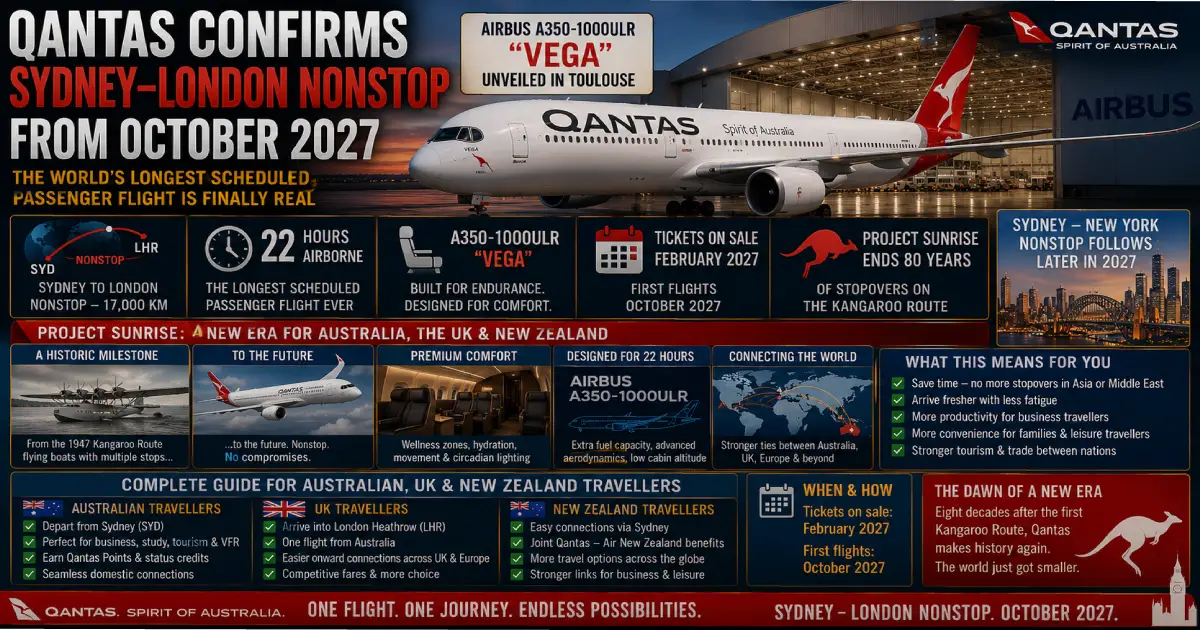
Published: June 18, 2026 — Thursday Announcement date: June 17, 2026 — Airbus headquarters, Toulouse, France Route: Sydney (SYD) → London Heathrow (LHR) — nonstop, both directions Launch date: October 2027 — timed for the IATA 2027–2028 Winter Season Tickets go on sale: February 2027 Distance: Over 16,000 km / approximately 9,942 miles / ~10,000 nautical miles Flight duration: 19–22 hours nonstop (~20 hours typical eastbound/westbound average) Time saved vs current one-stop service: Up to 4 hours Aircraft: Airbus A350-1000ULR (Ultra Long Range) — specially engineered for Qantas First aircraft name: “Vega” — named after a star, honouring 1940s Catalina flying boat navigation Total aircraft ordered: 12 × A350-1000ULR (plus 12 × A350-1000LR from FY28 under “Project Fysh”) First delivery: April 2027 Cabin capacity: 238 seats — across 4 cabins (vs 300–480 on a standard A350-1000) Cabin classes: First · Business · Premium Economy · Economy (140 economy seats) Special feature: “Wellbeing Zone” — dedicated mid-cabin stretching and hydration space Extra fuel capacity: +20,000 litres in rear-centre tank — extends range by 1,000 nautical miles Frequency: Daily nonstop service Current record holder (to be broken): Singapore Airlines SQ24 Singapore–New York — 15,349 km, just under 19 hours (no economy class) Qantas Kangaroo Route history: Started 1947 — originally 4 days, 7 stops (Darwin, Singapore, Calcutta, Karachi, Cairo, Castel Benito, Rome) Project Sunrise launched: 2017 — 10 years in development Next Project Sunrise route: Sydney–New York JFK — confirmed for “later in 2027” — exact date announced 2027 Existing ultra-long-haul services continuing: Perth–London · Perth–Rome · Perth–Paris · Sydney–Singapore–London (1-stop) CEO: Vanessa Hudson, Qantas Group Chief Executive Pilot training: Underway — Australia’s first A350 simulator (Sydney) + British Airways (UK) + additional overseas training
The tyranny of distance has finally been conquered. That is how Qantas Group CEO Vanessa Hudson described it on June 17, standing on the tarmac at Airbus’s Toulouse facility in front of the first Airbus A350-1000ULR ever built in Qantas colours. After ten years of development, two name changes, a pandemic-era pause, and nearly eighty years since the original Kangaroo Route first connected Sydney to London with seven stops over four days, Qantas has confirmed it: nonstop Sydney–London flights begin in October 2027. No stopover in Singapore. No stopover in Darwin. No connection through the Middle East or Southeast Asia. Just over 16,000 kilometres, up to 22 hours airborne, and a single aircraft that takes off from Sydney and lands at Heathrow. This will be the longest scheduled passenger flight in the world. Here is everything Australian, UK and New Zealand travellers need to know about the journey Qantas has spent a decade building toward.
Project Sunrise was launched in 2017 with a singular, audacious goal: connect Australia’s east coast directly to Europe and North America without a single stop. At the time, no commercial aircraft in the world was capable of safely covering the distance with a viable passenger payload. Qantas spent years working with both Airbus and Boeing to determine whether a version of their existing widebody aircraft could be engineered to make the journey.
In May 2022, Qantas placed its order: 12 Airbus A350-1000ULR aircraft, specially configured for the ultra-long-range mission. The “ULR” designation — Ultra Long Range — signals that this is not simply an A350-1000 with a marketing label. It is a structurally modified variant, fitted with an additional 20,000-litre fuel tank in the rear centre section, extending the aircraft’s range by approximately 1,000 nautical miles beyond the standard A350-1000.
On June 17, 2026, at an event inside Airbus’s Toulouse manufacturing headquarters, Qantas confirmed the route that the world had been waiting to learn: Sydney to London. Despite the announcement being, in CEO Vanessa Hudson’s own words, “hardly a surprise” — London had long been considered the most likely first Project Sunrise route — the formal confirmation marks what Hudson called “the most substantial milestone in [Qantas’s] 105-year existence.”
“Since we first flew the Kangaroo Route in 1947, where we stopped seven times on the way to London, every generation of aircraft has taken a stop out of the journey,” Hudson said. “This is a moment Qantas has been working towards since the day we were founded.”
The “tyranny of distance” phrase Hudson used in Toulouse is a deliberate callback — it is one of the most famous descriptions of Australia’s geographic isolation, drawn from historian Geoffrey Blainey’s 1966 book of the same name. For Qantas, eliminating the final stopover on the London route is as much a statement about Australia’s place in the world as it is an operational achievement.
The Airbus A350-1000ULR was chosen, and 12 aircraft were ordered in May 2022, specifically to make Project Sunrise possible. This is not a standard widebody pulled from an existing production line — it is a bespoke variant engineered around one mission: flying further than any passenger aircraft has flown on a scheduled commercial service, while keeping passengers comfortable for up to 22 hours.
Key technical specifications:
| Specification | Detail |
|---|---|
| Base aircraft | Airbus A350-1000 |
| Variant | A350-1000ULR (Ultra Long Range) |
| Extra fuel capacity | +20,000 litres (rear-centre tank) |
| Extended range | +1,000 nautical miles over standard A350-1000 |
| Maximum range | More than 16,000 km / ~10,000 nautical miles |
| Maximum flight duration | Up to 22 hours |
| Total aircraft ordered | 12 (A350-1000ULR) |
| First aircraft name | Vega |
| First delivery | April 2027 |
| Additional aircraft type | 12 × A350-1000LR from FY28 (Project Fysh) |
This is the single most telling design decision in the entire Project Sunrise programme. A standard Airbus A350-1000 operated by an airline like Cathay Pacific seats more than 330 passengers — some configurations push toward 480 in high-density layouts. Qantas’s Project Sunrise A350-1000ULR will carry just 238 passengers across four cabins.
That is roughly half to two-thirds of a standard A350-1000’s typical capacity. The reasoning is twofold. First, the additional fuel tank physically displaces cabin space and adds weight, which must be offset by carrying fewer passengers (and therefore less overall payload weight) to maintain the aircraft’s ultra-long-range performance. Second — and this is the deliberate design philosophy Qantas has built the entire programme around — a 20-hour-plus flight cannot be sold as a standard long-haul product. Passenger wellbeing on a flight of this duration is not a marketing add-on. It is the central design constraint.
A defining feature of the Project Sunrise cabin is the “Wellbeing Zone” — a dedicated mid-cabin space separate from any seating class, designed specifically for passengers to stretch, move around and access hydration stations during the flight. On a 20-hour-plus nonstop service, in-seat immobility is a genuine health consideration — deep vein thrombosis risk increases meaningfully on flights of this duration. The Wellbeing Zone is Qantas’s structural response: a built-in space, not just an aisle, dedicated to passenger movement.
The Project Sunrise A350-1000ULR will operate four distinct cabins:
The 140-seat economy cabin is itself a significant data point. Singapore Airlines’ SQ24 service — the current holder of the world’s longest scheduled flight record (Singapore–New York, 15,349 km, just under 19 hours) — does not carry economy class passengers at all. It is an all-premium configuration. Qantas’s decision to include a substantial 140-seat economy cabin on a flight that will be even longer than SQ24 is a deliberate statement: Project Sunrise is designed as a mass-market proposition, not an ultra-premium niche product.
The Sydney–London route spans over 16,000 kilometres — nearly 10,000 nautical miles — making it Qantas’s longest single sector and, upon launch, the longest regularly scheduled nonstop passenger flight in the world.
Flight duration will run between 19 and 22 hours nonstop, with the exact time depending on prevailing winds and the specific direction of travel (eastbound and westbound jet stream conditions typically produce different flight times on routes of this length). The new flights will cut up to four hours from current one-stop itineraries — a genuinely significant time saving for passengers who currently route through Singapore, Dubai, Hong Kong or other connecting hubs.
The present longest regularly scheduled nonstop passenger flight is Singapore Airlines’ route between Singapore and New York, covering 15,349 kilometres in just under 19 hours. Qantas’s Sydney–London service, at over 16,000 km, will exceed this distance — and depending on conditions, may also exceed the flight duration, making it the new outright holder of the title “world’s longest scheduled passenger flight” upon its October 2027 launch.
Qantas first connected Sydney and London in 1947, when the original Kangaroo Route took four days with seven stops — Darwin, Singapore, Calcutta (now Kolkata), Karachi, Cairo, Castel Benito (in present-day Libya) and Rome — before finally reaching London. Each successive generation of aircraft over the following 80 years progressively eliminated stops: the early jet age cut it to two or three stops, the 1980s and 1990s reduced it further, and Qantas’s current Sydney–Singapore–London service represents the one-stop modern baseline.
October 2027 closes the loop entirely. Eighty years after the first Kangaroo Route flight took four days and seven stops, Qantas will fly the same city pair nonstop in under a single day.
The new nonstop service will not replace Qantas’s existing long-haul options — it will operate alongside them:
This means Qantas will, from October 2027, offer Australian and UK travellers three distinct ways to fly Sydney–London: the new nonstop Project Sunrise service, the established one-stop Singapore routing, or connecting via Perth and another European gateway.
A critical piece of evidence underpinning Qantas’s confidence in Project Sunrise is the track record of its existing ultra-long-haul network. Since 2018, Qantas’s Perth–London route — followed by Perth–Rome, Perth–Paris, Melbourne–Dallas and Auckland–New York — has consistently posted some of the airline’s highest customer satisfaction scores of any route in its network.
This matters enormously for the Sydney–London launch. Ultra-long-haul flying was, prior to Perth–London’s 2018 launch, an unproven commercial proposition — airlines and analysts alike questioned whether passengers would tolerate 17+ hour nonstop flights, or whether the psychological and physical demands of such a journey would suppress demand and satisfaction. The Perth–London data answered that question definitively: passengers not only tolerate ultra-long-haul flying, they rate it among their best Qantas experiences. The single connection eliminated, the predictable single boarding and landing process, and Qantas’s cabin design investments (which directly informed the Project Sunrise Wellbeing Zone concept) all appear to outweigh the simple discomfort of extended time in the air.
Sydney–London, at up to 22 hours, will be roughly 4–6 hours longer than the existing Perth–London service. But the underlying customer satisfaction evidence gives Qantas a strong commercial basis for confidence that the even-longer Sydney route will be similarly well received.
Project Sunrise will ultimately connect Australia’s eastern seaboard with additional global hubs, with Sydney–New York confirmed as the subsequent route following Sydney–London. Qantas has stated that the New York service will launch towards the end of 2027 — just a few months after the London route begins — with a confirmed specific date to be announced in early 2027.
Sydney–New York presents an even greater distance and duration challenge than Sydney–London, given New York’s position on the US East Coast relative to London’s in Western Europe. The same fleet of 12 A350-1000ULR aircraft will be deployed across both routes, meaning Qantas’s Project Sunrise operation will, by the end of 2027, be running two of the longest scheduled flights in aviation history simultaneously from the same Sydney base.
Qantas’s total Project Sunrise-related order extends beyond the 12 A350-1000ULR aircraft. The airline will also receive 12 A350-1000LR (Long Range, not Ultra Long Range) aircraft from FY28 as part of the “Project Fysh” announcement made in August 2023 — named after Qantas co-founder Hudson Fysh. These LR variants, while not capable of the extreme Sydney–London/New York missions, will support Qantas’s broader long-haul network modernisation across other international routes.
| Date | Milestone |
|---|---|
| April 2027 | First A350-1000ULR (“Vega”) delivered to Qantas |
| February 2027 | Tickets go on sale for Sydney–London Project Sunrise service |
| October 2027 | First commercial Sydney–London nonstop flight departs |
| Late 2027 | Sydney–New York Project Sunrise service launches (exact date TBC, early 2027) |
Qantas has not yet released specific fare information for the Project Sunrise Sydney–London service — pricing details are expected closer to the February 2027 on-sale date. Based on the established pattern from Perth–London (which commands a premium over connecting one-stop fares but not an extreme one) and the reduced 238-seat capacity of the Project Sunrise aircraft, industry analysts expect:
Best suited for:
Consider the one-stop alternative if:
UK travellers planning Australia trips for late 2027 onward should monitor qantas.com for the February 2027 on-sale date. The nonstop London–Sydney westbound service will be subject to the same up-to-22-hour duration, and UK passengers should expect Heathrow Terminal 3 (Qantas’s existing London base) to be the operating terminal, though this has not yet been formally confirmed for the Project Sunrise service specifically.
Australian travellers should watch qantas.com.au for booking opening in February 2027. Given the global media attention on this launch and the genuine novelty of the world’s longest flight record, the inaugural October 2027 service and the surrounding launch period are likely to see exceptionally high demand — booking early once sales open is recommended for anyone hoping to fly on or near the launch date itself.
Pilots have started training using Australia’s first A350 simulator, based in Sydney, as well as with British Airways in the UK — leveraging BA’s existing A350 fleet experience. Some Qantas pilots are also gaining additional experience with other overseas operators as part of the comprehensive training programme required before ultra-long-haul certification.
A second A350-1000ULR aircraft has already entered its eight-week testing and certification programme after completing its maiden flight earlier in June 2026. This testing phase is critical — Project Sunrise’s entire commercial viability rests on Airbus and aviation regulators certifying that both the aircraft’s extended-range fuel system and Qantas’s crew duty and rest protocols meet safety standards for flights of this unprecedented duration.
The combination of aircraft certification (expected to complete well ahead of the April 2027 first delivery) and pilot training (already under way 16 months before launch) reflects the scale of operational preparation required to safely operate a 22-hour nonstop passenger service — a feat with no direct precedent in commercial aviation history at this distance with a substantial economy cabin.
| Fact | Detail |
|---|---|
| Launch date | October 2027 |
| Tickets on sale | February 2027 |
| Route | Sydney (SYD) ↔ London Heathrow (LHR) |
| Distance | 16,000+ km / ~9,942 miles |
| Duration | 19–22 hours nonstop |
| Time saved vs 1-stop | Up to 4 hours |
| Aircraft | Airbus A350-1000ULR |
| First aircraft | “Vega” — delivered April 2027 |
| Total ULR aircraft | 12 |
| Seats | 238 — First, Business, Premium Economy, Economy |
| Economy seats | 140 |
| Frequency | Daily |
| World record | Will be world’s longest scheduled passenger flight |
| Current record holder | Singapore Airlines SQ24 (SIN–JFK, 15,349km, no economy) |
| Next route | Sydney–New York JFK — late 2027 |
| Existing routes continuing | Perth–London, Perth–Rome, Perth–Paris, Sydney–Singapore–London |
| Programme launched | 2017 |
| Book at | qantas.com (global) · qantas.com.au (Australia) |
Posted By : Vinay
This article is provided for general informational purposes only and is based on information available at the time of publication. Travel advisories, airline schedules, airport operations, visa requirements, government regulations, and other travel-related information are subject to change without prior notice. While Travel Tourister makes reasonable efforts to verify information using official announcements, government publications, airline and airport communications, and other reliable sources, we cannot guarantee that all information remains complete, accurate, or up to date at all times. Readers should independently verify any information that may affect their travel plans with the relevant airline, airport authority, government agency, embassy, or other official source before making travel, financial, or other decisions. Travel Tourister shall not be liable for any direct or indirect loss, inconvenience, or damages arising from the use of or reliance on the information contained in this article. Nothing in this publication constitutes legal, immigration, financial, or professional travel advice. If you believe any information in this article is inaccurate or outdated, please contact our editorial team. We review all credible correction requests promptly and update our content whenever appropriate.
Lastest News
2nd Floor, 39, Above Kirti Club, DLF Industrial Area, Kirti Nagar, New Delhi, Delhi 110015



Travel Tourister is a leading Travel portal where we introduce travellers to trusted travel agents to make their journey hasselfree, memorable And happy. Travel Tourister is a platform where travellers get Tour packages ,Hotel packages deals through trusted travel companies And hoteliers who are working with us across the world. We always try to find new and more travel agents and hoteliers from every nook and corners across the world so that you could compare the deals with different travel agents and hoteliers and book your tour or hotel with the one you have chosen according to your taste and budget.
Copyright © Travel Tourister, India. All Rights Reserved

 Call
Call Enquiry