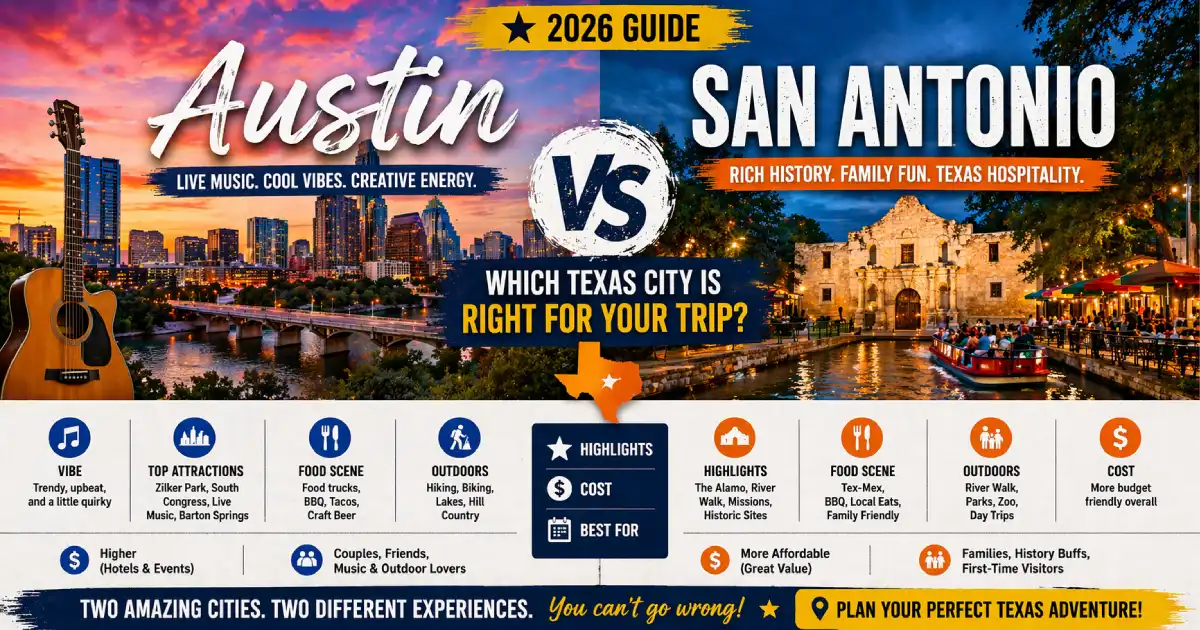
Austin vs San Antonio: Which Texas City Is Right for Your Trip? (2026 Guide)
Published on : 16 Apr 2026
Austin vs San Antonio — 80 Miles Apart, A Century Apart in Character
By Travel Tourister | Updated March 2026
Austin and San Antonio sit 80 miles apart on I-35 — close enough to drive between them in 90 minutes, far enough apart in character that choosing between them is the most specific travel decision available in Texas. Austin is the most self-consciously creative city in the state: the Live Music Capital of the World with 250+ venues, Barton Springs Pool in the urban core, South by Southwest every March, Franklin Barbecue making headlines internationally, and a city personality built around the perpetual tension between the “Keep Austin Weird” ethos it invented and the tech industry growth that has been slowly resolving that tension in favor of the tech industry. San Antonio is the most historically layered city in Texas: the Alamo (the most visited historic site in Texas, where 189 defenders held off a Mexican army of thousands in 1836 before being killed to the last man in one of the most consequential battles in American history), four other Spanish colonial missions in a UNESCO World Heritage complex, the River Walk (the most visited destination in Texas, full stop — more visitors annually than the Grand Canyon), and a Tejano cultural depth that no other Texas city replicates at the same scale or with the same authenticity.
They are also the gateway cities for the Texas Hill Country — the cedar-and-limestone plateau west of Austin and north of San Antonio that produces Texas’s finest wine country (the Fredericksburg wine trail), the most beautiful state parks in Central Texas (Enchanted Rock, Pedernales Falls, Lost Maples), and the most specifically Hill Country cultural experience (the Gruene Hall honky-tonk, the Wimberley artisan community, the Luckenbach dance hall). Both cities make legitimate claims as the best base for Hill Country exploration, and that specific question — which city is the better Hill Country gateway — is the most productively answered part of this comparison.
For complete city guides, see our Things to Do in Austin and Things to Do in San Antonio guides.
Quick Verdict: Austin vs San Antonio at a Glance
Category
🎸 Austin Wins
⚔️ San Antonio Wins
Winner
History & Landmarks
Texas State Capitol, UT Campus, 6th Street history
The Alamo, 4 Spanish Missions (UNESCO), Spanish Governor’s Palace
⚔️ San Antonio
Live Music
6th Street, Stubb’s, Red River, 250+ venues, ACL Festival, SXSW
Gruene Hall (90 min), River Walk music
🎸 Austin
BBQ
Franklin, La Barbecue, Loro — most celebrated in America
Good but not nationally celebrated
🎸 Austin
Tex-Mex
Good — Güero’s, El Real, Juan in a Million
Best in Texas — Mi Tierra (24hrs, since 1941), Los Barrios, The Granary
⚔️ San Antonio
Outdoor Swimming
Barton Springs (68°F natural pool), Jacob’s Well (45 min), Hamilton Pool (45 min)
San Antonio River (not swimmable), SeaWorld waterpark
🎸 Austin
River Walk
Lady Bird Lake (kayaking), Barton Creek
The River Walk — most visited destination in Texas (15 million visitors/year)
⚔️ San Antonio
Family Activities
Zilker Park, Barton Springs, science museum
SeaWorld, Fiesta Texas (Six Flags), the Alamo, Natural Bridge Caverns, San Antonio Zoo
⚔️ San Antonio
Breakfast Tacos
Juan in a Million, Veracruz, Tacodeli
Extremely strong local scene — Roland’s, Taqueria Datapoint
🤝 Tie (both excellent)
Walkability
Downtown, SoCo corridor, 6th Street
River Walk (most walkable tourist area in Texas), downtown historic core
⚔️ San Antonio (River Walk wins)
Nightlife
6th Street, Rainey Street, Red River
River Walk bars, Pearl District, St. Mary’s Strip
🎸 Austin
Hill Country Gateway
Closer to Pedernales Falls, Hamilton Pool, Barton Creek
Closer to Fredericksburg wine country, Enchanted Rock, Gruene Hall
🤝 Tie (different areas)
Hotel Cost
$145–$245/night midrange
$120–$195/night midrange
⚔️ San Antonio (notably cheaper)
Cultural Depth
Live music heritage, UT Austin intellectual culture, tech creative class
Deepest Tejano and Mexican-American heritage in Texas, 300+ years of Spanish colonial history
⚔️ San Antonio
Austin vs San Antonio: City Personality
Austin: The Creative Capital in Tension With Its Own Success
Austin is the most self-consciously creative major Texas city — a place where the “Keep Austin Weird” bumper sticker was invented, where the Live Music Capital of the World designation is backed by a genuine 250+ venue infrastructure, where the University of Texas produces an intellectual and arts community that has fueled the city’s creative identity since the 1960s, and where the food scene has been producing James Beard Award winners and nationally significant BBQ operations for long enough that the fame now drives as much of the dining conversation as the food itself. Austin is the Texas city that most specifically rewards the visitor who shows up for the music, the food, the outdoor swimming, and the creative energy.
The city’s perpetual identity tension — the bohemian creative community that built Austin’s national reputation increasingly priced out by the tech industry migration that reputation attracted — is most visible in the real estate market and the morning commute, less visible on the 6th Street entertainment corridor on a Friday evening when the venues are open and the music from competing bars overlaps in the street in the specific spontaneous way that no other American city replicates at the same density. Austin is still the Live Music Capital of the World. It is also increasingly a tech company campus with live music on the weekends. The visitor who comes for the music, the breakfast tacos, and Barton Springs will find all three in the form they always expected.
Austin visitors tend to be: Music and culture travelers, food-focused visitors targeting Franklin Barbecue and the taco scene, outdoor recreation seekers (Barton Springs, Lady Bird Lake, Hill Country hiking), SXSW and ACL Festival attendees, and visitors who want the most characteristically “creative Texas” city experience.
San Antonio: The Most Historically Layered City in Texas
San Antonio is the most historically continuous major Texas city — a city that has been inhabited, contested, and culturally complex since Spanish missionaries founded Mission San Antonio de Valero in 1718, making it 55 years older than the United States itself. The city’s history — Spanish colonial mission culture, Mexican governance, the Texas Revolution and the Alamo (1836), Reconstruction, the US military presence (four major military installations including Joint Base San Antonio), and the continuous Tejano cultural tradition that predates Anglo settlement by a century and remains the city’s most distinctive cultural inheritance — is the most layered and the most historically specific in Texas.
The result is a city that is simultaneously the most tourist-friendly in Texas (the River Walk and the Alamo are the most visited destinations in the state, with the most developed tourism infrastructure) and the most genuinely rooted in a cultural tradition that predates tourism — the Tejano community, the mariachi tradition, the Dia de los Muertos celebrations, and the Mi Tierra restaurant (open 24 hours since 1941, the most festively decorated Mexican restaurant in Texas and the most historically embedded single restaurant in San Antonio) all represent the authentic foundation beneath the tourist surface. San Antonio rewards the visitor who goes beyond the River Walk to find the real city underneath it.
San Antonio visitors tend to be: History travelers (the Alamo, the Missions UNESCO World Heritage Site), families (SeaWorld, Fiesta Texas, Natural Bridge Caverns), Tex-Mex seekers, military families and veterans, and visitors who want the most specifically Hispanic and the most historically layered major Texas city experience.
Austin vs San Antonio: History & Landmarks
Austin’s History — Political Power and University Culture
Austin’s historical identity is built around the Texas state government (the city has been the state capital since 1839) and the University of Texas (established 1883, the most significant public research university in the South). The Texas State Capitol — the most architecturally impressive state capitol building in the United States, taller than the US Capitol in Washington at 311 feet, built from Sunset Red granite quarried from Marble Falls in the Texas Hill Country — is the finest single public building in Austin and genuinely worth the free guided tour. The Capitol’s historic Annex tunnels, the governor’s office, and the Senate and House chambers produce the most accessible Texas legislative history education available to any visitor.
The University of Texas campus is the most beautiful and architecturally significant university campus in Texas — the Harry Ransom Center (one of the world’s great humanities research libraries, with one of the world’s 50 surviving Gutenberg Bibles accessible behind glass), the Blanton Museum of Art (the finest university art museum in Texas), and the LBJ Presidential Library (the most politically specific and the most intellectually engaged presidential library in Texas) collectively provide a cultural depth that makes the UT campus the most rewarding single university campus walk in the state.
San Antonio’s History — The Most Specific in Texas
San Antonio’s history is the most genuinely consequential and the most layered in Texas — and the Alamo is only the most famous expression of a historical depth that runs 300+ years deeper than the 1836 battle that defined it in American popular culture.
The Alamo (Mission San Antonio de Valero): The most visited historic site in Texas — the 1836 Battle of the Alamo, where 189 Texian defenders including William Barret Travis, Jim Bowie, and Davy Crockett held a former Spanish mission against a Mexican army of 1,500+ for 13 days before being killed to the last man, is the most emotionally specific and the most politically consequential battle in Texas history. The site is free to visit; the museum ($18/adult) provides the most comprehensive primary-source Alamo documentation accessible to the public
San Antonio Missions National Historical Park (UNESCO World Heritage Site): Four Spanish colonial missions — Mission Concepción, Mission San José (the most architecturally complete and the most beautifully preserved Spanish colonial church in North America), Mission San Juan, and Mission Espada — stretching 9 miles south along the San Antonio River, constituting the most significant and the most intact Spanish colonial religious architecture accessible in the United States. Free admission (National Park Service). The most undervisited world-class historical site in Texas.
Spanish Governor’s Palace: The 1749 Spanish colonial administrative palace — the only surviving example of an aristocratic Spanish colonial residence in Texas, free to tour on weekdays
La Villita Historic District: The oldest neighborhood in San Antonio — the original Spanish civilian settlement adjacent to the River Walk, with the most intact Spanish and German colonial architecture accessible in the city
History verdict: San Antonio wins decisively — the Alamo, the UNESCO World Heritage Mission complex, and 300 years of Spanish colonial history make San Antonio the most historically significant major city in Texas by any measure. Austin’s Texas State Capitol is genuinely excellent; it is not in the same historical weight class as the Alamo and the Missions.
Austin vs San Antonio: Food Scene
Austin Food — BBQ Royalty and Breakfast Taco Culture
Austin’s food identity rests on two pillars that are genuinely unmatched in San Antonio: the BBQ scene and the breakfast taco culture. Franklin Barbecue — the most celebrated BBQ restaurant in America by every national metric (James Beard Award, Texas Monthly #1, multiple national magazine covers) — is in Austin. The line at 7 AM on a Saturday is the most specifically Austin food experience accessible at any price point. La Barbecue (the most acclaimed female-pitmaster operation in Texas), Loro (the Aaron Franklin and Tyson Cole collaboration producing the most creative BBQ-meets-Asian fusion accessible in Texas), and Micklethwait Craft Meats (the most technically ambitious smaller BBQ operation in Austin) collectively produce the most nationally recognized BBQ scene outside the Lockhart-Luling corridor on I-35.
The breakfast taco culture is equally irreplaceable — Juan in a Million’s Don Juan taco (plate-sized, $5, the most generous single taco in Texas), Veracruz All Natural’s migas taco (food truck, the most nationally recognized Austin taco brand, fresh salsa and eggs in a corn tortilla that is the most frequently photographed Austin breakfast), and Tacodeli’s Salsa Doña (kept behind the counter, available only upon request — the most specifically Austin food secret). These specific operations, at these specific prices, in this specific city character, are unavailable in San Antonio at the same quality and density.
Austin’s fine dining is equally ambitious — Uchi (James Beard Award-winning Japanese, the finest sushi in Texas), Odd Duck (the most farm-to-table-committed and the most ingredient-specific casual fine dining in Austin), and Emmer & Rye (the dim-sum-cart-format seasonal menu that is the most specifically creative fine dining format accessible in Central Texas).
San Antonio Food — The Tex-Mex Capital of Texas
San Antonio’s food identity is rooted in Tex-Mex in the most historically authentic and the most culturally specific form accessible in Texas — a cuisine tradition that predates the term “Tex-Mex” by a century, built on the Tejano community’s adaptation of Northern Mexican cooking traditions to Texas ingredients and the specific flavors of the San Antonio River basin. The San Antonio Tex-Mex scene:
Mi Tierra Café y Panadería: The most festively decorated and the most historically continuous Tex-Mex restaurant in San Antonio — open 24 hours since 1941 in the Market Square (El Mercado) district, with 500+ poinsettia decorations and Christmas lights year-round, mariachi music throughout the day, and the house puffy tacos (the most specifically San Antonio Tex-Mex invention — a corn tortilla puffed in hot oil to a hollow, crispy shell that is unavailable in this form in any other Texas city) as the most ordered single item ($16–$22)
Los Barrios Restaurant: The most beloved family-owned Tex-Mex institution in San Antonio — the Barrios family has been feeding the San Antonio community since 1979 with the most consistently excellent and the most honestly priced Tex-Mex accessible in the city ($18–$28/person)
Cured at the Pearl Brewery: The most acclaimed fine dining in San Antonio — a charcuterie-focused restaurant in the renovated Pearl Brewery complex that is the most James-Beard-adjacent restaurant in the city, with the house-cured meats and the seasonal Texas ingredient menu that make it the most culinarily ambitious fine dining accessible in San Antonio
The Original Puffy Taco: Henry’s Puffy Tacos — the most specifically San Antonio and the most irreplaceable single food in the city, unavailable in any equivalent form in Austin or any other Texas city. The puffy taco (puffed corn tortilla, hand-formed, filled with picadillo, guacamole, or beans and cheese) is the food that most specifically belongs to San Antonio in the way that the breakfast taco belongs to Austin
Food verdict: Austin wins on BBQ (no contest) and breakfast tacos (very close). San Antonio wins on Tex-Mex and the most historically authentic puffy taco tradition. If you eat one thing in San Antonio, it should be a puffy taco at Henry’s. If you eat one thing in Austin, it should be brisket at Franklin (with a 7 AM arrival to secure a spot before the inevitable sell-out).
Austin vs San Antonio: The River Walk vs Barton Springs
San Antonio’s River Walk — The Most Visited Destination in Texas
The San Antonio River Walk (Paseo del Río) — the 15-mile network of walkways along the San Antonio River, primarily in the 2.5-mile downtown loop that connects the Convention Center to the Pearl Brewery district — is the most visited tourist destination in Texas (15 million visitors annually, more than the Grand Canyon), and genuinely worth the visit for the specific combination of things it does: the most pedestrian-friendly and the most shaded urban walking available in any Texas city (the River Walk is below street level, with the river’s canopy of cypress trees providing shade that no surface street can match at San Antonio’s summer temperatures), the most festively lit evening waterway walk in the American South, and the most boat-tour-accessible urban river in Texas (the flat-bottomed Rio San Antonio Cruises are the most relaxing 40 minutes accessible in San Antonio, $14/adult).
The honest River Walk assessment: the restaurants on the River Walk itself (the tourist-facing corridor immediately adjacent to the Alamo and the Convention Center) are the most overpriced and the least interesting in San Antonio — the visitor who eats on the River Walk proper will pay tourist prices for mediocre food. The visitor who uses the River Walk as a walking and evening experience and eats at Mi Tierra, Los Barrios, or the Pearl District’s Cured will have the best version of the San Antonio food and walking experience simultaneously.
Austin’s Barton Springs — The Most Extraordinary Urban Swimming in America
Barton Springs Pool — a 3-acre natural spring-fed swimming hole in Zilker Park, 2 miles from downtown Austin, fed by the Edwards Aquifer at a constant 68°F year-round — is the most specifically extraordinary urban outdoor swimming experience in the United States. No other major American city has anything comparable: a natural limestone-bottom swimming pool fed by an underground aquifer at a constant cool temperature, surrounded by 350-year-old pecan trees on the banks of the Colorado River, 2 miles from the Texas State Capitol, with a lawn for sunbathing and a diving area and a children’s shallow section and a $3–$9 admission fee (free before 8 AM on weekdays when the gates open).
Barton Springs is the most democratic and the most specifically Austin public space — the city’s politicians, professors, musicians, students, construction workers, tech industry employees, and their dogs all share the same limestone steps and the same 68°F water on a July afternoon in the specific egalitarian outdoor culture that Austin has maintained despite everything that has changed around it. It is the one Austin experience that no development pressure, no gentrification, no tech company headquarters, and no SXSW wristband economy has been able to commodify. It costs $3 on a weekday morning. It is the most extraordinary urban swimming in America. Go before 8 AM. It is free.
River Walk vs Barton Springs verdict: They serve entirely different purposes and both win in their category. The River Walk is the most developed and the most walkable tourist waterfront in Texas — use it for evening walking, boat tours, and navigation between downtown San Antonio’s attractions. Barton Springs is the most extraordinary urban natural swimming in the United States — use it for the specific experience of swimming in 68°F spring water in the middle of a major American city, which is an experience available nowhere else.
Austin vs San Antonio: Hill Country Gateway
This is the most practically useful comparison for the visitor planning to include the Texas Hill Country — the cedar-and-limestone plateau west of Austin and north of San Antonio that produces Texas’s finest wine country, most scenic state parks, and most specifically Hill Country cultural experiences.
Austin as Hill Country Base
Austin’s proximity to the eastern and central Hill Country gives it the best access to:
Pedernales Falls State Park (40 miles west): The most dramatically scenic Texas Hill Country state park accessible from Austin — the Pedernales River’s limestone waterfalls and swimming holes are the finest accessible from any major Texas city within 45 minutes of driving
Hamilton Pool Preserve (35 miles west): The most photogenic natural swimming hole in Texas — a collapsed grotto with a 50-foot waterfall into an emerald pool; reservation required at recreation.gov ($13/vehicle); the most specifically photographed Texas Hill Country landmark
Jacob’s Well (50 miles west, Wimberley): The most dramatic natural swimming feature in the Hill Country — an artesian spring that has been flowing for 10,000+ years, producing a 12-foot diameter well of crystal-clear water; reservation required; the Wimberley artisan community adjacent makes it the most complete Hill Country half-day accessible from Austin
Barton Creek Greenbelt (within Austin city limits): The most immediately accessible Hill Country hiking from any Austin hotel — limestone canyon trails beginning 1 mile from downtown, with swimming holes along the creek accessible without a car
San Antonio as Hill Country Base
San Antonio’s proximity to the western Hill Country gives it the best access to:
Enchanted Rock State Natural Area (85 miles north): The most geologically specific Texas Hill Country landmark — a 1,825-foot pink granite dome rising 425 feet from the surrounding terrain, one of the largest batholiths in the United States, with the finest panoramic Hill Country view accessible from any Central Texas hiking trail. Reservation required at recreation.gov ($8/person). The most specifically dramatic Hill Country day hike accessible from any Texas city.
Fredericksburg and the Texas Wine Country (75 miles north): The most developed wine country in Texas — 50+ wineries along US-290 between Johnson City and Fredericksburg, the most German-heritage small town in Texas (Fredericksburg was founded by German immigrants in 1846 and still celebrates Oktoberfest and maintains German-language church services), and the National Museum of the Pacific War (the most significant WWII museum in Texas, documenting Admiral Chester Nimitz’s role as Fleet Admiral of the US Pacific Fleet). The most complete Hill Country town day trip accessible from San Antonio.
Gruene Hall (45 miles north): The oldest dance hall in Texas (since 1878), the most specifically Texas honky-tonk accessible from San Antonio — Willie Nelson, Lyle Lovett, and every significant Texas country artist has played Gruene Hall; the Sunday afternoon dance is the most authentic and the most community-attended music event accessible in the Hill Country without a festival ticket
Natural Bridge Caverns (25 miles north): The most impressive cave system accessible as a day trip from San Antonio — the most developed show cave in Texas, with the most elaborate stalactite and stalagmite formations accessible on a guided tour; the most efficient family adventure accessible within 30 minutes of San Antonio
Hill Country verdict: Tie — different access points, equally rewarding. Choose Austin as your Hill Country base if you want Hamilton Pool, Pedernales Falls, Jacob’s Well, and Wimberley. Choose San Antonio if you want Enchanted Rock, Fredericksburg wine country, Gruene Hall, and Natural Bridge Caverns. The most rewarding single Hill Country trip from Texas uses both cities — drive from San Antonio through Fredericksburg and the wine country, past Enchanted Rock, through Johnson City, and into Austin; the 3-hour Hill Country circuit is the finest single driving day accessible in Central Texas.
Austin vs San Antonio: Live Music & Nightlife
Austin — The Live Music Capital
Austin’s live music scene is the most per-capita live-music-dense in the United States — 250+ venues, the 6th Street entertainment district (free to walk, with cover charges $5–$20 at the most popular venues), Rainey Street’s converted bungalow bars (the most neighbourhood-feeling and the most locally attended nightlife corridor in Austin), the Red River Cultural District (Stubb’s Amphitheater, Emo’s, and the most indie and the most musically specific venue cluster in the city), and the South Congress/South Lamar areas’ cocktail bars and wine bars that produce the most specifically food-adjacent nightlife in Austin’s adult dining-and-drinking culture.
Stubb’s Amphitheater — a 5,000-person capacity outdoor stage in the Red River Cultural District with the Austin skyline visible above the stage — is the finest outdoor music venue in Texas. The view of the city from the Stubb’s lawn during a performance is the most specifically Austin visual experience accessible at any concert in the state. The Austin City Limits Music Festival (October, Zilker Park, 75,000 daily capacity) and South by Southwest (March, 2,000+ official and unofficial events across the city) are the two most nationally significant annual Texas music events.
San Antonio Nightlife — River Walk and the St. Mary’s Strip
San Antonio’s nightlife is less nationally celebrated than Austin’s but genuinely active — the River Walk’s bar corridor (most tourist-facing and most festively lit, best for a first evening), the Pearl District’s craft cocktail bars (the most food-sophisticated and the most locally attended adult drinking scene in San Antonio), and the St. Mary’s Strip (the most indie and the most specifically local — the Music Strip on St. Mary’s Street is San Antonio’s equivalent of Austin’s Red River Cultural District, with smaller venues, more specifically local music, and the most genuinely San Antonio bar culture accessible in the city).
The most specific San Antonio live music experience is mariachi — the Mariachi Vargas de Tecalitlán has been based in San Antonio since 1958, and the El Mercado/Market Square plaza produces the most accessible live mariachi performances of any American city outside Los Angeles on weekend afternoons. The most specifically San Antonio musical tradition is not the River Walk bands playing for tourist tips but the mariachi culture that permeates the city’s weddings, quinceañeras, and Sunday afternoon plaza gatherings.
Music and nightlife verdict: Austin wins clearly — 250+ venues vs San Antonio’s smaller scene is not a close comparison. San Antonio’s mariachi culture is the most specifically San Antonio music tradition and genuinely worth experiencing; it is not what “nightlife” means to most Tier 1 travelers planning a Texas music trip.
Austin vs San Antonio: Family Activities
Austin Families
Barton Springs Pool: The most family-appropriate natural swimming in any major Texas city — the shallow wading area, the diving boards, and the constant 68°F temperature make it simultaneously the safest and the most specifically extraordinary swimming accessible in Austin ($3–$9; free weekday mornings before 8 AM)
Zilker Park: 350 acres of riverside park — the most family-usable urban park in Texas, with the Kite Festival (March), the Trail of Lights (December), the Barton Springs Pool, and the miniature train ride that has been transporting Austin children through Zilker’s oak canopy since 1962
Thinkery (Children’s Museum of Austin): The most STEM-focused and the most hands-on children’s museum in Central Texas — the most appropriate indoor family activity when Austin’s summer heat limits outdoor time ($12/person)
Congress Avenue Bat Colony: 1.5 million Mexican free-tailed bats emerging from under the Congress Avenue Bridge at dusk from late March through October — the most dramatic free wildlife event accessible in any major American city; best observed from the Austin American-Statesman bat viewing area or from a Lady Bird Lake kayak ($0 from the bridge; $25–$45 for the kayak tour that positions you under the bridge at emergence)
San Antonio Families
SeaWorld San Antonio: The most complete marine-life theme park in Texas — dolphin and orca shows (limited orca performance following activist pressure), roller coasters, and the most complete water park attached to a marine theme park in the South. One of three SeaWorld parks in the US, making San Antonio the most SeaWorld-accessible city in Texas ($75–$95/adult online)
Six Flags Fiesta Texas: The most scenically positioned theme park in Texas — built inside a limestone quarry on San Antonio’s north side, with the quarry walls as the most dramatic single roller coaster backdrop in the state; the Superman Krypton Coaster (the most intense steel coaster accessible in San Antonio) and the Rattler wooden coaster are the most attended attractions ($60–$80/adult online)
Natural Bridge Caverns: The most impressive show cave accessible from any major Texas city as a day trip — 25 miles north of San Antonio, the most elaborate stalactite formations in Texas in the most comprehensively developed cave tourism infrastructure ($25–$35/adult)
San Antonio Zoo: One of the largest zoos in the United States (750+ species) — the Africa Live habitat and the Amazonia section are the most immersive exhibits; the natural zoo landscape in Brackenridge Park is the most beautifully forested zoo setting accessible in South Texas ($22/adult)
The Alamo: The most historically educational single site for children in Texas — the IMAX theater adjacent to the Alamo ($18/adult) provides the most contextually complete Alamo experience for children who need the visual narrative before the site walk
Family verdict: San Antonio wins — SeaWorld, Six Flags Fiesta Texas, Natural Bridge Caverns, and the San Antonio Zoo give San Antonio the most concentrated family theme park and attraction infrastructure of any Texas city. For families with children specifically interested in theme parks and wildlife shows, San Antonio is the clearest choice. For families interested in natural swimming, free wildlife spectacles, and outdoor urban recreation, Austin’s Barton Springs and bat colony are genuinely extraordinary — but the theme park infrastructure is San Antonio’s strongest single category advantage.
Austin vs San Antonio: Cost of Visiting
Cost Category
🎸 Austin
⚔️ San Antonio
Cheaper?
Midrange Hotel (per night)
$145–$245
$120–$195
⚔️ San Antonio
Budget Hotel (per night)
$95–$145
$80–$125
⚔️ San Antonio
River Walk Hotel (premium)
N/A
$200–$380 (directly on River Walk)
🎸 Austin (no River Walk premium)
Casual Dinner (per person)
$25–$45
$18–$35
⚔️ San Antonio
Tex-Mex (Mi Tierra)
N/A equivalent
$16–$28/person
⚔️ San Antonio
BBQ (Franklin)
$25–$40/person
No equivalent
🎸 Austin (has it)
Barton Springs Swimming
$3–$9 (free before 8 AM weekdays)
No equivalent
🎸 Austin (has it)
The Alamo
Not accessible
Free (grounds); $18 museum
⚔️ San Antonio (has it)
Hill Country Day Trip
Hamilton Pool $13 + gas
Enchanted Rock $8 + gas
🤝 Comparable
Event-Week Premium
SXSW March (+100%), ACL Oct (+80%), F1 Oct (+120%)
Fiesta SA April (+40%), Spurs playoffs (+30%)
⚔️ San Antonio (smaller spikes)
Live Music
Free (6th Street walking) to $20 covers
River Walk bars free entry; Gruene Hall $5–$15
🤝 Comparable
Cost verdict: San Antonio is notably cheaper — hotel rates are consistently $25–$50/night lower than Austin’s midrange across all seasons (outside Austin’s dramatic event-week spikes when the gap widens dramatically). Casual dining is more affordable; the Tex-Mex tradition produces genuinely excellent food at lower price points than Austin’s increasingly tech-industry-priced restaurant scene. San Antonio is the most value-complete major Texas city for the budget-conscious Tier 1 traveler who wants genuine Texas history, good food, and strong family activities without Austin’s SXSW-era hotel premium structure.
Who Should Visit Austin?
Choose Austin if you:
Want the Live Music Capital of the World at its most accessible — 250+ venues, 6th Street free walking, Stubb’s Amphitheater, and the Red River Cultural District produce the most per-capita live music of any American city
Are visiting for SXSW (March), ACL Music Festival (October), or the Formula 1 United States Grand Prix (October) — these three events are genuinely irreplaceable and worth the premium; book hotels 4–6 months ahead
Want Franklin Barbecue — the most celebrated BBQ in America; arrive at 7 AM, bring something to read, this is the most rewarding BBQ pilgrimage in the United States
Want to swim at Barton Springs Pool — the most extraordinary urban natural swimming in the United States; no other major American city has anything comparable
Want outdoor recreation integrated directly into the urban core — Lady Bird Lake kayaking, Barton Creek Greenbelt hiking, and Zilker Park are all within 2 miles of downtown
Are using Austin as a base for eastern Hill Country day trips — Hamilton Pool, Pedernales Falls, Jacob’s Well, and Wimberley are all within 35–55 miles
Want the most walkable, creative, and bohemian-adjacent major Texas city character despite the gentrification pressure
Who Should Visit San Antonio?
Choose San Antonio if you:
Want the most historically specific and the most emotionally resonant Texas history experience — the Alamo (free to visit the grounds), the four Spanish colonial missions (UNESCO World Heritage Site, free NPS entry), and 300+ years of Spanish colonial, Mexican, and Tejano history make San Antonio the most historically layered major city in Texas
Are traveling with children who want theme parks — SeaWorld and Six Flags Fiesta Texas make San Antonio the most family-theme-park-complete major Texas city
Want the most authentic and the most historically rooted Tex-Mex dining — Mi Tierra’s puffy tacos, Los Barrios family recipes, and the San Antonio Tex-Mex tradition that predates the term “Tex-Mex” by a century
Are on a tighter budget — San Antonio is notably cheaper than Austin for hotels, dining, and entertainment across all seasons, with none of Austin’s dramatic SXSW/ACL/F1 event-week price spikes
Want a River Walk evening — the most pedestrian-friendly and the most festively lit waterfront walking in Texas, best experienced in the evening when the cypress trees are lit and the restaurants are open and the boat tours are running
Are using San Antonio as a base for western Hill Country day trips — Enchanted Rock, Fredericksburg wine country, Gruene Hall, and Natural Bridge Caverns are all within 25–85 miles
Want the most genuinely diverse Hispanic-heritage cultural experience in Texas — Fiesta San Antonio (the most attended annual festival in Texas, 10 days in April), the Dia de los Muertos celebrations in November, and the mariachi tradition embedded in the city’s daily life
Can You Visit Both Austin and San Antonio?
Absolutely — and given the 80-mile distance (90-minute drive on I-35), combining Austin and San Antonio is the most efficient multi-city Texas trip accessible in a single week. The cities complement each other perfectly: Austin delivers the music, the BBQ, and the outdoor swimming that San Antonio lacks; San Antonio delivers the history, the Tex-Mex depth, the River Walk, and the budget accommodation that Austin increasingly cannot match.
4-day trip: Austin 2 days (Barton Springs, Franklin Barbecue, 6th Street music) → San Antonio 2 days (Alamo, Mission San José, Mi Tierra puffy tacos, River Walk evening)
6-day trip: Austin 3 days (add Lady Bird Lake kayaking, Hamilton Pool day trip) → San Antonio 3 days (add Natural Bridge Caverns, Enchanted Rock or Fredericksburg day trip from San Antonio)
Hill Country circuit (best option for Hill Country travelers): Arrive Austin → Barton Springs and BBQ → drive through Wimberley and Jacob’s Well → Fredericksburg wine country → Enchanted Rock → Gruene Hall → arrive San Antonio → Alamo and Missions → Mi Tierra → depart. The most complete Texas Hill Country experience in 4–5 days, using both cities as bookends
Full Texas circuit: Fly into Austin, drive Austin → San Antonio → Houston → Dallas, fly out of Dallas/Fort Worth — the most efficient multi-city Texas itinerary for the Tier 1 international visitor spending 8–10 days in the state
Austin vs San Antonio: Practical Tips
Topic
🎸 Austin
⚔️ San Antonio
Best Time to Visit
March (SXSW), October (ACL + F1), April (ideal weather + bluebonnets)
October–April; April for Fiesta San Antonio (most festive week of the year)
Worst Time
August (105°F+ heat); SXSW/ACL/F1 if on a tight budget (hotels $400+)
July–August (98°F+ with Gulf humidity; River Walk tourism at peak congestion)
Best Area to Stay
Downtown (6th Street walking) or South Congress (SoCo boutiques and restaurants)
River Walk area for the full experience; Pearl District for the most locally sophisticated
Don’t Miss
Barton Springs (free before 8 AM); Franklin Barbecue (7 AM); Congress Ave bat colony at dusk
The Alamo at dawn before the crowds; Mission San José Sunday noon Mariachi Mass; Mi Tierra puffy tacos
Avoid
The “Dirty Sixth” section of 6th Street late weekend nights (rowdy tourist bar strip); visiting during SXSW without hotel booked months ahead
Eating on the River Walk proper (tourist prices, mediocre food); confusing the Alamo’s small size for a lesser experience — read the history first
Free Highlights
6th Street music walking, Barton Springs (weekday mornings), Zilker Park, Congress Ave bats, Texas State Capitol tour, UT campus walk, LBJ Library
The Alamo grounds, four Spanish Missions (NPS, free), River Walk walking, El Mercado Market Square, La Villita Historic Arts Village, San Fernando Cathedral
Best Hill Country Trips
Hamilton Pool (35 mi); Pedernales Falls (40 mi); Jacob’s Well / Wimberley (50 mi)
Natural Bridge Caverns (25 mi); Enchanted Rock (85 mi); Fredericksburg wine country (75 mi); Gruene Hall (45 mi)
Frequently Asked Questions: Austin vs San Antonio
Is Austin or San Antonio better for a first-time Texas visitor?
San Antonio is the better choice for most first-time Texas visitors — the combination of the Alamo (the most specifically iconic Texas historical site), the River Walk (the most walkable and the most photogenic tourist waterfront in Texas), the Mission San José Sunday Mariachi Mass (the most specifically San Antonio cultural experience accessible in a single morning), and Mi Tierra’s puffy tacos (the most irreplaceable San Antonio food) delivers the most distinctively and most recognizably Texas experience in any single city. Austin is the better choice for the first-time visitor who specifically wants live music, BBQ, and outdoor swimming — in which case Barton Springs and Franklin Barbecue and the 6th Street music walk are more specifically extraordinary than the River Walk experience. San Antonio wins on history and cultural depth; Austin wins on food celebrity and outdoor life. For a true first-timer, the single most efficient Texas first visit is 2 days in San Antonio and 2 days in Austin, in that order.
Is San Antonio safer than Austin?
Both cities have safe tourist areas and areas with elevated crime rates — the standard urban safety advice applies to both. The tourist-facing areas of San Antonio (River Walk, downtown historic core, the Missions, the Pearl District) and Austin (6th Street, SoCo, Rainey Street, the UT campus area, Barton Springs) are all well-trafficked and safe for standard visitor activity. Both cities have ZIP codes with higher crime rates that are not tourist destinations and that visitors don’t typically encounter. Apply standard travel situational awareness in both cities and you will not encounter specific safety issues in either.
Which city has better Tex-Mex?
San Antonio wins Tex-Mex decisively — the puffy taco tradition (available at Henry’s Puffy Tacos and multiple San Antonio institutions in a form that is genuinely unavailable in Austin), Mi Tierra’s 24-hour festive dining culture, the Los Barrios family recipes, and a Tejano food tradition that predates the term “Tex-Mex” by a century collectively produce a Tex-Mex landscape that is the most historically rooted and the most genuinely specific of any Texas city. Austin’s Tex-Mex (Güero’s on South Congress, El Real near UT) is genuinely good — it is not the puffy taco at Henry’s, which is the most irreplaceable single Tex-Mex preparation accessible in Texas. San Antonio owns the Tex-Mex identity in the way that Austin owns the BBQ identity. If Tex-Mex is the primary food priority: San Antonio. If BBQ is the primary food priority: Austin, and specifically Franklin, and specifically 7 AM.
Which is the better Hill Country base — Austin or San Antonio?
The honest answer is that they access different parts of the Hill Country with comparable efficiency, and the right choice depends on which Hill Country experiences you’re targeting. Choose Austin for Hamilton Pool (the most photogenic natural swimming hole in Texas, 35 miles west), Pedernales Falls State Park (40 miles west), and the Wimberley-Jacob’s Well corridor (50 miles west). Choose San Antonio for Enchanted Rock (85 miles north, the most geologically spectacular Hill Country hiking), Fredericksburg and the wine country (75 miles north, the most developed Texas wine trail), and Gruene Hall (45 miles north, the oldest dance hall in Texas). The most productive Hill Country strategy: use both cities as bookends for a driving circuit that covers both regions — arrive Austin, drive west through Wimberley and Fredericksburg, turn south through Enchanted Rock and Kerrville, arrive San Antonio. The Hill Country circuit works better east-to-west (Austin to San Antonio) than in reverse, because the scenery becomes more dramatic as you move west.
What is the best San Antonio event to plan a trip around?
Fiesta San Antonio — the 10-day annual festival in April that celebrates the Battle of San Jacinto (April 21, 1836, when Sam Houston’s army defeated Santa Anna and secured Texas independence) with the most attended series of events in Texas — is the most festive and the most specifically San Antonio annual event accessible in any Texas city. The Texas Cavaliers River Parade (the most decorated River Walk parade of the year), the Battle of Flowers Parade (the oldest battle commemoration parade in Texas, first held in 1891), and the Fiesta Flambeau Parade (the largest illuminated night parade in the United States) are the three most attended single events during the 10-day festival. Hotel rates rise 30–40% during Fiesta — book 6–8 weeks ahead. The most specific Fiesta experience: attend the A Night in Old San Antonio (NIOSA) event, the largest annual single-night festival in Texas, held in La Villita Historic Arts Village over four evenings during Fiesta week ($20–$25/adult).
Final Verdict: Austin vs San Antonio
Austin and San Antonio are the most complementary city pair in Texas — 80 miles apart, better together than either is alone, and genuinely different enough that visiting one without the other leaves the most important half of the Central Texas experience unaddressed. The most honest single-sentence summary of each:
Choose Austin if you want the Live Music Capital of the World at its most accessible (6th Street free walking, Stubb’s Amphitheater, 250+ venues), the most celebrated BBQ in America (Franklin Barbecue, arrive at 7 AM, it is worth the wait and the planning), the most extraordinary urban natural swimming in the United States (Barton Springs Pool, 68°F spring water, free before 8 AM weekdays), and the eastern Hill Country’s finest swimming holes (Hamilton Pool, Jacob’s Well) within 35–50 miles of downtown. Austin is the Texas city that most rewards the visitor who shows up for the music and the food and the outdoor life and is rewarded with exactly those things in the form they hoped they would find — still available, still excellent, still specifically Austin, despite everything the growth has changed around the edges.
Choose San Antonio if you want the most historically layered major city in Texas (the Alamo, four UNESCO World Heritage missions, 300+ years of Spanish colonial and Tejano history), the most genuinely festive public space in Texas (the River Walk at sunset with the cypress trees lit and the boat tours moving through the water and the mariachi music from the El Mercado plaza audible two blocks away), the most irreplaceable single Texas food (the puffy taco at Henry’s, which is unavailable in any equivalent form in any other Texas city), the most affordable major Texas city without compromising on what matters, and the western Hill Country’s most spectacular day trips (Enchanted Rock’s granite dome, Fredericksburg’s wine trail, Gruene Hall’s 147-year-old dance floor). San Antonio is the Texas city that most rewards the visitor who arrives expecting only the Alamo and the River Walk and finds instead a 300-year-old city with the most specifically layered and the most genuinely rooted Hispanic cultural identity of any major American city — and realizes that the Alamo is only the beginning of the story, and that the beginning of the story requires the missions and the Spanish colonial history and the Tejano culture and the puffy tacos to understand what San Antonio actually is.
Both cities are genuinely extraordinary. Austin is the more creative and the more outdoors-integrated. San Antonio is the more historical and the more culturally rooted. The best Central Texas trip includes both — and the Hill Country circuit between them is the finest single driving experience in Texas, regardless of which direction you drive it.
For more detail, see our complete guides: 50 Things to Do in Austin, Best Restaurants in Austin, 50 Things to Do in San Antonio, and Best Restaurants in San Antonio.
—
For the most current visitor information, park reservations, road conditions, and travel advisories for Austin, San Antonio, and the Texas Hill Country, consult these official government sources:
AustinTexas.gov — Official City of Austin Visitor Information — Official Austin city government resource for Barton Springs Pool hours and pricing, Lady Bird Lake permit information, Zilker Park event schedules, and current city visitor resources updated by the City of Austin.
Texas Parks & Wildlife Department (TPWD) — Official Texas State Government — Official Texas state government resource for Hill Country state park reservations (Enchanted Rock, Pedernales Falls, Hamilton Pool, Lost Maples), current trail conditions, Texas fishing licenses, and all Texas state park entry requirements and reservation procedures.
—
About Travel TouristerTravel Tourister’s Texas specialists have extensively explored both Austin and San Antonio — from Barton Springs and Franklin Barbecue to the Alamo at dawn and Mi Tierra’s puffy tacos — to provide the most honest and most specific comparison available for Tier 1 travelers choosing between Central Texas’s two most culturally distinct and most perfectly complementary cities.Need help planning your Austin–San Antonio Hill Country trip? Our specialists can help you build the optimal itinerary, time your visit around SXSW, ACL, Fiesta San Antonio, or the Texas Hill Country wildflower season, and identify the best BBQ, Tex-Mex, and Hill Country day trips for any visit length or travel style.
Posted By : Vinay
As a lead contributor for Travel Tourister, Vinay is dedicated to serving our Tier 1 audience (US, UK, Canada, Australia). His mission is to deliver precise, fact-checked news and actionable, data-driven articles that empower readers to make informed decisions, minimize travel risks, and maximize their adventure without compromising safety or budget.
Travel Tourister is a leading Travel portal where we introduce travellers to trusted travel agents to make their journey hasselfree, memorable And happy. Travel Tourister is a platform where travellers get Tour packages ,Hotel packages deals through trusted travel companies And hoteliers who are working with us across the world. We always try to find new and more travel agents and hoteliers from every nook and corners across the world so that you could compare the deals with different travel agents and hoteliers and book your tour or hotel with the one you have chosen according to your taste and budget.




 Call
Call Enquiry