Published on : 18 Jun 2026
By Travel Tourister | Updated June 2026
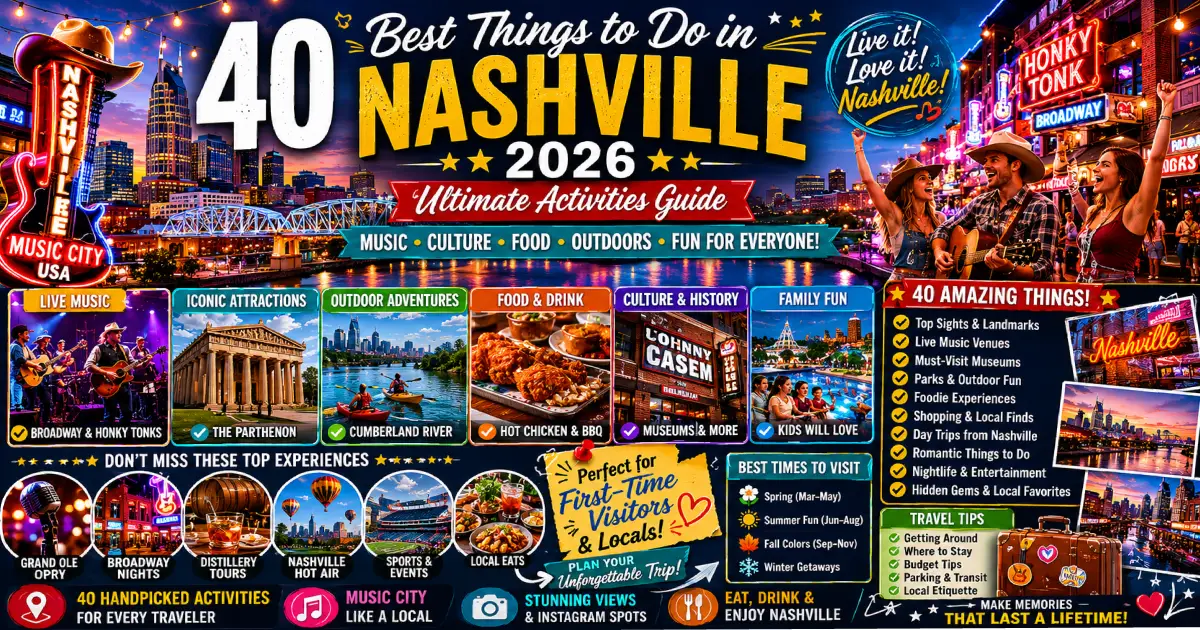
Nashville has transformed over the past two decades from a music-industry company town into one of America’s fastest-growing tourist destinations — 16 million annual visitors drawn by a combination of genuine musical heritage (the Grand Ole Opry, the Ryman Auditorium, Music Row’s recording studios), an explosively popular bachelorette-party and weekend-getaway culture centered on Lower Broadway’s honky-tonk strip, and a food scene that has earned national recognition well beyond hot chicken and barbecue. The best things to do in Nashville span genuinely free experiences (walking Lower Broadway’s neon-lit honky-tonks where bands play multiple sets daily without a cover charge, exploring the Parthenon replica in Centennial Park, hiking at Radnor Lake) to bucket-list splurges (Grand Ole Opry tickets, RCA Studio B tours where Elvis and countless country legends recorded, and the city’s increasingly sophisticated fine-dining scene).
What makes Nashville distinctive among American music cities is the sheer density of live music available without planning or cover charges — Lower Broadway’s honky-tonks (Tootsie’s Orchid Lounge, Robert’s Western World, Layla’s, and dozens more) operate multiple stages simultaneously from late morning until 2-3 AM, with bands playing 45-minute-to-hour sets for tips, meaning a single afternoon walking four blocks of Broadway exposes visitors to dozens of working musicians without spending money beyond drinks and tips. This sits alongside Nashville’s “serious” music infrastructure — the Country Music Hall of Fame, the historic Ryman Auditorium (the “Mother Church of Country Music”), and Music Row’s working recording studios — creating a city where casual tourist fun and genuine music-industry history exist within walking distance of each other.
This guide covers the 40 best things to do in Nashville organized by category — honky-tonks and live music, museums and music history, food and drink experiences, outdoor activities, and day trips — with practical details covering costs, neighborhood locations, booking requirements, and insider timing advice for 2026 visitors planning trips of any length.
For complete guides, see our Places to Visit in Nashville 2026, Best Restaurants in Nashville, and Best Time to Visit Nashville guides.
| # | Activity | Category | Cost | Time Needed | Book Ahead? |
|---|---|---|---|---|---|
| 1 | Walk Lower Broadway’s Honky-Tonks | Music | Free (tips encouraged) | 2–4 hrs | No |
| 2 | See a Show at the Ryman Auditorium | Music | $40–$120 | 2–3 hrs | Yes |
| 3 | Tour the Country Music Hall of Fame | Museum | $28–$45 | 2–3 hrs | No |
| 4 | Attend the Grand Ole Opry | Music | $45–$100+ | 2.5–3 hrs | Yes (weeks) |
| 5 | Eat Nashville Hot Chicken | Food | $10–$20 | 30–60 min | No |
| 6 | Explore the Parthenon (Centennial Park) | Landmark | $10 | 1 hr | No |
| 7 | Tour RCA Studio B | Music History | $20–$30 | 1 hr (guided) | Yes |
| 8 | Visit the Johnny Cash Museum | Museum | $25 | 1–1.5 hrs | No |
| 9 | Explore the Gulch Neighborhood | Neighborhood | Free | 1–2 hrs | No |
| 10 | Tour Belle Meade Historic Plantation | History | $22 | 1.5 hrs | No |
| 11 | Visit the Hermitage (Andrew Jackson’s Home) | History | $28 | 2–3 hrs | No |
| 12 | Take a Distillery/Whiskey Tour | Food/Drink | $15–$40 | 1–1.5 hrs | Recommended |
| 13 | Explore the Gaylord Opryland Resort | Architecture | Free (to walk through) | 1–2 hrs | No |
| 14 | Walk the Pedestrian Bridge | Views | Free | 30 min | No |
| 15 | Visit Centennial Park | Outdoors | Free | 1–2 hrs | No |
| 16 | Tour the State Capitol | History | Free | 45–60 min | Recommended |
| 17 | Explore 12 South Neighborhood | Neighborhood/Shopping | Free | 2–3 hrs | No |
| 18 | Visit the Musicians Hall of Fame | Museum | $25 | 1.5 hrs | No |
| 19 | Take a Songwriter’s Round (Bluebird Cafe) | Music | $0–$25 cover | 2 hrs | Yes |
| 20 | Kayak/Canoe the Cumberland River | Outdoors | $40–$60 | 2–3 hrs | Recommended |
| 21 | Explore East Nashville | Neighborhood | Free | 2–3 hrs | No |
| 22 | Visit the Frist Art Museum | Museum | $15 | 1.5–2 hrs | No |
| 23 | Take a Pedal Tavern/Party Bike Tour | Entertainment | $30–$45 | 1.5–2 hrs | Yes |
| 24 | Hike Radnor Lake State Natural Area | Outdoors | Free | 1.5–2 hrs | No |
| 25 | Visit the Adventure Science Center | Museum | $20 | 2–3 hrs | No |
| 26 | Explore the Nashville Farmers’ Market | Food/Shopping | Free | 1–2 hrs | No |
| 27 | Take a Food Tour of Nashville | Food | $65–$100 | 2.5–3 hrs | Yes |
| 28 | Visit Cheekwood Estate & Gardens | Outdoors/Art | $25 | 2–3 hrs | No |
| 29 | See Live Music at the Station Inn | Music | $20–$25 cover | 2 hrs | Recommended |
| 30 | Take a Brewery Tour | Food/Drink | $10–$20 | 1–1.5 hrs | No |
| 31 | Visit the Tennessee State Museum | Museum | Free | 1.5–2 hrs | No |
| 32 | Explore Printer’s Alley | Nightlife | Free | 1–2 hrs | No |
| 33 | Day Trip to Franklin, TN | Day Trip | Free–$20 | Half day | No |
| 34 | Visit the National Museum of African American Music | Museum | $30 | 2 hrs | No |
| 35 | Attend a Predators (NHL) or Titans (NFL) Game | Sports | $30–$200+ | 2.5–3.5 hrs | Yes |
| 36 | Explore Marathon Village | Shopping/History | Free | 1 hr | No |
| 37 | Visit Fort Nashborough | History | Free | 30 min | No |
| 38 | Take a Ghost Tour of Downtown | Entertainment | $25–$35 | 1.5–2 hrs | Yes |
| 39 | Visit Wave Country (Summer Water Park) | Outdoors | $10–$12 | 2–4 hrs | No |
| 40 | Shop at Marathon Music Works Area | Shopping | Free | 1–2 hrs | No |
Cost: Free (tips for bands strongly encouraged) | Location: Lower Broadway, downtown | Best Time: Afternoon through late night, any day
Lower Broadway is the single defining Nashville experience — a roughly five-block stretch of honky-tonk bars (Tootsie’s Orchid Lounge, Robert’s Western World, Layla’s, Legends Corner, and dozens more) where live bands play continuously from late morning until 2-3 AM across multiple floors within each venue, with no cover charge at most locations and musicians working for tips and exposure. The strip’s neon signage, boot shops, and constant overlapping music from adjacent venues create a sensory-overload atmosphere that’s become synonymous with Nashville’s identity as “Music City” — every genre of country, alongside rock and pop covers, is represented across the strip’s dozens of stages on any given night.
Tootsie’s Orchid Lounge (the strip’s most historically significant venue, where songwriters reportedly once snuck out the back door to pitch songs to Ryman Auditorium performers across the alley when the Ryman was the Grand Ole Opry’s home) remains essential, alongside Robert’s Western World (known for its Hoss Burgers, PBR-and-a-shot specials, and traditional honky-tonk country focus rather than chasing current pop-country trends). The rooftop bars (Nashville Underground, Honky Tonk Central, and others featuring multiple levels) offer elevated views over Broadway’s chaos for visitors wanting to watch the scene from above.
Insider tips: Visit during weekday afternoons (2-5 PM) for a noticeably calmer, more music-focused experience before the bachelorette party crowds intensify in the evening — many of the same excellent bands play afternoon sets with far fewer crowds. Tipping bands directly (cash, placed in tip jars/buckets near the stage) is the expected way musicians earn income on Broadway — bring cash specifically for this purpose throughout an evening of bar-hopping.
Cost: $40–$120 depending on performer | Address: 116 5th Avenue North | Best Time: Check current show schedule | Book: Weeks ahead for popular acts
The Ryman Auditorium, built in 1892 as a tabernacle (revival meeting hall) and serving as the Grand Ole Opry’s home from 1943 to 1974, is universally known as the “Mother Church of Country Music” — its wooden pews (still installed, creating genuinely unique sightlines and acoustics compared to modern venues), exposed brick, and stained-glass windows create an atmosphere unlike any other American music venue, with acoustics so respected that artists across genres (not just country) actively seek to perform there specifically for the sound quality and historical weight. The venue hosts a year-round performance calendar (when the Opry isn’t using it for its winter season, as the Opry alternates between the Ryman and the larger Grand Ole Opry House depending on season) featuring country, bluegrass, rock, and comedy performers.
Daytime self-guided tours ($25-30, available when no rehearsals/events are occurring) allow visitors to explore the venue, stand on the actual stage, and learn the building’s history through exhibits covering its tabernacle origins and decades as the Opry’s home — a worthwhile alternative for visitors unable to attend an evening performance.
Insider tips: Check the Ryman’s show calendar before booking Nashville travel dates if seeing a specific type of performance here is a priority — the venue’s booking spans genres significantly beyond country, and many shows sell out given the venue’s relatively limited seating capacity (2,362) and outsized reputation. The wooden pew seating means comfort differs from modern arena/theater seating — appropriate expectations help, though the historical authenticity is precisely the point.
Cost: $45–$100+ depending on seating and show | Venue: Grand Ole Opry House (most of the year) or Ryman Auditorium (select winter shows) | Best Time: Wednesday, Friday, or Saturday shows | Book: Weeks ahead
The Grand Ole Opry, broadcasting continuously since 1925 (making it the longest-running radio broadcast in American history), represents country music’s most iconic institution — a live show format featuring multiple performers (typically 6-8 acts per show, mixing established stars, rising artists, and legacy performers) rotating through brief sets, all broadcast live on WSM radio and increasingly via additional streaming platforms, maintaining a direct broadcast tradition extending back a full century. The Opry’s “circle” — a 6-foot circle of wood salvaged from the Ryman Auditorium’s stage and embedded center-stage at the Grand Ole Opry House — connects the current venue physically and symbolically to the institution’s Ryman-era history.
The show’s format (multiple short performances rather than a single artist’s full concert) means audiences experience genre breadth within a single evening — traditional country, bluegrass, contemporary country-pop, and occasional comedy or spoken-word segments, with the Opry’s famous live radio-show pacing (commercial-style sponsor announcements integrated into the live show, maintaining the broadcast’s historical format) creating a genuinely unique entertainment experience distinct from a standard concert.
Insider tips: Book tickets several weeks ahead, particularly for weekend shows or when popular touring artists are scheduled as guest performers — the Opry publishes lineups in advance, allowing fans to select dates based on specific artists if desired. Backstage tours (separate ticketed experience, daytime) provide additional context on the show’s history and broadcast operations for visitors wanting deeper engagement beyond attending a performance.
Cost: $0–$25 cover depending on show | Address: 4104 Hillsboro Pike | Best Time: Evening shows, reservations essential | Book: Weeks ahead via website
The Bluebird Cafe, a small, unassuming venue in the Green Hills neighborhood (notably away from downtown’s honky-tonk district), represents Nashville’s “songwriter’s round” tradition at its most authentic — multiple songwriters (often hit songwriters whose names audiences may not recognize despite having written songs performed by major country stars) sit in a circle, taking turns performing their own songs and explaining the stories behind them, in a setting demanding genuine audience silence and attention (the venue strictly enforces a no-talking policy during performances, a notable contrast to Broadway’s loud, drink-focused honky-tonk atmosphere).
The venue gained broader fame partly through its depiction in the TV show “Nashville,” but its actual significance predates and exceeds that exposure — numerous major country hits were essentially workshopped or first performed in this room, and the songwriter’s round format (hearing the actual writer perform a song, often stripped down to just voice and guitar, with context about its creation) offers a genuinely different and more intimate music experience than Broadway’s bar-band cover sets.
Insider tips: Reservations are essential and should be made as far ahead as possible via the venue’s website — walk-in availability is extremely limited given the venue’s small size (90 seats) and significant demand. The strict no-talking-during-performances policy is genuinely enforced (the venue will ask repeat talkers to leave) — this is intentional and central to the songwriter’s round experience, distinguishing it from Broadway’s more raucous atmosphere.
Cost: $20–$25 cover | Address: 402 12th Avenue South | Best Time: Any night, particularly Sunday bluegrass jam | Book: Recommended, especially weekends
The Station Inn, operating since 1974 in a converted cinderblock building in the Gulch neighborhood, is widely considered the most important bluegrass venue in the United States — a no-frills room with simple table seating that has hosted essentially every major bluegrass artist of the past five decades, maintaining a programming focus specifically on bluegrass, old-time, and acoustic roots music distinct from Nashville’s broader country-music tourist infrastructure. The venue’s unpretentious atmosphere (no stage lighting spectacle, no elaborate sound system theatrics — just exceptional musicians playing acoustic instruments in a room designed for listening) creates an experience that serious bluegrass and roots-music fans consider essential, while remaining accessible to curious visitors without specific bluegrass background.
The Sunday night bluegrass jam (long-running, informal, drawing both professional musicians and serious amateurs for a collaborative jam session format) offers a particularly distinctive experience — less a “show” than a genuine musical gathering that visitors can observe and absorb.
Insider tips: The venue’s small size and significant reputation mean advance tickets/reservations are recommended, particularly for weekend shows featuring well-known touring bluegrass acts. The Gulch neighborhood location places the Station Inn within easy reach of that neighborhood’s restaurants and bars for a fuller evening itinerary beyond the show itself.
Cost: $28–$45 (various ticket tiers including studio tours) | Address: 222 5th Avenue South | Best Time: Weekday mornings | Book: Not required but recommended for studio tour add-ons
The Country Music Hall of Fame and Museum represents the definitive institutional history of country music — a comprehensive collection spanning the genre’s roots in Appalachian folk and blues traditions through contemporary country-pop, including artifacts like Elvis Presley’s “Solid Gold Cadillac,” Johnny Cash’s handwritten lyrics, and stage costumes from across country music’s full history, housed in a building whose architecture deliberately references musical elements (the building’s curved design evokes a 1950s era Cadillac fin, while a section of the roofline represents piano keys). The Hall of Fame Rotunda itself (where inducted artists’ bronze plaques are displayed) represents country music’s most significant honor, with induction ceremonies and the physical space carrying substantial weight within the industry.
Add-on experiences include guided tours of Historic RCA Studio B (see below, requiring a separate ticket but bookable in combination) and rotating special exhibitions focusing on specific artists or eras — recent major exhibitions have covered figures from Dolly Parton to various country subgenres in dedicated depth beyond the permanent collection’s broader historical sweep.
Insider tips: The museum requires meaningful time investment (2-3 hours minimum for the permanent collection alone) — visitors interested in the RCA Studio B add-on tour should check current shuttle/tour timing, as this requires transportation to the actual studio location on Music Row, departing from the museum at specific scheduled times throughout the day.
Cost: $20–$30 (often bundled with Country Music Hall of Fame admission) | Address: Music Row (tour departs from Country Music Hall of Fame) | Best Time: Book specific tour time slots | Book: Required, limited daily slots
RCA Studio B, operating from 1957 to 1977, recorded an extraordinary concentration of American musical history within its modest walls — over 1,000 Elvis Presley recordings were made here (more than any other single location), alongside hits from the Everly Brothers, Roy Orbison, Dolly Parton, and countless other major artists who recorded at the studio during Nashville’s emergence as a dominant force in the broader American recording industry beyond just country music. The guided tour (limited group size, scheduled departures via shuttle from the Country Music Hall of Fame) takes visitors into the actual recording room, with guides explaining the recording techniques, microphone placements, and specific historical sessions that occurred in the space.
The studio’s preservation (largely unchanged from its operating decades, providing genuine historical authenticity rather than a recreation) makes it one of Nashville’s most significant music-history sites for visitors specifically interested in recording history and the technical/business side of the music industry, beyond the performance-focused experiences of Broadway and the Opry.
Insider tips: Tours depart on a limited schedule throughout the day and require advance booking — check current timing when planning a Country Music Hall of Fame visit, as combining both experiences requires accounting for the shuttle tour’s specific departure windows within your museum visit timing.
Cost: $25 | Address: 119 3rd Avenue South | Best Time: Any time, allow 1-1.5 hours
The Johnny Cash Museum, located steps from Lower Broadway, presents the most comprehensive collection of Johnny Cash artifacts and memorabilia anywhere — stage costumes, instruments, personal items, and extensive multimedia exhibits covering Cash’s full career arc from his early Sun Records days through his collaborations with Rick Rubin late in his career (the “American Recordings” series), as well as his complex personal history (struggles with addiction, his relationship with June Carter Cash, and his prison concerts at Folsom and San Quentin that became central to his public legacy). The museum’s depth (covering not just Cash’s own career but the broader Carter Family musical dynasty he married into) provides context for understanding country music’s broader family-lineage traditions.
The museum’s gift shop offers notably extensive Cash-related merchandise and music, while the museum’s central downtown location (within easy walking distance of Broadway’s honky-tonks) makes it convenient to combine with broader downtown music-history exploration.
Insider tips: The museum’s central location means it’s easily combined with a Broadway honky-tonk walk or other downtown museum visits (Country Music Hall of Fame is a short walk away) — consider sequencing multiple music-history museums in a single day given their proximity.
Cost: $30 | Address: 510 Broadway | Best Time: Weekday afternoons
The National Museum of African American Music (NMAAM), opened in 2021, fills a significant gap in Nashville’s predominantly country-music-focused tourist infrastructure — comprehensive exhibits covering the African American roots of essentially all American popular music genres (gospel, blues, jazz, R&B, hip-hop, and the often-underacknowledged African American contributions to country music itself), presented through immersive, interactive exhibits that allow visitors to experience musical styles and historical contexts through audio, video, and hands-on elements rather than purely static display.
The museum’s central downtown location (directly on Broadway, integrated into the same commercial district as the honky-tonks) makes a deliberate statement about reclaiming and contextualizing Nashville’s musical identity beyond the country-music-dominant narrative that the broader tourist district often presents — the museum has become an essential counterpoint and complement to the city’s other music history institutions.
Insider tips: The museum’s interactive exhibits (including opportunities to experience how different musical genres developed and influenced each other) reward unhurried exploration — allow at least 2 hours for a meaningful visit given the depth and interactive nature of the content, distinct from the more artifact-display-focused approach of some other Nashville music museums.
Cost: $25 | Address: 401 Gay Street | Best Time: Any time
The Musicians Hall of Fame and Museum takes a different approach from Nashville’s artist-focused museums — honoring the session musicians and backing bands (Nashville’s legendary “A-Team” of studio musicians, alongside famous backing musicians from across American popular music genres) whose instrumental work shaped countless hit recordings without the same individual fame as the featured artists they supported. The museum’s collection includes instruments actually played on famous recordings, alongside exhibits explaining the specific contributions of Nashville’s studio musician community to the city’s broader “Music City” identity.
This museum’s somewhat lower profile compared to the Country Music Hall of Fame or Johnny Cash Museum means it typically offers a less crowded, more leisurely visiting experience, appealing particularly to visitors with deeper interest in the technical/musicianship side of recorded music history rather than primarily artist biography and memorabilia.
Insider tips: This museum pairs well with RCA Studio B’s recording-history focus for visitors specifically interested in the “how the music actually got made” angle, as opposed to the more performance/celebrity-focused approach of Nashville’s other major music museums.
Cost: $10–$20/person | Best Locations: Prince’s Hot Chicken Shack, Hattie B’s, Bolton’s Spicy Chicken & Fish | Best Time: Lunch or dinner, any day
Nashville hot chicken — fried chicken coated in a paste of cayenne pepper and other spices, typically served on white bread with pickle slices to help cut the heat — originated specifically in Nashville (the most commonly cited origin story involves Prince’s Hot Chicken Shack and a spurned-lover’s revenge recipe gone unexpectedly popular) and has become one of the most significant American regional food exports of the past two decades, with Nashville hot chicken now appearing on menus nationwide despite the dish’s specifically local origins. Prince’s Hot Chicken Shack (the dish’s originating restaurant, now operating from a newer location after decades at its original spot) maintains the most historically significant claim to the dish, while Hattie B’s (multiple locations, more polished/contemporary presentation) has become the most popular destination for visitors specifically seeking the hot chicken experience without Prince’s sometimes-significant wait times.
The heat levels at most hot chicken restaurants escalate dramatically — “mild” already carries genuine spice by non-Nashville standards, while the upper tiers (“Shut the Cluck Up” at Hattie B’s, or similarly extreme designations elsewhere) represent genuinely painful heat levels that most diners should approach with caution regardless of general spice tolerance.
Insider tips: Start with a moderate heat level (medium, or the equivalent middle-tier designation) even if you consider yourself spice-tolerant — Nashville hot chicken’s heat level naming conventions tend to run hotter than equivalent designations at other spicy-food restaurants. Prince’s authentic original-recipe claim comes with potentially longer waits and less polished presentation than Hattie B’s — choose based on whether historical authenticity or convenience/comfort matters more for your visit.
Cost: $15–$40 depending on distillery and tour type | Best Options: Nelson’s Green Brier Distillery, Corsair Distillery, Pennington Distilling Co. | Best Time: Daytime tours, check current schedules
While Jack Daniel’s (Tennessee’s most famous whiskey brand) distills in Lynchburg, roughly 70 miles from Nashville (making it a day-trip rather than in-city activity), Nashville itself hosts a growing concentration of craft distilleries offering tours and tastings within city limits — Nelson’s Green Brier Distillery (revived by descendants of the original 19th-century distillery family, with a notable history involving Prohibition-era closure and a multi-generational revival story), Corsair Distillery (known for experimental and craft spirits beyond traditional Tennessee whiskey), and various other craft operations provide accessible introductions to Tennessee whiskey-making without requiring the Lynchburg day trip.
Tours typically cover the distillation process, aging requirements specific to Tennessee whiskey (the Lincoln County Process, involving charcoal filtering before barrel aging, which technically distinguishes “Tennessee whiskey” from bourbon despite significant production similarities), and conclude with tastings of the distillery’s various products.
Insider tips: For visitors specifically wanting the full Jack Daniel’s experience, the Lynchburg distillery requires a roughly 70-mile, 90-minute drive from Nashville — feasible as a half-day or full-day excursion but requiring more planning than the in-city craft distillery options. Nashville’s in-city distilleries offer a more efficient introduction to Tennessee whiskey culture for visitors without time for the Lynchburg trip.
Cost: Free to browse | Address: 900 Rosa L Parks Boulevard | Best Time: Weekend mornings | Hours: Daily, vendor hours vary
The Nashville Farmers’ Market, operating since 1828 in some form (making it one of the oldest continuously operating public markets in the American South), combines a year-round indoor market hall (featuring international food vendors, alongside locally-focused produce and specialty food businesses) with seasonal outdoor farmer stalls (April through November, featuring Tennessee-grown produce, flowers, and artisanal products). The market’s International Marketplace section reflects Nashville’s growing immigrant population (with vendors representing Mexican, Laotian, Ethiopian, and various other culinary traditions) alongside more traditional Southern farmers’ market offerings.
The market’s location near Bicentennial Capitol Mall State Park (itself worth a brief visit for its monuments and Tennessee history-focused design elements) and reasonably central position make it an accessible stop for visitors wanting a more local, less overtly tourist-oriented Nashville experience than the downtown honky-tonk district.
Insider tips: Weekend mornings offer the fullest market experience, particularly during the April-November outdoor vendor season — weekday visits still provide access to the year-round indoor market hall vendors but miss the additional outdoor stalls and broader weekend atmosphere.
Cost: $65–$100/person | Best Tours: Nashville Food Tours, various neighborhood-specific operators | Duration: 2.5–3 hours
Guided food tours provide an efficient way to sample Nashville’s expanding culinary scene beyond the obvious hot chicken and barbecue stops — combining visits to multiple restaurants (typically 4-6 stops) with neighborhood walking and historical/cultural context about Nashville’s food evolution from traditional Southern cooking through the contemporary chef-driven restaurant boom that has accompanied the city’s broader population and tourism growth over the past 15 years. Tours often focus on specific neighborhoods (downtown, the Gulch, 12 South, East Nashville) allowing repeat visitors to explore different culinary territories across multiple tour bookings.
The tours typically include a mix of established institutions and newer restaurants reflecting Nashville’s rapidly changing food scene, with guides providing context on Nashville’s transition from a music-industry-focused tourist destination toward a broader culinary reputation that increasingly draws visitors for food specifically, independent of music interests.
Insider tips: Book tours covering neighborhoods you’re less likely to explore independently (East Nashville or 12 South, for visitors planning to spend most independent time downtown) to maximize the value of guided neighborhood context alongside the food sampling itself.
Cost: $10 (interior museum); park itself free | Address: 2500 West End Avenue (Centennial Park) | Best Time: Any time; interior hours vary
Nashville’s Parthenon, a full-scale replica of the original Athenian Parthenon (built originally for Tennessee’s 1897 Centennial Exposition, then rebuilt in permanent materials in the 1920s-1930s after the original temporary structure deteriorated), represents one of America’s most unexpected architectural landmarks — Nashville earned the nickname “Athens of the South” partly due to this structure, which houses a 42-foot replica of the Athena Parthenos statue (one of the largest indoor sculptures in the Western world) inside, alongside a small art museum featuring rotating exhibitions in the building’s lower level.
The surrounding Centennial Park (133 acres, Nashville’s most significant downtown-adjacent green space) provides walking paths, a lake, and regular community events, making the Parthenon visit easily combinable with broader park exploration — the building’s exterior (viewable and photographable without paying interior admission) alone represents one of Nashville’s most striking and unexpected sightseeing experiences.
Insider tips: The building’s exterior columns and pediment sculptures (replicating the original Parthenon’s design, including the controversial decision to paint certain sculptural elements in colors reflecting historical accuracy about ancient Greek temple painting, rather than the all-white marble aesthetic commonly associated with classical architecture) reward close inspection — the coloring represents serious archaeological research into how the original Parthenon actually appeared, rather than artistic license.
Cost: Free | Address: 1160 Otter Creek Road | Best Time: Early morning or late afternoon, year-round
Radnor Lake State Natural Area, located in the Oak Hill area south of downtown Nashville, offers the most accessible substantial nature experience within reasonable distance of central Nashville — a 1,368-acre natural area surrounding a lake (created originally as a railroad water source in the 1910s, later preserved as parkland) with several miles of hiking trails ranging from an easy, mostly-flat lake loop trail (2.6 miles, popular with runners and casual walkers) to steeper trails through surrounding hardwood forest offering more substantial hiking for visitors seeking genuine elevation change and forest immersion.
The area’s wildlife (deer are commonly spotted, along with various bird species, and the lake itself attracts waterfowl) and well-maintained trail system make it Nashville’s most popular nature destination for both serious hikers and casual visitors seeking outdoor time without leaving city limits — a useful counterpoint to the downtown honky-tonk/museum circuit for visitors wanting to balance Nashville’s urban entertainment with genuine nature access.
Insider tips: The main lake loop trail (Lake Trail, 2.6 miles, relatively flat) provides the most accessible hiking option suitable for most fitness levels, while the Ganier Ridge Trail offers more substantial elevation change for visitors specifically seeking more challenging terrain. Early morning visits (particularly weekday mornings) offer the best wildlife-viewing opportunities and least crowded trail conditions.
Cost: Free | Location: Connects downtown to East Nashville across the Cumberland River | Best Time: Sunset, evening for skyline views
The John Seigenthaler Pedestrian Bridge (commonly called simply the “Pedestrian Bridge”), a converted former vehicle bridge spanning the Cumberland River, provides Nashville’s best free skyline photography opportunity — connecting downtown (near Nissan Stadium and the broader riverfront district) to East Nashville, with unobstructed views of Nashville’s growing downtown skyline (notably including the AT&T Building, locally nicknamed the “Batman Building” for its twin-spired design resembling the superhero’s cowl) particularly striking at sunset and after dark when the skyline’s lighting creates dramatic reflections on the Cumberland River.
The bridge connects naturally to broader riverfront walking paths and East Nashville’s increasingly popular dining and shopping district, making it a useful transitional route for visitors wanting to walk between downtown and East Nashville rather than relying on rideshare/driving for this specific connection.
Insider tips: Sunset timing provides the most dramatic photography conditions — the skyline’s “Batman Building” and surrounding towers catch golden-hour light effectively, while post-sunset timing (15-20 minutes after sunset, during blue hour) often provides the most balanced exposure for skyline photography combining building lighting with remaining ambient sky color.
Cost: $25 | Address: 1200 Forrest Park Drive | Best Time: Spring (bloom season) or fall (foliage)
Cheekwood, a historic estate originally built by the Cheek family (whose fortune derived from Maxwell House Coffee), combines a Georgian-style mansion (now operating as an art museum with rotating exhibitions) with 55 acres of formal and woodland gardens that represent some of the Nashville area’s finest horticultural displays — seasonal bulb displays (daffodils and tulips in spring), an extensive Japanese garden, and various themed garden rooms create a horticultural experience comparable to significant botanical gardens in much larger American cities, situated within a 30-minute drive of downtown Nashville.
The estate’s art museum (housed within the mansion itself) features both permanent collections and temporary exhibitions, while seasonal events (including notable holiday light displays in winter, and various garden-focused programming throughout the growing season) extend the property’s appeal beyond a single static garden-viewing experience into a venue with changing seasonal programming worth multiple visits across different times of year.
Insider tips: Spring (particularly April, during peak bulb bloom) and fall (October-November foliage) represent the most visually rewarding visiting windows for garden-focused visitors, though the property’s combination of art museum and garden access means it offers reasonable value even during less peak seasonal windows. The property requires a car (not Metro/transit accessible) — factor this into planning if relying on rideshare or without a rental vehicle.
Cost: Free to explore | Location: 12th Avenue South, south of downtown | Best Time: Weekend afternoons
12 South has transformed over the past 15 years from a relatively overlooked residential strip into one of Nashville’s most popular boutique shopping and dining destinations — a roughly half-mile commercial corridor featuring independent boutiques, the famous “I Believe in Nashville” mural (one of the city’s most Instagrammed single locations, painted on the side of a building and serving as an essential photo stop for visitors), and restaurants ranging from casual to upscale that have made the neighborhood a magnet for both Nashville residents and visitors seeking a more curated, design-conscious shopping experience than downtown’s tourist-oriented gift shops.
The neighborhood’s walkability (the core commercial strip covers a manageable distance for browsing on foot) and concentration of locally-owned businesses (rather than national chains) reflect Nashville’s broader neighborhood commercial district pattern, similar to how other rapidly-growing Southern cities have seen specific streets emerge as boutique/dining destinations distinct from both downtown tourist zones and purely residential areas.
Insider tips: The “I Believe in Nashville” mural draws consistent crowds for photos — visiting early on weekend mornings provides the best opportunity for an uncrowded photo, as the mural becomes a consistent queue point by mid-morning on weekends. Combine 12 South exploration with a meal at one of the neighborhood’s well-regarded restaurants for a complete half-day itinerary distinct from downtown’s honky-tonk focus.
Cost: Free to explore | Location: East Nashville, across the Cumberland River from downtown | Best Time: Weekend afternoons and evenings
East Nashville represents the city’s most significant “alternative” or “indie” neighborhood identity — a collection of distinct commercial strips (Five Points, Riverside Village, and Gallatin Avenue’s broader corridor) featuring independent restaurants, bars, vintage shops, and a music scene with a notably different character from downtown’s honky-tonk tourist focus, drawing comparisons to Brooklyn or Austin’s similarly-positioned “creative class” neighborhoods within their respective cities. The neighborhood’s recovery and gentrification following a significant 1998 tornado (which devastated substantial portions of East Nashville, leading to a wave of rebuilding that coincided with and accelerated the neighborhood’s emergence as a trendy destination) has created a built environment mixing historic homes with newer construction and renovation.
The neighborhood’s restaurant and bar scene (including numerous well-regarded restaurants that draw visitors specifically across the river from downtown) and its somewhat lower-key, more residential atmosphere compared to Lower Broadway’s tourist intensity make it a popular choice for visitors wanting a different, more “local” Nashville experience.
Insider tips: The Pedestrian Bridge (see #17) provides a pleasant walking connection from downtown to East Nashville for visitors without a car, though the neighborhood’s various commercial strips (Five Points specifically) require additional walking or short rideshare trips once across the bridge given the spread-out nature of East Nashville’s commercial areas.
Cost: Free to explore | Location: Between 3rd and 4th Avenues, downtown | Best Time: Evening
Printer’s Alley, a narrow downtown alley historically home to Nashville’s printing and publishing industry (hence the name) before evolving into an entertainment district featuring bars and clubs (including a notable history as a speakeasy district during Prohibition), offers a different downtown atmosphere from Lower Broadway’s wide-open honky-tonk strip — a more intimate, somewhat hidden-feeling entertainment corridor that rewards visitors who venture beyond the more obvious Broadway tourist concentration.
The alley’s bars and clubs (varying in focus from live music to general nightlife) provide an alternative downtown evening option, while the alley’s historical character (genuine early-20th-century urban alley architecture, distinct from Broadway’s more thoroughly redeveloped/commercialized tourist infrastructure) offers some sense of “old Nashville” amid downtown’s broader rapid redevelopment.
Insider tips: Printer’s Alley provides a useful alternative or addition to a Broadway-focused evening — its smaller scale and slightly different atmosphere offer contrast for visitors who’ve already experienced Broadway’s more famous (and more crowded) honky-tonk circuit.
Cost: $30–$45/person | Various operators downtown | Best Time: Daytime, book ahead for groups
Pedal taverns (multi-passenger bicycle-bars where groups pedal a wheeled bar/vehicle along a set downtown route while drinking, typically with a designated non-pedaling driver steering) have become a quintessential, if somewhat polarizing, Nashville bachelorette-party and group-celebration activity — groups of 10-15 pedal collectively while progressing slowly through downtown streets, often stopping at predetermined bar locations along the route, creating a highly visible and audible presence on downtown Nashville streets that’s become as much a part of the city’s current tourist identity as the honky-tonks themselves.
Multiple operators run pedal tavern tours with varying routes and stop configurations — most require advance booking for groups, BYOB policies (check current specific operator rules), and reasonable physical ability (the pedaling, while assisted by multiple riders and often supplemented by the vehicle’s own motor on hills, still requires basic mobility).
Insider tips: Book well ahead for weekend dates, particularly if traveling with a bachelorette party or similar group celebration, as availability for popular Friday/Saturday time slots fills quickly. Check current alcohol policies (BYOB vs. provided) and any group size minimums/maximums before booking, as these vary by operator.
Cost: $25–$35/person | Various downtown departure points | Best Time: Evening | Book: Recommended
Nashville’s ghost tours combine the city’s genuine historical depth (Civil War history, the Ryman Auditorium’s tabernacle origins, various downtown buildings with documented haunted reputations) with the entertainment-focused storytelling common to ghost tours in historic American cities — guides lead walking groups through downtown Nashville, combining historical fact with local legend and ghost-story tradition, typically covering sites like the Ryman Auditorium, various downtown hotels, and other buildings with longstanding reputation for paranormal activity or simply significant historical tragedy.
These tours provide a genuinely different lens on downtown Nashville’s history compared to the music-focused narrative dominating most tourist attention, appealing to visitors interested in local history and folklore beyond the city’s musical identity, while still incorporating music-history elements given the inevitable overlap between Nashville’s historic buildings and its musical past.
Insider tips: Evening tours (typically starting around dusk) provide the most atmospheric experience appropriate to the ghost-tour format — book ahead, particularly during October when Nashville’s ghost tour demand increases significantly around Halloween.
Cost: $40–$60 (rental/guided paddle) | Best Operators: Cumberland River Compact-affiliated outfitters, various downtown-adjacent put-in points | Best Time: Spring through fall
Paddling the Cumberland River, which runs directly through downtown Nashville, offers a genuinely different perspective on the city — views of the downtown skyline from water level, the Pedestrian Bridge and other downtown bridges from below, and a generally calmer, more nature-focused experience than the city’s land-based tourist activities, despite the river’s central urban location. Several outfitters offer rental kayaks/canoes and guided tours departing from points near downtown, typically covering a few hours of paddling with views encompassing both Nashville’s downtown skyline and quieter, more natural riverbank sections depending on the specific route.
The activity provides a notable contrast to Nashville’s honky-tonk-and-museum-focused tourist itinerary — appealing particularly to visitors seeking outdoor recreation that doesn’t require leaving the city for state parks or more distant natural areas, while still providing genuine nature/water-based recreation.
Insider tips: Spring and fall generally offer the most comfortable paddling conditions (avoiding summer’s most intense heat and humidity) — check current water levels and any safety advisories before booking, as river conditions can vary based on recent rainfall and seasonal water management.
Cost: $30–$200+ depending on opponent/seating | Venues: Nissan Stadium (Titans), Bridgestone Arena (Predators) | Best Time: Check team schedules | Book: Recommended in advance for popular games
Nashville’s professional sports scene has grown significantly alongside the city’s broader population and tourism boom — the Tennessee Titans (NFL, playing at Nissan Stadium directly across the Cumberland River from downtown, offering skyline views from the stadium) and Nashville Predators (NHL, playing at the downtown Bridgestone Arena, immediately adjacent to the Lower Broadway honky-tonk district) both provide genuine professional sports experiences integrated tightly with the city’s downtown tourist infrastructure, allowing visitors to combine a game with broader downtown exploration given the venues’ central locations.
Bridgestone Arena’s particular proximity to Broadway (literally adjacent to the honky-tonk strip) means Predators games naturally combine with pre/post-game honky-tonk visits, while the team’s notably enthusiastic fan culture (including the unusual tradition of fans throwing catfish onto the ice during playoff games, an idiosyncratic Nashville sports tradition) adds local color distinct from typical NHL game-day atmosphere elsewhere.
Insider tips: Predators games, given Bridgestone Arena’s downtown location, integrate particularly well with a broader Lower Broadway visit — consider timing dinner/honky-tonk exploration around a game schedule for an efficient combined evening. Titans games at Nissan Stadium require crossing the Cumberland River (via the Pedestrian Bridge for those walking, or various vehicle routes) — factor additional travel time into game-day planning compared to the more centrally-located Bridgestone Arena.
Cost: $28 | Address: 4580 Rachel’s Lane, Hermitage, TN (eastern Nashville suburb) | Best Time: Weekday mornings, allow 2-3 hours
The Hermitage, President Andrew Jackson’s plantation estate located in Nashville’s eastern suburbs, provides extensive insight into early 19th-century American political history and the complicated, often disturbing legacy of plantation slavery that built Jackson’s wealth and political career — the preserved mansion (largely original to Jackson’s era), surrounding gardens, and Jackson’s tomb are presented alongside increasingly thorough interpretation of the enslaved people who lived and worked at the property, reflecting broader shifts in how historic plantation sites across the American South have evolved their presentation over recent decades to more fully address slavery’s central role in these properties’ history and economics.
The site includes archaeological work on slave quarters and ongoing research into the lives of specific enslaved individuals who lived at the Hermitage, representing a more comprehensive historical presentation than plantation tourism’s historical tendency to focus primarily on the wealthy plantation-owning family’s perspective and lifestyle.
Insider tips: The property requires a car or significant rideshare expense given its suburban location outside Nashville’s downtown/Metro-accessible core — factor this transportation requirement into planning. Allow sufficient time (2-3 hours) given the property’s scope, including the mansion tour, grounds, and exhibits covering both Jackson’s political career and the property’s broader social/economic history.
Cost: $22 | Address: 5025 Harding Pike | Best Time: Weekday afternoons
Belle Meade, a 19th-century plantation that became renowned specifically for thoroughbred horse breeding (the property’s stallions contributed significantly to the bloodlines of numerous subsequent American champion racehorses, including connections to Secretariat’s lineage), offers a different angle on Nashville’s plantation-era history compared to the Hermitage’s presidential focus — emphasizing the area’s role in American horse racing and breeding history alongside the standard plantation mansion tour and, like the Hermitage, increasingly thorough interpretation of the enslaved labor that built and operated the property.
The site’s modern addition of a winery (Belle Meade Plantation Winery, offering tastings as part of certain tour packages) provides a contemporary recreational element alongside the historical tour, while the property’s location within Nashville’s affluent Belle Meade neighborhood (itself named for the historic plantation and representing one of the city’s most prestigious residential areas) offers some insight into how historic plantation land has been incorporated into Nashville’s broader suburban development pattern.
Insider tips: The winery tasting add-on (check current package options) provides a pleasant supplementary experience for visitors wanting more than just the historical tour — the property’s relatively close-in location (closer to downtown than the Hermitage) makes it a somewhat more convenient plantation-history option for visitors without extensive time for the more distant Hermitage.
Cost: Free | Address: 600 Charlotte Avenue | Best Time: Weekday mornings, guided tours recommended
The Tennessee State Capitol, completed in 1859 and designed in Greek Revival style, occupies a prominent hilltop position offering views across downtown Nashville — the building remains an active seat of state government (housing the Tennessee General Assembly and various state offices), with free guided tours covering the building’s architecture, history, and current governmental function, alongside the graves of President James K. Polk and the building’s original architect, both located on the capitol grounds (an unusual arrangement reflecting 19th-century burial customs for significant figures associated with prominent public buildings).
The surrounding Capitol Hill area, including the adjacent Bicentennial Capitol Mall State Park (featuring a 200-foot granite map of Tennessee, a World War II memorial, and various other state history-focused monuments), provides additional context for visitors interested in Tennessee state history beyond the federal/national historical narrative more commonly emphasized in other American capital city tourism.
Insider tips: Guided tours (check current schedule, typically offered at set times on weekdays when the legislature isn’t in active session creating security restrictions) provide more substantial historical context than self-guided exploration — book or check timing in advance if a guided experience is preferred over simply viewing the building’s exterior and grounds.
Cost: Free to explore | Address: 1305 Clinton Street | Best Time: Weekend afternoons
Marathon Village, a converted early 20th-century automobile factory (the Marathon Motor Works, which produced cars in Nashville from 1907 to roughly 1914, a relatively obscure chapter in early American automotive history), has been redeveloped into a mixed-use complex housing artisan shops, a distillery (Corsair Distillery, mentioned above, operates from this location), antique dealers, and event space, all within the distinctive industrial-era brick building that retains substantial architectural character from its manufacturing origins.
The complex’s relatively under-visited status compared to Nashville’s more famous tourist destinations makes it appealing for visitors interested in discovering lesser-known Nashville history and shopping/browsing in a setting distinct from both downtown’s tourist density and the more polished boutique strips of neighborhoods like 12 South.
Insider tips: Combining a Marathon Village visit with the Corsair Distillery tour (if interested in craft spirits, see #12) creates an efficient pairing within the same building complex — check current shop hours, as some of the smaller artisan vendors maintain more limited operating schedules than the distillery itself.
About Travel Tourister Travel Tourister’s destination specialists have explored Nashville across honky-tonks, music history museums, and emerging neighborhoods — from afternoon Broadway band-hopping and Bluebird Cafe songwriter rounds to Radnor Lake sunrise hikes and East Nashville’s restaurant scene — to deliver the most practical and honest guide to the best things to do in Nashville for every type of 2026 visitor.
Posted By : Vinay
Latest Article
2nd Floor, 39, Above Kirti Club, DLF Industrial Area, Kirti Nagar, New Delhi, Delhi 110015



Travel Tourister is a leading Travel portal where we introduce travellers to trusted travel agents to make their journey hasselfree, memorable And happy. Travel Tourister is a platform where travellers get Tour packages ,Hotel packages deals through trusted travel companies And hoteliers who are working with us across the world. We always try to find new and more travel agents and hoteliers from every nook and corners across the world so that you could compare the deals with different travel agents and hoteliers and book your tour or hotel with the one you have chosen according to your taste and budget.
Copyright © Travel Tourister, India. All Rights Reserved

 Call
Call Enquiry