Published on : 18 Jul 2026
By Travel Tourister | Updated July 2026
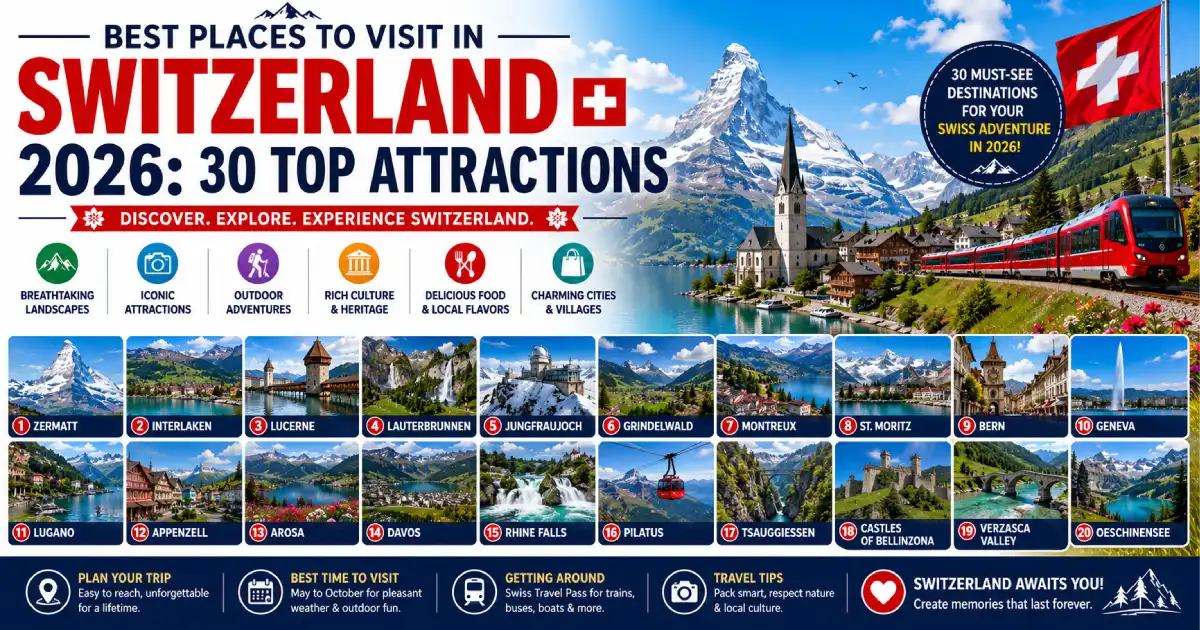
Switzerland compresses an extraordinary range of landscapes and cultural experiences into a country roughly the size of the Netherlands — the Bernese Oberland’s glacier-draped peaks (the Eiger, Mönch, and Jungfrau visible simultaneously from Grindelwald) rising above flower-meadow valleys, Lake Geneva’s Riviera-like southern shore where terraced vineyards meet the Alps across glittering blue water, the Rhine Falls thundering at Schaffhausen as Europe’s largest waterfall, and medieval old towns (Bern’s arcaded streets, Lucerne’s covered wooden bridge, Lausanne’s cathedral quarter) that have survived largely intact across six or eight centuries of continuous habitation. The best places to visit in Switzerland span the world’s most celebrated mountain railway (the Jungfraujoch rack railway to the “Top of Europe” at 3,454 meters), the cleanest urban lakes in Europe (Zurich’s Zürichsee and Lake Thun offering swimming from city center beaches in midsummer), chocolate and watch-making cultural heritage embedded in specific towns (Broc for Cailler, La Chaux-de-Fonds for watchmaking history), and the extraordinary efficiency of Swiss transportation infrastructure — the Swiss Travel Pass allows unlimited train, bus, and boat travel on a network so comprehensive that nearly every significant attraction is reachable without a rental car.
What distinguishes Switzerland from neighboring Alpine countries (Austria, France, Germany) is this transportation-enabled accessibility alongside extraordinary concentration of world-class experiences in a very small area — a visitor spending a week in Switzerland based in Lucerne can reach the Jungfraujoch, Lake Geneva, Zurich, the Rhine Falls, and the Glacier Express route by train without the logistical complexity that equivalent journeys through multiple European countries would require. The Swiss Travel Pass (available in 3, 4, 6, 8, or 15-day versions, purchasable outside Switzerland for non-residents) provides unlimited travel on virtually the entire Swiss public transport network including mountain railways, lake steamers, and panoramic rail routes — the single most important travel infrastructure decision for most Switzerland visitors, replacing rental cars and individual ticket purchases with a single daily cost that typically provides better value for visitors doing any meaningful amount of travel.
This guide covers the 30 best places to visit in Switzerland with practical details — travel logistics, seasonal considerations, entry costs, and insider tips — for 2026 visitors planning their first or return Swiss trip.
For complete guides, see our Best Time to Visit Switzerland 2026, Switzerland Travel Guide 2026, and Things to Do in Switzerland 2026 guides.
| Place | Region | Entry Cost | Best For | Best Season |
|---|---|---|---|---|
| Jungfraujoch | Bernese Oberland | CHF 160–220 (return) | High Alpine views, glacier | June–October |
| Lucerne | Central Switzerland | Free (city) | Medieval bridges, lake views | Year-round |
| Interlaken | Bernese Oberland | Free (base town) | Adventure sports, alpine gateway | Year-round |
| Zurich | German Switzerland | Free (city) | Art, culture, lakeside | Year-round |
| Grindelwald | Bernese Oberland | Free (village) | Alpine village, Eiger views | Year-round |
| Bern | German Switzerland | Free (city) | Medieval old town, bears | Year-round |
| Zermatt | Valais | Free (car-free village) | Matterhorn, skiing, hiking | Year-round |
| Lake Geneva / Geneva | Léman Region | Free (city) | Diplomacy, wine country, lakefront | Year-round |
| Lausanne | Léman Region | Free (city) | Olympic Museum, Gothic cathedral | Year-round |
| Montreux | Léman Region | Free (lakefront) | Jazz festival, Chillon Castle | May–October |
| Rhine Falls | Northern Switzerland | CHF 5 (viewing platform) | Europe’s largest waterfall | Spring–Fall |
| St. Moritz | Graubünden | Free (town) | Luxury resort, Engadine lakes | Year-round |
| Lugano | Ticino | Free (city) | Italian Switzerland, palm trees | April–October |
| Lauterbrunnen Valley | Bernese Oberland | Free (valley) | 72 waterfalls, cliff villages | May–October |
| Basel | Northwest Switzerland | Free (city) | Art Basel, Rhine swimming | Year-round |
| Chillon Castle | Lake Geneva | CHF 13.50 | Medieval castle on lake | Year-round |
| Glacier Express | Graubünden/Valais | From CHF 175 | Scenic panoramic railway | May–October |
| Mürren | Bernese Oberland | Free (car-free village) | Car-free cliff village, Schilthorn | May–October |
| Appenzell | Eastern Switzerland | Free (village) | Traditional culture, cheese | Year-round |
| Lake Thun & Lake Brienz | Bernese Oberland | Free (lake) | Turquoise lakes, boat trips | May–October |
| Schaffhausen | Northern Switzerland | Free (city) | Rhine Falls, medieval old town | Year-round |
| Wengen | Bernese Oberland | Free (car-free village) | Car-free alpine village, hiking | May–October |
| Locarno | Ticino | Free (city) | Film festival, lake swimming | May–October |
| Gruyères | Fribourg | CHF 6 (castle) | Cheese, medieval town | Year-round |
| Stein am Rhein | Northern Switzerland | Free (village) | Frescoed buildings, Rhine | April–October |
| Saas-Fee | Valais | Free (car-free village) | Glacier skiing, car-free village | Year-round |
| Chur | Graubünden | Free (city) | Switzerland’s oldest city | Year-round |
| Davos | Graubünden | Free (town) | World Economic Forum site, skiing | Year-round |
| Luzerner Fasnacht | Lucerne | Free | Wild carnival | February |
| Aarau | Aargau | Free (city) | Art, old town | Year-round |
Entry: CHF 160–220 round trip by rail (from Grindelwald or Lauterbrunnen) | Season: Year-round, best June–October | Journey: 2 hours each way from Interlaken | Altitude: 3,454 meters (11,332 feet)
Jungfraujoch is the highest railway station in Europe and one of the most remarkable engineering achievements in the world — a rack-and-pinion railway (the Jungfrau Railway, completed 1912 after 16 years of construction) bored through the interior of the Eiger and Mönch mountains to emerge at a saddle between the Mönch and Jungfrau peaks at 3,454 meters altitude, where the Sphinx Observatory, Aletsch Glacier viewing terrace, Ice Palace (carved tunnels within the glacier itself), and the “Top of Europe” experience platform deliver genuinely extraordinary high-altitude environments to visitors who need no mountaineering skill or equipment to reach them. The Aletsch Glacier (visible from the Jungfraujoch viewing terrace) is the longest glacier in the Alps — 23 kilometers of ice descending southward through a U-shaped valley in a visual demonstration of glacial scale that photographs only partially convey.
The journey to Jungfraujoch itself is as remarkable as the destination — the route from Interlaken Ost (or directly from Grindelwald and Lauterbrunnen) passes through classic Bernese Oberland scenery on the way to Kleine Scheidegg (the junction at 2,061 meters where the Jungfrau Railway begins its tunnel ascent), with views of the Eiger’s north face — the most technically demanding wall in the Alps, whose first ascent in 1938 remains one of climbing history’s most significant achievements — visible from the train windows.
Insider tips: Clear weather is the single most important factor in a Jungfraujoch visit — arriving on an overcast day produces an experience of standing in thick cloud at altitude with no views, which is a very expensive disappointment. Check the Jungfrau Railway website’s live weather cameras (available at jungfrau.ch) in the days before visiting, and book flexible tickets (slightly more expensive but refundable/changeable if weather deteriorates) rather than fixed-date tickets that commit to a specific day regardless of conditions. The “Good Morning Ticket” (available for the first train departure of the day) provides a meaningful discount over standard prices, rewarding early risers with both savings and the best chance of pre-cloud-buildup visibility.
Entry: Free (city) | Getting there: Direct trains from Zurich (48 min), Bern (70 min), Basel (60 min) | Best Time: Year-round; February (Fasnacht carnival) unique
Lucerne is Switzerland’s most photographed city — the Chapel Bridge (Kapellbrücke, a 14th-century wooden covered bridge crossing the Reuss River, the oldest preserved wooden bridge in Europe and the most photographed single structure in Switzerland), Lake Lucerne’s deep blue surface reflecting the surrounding pre-Alps, the medieval Musegg Wall (a well-preserved stretch of 14th-century city fortifications with nine intact towers, several climbable for lake and mountain views at no charge), and the backdrop of Mount Pilatus and Mount Rigi across the lake create a visual environment that consistently delivers more than its travel-brochure reputation promises.
The city’s compactness makes it walkable in a single day — the Chapel Bridge to the Old Town (Altstadt) crosses in minutes, the Lion Monument (Löwendenkmal, a dying lion carved into a natural rock face commemorating the Swiss Guards killed during the French Revolution’s 1792 Tuileries Palace storming) is a 10-minute walk from the bridge, and the Old Town’s painted facades, guild halls, and the Spreuerbrücke (a second historic covered bridge containing a series of 17th-century paintings of the Dance of Death) are navigable by foot without maps. The nearby Museum of Transport (Verkehrshaus, Switzerland’s most visited museum, covering Swiss transport history from trains to space exploration with hands-on exhibits) and the Rosengart Collection (Picasso, Klee, and other 20th-century masterworks in a compact private museum) extend a Lucerne visit into full-day territory.
Insider tips: The Chapel Bridge’s interior panels (paintings depicting Swiss history originally installed in the 17th century, largely destroyed in a 1993 fire and subsequently replaced with reproductions of the originals) are easily overlooked by visitors walking across without looking up — taking 10 minutes to walk the bridge slowly while reading the panel images rewards the attention with genuinely interesting historical content. The Luzerner Fasnacht (Lucerne Carnival, the days before Ash Wednesday, typically February) transforms the city into one of Europe’s most spectacular and least-touristy carnivals — a specifically Swiss event with deep local roots quite different from the Italian-influenced Carnivals of Basel or Venice.
Entry: Free (town) | Getting there: Direct trains from Bern (50 min), Zurich (2 hrs), Basel (90 min) | Best Time: May–October for hiking; December–March for skiing
Interlaken functions as the Bernese Oberland’s primary gateway town — sitting literally between two lakes (Inter-laken: “between lakes” in Latin, positioned between Lake Thun to the west and Lake Brienz to the east) at the foot of the Bernese Alps, with the Eiger, Mönch, and Jungfrau visible at the end of the Höheweg promenade on clear days in a mountain panorama that draws visitors specifically to this viewpoint. The town itself serves tourism rather than providing a genuinely preserved historic environment (unlike Lucerne or Bern) — most visitors use Interlaken as a base from which to access the surrounding Bernese Oberland’s hiking, skiing, and scenic railway experiences rather than as a destination in itself.
The adventure sports industry centered on Interlaken (paragliding, skydiving, canyoning, white-water rafting, bungee jumping, and various other adrenaline activities operating throughout the surrounding landscape) has made the town a specific destination for thrill-seekers — Interlaken hosts more adventure sport operators per capita than virtually any comparable European town, and the surrounding landscape (glacial rivers, canyon formations, mountain airspace) provides terrain for every category of adrenaline activity.
Insider tips: Interlaken’s two train stations (Interlaken West and Interlaken Ost) serve different valley directions — trains to Grindelwald and Lauterbrunnen (for Jungfraujoch access) depart from Interlaken Ost, while trains to Thun and Bern depart from both but primarily Interlaken West. Arriving at the wrong station for onward connections is the most common logistics mistake for first-time Interlaken visitors — confirming specific platform and station for each connection avoids this.
Entry: Free (city) | Getting there: Major international airport (ZRH), direct trains throughout Switzerland | Best Time: Year-round; December (Christmas markets); July (Street Parade)
Zurich is simultaneously Switzerland’s largest city (approximately 440,000 residents in the city proper, 1.4 million in the metropolitan area) and its cultural capital — the Kunsthaus Zürich (Switzerland’s most significant art museum, recently expanded with a major new building housing one of Europe’s largest Giacometti collections alongside Monet, Munch, Picasso, and extensive contemporary holdings), the Swiss National Museum (in a castle-like building adjacent to the main train station, covering Swiss cultural history comprehensively), the Zürich Opera House (among Europe’s most respected opera companies), and a gallery district (Löwenbräu-Areal, a converted brewery complex housing multiple contemporary art galleries and the Migros Museum für Gegenwartskunst) that makes Zurich one of the significant contemporary art markets globally.
The city’s lakeside location (the Zürichsee extending south from the city, with passenger lake steamers, swimming areas, and sunset viewpoints along the shore) and the Old Town’s (Altstadt) preserved medieval and Baroque architecture (the twin-towered Grossmünster cathedral where Zwingli launched the Protestant Reformation in 1519, the Fraumünster with Marc Chagall-designed stained glass windows, and the Lindenhügel hill providing the city’s best Old Town overview) create an urban environment that rewards exploration beyond the financial and luxury-retail reputation that often defines Zurich’s international image.
Insider tips: The Zürichsee swimming (Badis — traditional lakeside swimming facilities, the most famous being the Seebad Utoquai and the Frauenbadi and Männerbadi near the city center) is one of Europe’s genuinely extraordinary urban swimming experiences — crystalline lake water warm enough for comfortable swimming July–September, within minutes of central Zurich, at minimal cost (CHF 5–8 entry). Swimming in the Limmat River (which flows through the Old Town from the lake) is also common among locals and perfectly safe during summer — the Flussbad Oberer Letten is a popular Limmat swimming facility a 15-minute walk from the main station.
Entry: Free (village) | Getting there: Train from Interlaken Ost (35 min) | Best Time: June–October (hiking), December–March (skiing)
Grindelwald is the Bernese Oberland’s most famous alpine village — a community of approximately 4,000 permanent residents set in a high valley directly below the Eiger’s north face, surrounded by the full Bernese Alps panorama (Wetterhorn to the east, Schreckhorn above the Oberer Grindelwaldgletscher, and the Eiger-Mönch-Jungfrau trio dominating the valley’s southern skyline), providing a base for hiking, skiing, and mountain railway access that has drawn visitors since the 19th century when British alpinists first established the village as a mountain tourism destination.
The Eiger Express gondola (opened 2020, one of the fastest cable car systems in the Alps) connects Grindelwald to the Eiger Glacier station at 2,320 meters in under 15 minutes — dramatically reducing travel time to the Jungfraujoch while providing remarkable close-range views of the Eiger’s lower face. The First gondola (ascending to 2,168 meters, with the First Cliff Walk — a metal walkway bolted to the cliff face offering exposure and views that genuinely startle visitors accustomed to normal mountain viewing platforms) and the surrounding hiking network (over 300 kilometers of marked trails at various difficulty levels) provide full-day outdoor activity for visitors across a wide fitness spectrum.
Insider tips: Grindelwald’s First Cliff Walk (accessed via the First gondola, CHF 36–42 one-way) requires about 30 minutes of walking from the gondola station to the cliff walkway itself — the walkway’s glass-floored section and cliff-edge exposure create a visceral experience of alpine heights that standard mountain viewpoints don’t replicate. The village itself (below the gondola infrastructure, in the valley-floor residential and commercial area) provides far more authentic Swiss alpine village character than Interlaken — staying in Grindelwald rather than Interlaken provides significantly better Alpine-village immersion for visitors whose priority is experiencing the mountain environment rather than urban amenities.
Entry: Free (city) | Getting there: Direct trains from Zurich (58 min), Geneva (1 hr 45 min), Basel (55 min) | Best Time: Year-round; November–December for Onion Market
Bern serves as Switzerland’s federal capital (hosting the Federal Parliament in the Bundeshaus, visible from the rose garden overlook on the Rosengarten hill northeast of the Old Town) while maintaining a medieval core so comprehensively preserved that UNESCO designated it a World Heritage Site in 1983 — the 6 kilometers of arcaded sandstone walkways (Lauben) that line the Old Town’s main streets, providing covered pedestrian infrastructure in rain and snow that dates from the 12th-century city founding, create the most unusual streetscape of any Swiss city and one of the most distinctive in Europe. The arcades (covered on three sides, open to the street, lining every major commercial street in the Old Town) mean Bern is genuinely one of the most walkable cities in Europe regardless of weather — an attribute that transforms a rainy day from a disappointment into a different kind of pleasure.
The Old Town’s major sites include the Bern Münster (Switzerland’s largest Gothic cathedral, with a carved Last Judgment portal, the highest church tower in Switzerland at 100 meters with a spiral staircase climbable for panoramic views, and a carved choir that remained in construction for nearly two centuries), the Zytglogge (a 13th-century clock tower whose astronomical clock mechanism performs an animated display 4 minutes before each hour), and the BärenPark (Bern’s bear park on the banks of the Aare — live bears have been kept in Bern since 1513, the bear being the city’s heraldic symbol, with the current riverside park providing a more natural habitat than the previous bear pit). The Einstein Museum (in the building where Albert Einstein lived 1903–1905 while developing the Special Theory of Relativity — “the miracle year” of 1905 produced five papers that transformed physics) provides an unexpected scientific pilgrimage.
Insider tips: The Rose Garden (Rosengarten) overlook — a 10-minute walk from the Old Town, free to access — provides the most frequently reproduced aerial view of Bern’s Old Town: the Aare river bending in an almost-complete loop around the medieval peninsula with the cathedral and Bundeshaus visible within it, all set against the snow-capped Bernese Alps when conditions are clear. This is one of Switzerland’s best “free view” photography locations and entirely unknown to many visitors who spend their Bern time within the Old Town without ascending to this overlook.
Entry: Free (car-free village) | Getting there: Glacier Express or Matterhorn Gotthard Bahn from Visp or Brig (direct trains from Geneva, Zurich, and Bern via Visp) | Best Time: June–October (hiking), December–April (skiing)
Zermatt is the most internationally famous Alpine resort village in the world — a car-free mountain town at 1,608 meters altitude, accessible only by train (the last private cars must be left in Täsch, 5 kilometers below, in the largest paid parking structure in Switzerland), dominated visually by the Matterhorn (4,478 meters, the most photographed mountain in the Alps and arguably in the world) whose distinctive pyramidal summit visible from the village below produces a specific visual jolt even for visitors who’ve seen the image thousands of times before experiencing it in person. The Matterhorn’s perfectly symmetrical four-ridged profile (visible from Zermatt’s main street and from dozens of viewpoints in the surrounding valley) has made it Switzerland’s single most powerful visual symbol globally, appearing on Toblerone chocolate packaging and countless Swiss tourism materials for generations.
The surrounding mountain environment (the area’s “four-thousanders” — peaks exceeding 4,000 meters — number 38, more than in any comparable area of the Alps) provides extraordinary hiking terrain in summer, with trails ranging from the easy Five Lakes Walk (Fünf-Seen-Wanderung, 9.6 kilometers, connecting five alpine lakes each reflecting the Matterhorn at different angles, marked trails, no technical skill required, one of the most beautiful half-day hikes in Europe) to the technically demanding approach routes used by mountaineers making guided ascents of the Matterhorn itself.
The Matterhorn Glacier Paradise (the highest cable car station in Europe, at 3,883 meters, accessible from Zermatt via a series of cable car connections, CHF 100+ round trip) and the Gornergrat rack railway (3,089 meters, providing the most spectacular front-on Matterhorn view available without mountaineering, CHF 55–95 return depending on season) represent the primary “high altitude” visitor experiences above the village.
Insider tips: The Matterhorn’s famous appearance at sunrise (when alpenglow — the pre-sunrise reddish illumination of the summit before direct sunlight reaches the valley) is most dramatically experienced from the area of Ried (a short walk or taxi from central Zermatt), where the mountain faces directly east-northeast and catches the first light without intervening terrain blocking the sunrise effect. Set an alarm — the light quality window is 15–20 minutes and the Matterhorn’s extraordinary color during alpenglow doesn’t last.
Entry: Free (city and lakefront) | Getting there: Direct trains from Zurich (2 hrs 45 min), Bern (1 hr 45 min); Geneva Airport (GVA) is Switzerland’s second international hub | Best Time: Year-round; summer for lakeside activities
Lake Geneva, the largest lake in Western Europe (582 square kilometers, shared between Switzerland and France), provides the setting for Switzerland’s French-speaking region’s most spectacular scenery — the Arc Lémanique (the arc of lakeside towns from Geneva through Lausanne, Montreux, and the Lavaux vineyard terraces) combining Alpine foothills dropping directly to the lake’s northern shore with the permanent snow-capped peaks of the French Alps (including Mont Blanc, visible on clear days from multiple lakeside viewpoints) across the water to the south. The lake’s intense blue-green color (produced by exceptional water clarity and depth) and the terraced vineyards of the Lavaux UNESCO wine region (hillside vineyards planted since the 12th century, requiring hand cultivation on terraces that make mechanization impossible) create one of Europe’s most consistently photographed landscapes.
Geneva itself (the lake’s western anchor, Switzerland’s second-largest city) offers the Palais des Nations (UN European headquarters, guided tours available, CHF 15), the Jet d’Eau (the 140-meter water jet that has become Geneva’s visual symbol, shooting lake water 140 meters into the air from a pier near the city center), the Old Town’s St. Pierre Cathedral (where Calvin preached the Reformation), and the International Red Cross and Red Crescent Museum (one of Switzerland’s most moving museum experiences, covering the history of humanitarian aid) alongside the luxury watchmaking and private banking infrastructure that sustains the city’s specific international identity.
Insider tips: The lake steamer service (CGN — Compagnie Générale de Navigation, included in the Swiss Travel Pass) provides the most atmospheric way to travel between Geneva, Lausanne, and Montreux rather than by train — the lake crossing takes longer than rail but offers deck views of the Lavaux vineyards and French Alps that the train’s inland routing doesn’t provide. The Geneva–Montreux lake route (approximately 3.5 hours, with multiple intermediate stops) is one of Switzerland’s most beautiful lake journeys and fully included with the Swiss Travel Pass.
Entry: Free (city) | Getting there: Direct trains from Geneva (35 min), Zurich (2 hrs 10 min), Bern (1 hr 10 min) | Best Time: Year-round; best April–October for outdoor activities
Lausanne occupies a hillside position above Lake Geneva (its lower town, the Ouchy lakefront, sitting approximately 60 meters below the upper city center — connected by Metro, Switzerland’s smallest metro system) that creates a multi-layered urban environment unusually varied for a Swiss city of its size. The Gothic Cathedral of Notre-Dame (completed 1275, consecrated by Pope Gregory X in the presence of Rudolf of Habsburg — one of the most historically significant Gothic cathedrals in Switzerland, with a fully functioning nightwatch tradition maintained since 1405: a watchman calls out the hours from 10 PM to 2 AM nightly from the cathedral tower) and the historic Old Town’s market square dominate the upper city, while the Ouchy lakefront provides promenades, the Olympic Museum (the International Olympic Committee is headquartered in Lausanne, and the Olympic Museum, CHF 20, provides the most comprehensive exhibition of Olympic history globally), and direct lake-steamer access to the broader Lac Léman region.
The Lausanne Underground Art Scene (the graffiti-covered Flon district, once a freight depot now converted to bars, clubs, galleries, and independent retailers) and the Fondation de l’Hermitage (a 19th-century villa housing rotating fine art exhibitions, CHF 18) extend Lausanne’s cultural range beyond its cathedral and Olympic identity.
Insider tips: The Lausanne Cathedral’s night watch (the watchman calling “C’est le guet” from the tower at 10 PM, 11 PM, midnight, 1 AM, and 2 AM, announcing the hour and the fact that all is well — a tradition maintained without interruption since 1405) is one of Switzerland’s most quietly remarkable living traditions, easily experienced from the cathedral square by visitors whose evening schedule includes being in Lausanne after 10 PM.
Entry: Free (lakefront); Chillon Castle CHF 13.50 adults | Getting there: Trains from Geneva (50 min), Lausanne (20 min) | Best Time: May–October; Jazz Festival (July)
Montreux, the “Swiss Riviera” town on Lake Geneva’s eastern shore, combines the lake’s most dramatic scenery (the narrowing lake perspective toward the Rhône valley and the high Alps above Villeneuve and Chillon), the world-famous Montreux Jazz Festival (held annually in early July since 1967, drawing international artists and 200,000+ visitors across two weeks, with free outdoor concerts alongside ticketed indoor performances), and the Château de Chillon (Chillon Castle, a 13th-century island fortress connected to the lakeshore by a causeway, one of the best-preserved medieval castles in Europe and the site that inspired Byron’s “The Prisoner of Chillon” after his 1816 visit).
Chillon Castle’s island position (built on a natural rock in the lake, with the castle walls rising directly from the water on three sides) creates a dramatically photogenic lakeside silhouette visible from Montreux’s shore promenade — the views across the castle from the lakeside path at golden hour are among the most frequently photographed compositions in Switzerland. The interior (accessible via the CHF 13.50 admission) covers the castle’s complete architectural history from its 12th-century origins through its role as residence for the Counts of Savoy and its eventual incorporation into the Swiss Confederation.
Insider tips: The lakeside path from Montreux to Chillon (approximately 3.5 kilometers each way, entirely flat, following the lake edge through the Victorian-era resort development between the two destinations) is one of Switzerland’s most pleasant short walks — the combination of lake views, mountain backdrop, flowering rose gardens along the promenade, and Chillon Castle appearing progressively larger as you approach from the north creates a walking experience that rewards the minimal time and zero cost relative to the train alternative.
Entry: Free (valley floor); cable cars additional | Getting there: Train from Interlaken Ost (22 min) | Best Time: May–October
Lauterbrunnen Valley is one of the most visually extraordinary geological formations in Europe — a glacier-carved U-shaped valley 300 meters deep with near-vertical cliff walls on both sides, hosting 72 named waterfalls (including the Staubbachfall, a 297-meter free-falling waterfall dropping directly from the cliff edge above the village, the third highest waterfall in Switzerland and visible from the valley floor) and the car-free cliff villages of Mürren (on the western cliff) and Wengen (on the eastern slope), accessible only by cable car and mountain railway respectively. The valley’s depth and orientation (north-south, with direct sunlight reaching the valley floor only briefly around midday) creates specific atmospheric conditions — mist rising from waterfalls, the thundering sound of the Trümmelbach Falls (glacial meltwater waterfalls inside the mountain, accessible via a tunnel and elevator, CHF 13), and the perpetual sense of geological drama that makes Lauterbrunnen consistently cited as among Switzerland’s most memorable single destinations.
Insider tips: Arriving in Lauterbrunnen from Interlaken on a clear morning provides the strongest single first impression in Switzerland’s travel experience — the train emerges from relatively gentle Interlaken valley into the sudden, dramatic walls of the Lauterbrunnen cliffs with waterfalls visible immediately in multiple directions. Plan for the arrival to occur in morning light (not after dark) to experience this introduction fully.
Entry: Free (village) | Getting there: Cable car from Lauterbrunnen + BLM mountain railway (CHF 8–12 each way) | Best Time: June–October, December–March | Altitude: 1,638 meters
Mürren, a car-free mountain village of approximately 500 permanent residents perched on the western cliff above Lauterbrunnen Valley, provides the most dramatic village-level view of the Eiger-Mönch-Jungfrau trio available from inhabited terrain — the village’s position on the cliff edge, directly facing the massive three-peak panorama across the valley, creates a visual immersion impossible from valley floor or summit positions. The Schilthorn (2,970 meters, accessible via cable car, CHF 70+ return), site of the 360-degree Piz Gloria revolving restaurant (a James Bond filming location — “On Her Majesty’s Secret Service” 1969 — with a Bond World 007 exhibition) sits above Mürren as its primary uplift destination.
The village itself (wooden chalets, narrow lanes, zero vehicles) provides the most authentically Swiss alpine village experience in the Bernese Oberland — significantly less developed for tourism than Grindelwald and significantly more characterful than Wengen, making it the best choice among the three car-free Bernese Oberland villages for visitors prioritizing alpine village atmosphere alongside mountain access.
Insider tips: Mürren is accessible from both Lauterbrunnen (cable car to Gimmelwald + trail or Mürren-BLM railway) and Stechelberg (cable car direct to Schilthorn, stopping at Mürren on the way) — the Stechelberg approach provides a less-used access route that reduces crowding on the cable car during peak summer weekends. Staying overnight in Mürren (several small hotels and guesthouses) provides the experience of the village after the day visitors return to Interlaken — evening light on the Jungfrau across the valley, with the village’s complete silence (no cars, no through traffic), is among Switzerland’s most distinctive overnight experiences.
Entry: From CHF 175 second class, Zermatt to St. Moritz (or reverse); Seat reservation CHF 13–49 additional | Duration: 7 hours 45 minutes full journey | Season: Daily year-round; panoramic dining car available | Book: Advance reservation required (especially summer)
The Glacier Express (marketed as “the world’s slowest express train”) traverses one of Switzerland’s most extraordinary railway routes — 291 kilometers from Zermatt in the Valais through the Andermatt junction (at the roof of Switzerland, crossing the Oberalp Pass at 2,033 meters, the highest point on the route) through Graubünden’s Surselva region and the Engadine Valley to St. Moritz, crossing 291 bridges and passing through 91 tunnels in a journey through alpine landscapes of extraordinary variety. The panoramic rail cars (floor-to-ceiling curved windows) provide viewing comfort unmatched by standard rail carriages, while the dining car service (lunch included in some ticket tiers) adds to the experience of spending nearly 8 hours on a single train journey without feeling time wasted.
The route’s most dramatic section (the Landwasser Viaduct near Filisur — a curved limestone viaduct that carries the railway 65 meters above the Landwasser River in a single graceful arc, one of the most photographed railway structures in the world) and the Oberalp Pass crossing (open snowfields in winter, dramatic mountain panoramas year-round) provide the two most significant photographic moments of the journey.
Insider tips: The Glacier Express is included in the Swiss Travel Pass (with mandatory seat reservation, CHF 13–49 additional) — significantly reducing the cost for Swiss Travel Pass holders relative to individual ticket purchase. Traveling the route west-to-east (Zermatt to St. Moritz) versus east-to-west has no particular photography advantage — the landscapes are equally spectacular in both directions. However, sitting on the right side of the train (facing the direction of travel) provides better views of the Landwasser Viaduct when traveling eastbound (Zermatt direction), while sitting on the left provides better views traveling westbound.
Entry: Free (town) | Getting there: Glacier Express from Zermatt (7 hrs 45 min) or Bernina Express from Tirano, Italy; direct trains from Zurich (3 hrs) | Best Time: December–April (skiing), June–September (hiking and summer luxury)
St. Moritz, the Engadine Valley’s most internationally recognized resort town, has hosted the Winter Olympics twice (1928 and 1948) and maintains its position as one of the most exclusive winter resort destinations in Europe — a combination of exceptional skiing terrain (the Corviglia and Corvatsch ski areas covering significant vertical and variety), extraordinary winter sunlight (the Engadine’s high-altitude position, approximately 1,800 meters, produces the reliable winter sunshine that the resort has marketed as “champagne climate” for over 150 years), and luxury hospitality infrastructure (the Badrutt’s Palace Hotel, the Kulm Hotel where St. Moritz tourism originated, and various other five-star properties) that has attracted wealthy international visitors since the 19th century. The town’s smaller summer season (hiking, lake swimming in Lakes Champfèr, Silvaplana, and Sils — the Engadine chain, turquoise-green with glacial meltwater), cycling, and high-altitude outdoor recreation) provides an equally compelling but significantly less crowded alternative to the winter peak.
Insider tips: The Engadine Valley itself (the broader Upper Inn River valley within which St. Moritz sits, extending west to Maloja and east toward Pontresina) provides exceptional landscape and hiking independent of St. Moritz’s resort infrastructure — the village of Sils Maria (19 kilometers west, where Nietzsche spent 7 consecutive summers and conceived Zarathustra, with a small Nietzsche museum in his former residence) and the Maloja Pass (dramatic descent from the Engadine plateau toward the Italian border) extend any St. Moritz visit into the broader valley without requiring resort prices for accommodation.
Entry: Free (city) | Getting there: Direct trains from Zurich (56 min), Bern (55 min), Geneva (2 hrs 45 min); Basel connects to Germany and France directly | Best Time: Year-round; Art Basel (June) internationally significant
Basel occupies a unique position in Swiss geography and culture — a city divided between three countries (the Rhine River separating Swiss Basel from German Weil am Rhein, while Basel-Mulhouse Airport serves France and is technically on French territory), hosting the world’s most important contemporary art fair (Art Basel, June annually, 93,000 visitors, 290 galleries from 35 countries), and maintaining one of Switzerland’s finest museum collections in a smaller, more manageable urban environment than Zurich or Geneva. The Kunstmuseum Basel (Switzerland’s oldest public art museum, with collections spanning Holbein the Younger’s definitive portrait collection through 20th-century European masters) and the seven additional art museums within walking distance of the Old Town create a density of museum quality per square kilometer matched by very few cities in Europe.
The Rhine swimming — Basel’s most distinctive summer activity, in which residents float downstream in the Rhine River carried by current, from city-center bathing establishments to downstream exit points (traditional waterproof bags, the “Wickelfisch,” keep clothes and valuables dry during the float) — represents one of Europe’s most unusual and most genuinely participatory urban outdoor experiences, something that exists essentially nowhere else in a comparable major European city.
Insider tips: The Rhine ferry crossings (Fähren, small cable ferries running between the Basel Rhine banks on cables rather than engines, propelled solely by the river current against angled hulls) cross the Rhine in the Old Town area for CHF 1.60 per person — a genuinely unique transportation mode that works through pure hydrodynamics. The four Rhine ferries in Basel are among the last cable ferries operating in a major European city.
Entry: CHF 5 (viewing platforms); viewpoints from Swiss side free | Getting there: Train to Schaffhausen, then bus or short train to Neuhausen am Rheinfall | Best Time: May–July (highest water levels after alpine snowmelt)
The Rhine Falls (Rheinfall), located near Schaffhausen in northern Switzerland, constitutes the largest waterfall in Europe by water volume (at peak flow, approximately 600 cubic meters per second — comparable to Niagara Falls in flow dynamics if not in height) — the Rhine River dropping approximately 23 meters over a 150-meter-wide rocky outcropping in a thundering, mist-producing display that manages to feel genuinely powerful rather than merely picturesque even for visitors who’ve seen it in photographs. The falls are accessible from both the Zurich Unterland north shore (where Schloss Laufen castle sits directly above the falls’ right bank, with a series of descending viewing platforms, CHF 5 fee, reaching river level where the mist is heaviest) and the Neuhausen side (Schlösschen Wörth, a small castle on a rock island in the middle of the falls, reachable by a tourist boat service operating in peak season).
Insider tips: The timing of Rhine Falls visits significantly affects the water volume and dramatic impact — spring snowmelt (May–July) produces the highest water flows and most spectacular display, while late summer (August–September) can reduce volume to a fraction of peak-season levels. The falls are illuminated on Friday evenings during summer for “Night Falls” events — a genuinely striking light display on the water, with additional ticketing.
Entry: Free (village) | Getting there: Train from Zurich via St. Gallen (approximately 1.5 hours), or Appenzell Bahnen from St. Gallen directly | Best Time: Year-round; Landsgemeinde (April/May) unique
Appenzell, the capital of the Appenzell Innerrhoden half-canton (Switzerland’s smallest and most conservative canton — the last to grant women voting rights at cantonal level, in 1990 only after a Federal Supreme Court ruling), represents Switzerland’s most vivid concentration of traditional culture — elaborate painted facades on the main square’s buildings, the Landsgemeinde (an open-air cantonal parliament meeting held annually in the main square in late April or early May, where citizens vote by show of hands on cantonal matters in a tradition dating to 1378 and one of the oldest forms of direct democracy still practiced in Europe), Appenzell embroidery (a specific needlework tradition still practiced locally), and the specific cheese culture (Appenzeller cheese, with a secret herbal brine recipe unchanged since the 13th century, produced exclusively within a defined geographic area surrounding the village).
The Appenzell hiking landscape (the Alpstein massif, dominated by the Säntis peak at 2,502 meters, visible from the village and accessible via cable car from nearby Schwägalp) provides some of eastern Switzerland’s most rewarding trail networks, while the Wildkirchli (a hermit chapel in a cave inside the Alpstein, accessible via an hours-long hike) represents Switzerland’s most unusual religious site.
Insider tips: The Landsgemeinde in Appenzell (typically the last Sunday in April — check the specific year’s date) is one of Europe’s most remarkable civic events and one that draws almost exclusively European visitors rather than international tourists — arriving in Appenzell specifically for this event and finding the main square filled with canton residents voting in traditional dress by raised hands provides an experience of genuine Swiss direct democracy at its most visually distinctive.
Entry: Free (city) | Getting there: Direct trains from Zurich (2 hrs 15 min), from Milan Centrale (80 min) | Best Time: April–October | Language: Italian
Lugano, the largest city in Italian-speaking Switzerland (Ticino canton), provides the most striking evidence of Switzerland’s internal cultural diversity — an Italian-feeling lakeside city (palm trees, gelato, cappuccino culture, piazzas rather than Plätze) at the foot of Monte San Salvatore and Monte Brè, on a lake (Lago di Lugano) that straddles the Swiss-Italian border, providing Mediterranean atmosphere within the Swiss legal and logistical framework that makes it simultaneously more organizationally reliable and more expensive than comparable Italian Riviera destinations.
The city’s lakefront promenade (Lungolago), the Parco Civico (the lakefront park between the train station and the old town, with tropical plantings including multiple palm tree species), and the funiculars ascending Monte San Salvatore (CHF 22 return, panoramic lake and Alps views) and Monte Brè (CHF 26 return, the sunniest mountain in Switzerland by annual sunshine hours) create a specific resort atmosphere that distinguishes Lugano from German-speaking Switzerland’s more restrained urban environments.
Insider tips: The boat service on Lago di Lugano (included in the Swiss Travel Pass) provides the most atmospheric access to the lake’s surrounding villages — Gandria (an Italian-feeling fishing village with no road access, only water or footpath), Morcote (regularly cited as one of Switzerland’s most beautiful villages, with a stepped village center and a Romanesque church overlooking the lake), and the Italian-territory enclave of Campione d’Italia (technically Italy, requiring passport but Euros and Italian law) are all accessible by lake steamer from Lugano.
Entry: Free (walking the terraces); wine tastings at individual cellars vary | Getting there: Train stops at Cully, Epesses, Rivaz (between Lausanne and Vevey) | Best Time: September–October (harvest); May–June (flowering vines)
The Lavaux vineyard terraces (UNESCO World Heritage Site since 2007) extend approximately 30 kilometers along Lake Geneva’s northern shore between Lausanne and Montreux — a continuous band of hillside viticulture on terraced plots that have been maintained since the 12th century, when Cistercian and Benedictine monks first established systematic wine production here, with the terraces’ stone-wall construction representing over 800 years of continuous agricultural engineering. The specific Chasselas variety (the dominant white grape of the Lavaux, producing Switzerland’s most distinctive wines — floral, mineral, with a specific “goût de terroir” that Swiss wine enthusiasts describe as unmistakably Lavaux) is cultivated on terraces so steep that mechanization is impossible, maintaining hand-cultivation methods that have persisted unchanged for centuries.
The Lavaux walking path (clearly marked trail running through the vineyard terraces between villages, providing close-range access to the vines and Lake Geneva views that winery roads don’t offer) provides one of Switzerland’s most rewarding half-day hikes — not physically demanding, but visually extraordinary in a way that combines wine-culture immersion with one of Europe’s most distinctive agricultural landscapes.
Insider tips: The harvest season (mid-September to mid-October, varying by year based on weather conditions) provides the Lavaux at its most actively inhabited — harvest teams working the steep terraces, cellar doors open for immediate tastings of the just-pressed juice, and the specific wine-harvest atmosphere that the vineyards’ management organization (the Cave de la Côte and individual domaine operators) celebrates with organized harvest events during this period.
Entry: Free (city) | Getting there: Direct trains from Zurich (70 min), from St. Moritz (Glacier Express route, 2 hrs) | Best Time: Year-round
Chur, the capital of Graubünden canton (Switzerland’s largest, most linguistically diverse canton, where German, Romansh, and Italian are all official languages), holds the distinction of being Switzerland’s oldest continuously inhabited settlement — evidence of human habitation stretching back approximately 13,000 years, with the specific town center dating to Celtic and Roman periods. The Old Town (pedestrianized, centered on the Postplatz and Regierungsplatz) contains the Cathedral of the Assumption (a 12th–15th century building incorporating Romanesque and Gothic elements, the most historically significant religious building in Graubünden, housing a painted Gothic altarpiece from 1491 considered one of the finest of its type in Switzerland) and the Raetian Museum (Rätisches Museum, covering Graubünden’s archaeological and cultural history from pre-Roman through modern periods, in a 17th-century building).
Insider tips: Chur functions primarily as a transit hub for Graubünden (connecting to the Glacier Express, Bernina Express, and various regional rail routes into the canton’s mountain communities) rather than a primary destination — but the Old Town’s historical depth (genuinely 2,000+ years of urban continuity visible in the street pattern and building archaeology) rewards a 2–3 hour stop between connections rather than treating it purely as a railway junction.
Entry: CHF 6 (castle) | Getting there: Train from Fribourg (25 min) or Lausanne (45 min), then bus or narrow-gauge railway from Bulle | Best Time: Year-round; spring and fall most pleasant
Gruyères (distinct from Gruyère, the cheese — the village name has an accent, the cheese doesn’t) is a medieval hilltop village of extraordinary charm — a single main street of medieval buildings (the village has a population of approximately 2,000 in the commune but the fortified historic core is far smaller) culminating in the 11th-century Château de Gruyères (a remarkably well-preserved castle housing period furniture and a comprehensive history of the counts of Gruyères, CHF 12 adults) and surrounded by the rolling green hills of the pre-Alps whose milk production makes Gruyère cheese (AOP designation, produced only in a specific geographic area centered on this village) the most globally recognized Swiss cheese.
The La Maison du Gruyère cheese dairy (in Pringy, immediately below the village, combined admission packages available) allows visitors to observe the cheese-making process (live in the morning, when milk arrives from surrounding farms and the daily production is visible through viewing windows) alongside a comprehensive explanation of Gruyère cheese’s specific production method, aging process, and tasting stations.
Insider tips: The HR Giger Museum (in the village’s medieval castle complex, CHF 12.50) provides one of Switzerland’s most unexpected cultural juxtapositions — the Swiss surrealist artist HR Giger (designer of the Alien creature and Oscar winner for visual effects) maintained a museum in this medieval hilltop village, displaying his characteristically dark biomechanical artworks in medieval stone rooms that create a genuinely surreal contrast. The adjacent HR Giger Bar (decorated entirely in Giger’s signature aesthetic — chairs designed to look like vertebrae, tables resembling xenomorph skulls) is one of Switzerland’s most distinctive dining experiences purely for environmental immersion.
Entry: Free (city) | Getting there: Direct trains from Zurich (2 hrs 30 min), Lugano (40 min) | Best Time: May–October; Locarno Film Festival (August)
Locarno, at the northern tip of Lake Maggiore (the lake shared between Switzerland and Italy, with the Swiss portion in Ticino canton’s far south), experiences a climate so mild by Swiss standards that camellias, magnolias, and azaleas bloom in the city’s parks in early spring — a Mediterranean character reinforced by the old town’s arcaded Piazza Grande (one of Switzerland’s largest covered piazzas, which transforms each August into the Locarno Film Festival’s outdoor cinema venue, a 7,500-seat screen in the open piazza, one of the world’s most distinctive film festival settings).
The Madonna del Sasso (a pilgrimage church above the city, accessible by funicular or footpath, providing views down over Locarno and Lake Maggiore that constitute the region’s most frequently photographed single perspective) and the boat service on Lake Maggiore (reaching the Brissago Islands — two small islands in the Swiss portion of the lake, housing a remarkable subtropical botanical garden within the lake — CHF 23 return) extend any Locarno visit.
Insider tips: The Locarno Film Festival (early August annually, check specific dates) screens films both in the outdoor Piazza Grande and in smaller indoor venues throughout the old town — some screenings are ticketed while others (particularly afternoon programs) are free or low-cost. The combination of film culture, Italian-Swiss atmosphere, and lake setting makes festival week Locarno one of Switzerland’s most distinctive cultural events.
Entry: Free (village) | Getting there: Train from Zurich (1 hr 15 min via Schaffhausen) | Best Time: April–October
Stein am Rhein is Switzerland’s most perfectly preserved medieval village — a small town (approximately 3,000 residents) on the High Rhine (the Rhine as it exits Lake Constance, flowing westward before the Rhine Falls) whose main street (Rathausplatz and Unterstadt) is lined with medieval timber-framed buildings completely covered in elaborate frescoes (painted facades depicting scenes from Swiss history, heraldry, and medieval legend, many dating from the 16th–17th centuries) creating what many consider the most cohesive and visually striking historic streetscape in German-speaking Switzerland.
The Kloster St. Georgen (a former Benedictine monastery now operating as a museum, CHF 5, directly on the Rhine with cloisters and medieval interior furnishings intact) and the walk along the Rhine banks (where the river’s clarity and the reflected painted facades create photography opportunities that consistently surprise visitors who arrive without specific expectations) complete the village’s compact but genuinely impressive historic offer.
Insider tips: Stein am Rhein is manageable as a half-day excursion from Zurich (including travel time) rather than requiring overnight accommodation — pairing it with a Rhine Falls visit (both accessible from Schaffhausen, 30 minutes apart by train) creates an efficient full-day northern Switzerland excursion from a Zurich base without overnight logistics.
Entry: Free (car-free village) | Getting there: Train to Visp or Brig, then bus to Saas-Fee (50 min from Visp) | Best Time: Year-round; summer glacier skiing unique | Altitude: 1,800 meters
Saas-Fee, a car-free glacier village in a dramatic amphitheater surrounded by 13 peaks exceeding 4,000 meters (the “Crown of the Alps” local marketing designates the surrounding peaks, which include the Dom, the highest mountain entirely within Switzerland at 4,545 meters), provides Switzerland’s most immersive high-altitude glacier environment accessible without mountaineering — the Fee Glacier descends to within 1.5 kilometers of the village floor, the Metro Alpin underground funicular (the world’s highest underground funicular, ascending to 3,500 meters inside the mountain) reaches the Mittelallalin station and rotating restaurant, and the year-round summer skiing (on the high glacier, available even in midsummer when lower resorts are entirely snow-free) makes Saas-Fee the primary summer skiing destination in the Alps.
Insider tips: Saas-Fee’s electric village vehicles (small electric taxis and shuttle vehicles — the only motor vehicles permitted in this car-free village) provide transportation within the village for visitors with significant luggage or mobility considerations. The Saas-Fee Fee-Chalet districts (the traditional wooden chalet neighborhoods east and north of the main tourist street) retain genuinely traditional alpine village character that the main tourist street’s hotels and restaurants somewhat obscure.
Entry: From CHF 65 second class (Chur to Tirano); Swiss Travel Pass valid; seat reservation CHF 13–49 | Duration: 4 hours from Chur, 2.5 hours from St. Moritz | Season: Year-round (winter adds snow landscape) | UNESCO: World Heritage Site railway
The Bernina Express route (Chur or St. Moritz to Tirano, Italy, crossing the Bernina Pass at 2,253 meters — the highest railway crossing in the Alps) is a UNESCO World Heritage railway (recognized jointly with the Albula Railway in 2008) and, for many visitors, provides an even more concentrated scenic experience than the more famous Glacier Express. The route’s specific engineering achievements (the Brusio spiral viaduct, a circular viaduct that gains elevation by curling back over itself in a complete circle — one of the most photographed railway structures in the world; the Landwasser Viaduct on the Albula section) and the contrast between the snow-covered Bernina Pass (visible glaciers, the Morteratsch Glacier approach, the Piz Bernina summit at 4,048 meters) and the palm trees of Tirano at route’s end create a single journey that crosses from alpine Central Europe to Mediterranean Italy in 2.5 hours of continuous extraordinary landscape.
Insider tips: The Bernina Express route (particularly the St. Moritz to Tirano section) is entirely open to regular Rhaetian Railway trains with Swiss Travel Pass at no additional cost beyond the seat reservation — the “Bernina Express” brand is essentially the panoramic-car version of a route that runs multiple times daily. Traveling on a standard Rhaetian Railway train (CHF 13 reservation rather than CHF 49 Bernina Express reservation) on the same tracks provides the same landscape at significantly lower cost.
About Travel Tourister Travel Tourister’s destination specialists have explored Switzerland across all four linguistic regions and all seasons — from Jungfraujoch sunrise visits and Matterhorn alpenglow mornings to Lavaux harvest-season walks and Basel Rhine swimming afternoons — to deliver the most practical and honest guide to the best places to visit in Switzerland for every type of 2026 visitor.
Posted By : Vinay
Latest Article
2nd Floor, 39, Above Kirti Club, DLF Industrial Area, Kirti Nagar, New Delhi, Delhi 110015



Travel Tourister is a leading Travel portal where we introduce travellers to trusted travel agents to make their journey hasselfree, memorable And happy. Travel Tourister is a platform where travellers get Tour packages ,Hotel packages deals through trusted travel companies And hoteliers who are working with us across the world. We always try to find new and more travel agents and hoteliers from every nook and corners across the world so that you could compare the deals with different travel agents and hoteliers and book your tour or hotel with the one you have chosen according to your taste and budget.
Copyright © Travel Tourister, India. All Rights Reserved

 Call
Call Enquiry