Published on : 30 Jul 2026
By Travel Tourister | Updated July 2026
Switzerland’s restaurant scene is as geographically and culturally layered as the country itself — Zurich’s sophisticated urban dining landscape (Switzerland’s densest concentration of Michelin stars, anchored by restaurants like Igniv by Andreas Caminada and Pavillon at Baur au Lac that have earned international recognition), Geneva’s French-inflected brasserie and fine-dining culture shaped by the city’s international diplomatic and financial character, the mountain resort restaurants of Zermatt and St. Moritz where raclette and Alpine cuisine are served at altitudes and prices that reflect the specific economics of car-free resort living, and the Italian-Swiss Ticino where espresso culture, polenta, and risotto replace the cheese and rösti of the German-speaking north. The best restaurants in Switzerland reflect this fourfold identity without resolving it into a single national cuisine — Switzerland’s four culinary traditions (German, French, Italian, and Romansh) are not fusion but genuinely distinct regional expressions, each coherent within its linguistic geography and each offering something unavailable in the others.
What makes Swiss restaurant dining genuinely different from neighboring European countries is the specific price-to-quality relationship — Switzerland is consistently the most expensive restaurant market in Europe, reflecting the country’s extraordinary labor costs (a dishwasher in Zurich earns significantly more than a sous chef in many EU countries), the import costs of ingredients not produced locally (the Swiss agricultural sector produces excellent cheese, meat, and some produce, but tropical fruits, coffee, and various other ingredients carry import premiums), and the Swiss cultural expectation of service quality that sustains labor-intensive hospitality standards. Within this expensive context, however, the quality ceiling is genuinely high — the Michelin Guide Switzerland 2025 awarded more stars per capita than any other European country except France, and the mountain resort restaurants (Zermatt, St. Moritz, Grindelwald) combine genuinely excellent food with dining settings — views of the Matterhorn through a restaurant window, fondue beside a crackling fire above 2,000 meters — that no urban restaurant in the world can replicate.
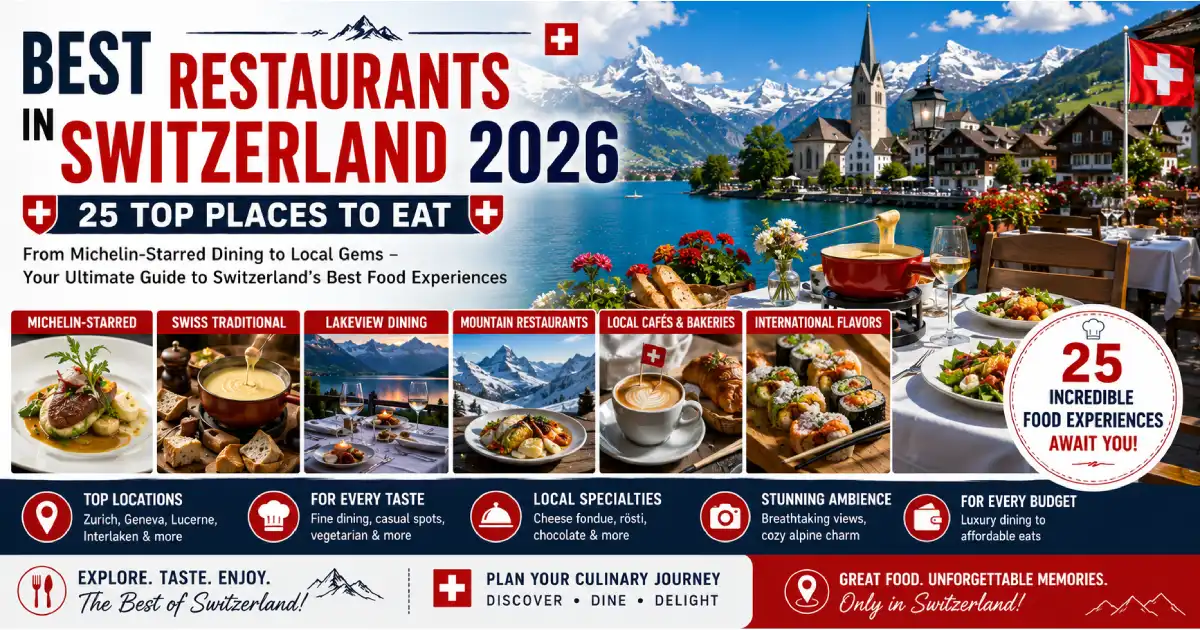
This guide covers the 25 best restaurants in Switzerland — organized by type and region from essential Swiss culinary traditions (the best fondue, raclette, and rösti experiences) through Zurich’s sophisticated contemporary dining and Geneva’s French-Swiss brasserie culture — with practical details on cost, location, reservation requirements, and what to order for 2026 visitors planning where to eat across Switzerland.
For complete guides, see our Best Places to Visit in Switzerland 2026, Things to Do in Switzerland 2026, and Switzerland Travel Guide 2026 guides.
| Restaurant | Cuisine | City/Location | Price Range | Reservation |
|---|---|---|---|---|
| Igniv by Andreas Caminada | Modern Swiss Sharing | Zurich (& St. Moritz) | CHF 85–160 | Yes (weeks) |
| Pavillon | French Fine Dining | Zurich | CHF 150–250+ | Yes (weeks) |
| Kronenhalle | Swiss Classic | Zurich | CHF 60–100 | Yes |
| Zunfthaus zur Waag | Traditional Zurich | Zurich | CHF 50–90 | Yes |
| Hiltl | Vegetarian | Zurich | CHF 20–40 | No |
| Restaurant Chesery | Alpine Fine Dining | Gstaad | CHF 120–200+ | Yes (months) |
| Le Café Beau-Rivage | French Brasserie | Geneva | CHF 45–80 | Yes |
| Café du Centre | Brasserie Classic | Geneva | CHF 30–55 | No |
| Restaurant de l’Hôtel de Ville | French Fine Dining | Crissier (Lausanne area) | CHF 250–400+ | Yes (months) |
| Sens | Modern Swiss | Lausanne | CHF 80–130 | Yes (weeks) |
| Bains des Pâquis | Fondue/Raclette | Geneva | CHF 20–35 | No |
| Chez Vrony | Alpine Swiss | Zermatt | CHF 50–100 | Yes |
| Restaurant Findlerhof | Alpine Swiss | Zermatt (Findeln) | CHF 40–85 | Yes |
| Whymper Stube | Fondue | Zermatt | CHF 35–70 | Yes |
| Restaurant Acquerello | Italian Fine Dining | Zurich | CHF 90–150 | Yes (weeks) |
| Memories | Modern Swiss (2 stars) | Bad Ragaz | CHF 280–350+ | Yes (months) |
| Kulmhotel Gornergrat | Alpine | Zermatt area | CHF 40–80 | Recommended |
| Wirtschaft zum Wiesengrund | Traditional Swiss | Zurich (Witikon) | CHF 35–65 | Yes |
| Spiga | Northern Italian | Zurich | CHF 45–80 | Yes |
| Restaurant La Terrasse | French-Swiss | Montreux | CHF 60–100 | Yes |
| Fumagalli | Swiss-Italian | Ticino (Bellinzona) | CHF 35–65 | Yes |
| Cantina Canetti | Grotto | Ticino (rural) | CHF 25–45 | Recommended |
| Alpenblick | Mountain Guesthouse | Grindelwald/Interlaken area | CHF 25–55 | No |
| Chesery (Gruyères) | Swiss Regional | Gruyères | CHF 35–60 | Recommended |
| Tibits | Vegetarian Buffet | Zurich/Bern/Basel | CHF 18–30 | No |
Cuisine: Fondue, Raclette, Swiss | Location: Geneva lakefront | Price: CHF 20–35/person | Reservation: No | Address: Quai du Mont-Blanc 30, Geneva
The Bains des Pâquis is simultaneously Geneva’s most beloved public outdoor swimming facility (a historic 1930s lakefront bath house extending into Lake Geneva on wooden jetties) and, during cooler months from September through April, one of Geneva’s most atmospheric fondue destinations — a fondue service operating within the bath house building that draws a genuinely mixed crowd of Geneva residents (students, office workers, retirees, diplomats’ staff) who come for the CHF 20–25 moitié-moitié fondue served with wine at communal wooden tables in an unpretentious setting directly on the lake. The Bains des Pâquis fondue experience is specifically Geneva’s answer to the question of where to eat the city’s best fondue without paying the premium of a hotel restaurant or tourist-oriented chalet restaurant.
The moitié-moitié fondue (half Gruyère, half Vacherin Fribourgeois — the foundational Swiss fondue recipe that originates from the border region between the Fribourg and Gruyère production areas) arrives with bread, small potatoes, and cornichons in a straightforward format that emphasizes the cheese quality over presentation elaboration.
What to order: Moitié-moitié fondue, a carafe of house white wine (Fendant, the Valais Chasselas that traditionally accompanies fondue, or a Vaud white from the Lavaux), and the fondant au chocolat (chocolate fondant dessert) if available as a seasonal special.
Insider tips: The fondue season at Bains des Pâquis runs September through April — arriving in summer expecting fondue will result in discovering the baths operating as a swimming facility rather than a fondue restaurant, which is an equally valid but entirely different experience. Weekend evening fondue sessions fill quickly — arriving at opening or calling ahead is recommended despite the restaurant’s no-reservation policy, which in practice means first-come priority rather than guaranteed walk-in access on busy autumn and winter evenings.
Cuisine: Fondue, Swiss Alpine | Location: Zermatt | Price: CHF 35–70/person | Reservation: Required | Address: Hotel Monte Rosa, Bahnhofstrasse 80, Zermatt
The Whymper Stube, named for Edward Whymper (the British alpinist who led the first ascent of the Matterhorn in 1865 and was staying in the Monte Rosa Hotel — the oldest hotel in Zermatt — during the fateful climb), operates in the cellar of the Monte Rosa Hotel as Zermatt’s most historically resonant fondue restaurant. The stone-walled, low-ceilinged cellar (original 19th-century construction, period photographs and mountaineering memorabilia covering the walls) creates an atmosphere that connects contemporary cheese fondue with the specific Victorian Alpine adventure culture from which Zermatt’s entire tourist identity derives.
The fondue here (Valais fondue using regional cheese varieties, at Zermatt’s necessarily elevated price point — CHF 35–45 for the fondue itself, before wine and accompaniments) is genuinely good, representing the local Valais cheese tradition rather than the Fribourg moitié-moitié that Geneva’s Bains des Pâquis exemplifies. The experience is indivisible from the setting — eating fondue in a cellar full of Matterhorn history, in a car-free village where the most recent vehicle outside is an electric taxi, represents a specifically Zermatt pleasure that justifies the premium over equivalent fondue available in less atmospheric settings.
What to order: The house Valais fondue, a Valais Fendant wine (Chasselas from the local region), and the Zermatt Täller (the local specialty dessert involving Kafi Luz — coffee with schnapps — as an accompanying tradition).
Insider tips: Whymper Stube is one of Zermatt’s most consistently demanded dinner reservations during winter season (December–March) and summer hiking season (June–September) — booking 2–4 weeks ahead during these periods is strongly recommended. The Monte Rosa Hotel’s broader historical significance (where Whymper prepared for and returned from the Matterhorn first ascent) makes even a pre-dinner drink at the hotel bar worthwhile for those interested in Alpine mountaineering history.
Cuisine: Swiss Alpine, Regional | Location: Findeln area above Zermatt (1,996 meters) | Price: CHF 50–100/person | Reservation: Required | Access: On foot (45 min from Zermatt) or via Sunnegga gondola + walk
Chez Vrony occupies a position that virtually no other restaurant in the world can claim — a traditional Swiss mountain restaurant (Bergrestaurant) at 1,996 meters altitude in the Findeln hamlet above Zermatt, with the Matterhorn visible directly from the sun terrace in a perspective that professional Alpine photographers describe as among the finest accessible Matterhorn viewpoints outside of dedicated summit positions. The restaurant has operated since 1966 under the same family’s stewardship, maintaining the specific character of a genuine Swiss mountain guesthouse (locally-sourced ingredients, traditional regional preparations) while serving visitors who arrive on skis in winter and on foot or via the Sunnegga gondola in summer.
The menu balances Swiss Alpine classics (rösti in multiple preparations, locally sourced cheese dishes, Alpine charcuterie) with seasonal specials reflecting the specific regional agriculture of the Mattertal valley below Zermatt — the beef and dairy production of the surrounding Valais farmland appearing on the menu in preparations that reflect genuinely local sourcing rather than the commodity-product sourcing that many mountain restaurants default to at altitude.
What to order: The Chez Vrony rösti (a definitive version of this Swiss potato classic, prepared in the traditional method with clarified butter), any cheese preparation using local Valais cheese, and the house wine from the Valais region.
Insider tips: The sun terrace reservation (specifying terrace seating rather than interior seating when booking) is essential for the full Chez Vrony experience — interior seating, while comfortable, eliminates the Matterhorn view that defines the restaurant’s identity. Lunch service (rather than dinner, which requires descending from altitude in darkness) allows the complete terrace-view experience in daylight, and represents the most efficient use of a mountain restaurant visit that combines hiking and dining within a single day’s itinerary.
Cuisine: Swiss Alpine | Location: Findeln, Zermatt (2,050 meters) | Price: CHF 40–85/person | Reservation: Yes | Access: Sunnegga gondola + 20-minute walk
The Findlerhof, neighboring Chez Vrony in the tiny Findeln hamlet above Zermatt, offers a slightly more accessible version of the high-altitude Zermatt mountain restaurant experience — the sun terrace overlooking the Matterhorn, the traditional Swiss Alpine menu (cheese dishes, charcuterie, potato preparations, and various seasonal specials), and the specific pleasure of eating lunch outdoors at 2,050 meters while the Matterhorn dominates the skyline. The restaurant’s wine cellar (an unusual feature at this altitude, but reflecting the seriousness with which the Findlerhof approaches its beverage program) and the local Valais cheese selection distinguish it from more purely tourist-formula mountain restaurants.
What to order: Local cheese platter (allowing comparison of the Valais regional varieties — Raclette du Valais AOP, various mountain cheeses from the surrounding Mattertal farms), rösti, and a glass of Heida (the rare, high-altitude white wine variety grown specifically in the Valais at elevations above 1,000 meters — one of the world’s highest-altitude commercial wine productions, barely known outside the Valais but compelling in its specific aromatic character).
Insider tips: The Heida wine (also called Rèze or Savagnin in different linguistic contexts) represents one of the most specific Swiss regional wine experiences available anywhere — a grape variety found essentially only in the upper Valais, producing wines of distinctive aromatic complexity that no imported Swiss wine substitute can replicate. Asking specifically for Heida or Valais high-altitude wines at Findlerhof (or any upper Valais restaurant) introduces visitors to a wine tradition entirely outside mainstream Swiss wine awareness.
Cuisine: Traditional Swiss | Location: Zurich-Witikon (outer Zurich, tram accessible) | Price: CHF 35–65/person | Reservation: Required, weeks ahead | Address: Wiesnecktobel 2, Zurich
Wirtschaft zum Wiesengrund, located in a converted farmhouse in the Witikon quarter of outer Zurich (accessible by tram from the city center, approximately 20 minutes), represents the most complete traditional Swiss restaurant experience accessible from a major Swiss city — a farmhouse dining room (low beamed ceilings, worn wooden tables, a specific warmth generated by centuries of similar gatherings) serving the specific Swiss-German regional dishes (Zürcher Geschnetzeltes — the thin-sliced veal in cream and mushroom sauce that is Zurich’s definitive local dish; various rösti preparations; seasonal Swiss game during hunting season; homemade würste) that define what “Swiss food” means when Swiss people are cooking for each other rather than for international visitors.
The restaurant’s location in a genuine outer-Zurich farmhouse neighborhood (not a central tourist area) and its consistent popularity with local Zurich residents rather than primarily international visitors creates an atmosphere where the food’s cultural authenticity is self-evident rather than performed — the same dishes being eaten by Swiss families at the surrounding tables as by visiting travelers reinforces the sense that this represents an actual living tradition rather than a museum reconstruction of it.
What to order: Zürcher Geschnetzeltes (the definitive Zurich veal dish, served over Rösti or egg noodles — this is the city’s most authentic single local dish and Wirtschaft zum Wiesengrund prepares it with specific care for the cream sauce’s consistency and the veal’s proper slicing), seasonal specials (the October–November game menu, when venison, wild boar, and various forest preparations appear alongside the year-round Swiss classics), and a local Zurich wine (the Zürich wine region produces primarily Pinot Noir and Riesling Sylvaner, rarely exported beyond the canton, and worth trying specifically with local dishes).
Insider tips: The restaurant’s outer-Zurich location deters some visitors who prefer central accessibility — the tram journey (approximately 20 minutes, tram 11 to Witikon terminus plus a brief walk) is entirely manageable and forms part of the “local Zurich” experience that the restaurant’s neighborhood provides. Reservations for Saturday dinner are the most competitive — Tuesday through Thursday evenings provide equivalent food quality with considerably easier booking access.
Cuisine: Swiss Classic, Brasserie | Neighborhood: Zurich Old Town (Niederdorf) | Price: CHF 60–100/person | Reservation: Required | Address: Rämistrasse 4, Zurich
The Kronenhalle is Zurich’s most historically significant restaurant — an institution operating continuously since 1924 in a grand dining room whose walls constitute one of the most extraordinary restaurant art collections in Europe (original works by Miró, Chagall, Picasso, Matisse, and Giacometti covering every wall surface, hung in the 1920s–1950s when the artists were personal friends of the owners rather than international market trophies). The food (traditional Swiss-French brasserie — steak tartare, veal cutlet, Zürcher Geschnetzeltes, seasonal fish from Swiss lakes) matches the institution’s establishment character without attempting contemporary innovation that would jar against the 1920s brasserie atmosphere.
The Kronenhalle functions as Zurich’s essential “grand institution” restaurant experience — the place where Swiss establishment figures, visiting dignitaries, and internationally-aware visitors come to experience what a century of consistent Swiss restaurant culture looks like in its most formal expression.
What to order: Zürcher Geschnetzeltes (the quintessential Zurich preparation, Kronenhalle’s version being the city’s benchmark against which other versions are measured), the steak tartare (hand-chopped at the table in the traditional format), and whatever the seasonal fish preparation is from Lake Zurich or Lake Constance.
Insider tips: The Kronenhalle’s bar (a separate room maintaining the same art collection and mid-century atmosphere, with an excellent cocktail and Swiss wine program) provides access to the institution’s atmosphere without the cost of a full dinner — spending an evening hour at the bar before or after dinner elsewhere is a legitimate and distinctly Zurich cultural experience. The Kronenhalle fondue (served during fondue season in a suitably serious institutional format) is among Zurich’s most famed versions.
Cuisine: Modern Swiss Sharing | Location: Zurich (also St. Moritz, Bad Ragaz) | Price: CHF 85–160/person | Reservation: Required, weeks ahead | Address: Zurich location check current (part of Grand Hotel Zurich)
Andreas Caminada is Switzerland’s most internationally celebrated contemporary chef — his flagship restaurant Schloss Schauenstein (in Fürstenau, Graubünden) holds 3 Michelin stars and regularly appears on World’s 50 Best lists, while Igniv (“nest” in Romansh, the language of Caminada’s home Graubünden region) represents his more accessible sharing-plates concept that has established locations in Zurich, St. Moritz, Bangkok, and beyond. The Igniv format (multiple small dishes designed for communal sharing, presented in a sequence that builds from lighter to more intense flavors) draws directly on Caminada’s Swiss regional identity — Romansh cultural references, Alpine ingredient sourcing, and a specific combination of technical precision with genuine warmth that distinguishes his cooking from the sometimes sterile technical ambition of comparable European fine dining.
The Zurich location (within a hotel setting, with a dining room designed to reflect Igniv’s nest concept in its textured, cave-like interior) provides the most accessible version of Caminada’s culinary vision — a reservation achievable with reasonable advance planning versus the months-ahead booking required for Schloss Schauenstein.
What to order: The sharing menu (a fixed progression of sharing dishes, the most complete representation of the Igniv concept) rather than à la carte individual ordering, which provides less complete access to the kitchen’s range and the format’s communal intention.
Insider tips: The St. Moritz Igniv location (within the Grand Hotel Kronenhof in Pontresina) provides an alternative booking option for visitors specifically in the Engadine — the mountain resort context adds an Alpine dimension to the dining experience that the Zurich hotel setting doesn’t provide, while the cooking standard is maintained consistently across locations.
Cuisine: French Fine Dining | Location: Baur au Lac, Zurich | Price: CHF 150–250+/person | Reservation: Required, weeks ahead | Address: Talstrasse 1, Zurich
Pavillon, the flagship fine dining restaurant of Zurich’s Baur au Lac hotel (one of Switzerland’s most historically prestigious grand hotels, operating since 1844 on the Zurich lakefront), represents Swiss fine dining at its most formal and most technically accomplished — a Michelin-starred kitchen executing French-influenced contemporary cuisine in a setting (the hotel’s lake garden terrace, weather permitting, or the formal dining room with lake and park views) that constitutes one of Europe’s most beautiful single restaurant environments. The combination of the Baur au Lac’s institutional gravitas (every Swiss Federal Council president, European monarch, and visiting head of state has stayed here over the past 180 years), the lakefront garden setting, and the kitchen’s genuine Michelin-recognized technical quality creates a dining experience that functions simultaneously as culinary achievement and cultural immersion in Switzerland’s specific luxury establishment culture.
What to order: The tasting menu (the most complete representation of the kitchen’s seasonal vision and technical range) and the sommelier’s Swiss wine pairing if available — Pavillon’s wine program specifically champions Swiss wines that international visitors rarely encounter, providing a genuinely educational complement to the food.
Insider tips: The lakefront terrace (available in summer from late May through September, weather permitting) transforms Pavillon’s atmosphere from formal hotel fine dining to one of the most extraordinary outdoor restaurant settings in Europe — reserving specifically with a request for terrace seating and checking weather forecasts in the days before the reservation significantly affects the overall experience. Winter dining (in the formal interior) is equally accomplished but differently atmospheric.
Cuisine: Italian Fine Dining | Location: Zurich (Oberstrasse) | Price: CHF 90–150/person | Reservation: Required, weeks ahead | Address: Dufourstrasse 25, Zurich
Acquerello has maintained a Michelin star for over 15 years as Zurich’s most consistently excellent Italian restaurant — a chef-driven operation (chef Mario Caramella, Italian-born, Switzerland-based for decades) whose kitchen executes Italian regional cuisine (primarily northern Italian — risotto, pasta, seafood from the Mediterranean sourced specifically from Italian suppliers) with a precision and ingredient quality that matches Zurich’s price level while maintaining Italian culinary authenticity rather than creating a Swiss-Italian fusion that satisfies neither tradition. The restaurant’s specific commitment to Italian regional sourcing (certain cheeses, specific cured meats, seasonal Italian ingredients flown in at quality standards that Zurich’s food service market doesn’t otherwise offer) distinguishes it from Italian restaurants that adapt to local ingredient availability at the cost of regional authenticity.
What to order: Any risotto preparation (the kitchen’s technical benchmark, executed with the specific rice varieties, stocks, and finishing technique that distinguish properly-made Northern Italian risotto from the generic “risotto” served across European restaurants), handmade pasta, and the seasonal fish preparations reflecting the Italian seafood sourcing the kitchen maintains.
Insider tips: Acquerello’s wine list (focused on Italian wines, with particular depth in Barolo, Barbaresco, and Brunello di Montalcino that the restaurant has cellared in specific vintages over decades) provides access to older Italian wine vintages at prices lower than comparable Italian restaurant wine lists in London or New York — a specific wine-focused value within the overall Zurich premium pricing context.
Cuisine: Vegetarian | Location: Zurich (Sihlstrasse) | Price: CHF 20–40/person | Reservation: No | Address: Sihlstrasse 28, Zurich
Hiltl, operating continuously since 1898, holds the Guinness World Record as the world’s oldest vegetarian restaurant — a Swiss institution that predates the global vegetarian movement by several decades, having served meat-free food in Zurich when vegetarianism was a minority dietary philosophy rather than a mainstream choice. The restaurant’s current format (a buffet system supplemented by à la carte options, a large and varied daily selection of hot and cold vegetarian and vegan preparations representing cuisines from across Europe, Asia, and the Americas) provides the most variety-per-franc dining in Zurich regardless of dietary persuasion — the buffet’s quality (genuinely excellent, changing daily, reflecting seasonal ingredients and a kitchen that has been refining vegetarian cooking for over 125 years) makes Hiltl relevant for all visitors rather than exclusively those who avoid meat.
What to order: The buffet (CHF by weight — fill a plate from the extensive hot and cold selections, pay by weight at the counter, a format that allows sampling widely rather than committing to a single dish) and the house-made Hiltl chai (a specific recipe that has been served for decades, one of Zurich’s most beloved non-alcoholic restaurant beverages).
Insider tips: Hiltl operates multiple Zurich locations and extended hours (the main Sihlstrasse location open daily until midnight, unusual for Swiss restaurants which typically close kitchen service by 10 PM) — making it one of Zurich’s best late-night dining options for visitors whose evening activities have extended beyond standard restaurant service hours. The weekend Hiltl Brunch (Saturday and Sunday, CHF 39 per person, extended buffet with brunch-specific additions) represents one of Zurich’s best brunch value propositions.
Cuisine: Northern Italian | Location: Zurich (Langstrasse) | Price: CHF 45–80/person | Reservation: Yes | Address: Rotwandstrasse 48, Zurich
Spiga occupies the Langstrasse district (Zurich’s most culturally diverse and most nightlife-active neighborhood) with a specifically Northern Italian menu — handmade pasta, risotto, ossobuco, and a wood-fired pizza program (unusual in a pasta-and-risotto-focused Italian restaurant, but Spiga’s Neapolitan-influenced pizza is consistently cited separately from the broader menu as one of Zurich’s better wood-fired offerings) served in a neighborhood setting that attracts Zurich residents far more consistently than international visitors. The Langstrasse location gives Spiga a social atmosphere more genuinely neighborhood-oriented than the hotel-restaurant and business-dining establishments that dominate Zurich’s more tourist-accessible restaurant landscape.
What to order: Handmade pasta (the fresh pasta preparation is the kitchen’s clearest strength, with specific Northern Italian regional formats — bigoli, tagliolini, various stuffed pasta in seasonal sauces), a Piedmontese or Lombardy red wine, and the tiramisù if available as a dessert option.
Insider tips: The Langstrasse location places Spiga within walking distance of Zurich’s most active bar and club scene — convenient for visitors planning a restaurant dinner followed by Langstrasse nightlife exploration without changing neighborhoods.
Cuisine: French Brasserie | Location: Geneva Old Town | Price: CHF 30–55/person | Reservation: No (walk-in) | Address: Place du Molard 5, Geneva
Café du Centre is Geneva’s most consistently recommended everyday brasserie — a large, traditional Swiss-French café-restaurant on the Place du Molard (a central Geneva square connecting the Old Town to the Rhône bridge area) serving classic brasserie preparations (steak-frites, moules-frites, entrecôte bernaise, steak tartare, and a reliable croûte au fromage — the Swiss French-speaking version of a cheese toast that differs from the German-speaking Schweizer Käsetoast in specific bread-to-cheese ratios and additional egg and wine additions to the cheese sauce) in a bustling, social atmosphere that functions as a genuine everyday restaurant for Geneva office workers and residents alongside its tourist accessibility.
The specific brasserie character of Café du Centre (banquette seating, tiled floors, the din of a full dining room at noon, waiters navigating efficiently between tightly-placed tables) reflects the French-Swiss cultural identity of Geneva more accurately than any hotel restaurant — eating here feels like eating in the city rather than eating in a hospitality facility within the city.
What to order: Steak tartare (prepared tableside at traditional establishments — Café du Centre maintains this format on request), moules-frites (a Belgian-French standard that Geneva’s proximity to the French border has made locally customary), and a carafe of Swiss white wine from the Vaud or Valais.
Insider tips: The lunchtime service at Café du Centre (noon to 2:30 PM weekdays) provides the most authentically Geneva dining experience — the dining room fills primarily with office workers from the surrounding international organizations and finance sector at lunch, creating a social atmosphere that evening tourist-oriented service doesn’t replicate. The Tagesmenü/menu du jour (two courses, CHF 22–28) provides the best value on the weekday menu.
Cuisine: French Brasserie/Swiss | Location: Geneva lakefront | Price: CHF 45–80/person | Reservation: Yes | Address: Quai du Mont-Blanc 13, Geneva
Le Café Beau-Rivage, the brasserie component of the historic Beau-Rivage Hotel (operating since 1865 on the Geneva lakefront, where Empress Sisi of Austria-Hungary was assassinated in 1898 — a historical footnote that the hotel commemorates within its public spaces), provides Geneva’s most classically beautiful lakefront brasserie setting — a terrace extending to the water’s edge with views across Lake Geneva to the French Alps, jet d’eau visible to the west, and the Savoyard mountains framing the southern horizon. The food (French brasserie classics executed with Swiss precision — the perch fillets from Lake Geneva being the most specifically local preparation, available only in this region’s restaurant tradition) matches the setting’s quality rather than coasting on it.
The filets de perche du lac (freshwater perch fillets from Lake Geneva, breaded and pan-fried in butter, served with French fries and lemon — a specifically Léman regional preparation that travelers specifically in the Geneva-to-Montreux lakeshore area should seek out as the most geographically specific dish available in this part of Switzerland) represents the most authentically local Lake Geneva preparation on the menu.
What to order: Filets de perche du lac (the regional specialty, available wherever this preparation is offered with genuine Lake Geneva perch — the season and Lake Geneva’s perch population occasionally affect availability, so confirming with the server that the perch is genuinely from the lake rather than a substitute is worthwhile), and a Fendant or Chasselas from the Vaud or Geneva wine regions to accompany.
Insider tips: The lakefront terrace (available May–September, weather permitting) constitutes one of the most beautiful outdoor dining settings in Switzerland — reserving specifically for terrace seating and confirming weather conditions before the reservation helps ensure the full experience. Evening terrace dining as the Jet d’Eau catches the last western light and the Alps across the lake transition through sunset colors provides a specifically Geneva dining memory unavailable anywhere else.
Cuisine: French Fine Dining (3 Michelin Stars) | Location: Crissier (near Lausanne) | Price: CHF 250–400+/person | Reservation: Required, months ahead | Address: Rue d’Yverdon 1, Crissier
Restaurant de l’Hôtel de Ville in Crissier (a village immediately west of Lausanne) holds the most historically significant position in Swiss fine dining — the restaurant established by Frédy Girardet (considered by many of his peers to be the world’s greatest chef during his tenure in the 1970s–1990s, a figure whose influence on European cuisine has been compared to Escoffier’s) and subsequently directed by chefs who have maintained its three-Michelin-star standard through multiple transitions. The current chef (Philippe Rochat’s legacy maintained through his successors) continues producing the specifically French-Swiss haute cuisine that made Crissier an international fine dining pilgrimage destination visited by chefs from across the world during Girardet’s era.
The restaurant’s location (not in Geneva or Zurich but in a modest suburban village, reached by taxi from Lausanne) and its specific position in Swiss culinary history make it a destination for serious food travelers rather than primarily luxury hotel guests or business diners — the pilgrimage character of the visit is inseparable from the experience.
What to order: The full tasting menu — this restaurant requires the complete tasting menu experience to understand both its current expression of French-Swiss haute cuisine and its historical position in the tradition Girardet established.
Insider tips: Reservations require planning months in advance — the restaurant’s consistent three-star status and international reputation among serious food travelers creates demand that even its large dining room (by fine dining standards) cannot absorb without significant advance planning. International visitors planning a Swiss trip around a Crissier meal should book as early as possible after deciding on travel dates.
Cuisine: Alpine Fine Dining | Location: Gstaad | Price: CHF 120–200+/person | Reservation: Required, months ahead in peak season | Address: Lauenenstrasse, Gstaad
Restaurant Chesery, operating since 1972 in Gstaad (the Swiss resort most associated with international jet-set luxury — its clientele over the decades has included European royalty, Hollywood figures, and hedge fund managers who own chalets in the surrounding Saanenland) has maintained a Michelin star and a reputation as one of Switzerland’s finest mountain resort restaurants across five decades of service. The dining room (a converted 18th-century chalet, warm with wood-paneled walls, candlelight, and the specific Berner Oberland architectural character that Gstaad’s built environment preserves) and the menu (drawing on the local Bernese Oberland ingredients — the region’s specific Alpine dairy products, game from the surrounding forests, and vegetables from the valley farms below) provide a genuinely localized fine dining experience rather than the generic European haute cuisine that characterizes many luxury resort restaurants.
What to order: Whatever the seasonal game preparation is (autumn game season — venison, chamois, wild boar from the surrounding Berner Oberland forests — represents the kitchen at its most specifically regional), and any preparation featuring local Berner Oberland dairy products or cheese.
Insider tips: The Gstaad high season (Christmas through New Year, and February school holidays) requires booking months in advance for Chesery — early January and March (between the major holiday periods) offer equivalent food quality with somewhat more accessible reservation timelines and the possibility of exploring Gstaad’s immediate surroundings without the peak-season crowds.
Cuisine: Swiss Alpine | Location: Gornergrat (3,089 meters, above Zermatt) | Price: CHF 40–80/person | Reservation: Recommended | Access: Gornergrat rack railway from Zermatt (CHF 55–95 return)
The Kulmhotel Gornergrat restaurant (at 3,089 meters, one of the highest hotel restaurants in the Alps accessible to non-mountaineers) provides the most dramatically situated dining in Switzerland — a table at the window of the Kulmhotel’s restaurant, with the Matterhorn directly across the Gorner Glacier basin at eye level, the Monte Rosa massif (Switzerland’s highest peak) visible to the east, and the most comprehensive alpine panorama available from any habitable structure in the Swiss Alps. The food (Swiss Alpine standards — rösti, cheese dishes, soup, simple meat preparations appropriate to the altitude and the kitchen’s necessarily limited logistics at 3,089 meters) is honest rather than ambitious, and the dining context renders culinary ambition largely irrelevant — what is served is genuinely secondary to where it is served.
What to order: The cheese soup (a thick, warming alpine broth that the altitude and surrounding mountain environment makes genuinely restorative rather than merely appetizing) and whatever the simple Alpine main preparations are — the lunch format (the restaurant is primarily a lunchtime destination, as most visitors descend before dinner) keeps the menu accessible and appropriate.
Insider tips: The morning train timing (first Gornergrat rack railway from Zermatt, 7 AM–8 AM depending on season) allows arriving at the summit before the day visitors who depart on mid-morning trains — a window for photographing the Matterhorn in alpenglow and enjoying the restaurant’s breakfast service (available to hotel guests and some early-arrival visitors) before the peak midday crowd arrives.
Cuisine: Swiss-Italian (Grotto) | Location: Rural Ticino (specific location varies — grottes are small, seasonal establishments in specific village areas) | Price: CHF 25–45/person | Reservation: Recommended | Season: April–October typically
The Ticino grotto (plural: grotti) is one of Switzerland’s most distinctive dining institutions — small, often outdoor restaurants traditionally carved into rocky hillsides (grottoes in the literal sense, using the natural rock as a cool storage area for wine and food) serving the specific Italian-Swiss cuisine of Ticino: polenta (either grilled or soft, accompanying virtually every meat and mushroom preparation), risotto (the Ticino version draws on the Lombardy tradition immediately south of the border, using Arborio rice in preparations more rustic than Milanese restaurant versions), rabbit (coniglio in umido — braised rabbit with vegetables, the classic Ticino grotto main course), local charcuterie, and the specific Merlot wines of the Ticino that represent Switzerland’s most important Italian-influenced viticulture.
Cantina Canetti (a representative name for the category rather than a single specific restaurant — authentic grottes are small, family-operated, and often discovered through local recommendation rather than tourist infrastructure) provides the most genuine expression of Ticino food culture available: outdoor stone tables, a vine-covered pergola providing shade, the specific silence of a Ticino hillside village, and the complete sense of being in Italian Switzerland rather than in Switzerland’s German or French language zones.
What to order: Polenta e funghi (grilled polenta with seasonal wild mushrooms — porcini when in season in autumn, various other local varieties throughout the season), rabbit in umido or brasato (braised meat preparations that characterize the Ticino grotto tradition), and a glass of Ticino Merlot (the dominant red wine variety of the canton, producing wines of varying quality but at its best expressing a specifically terroir-driven Merlot character different from Bordeaux or California Merlot).
Insider tips: The best Ticino grottes are typically small, often unmarked by prominent signage, and most reliably discovered by asking accommodation staff or local residents for their specific village recommendations rather than relying on general tourist guides. The grotto experience is as much about the setting (the stone outdoor space, the vines, the Ticino light) as the food — seeking out a grotto in a specific rural Ticino village (the Malcantone and Luganese hill areas above Lugano being particularly rich in traditional grottes) rewards the effort with a dining experience unavailable in any Swiss city restaurant.
Cuisine: Swiss-Italian Regional | Location: Bellinzona, Ticino | Price: CHF 35–65/person | Reservation: Yes | Address: Bellinzona city center (check current)
Fumagalli provides the most accessible introduction to Ticino’s urban restaurant culture in Bellinzona — the Ticino capital and UNESCO World Heritage city (home to three medieval castles collectively recognized as outstanding examples of late-medieval fortification architecture) offers a restaurant scene that serves the local Ticino resident population rather than primarily the Lugano tourist market, providing slightly lower prices and more genuine regional character than Lugano’s lakefront establishments. The menu covers Ticino classics (polenta preparations, risotto, braised meats) alongside a broader Italian-Swiss menu drawing on the specific regional ingredients — the Ticino beef (locally raised cattle from the valley farms above Bellinzona), seasonal mushrooms and chestnuts (the chestnut forests of the surrounding hills produce the marrons that feature prominently in Ticino autumn menus), and the local wine production.
What to order: Seasonal preparations reflecting current Ticino agricultural production — chestnuts (marroni) in autumn preparations (gnocchi di castagne, crema di marroni, marrons with game) represent the most specifically regional Ticino flavors, available only during the October–November chestnut season.
Insider tips: Bellinzona’s accessibility by train from Lugano (20 minutes) and from the Gotthard route (through which visitors arriving from German-speaking Switzerland pass) makes it a logical mid-journey stop rather than requiring a dedicated visit — the UNESCO castles (particularly Castelgrande, with a funicular from the old town and a panoramic terrace) combined with lunch at Fumagalli or a similar Bellinzona restaurant creates a natural half-day Ticino cultural stop.
Cuisine: Modern Swiss Fine Dining (2 Michelin Stars) | Location: Bad Ragaz | Price: CHF 280–350+/person | Reservation: Required, months ahead | Address: Grand Resort Bad Ragaz, Bad Ragaz
Memories, chef Sven Wassmer’s two-Michelin-star restaurant within the Grand Resort Bad Ragaz (a luxury spa hotel resort in the Rhine Valley of eastern Switzerland), represents the most technically ambitious Swiss contemporary cuisine available outside Caminada’s Schloss Schauenstein — a tasting menu format that draws specifically on the Graubünden and eastern Swiss region’s ingredients (alpine herbs, specific valley-produced dairy, game from the surrounding hunting grounds) presented through a contemporary fine dining lens that the two-star recognition confirms meets the highest international standards. Wassmer’s cooking combines exceptional technical precision with a genuine sense of regional identity — the menu’s Alpine character is not decorative but structural, reflecting an ingredient philosophy that uses the surrounding landscape as a primary creative resource.
What to order: The full tasting menu (CHF 280–350 per person, multiple courses, changing seasonally) — partial experiences reduce access to the kitchen’s complete seasonal vision and the progression of flavors that defines the tasting menu format’s distinct value over à la carte ordering.
Insider tips: The Grand Resort Bad Ragaz’s spa facilities (a destination spa in their own right, drawing European visitors specifically for the thermal waters) and the resort’s additional dining options allow building a longer stay around the Memories reservation — the overnight or multi-night resort stay combining spa and the fine dining reservation amortizes the travel cost of reaching Bad Ragaz (accessible by train from Zurich in approximately 75 minutes, or from Chur in 30 minutes) across a more complete experience.
Cuisine: Vegetarian Buffet | Location: Zurich, Bern, Basel, Winterthur | Price: CHF 18–30/person (by weight) | Reservation: No | Hours: Daily, extended hours
Tibits (a Hiltl Group concept, younger sibling to the world’s oldest vegetarian restaurant) operates Switzerland’s most popular contemporary vegetarian buffet — a pay-by-weight system (currently approximately CHF 4.20–4.50/100g) offering an extensive selection of hot and cold vegetarian and vegan dishes that rotate throughout the day and change seasonally, served in a modern, well-designed restaurant environment popular with urban Swiss professionals, students, and visitors wanting quality vegetarian food at a predictable and manageable cost within Switzerland’s expensive dining landscape. The buffet format allows tasting multiple dishes without committing to a single dish at a Swiss restaurant’s à la carte prices — a flexibility that provides the best introduction to vegetarian Swiss and international cooking for visitors unfamiliar with the category.
What to order: The buffet changes daily and seasonally — building a plate that spans the hot and cold selections (rather than focusing on a single section) provides the broadest introduction to what Tibits is currently producing. The freshly pressed juices and smoothies complement the food menu with similar quality standards.
Insider tips: Tibits operates in the main train stations of Zurich and Bern (within the station building, with extended hours compared to street-level restaurants) — providing a high-quality, reasonably-priced dining option available before early trains and after evening arrivals that most Swiss restaurants don’t cover. The train station locations are genuinely excellent quality rather than transit-food compromises.
About Travel Tourister Travel Tourister’s destination specialists have eaten across Switzerland’s full culinary range — from Bains des Pâquis fondue on the Geneva lakefront and Chez Vrony rösti with Matterhorn views to Kronenhalle’s institutional Zurich elegance and Ticino hillside grottes with polenta and local Merlot — to deliver the most practical and honest guide to the best restaurants in Switzerland for every type of 2026 visitor and every budget.
Posted By : Vinay
Latest Article
2nd Floor, 39, Above Kirti Club, DLF Industrial Area, Kirti Nagar, New Delhi, Delhi 110015



Travel Tourister is a leading Travel portal where we introduce travellers to trusted travel agents to make their journey hasselfree, memorable And happy. Travel Tourister is a platform where travellers get Tour packages ,Hotel packages deals through trusted travel companies And hoteliers who are working with us across the world. We always try to find new and more travel agents and hoteliers from every nook and corners across the world so that you could compare the deals with different travel agents and hoteliers and book your tour or hotel with the one you have chosen according to your taste and budget.
Copyright © Travel Tourister, India. All Rights Reserved

 Call
Call Enquiry