Published on : 23 Sep 2026
By Travel Tourister | Updated Sep 2026
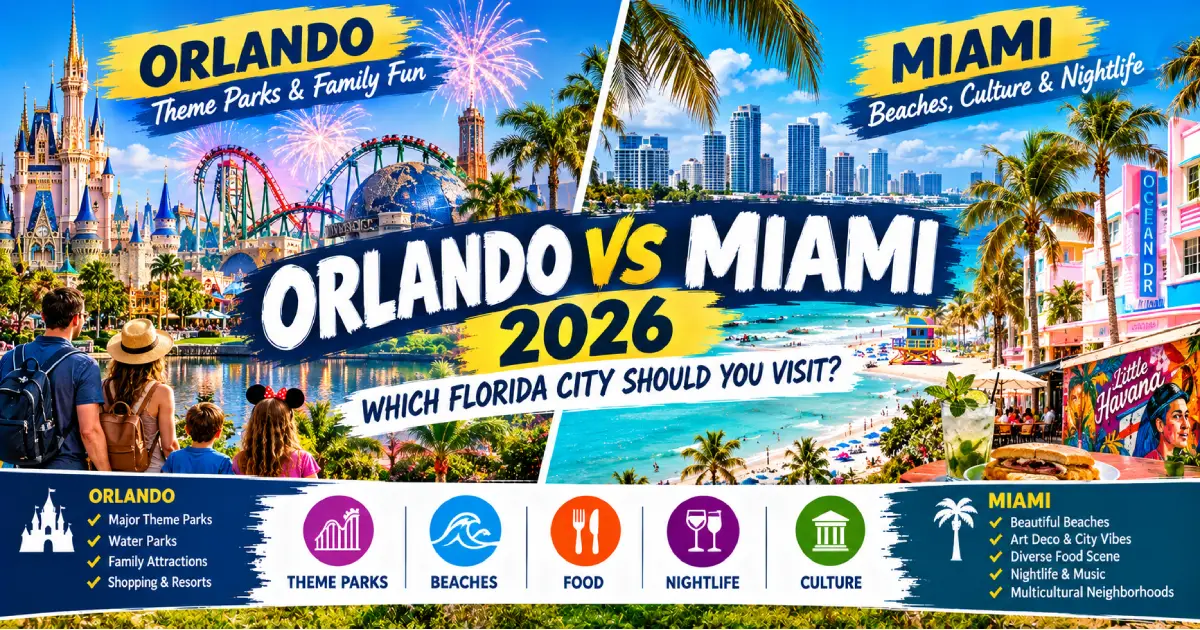
Orlando versus Miami is the defining Florida travel decision — the choice between the two cities that most comprehensively represent Florida’s range of character, and the question that most domestic and international visitors to Florida face when planning their first or returning trip to the Sunshine State. Orlando and Miami are 236 miles apart on Florida’s I-4 and Florida’s Turnpike, approximately 4 hours by car, and about as different as two cities in the same state can be: Orlando is the world’s theme park capital — a city of 320,000 permanent residents whose entire urban economy orbits the 74 million annual tourists who come primarily for Walt Disney World, Universal Orlando, and the concentrated theme park landscape that no other city on Earth replicates. Miami is the American Riviera — a city of 470,000 permanent residents (6.2 million in the metro) whose specific combination of the Art Deco Historic District of South Beach, the Latin American cultural majority (the Cuban-American community in Little Havana, the Venezuelan, Colombian, Argentine, and Brazilian communities creating the most specifically Latin-American single US city character), the Wynwood street art district, the 1990s-era nightclub culture that made South Beach globally famous, and the specific Miami Beach weather (75–85°F year-round, the warmest reliable temperatures of any major US Atlantic city) creates a destination whose identity is the direct opposite of Orlando’s controlled, family-first theme park character.
The Orlando vs. Miami decision is less about which city is better and more about which city is right for the specific trip — the family with children ages 5–12 for whom Walt Disney World is the primary Florida motivation has essentially no reason to choose Miami over Orlando, while the adult couple seeking warm weather, beach access, South Beach nightlife, and Art Deco architecture has essentially no reason to choose Orlando over Miami. This guide provides the most complete head-to-head comparison of both cities across every relevant travel dimension for 2026.
For complete city guides, see our Orlando Travel Guide 2026, Things to Do in Orlando 2026, Best Cities to Visit in USA 2026, and San Francisco vs Los Angeles 2026.
| Category | Orlando | Miami |
|---|---|---|
| Population (city) | 320,000 | 470,000 |
| Population (metro) | 2.7 million | 6.2 million |
| Primary identity | Theme park capital of the world | American Riviera, Latin cultural hub |
| Best beaches | No ocean beaches (landlocked) | South Beach, Miami Beach, Key Biscayne |
| Ocean access | 60 min to Cocoa Beach (Atlantic) | Immediate — South Beach adjacent |
| Average high (July) | 92°F / 33°C | 90°F / 32°C |
| Average high (January) | 72°F / 22°C | 77°F / 25°C |
| Hurricane risk | Low (inland) | High (coastal) |
| Mid-range hotel/night | $120–$280 (off-site); $200–$400 (Disney) | $200–$450 (South Beach); $120–$200 (Miami proper) |
| Best for families | ✅ Strongly — theme parks define family Orlando | ⚠️ Partially — beach culture; no theme parks |
| Best for couples | ⚠️ Partially — EPCOT, Universal; limited nightlife | ✅ Strongly — South Beach, nightlife, Art Deco |
| Best for nightlife | Limited (Disney Springs, I-Drive) | World-class (South Beach clubs, Wynwood bars) |
| Best for food | Theme park dining + Restaurant Row | Exceptional Cuban, seafood, international |
| Car necessary? | Yes (strongly recommended) | Partially (South Beach walkable; Miami proper needs car) |
| International character | Limited | Very high — 70% Hispanic/Latino population |
| Best season | Jan–Feb (lowest crowds/prices); Oct (best weather) | Dec–April (dry season, ideal weather) |
| Worst season | July (max crowds, heat, prices) | Aug–Oct (hurricane season, humidity) |
| Airport | MCO (Orlando International) | MIA (Miami International) or FLL (Fort Lauderdale) |
| Average trip cost (5 days, couple) | $3,500–$6,000 | $2,500–$5,000 |
This is the most one-sided single category in the Orlando vs. Miami comparison — Orlando is the world’s theme park capital with the highest concentration of major theme parks at any single American destination; Miami has zero theme parks of any significance within a practical day-trip distance.
Walt Disney World (4 parks): Magic Kingdom, EPCOT, Hollywood Studios, Animal Kingdom — the most visited tourist destination on Earth, 58 million annual visitors, the Cinderella Castle, Star Wars: Galaxy’s Edge, Pandora: The World of Avatar
Universal Orlando Resort (3 parks): Universal Studios Florida, Islands of Adventure, and the 2025-opened Epic Universe — Harry Potter’s Diagon Alley, Hogsmeade, and Ministry of Magic; Hagrid’s Magical Creatures Motorbike Adventure; VelociCoaster; Super Nintendo World
SeaWorld Orlando: Mako hypercoaster, Ice Breaker launch coaster, marine animal experiences
Discovery Cove: The swim-with-dolphins all-inclusive day resort — the most specifically extraordinary single-day non-theme-park Orlando wildlife experience
LEGOLAND Florida: The most specifically age-appropriate Florida theme park for ages 2–12
Miami has no theme parks. The nearest theme parks are:
The theme park verdict: Orlando wins completely, without contest. If theme parks are the primary travel motivation, there is no meaningful comparison.
The second most one-sided category — Miami sits directly on the Atlantic Ocean with miles of world-class sandy beaches immediately accessible from the hotel corridor; Orlando is 60 miles from the nearest beach.
South Beach (Miami Beach): The global icon — the 3.5-mile stretch of white sand and turquoise Atlantic water fronting the Art Deco Historic District, the most specifically famous single American beach by international recognition. The South Beach ocean temperature (77–82°F/25–28°C in summer, 68–72°F/20–22°C in winter — warm enough for comfortable swimming year-round in most months) combined with the specific South Beach character (the beach volleyball courts, the Art Deco hotels facing the sand, the Ocean Drive promenade immediately behind the beach, and the specific South Beach people-watching culture) create the most specifically complete American beach experience.
Key Biscayne (Crandon Park Beach): The most beautiful natural beach in the Miami area — the specific national park character (the Virginia Key and Key Biscayne beaches maintained in their natural state with significantly less commercial development than South Beach), the clearer water (the specific Key Biscayne geography — separated from the Atlantic by the shallow Biscayne Bay — producing clearer, calmer water than the open-Atlantic South Beach), and the significantly reduced crowd density relative to South Beach creating the most relaxing single Miami beach experience.
Miami Beach (north of South Beach): The Mid-Beach and North Beach sections (from 24th Street through the 79th Street Causeway) providing the South Beach ocean access without the peak South Beach crowd concentration — the specific family-beach positioning of North Beach (the Surfside and Bal Harbour sections providing the most specifically family-accessible Miami beach environment) at significantly lower hotel rates than the South Beach core.
Orlando has no beaches. The nearest Atlantic beach — Cocoa Beach (Space Coast, 60 miles east) — requires a 1-hour drive and provides the most convenient single day-trip beach from an Orlando base. The Cocoa Beach water temperature (78–84°F/26–29°C in summer — warm and genuinely swimmable) and the Space Coast character (the Kennedy Space Center proximity creating the most specifically unusual Florida beach context) make Cocoa Beach a worthwhile day trip but not a substitute for immediate beach access.
The beach verdict: Miami wins completely. If beach access is the primary travel motivation, there is no meaningful comparison.
Both cities share the subtropical Florida climate — hot, humid summers; warm winters; hurricane season from June through November — with Miami’s coastal position providing a specific year-round advantage over Orlando’s inland location.
Winter (December–March): 75–80°F/24–27°C — the most specifically rewarding Florida weather window, the dry season providing the lowest humidity of the year alongside temperatures comfortable for both beach activity (the winter ocean at 68–72°F/20–22°C, cool but swimmable for heat-tolerant visitors) and outdoor dining, walking the Art Deco district, and the Wynwood outdoor gallery experience. Miami’s December–March window is the single most consistently praised Florida climate period by resident and visitor consensus.
Summer (June–September): 88–90°F/31–32°C with high humidity — hot but moderated by the sea breeze that the ocean-adjacent position provides. Miami’s summer is slightly less extreme than Orlando’s (the ocean breeze cooling the coastal environment by 3–5°F vs. the inland position) but the hurricane season risk (Miami’s coastal location making it significantly more hurricane-exposed than Orlando’s inland position) is the summer’s primary planning consideration.
The winter advantage: Miami’s winter (December–March) at 75–80°F/24–27°C is consistently 3–5°F warmer than Orlando’s (72–76°F/22–24°C) during the same period — the coastal Gulf Stream’s warming effect providing the most reliably warm single US Atlantic beach destination weather available from November through April.
Winter (December–February): 65–75°F/18–24°C — comfortable for theme park activity (the outdoor walking, queuing, and general theme park exposure most pleasant in this range), with occasional cold fronts dropping temperatures to the 45–50°F/7–10°C range for 1–2 days.
Summer (June–September): 90–92°F/32–33°C with very high humidity and the daily afternoon thunderstorm pattern — the most challenging theme park conditions, the heat index regularly reaching 100–108°F/38–42°C during peak afternoon hours.
The weather verdict: Miami edges Orlando year-round, particularly in the winter when the coastal warming produces genuinely warm beach weather that Orlando’s inland location doesn’t match. For summer visits, both cities are hot — Miami’s ocean breeze providing a slight advantage.
Orlando’s specific cost structure — the theme park ticket as the dominant expense, the accommodation as secondary — makes Orlando’s total cost highly variable based on how many park days are planned:
With theme parks (4 park days, family of 4, 5 nights):
Without theme parks (5 nights, couple, non-park activities):
Key insight: Orlando without theme parks is significantly cheaper than Miami or most major US cities — the hotel rates in the Kissimmee and off-site International Drive corridors providing some of the lowest accommodation prices of any US tourist destination.
Miami’s cost structure — the South Beach hotel premium as the dominant expense, with food and nightlife as significant secondary costs — is most comparable to the mid-range hotel/off-site Orlando calculation:
South Beach (5 nights, couple):
Miami proper / off-beach (5 nights, couple):
The cost verdict: For families planning 4+ Disney park days, Orlando costs more than Miami. For couples or adults visiting without theme park focus, Miami and Orlando are broadly comparable — with the South Beach hotel premium making Miami marginally more expensive for equivalent-quality accommodation.
Miami provides the most specifically culturally diverse food scene of any Florida city — the Latin American majority creating a restaurant culture whose Cuban, Venezuelan, Colombian, Peruvian, Argentine, and Brazilian food traditions each reach levels of authenticity that no other US city south of New York matches:
Cuban food (Little Havana): The most specifically authentic Cuban food available in the continental United States — the ropa vieja (the shredded braised beef in tomato-pepper sauce at Versailles Restaurant, the most celebrated single Miami Cuban restaurant), the Cuban sandwich (the specific Miami Cuban sandwich, distinct from the Tampa Cuban in its specific meat selection), the café cubano (the intensely sweet espresso shot that the Cuban-American coffee tradition specifically expresses), and the street-food counter (the ventanita — the walk-up Cuban counter that serves café cubano and pastelitos [guava pastries] to the neighborhood’s residents throughout the day) creating the most authentically Cuban single American dining corridor.
Wynwood dining: The arts district’s restaurant evolution — the farm-to-table restaurants, the craft cocktail bars, and the specific food truck culture that the Wynwood Walls visitor traffic has supported creating the most specifically contemporary Miami dining neighborhood.
Seafood: The Florida Keys and Atlantic fisheries providing the most specifically Florida-sourced seafood available at any Miami restaurant — the stone crab (October–May, the most specifically Miami single seafood experience, the stone crab claws served chilled with the Joe’s Stone Crab mustard sauce at Joe’s Stone Crab restaurant [the most historically significant single Miami seafood institution, operating since 1913]), the Florida lobster (smaller than the Maine variety, the sweeter meat available at the Keys-sourced restaurants), and the fresh fish preparations (the snapper, the mahi-mahi, and the grouper that the Atlantic and Keys fisheries provide to Miami restaurants).
Orlando’s food culture spans the extraordinary (Victoria & Albert’s, Norman’s, the Restaurant Row independents) through the specifically theme-park-focused (Be Our Guest, Space 220, Three Broomsticks) to the genuinely excellent neighborhood dining (Mills 50’s Vietnamese and pan-Asian tradition, the Thornton Park character restaurants, the Winter Park Park Avenue dining) — providing a more specifically varied food culture than the theme park reputation suggests, but one that lacks the specific cultural depth that Miami’s Latin American majority provides.
The food verdict: Miami wins for cultural diversity, Cuban food specifically, and the year-round outdoor dining character that the climate supports. Orlando wins for the specific theme park dining experiences (Victoria & Albert’s, Be Our Guest, Space 220) and the accessible Restaurant Row mid-range dining that the off-site corridor provides.
Miami’s nightlife — particularly South Beach’s — is among the most celebrated in the world: the specific South Beach nightclub culture (the LIV nightclub at the Fontainebleau [the most internationally famous single Miami nightclub, the specific South Beach mega-club culture whose $30 cover charges and the celebrity DJ bookings create the most specifically global nightclub brand associated with any American city], the E11EVEN Miami [the 24-hour nightclub in downtown Miami whose specific 24-hour operation reflects the Miami nightlife culture’s specific commitment to extended entertainment hours that no other US city matches], and the Ocean Drive bar culture [the outdoor tables on the Art Deco hotel terraces, the specific South Beach people-watching culture, and the nighttime Ocean Drive energy creating the most specifically atmospheric single American outdoor nightlife environment]) together create the most globally recognized single US nightlife destination.
The Wynwood nightlife: The arts district’s bar and restaurant scene (the MANA Wynwood, the Boxelder craft beer bar, and the various independent bars in the converted warehouse buildings creating the most specifically local and most specifically anti-mega-club Miami nightlife alternative to South Beach’s VIP culture).
Orlando’s nightlife — primarily concentrated in Disney Springs, Universal CityWalk, and the International Drive corridor — is designed primarily for the theme park visitor demographic and the convention market rather than for the global nightlife tourism that Miami attracts:
Disney Springs: The most accessible Orlando entertainment complex — the bars, the Cirque du Soleil performances, the bowling/entertainment venues, and the lakeside restaurant terraces providing a pleasant evening but nothing approaching Miami’s specific nightclub culture.
CityWalk: The Universal entertainment district — the bars, the clubs, and the specific entertainment venues providing the most energetic single Orlando non-theme-park evening, but at a scale and intensity that Miami’s South Beach consistently exceeds.
I-Drive entertainment: The International Drive corridor’s entertainment venues (ICEBAR, the various dinner shows, the comedy clubs) providing specifically tourist-facing entertainment that the local Orlando population typically ignores.
The nightlife verdict: Miami wins decisively — it’s not close. Orlando has pleasant evening entertainment; Miami has one of the world’s most celebrated nightlife scenes.
Miami’s specific cultural identity is the most internationally diverse of any American Sun Belt city — the 70% Hispanic/Latino population creating a city that feels more specifically Latin American than any other US city, the specific bilingualism (Spanish and English spoken interchangeably throughout Miami, the Spanish-language media [Univision’s Miami headquarters, the Spanish-language press] alongside the English-language equivalent), the Latin American artistic tradition (the Pérez Art Museum Miami [PAMM], the Vizcaya Museum and Gardens, and the Frost Museum of Science providing the most sophisticated cultural institution landscape of any Florida city), and the Wynwood Walls (the 50,000 square feet of outdoor murals by the world’s most celebrated street artists — the single most impressive outdoor mural program in the United States, rivaling New York’s 5Pointz and Los Angeles’ Venice Beach Walls).
Art Basel Miami Beach: The December art fair (Art Basel’s Miami Beach satellite, held annually in early December at the Miami Beach Convention Center) is the most specifically prestigious single arts event in the American South — the gallery exhibitions, the satellite fairs (NADA, Untitled, Scope, and the various other Art Basel satellite fairs throughout Miami Beach and Wynwood), and the specific art-week culture (the parties, the pop-up exhibitions, and the general Miami creative energy during Art Basel week creating the single most arts-culturally dense week available at any US city south of New York).
The Art Deco Historic District: The most concentrated surviving Art Deco architectural neighborhood in the world — the 800+ buildings along Ocean Drive, Collins Avenue, and Washington Avenue (the specific pastel-painted hotels, the porthole windows, the streamline moderne facades, and the neon signs creating the most specifically 1930s-Hollywood-glamour single American streetscape).
Orlando’s cultural identity is primarily defined by the theme park landscape — the city’s cultural institutions (the Orlando Museum of Art, the Dr. Phillips Center for Performing Arts, the Morse Museum of American Art in Winter Park, the Orlando Science Center) exist alongside the theme parks but don’t define the city’s character for the majority of visitors.
The Morse Museum (Winter Park): The single most extraordinary Orlando-area cultural institution — the world’s largest Louis Comfort Tiffany collection, genuinely world-class, genuinely unknown outside the art world. The specific Morse Museum experience (see Things to Do in Orlando 2026) rewards the culturally-focused visitor who discovers it.
The cultural verdict: Miami wins — the Art Deco architecture, the Latin cultural identity, the Wynwood street art, Art Basel, and the PAMM together provide a more specifically culturally complex destination than Orlando’s theme park-defined identity.
The Everglades (45 minutes south): The most specifically extraordinary natural landscape immediately accessible from any major US city — the 1.5-million-acre subtropical wilderness (the sawgrass prairies, the cypress swamps, and the mangrove forests of the largest tropical wilderness in the United States) accessible as a day trip from Miami that Orlando visitors must drive 3+ hours to reach.
Biscayne National Park (30 minutes south): The marine national park whose 95% underwater character (the coral reefs, the mangrove shoreline, and the specific marine biodiversity of the Biscayne Bay ecosystem) provides snorkeling and glass-bottom boat experiences of specific natural quality.
Key West and the Florida Keys (3.5 hours south): The most specifically Florida single road trip — the Overseas Highway connecting Miami to Key West across 42 miles of open water (the most specifically dramatic single American highway drive) providing the Seven Mile Bridge, the Key West culture, and the most southerly continental US destination.
Blue Spring State Park (1 hour north): The winter manatee gathering (November–March, 100+ manatees visible in the crystal-clear spring run)
Wekiwa Springs State Park (30 minutes): The natural freshwater swimming hole
Kennedy Space Center (1 hour east): The Space Shuttle Atlantis and the active launch viewing
The Everglades (3 hours south): Accessible as a Miami day trip but requiring Orlando visitors to either skip it or make it a full-day commitment from an Orlando base.
The nature verdict: Miami wins for coastal and Everglades access; Orlando wins for the freshwater springs and the Space Coast.
Walt Disney World and Universal Orlando provide the most specifically family-focused destination in the United States — the Magic Kingdom’s emotional power for children ages 3–12, the character meets, the specifically family-calibrated ride heights and experiences, and the Disney resort infrastructure (the on-site hotels, the Disney transportation, and the generally family-welcoming environment throughout) creating the most specifically child-optimized single American vacation destination.
Orlando family advantages:
Miami has genuine family appeal — the beach (the specific South Beach family experience, the shallow water and the sandcastle-building culture of the family beach sections), the Zoo Miami (one of the finest zoos in Florida), the Frost Museum of Science (the most specifically child-engaging Miami museum), and the general outdoor lifestyle culture. But Miami’s specific identity (the nightlife, the adult beach culture, and the specific South Beach character) is not primarily family-focused in the way that Orlando’s entire infrastructure is.
The family verdict: Orlando wins for families with children under 15 for whom the theme park experience is the primary motivation. Miami is appropriate for families with older teenagers who appreciate beach culture, water sports, and the city’s specific character.
For visitors with 10+ days in Florida, the Orlando-Miami combination provides the most specifically varied single Florida trip available — the theme park experience in the first half and the beach/culture/nightlife experience in the second (or vice versa), the 4-hour drive between cities along the Florida Turnpike allowing a natural split:
5-day Orlando + 5-day Miami itinerary: Days 1–5: Orlando (3 Disney days + 1 Universal day + 1 Kennedy Space Center/Winter Park day) Drive: Orlando → Miami via Florida Turnpike (4 hours, or fly on Spirit/Southwest for $50–$80 one-way) Days 6–10: Miami (South Beach, Little Havana, Wynwood, Everglades day trip, Key West overnight)
The alternative approach — add Miami as a post-Orlando extension: Many visitors use Miami International Airport (MIA) or Fort Lauderdale Airport (FLL, 30 miles north of Miami) as the departure point after an Orlando visit — the Florida Turnpike drive from Orlando to MIA/FLL providing the most efficient single Florida visit conclusion.
✅ Families with children ages 3–15 for whom theme parks are the primary motivation ✅ Walt Disney World or Universal Epic Universe is a specific travel goal ✅ Harry Potter fans who want all three Wizarding World experiences ✅ Budget-conscious travelers who want Florida at the lowest possible cost (off-site Kissimmee hotels at $70–$90/night) ✅ First-time Florida visitors who want the quintessential American family vacation ✅ Space exploration enthusiasts (Kennedy Space Center is 1 hour from Orlando) ✅ Visitors with young children who specifically need the age-calibrated theme park experience
✅ Couples, adults, and solo travelers prioritizing beach access and nightlife ✅ Beach-first travelers (South Beach, Key Biscayne, the Atlantic Ocean immediately accessible) ✅ Food culture enthusiasts (Cuban food, the Latin American restaurant diversity, Joe’s Stone Crab) ✅ Nightlife seekers (South Beach clubs, Wynwood bars, the Miami beach party culture) ✅ Art and architecture enthusiasts (Art Deco Historic District, Wynwood Walls, PAMM) ✅ Latin American cultural interest (the most authentically Latin American US city) ✅ Winter weather seekers (Miami’s January at 77°F vs. Orlando’s 72°F) ✅ Everglades and natural Florida enthusiasts (45 minutes from Miami) ✅ Art Basel attendees (December art fair — the most important US art event outside New York)
✅ 10+ days in Florida allows the Orlando-Miami split ✅ You want the most comprehensively varied single Florida trip ✅ Adults traveling with children who want both the theme park experience and beach time ✅ International visitors on a Florida-specific trip who want to experience both the theme park landscape and the real Florida character
About Travel Tourister Travel Tourister’s destination specialists have extensively visited both Orlando and Miami across multiple seasons and trip types — from Walt Disney World Magic Kingdom rope-drop mornings and Universal Islands of Adventure Hagrid’s Motorbike Adventure early-admission sessions to Miami South Beach sunrise Ocean Drive walks and Joe’s Stone Crab stone claw dinners, from Blue Spring State Park January manatee boardwalk mornings and Orlando’s Wekiwa Springs afternoon swims to the Everglades National Park Anhinga Trail bird encounters and Biscayne National Park snorkeling excursions, from Victoria and Albert’s Disney Grand Floridian tasting menus to Versailles Restaurant Little Havana ropa vieja lunches and Wynwood Walls Saturday-night gallery walks — to deliver the most thoroughly tested and most honestly calibrated Orlando vs Miami comparison for every type of 2026 Florida visitor.
Posted By : Vinay
Latest Article
2nd Floor, 39, Above Kirti Club, DLF Industrial Area, Kirti Nagar, New Delhi, Delhi 110015



Travel Tourister is a leading Travel portal where we introduce travellers to trusted travel agents to make their journey hasselfree, memorable And happy. Travel Tourister is a platform where travellers get Tour packages ,Hotel packages deals through trusted travel companies And hoteliers who are working with us across the world. We always try to find new and more travel agents and hoteliers from every nook and corners across the world so that you could compare the deals with different travel agents and hoteliers and book your tour or hotel with the one you have chosen according to your taste and budget.
Copyright © Travel Tourister, India. All Rights Reserved

 Call
Call Enquiry