Published on : 18 Sep 2026
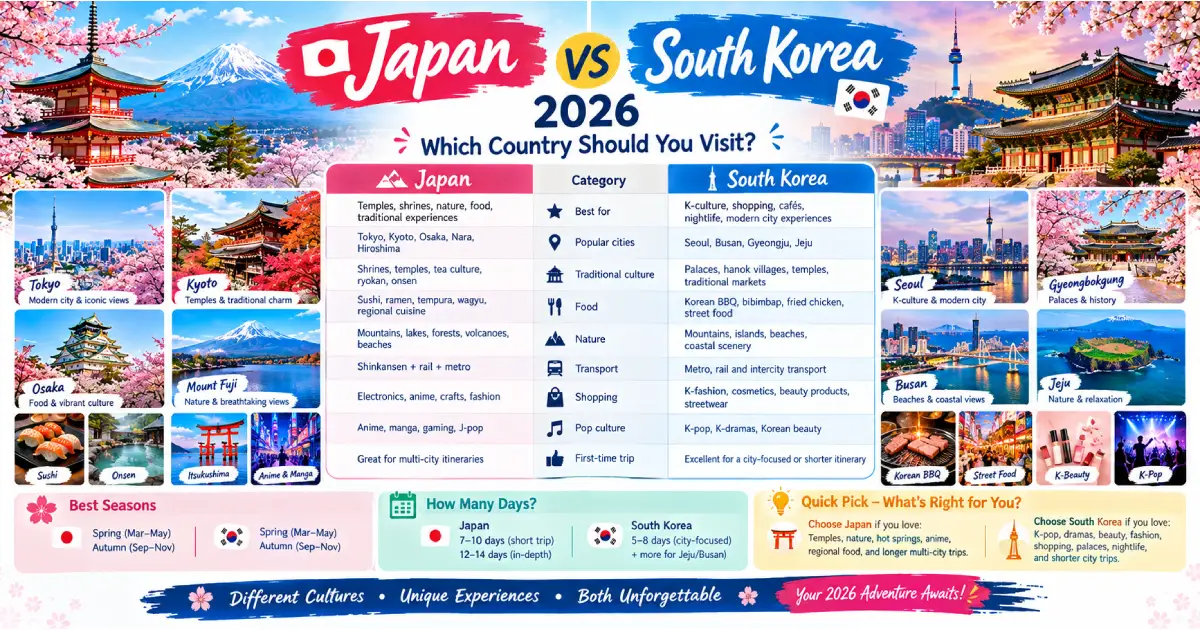
Japan and South Korea are the two East Asia trips tier-1 travelers most often weigh against each other — geographically close (a 2.5-hour flight apart), similarly efficient to navigate, and both delivering world-class food and a genuinely distinct cultural identity, which is exactly what makes choosing between them for a single trip a harder decision than Japan vs almost anywhere else in Asia. The honest short version: Japan is the more structured, more expensive, more temple-and-tradition-dense trip that rewards patience and precision; South Korea is faster-paced, noticeably cheaper, and built around a livelier, more contemporary energy — K-pop, K-drama filming locations, 24-hour cities, and a nightlife culture with genuinely no closing time — layered over its own deep Buddhist and Confucian historical core that surprises visitors who arrive expecting only the modern, pop-culture side.
Japan is best for travelers who want a structured, high-craft trip where trains run to the second, meals are quiet acts of precision, and culture sits in the small details — wrapped umbrellas, slippered ryokan floors, a sushi chef who has cut the same fish the same way for thirty years.
South Korea is best for travelers who want energy, value, and a specifically contemporary cultural pull — a place where a full Korean BBQ dinner with drinks runs a fraction of Tokyo prices, the nightlife genuinely doesn’t stop, and K-pop and K-drama fandom gives a first-time visitor a built-in reason to explore neighborhoods a generic sightseeing list would skip.
| Category | Winner | Why |
|---|---|---|
| 💰 Cost | South Korea | Meaningfully cheaper across hotels, food, and domestic transport |
| 🍜 Food Scene | Tie | Both world-class; different strengths (precision vs bold flavor) |
| ⛩️ Culture & History | Japan | Greater density and preservation of pre-modern sites |
| 🌃 Nightlife | South Korea | Later hours, no last-train cutoff culture, livelier scene |
| 🚄 Ease of Travel | Japan | More English signage, more tourist-refined systems overall |
| 🛍️ Shopping & Pop Culture | South Korea | K-beauty, K-pop, and fashion retail depth |
| 🏞️ Nature & Landscapes | Japan | More varied — Alps, coastline, volcanic terrain, four distinct seasons |
| 👨👩👧 Family-Friendly | Japan | Slightly more visitor infrastructure built around families |
| ✈️ Flight Time from Tier-1 Countries | Roughly Tied | Comparable long-haul times from US/UK/Canada/Australia |
Overall: Japan leads on depth and infrastructure polish; South Korea leads on value and pace. Neither “wins” outright — the better trip depends specifically on what kind of two weeks you want.
South Korea is consistently 20–35% cheaper than Japan across the categories that matter most to a trip’s total cost: hotels, restaurant meals, and domestic transport. A comparable 3-star hotel that runs $80–$120/night in Tokyo or Kyoto typically runs $50–$85/night in Seoul or Busan, and a full Korean BBQ dinner with soju for two can come in under $40 in Seoul, where an equivalent quality sit-down dinner in Tokyo runs closer to $60–$90. Japan isn’t uniformly expensive (see our Is Japan Expensive in 2026? breakdown — the budget end is cheaper than most tier-1 visitors expect), but South Korea’s budget and mid-range tiers both undercut Japan’s by a consistent, noticeable margin.
This is the category where declaring a winner genuinely misrepresents the comparison. Japanese food culture rewards specialization and precision — a restaurant serving exactly one dish, executed with extreme technical control, at every price point from a $6 ramen bowl to a $400 sushi omakase. Korean food culture rewards boldness and communal eating — barbecue grilled tableside, banchan (small side dishes) arriving without being asked, and a fermented, spice-forward flavor profile (gochujang, kimchi, doenjang) that Japanese cuisine largely doesn’t explore. Visitors who prioritize precision and quiet ritual tend to prefer Japan; visitors who prioritize bold, communal, spicy flavors tend to prefer Korea — both are legitimately world-class, not a consolation-prize comparison.
Japan’s historical preservation runs deeper and denser: Kyoto alone holds roughly 1,600 Buddhist temples and hundreds of Shinto shrines, many centuries old and meticulously maintained, alongside surviving feudal-era castles (Himeji, Matsumoto) and entire preserved historic districts. South Korea’s own history is equally rich — Gyeongbokgung Palace, the Joseon Dynasty’s five grand palaces, and Gyeongju’s UNESCO-listed Silla-era sites are genuinely impressive — but South Korea’s 20th-century history (Japanese colonial occupation from 1910–1945, followed by the Korean War’s widespread destruction) means a meaningfully smaller share of pre-modern architecture survives intact compared to Japan’s.
Seoul’s nightlife runs later and looser than almost anywhere in Japan — Hongdae’s club district, Itaewon’s international bar scene, and 24-hour noraebang (karaoke room) culture operate without Japan’s more structured “last train” cutoff that often ends a Tokyo night by necessity around midnight. Japan’s nightlife (Shinjuku’s Golden Gai, Osaka’s Dotonbori) is genuinely excellent but generally quieter and more contained than Seoul’s, where staying out until sunrise is a normal, unremarkable plan on a weekend.
Japan’s tourist infrastructure has a longer head start on accommodating English-speaking visitors — more English signage on trains and in stations, a more internationally bedded-in tipping-free and cash-friendly service culture, and the JR Pass system built specifically for tourist rail travel. South Korea’s T-money transit card and Seoul subway are excellent and genuinely easy to use, and Korea has closed much of this gap over the past decade, but Japan retains a slight edge specifically for a first-time, no-Japanese-or-Korean-language visitor.
South Korea’s global cultural export moment (K-pop, K-drama, K-beauty) gives Seoul a specific, currently-peaking pull that Japan’s own considerable pop culture (anime, manga, Akihabara) doesn’t quite match for the current generation of tier-1 travelers — Myeongdong’s K-beauty retail density, Hongdae’s K-pop entertainment agency buildings and fan cafes, and K-drama filming location tourism are all genuinely current cultural draws rather than nostalgia plays.
Japan’s geography offers meaningfully more range within a single trip: the Japan Alps’ genuine high-altitude mountain scenery, four clearly distinct seasons (cherry blossoms, humid summer, autumn foliage, snow), volcanic terrain (Mount Fuji, Hakone’s Owakudani), and extensive coastline. South Korea’s own landscapes — Jeju Island’s volcanic scenery, Seoraksan National Park’s granite peaks — are genuinely beautiful but narrower in overall range across a typical two-week visitor itinerary.
Japan’s tourist infrastructure has slightly more depth built specifically around family travel — extensive theme parks (Tokyo Disneyland/DisneySea, Universal Studios Japan), a strong culture of public safety and cleanliness that specifically reassures parents traveling with children, and widespread, high-quality konbini food that simplifies feeding picky eaters on the move. South Korea (Everland, Lotte World) offers real family-friendly options too, but with a somewhat narrower overall spread of specifically child-oriented attractions than Japan’s.
| Expense | Japan (Tokyo/Kyoto) | South Korea (Seoul) |
|---|---|---|
| 3-star hotel, per night | $80–$150 | $55–$100 |
| Mid-range dinner for one | $25–$45 | $15–$30 |
| Subway single ride | ~$1.30 | ~$1.10 |
| 7-day trip, mid-range budget (excl. flights) | $900–$1,400 | $650–$1,050 |
Choose Japan first if: you want the more structured, deeper-history trip, a strong personal interest in traditional culture, food craftsmanship, or nature (Mount Fuji, the Japan Alps, four-season scenery), and don’t mind a somewhat higher budget and a quieter, earlier-ending evening pace.
Choose South Korea first if: budget is a bigger factor, you’re specifically drawn by K-pop, K-drama, or Korean beauty and fashion culture, you want a livelier, later-running nightlife scene, and you’re comfortable with a country that’s slightly less internationally tourist-refined but closing that gap quickly.
Consider both in one trip if: your total travel window is 14+ days — Tokyo to Seoul is a roughly 2.5-hour direct flight, and combining a Japan-focused first week with a Korea-focused second week is one of the most popular multi-country East Asia routes among tier-1 travelers specifically because the contrast (structured/expensive vs. energetic/affordable) makes each country feel more distinct by comparison rather than blending together.
About Travel Tourister Travel Tourister’s destination specialists have run both East Asia circuits side by side — from Kyoto’s pre-dawn torii gates and Hakone’s onsen ryokan quiet to Seoul’s Hongdae nightlife and Myeongdong K-beauty crawls — to give tier-1 travelers an honest, non-biased comparison for deciding between Japan and South Korea in 2026.
Posted By : Vinay
Latest Article
2nd Floor, 39, Above Kirti Club, DLF Industrial Area, Kirti Nagar, New Delhi, Delhi 110015



Travel Tourister is a leading Travel portal where we introduce travellers to trusted travel agents to make their journey hasselfree, memorable And happy. Travel Tourister is a platform where travellers get Tour packages ,Hotel packages deals through trusted travel companies And hoteliers who are working with us across the world. We always try to find new and more travel agents and hoteliers from every nook and corners across the world so that you could compare the deals with different travel agents and hoteliers and book your tour or hotel with the one you have chosen according to your taste and budget.
Copyright © Travel Tourister, India. All Rights Reserved

 Call
Call Enquiry