Published on : 27 Oct 2026
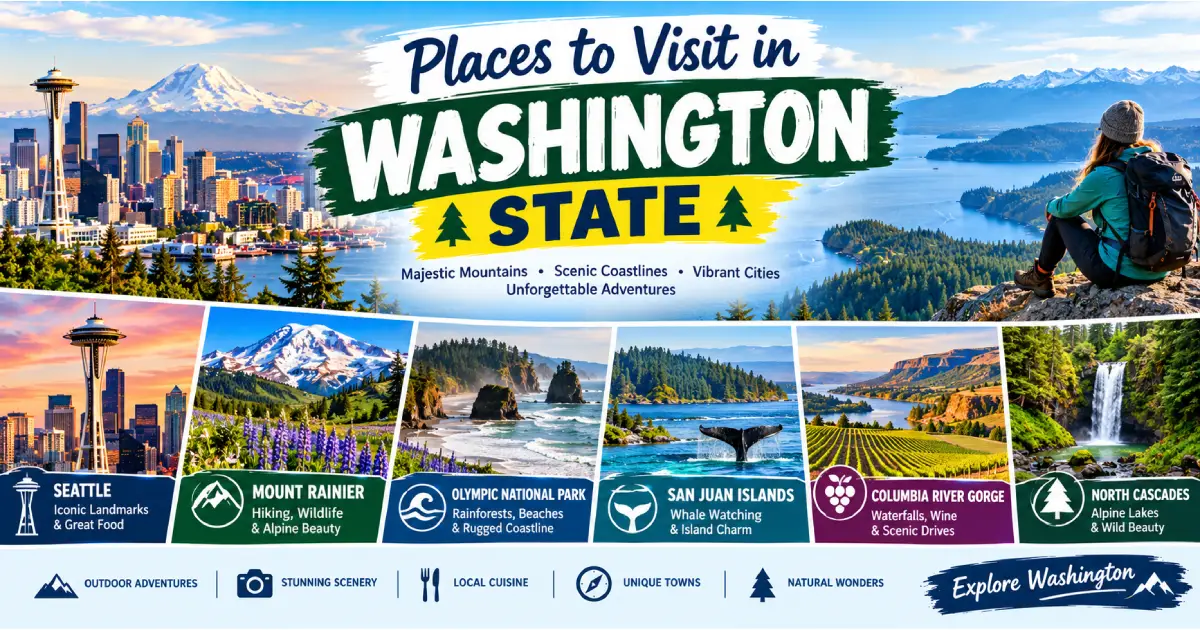
Washington State is the most geographically diverse state in the Pacific Northwest — a 71,298-square-mile landscape that compresses rainforest, volcanic peaks, high desert, glacier-capped mountain ranges, and one of the most productive agricultural regions in the United States into a single state divided by the Cascade Range into two climatic and cultural worlds. West of the Cascades: the wet, temperate, heavily forested western slope dominated by Seattle and its satellite cities, the Olympic Peninsula’s ancient temperate rainforest, the San Juan Islands’ maritime culture, and the dramatic Pacific coastline. East of the Cascades: the dry Columbia Plateau, the Palouse’s wheat-farming hills, the Columbia River wine country, and the Okanogan Highlands. The Cascade Range itself — Mount Rainier (14,411 ft), Mount Baker (10,781 ft), North Cascades, Glacier Peak, Mount St. Helens just across the Oregon border — is the finest volcanic mountain range in the contiguous United States.
Seattle (population 750,000) is the state’s cultural and economic engine — the home of Amazon, Microsoft, Boeing, and Starbucks (all founded here), a waterfront city on Puget Sound with the Olympic Mountains visible across the water to the west and Mount Rainier visible to the south on clear days, and a food, music, and arts scene with no peer in the Pacific Northwest. But Washington’s most extraordinary places are outside Seattle: the Hoh Rain Forest (where 12–14 feet of annual precipitation creates temperate rainforest ecosystems found otherwise only in New Zealand and coastal Chile), the North Cascades Highway (the most scenic mountain drive in the state), the Columbia River Gorge, and the Columbia River wine country (the Yakima Valley and Walla Walla produce some of the finest Cabernet Sauvignon and Syrah in the world).
In 2026, Washington has refined its reservation and timed-entry systems for its most popular destinations: Mount Rainier’s Paradise area requires timed entry permits July–August; the Enchantments (Alpine Lakes Wilderness) overnight lottery is the most competitive in the Pacific Northwest; and the San Juan Islands ferry system has added advance reservations for peak summer sailings. This guide covers the 15 best places to visit in Washington State, from the Olympic Peninsula’s old-growth rainforest to the volcanic plains of eastern Washington.
| Destination | Region | Best For | Best Season |
|---|---|---|---|
| Seattle | Puget Sound | City, food, culture | Year-round |
| Olympic National Park | Olympic Peninsula | Rainforest, coast, mountains | June–September |
| Mount Rainier NP | Central Cascades | Volcanic peak, wildflowers | July–September |
| San Juan Islands | Puget Sound / Salish Sea | Whale watching, cycling | June–September |
| North Cascades NP | Northern Cascades | Glaciers, remote wilderness | July–September |
| Columbia River Gorge | South-Central WA | Waterfalls, windsurfing | May–October |
| Leavenworth | Eastern Cascades | Bavarian village, hiking | Year-round |
| Walla Walla | Southeast WA | Wine, history | May–October |
| Mount St. Helens | Southern Cascades | Volcanic geology | June–October |
| Palouse | Southeast WA | Rolling wheat hills, photography | May–June (green) / August (harvest) |
| Whidbey Island | Puget Sound | Island drives, beaches | June–September |
| Port Townsend | Olympic Peninsula | Victorian architecture, arts | Year-round |
| Spokane | Eastern WA | Gateway city, Riverfront Park | Year-round |
| Cape Flattery | NW tip of Olympic Peninsula | Westernmost point in lower 48 | June–September |
| Methow Valley | North-Central Cascades | Nordic skiing, outdoor recreation | Year-round |
Region: Puget Sound | Elevation: Sea level–520 ft Best Season: June–September (driest, warmest); year-round for culture Getting There: Seattle-Tacoma International Airport (SEA), 14 miles south
Seattle is the finest large city in the Pacific Northwest and one of the most distinctive major cities in the United States — a city built on seven hills between Puget Sound and Lake Washington, with a downtown skyline framed by the Olympic Mountains to the west and Mount Rainier to the southeast, a waterfront culture defined by its position on a deep-water port at the southeastern corner of the Salish Sea, and a food scene that draws on the finest seafood (Dungeness crab, Pacific oysters, king salmon, geoduck) and produce (Yakima Valley apples, Washington asparagus, Walla Walla sweet onions) in the American West.
Essential Seattle:
Region: Olympic Peninsula | Entry: $35/vehicle | Area: 1,441 sq miles Best Season: June–September (Hoh Rain Forest accessible year-round) Getting There: 3 hours from Seattle via US-101
Olympic National Park is the most ecologically diverse national park in the continental United States — a single park that encompasses three distinct ecosystems (temperate rainforest, subalpine mountain terrain, and 73 miles of Pacific coastline) with no roads connecting them, preserving the most complete example of North America’s temperate rainforest ecology and some of the most remote coastline accessible by hiking in the lower 48.
Hoh Rain Forest (13 miles south of Forks on Upper Hoh Road): The finest temperate rainforest in the United States — an old-growth forest receiving 12–14 feet of annual precipitation, with Sitka spruce and western red cedar trees reaching 300 feet and 23 feet in circumference, bigleaf maple draped with club moss creating the most otherworldly forest interiors in North America. The Hall of Mosses Trail (0.8-mile loop, flat, easy) is the most photographed trail in Washington State — the finest 45-minute walk in the Pacific Northwest. The Hoh River Trail continues 17 miles to the Blue Glacier on Mount Olympus (7,965 ft).
Hurricane Ridge (18 miles south of Port Angeles on Hurricane Ridge Road): The finest above-treeline viewpoint on the Olympic Peninsula — a 5,240-foot ridge with panoramic views of the Olympic Mountains (Mount Olympus, 7,965 ft, visible straight ahead), the Strait of Juan de Fuca, and Vancouver Island beyond. The Hurricane Ridge Visitor Center (open daily in summer, weekends only in winter) anchors the finest day-hiking network in the park: the Big Meadow Trail (1 mile, flat) and Klahhane Ridge Trail (3.8 miles RT, moderate) are the best options.
Rialto Beach (2 miles north of La Push): The finest beach on the Olympic Coast — a wild Pacific beach of dark basalt cobbles and sea stacks, accessible from a short flat walk from the parking area, with the Hole-in-the-Wall (a 1-mile walk north, a sea-arch accessible at low tide) and the largest concentration of drift logs on the Washington coast. Olympic Coast backpacking (reservations required, $8/person/night, recreation.gov) provides access to the most remote coastline in the lower 48.
Sol Duc Hot Springs (12 miles east of Forks on Sol Duc Road): Three natural hot springs pools (98–104°F) in an old-growth forest setting — the most distinctively situated hot springs resort in Washington. Day-use $17/person; Sol Duc Hot Springs Resort ($180–$260/night cabin, open mid-May–October) for overnight stays.
Region: Central Cascades, Pierce and Lewis Counties | Entry: $35/vehicle Best Season: July–September (Paradise area peak wildflowers: late July–August) Getting There: 2.5 hours from Seattle via WA-7 or WA-706 2026 Timed Entry: Paradise area requires advance permit July–August; recreation.gov
Mount Rainier is the most topographically prominent mountain in the contiguous United States — a 14,411-foot dormant stratovolcano that rises 13,211 feet above its base (more local relief than any mountain in the lower 48, including Denali relative to its base) and supports 26 named glaciers (the largest glacial system in the lower 48 outside Alaska). On clear days, Rainier is visible from Seattle, Portland, and the Cascade ridgelines of both Washington and Oregon simultaneously — a presence in the landscape that defines the Pacific Northwest skyline.
Paradise (5,400 ft): The most popular area in the park — a subalpine meadow on the mountain’s south face that produces the finest wildflower display in Washington (late July–August: avalanche lily, lupine, paintbrush, and bistort in meadows above the visitor center), with the Henry M. Jackson Visitor Center (2008, the largest visitor center in the National Park system), the Paradise Inn (1916, National Historic Landmark, $165–$250/night, open late May–early October), and the finest network of day hikes at any Cascade volcano. The Skyline Trail (5.5-mile loop, 1,400 ft gain, moderate) is the finest day hike at Paradise — reaching Panorama Point (6,800 ft) for the most comprehensive view of the mountain and the glaciers above.
Sunrise (6,400 ft): The highest point accessible by road in Washington — a higher and more austere alpine environment than Paradise, with the finest views of the mountain’s northeast face (the Liberty Ridge and Willis Wall), the White River valley, and the Emmons Glacier (the largest glacier in the lower 48 by area, 4.3 square miles). The Sunrise Visitor Center (open July–September) and the Sourdough Ridge Trail (2.5-mile loop, easy) are the standard introduction.
Spray Park: The finest off-the-beaten-path wildflower hike in the park — a 9-mile round-trip from Mowich Lake through old-growth forest to a subalpine meadow with the clearest view of the mountain’s northwest face. Far less crowded than Paradise; the wildflower display (late July–mid-August) rivals Paradise in intensity and surpasses it in solitude.
Region: Puget Sound / Salish Sea, northwest of Anacortes Best Season: June–September (whale watching: May–October) Getting There: Washington State Ferries from Anacortes (1.5 hours from Seattle); advance reservations required July–August at wsdot.wa.gov/ferries Main Islands (served by ferry): San Juan, Orcas, Lopez
The San Juan Islands are the finest maritime destination in the Pacific Northwest — an archipelago of 172 named islands and reefs in the Salish Sea between Washington’s mainland and Vancouver Island, BC, inhabited by resident orca (killer whale) pods that are the most reliably viewable in the United States, Dall’s porpoises and harbor porpoises in near-daily abundance, bald eagles at the highest density of any area in the lower 48, and a human community that has maintained a fishing and agricultural character alongside the tourism economy.
San Juan Island (Friday Harbor): The most developed of the main islands — the ferry landing at Friday Harbor (population 2,300) has the finest concentration of restaurants and lodging. The Whale Museum (62 First St N, $9) and San Juan Island National Historical Park (English and American Camps, free) are the two essential non-whale-watching attractions. The west side of the island (Lime Kiln Point State Park, the “Whale Watch Park”) is the only land-based orca watching location in the world — resident J, K, and L pods pass within 300 feet of the rocky shore on their feeding routes June–September.
Orcas Island (Eastsound): The largest and most dramatic of the San Juan Islands — Moran State Park (5,252 acres, the largest state park in Washington, with Mount Constitution at 2,409 ft providing the finest view in the San Juans) and Cascade Lake (kayaking and swimming) are the primary natural attractions. The Rosario Resort (1400 Rosario Rd, $199–$450, a 1906 mansion converted to a resort) is the finest lodging in the islands.
Lopez Island: The flattest and most cycling-appropriate of the main islands — 30 miles of low-traffic roads, the Spencer Spit State Park beach camping, and a slow pace that makes it the finest place in the San Juans to simply exist for a few days without an itinerary. The Lopez Village market and Holly B’s Bakery are the finest local-food destinations on the island.
Whale watching: May–October for resident orca pods (J, K, L pods — Southern Resident Killer Whales, a genetically distinct population found nowhere else in the world); minke whales May–September; humpback whales August–October (increasing in frequency as the population recovers). San Juan Safaris (docked at Friday Harbor, $109–$129/person, 3.5 hours) and Western Prince Cruises are the two established guided operators.
Region: Northern Cascades | Entry: Free (North Cascades Highway, WA-20, passes through) Best Season: July–September (North Cascades Highway closes mid-November–April) Getting There: 2.5 hours from Seattle via I-5 north and WA-20 east
North Cascades National Park is the most rugged and least-visited major national park in Washington — a 504,000-acre wilderness of jagged peaks, active glaciers (more than 300 glaciers, the largest concentration in the lower 48 outside Alaska), and old-growth forest that has earned the name “the American Alps.” The North Cascades Highway (WA-20, North Cascades Scenic Byway) traverses the park’s southern boundary from Burlington on the western slope to Winthrop on the eastern slope, crossing Washington Pass (5,477 ft) with the Liberty Bell rock formation — one of the finest single viewpoints on any Pacific Northwest highway.
Washington Pass Overlook (WA-20 mile 161.5): The finest roadside viewpoint in Washington State — a short paved path from the WA-20 pullout to a viewing platform directly below the Liberty Bell group (a cluster of granite spires first climbed in 1946), with the full North Cascades ridgeline visible in both directions. Early Rock (7,720 ft) and Concord Tower are the dominant formations; the view east toward the Methow Valley is equally dramatic.
Diablo Lake (WA-20 mile 127): The most photographed lake in the North Cascades — a reservoir with water that appears impossibly turquoise-green (the color produced by glacier flour, fine glacial rock suspended in the meltwater) surrounded by glacier-fed peaks. The Diablo Lake Overlook is a 5-minute walk from the WA-20 pullout; the Diablo Lake Trail (7.6-mile loop, moderate) provides the finest lakeside hiking.
Ross Lake: The largest reservoir in the North Cascades complex — accessible by water taxi from Diablo Dam ($25/person RT, June–October) or by a 2-mile trail from the WA-20 access road. Ross Lake Resort (16 floating cabins, $225–$350/night, June–October; rosslakerresort.com) is one of the most distinctive lodging options in Washington State — a floating cabin resort only accessible by water or foot.
Cascade Pass (3,400 ft, 7.4 miles RT, 1,800 ft gain): The finest day hike in North Cascades NP — a trail to a high pass with views of the Ptarmigan Ridge, Johannesburg Mountain (8,245 ft), and the Cascade River valley. The upper basin holds snow until late July; wildflowers peak mid-August.
Region: South-Central Washington / Oregon border | Entry: Free; some sites charge day-use fees Best Season: March–June (peak waterfalls from snowmelt); July–October (windsurfing, wineries) Getting There: 2.5 hours from Seattle via I-5 south and I-84 east; 45 minutes from Portland
The Columbia River Gorge is a 80-mile canyon cut by the Columbia River through the Cascade Range — a National Scenic Area shared between Washington and Oregon, with Washington’s north shore (WA-14) providing the finest drive along the gorge with the river and the Oregon waterfalls visible across the water, and the Oregon south shore (Historic Columbia River Highway) providing direct access to the waterfall corridor. The gorge contains 77 waterfalls within 25 miles — the highest concentration of waterfalls accessible from a highway in the United States.
Washington’s north shore (WA-14, Cape Horn): The finest scenic drive in southern Washington — a 73-mile route from Vancouver through the gorge to Maryhill, with the Cape Horn viewpoint (mile 26 on WA-14, a turnout above the 700-foot basalt cliff with the full Columbia River and the Oregon waterfall corridor visible) as the single finest viewpoint in the Washington gorge. The Cape Horn Trail (7.6 miles RT, moderate, 1,000 ft gain) descends from the highway to the river level and back up to the clifftop.
Beacon Rock State Park (WA-14, mile 35): The second-largest monolith in the United States (848 ft, a volcanic plug left by a 57,000-year-old lava flow) with a 1.8-mile switchbacking trail to the summit (52 handrails and bridges, moderate difficulty) and the finest view of the upper Columbia River Gorge from any summit in Washington. The park also has camping ($22–$45/night) and rock climbing on the basalt walls.
Maryhill Museum of Art (35 Maryhill Museum Dr, Goldendale): The finest roadside museum surprise in the Pacific Northwest — an isolated mansion on the Washington side of the gorge (built 1914 by railroad magnate Sam Hill) converted to a museum with a collection of Rodin sculptures (the finest Rodin collection west of the Mississippi), Native American artifacts, and one of the finest collections of Russian Imperial chess sets in the world. Adjacent: a full-scale replica of Stonehenge built by Sam Hill as a WWI memorial.
Wind and kite surfing (White Salmon/Stevenson area): The Columbia River Gorge is the finest windsurfing destination in North America — the consistent afternoon thermal wind (the “Coho,” blowing west through the gorge as warm inland air pulls cooler Pacific air eastward, averaging 15–25 knots on summer afternoons) makes the Stevenson and White Salmon reaches the most reliable intermediate-to-expert wind sports venue in the United States. Gorge Wind Sports (226 Portway Ave, Hood River, OR) provides rentals and lessons.
Region: Eastern Cascades, Chelan County | Elevation: 1,165 ft Best Season: Year-round; peak: December (Christmas lights), September (Oktoberfest), July–August (summer festivals) Getting There: 2.5 hours from Seattle via US-2 over Stevens Pass
Leavenworth is the finest themed mountain town in the Pacific Northwest and one of the most genuinely festive small towns in the western United States — a former logging and railroad town of 2,000 that transformed itself in the 1960s into a Bavarian Alpine village (the architectural makeover was a civic decision; the entire downtown was redesigned with Bavarian facades, window boxes, and German signage) and has since become the second-most-visited destination in Washington after Seattle. The surrounding Wenatchee National Forest and the Enchantment Peaks make Leavenworth simultaneously a tourist town and a world-class outdoor recreation gateway.
Downtown Leavenworth: The Front Street pedestrian core — 3 blocks of Bavarian-style shops, restaurants, and biergartens centered on the Marktplatz (an outdoor plaza with the finest Christmas lighting display in the Pacific Northwest: 500,000 LED lights, lit nightly December 1–January 1 in three distinct weekends). Oktoberfest (first three weekends of October, $35/day festival admission) is the finest German beer festival west of the Mississippi — a genuine multi-day event with live German bands, traditional dance, and 20+ German beer varieties.
The Enchantments: The most spectacular alpine lake basin in Washington — a 19-mile traverse through the Alpine Lakes Wilderness passing 11 named lakes (Snow Lake, Nada Lake, Perfection Lake, Leprechaun Lake, Aasgard Pass) at 7,000–8,000 feet with Cascade peaks above. Day permits (Core Zone: $3/day, lottery-based through recreation.gov, opens January 15 each year) and overnight permits (the most competitive wilderness lottery in the Pacific Northwest, $6/night) are required. Snow Lake (5.2 miles RT from Eightmile Creek trailhead, day use) is accessible without a permit and provides the finest accessible lake view in the Enchantments.
Ski Hill: A small community ski area directly above town — the only ski hill in the United States where you can ski from the mountain directly onto the main street of a Bavarian village. 6 runs, 1 chairlift, rope tow; $20/day lift ticket. More significant as a cultural experience than as a ski destination.
Region: Southeast Washington | Elevation: 949 ft Best Season: May–October (peak wine season); harvest: September–October Getting There: 4.5 hours from Seattle; 5 hours from Portland; Walla Walla Regional Airport (ALW) with daily flights from Seattle
Walla Walla is the finest wine destination in the Pacific Northwest and one of the most distinguished wine appellations in the United States — a small city of 34,000 in the southeastern Washington wheat country that has developed 120+ wineries in the Walla Walla AVA (American Viticultural Area, shared with a small section of Oregon) since the first modern winery opened in 1977. The Walla Walla AVA produces some of the finest Cabernet Sauvignon, Syrah, and Merlot in North America — wines that compete directly with the best of Napa Valley and Willamette Valley at half the price.
Walla Walla wineries (selection): Leonetti Cellar (the founding winery of the modern Walla Walla wine industry; 1977; highly allocated, mailing list only), Cayuse Vineyards (biodynamic pioneer; Horsepower Vineyards Syrah; mailing list allocation), L’Ecole No. 41 (in a renovated 1915 schoolhouse; the most visitor-friendly of the top-tier producers; $20–$100/bottle), Seven Hills Winery (one of the largest estate vineyards in the AVA; excellent tasting room; $25–$80), and Dunham Cellars (in a restored WWII-era airplane hangar; $30–$85). Most tasting rooms open Friday–Sunday; reservations recommended.
Downtown Walla Walla: The finest small-city downtown in eastern Washington — a 4-block commercial core of Victorian commercial buildings with independent restaurants, galleries, and the Marcus Whitman Hotel (6 W Rose St, $159–$299, 1928 historic hotel, the finest lodging in Walla Walla). The Walla Walla Farmers Market (5th Ave and Alder St, Saturday mornings June–October) sells the finest produce in eastern Washington — Walla Walla Sweet Onions (a genuine appellation variety, grown only in the Walla Walla Valley, harvested June–August), asparagus, peaches, and garlic.
Whitman Mission National Historic Site (7 miles west of Walla Walla on US-12, free): The site of the 1847 Whitman Massacre — the mission established by Marcus and Narcissa Whitman on the Oregon Trail in 1836 that became the largest waystation on the trail and was destroyed in 1847 by Cayuse people in response to the epidemic diseases the missionaries had introduced. The National Park Service site provides the most balanced interpretation of this pivotal episode in Pacific Northwest history.
Region: Southern Cascades, Cowlitz and Skamania Counties Entry: $8/person (Coldwater Ridge and Johnston Ridge Observatory) Best Season: May–October; Johnston Ridge Road opens late May Getting There: 2.5 hours from Seattle; 1.5 hours from Portland via I-5 and WA-504
Mount St. Helens is the most geologically significant landscape accessible from the Pacific Northwest cities — a stratovolcano whose May 18, 1980 eruption (the largest volcanic event in recorded US history; killed 57 people, destroyed 230 square miles of forest, sent ash 15 miles into the stratosphere) removed the top 1,300 feet of the mountain and created the most dramatic volcanic landscape visible from a paved road in the continental United States. The recovery of the blast zone — a 40-year study in ecological succession — is itself one of the most significant ongoing natural science stories in North America.
Johnston Ridge Observatory (WA-504, 52 miles from I-5 Exit 49, 4,314 ft): The finest viewpoint in the monument — a visitor center and interpretive center at the end of the Spirit Lake Highway, 5 miles from the crater rim, with a direct view into the mile-wide volcanic crater and the lava dome within it. The Eruption Trail (0.5-mile, paved, accessible) circles the observatory with interpretive signs on the 1980 eruption sequence. Open late May–October.
Hummocks Trail (Johnston Ridge to Coldwater Lake, 2.6-mile loop): The finest short hike in the monument — a loop through the hummocky terrain of the 1980 debris avalanche deposit (the largest landslide in recorded human history, 0.67 cubic miles of material, traveling at 100–150 mph), with interpretive signs on the eruption sequence and the ecological recovery. Elk are frequently visible from this trail.
Ape Cave (Forest Road 8303, 12 miles north of Cougar, WA): The longest lava tube in the contiguous United States — a 2.5-mile lava tube formed 2,000 years ago by a basaltic lava flow, with the finest underground hiking accessible from a trailhead in Washington. The lower cave (1.5 miles one-way, easy flat walking with a headlamp) and the upper cave (1.5 miles, requires scrambling over large lava chunks) are the two sections; lantern rental ($7) available at the cave entrance.
Region: Southeast Washington and northern Idaho | Hub towns: Pullman, Colfax, Palouse Best Season: May–June (green rolling hills); August (golden harvest) Getting There: 5 hours from Seattle via I-90 east; Pullman-Moscow Regional Airport (PUW) with daily Seattle flights
The Palouse is the most visually distinctive agricultural landscape in the United States — a 3,000-square-mile region of wind-deposited loess (fine glacial silt) hills in southeastern Washington and northern Idaho that has been shaped by 10,000 years of dry-farming wheat agriculture into a landscape of perfectly smooth rolling hills without a single tree, rock, or fence line visible on the hillsides. In May and June (when the winter wheat is green), the Palouse looks like a painting by a particularly idealistic landscape artist; in August (harvest), the combines trace contour lines across the golden hills in patterns that photographers from around the world come to capture.
Steptoe Butte State Park (10 miles north of Colfax on WA-195): The finest single viewpoint in the Palouse — a 3,612-foot quartzite butte that rises 1,000 feet above the surrounding wheat fields, accessible by a 3.5-mile paved road to the summit. The summit provides a 360-degree view of the Palouse hills extending 40 miles in every direction — the finest panoramic view of an agricultural landscape in North America. Golden hour photography (sunrise or sunset) from Steptoe Butte is the most rewarding landscape photography accessible from a paved road in Washington.
Palouse Falls State Park (17 miles northeast of Washtucna on WA-261): A 198-foot waterfall on the Palouse River dropping into a 400-foot basalt canyon — the finest waterfall in eastern Washington and Washington’s official state waterfall. The canyon below the falls was carved by the Missoula Floods (15,000–18,000 years ago), and the geological context (visible in the canyon walls) provides the most accessible introduction to Washington’s catastrophic flood geology.
Region: Puget Sound, north of Seattle | Length: 55 miles (longest island in the contiguous US) Best Season: June–September Getting There: Clinton ferry from Mukilteo (30 minutes from Seattle, 20-minute crossing, $12/vehicle); or drive via Deception Pass Bridge from Anacortes (1.5 hours from Seattle)
Whidbey Island is the finest island day-trip and weekend destination accessible from Seattle — a 55-mile-long island in Puget Sound with a dramatically varied character: the dramatic Deception Pass State Park at the north end (the most visited state park in Washington), the Victorian seaport town of Coupeville at the center, the excellent local food scene at Langley on the south end, and a pastoral agricultural interior (Whidbey is one of the few places in the Pacific Northwest where small-scale farming has survived near a major metropolitan area).
Deception Pass State Park (north end, 4,128 acres): Washington’s most visited state park — the Deception Pass Bridge (1935, 182 feet above the water, connecting Whidbey Island to Fidalgo Island) spans the tidal strait with the finest turbulent water visible from a road bridge in the Pacific Northwest. The park has 38 miles of trails, two campgrounds ($22–$45/night), and the finest concentration of marine and forest wildlife on Whidbey — resident bald eagles, harbor seals on the rocks below the bridge, and Dungeness crab accessible from the North Beach.
Coupeville (central Whidbey): A genuine Victorian seaport town (established 1852, one of the oldest settlements in Washington) with a waterfront wharf (the original 1905 commercial wharf, now a marine research station and viewing platform), the Island County Historical Society Museum ($5, the finest small museum in the San Juan/Whidbey region), and Toby’s 1890 Tavern (the finest Penn Cove mussel preparation in Washington — Penn Cove mussels, farmed in the cove directly below the town, are the finest cultivated mussels in the United States).
Region: Olympic Peninsula, Jefferson County | Elevation: Sea level Best Season: Year-round (the driest town on the Olympic Peninsula) Getting There: 1.5 hours from Seattle via the Edmonds-Kingston ferry + WA-104; or 2.5 hours by road
Port Townsend is the finest Victorian seaport town in the Pacific Northwest and the most architecturally intact 19th-century commercial district in Washington State — a town built in the 1880s when boosters expected it to become the leading port of the Puget Sound, before Seattle’s deep-water harbor advantage ended that ambition and left Port Townsend with a downtown of 1880s brick commercial buildings and a residential neighborhood of Victorian painted ladies (the finest concentration in Washington) essentially unmodified since 1895.
Victorian architecture tour (self-guided, free): The 8-block downtown commercial district (Water Street) and the residential Uptown neighborhood (Lawrence and Washington Streets) contain 70+ designated historic structures — the finest Victorian-era urban fabric in Washington and among the finest in the American West. The Jefferson County Historical Society (540 Water St, $7) provides the best architectural walking tour guide.
Fort Worden State Park (200 Battery Way, $22–$45/camping): A decommissioned 1898 US Army artillery installation on the headland above Port Townsend — 434 acres of gun batteries (the finest intact coastal defense fortifications in the Pacific Northwest), a marine science center (Point Wilson Lighthouse, 1879), and the finest camping with Victorian architecture views in Washington. The conference center (former barracks, now event facility) hosts the Centrum Foundation’s summer music workshops — the finest acoustic music workshop programs in the Northwest.
Port Townsend Film Festival (September, $15–$75/day pass): The finest small-city film festival in Washington State — a 4-day September event screening independent and documentary films with Q&A sessions.
Region: Northwest tip of the Olympic Peninsula, Clallam County Distance from Seattle: 3.5 hours via US-101 and WA-112 to Neah Bay Trail: 1.5-mile RT from the Makah tribal trailhead ($10 recreation permit, required) Best Season: June–September
Cape Flattery is the northwesternmost point of the contiguous United States — a dramatic sea cliff at the mouth of the Strait of Juan de Fuca, accessible by a 0.75-mile forest trail from the Makah Reservation at Neah Bay, dropping to a series of wooden viewing platforms above sea caves, sea stacks, and turbulent Pacific water with Vancouver Island visible 17 miles across the strait. The combination of the trail through old-growth Sitka spruce forest, the dramatic cliff geology (basalt sea caves and a natural arch), and the sense of standing at the geographic edge of the country make Cape Flattery one of the finest short hikes in Washington State.
Makah Museum (Neah Bay, $7): The finest Native American cultural museum in Washington — a collection covering 3,800 years of Makah history with exceptional material from the Ozette archaeological site (a 500-year-old village buried by a mudslide and excavated beginning in 1970, producing 55,000+ artifacts including the most complete collection of Northwest Coast whaling implements in the world). Worth 90 minutes before the Cape Flattery trail.
Neah Bay (year-round fishing): The finest ocean fishing port accessible from Seattle — halibut, lingcod, and Pacific salmon from the most productive ocean fishing grounds in Washington. Charter boats available year-round; summer halibut season (June–August) and fall salmon coho season (August–October) are the peak periods.
Region: Eastern Washington | Population: 230,000 | Elevation: 1,843 ft Best Season: Year-round (eastern Washington receives 300+ days of sunshine) Getting There: Spokane International Airport (GEG), served by all major carriers; 4.5 hours from Seattle via I-90
Spokane is the economic and cultural center of eastern Washington and the finest inland city in the Pacific Northwest — a city of 230,000 on the Spokane River with a genuine downtown (the finest urban waterfall in any American city — the 130-foot Spokane Falls runs through the center of downtown, visible from the bridges of the main commercial street), an outstanding art museum, and access to the finest lake country in the Pacific Northwest (Lake Coeur d’Alene, 30 minutes east in Idaho, is the finest resort lake in the Inland Northwest).
Riverfront Park (507 N Howard St): The centerpiece of Spokane — a 100-acre urban park built on the site of the 1974 World’s Fair (Expo ’74), with the Spokane Falls viewable from a pedestrian gondola ($6/person) that spans the river, the historic carousel (one of the finest remaining hand-carved carousels in the United States, originally built 1909), and the Spokane Convention Center on the riverbank.
Northwest Museum of Arts and Culture (2316 W First Ave, $14): The finest museum in eastern Washington — a collection of 3.5 million objects and documents covering the Indigenous cultures of the Inland Northwest (the finest Plateau culture collection in the country), the natural history of the Columbia Plateau, and the regional art and photography of the Inland Northwest.
Manito Park (4 W 21st Ave, free): The finest public garden in eastern Washington — a 90-acre city park with a formal rose garden (1,500 rose plants, peak June–July), Japanese garden (Nishinomiya Tsutakawa Garden, donated by Spokane’s Japanese sister city), lilac garden, and perennial garden.
Region: North-Central Cascades, Okanogan County | Towns: Winthrop, Twisp, Mazama Best Season: Winter (Nordic skiing, December–March); Summer (hiking, cycling, July–September) Getting There: 3 hours from Seattle via WA-20 over Washington Pass (road closed November–April); or 4 hours via US-97 (year-round)
The Methow Valley is the finest Nordic skiing destination in the United States and the most authentic small-town outdoor recreation community in Washington — a dry east-side Cascades valley (12 inches of annual precipitation, 300 days of sunshine) with 200 kilometers of groomed cross-country ski trails (the Methow Trails system, the largest cross-country ski network in the United States outside Alaska), a summer mountain biking and hiking trail network that rivals any in the Northwest, and the most distinctive small-town culture in Washington in the towns of Winthrop (a self-described “western” town with wooden boardwalk storefronts), Twisp (an arts community with galleries and studios), and Mazama (a crossroads community at the upper valley with the finest general store in Washington).
Methow Trails Nordic Skiing (December–March): 200 km of groomed classic and skate ski trails connecting Mazama, Winthrop, and Twisp — the finest groomed Nordic network in the United States. Trail pass $28/day adult; ski rental available at Methow Cycle & Sport (Twisp) and Liberty Bell Alpine Tours (Mazama). The Sun Mountain Lodge (Patterson Lake Rd, $195–$350/night, sunmountainlodge.com) provides ski-in/ski-out access to the trail network and the finest dining in the valley.
Sun Mountain Lodge trails (summer): 35 miles of mountain bike and hiking trails directly from the lodge, with the Patterson Lake Loop (7.4 miles, moderate) as the finest day hike — through ponderosa pine and meadow terrain with views of the North Cascades ridgeline.
Seattle to Olympic Peninsula: Ferry from Edmonds to Kingston (1 hour, $17/vehicle) + WA-104 west to US-101, or Bremerton ferry (1 hour) + WA-3 south to Hood Canal Bridge. Drive from downtown Seattle via I-5 south and WA-16 over the Tacoma Narrows Bridge is slower but avoids ferry waits.
Washington State Ferries (wsdot.wa.gov/ferries): The largest state ferry system in the United States — 10 routes connecting Puget Sound communities. The Anacortes–San Juan Islands route (peak summer advance reservations essential) and the Mukilteo–Clinton route (Whidbey Island) are the most visitor-relevant. Vehicle reservations open 2 months in advance for summer peak period.
Seattle to Eastern Washington: I-90 east over Snoqualmie Pass (3,022 ft, open year-round) is the primary route — 4.5 hours to Spokane, 3 hours to Ellensburg. US-2 north of I-90 over Stevens Pass (4,061 ft) provides an alternative route connecting Seattle to Leavenworth (2.5 hours) and eastern Washington.
Summer (June–September): The finest season for most Washington destinations — the only reliable dry period west of the Cascades, with 70–80°F temperatures in Seattle and the Puget Sound region. Peak crowds at national parks and San Juan Islands; advance reservations essential.
Fall (September–November): The finest season for wine country (harvest in Walla Walla and Yakima Valley), the Palouse (harvest photography), and the San Juan Islands (fewer crowds, whale watching continues). Western Washington weather deteriorates from October.
Winter (December–March): The finest season for Methow Valley Nordic skiing, Leavenworth Christmas lights, and skiing at Crystal Mountain (the finest ski resort in Washington, 2,600 acres, 25 miles from Mount Rainier’s north entrance) and Stevens Pass. Western Washington is consistently wet and grey November–April.
Posted By : Vinay
Latest Article
2nd Floor, 39, Above Kirti Club, DLF Industrial Area, Kirti Nagar, New Delhi, Delhi 110015



Travel Tourister is a leading Travel portal where we introduce travellers to trusted travel agents to make their journey hasselfree, memorable And happy. Travel Tourister is a platform where travellers get Tour packages ,Hotel packages deals through trusted travel companies And hoteliers who are working with us across the world. We always try to find new and more travel agents and hoteliers from every nook and corners across the world so that you could compare the deals with different travel agents and hoteliers and book your tour or hotel with the one you have chosen according to your taste and budget.
Copyright © Travel Tourister, India. All Rights Reserved

 Call
 Enquiry