Published on : 02 Nov 2026
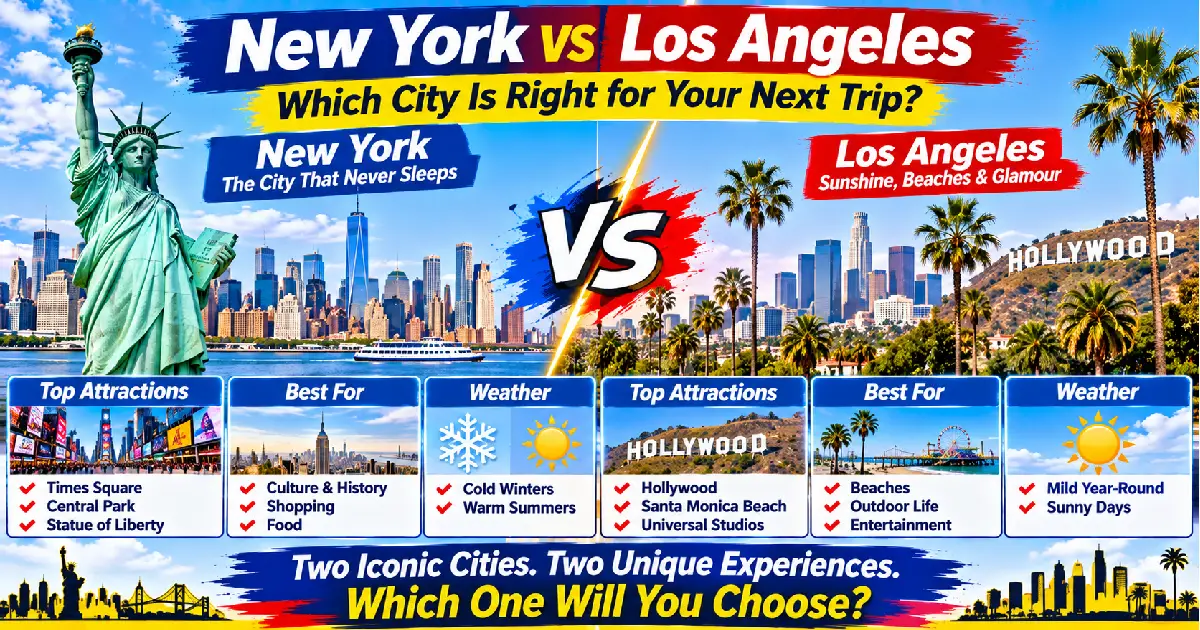
New York City and Los Angeles are the two poles of the American urban experience — the cities that have shaped the country’s culture, economy, mythology, and self-image more than any others, and that continue to define what an American city can be in profoundly different ways. New York is vertical, dense, walkable, and relentlessly kinetic: a city that crowds five boroughs and 8.3 million people into 302 square miles, where the energy is generated by compression and friction, where the subway runs all night and the deli never closes and every neighborhood contains a hundred nationalities living at the top of their voices. Los Angeles is horizontal, sprawling, and car-dependent: a city of 503 square miles and 4 million people spread across an enormous coastal plain between the Pacific Ocean and the San Gabriel Mountains, where the energy comes from space and light and reinvention, where the weather is reliably extraordinary and the culture is built on the possibility of becoming something new.
Both cities are extraordinary travel destinations — among the finest in the world — but they reward different travelers in different ways, and understanding those differences is the most useful thing this guide can do. New York rewards the visitor who wants to walk everywhere, eat everything, fill every hour with something extraordinary, and feel the full electric charge of the most intense urban environment in the Western Hemisphere. Los Angeles rewards the visitor who wants to drive the coast highway with the windows down, spend a morning at the Getty and an afternoon at the beach, eat Korean barbecue in Koreatown and ramen in Little Tokyo and tacos from a truck in East LA, and feel the particular California optimism that comes from a place where the sun genuinely does shine most days. The question is not which city is better — both are world-class — but which one is right for you, right now.
This guide compares New York and Los Angeles across every dimension a traveler cares about: neighborhoods, food, weather, cost, beaches, culture, nightlife, day trips, and practical logistics. Read it as a tool for making the decision that is right for your trip, not as an argument for one city over the other.
| Category | New York City | Los Angeles |
|---|---|---|
| Population | 8.3 million | 4 million (13M metro) |
| Area | 302 square miles | 503 square miles |
| Getting around | Subway + walking | Car essential |
| Weather | Four seasons; hot summers, cold winters | Mediterranean; 70°F year-round |
| Best season | Apr–Jun, Sep–Nov | Year-round; Oct–Nov for best weather |
| Average hotel | $250–350/night | $180–280/night |
| Average dinner | $55–90/person | $45–75/person |
| Beaches | 1 hour away (Long Island/Jersey Shore) | Integrated into the city |
| Top food scene | Most diverse on Earth | Best Mexican, Korean, Japanese in US |
| Top museums | The Met, MoMA, Natural History | Getty, LACMA, Broad |
| Day trips | Hudson Valley, Catskills, Hamptons | Malibu, Palm Springs, Big Sur |
| Best for | Walking, culture, nightlife, food density | Beach, driving, outdoor space, film culture |
New York’s neighborhoods are the city’s defining texture — each one a distinct world compressed into a few blocks, with its own character, cuisine, history, and visual identity.
Manhattan is what most visitors picture: Midtown (Times Square, Rockefeller Center, Grand Central Terminal — the commercial and tourist core, magnificent in scale but best experienced as a transit hub rather than a destination), Lower Manhattan and the Financial District (Wall Street, the 9/11 Memorial and Museum — one of the finest and most moving memorial museums in the world — the Brooklyn Bridge, the Staten Island Ferry for the finest free view of the Manhattan skyline), SoHo and Tribeca (cast-iron architecture, high-end boutiques, the finest gallery concentration in the city in the West Village and Chelsea), the East Village and Lower East Side (the most historically layered neighborhood in New York — Jewish, Puerto Rican, and now a restaurant-and-bar district of extraordinary density), Harlem (the cultural capital of Black America, home of the Cotton Club era, the Apollo Theater since 1934, excellent soul food, and some of the finest brownstone architecture in the city), and Washington Heights (Dominican culture, the finest views of the Hudson River from the George Washington Bridge walkway, and the Cloisters — the Metropolitan Museum’s medieval art collection in a reconstructed French monastery at the northern tip of Manhattan, one of the finest museum experiences in New York).
Brooklyn has supplanted much of Manhattan as the city’s cultural center: DUMBO (the most photographed view of the Brooklyn Bridge from Washington Street), Williamsburg (the finest independent restaurant concentration in Brooklyn, the best vintage clothing market in the city), Park Slope (Prospect Park — Frederick Law Olmsted’s 1867 masterpiece and arguably the finest urban park in the US), Crown Heights (Caribbean food, the Brooklyn Museum, the Brooklyn Botanic Garden’s 52 acres and cherry blossoms in April), Bed-Stuy (historic brownstones, the best Caribbean and soul food in the city), and Coney Island (Nathan’s Famous hot dogs, the Cyclone roller coaster since 1927, the Boardwalk, and a beach that is genuinely 45 minutes from Midtown by subway — the most democratically accessible summer escape in New York).
LA’s neighborhoods function differently than New York’s — separated by freeways, defined by culture and income rather than geography, and most rewarding when explored by car with a specific destination in mind.
Hollywood and the Hills (the Hollywood Walk of Fame, Griffith Park and the Griffith Observatory — free, the finest city view in LA from the lawn below the observatory — Runyon Canyon for hiking above the city, the Hollywood Bowl for outdoor concerts, the TCL Chinese Theatre and the El Capitan for movie culture). West Hollywood and Beverly Hills (the Sunset Strip — the most storied rock-and-roll mile in America, Whisky a Go Go and the Roxy still operating — Rodeo Drive, the finest people-watching in LA at The Grove mall on weekends). Silver Lake and Los Feliz (the most walkable and most New York–feeling neighborhood in LA, with independent bookshops, coffee roasters, the finest small restaurant scene in the city, and Barnsdall Art Park’s Hollyhock House — Frank Lloyd Wright’s first Los Angeles commission, 1921, a UNESCO World Heritage Site and one of the most important buildings in American architectural history). Koreatown (the highest density of Korean restaurants and karaoke bars on Earth outside Seoul, 24-hour culture, the best Korean BBQ in the United States). Downtown LA (the Broad Museum of contemporary art, the Museum of Contemporary Art, the Last Bookstore — the most spectacular used bookshop in the US, 22,000 square feet of stacked books in an old bank vault, free entry — the Grand Central Market since 1917, and the Walt Disney Concert Hall by Frank Gehry, 2003, the finest concert hall interior in America). Venice and Santa Monica (the boardwalk, Muscle Beach, the Abbot Kinney Boutique corridor, the finest bike path in the US along the coast, and the Santa Monica Pier with its Pacific Park amusement rides). Malibu (27 miles of PCH beach driving, the Getty Villa — a reconstructed Roman villa housing the finest collection of ancient Greek and Roman art in the western US, free with advance reservation).
New York is the most culinarily diverse city on Earth — the product of successive waves of immigration from every country and culture, each leaving a permanent imprint on the food landscape. The city has 30,000+ restaurants across every price point, cuisine, and neighborhood, and the density of exceptional eating within a few blocks of anywhere in Manhattan or Brooklyn is unmatched in the world.
The signature New York experiences: A New York–style pizza slice ($3.50–5) folded lengthwise at Di Fara Pizza (Midwood, Brooklyn — Domenico DeMarco has been making pizza by hand since 1965, long lines, worth every minute), Joe’s Pizza (Greenwich Village, the finest slice in Manhattan), or Prince Street Pizza (NoLIta, best square slice). A bagel with lox and cream cheese ($12–16) at Russ & Daughters (Houston Street since 1914, the finest appetizing shop in America) or Ess-a-Bagel (Midtown). Jewish deli at Katz’s Delicatessen (205 East Houston Street, open since 1888, the pastrami sandwich at $25 is the most famous single sandwich in New York). Dim sum in Flushing, Queens (the finest Chinese food outside mainland China — Golden Shopping Mall basement has the most authentic hand-pulled noodles and dumplings). Dominican food in Washington Heights, Ethiopian in Harlem, Bangladeshi in Jackson Heights (Queens, the most internationally diverse neighborhood in the world), Italian-American in Carroll Gardens and Bensonhurst.
Fine dining: New York has more Michelin-starred restaurants than any city in the United States — Le Bernardin (the finest seafood restaurant in America, $175 prix fixe, reservations 30 days in advance), Eleven Madison Park (plant-based tasting menu, $365/person), Per Se (Thomas Keller, $385/person, overlooks Central Park), and Gramercy Tavern (the finest accessible upscale American restaurant in the city, $90–140 prix fixe, some tables walk-in). The West Village and East Village restaurant corridors are the finest concentrated dining neighborhoods in America for the $40–80/person range.
Los Angeles has the finest Mexican food outside Mexico (and arguable within it), the finest Korean food outside Korea, the finest Japanese food in the United States, and a homegrown California cuisine tradition — farm-to-table before anyone called it that — that traces directly to Alice Waters’ Chez Panisse in nearby Berkeley and has been refined by a generation of LA chefs into a distinct idiom.
The signature LA experiences: Street tacos ($2.50–4 each) at Mariscos Jalisco food truck (East LA, the finest shrimp taco in Los Angeles, a genuine tostada with fried shrimp, avocado, and a sauce that people drive across the city for), El Chato Taco Truck (West Olympic Blvd, open 8 PM–3 AM, the finest taco truck in LA for carne asada). Ramen at Tsujita LA Artisan Noodle (West LA, finest tsukemen in the US, lines from opening). Korean BBQ at Park’s BBQ (Koreatown, the gold standard, $45–65/person, reservations essential) or Quarters Korean BBQ (unlimited KBBQ $35/person). Sushi at Sushi Saito ($350/person omakase, the finest sushi in LA) or the accessible and brilliant Sugarfish ($35–55, 10 locations). Persian food in Tehrangeles (Westwood), Armenian in Glendale, Thai in East Hollywood — LA’s ethnic food geography is a map of the 20th century’s migrations.
Fine dining: Providence (Capitol Reef, the finest seafood restaurant in LA, 2 Michelin stars, $225 tasting menu), n/naka (kaiseki tasting menu, 2 Michelin stars, $350/person, reservations released one month in advance and booked within minutes — the hardest reservation in LA), Gjelina (Abbot Kinney, Venice, the restaurant that defined California casual dining for a decade, $28–52), Guerrilla Tacos (the most celebrated taco chef in America, Wes Avila — $5–8/taco, reservations for the sit-down location at Smorgasburg LA on Sundays).
The verdict on food: New York wins on sheer diversity and density — within a single square mile of almost any Manhattan neighborhood, you can eat more extraordinary food from more countries than anywhere else in the world. Los Angeles wins on specific cuisines — if you want the best Mexican, Korean, or Japanese food in the United States, LA is unambiguously the destination — and on the quality of its farmers’ markets and produce-driven cooking, which benefits from being within 100 miles of the most productive agricultural land in the country.
New York has four genuine seasons, which is both its greatest weather appeal and its greatest weather challenge. Spring (April–May) is the finest season — mild temperatures (55–72°F), trees and flowers in bloom in Central Park and along every tree-lined block, the city energized after winter. Summer (June–August) is hot (85–95°F), humid (dew points above 70°F for weeks at a time), and occasionally oppressive — the upside is that New York in July is fully alive, the rooftop bars are open, and the city’s energy is at its peak. Fall (September–November) is the second-finest season — warm September, spectacular October (one of the finest urban fall foliage displays in America, particularly in Central Park and Prospect Park), increasingly cold November. Winter (December–February) is cold (25–40°F), occasionally snowy (a major snowstorm transforms the city into a genuine winter wonderland for about 24 hours before the reality of slush sets in), and brisk in ways that either energize or discourage depending on temperament.
Best months for a visit: April–May and September–October. Avoid July and August if heat and humidity bother you; embrace them if you want the full summer New York experience of rooftop bars, outdoor concerts in Central Park, and the Coney Island boardwalk.
Los Angeles has the finest urban weather in the continental United States — a Mediterranean climate with an average of 284 sunny days per year, average temperatures between 58°F (January) and 84°F (August), and almost no humidity. Rain falls almost exclusively between November and March, and “rain” in LA typically means a few inches over a few days, not the sustained precipitation of the East Coast or Pacific Northwest. The city is genuinely pleasant in every month of the year, though the marine layer (a morning fog that burns off by noon from June through September along the coast — “June Gloom”) can make beach mornings grey and cool.
Best months for a visit: October and November are the finest — the marine layer is gone, the summer crowds have thinned, temperatures are 72–78°F, the light is extraordinary (the “Santa Ana wind” conditions that periodically clear the air to crystal visibility, revealing the full San Gabriel Mountain backdrop that the summer haze hides), and hotel rates drop from peak summer levels. March–May is the second-best period — wildflowers in the hills, green mountains (before the summer brown), and comfortable temperatures.
The verdict on weather: Los Angeles wins decisively — 284 sunny days per year versus New York’s 234, no winter cold, no summer humidity, and beaches available year-round. If weather is a primary factor in your decision, Los Angeles is the clear choice.
New York is not a beach city, but it has good beaches — the key is knowing where they are and how to reach them. Coney Island (45 minutes by subway from Midtown, free) is the most New York beach experience — a 2.5-mile boardwalk, Nathan’s hot dogs, the 1927 Cyclone wooden roller coaster ($15), and a beach that gets genuinely crowded on summer weekends but retains a working-class democratic character that no other beach in the metro area can match. Rockaway Beach (Queens, 1 hour by subway, free) is the best surfing beach accessible by public transit in any American city, with a surf break that produces consistent 3–5 foot Atlantic swells in summer. Jones Beach (Long Island, 1 hour by car or LIRR + bus, $10/vehicle) is the finest beach within reach of New York City — 6.5 miles of Atlantic barrier beach with excellent swimming, a concert venue, and the most beautiful Art Deco bathhouse in the country (Robert Moses designed the entire complex in 1929).
The Hamptons (2.5–3 hours by car or train from Manhattan) are among the finest beaches on the East Coast — Main Beach in East Hampton (consistently rated among the top 10 beaches in the US) and Coopers Beach in Southampton are the standouts — but the crowds, the traffic, and the cost ($50+ for a beach parking permit on summer weekends) make them a weekend trip rather than a casual afternoon.
Los Angeles is built around its beaches — 75 miles of Pacific coastline from Malibu in the north to Long Beach in the south, most of it publicly accessible and within 30–45 minutes of most of the city. Santa Monica (the most accessible and most facilities-rich beach, bike path connecting 22 miles of coast, the Pier), Venice Beach (the boardwalk, Muscle Beach, Snapchat headquarters across the street from the boardwalk — a genuinely surreal LA experience), Malibu (El Matador State Beach — the finest cove beach with sea caves and stacks, $8/vehicle; Zuma Beach — the finest family beach; Point Dume — cliff walks above the Pacific), Manhattan Beach (the finest volleyball beach in the country, excellent restaurants on the pier and strand), El Segundo and Hermosa Beach (laid-back South Bay surfing culture), and Laguna Beach (50 miles south in Orange County — the finest cove beaches in Southern California, tide pools, and an art colony that has operated since the 1920s).
The verdict on beaches: Los Angeles wins comprehensively — integrated beaches within the city, year-round swimming temperatures (60–68°F, cold but swimmable), and 75 miles of accessible coastline versus New York’s 1–2 hour commute to reach any beach of consequence.
New York has the finest concentration of world-class museums anywhere in the United States — the Metropolitan Museum of Art (the largest art museum in the Western Hemisphere, 2 million objects including the finest Egyptian, Greek, Roman, and medieval collections in the US, $30/adult, pay-what-you-wish for New York State residents), MoMA (the Museum of Modern Art, the definitive collection of 20th-century art, $28/adult — Picasso’s Les Demoiselles d’Avignon, Van Gogh’s The Starry Night, Warhol, Pollock, de Kooning in permanent collection), the American Museum of Natural History ($28/adult, finest natural history museum in the world — the 94-foot blue whale, the 34-ton meteorite, the Hall of Human Origins), The Frick Collection (1914 Gilded Age mansion, Vermeer, Rembrandt, Holbein, El Greco in intimate domestic setting, $22/adult — the finest small museum experience in New York), The Whitney Museum of American Art (Renzo Piano building in the Meatpacking District, finest collection of American art of the 20th and 21st centuries, $25/adult), and The Cloisters (medieval art in a monastery reconstructed from five French medieval cloisters, $30/adult, included with Met admission).
Performing arts: Carnegie Hall (the finest concert venue in America, tickets $35–300), the Metropolitan Opera (October–June, the most important opera company in the Western Hemisphere, tickets $25–400), Broadway (the global standard for musical theater, 41 theaters in the Theater District, tickets $75–300 standard, $35–40 for rush/lottery), and Lincoln Center (New York Philharmonic, New York City Ballet, New York City Opera — a campus of performing arts venues with free outdoor programming in summer).
Los Angeles has world-class museums and the most important popular culture institutions in the world. The Getty Center (1997, Richard Meier architecture on a 110-acre hilltop, free admission — Van Gogh’s Irises, Rembrandt, Monet, Cézanne, extraordinary decorative arts, the finest garden of any American museum, and the most spectacular city view from any museum in the country), the Getty Villa (Malibu, ancient Greek and Roman art in a reconstructed Roman villa, free with advance reservation, one of the finest experiences in LA), the LACMA (Los Angeles County Museum of Art, the largest art museum in the western US, $20/adult, the Urban Light installation of 202 vintage street lamps is the most photographed public art in LA), the Broad (free, 2,000 works of contemporary art including Jeff Koons, Cindy Sherman, Jean-Michel Basquiat, and the finest Koons collection in the world, free timed-entry reservations required), and the Academy Museum of Motion Pictures (2021, the finest museum devoted to the history of cinema anywhere in the world, $25/adult).
Film and entertainment culture: Universal Studios Hollywood ($109–139/day), Warner Bros. Studio Tour ($70/adult, the finest behind-the-scenes studio tour in Hollywood), the Hollywood Bowl (July–September, the finest outdoor concert venue in America — bring a picnic, arrive early, hear the LA Philharmonic under the stars for $1–150), and the Pantages Theatre (Broadway touring productions in a 1930 Art Deco palace).
The verdict on museums: New York wins on depth and breadth — the Met, MoMA, and the Frick together represent perhaps the finest concentration of art in the Western Hemisphere. Los Angeles wins on accessibility (the Getty is free and extraordinary) and on cinema culture, which is genuinely unique to LA.
New York is one of the most expensive cities in the world to visit. Hotels in Manhattan average $280–380/night for a mid-range room; budget options below $150/night are essentially nonexistent in Manhattan (Brooklyn has more affordable options starting around $130/night). Food ranges from the $3.50 pizza slice and $6 bodega breakfast sandwich to tasting menus at $200–400/person; a typical mid-range dinner for two with wine costs $120–180. Transport is the great equalizer — the subway ($2.90/ride, $34 for a 7-day unlimited pass) is the finest value in the city, taking you within walking distance of virtually any destination in Manhattan, Brooklyn, and Queens. Museum admissions add up: the Met ($30) + MoMA ($28) + Natural History ($28) + Whitney ($25) = $111 per person for the big four alone.
Budget estimate per person per day: $200–300 (mid-range, including hotel share, meals, museums, and transit); $400–600 (comfortable); $100–150 (budget, staying in a hostel and eating street food and bodegas).
Los Angeles is expensive but somewhat more affordable than New York for comparable quality. Hotels average $180–280/night for a mid-range room; the dispersed geography means budget options exist in neighborhoods like Koreatown and Hollywood ($100–150/night) without sacrificing safety or access. Food is broadly more affordable than New York — excellent tacos for $3–5, Korean BBQ for $35–45/person, and the produce-driven California cuisine ethos means fine-quality ingredients at mid-range prices. The great LA disadvantage is transportation — a car rental adds $60–100/day plus parking ($20–50/day in most neighborhoods), and the alternatives (Uber/Lyft) add up quickly across LA’s distances.
Budget estimate per person per day: $180–280 (mid-range, including hotel share, meals, Uber/Lyft, and one activity); $350–500 (comfortable with car rental); $100–140 (budget, staying in a hostel, using public transit, eating street food).
The verdict on cost: Los Angeles is modestly more affordable for hotels and food, but the unavoidable car costs (rental + parking + gas) close the gap. For visitors who can use New York’s subway effectively, New York is often the better value for the amount of experience per dollar.
New York’s nightlife is the most diverse, most relentless, and most internationally significant in the United States — a city that genuinely never sleeps, where the subway runs all night, the delis are open at 4 AM, and the music and bar scene spans everything from jazz clubs that have operated since the 1950s to house and techno rooms that defined global dance music.
Jazz: The Village Vanguard (178 7th Avenue South, open since 1935, the most important jazz club in the world — every major jazz musician of the last 70 years has recorded a live album here, Monday night rehearsal band has played every Monday for decades, $35–45/person) and Smalls Jazz Club (183 West 10th Street, intimate basement, the finest late-night jazz in New York, $25 cover includes all drinks). Live music: Brooklyn Steel and Brooklyn Bowl for mid-size rock and soul shows, Irving Plaza and Terminal 5 for larger rock acts, Carnegie Hall and Lincoln Center for classical. Bars: The Dead Rabbit Grocery and Grog (lower Manhattan, consistently ranked among the world’s finest cocktail bars), Employees Only (West Village, Art Deco speakeasy, finest punch bowl cocktails in the city), Please Don’t Tell (PDT — access through a phone booth in a Crif Dogs hot dog shop, one of the original speakeasy-concept bars, reservations by phone at exactly 3 PM). Clubs: Output (Williamsburg) and Elsewhere (Bushwick) for electronic music; the Nowadays outdoor stage in Ridgewood for summer parties.
LA’s nightlife is more spread out and more car-dependent than New York’s, but the scene — particularly in Silver Lake, WeHo, Downtown, and the Sunset Strip — is genuinely world-class and more relaxed than New York in its dress codes and attitude.
The Sunset Strip (1.5 miles of West Hollywood on Sunset Boulevard): The Whisky a Go Go (opened 1964, where The Doors were the house band, where Led Zeppelin and Jimi Hendrix played — still operating as a live music venue, $20–40 cover), the Roxy Theatre (1973, Neil Young and Bob Marley both played here in the first week — historic mid-size rock venue), and the Viper Room (River Phoenix died outside this door in 1993 — still a functioning music bar). Bars: The Dresden (Los Feliz, the lounge where Marty and Elayne have played jazz standards six nights a week since 1982 — the most quintessentially LA bar experience), Good Times at Davey Wayne’s (Hollywood, 1970s American basement bar themed environment, one of the finest creative cocktail bars in LA), La Descarga (Hollywood, Cuban rum bar with live salsa, the finest dance-bar experience in LA). Clubs: Exchange LA (Downtown, in a 1924 Beaux-Arts banking hall, the finest nightclub building in the US) and Sound (Hollywood). Comedy: The Comedy Store (Sunset Strip, open since 1972 — where Robin Williams, Eddie Murphy, and Jerry Seinfeld all developed their acts, still the finest stand-up room in America) and The Groundlings (Melrose Avenue, the finest improvisational comedy school and theater in the US — Kristen Wiig, Will Ferrell, and Melissa McCarthy all came through here).
The verdict on nightlife: New York wins on density, diversity, and the 24-hour culture that means the night can genuinely extend to dawn without ever leaving walkable radius. Los Angeles wins on the historic music venue culture of the Sunset Strip and on the more relaxed, accessible atmosphere of its bar scene.
Choose New York if:
Choose Los Angeles if:
The honest answer is that the best travelers visit both — they are complementary experiences, not competing ones. New York teaches you what density and ambition look like at their maximum. Los Angeles teaches you what happens when you give a city space and light and the Pacific Ocean. Together they define the range of what America’s cities can be.
Posted By : Vinay
Latest Article
2nd Floor, 39, Above Kirti Club, DLF Industrial Area, Kirti Nagar, New Delhi, Delhi 110015



Travel Tourister is a leading Travel portal where we introduce travellers to trusted travel agents to make their journey hasselfree, memorable And happy. Travel Tourister is a platform where travellers get Tour packages ,Hotel packages deals through trusted travel companies And hoteliers who are working with us across the world. We always try to find new and more travel agents and hoteliers from every nook and corners across the world so that you could compare the deals with different travel agents and hoteliers and book your tour or hotel with the one you have chosen according to your taste and budget.
Copyright © Travel Tourister, India. All Rights Reserved

 Call
 Enquiry