Published on : 03 Nov 2026
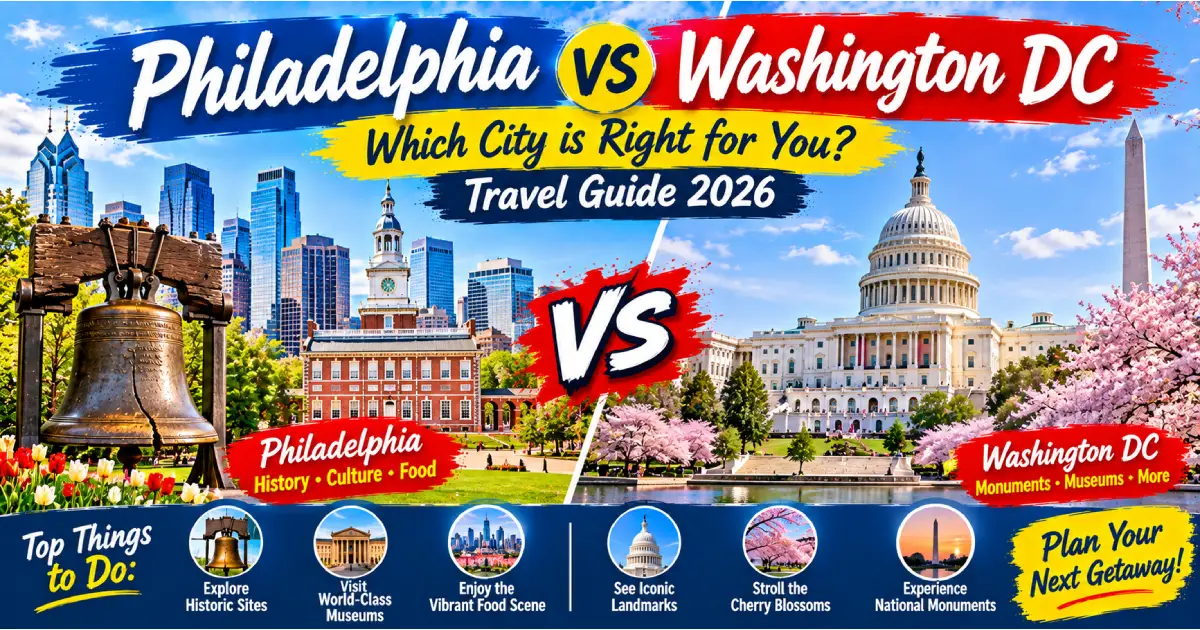
Philadelphia and Washington DC are the two great cities of the American Mid-Atlantic — neighbors on Amtrak’s Northeast Corridor (96 miles apart, 68 minutes by Amtrak, $15–40 one way), linked by a shared colonial and revolutionary history, and competing in the minds of East Coast travelers who want to understand where America came from and what it has become. Philadelphia is the older city — founded 1682 by William Penn, the first capital of the United States, the city where the Declaration of Independence was signed and the Constitution was written, a working-class, immigrant, row-house city of 1.6 million that has never entirely shed its reputation for being the second-best version of New York but has, in the past 15 years, developed a food scene, an arts community, and a neighborhood culture that makes it one of the most genuinely livable and rewarding cities in the country. Washington DC is the capital — a planned city of monuments, marble, and institutional power, of 700,000 residents (4.8 million metro) living among the Smithsonian’s 19 free museums, the greatest concentration of world-class museums per square mile in the United States, and the physical apparatus of American democratic governance.
Both cities are essential American travel destinations, and the traveler who visits one without the other is missing half the story. But if you have time for only one, the choice depends on what you want: Philadelphia rewards the visitor who wants to eat extraordinarily well, walk through genuinely historic neighborhoods, and experience a city that feels lived-in and authentic rather than curated. Washington rewards the visitor who wants to understand American history, stand in the museums that contain the most important artifacts of the national story, and experience the physical grandeur of a city designed as a monument to democratic ideals. This guide compares them honestly and in full.
| Category | Philadelphia, Pennsylvania | Washington, DC |
|---|---|---|
| Population | 1.6 million (6.2M metro) | 700,000 (4.8M metro) |
| Founded | 1682 | 1791 |
| First US capital? | Yes (1790–1800) | Yes (since 1800) |
| Museum admission | Most paid ($10–25) | Smithsonian: FREE (19 museums) |
| Average hotel | $150–260/night | $170–310/night |
| Average dinner | $45–75/person | $50–85/person |
| Getting around | SEPTA subway/trolley + walking | Metro + walking (excellent) |
| Top food experience | Cheesesteak, Reading Terminal Market, Italian Market | Ben’s Chili Bowl, Ethiopian, Old Ebbitt Grill |
| Key historic sites | Independence Hall, Liberty Bell, Eastern State | Capitol, Lincoln Memorial, National Mall |
| Best season | April–May, September–October | March–May (Cherry Blossoms), Sept–Oct |
| Day trips | NYC (1.5 hr), DC (1 hr), Gettysburg (2 hr) | Philadelphia (1 hr), Shenandoah (1.5 hr), Annapolis (45 min) |
Philadelphia’s neighborhoods are a grid of row houses, corner bars, and parish churches — the physical legacy of the wave immigration (Irish, Italian, Polish, Jewish, African American, Puerto Rican, Vietnamese, Chinese) that shaped the city from the 1840s through the 1970s, and of the gentrification that has transformed some of those neighborhoods since 2000.
Old City and Society Hill (the original colonial settlement — the most historically dense neighborhood in the United States: Independence Hall (where the Declaration of Independence was adopted July 4, 1776, and the Constitution was signed September 17, 1787 — timed-entry tickets free at recreation.gov or $1 in person, the finest single historic building in America), Liberty Bell Center (free, the 2,080-pound bell with its iconic crack, cast in London 1752, the single most visited historic artifact in Philadelphia), Elfreth’s Alley (the oldest continuously inhabited residential street in the United States, 1702 — 32 houses still occupied, free to walk, an extraordinary sight two blocks from the tourist corridor), Christ Church (the “Nation’s Church,” 1744, where Washington, Franklin, Betsy Ross, and five other Declaration signers worshipped, 75 cents to enter), Betsy Ross House ($7/adult), and the National Constitution Center ($17/adult, the finest interactive museum of constitutional history in the world). Society Hill adjacent — the most beautifully preserved 18th-century neighborhood in America, brick sidewalks, Federal townhouses, Head House Square, the finest urban domestic architecture east of Annapolis.
Center City (the modern downtown grid laid out by Penn in 1682 — City Hall at Broad and Market, the largest municipal building in the United States, the 548-foot tower topped with William Penn’s bronze statue, free tours of the observation deck $6, the finest view of Philadelphia’s skyline from any point in the city). Rittenhouse Square (the most beautiful urban park in Philadelphia, designed by Penn in the original 1682 plan as one of five public squares, ringed by the finest residential architecture in the city, the Saturday farmers’ market, the finest people-watching). Washington Square (one of Penn’s original five squares, the Tomb of the Unknown Soldier of the American Revolution, shaded by mature trees).
South Philadelphia (the most authentically working-class neighborhood in Philadelphia, the home of the Italian Market — see food section — the Pat’s and Geno’s cheesesteak rivalry, the Philadelphia Sports Complex with Lincoln Financial Field/Citizens Bank Park/Wells Fargo Center, the Vietnamese neighborhood along Washington Avenue). East Passyunk Avenue (the most exciting restaurant corridor in Philadelphia — a diagonal street cutting through South Philly with more excellent independent restaurants per block than any other street in the city). Fishtown (the most rapidly gentrifying neighborhood in Philadelphia — the former working-class Irish and Polish fishing neighborhood now has the finest bar and cocktail scene in the city, Frankford Hall beer garden, Fette Sau BBQ, The Fillmore Philadelphia). Northern Liberties (the creative/artistic neighborhood adjacent to Fishtown, the The Piazza outdoor gathering space, independent coffee shops and galleries).
West Philadelphia and University City (home of the University of Pennsylvania and Drexel University, the University of Pennsylvania Museum of Archaeology and Anthropology $18/adult — one of the finest archaeological collections in the Western Hemisphere, the Egyptian mummy collection and the Mesopotamian artifacts are extraordinary). Germantown (the 18th-century German immigrant neighborhood 8 miles from Center City — the site of the Battle of Germantown 1777, the Cliveden National Historic Landmark mansion $15/adult where the battle centered, and the most intact colonial-era streetscape in Philadelphia).
Washington’s neighborhoods are organized around the National Mall and the four quadrants (NW, NE, SW, SE) of L’Enfant’s 1791 diagonal-avenue-over-grid plan — a plan so influential and so beautiful that it has defined American city planning ever since.
The National Mall (the 1.9-mile grassy corridor from the Capitol to the Lincoln Memorial — the central axis of American civic identity, flanked by 19 Smithsonian museums, the Washington Monument, the World War II Memorial, the Vietnam Veterans Memorial, the Korean War Veterans Memorial, and the Lincoln Memorial. The Mall is free to walk at all hours, the finest free public space in America and one of the finest urban landscapes in the world). The Capitol Hill neighborhood (surrounding the US Capitol — Eastern Market (7th and C Street SE, open since 1873, the finest indoor public market in Washington, Saturday and Sunday flea market, excellent farm produce and prepared food), the most walkable and most neighborhood-feeling residential district adjacent to a federal government complex in the world, Victorian row houses on tree-lined streets).
Georgetown (the finest neighborhood in Washington for visitors — a pre-Federal era port city (established 1751, predating DC itself) with the most beautiful streetscape in the capital, Federal and Victorian row houses on steep streets above the C&O Canal (184.5-mile towpath trail to Cumberland MD, best walking/cycling in DC), M Street and Wisconsin Avenue retail and restaurant corridors, the Georgetown Waterfront Park on the Potomac). Dupont Circle (the most cosmopolitan neighborhood in Washington — independent bookshops (Kramerbooks, open since 1976, one of the finest bookshops on the East Coast, open until 1 AM Friday–Saturday), art galleries, The Phillips Collection ($16/adult, the finest private art museum in Washington, Renoir’s Luncheon of the Boating Party is the masterpiece), sidewalk café culture, the LGBTQ+ bar scene along 17th Street).
Adams Morgan (the most culturally diverse neighborhood in DC — 18th Street NW restaurant and bar strip, the finest Ethiopian and Latin American food in the city, the most vibrant Saturday night bar scene, Madam’s Organ blues bar and soul food restaurant, the neighborhood that most resembles a real-city neighborhood rather than a government-adjacent district). Shaw and U Street Corridor (the “Black Broadway” — the neighborhood where Duke Ellington was born, where Langston Hughes lived, where the Howard Theatre (1910, the oldest continuously operating theater for African Americans in the US) and the Lincoln Theatre (1922) anchored a jazz and blues scene that rivaled Harlem in the 1920s–1940s; the African American Civil War Memorial and Museum (free) commemorates the 209,145 United States Colored Troops who served in the Civil War). 14th Street NW Corridor (the most rapidly developed restaurant and bar street in DC, the Ghibellina pizza restaurant, The Pig charcuterie bar, Estadio Spanish).
The Wharf (a 3.2-mile waterfront development completed 2017 on the southwest waterfront — the finest new urban waterfront in Washington, waterfront restaurants and hotels, the Anthem concert venue, ferry service to Old Town Alexandria, evening programming on the docks). Navy Yard (the new neighborhood around Nationals Park — the finest baseball stadium architecture built in the 21st century — and a developing restaurant and residential corridor along the Anacostia River waterfront).
Philadelphia’s museums are world-class but almost all require admission — the exception being the National Constitution Center and most National Park Service sites (Independence Hall, Liberty Bell, free).
Philadelphia Museum of Art (2600 Benjamin Franklin Pkwy, $25/adult — the third-largest art museum in the United States, the Rocky Steps that Sylvester Stallone ran up in 1976 are the most visited museum entrance in America, the collection itself is extraordinary: the finest collection of Thomas Eakins in the world, excellent European paintings including Van Gogh, Cézanne, Duchamp’s Large Glass, the finest American decorative arts collection east of the Met). Barnes Foundation (2025 Benjamin Franklin Pkwy, $30/adult — the most eccentric and most important private art collection in America, assembled by Dr. Albert C. Barnes in the 1920s: 181 Renoirs, 69 Cézannes, 59 Matisses, 46 Picassos, arranged in “ensembles” on the walls that mix Old Masters with African art and metalwork in a way that Barnes believed would train the eye — one of the finest museum experiences in the country). Pennsylvania Academy of the Fine Arts (PAFA, 118 N Broad Street, $15/adult — the oldest art museum and art school in the United States, 1805, the finest Gothic-Renaissance building on the Benjamin Franklin Parkway, the Thomas Eakins collection is the finest outside the PMA). The Rodin Museum (2151 Benjamin Franklin Pkwy, $10/adult — the largest collection of Rodin sculptures outside Paris, The Thinker in the garden is the finest single public sculpture in Philadelphia). Eastern State Penitentiary (2027 Fairmount Ave, $21/adult — the most architecturally significant and historically important prison in American history, open 1829–1971, the radial “wagon wheel” floor plan was the most influential prison design in the world, Al Capone’s cell is preserved, the Halloween “Terror Behind the Walls” haunted attraction in October is among the finest in the country).
The Smithsonian Institution is the single greatest argument for visiting Washington over any other American city for a museum lover — 19 museums and galleries on or near the National Mall, all free, containing the most important collections of American history, natural history, air and space history, and art in the world.
National Museum of Natural History (Constitution Ave and 10th St NW, free — the 45.5-carat Hope Diamond in the Janet Annenberg Hooker Hall of Geology, the finest dinosaur hall in the world including the complete Tyrannosaurus rex “Nation’s T. rex” specimen, the Neanderthal DNA exhibit, the Butterfly Pavilion $8 extra — one of the finest natural history museums anywhere on Earth). National Air and Space Museum (Independence Ave and 6th St SW, free — the Wright Brothers’ Flyer (1903), Charles Lindbergh’s Spirit of St. Louis, the Apollo 11 Command Module Columbia, Neil Armstrong’s spacesuit, the Gemini IV capsule where Ed White made the first American spacewalk — the most visited museum in the United States, 7+ million visitors/year). National Museum of American History (Constitution Ave and 14th St NW, free — the original Star-Spangled Banner (the 30×42 foot flag that flew over Fort McHenry in 1814 and inspired Francis Scott Key), Julia Child’s kitchen, the Greensboro lunch counter where the 1960 sit-ins occurred, the American Presidency galleries). National Gallery of Art (Constitution Ave, free — East Building by I.M. Pei 1978, West Building 1941, together the finest art collection in Washington: Leonardo da Vinci’s Ginevra de’ Benci (the only Leonardo painting in the Americas), Vermeer, Rembrandt, the finest collection of French Impressionists outside the Musée d’Orsay, the only complete set of Rothko murals on view).
National Museum of African American History and Culture (NMAAHC, 1400 Constitution Ave NW, free — timed-entry passes required at recreation.gov, released 30 days in advance and typically sell out within hours of release — the most important new museum in the United States, opened 2016 in a David Adjaye building that is the finest piece of contemporary architecture on the National Mall, the collection spans from slavery through the Great Migration through the civil rights movement through contemporary Black American culture — Harriet Tubman’s shawl and hymnal, Chuck Berry’s red Cadillac, a segregation-era railroad car, Muhammad Ali’s boxing gloves — allow 4+ hours). United States Holocaust Memorial Museum (100 Raoul Wallenberg Place SW, free — timed-entry passes recommended for the permanent exhibition, one of the finest and most important museums in the world, the permanent exhibition “The Holocaust” takes 3+ hours and is among the most emotionally demanding museum experiences in existence — essential).
The verdict on museums: Washington wins, and it is not close — 19 free world-class museums versus Philadelphia’s excellent but paid museum landscape. The NMAAHC, the Natural History Museum, Air and Space, and the National Gallery together represent perhaps the finest free museum day available in any city on Earth. However, the Barnes Foundation and the Philadelphia Museum of Art together represent a museum experience that rewards the visitor willing to pay.
Philadelphia’s food culture is defined by two contradictory impulses: an authentic, immigrant-driven street food tradition (the cheesesteak, the soft pretzel, the water ice, the roast pork sandwich) and a sophisticated restaurant scene that has made East Passyunk Avenue and Fishtown into two of the finest dining corridors in the Northeast.
The cheesesteak: The most debated fast food in America, the Philadelphia cheesesteak is thinly shaved ribeye cooked on a griddle and served on an Amoroso’s hoagie roll with Cheez Whiz (authentic), provolone, or American cheese and your choice of onions. Pat’s King of Steaks (1237 E Passyunk Ave, open 24/7 since 1930 — Pat Olivieri invented the cheesesteak in 1930, the original, the institution, $14–16) and Geno’s Steaks (1219 S 9th Street, directly across the street from Pat’s, the neon-lit rival founded 1966 — the “rivalry” is largely a tourist phenomenon; both make an excellent cheesesteak) anchor the South Philly experience. The honest local consensus: John’s Roast Pork (14 E. Snyder Ave, also makes cheesesteak but the roast pork Italian with sharp provolone and broccoli rabe on a seeded roll is the finest sandwich in Philadelphia) and Jim’s Steaks (400 South Street) are the preferred alternatives.
Reading Terminal Market (12th and Arch Streets — the finest indoor public market in the United States, open since 1893 in the former headhouse of the Reading Railroad terminal. 75+ vendors: Dienner’s Country Restaurant for the finest Amish chicken pot pie in Philadelphia ($14), Down Home Diner for scrapple and eggs ($12), Beck’s Cajun Café for the finest étouffée outside New Orleans ($14), DiBruno Bros. cheese shop (founded 1939, the finest artisanal cheese selection in Philadelphia), 4th Street Deli for Jewish deli (the pastrami sandwich $18), Bassetts Ice Cream (the oldest ice cream brand in America, 1861, the butter pecan is the standout) — allow 2 hours minimum to eat your way through. Open Monday–Saturday 8 AM–6 PM, Sunday 9 AM–5 PM, closed Tuesday).
The Italian Market (9th Street between Christian and Washington Avenues — the oldest and largest outdoor Italian market in the United States, operating continuously since the 1880s, lined with produce vendors, butchers, cheese shops, fish markets, and the finest hoagie shops in Philadelphia: Claudio Specialty Food (est. 1910, the finest cheese and charcuterie selection), Di Bruno Bros. original location (920 S 9th Street), Villa di Roma restaurant (the finest red-sauce Italian in South Philly since 1963, $18–28)).
Fine dining: Zahav (237 St. James Place, Old City — Michael Solomonov’s Israeli restaurant is the most important restaurant in Philadelphia of the past 20 years: James Beard Outstanding Restaurant 2019, the hummus tehina (made with 100% tehina, not mixed) and the wood-roasted lamb shoulder for two ($95) are transformative, reservations open 30 days in advance and fill within hours), Vetri Cucina (1312 Spruce Street, Marc Vetri’s flagship, the finest Italian tasting menu on the East Coast outside New York, $175/person), Vernick Food & Drink (2031 Walnut Street, the finest all-day upscale American restaurant in Philadelphia, $42–68 mains), K’Far (Solomonov’s Israeli café, the finest sabich sandwich in Philadelphia at $16).
Washington’s food scene has transformed dramatically since 2010, driven by the same forces that transformed so many American cities — young professional population, food media attention, and a critical mass of talented chefs who stayed rather than moving to New York. The city now has 23 Michelin-starred restaurants (2026), a world-class Ethiopian food scene (the largest Ethiopian population outside Addis Ababa), and a genuine identity across multiple cuisines.
The definitive DC food experiences: Ben’s Chili Bowl (1213 U Street NW — open since 1958, the most beloved restaurant in Washington: the half-smoke (a spicy pork and beef sausage unique to DC, served in a steamed bun with chili, mustard, and onions — $9) is the signature dish, the chili cheese fries are excellent, the walls are covered with photographs of every celebrity, politician, and musician who has eaten here since 1958, Bill Cosby’s photo was taken down; open until 2 AM, cash preferred). Old Ebbitt Grill (675 15th Street NW — the oldest saloon in Washington, open since 1856, the most American restaurant in America: dark wood, brass rails, taxidermy, oysters on the half shell, and the city’s power brokers having lunch at the bar since before the Civil War, oysters $3.50 each, entrées $28–48). Ethiopian food on 9th Street NW (Little Ethiopia) and 18th Street NW (Adams Morgan): Ethiopic (401 H Street NE, the finest Ethiopian restaurant in DC, the doro wat (chicken stew) and the veggie combination on injera flatbread, $22–32), Habesha Market & Restaurant (Adams Morgan, more casual, larger portions, $18–28). Half-smoke beyond Ben’s at Shophouse and the DC mini-chain of Capital One Arena vendors.
Fine dining: José Andrés restaurants define DC’s upscale dining scene: minibar (855 E St NW, the most experimental restaurant in Washington, 2 Michelin stars, the 20–30-course molecular gastronomy tasting menu $385/person, the reservation is among the hardest in the city), Jaleo (480 7th Street NW, the most accessible Andrés restaurant, excellent tapas $14–22, the patatas bravas and the jamón ibérico are essential), America Eats Tavern (the finest American regional cooking in DC). The Inn at Little Washington (Washington VA, 67 miles west — Patrick O’Connell’s 3-Michelin-star restaurant in a Virginia village, the most acclaimed restaurant in the mid-Atlantic, $328/person prix fixe, the most extraordinary dining experience within 2 hours of DC). Bresca (1906 14th Street NW, 1 Michelin star, the finest creative tasting menu in DC, $135/person).
The verdict on food: Philadelphia wins on street food authenticity (cheesesteak, Reading Terminal Market, the Italian Market) and on the sheer quality of its best restaurants (Zahav is among the finest restaurants in America). Washington wins on cuisine diversity (the Ethiopian scene is world-class), the historic restaurant experience (Ben’s Chili Bowl, Old Ebbitt Grill), and the José Andrés restaurant ecosystem.
Both cities are essential for understanding American history, but they cover different eras and different themes.
Philadelphia covers the founding era (1682–1800) better than any city in the world — the physical spaces where the United States was created are here, remarkably intact, within a walkable few blocks of each other in Old City. Independence Hall (free) is the most important building in American democratic history. The Liberty Bell (free) is the most recognized symbol of American freedom in the world. The National Constitution Center ($17) makes the constitutional system understandable in a way that no textbook can. Congress Hall (free, adjacent to Independence Hall — where the first US Congress met, where Washington and Adams were inaugurated, where the Bill of Rights was debated) and Declaration House (free, where Thomas Jefferson rented rooms and wrote the Declaration of Independence) complete the founding landscape.
Washington DC covers the ongoing national story (1800–present) — the physical apparatus of American government, the memorials to every major military conflict, and the Smithsonian’s record of American culture, science, and history from the colonial period to the present. The National Mall memorials are among the finest pieces of public memorial art in the world: The Vietnam Veterans Memorial (Maya Lin, 1982 — 58,318 names of the American war dead carved in chronological order on two black granite walls that descend into the earth, the most emotionally powerful war memorial in the United States, free), The Lincoln Memorial (1922 — Daniel Chester French’s 19-foot seated Lincoln, the text of the Gettysburg Address and the Second Inaugural carved in the walls, the view down the Reflecting Pool to the Washington Monument is the finest civic vista in America, the site of Marian Anderson’s 1939 concert and MLK’s “I Have a Dream” speech August 28, 1963, free), The Martin Luther King Jr. Memorial (2011, the “Stone of Hope” 30-foot granite sculpture, free), and the Korean War Veterans Memorial (19 stainless steel soldier figures in a triangular field, free).
Philadelphia is one of the most affordable major cities on the East Coast — significantly cheaper than New York and Boston, modestly cheaper than Washington. Hotels in Center City average $150–260/night for mid-range; Old City and South Philadelphia offer options at $110–180/night. Food is genuinely affordable — an excellent cheesesteak $14, a full Reading Terminal Market meal $20, dinner at a good East Passyunk restaurant $50–70/person with drinks. Museums require admission ($15–30/each) but the key historic sites (Independence Hall, Liberty Bell, Constitution Center walking tour) are free. Transport: the SEPTA subway and bus system ($2.50/ride, $13 day pass) is functional for Center City and the major neighborhoods.
Budget estimate per person per day: $150–230 (mid-range); $280–420 (comfortable); $80–110 (budget).
Washington DC is more expensive than Philadelphia but offers extraordinary value in museums — the 19 free Smithsonian museums mean a visitor can spend 3+ days in world-class institutions without paying a cent in admission. Hotels in NW DC average $170–310/night for mid-range; Capitol Hill and neighborhoods along the Metro lines outside the core offer $130–220/night. Food is comparable to Philadelphia in the mid-range; fine dining is slightly more expensive. Transport: the DC Metro ($2–6/ride depending on distance and time, $15 day pass) is the finest heavy rail transit system in the United States — every major tourist site is within a 10-minute walk of a Metro station.
Budget estimate per person per day: $160–260 (mid-range, with free museums making culture essentially free); $300–450 (comfortable); $85–120 (budget, hostel, Ben’s Chili Bowl, Smithsonian).
The verdict on cost: Philadelphia is modestly more affordable across hotels and food. Washington’s free museums make it the better value for culture-focused visitors — a $0 admission day at the Natural History Museum + Air and Space + American History is an extraordinary cultural value that no other American city can match.
Choose Philadelphia if:
Choose Washington DC if:
The honest answer: Visit both — they are 68 minutes apart on Amtrak. If forced to choose: Washington DC wins for first-time visitors to the eastern United States because the Smithsonian’s free museums represent an unparalleled cultural value, the National Mall is the finest civic public space in America, and the NMAAHC is among the most important museums opened in this century. Philadelphia wins for return visitors who want to eat extraordinarily well, explore a city with genuine neighborhood character, and stand in the room where America was born.
Posted By : Vinay
Latest Article
2nd Floor, 39, Above Kirti Club, DLF Industrial Area, Kirti Nagar, New Delhi, Delhi 110015



Travel Tourister is a leading Travel portal where we introduce travellers to trusted travel agents to make their journey hasselfree, memorable And happy. Travel Tourister is a platform where travellers get Tour packages ,Hotel packages deals through trusted travel companies And hoteliers who are working with us across the world. We always try to find new and more travel agents and hoteliers from every nook and corners across the world so that you could compare the deals with different travel agents and hoteliers and book your tour or hotel with the one you have chosen according to your taste and budget.
Copyright © Travel Tourister, India. All Rights Reserved

 Call
 Enquiry