Published on : 21 Feb 2026
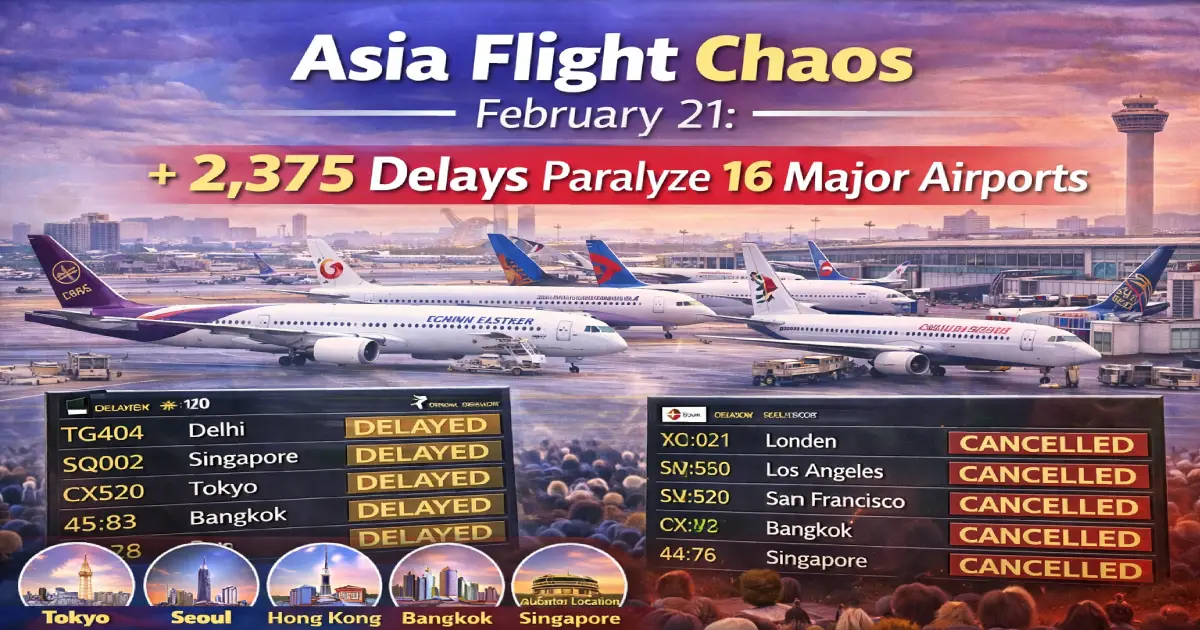
Date: February 21, 2026 Total Disruptions: 2,452 flights (2,375 delays + 77 cancellations) Countries Affected: 9 (Thailand, Japan, Indonesia, India, Singapore, Philippines, China, Malaysia, Jordan)
ASIA’S INFRASTRUCTURE CRISIS DEEPENS: Asia’s aviation network suffered another devastating day of operational chaos on February 21, 2026 as 2,375 flight delays and 77 cancellations paralyzed 16 major airports across nine countries — Thailand, Japan, Indonesia, India, Singapore, Philippines, China, Malaysia, and Jordan — marking the third consecutive week of systemic disruption that has now stranded hundreds of thousands of passengers and exposed the brutal reality that Asia’s post-pandemic travel boom has completely overwhelmed infrastructure built for a bygone era. Delhi’s Indira Gandhi International Airport leads today’s chaos with a staggering 385 delays + 4 cancellations (the highest in the region), followed by Bangkok Suvarnabhumi (318 delays), Kuala Lumpur (275 delays + 2 cancellations), Tokyo Haneda (232 delays), Singapore Changi (199 delays + 3 cancellations), and Jakarta (196 delays + 26 cancellations). The crisis is NOT weather-related — this is pure operational congestion as airports designed to handle 45-50 million passengers annually now struggle with 65-70 million, creating cascading delays throughout the day where a 30-minute morning slip becomes a 3-hour afternoon nightmare. IndiGo dominates disruption with 145 delays + 2 cancellations (India’s largest carrier accounting for 23% of all Indian delays), followed by Air India (136 delays + 2 cancellations), Batik Air (50 delays + 46 cancellations across four Indonesian airports), Air China (75 delays + 2 cancellations), United Airlines (5 delays + 2 cancellations at Narita), PAL Express (22 delays + 5 cancellations), and Royal Jordanian (5 delays + 3 cancellations). For Tier 1 travelers (US, UK, Canada, Australia), this means: (1) Connecting flights through Asia = HIGH RISK — miss your Delhi-Singapore connection, you’re stuck 24+ hours, (2) Budget carriers most affected — AirAsia, Scoot, Batik Air facing 60-80% on-time performance vs. normal 90%+, (3) Peak travel times = worst delays — morning departures slip 30-45 minutes, by afternoon everything’s 2-3 hours late, and (4) No end in sight — aviation analysts warn this pattern will continue through 2026 as Asia’s aviation growth (recovering to 110-120% of pre-pandemic capacity) has FAR outpaced infrastructure expansion (runway construction takes 5-10 years, terminal expansions 3-5 years). Today’s disruptions come just two days after you covered February 19’s 2,510 disruptions (Ho Chi Minh City 533 delays, Bangkok 353 delays, Jakarta 329 delays) and eight days after February 13’s record 4,216 delays (worst single-day in Asia aviation history), creating a relentless pattern where travelers planning March-April trips through Singapore, Hong Kong, Bangkok, Delhi, or Jakarta should build in minimum 3-4 hour layovers (vs. normal 2 hours) and prepare for 24+ hour delays if connections are missed.
Overall Statistics:
Total Disruptions: 389 (385 delays + 4 cancellations) Percentage of Scheduled Flights Affected: ~35-40%
Airlines Most Affected:
Why Delhi is #1:
Total Disruptions: 318 (318 delays + 0 cancellations) Percentage of Scheduled Flights Affected: ~30-35%
Airlines Most Affected:
Why Bangkok is #2:
Total Disruptions: 277 (275 delays + 2 cancellations) Percentage of Scheduled Flights Affected: ~28-32%
Airlines Most Affected:
Why Kuala Lumpur is #3:
Total Disruptions: 232 (232 delays + 0 cancellations) Percentage of Scheduled Flights Affected: ~22-26%
Airlines Most Affected:
Why Haneda is #4:
Total Disruptions: 202 (199 delays + 3 cancellations) Percentage of Scheduled Flights Affected: ~18-22%
Airlines Most Affected:
Why Singapore is #5:
Total Disruptions: 222 (196 delays + 26 cancellations) Percentage of Scheduled Flights Affected: ~20-24%
Airlines Most Affected:
Why Jakarta is #6:
7. Makassar Sultan Hasanuddin (UPG) – INDONESIA:
8. Beijing Capital (PEK) – CHINA:
9. Narita (NRT) – JAPAN:
10. Manila Ninoy Aquino (MNL) – PHILIPPINES:
11. Kolkata Netaji Subhas (CCU) – INDIA:
12. Singapore Changi (SIN) – SINGAPORE:
13. Shijiazhuang Zhengding (SJW) – CHINA:
14. Queen Alia (AMM) – JORDAN:
15. Kuala Lumpur (KUL) – MALAYSIA:
16. Halim Perdanakusuma (HLP) – INDONESIA:
145 delays + 2 cancellations
Routes Most Affected:
Why IndiGo Dominates Delays:
136 delays + 2 cancellations
Routes Most Affected:
Why Air India is #2:
Includes AirAsia Malaysia, Thai AirAsia, AirAsia X
Routes Most Affected:
Why AirAsia is #3:
Budget carrier, Singapore Airlines subsidiary
Routes Most Affected:
Why Scoot is #4:
Haneda + Narita combined
Routes Most Affected:
50 delays + 26 cancellations
Why Batik Air has HIGHEST cancellation rate:
Direct Impact:
Affected Routes:
Recommendations:
Direct Impact:
Affected Routes:
Direct Impact:
Direct Impact:
Most Affected:
February 13: 4,216 delays + 62 cancellations (RECORD SINGLE-DAY) February 17: 1,358 delays (Europe storm spills into Asia connections) February 19: 2,510 delays + 83 cancellations (Ho Chi Minh City 533 delays) February 21 (TODAY): 2,375 delays + 77 cancellations
Total February Disruptions (Estimated): 25,000-30,000 delays + 400-500 cancellations
Aviation Expert Quote:
“Asia’s aviation growth has been TOO successful, TOO fast. Airports built in the 1990s and 2000s are now handling double their design capacity. You can’t fix this overnight—runway construction takes 5-10 years, terminal expansions take 3-5 years.”
The Numbers:
Solutions (All Long-Term):
Timeline to Normal: 2028-2030 at earliest
1. Build Extra Layover Time:
2. Choose Off-Peak Flights:
3. Use Premium Airlines:
4. Consider Alternative Hubs:
5. Book Insurance:
6. Track Flights Obsessively:
Previous Asia Chaos Coverage:
Other Regional Coverage:
Last Updated: February 21, 2026 at 2:00 PM SGT (Singapore Time) Data Source: FlightAware, Airport Authorities Next Asia Update: Expected February 22-23 (weekend travel peak)
Posted By : Vinay
This article is provided for general informational purposes only and is based on information available at the time of publication. Travel advisories, airline schedules, airport operations, visa requirements, government regulations, and other travel-related information are subject to change without prior notice. While Travel Tourister makes reasonable efforts to verify information using official announcements, government publications, airline and airport communications, and other reliable sources, we cannot guarantee that all information remains complete, accurate, or up to date at all times. Readers should independently verify any information that may affect their travel plans with the relevant airline, airport authority, government agency, embassy, or other official source before making travel, financial, or other decisions. Travel Tourister shall not be liable for any direct or indirect loss, inconvenience, or damages arising from the use of or reliance on the information contained in this article. Nothing in this publication constitutes legal, immigration, financial, or professional travel advice. If you believe any information in this article is inaccurate or outdated, please contact our editorial team. We review all credible correction requests promptly and update our content whenever appropriate.
Lastest News
2nd Floor, 39, Above Kirti Club, DLF Industrial Area, Kirti Nagar, New Delhi, Delhi 110015



Travel Tourister is a leading Travel portal where we introduce travellers to trusted travel agents to make their journey hasselfree, memorable And happy. Travel Tourister is a platform where travellers get Tour packages ,Hotel packages deals through trusted travel companies And hoteliers who are working with us across the world. We always try to find new and more travel agents and hoteliers from every nook and corners across the world so that you could compare the deals with different travel agents and hoteliers and book your tour or hotel with the one you have chosen according to your taste and budget.
Copyright © Travel Tourister, India. All Rights Reserved

 Call
Call Enquiry